REVIEW 3 major objections 3 minor 34 references
The paper claims that when LLM agents take over carrier selection in digital freight matching, shippers converge on the same carrier on day one, and the only platform intervention that reliably prevents the pile-up is showing each carrier's
Reviewed by Pith at T0; open to challenge. T0 means a machine referee read the full paper against a public rubric. the ladder, T0–T4 →
T0 review · deepseek-v4-flash
2026-08-01 11:09 UTC pith:DIBO4PZG
load-bearing objection A transparent, honest simulation showing LLM shippers converge on one carrier from day one and capacity disclosure mitigates it; external validity rests on a homogeneity assumption the authors candidly flag. the 3 major comments →
When Shippers Become Algorithms: Candidate Exposure, Information Design, and the Concentration of LLM-Mediated Freight Markets
The pith
A machine-rendered reading of the paper's core claim, the machinery that carries it, and where it could break.
Core claim
On the paper's own terms, the discovery is that algorithmic monoculture in freight matching is instantaneous and institutional: for a fixed sampled carrier population, the same carrier is the modal first choice of every LLM vendor and every information structure on day one, with 34 to 38 of 50 requests in the reported example, and this consensus forms before the market has produced any feedback. The market then supplies its own correction—the crowded carrier hits its capacity cap and prices itself to the ceiling, while tender rejections push price-sensitive shippers toward unrated entrants whose displayed ratings converge to their true quality within thirty days—but the correction is bounded
What carries the argument
The central mechanism is the interaction of two feedback loops inside a simulated digital freight market: a rating loop that entrenches the early favorite (served loads generate reviews, so chosen carriers become more visible and are chosen again) and a price-capacity loop that disperses demand (crowded carriers hit daily capacity caps and raise spot prices, pushing shippers toward cheaper unrated entrants). The platform levers—candidate-list length L, the trust signal, and capacity disclosure—act on this loop pair, and waterfall tendering (offering each load down the agent's ranked list) is the institutional rule that converts correlated first choices into actual allocations under binding c
Load-bearing premise
The load-bearing premise is that the fifty shipper agents are near-identical clones of one centrally designed agent—same prompt template, JSON format, temperature 0.7, and history structure, differing only in stated priority—so the day-one consensus is an upper bound that could largely dissolve once real deployments vary in contracts, prompt engineering, tools, and policy.
What would settle it
Re-run the market with fifty independently engineered shipper agents—varied prompt templates, model versions, temperatures, history formats, and priority implementations—on the same carrier populations and load streams; if the day-one modal carrier no longer draws a clear majority of first choices, the monoculture claim is an artifact of population homogeneity. Alternatively, instrument a live digital freight platform's first day of LLM-driven requests: the claim fails if the top carrier's share stays near the random-choice level rather than the 68–76% band.
If this is right
- Platforms should keep candidate lists short: concentration stays flat up to about ten displayed carriers and then climbs steeply, so list length is a market-structure decision, not a user-interface detail.
- Disclosing remaining daily capacity is the intervention that works: it cut final concentration by a third, doubled shipper surplus, and prevented the day-one pile-up from forming.
- Mixing LLM vendors does not diversify demand, because the three models share the same day-one favorite; list-order randomization and popularity display also show no clearly detectable effect.
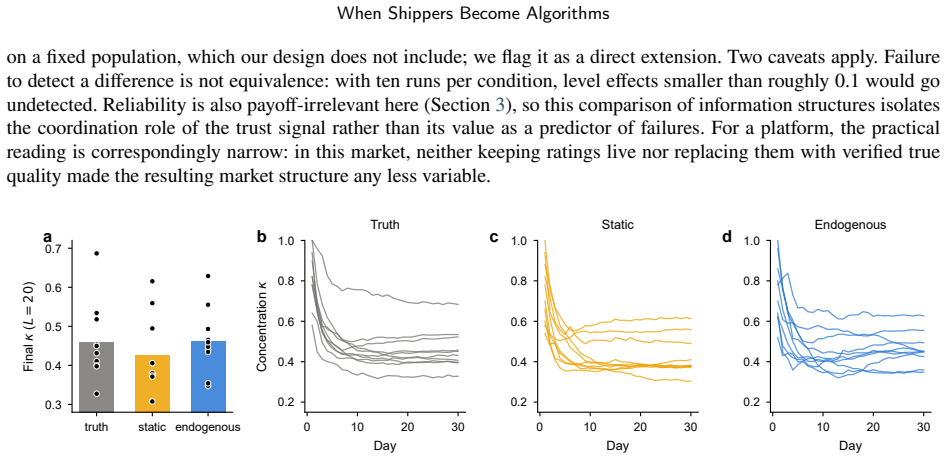
- Better trust signals will not stabilize market structure: replacing live ratings with disclosed true reliability changed neither the mean nor the run-to-run dispersion, which traces mostly to the sampled market.
- Static monoculture audits overstate lock-in: the market's capacity and price feedback undoes part of the day-one concentration, though it leaves concentration at 2.4 times the random floor.
Where Pith is reading between the lines
- We infer that the day-one consensus should be read as a worst-case upper bound: the paper's own population is fifty copies of one agent, so real heterogeneity in prompts, contracts, and tooling is the immediate open test; if it dissolves the consensus, the platform-lever results may shrink too.
- We infer that the capacity-disclosure mechanism likely generalizes to other LLM-mediated matching markets, where showing real-time availability could preempt pile-up more cheaply than regulating models.
- We infer that because reliability is payoff-irrelevant in the model, the null result for trust signals is a bound: with payoff-relevant quality or biased reviews, better information could still matter for match quality even if it does not reduce concentration.
- We infer a testable extension: vary candidate-list length while holding each carrier's display probability fixed, to separate the pure mechanics of list length from any model-level long-context effects.
Editorial analysis
A structured set of objections, weighed in public.
Referee Report
Summary. This paper reports agent-based simulations of a digital freight matching market in which fifty shipper agents, powered by commercial LLMs (GPT, Claude, Gemini) or reference algorithms, choose among twenty carriers over thirty days. The market implements waterfall tendering, carrier capacity constraints, congestion-based spot pricing, and an endogenous rating system. The authors manipulate candidate-list length L (3–20), the trust signal (true reliability, static ratings, or live ratings), and four interventions (capacity disclosure, fixed list order, popularity display, vendor mix). They report three main findings: (i) first-choice demand concentrates on a single carrier on day one; (ii) final concentration rises steeply once L exceeds about ten for GPT/Gemini but stays flat for Claude; (iii) replacing estimated ratings with true reliability changes neither the level nor the run-to-run spread of final concentration; and (iv) capacity disclosure lowers concentration by about a third and roughly doubles shipper surplus, while the other interventions show no clearly detectable effect. The paper concludes that platform information design, not model choice, is the effective lever.
Significance. If the results hold, the paper makes a useful contribution to the emerging literature on LLM-mediated markets and to the algorithmic monoculture debate: it is, to my knowledge, the first freight-specific market testbed that embeds real LLM choosers in a market with endogenous capacity, pricing, and ratings, and it shows that static monoculture analyses overstate lock-in once the market can respond. The authors have been unusually careful in several respects: the trust-signal conditions use paired seeds; multiple-comparison corrections (Holm–Bonferroni) are reported; bootstrap intervals accompany effect sizes; reference decision rules provide sensible floors; and the code, prompt templates, and complete audit logs are released. The paper also states its limitations candidly, including the payoff-irrelevance of quality and the homogeneity of the shipper population. The main open issues are evidential: the cross-vendor claim of a shared favorite is not supported by the described unpaired design, and the homogeneity of the agent population is load-bearing for the intervention comparison. These are fixable with additional experiments or careful recharacterization, but as written they pr
major comments (3)
- [§4 and §5.1, Abstract] The design section states that only the three trust-signal conditions share the carrier population, load stream, and candidate draws across runs; 'all other condition families redraw everything' (Section 4). Under this description, the exposure sweeps for GPT, Claude, and Gemini are unpaired: each vendor sees different carrier populations. The Abstract and Section 5.1 nevertheless assert that 'for a fixed sampled carrier population, the same carrier was the modal first choice of every model on day one,' illustrated by carrier 18 under the population of Fig. 1b. As described, the reported experiment does not contain a paired-seed vendor comparison on a fixed population, so this central claim—on which the vendor-mix conclusion and the 'model choice is not the lever' framing rest—is not formally supported. Please either add a formal paired-seed vendor comparison (same population, load strea
- [§3 and §6.5] The shipper population consists of fifty agents that share the same prompt template, JSON format, temperature 0.7, and history structure, differing only in the stated priority string (Section 3; acknowledged in Section 6.5, fifth limitation). The authors call the day-one consensus an upper bound. However, all intervention comparisons, including the headline capacity-disclosure result, are measured within this same homogeneous population. The vendor-mix condition varies only the model, not prompt engineering, tooling, contracts, or organizational policy. Consequently, the relative advantage of capacity disclosure over diversification may be an artifact of the narrow operationalization of heterogeneity. A load-bearing robustness test would vary prompt wording or agent architecture across shippers (or at least include two or three distinct prompt templates in the population) and report whet
- [§5.4] The vendor-mix comparison uses five unpaired runs per condition. The raw p-value is 0.075 and the Holm–Bonferroni-adjusted p-value is 0.23; the mean difference is 0.05 (0.41 vs 0.46), and no bootstrap CI is reported for this comparison. The text in Section 5.4 appropriately says that five runs cannot distinguish a null from a modest effect, yet the Abstract and Section 6.2 conclude that vendor diversification 'showed no clearly detectable effect' and 'fails' as a remedy. Given the low power and the lack of paired seeds, the stronger conclusion is not warranted; either additional runs/pairing are needed or the language should be limited to 'not detectable in our data.'
minor comments (3)
- [§6.2 and §6.5] The trust-signal null is carefully qualified in the limitations, and the Abstract includes the parenthetical 'by design, quality affects only what agents see, never delivery outcomes.' Consider placing the same qualifier in Section 6.2 where the lesson 'do not expect better trust signals to stabilize the market' is stated, to avoid overgeneralization.
- [§5.2] The static benchmark that freezes day-one choice frequencies and redraws displayed subsets is a useful decomposition, but the details of how the frozen frequencies are combined with the re-drawn subsets (e.g., how to handle a frozen favorite that is not in the re-drawn subset) are not specified. Please clarify in the methods or appendix.
- [Table 1] The row 'Information ablation (endogenous) GPT L=20 cells+5 runs' is hard to parse. Please clarify the cell-count convention so the reader can reconcile the 226-cell total.
Circularity Check
No significant circularity: the paper's results are emergent simulation outcomes, not fits or self-citational derivations.
full rationale
The paper's findings are produced by an agent-based simulation rather than derived from fitted parameters or from a self-citation chain. The day-one concentration, exposure-response, trust-signal null, and capacity-disclosure effect are all measured outcomes of model runs with fixed, disclosed parameters, and the paper explicitly decomposes the mechanical component of the exposure effect (candidate-set overlap) from agent behavior, rather than presenting it as a pure behavioral finding. The trust-signal ablation is the closest to a design tautology: the paper states that reliability is payoff-irrelevant 'by design' and that the comparison 'isolates the coordination role of the trust signal rather than its value as a predictor of failures.' This is disclosed in both Section 3 and Section 6.5, and the practical conclusion is correspondingly narrowed, so it is a stated modeling limitation rather than a hidden circular step. The homogeneous-agent population concern raised in Section 6.5 is an external-validity assumption about real deployments, explicitly labeled by the authors as an 'upper bound, the worst case'; it is not an internal reduction of the results to their inputs. No load-bearing self-citations or imported uniqueness theorems appear. The paper is self-consistent and does not disguise fitted inputs as predictions.
Axiom & Free-Parameter Ledger
free parameters (9)
- Price adjustment rate α =
0.10 (counterfactual 0.05, 0.02)
- Aggregate capacity ratio =
1.3 × expected daily demand
- Price cap =
1.5 (index units)
- Shipper value and delay cost =
value 1.2 per ton-distance; delay cost 0.3
- Waterfall tender depth =
3 ranked carriers
- Simulation horizon and final-κ window =
30 days; final κ averages days 26-30
- LLM temperature =
0.7
- Candidate-list draw =
L candidates drawn uniformly at random per load
- Initial track-record distribution =
n0 = max(0, round(200 f_j)-10), f_j Pareto(1.5) rescaled to ≤0.95
axioms (6)
- ad hoc to paper Quality is payoff-irrelevant: true reliability affects only the displayed rating, never service success or price.
- ad hoc to paper Shipper agents are near-identical replicated instances: same prompt template, JSON format, temperature, and history structure, differing only in stated priority.
- domain assumption Candidate display is uniform random, and order is randomized per prompt unless stated otherwise.
- domain assumption Carriers are non-strategic: mechanical pricing, no carrier-side AI, entry, or exit.
- domain assumption Ratings are unbiased Bernoulli reviews; no reputation inflation, censoring, or biased reviews.
- domain assumption Demand is stationary and homogeneous: one load per shipper per day, random OD/distance/weight, no contracts, seasonality, or route-specific suitability.
read the original abstract
Shippers are beginning to delegate carrier selection to large language model (LLM) agents. We ask what such delegation does to a freight matching market, and which platform design choices contain it. We carried out agent-based simulations in which fifty shipper agents, built on commercial LLMs from OpenAI (GPT), Anthropic (Claude), and Google (Gemini), procure truckload capacity for thirty days. The market implements the rules of digital freight matching: each load is offered down the shipper's ranked list of carriers (waterfall tendering), carriers have daily capacity limits, spot prices respond to congestion, and carrier ratings accumulate with transactions. We found three risks and one remedy that works. Agents converged at once: for a fixed sampled carrier population, the same carrier was the modal first choice of every model on day one, attracting up to 76% of requests. Because each agent picks from its own randomly drawn list of displayed candidates, the platform controls how many options each shipper sees; concentration rose steeply once lists exceeded about ten carriers, with the onset differing across models. Which carriers ended up dominant varied widely from one sampled market to another, and displaying true quality instead of estimated ratings changed neither the level nor this variability (by design, quality affects only what agents see, never delivery outcomes). Against these risks, disclosing each carrier's remaining daily capacity cut concentration by a third and doubled shipper surplus, while vendor diversification, list-order randomization, and popularity display showed no clearly detectable effect. Platform information design, ahead of model choice or model regulation, is the lever that works.
Figures




Reference graph
Works this paper leans on
-
[9]
Journal of Political Economy 100, 992–1026
A theory of fads, fashion, custom, and cultural change as informational cascades. Journal of Political Economy 100, 992–1026. doi:10.1086/261849. Bommasani,R.,Creel,K.A.,Kumar,A.,Jurafsky,D.,Liang,P.,2022. Pickingonthesameperson:Doesalgorithmicmonocultureleadtooutcome homogenization?, in: Advances in Neural Information Processing Systems 35 (NeurIPS 2022)...
doi:10.1086/261849 2022
-
[11]
arXiv preprint arXiv:2603.08853 doi:10.48550/a rXiv.2603.08853
LLM-agent interactions on markets with information asymmetries. arXiv preprint arXiv:2603.08853 doi:10.48550/a rXiv.2603.08853. Filippas, A., Horton, J.J., Golden, J.M.,
-
[13]
doi:10.1145/3670865.3673513.extended version: NBER Working Paper 31122
Large language models as simulated economic agents: What can we learn from homo silicus?, in: Proceedingsofthe25thACMConferenceonEconomicsandComputation(EC’24),pp.614–615. doi:10.1145/3670865.3673513.extended version: NBER Working Paper 31122. Fish, S., Gonczarowski, Y.A., Shorrer, R.I.,
-
[14]
arXiv preprint arXiv:2404.00806 doi:10.485 50/arXiv.2404.00806
Algorithmic collusion by large language models. arXiv preprint arXiv:2404.00806 doi:10.485 50/arXiv.2404.00806. Guo,P.,Haviv,M.,Luo,Z.,Wang,Y.,2023. Signalingservicequalitythroughqueuedisclosure. Manufacturing&ServiceOperationsManagement 25, 543–562. doi:10.1287/msom.2022.1170. Harris, A., Nguyen, T.M.A., 2025a. Long-term relationships and the spot market...
-
[16]
Strategic Exploitation in LLM Agent Markets: A Simulation Framework for E-Commerce Trust
Algorithmic monoculture and social welfare. Proceedings of the National Academy of Sciences 118, e2018340118. doi:10.1073/pnas.2018340118. Laurito,W.,Davis,B.,Grietzer,P.,Gavenčiak,T.,Böhm,A.,Kulveit,J.,2025. AI-AIbias:Largelanguagemodelsfavorcommunicationsgenerated by large language models. Proceedings of the National Academy of Sciences 122, e2415697122...
work page internal anchor Pith review Pith/arXiv arXiv doi:10.48550/arxiv.2605.10059 2025
-
[18]
Diagon: A Programmable Testbed for AI-Agent Cognitive Labor Markets
When agent markets arrive. arXiv preprint arXiv:2604.06688 doi:10.48550/arXiv.2604.06688. Liu, Y., Wahab, M.I.M.,
work page internal anchor Pith review Pith/arXiv arXiv doi:10.48550/arxiv.2604.06688
-
[19]
Transportation Research Part E: Logistics and Transportation Review 204, 104419
Multi-period binding freight contract using swing options. Transportation Research Part E: Logistics and Transportation Review 204, 104419. doi:10.1016/j.tre.2025.104419. Long, C.X., Simchi-Levi, D., Zhu, F., Su, H., Calmon, A.P., Calmon, F.P.,
arXiv 2025
-
[20]
arXiv preprint arXiv:2605.17036 doi:10.48550/arXiv.2605.17036
Reliability and effectiveness of autonomous AI agents in supply chain management. arXiv preprint arXiv:2605.17036 doi:10.48550/arXiv.2605.17036. Muchnik,L.,Aral,S.,Taylor,S.J.,2013.Socialinfluencebias:Arandomizedexperiment.Science341,647–651.doi:10.1126/science.1240466. Nie, T., He, J., Mei, Y., Qin, G., Li, G., Sun, J., Ma, W.,
-
[21]
Transportation Research Part E: Logistics and Transportation Review 197, 104075
Joint estimation and prediction of city-wide delivery demand: A large language model empowered graph-based learning approach. Transportation Research Part E: Logistics and Transportation Review 197, 104075. doi:10.1016/j.tre.2025.104075. Nosko, C., Tadelis, S.,
arXiv 2025
-
[24]
Generative agents: Interactive simulacra of human behavior, in: Proceedings of the 36th Annual ACM Symposium on User Interface Software and Technology (UIST ’23), pp. 1–22. doi:10.1145/3586183. 3606763. article
-
[25]
Monoculture in matching markets, in: Advances in Neural Information Processing Systems 37 (NeurIPS 2024), pp. 81959–81991. doi:10.52202/079017-2605. project44,
-
[26]
https://www.project44.com/press-releases/project44-launches-ai-freight-procurement-agent-to-cut-freight-s pend-and-accelerate-sourcing/. Roth,A.E.,2008. Whathavewelearnedfrommarketdesign? TheEconomicJournal118,285–310. doi:10.1111/j.1468-0297.2007.02121.x. Salganik, M.J., Dodds, P.S., Watts, D.J.,
arXiv 2008
-
[29]
International Journal of Production Research doi:10.1080/00207543.2026.2641103
Large language models in supply chain management: a systematic literature review and application framework. International Journal of Production Research doi:10.1080/00207543.2026.2641103. advance online publication. Syrnikov, M.B., Pierucci, F., Galisai, M., Prandi, M., Bisconti, P., Giarrusso, F., Sorokoletova, O., Suriani, V., Nardi, D.,
arXiv 2026
-
[30]
arXiv preprint arXiv:2601.11369 doi:10.48550/arX iv.2601.11369
Institutional AI: Governing LLM collusion in multi-agent cournot markets via public governance graphs. arXiv preprint arXiv:2601.11369 doi:10.48550/arX iv.2601.11369. Tadelis, S.,
-
[31]
Annual Review of Economics 8, 321–340
Reputation and feedback systems in online platform markets. Annual Review of Economics 8, 321–340. doi:10.1146/annure v-economics-080315-015325. Wang, H., Jiang, J., Hong, L.J., Jiang, G.,
-
[32]
arXiv preprint arXiv:2505.18597 doi:10.48550/arXiv.2 505.18597
LLMs for supply chain management. arXiv preprint arXiv:2505.18597 doi:10.48550/arXiv.2 505.18597. Wang,Y.,Zhang,L.,Guo,Y.,Wu,L.,2026. TowardsautomatedoptimizationalgorithmdesignwithLLM:Anexploratorystudyinmulti-objective weather routing. Transportation Research Part E: Logistics and Transportation Review 210, 104786. doi:10.1016/j.tre.2026.104786. Wu, Y.,...
-
[33]
European Journal of Operational Research 312, 227–239
The information value of logistics platforms in a freight matching market. European Journal of Operational Research 312, 227–239. doi:10.1016/j.ejor.2023.06.043. Zheng, L., Chiang, W.L., Sheng, Y., Zhuang, S., Wu, Z., Zhuang, Y., Lin, Z., Li, Z., Li, D., Xing, E.P., Zhang, H., Gonzalez, J.E., Stoica, I.,
-
[34]
JudgingLLM-as-a-judgewithMT-BenchandChatbotArena,in:AdvancesinNeuralInformationProcessingSystems36(NeurIPS2023), Datasets and Benchmarks Track, pp. 46595–46623. doi:10.52202/075280-2020. T. Ezaki et al.:Preprint submitted to ElsevierPage 17 of 17
-
[1992]
The Quarterly Journal of Economics 107, 797–817
A simple model of herd behavior. The Quarterly Journal of Economics 107, 797–817. doi:10.2307/2118364. Barabási, A.L., Albert, R.,
-
[1999]
Emergence of scaling in random networks. Science 286, 509–512. doi:10.1126/science.286.5439.509. Bikhchandani, S., Hirshleifer, D., Welch, I.,
-
[2000]
Pathological outcomes of observational learning. Econometrica 68, 371–398. doi:10.1111/1468-0262.00113. Song, Z., Xie, Y., Yang, L., Zhao, Y.,
-
[2006]
Experimental study of inequality and unpredictability in an artificial cultural market. Science 311, 854–856. doi:10.1126/science.1121066. Smith, L., Sørensen, P.,
-
[2010]
The Journal of Industrial Economics 58, 54–78
The dynamics of seller reputation: Evidence from eBay. The Journal of Industrial Economics 58, 54–78. doi:10.1111/j.1467-6451.2010.00405.x. Elliott, M., Golub, B., Leduc, M.V.,
arXiv 2010
-
[2011]
American Economic Review 101, 2590–2615
Bayesian persuasion. American Economic Review 101, 2590–2615. doi:10.1257/aer.101.6.2590. Kleinberg, J., Raghavan, M.,
-
[2014]
American Economic Review 104, 3565–3599
Inefficient hiring in entry-level labor markets. American Economic Review 104, 3565–3599. doi:10.1257/aer.104.11.3565. Park, J.S., O’Brien, J.C., Cai, C.J., Morris, M.R., Liang, P., Bernstein, M.S.,
-
[2015]
The Limits of Reputation in Platform Markets: An Empirical Analysis and Field Experiment. Working Paper 20830. National Bureau of Economic Research. doi:10.3386/w20830. Pallais, A.,
-
[2016]
Conflicting attachment and the growth of bipartite networks. Physical Review E 93, 032303. doi:10.1103/Phys RevE.93.032303. Liu,N.F.,Lin,K.,Hewitt,J.,Paranjape,A.,Bevilacqua,M.,Petroni,F.,Liang,P.,2024. Lostinthemiddle:Howlanguagemodelsuselongcontexts. Transactions of the Association for Computational Linguistics 12, 157–173. doi:10.1162/tacl_a_00638. Liu...
doi:10.1103/phys 2024
-
[2020]
Transportation Research Part E: Logistics and Transportation Review 142, 102073
Elephants or goldfish? an empirical analysis of carrier reciprocity in dynamic freight markets. Transportation Research Part E: Logistics and Transportation Review 142, 102073. doi:10.1016/j.tre.2020.102073. Anwar, M.S., Schoenebeck, G., Dhillon, P.S.,
arXiv 2020
-
[2021]
Manufacturing & Service Operations Management 23, 620–636
Managing congestion in matching markets. Manufacturing & Service Operations Management 23, 620–636. doi:10.1287/msom.2020.0927. Ashery, A.F., Aiello, L.M., Baronchelli, A.,
arXiv 2020
-
[2022]
Reputation inflation. Marketing Science 41, 733–745. doi:10.1287/mksc.2022.1350. Filippas, A., Horton, J.J., Manning, B.S.,
arXiv 2022
-
[2023]
Journal of Business Logistics 44, 228–256
Research on truckload transportation procurement: A review, framework, and future research agenda. Journal of Business Logistics 44, 228–256. doi:10.1111/jbl.12333. Acocella, A., Caplice, C., Sheffi, Y.,
-
[2024]
Filter bubble or homogenization? disentangling the long-term effects of recommendations on user consumption patterns, in: Proceedings of the ACM Web Conference 2024 (WWW ’24), pp. 123–134. doi:10.1145/3589334.3645497. Arnosti, N., Johari, R., Kanoria, Y.,
arXiv 2024
-
[2025]
Emergent social conventions and collective bias in LLM populations. Science Advances 11, eadu9368. doi:10.1126/sciadv.adu9368. Ballestero, G., Hosseini, H., Khanna, S., Shorrer, R.I.,
-
[2026]
arXiv preprint arXiv:2604.09502 doi:10.48550/arXiv.2604.09502
Strategic algorithmic monoculture: Experimental evidence from coordination games. arXiv preprint arXiv:2604.09502 doi:10.48550/arXiv.2604.09502. Banerjee, A.V.,
discussion (0)
Sign in with ORCID, Apple, or X to comment. Anyone can read and Pith papers without signing in.