Constraints on the Gas Geometry Surrounding Little Red Dots through Narrow-Line Diagnostics
Pith reviewed 2026-06-26 08:06 UTC · model grok-4.3
The pith
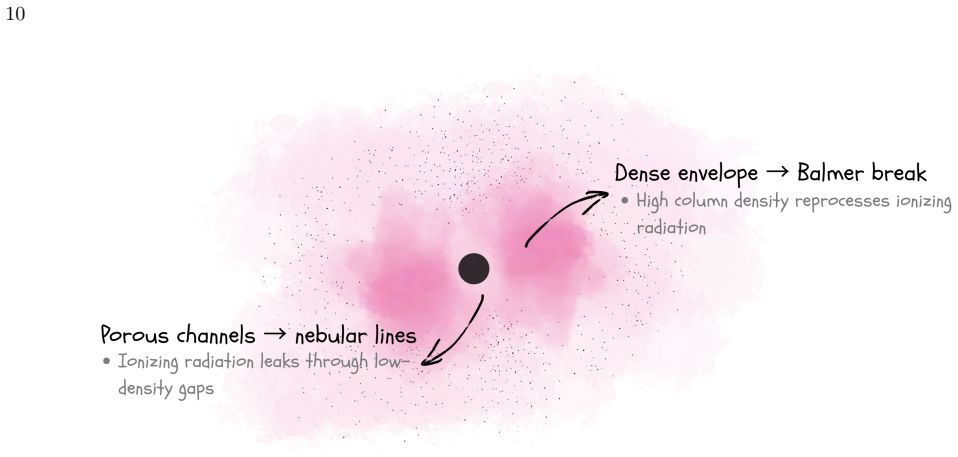
Narrow-line ratios in Little Red Dots show their gas envelopes contain lower-density channels that let high-energy photons escape.
A machine-rendered reading of the paper's core claim, the machinery that carries it, and where it could break.
Core claim
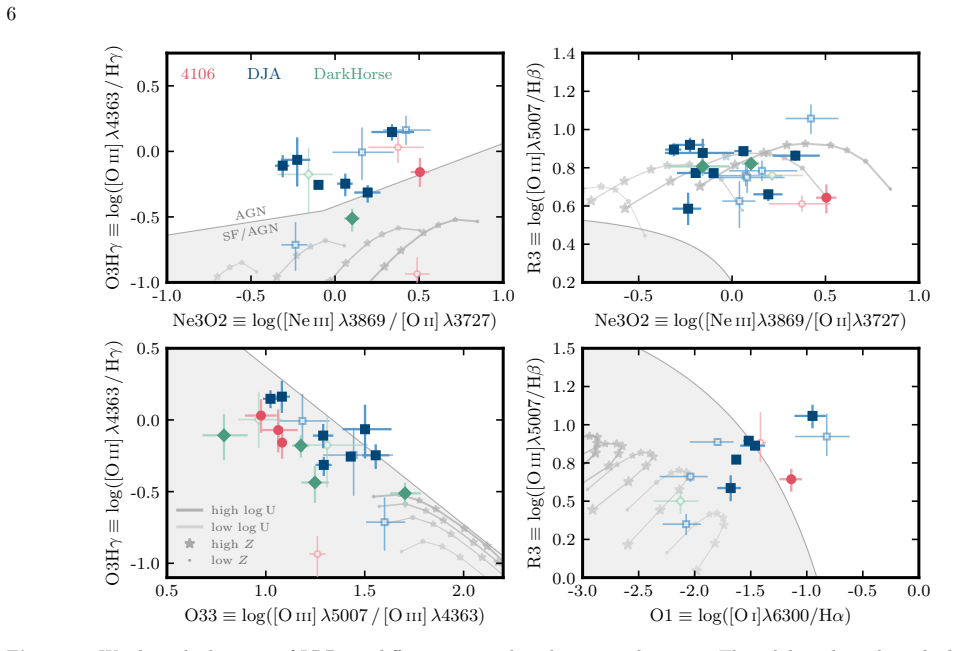
The central claim is that the observed narrow-line ratios are incompatible with stellar photoionization from a star-forming host alone, indicating lower-density channels within the gas envelope through which high-energy photons escape to excite the narrow-line gas, while the soft spectrum with He II over H beta less than or equal to 0.1 disfavours a uniform gas envelope with unity covering fraction and instead points to a more complex geometry producing anisotropic ionizing radiation.
What carries the argument
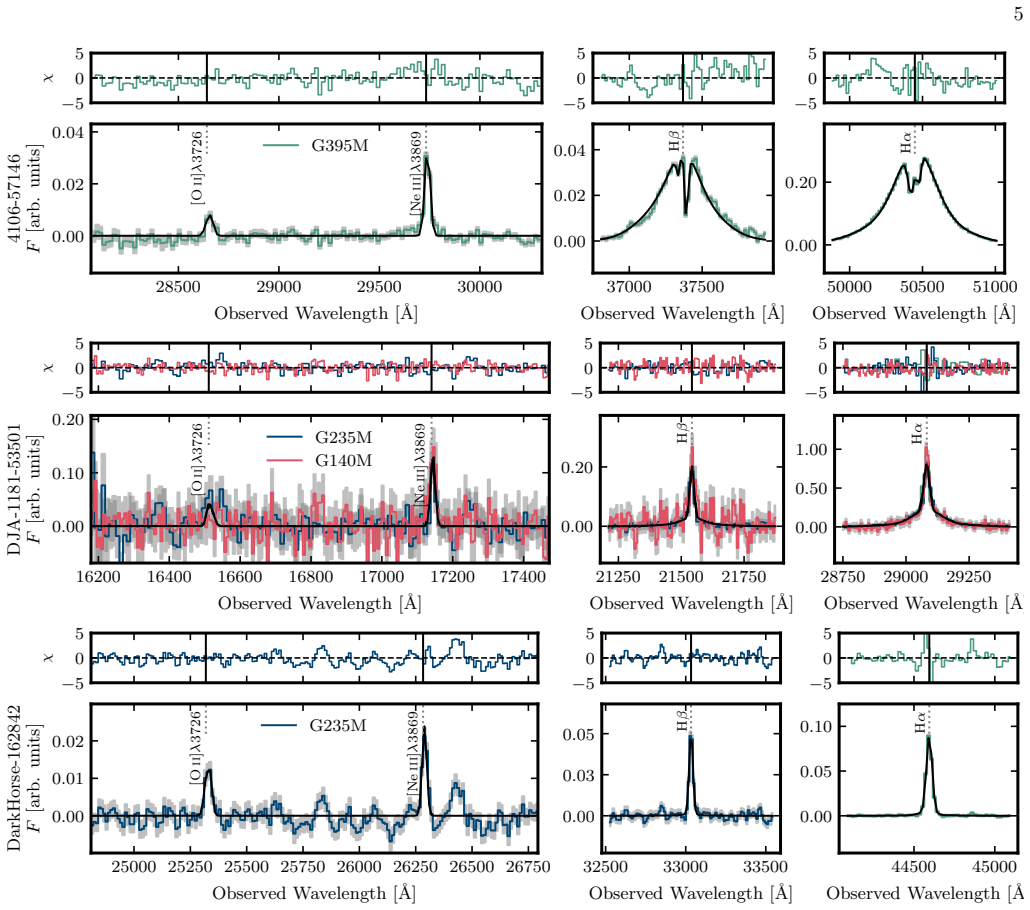
Narrow-line ratio diagnostics applied to NIRSpec grating spectra, including indicators of ionization parameter, electron temperature, and ionizing spectrum hardness such as O III to H beta, O I to H alpha, and He II to H beta.
If this is right
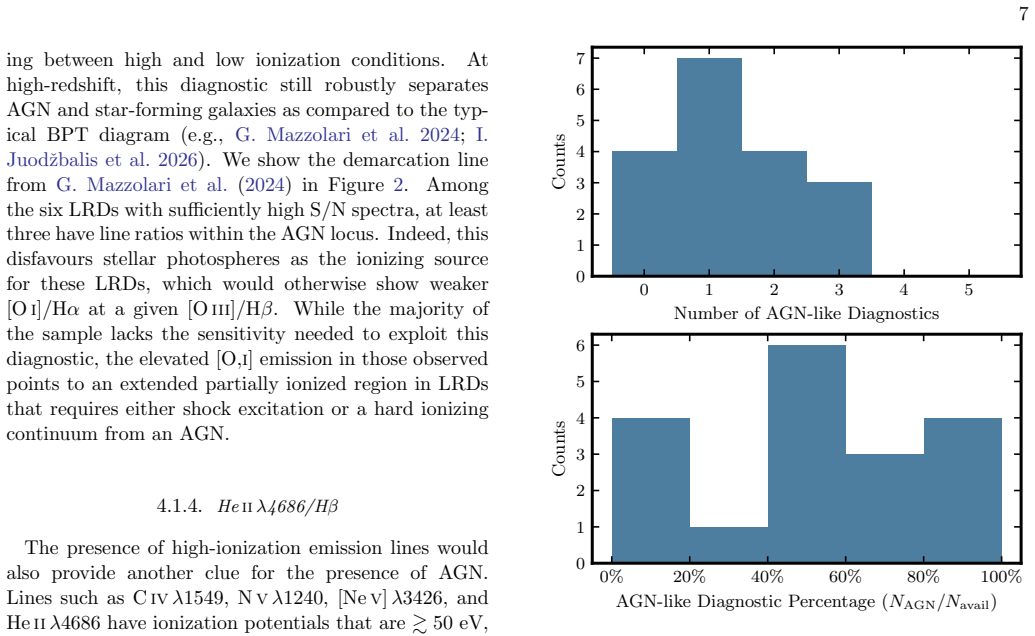
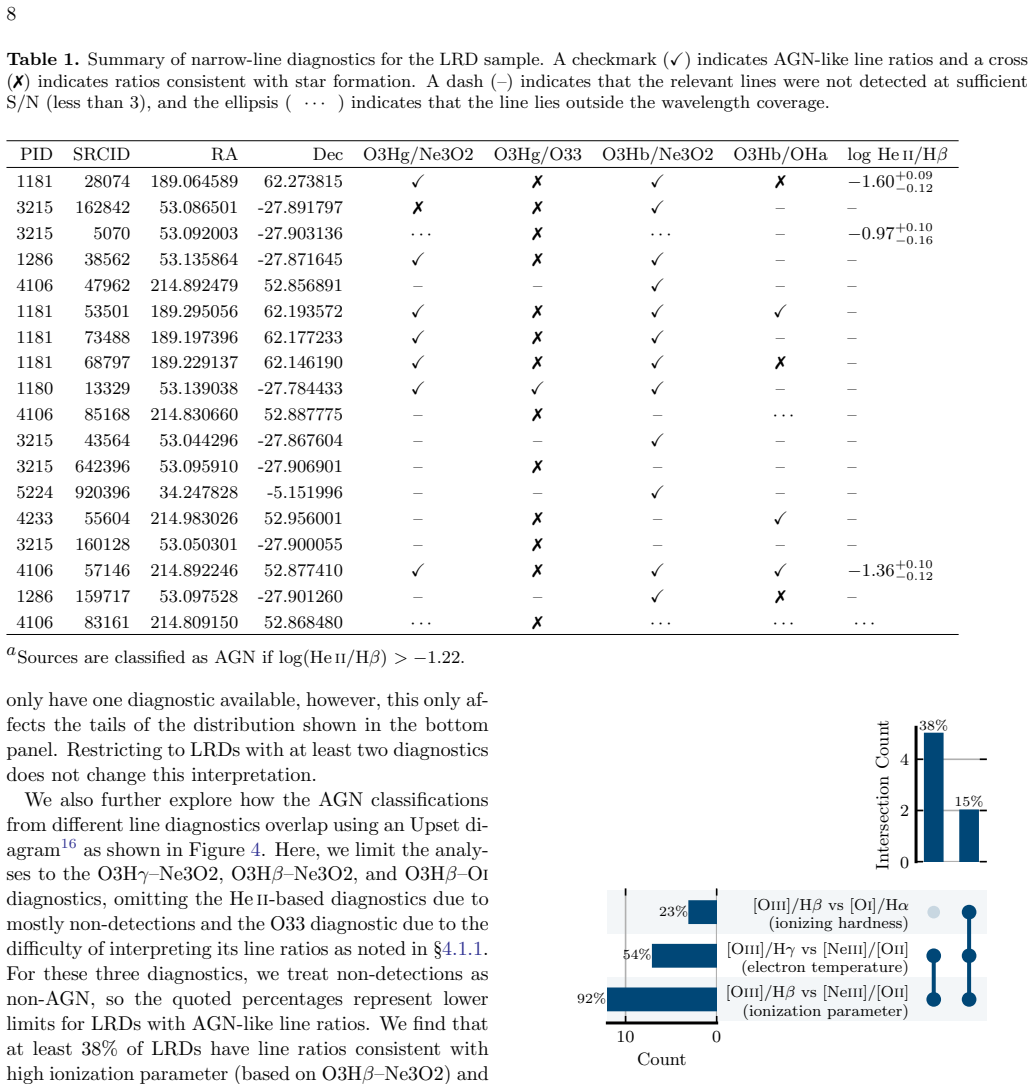
- At least forty percent of the sample requires a harder ionizing source than stars provide.
- The gas envelope must include lower-density paths for high-energy photons to reach the narrow-line region.
- A spherical shell with full covering fraction around the central engine is inconsistent with the data.
- The ionizing spectrum reaching the narrow-line gas is softer than that of standard active galactic nuclei.
Where Pith is reading between the lines
- The patchy geometry could allow partial direct leakage of continuum light from the central engine in certain directions.
- Similar line-ratio tests could be applied to other high-redshift populations suspected of having dense gas envelopes.
- If the channels are common, they may affect how much of the central radiation is reprocessed into the observed red continuum.
Load-bearing premise
The photoionization models and line-ratio diagnostics used to classify the ionizing source are accurate and complete for the physical conditions in these objects, with no major unaccounted contamination or calibration issues.
What would settle it
If deeper spectra or a larger sample showed every Little Red Dot with line ratios fully consistent with pure stellar photoionization under the same models, the requirement for escaping high-energy photons through channels would be ruled out.
Figures
read the original abstract
Little Red Dots (LRDs) are a recently identified population of high-redshift sources, with a common interpretation being accreting black holes embedded within a spherical, optically thick gas envelope. Within this framework, some models propose that the continuum arises from the dense-gas envelope, where hard ionizing radiation from the central engine is reprocessed into a stellar-like photosphere with an effective temperature of $\sim$5000 K. This implies that both the UV continuum and narrow-line emission are then powered by the host galaxy rather than an exposed central engine. To test whether this is consistent with the observed narrow-line ratios, we analyze multiple line diagnostics for a sample of $\sim$20 LRDs with high signal-to-noise NIRSpec grating spectra. We find that at least 40\% of the LRDs have line ratios pointing toward high ionization parameter and electron temperature, with a further 15\% also falling in the AGN regime for the O\textsc{i}/H$\alpha$ diagnostic, indicative of harder ionizing radiation. These line ratios are incompatible with stellar photoionization from a star-forming host alone. This suggests lower density channels within the gas envelope through which high energy photons can escape and excite the surrounding narrow-line emitting gas. At the same time, most LRDs lack strong high-ionization line emission, with He\,\textsc{ii}/H$\beta$ $\lesssim0.1$, consistent with an ionizing spectrum softer than that of a standard AGN. Together, these results disfavour a uniform gas envelope with a covering fraction of unity, and instead point to a more complex geometry that gives rise to anisotropic ionizing radiation.
Editorial analysis
A structured set of objections, weighed in public.
Referee Report
Summary. The manuscript analyzes narrow-line ratios from high-S/N NIRSpec grating spectra of ~20 Little Red Dots. It reports that at least 40% of the sample show line ratios indicating high ionization parameter and electron temperature, with a further 15% falling in the AGN regime on the O I/Hα diagnostic. These ratios are interpreted as incompatible with stellar photoionization from a star-forming host alone, implying the need for lower-density channels in the gas envelope to allow high-energy photons to escape and excite the narrow-line gas. Most sources lack strong He II/Hβ (≲0.1), consistent with a softer ionizing spectrum than typical AGN, disfavoring a uniform spherical envelope with unity covering fraction.
Significance. If the central claim holds, the work supplies direct observational constraints on LRD gas geometry, favoring anisotropic configurations with escape channels over simple spherical envelopes that reprocess AGN radiation into a ~5000 K stellar-like photosphere. The multi-diagnostic approach (ionization parameter, electron temperature, O I/Hα, and He II) and purely observational comparison to standard grids constitute a falsifiable test of envelope models. This strengthens the case for complex geometries in high-redshift compact sources.
major comments (2)
- [section presenting the line-ratio diagnostics and model comparison] The claim that observed ratios are incompatible with stellar photoionization (and therefore require escape channels) rests on standard BPT-style and ionization-parameter diagnostics. These were calibrated on lower-density (n_H ~10^2–10^4 cm^{-3}) and typically sub-solar metallicity H II regions; the manuscript does not show that the employed model grids extend to the n_H ≳ 10^5–10^6 cm^{-3} or Z ≳ 2 Z_⊙ regimes plausible inside a dense LRD envelope. If stellar SEDs can shift into the observed region of diagnostic space under those conditions, the incompatibility conclusion and the inference of channels would not follow.
- [results section reporting the diagnostic placements and percentages] The percentages (at least 40% for high U/T_e and a further 15% for O I/Hα) are central to the sample-wide claim, yet the text provides no explicit breakdown of how many objects have reliable measurements for each diagnostic, how upper limits or non-detections are treated, or the impact of measurement uncertainties on the fractions.
minor comments (2)
- [abstract] The abstract states the sample as '~20'; stating the precise number of LRDs with usable spectra and the selection criteria would improve reproducibility.
- Figures showing line-ratio placements should explicitly indicate whether error bars or 1σ uncertainties are included for each point.
Simulated Author's Rebuttal
We thank the referee for their constructive and detailed report. The comments highlight important points regarding the applicability of diagnostic grids and the transparency of our sample statistics. We address each major comment below and outline the revisions we will make.
read point-by-point responses
-
Referee: [section presenting the line-ratio diagnostics and model comparison] The claim that observed ratios are incompatible with stellar photoionization (and therefore require escape channels) rests on standard BPT-style and ionization-parameter diagnostics. These were calibrated on lower-density (n_H ~10^2–10^4 cm^{-3}) and typically sub-solar metallicity H II regions; the manuscript does not show that the employed model grids extend to the n_H ≳ 10^5–10^6 cm^{-3} or Z ≳ 2 Z_⊙ regimes plausible inside a dense LRD envelope. If stellar SEDs can shift into the observed region of diagnostic space under those conditions, the incompatibility conclusion and the inference of channels would not follow.
Authors: We acknowledge this is a valid concern. Our comparisons use publicly available photoionization grids (primarily from Cloudy-based libraries such as those in Kewley et al. and similar works) that reach n_H up to ~10^5 cm^{-3} and metallicities up to ~2 Z_⊙ in some cases, but do not fully sample the extreme n_H ≳ 10^6 cm^{-3} regime. Literature on dense H II regions indicates that while higher density can enhance certain collisionally excited lines, the combination of high ionization parameter and elevated T_e required to match our observed ratios remains difficult to achieve with stellar SEDs alone, even at super-solar Z. Nevertheless, to directly address the referee's point we will add an explicit discussion of density and metallicity trends (citing high-density H II region studies) and note the limitation of current grids as a caveat. We will also state that full exploration at n_H > 10^6 cm^{-3} would require new model runs beyond the scope of this work. This does not change our main conclusion but improves transparency. revision: partial
-
Referee: [results section reporting the diagnostic placements and percentages] The percentages (at least 40% for high U/T_e and a further 15% for O I/Hα) are central to the sample-wide claim, yet the text provides no explicit breakdown of how many objects have reliable measurements for each diagnostic, how upper limits or non-detections are treated, or the impact of measurement uncertainties on the fractions.
Authors: We agree that the presentation of the sample statistics requires greater clarity. In the revised manuscript we will add a dedicated subsection (or appendix table) that lists, for each of the ~20 objects: (i) which diagnostics have reliable detections, (ii) which are upper limits, (iii) the S/N threshold used, and (iv) the individual line ratios with uncertainties. We will explicitly state how many objects contribute to each percentage (e.g., number with measured [O III]/Hβ and [N II]/Hα for the BPT, number with [O I]/Hα detections), how non-detections are treated (conservatively as upper limits), and the results of a simple Monte Carlo test propagating measurement errors to show the stability of the 40% and 15% fractions. This will make the reported numbers fully reproducible and address the referee's concern directly. revision: yes
Circularity Check
No circularity: observational line ratios compared to external diagnostics
full rationale
The paper measures emission-line ratios from NIRSpec spectra of LRDs and places them on standard BPT-style and ionization-parameter diagnostic diagrams calibrated on external photoionization models. No step fits a parameter to a subset of the LRD data and then re-uses that fit as a 'prediction' of the same or closely related quantity. No self-citation supplies a uniqueness theorem or ansatz that the present analysis depends upon. The incompatibility conclusion follows directly from the observed ratios versus published model grids; the derivation chain is therefore self-contained and does not reduce to its own inputs by construction.
Axiom & Free-Parameter Ledger
axioms (1)
- domain assumption Standard optical line-ratio diagnostics (e.g., O I/Hα, ionization parameter indicators) reliably distinguish stellar versus AGN ionization under the physical conditions of high-redshift LRDs.
Reference graph
Works this paper leans on
-
[1]
Akins, H. B., Casey, C. M., Lambrides, E., et al. 2025, ApJ, 991, 37, doi: 10.3847/1538-4357/ade984 ´Alvarez-M´ arquez, J., Crespo G´ omez, A., Colina, L., et al. 2025, A&A, 695, A250, doi: 10.1051/0004-6361/202451731
-
[2]
Ananna, T. T., Bogd´ an,´A., Kov´ acs, O. E., Natarajan, P., & Hickox, R. C. 2024, ApJL, 969, L18, doi: 10.3847/2041-8213/ad5669
-
[3]
Ando, M., Harikane, Y., Katz, H., Inayoshi, K., & Tanaka, T. S. 2026, The UV Side of Little Red Dots: Red, Compact, and Iron-Enhanced Rest-UV Emission with a Strong Downturn around Lyα, https://arxiv.org/abs/2606.03522
Pith/arXiv arXiv 2026
-
[4]
Asada, Y., Inayoshi, K., Fei, Q., Fujimoto, S., & Willott, C. 2026, arXiv e-prints, arXiv:2601.10573, doi: 10.48550/arXiv.2601.10573
work page internal anchor Pith review Pith/arXiv arXiv doi:10.48550/arxiv.2601.10573 2026
-
[5]
Backhaus, B. E., Trump, J. R., Cleri, N. J., et al. 2022, ApJ, 926, 161, doi: 10.3847/1538-4357/ac3919
-
[6]
Backhaus, B. E., Bridge, J. S., Trump, J. R., et al. 2023, ApJ, 943, 37, doi: 10.3847/1538-4357/aca668
-
[7]
Backhaus, B. E., Trump, J. R., Pirzkal, N., et al. 2024, ApJ, 962, 195, doi: 10.3847/1538-4357/ad1520
-
[8]
Backhaus, B. E., Cleri, N. J., Trump, J. R., et al. 2025, ApJ, 994, 125, doi: 10.3847/1538-4357/ae1136
-
[9]
Baggen, J. F. W., Scoggins, M. T., van Dokkum, P., et al. 2026, ApJL, 1002, L4, doi: 10.3847/2041-8213/ae58a5
-
[10]
Baggen, J. F. W., van Dokkum, P., Brammer, G., et al. 2024, ApJL, 977, L13, doi: 10.3847/2041-8213/ad90b8
-
[11]
Baldwin, J. A., Phillips, M. M., & Terlevich, R. 1981, PASP, 93, 5, doi: 10.1086/130766
-
[12]
Begelman, M. C., & Dexter, J. 2026, ApJ, 996, 48, doi: 10.3847/1538-4357/ae274a
-
[13]
Begelman, M. C., Volonteri, M., & Rees, M. J. 2006, MNRAS, 370, 289, doi: 10.1111/j.1365-2966.2006.10467.x
-
[14]
Bezanson, R., Labbe, I., Whitaker, K. E., et al. 2024, ApJ, 974, 92, doi: 10.3847/1538-4357/ad66cf
-
[15]
2023, msaexp: NIRSpec analyis tools, 0.6.17 Zenodo, doi: 10.5281/zenodo.8319596
Brammer, G. 2023, msaexp: NIRSpec analyis tools, 0.6.17 Zenodo, doi: 10.5281/zenodo.8319596
-
[16]
doi:10.5281/zenodo.15472354 , url =
Brammer, G., & Valentino, F. 2025, The DAWN JWST Archive: Compilation of Public NIRSpec Spectra, 4.4 Zenodo, doi: 10.5281/zenodo.15472354
-
[17]
Brazzini, M., D’Eugenio, F., Maiolino, R., et al. 2026, arXiv e-prints, arXiv:2601.22214, doi: 10.48550/arXiv.2601.22214
-
[18]
2023, MNRAS, 525, 2087, doi: 10.1093/mnras/stad1704
Brinchmann, J. 2023, MNRAS, 525, 2087, doi: 10.1093/mnras/stad1704
-
[19]
2008, A&A, 485, 657, doi: 10.1051/0004-6361:200809783
Brinchmann, J., Kunth, D., & Durret, F. 2008, A&A, 485, 657, doi: 10.1051/0004-6361:200809783
-
[20]
Bunker, A. J., Cameron, A. J., Curtis-Lake, E., et al. 2024, A&A, 690, A288, doi: 10.1051/0004-6361/202347094 Calabr` o, A., Castellano, M., Zavala, J. A., et al. 2024, ApJ, 975, 245, doi: 10.3847/1538-4357/ad7602 12
-
[21]
Casey, C. M., Akins, H. B., Kokorev, V., et al. 2024, ApJL, 975, L4, doi: 10.3847/2041-8213/ad7ba7
-
[22]
Chen, K., Li, Z., Inayoshi, K., & Ho, L. C. 2025, ApJL, 994, L42, doi: 10.3847/2041-8213/ae1955
-
[23]
Chisholm, J., Berg, D. A., Boylan-Kolchin, M., et al. 2026, arXiv e-prints, arXiv:2602.15935, doi: 10.48550/arXiv.2602.15935
-
[24]
Cloonan, A. P., Whitaker, K. E., Manning, S. M., et al. 2026, arXiv e-prints, arXiv:2603.24700, doi: 10.48550/arXiv.2603.24700
-
[25]
Curtis-Lake, E., Cameron, A. J., Bunker, A. J., et al. 2026, MNRAS, doi: 10.1093/mnras/stag836 de Graaff, A., Rix, H.-W., Carniani, S., et al. 2024, A&A, 684, A87, doi: 10.1051/0004-6361/202347755 de Graaff, A., Rix, H.-W., Naidu, R. P., et al. 2025a, A&A, 701, A168, doi: 10.1051/0004-6361/202554681 de Graaff, A., Hviding, R. E., Naidu, R. P., et al. 2025...
-
[26]
J., Willott, C., Alberts, S., et al
Eisenstein, D. J., Willott, C., Alberts, S., et al. 2026, ApJS, 283, 6, doi: 10.3847/1538-4365/ae3163
-
[27]
Eldridge, J. J., Stanway, E. R., Xiao, L., et al. 2017, PASA, 34, e058, doi: 10.1017/pasa.2017.51
work page internal anchor Pith review doi:10.1017/pasa.2017.51 2017
-
[28]
Finkelstein, S. L., Bagley, M. B., Arrabal Haro, P., et al. 2025, ApJL, 983, L4, doi: 10.3847/2041-8213/adbbd3
-
[29]
, archivePrefix = "arXiv", eprint =
Foreman-Mackey, D., Hogg, D. W., Lang, D., & Goodman, J. 2013, PASP, 125, 306, doi: 10.1086/670067
-
[30]
Greene, J. E., Labbe, I., Goulding, A. D., et al. 2024, ApJ, 964, 39, doi: 10.3847/1538-4357/ad1e5f
-
[31]
Gunasekera, C. M., van Hoof, P. A. M., Dehghanian, M., et al. 2025, RMxAA, 61, 120, doi: 10.22201/ia.01851101p.2025.61.03.01
-
[32]
B., Perna, R., Cantiello, M., et al
Hassan, J. B., Perna, R., Cantiello, M., et al. 2026, ApJ, 998, 65, doi: 10.3847/1538-4357/ae3002
-
[33]
E., Watson, D., Brammer, G., et al
Heintz, K. E., Watson, D., Brammer, G., et al. 2024, Science, 384, 890, doi: 10.1126/science.adj0343
-
[34]
Hopkins, P. F., Murray, N., Quataert, E., & Thompson, T. A. 2010, MNRAS, 401, L19, doi: 10.1111/j.1745-3933.2009.00777.x
- [35]
-
[36]
Hviding, R. E., de Graaff, A., Miller, T. B., et al. 2025, A&A, 702, A57, doi: 10.1051/0004-6361/202555816
-
[37]
Hviding, R. E., de Graaff, A., Liu, H., et al. 2026, ApJL, 1000, L18, doi: 10.3847/2041-8213/ae4c88
-
[38]
Inayoshi, K., & Maiolino, R. 2025, ApJL, 980, L27, doi: 10.3847/2041-8213/adaebd
-
[39]
2023, ApJ, 956, 139, doi: 10.3847/1538-4357/acf376
Isobe, Y., Ouchi, M., Nakajima, K., et al. 2023, ApJ, 956, 139, doi: 10.3847/1538-4357/acf376
-
[40]
2026, arXiv e-prints, arXiv:2604.03370
Ji, X., Pezzulli, G., D’Eugenio, F., et al. 2026, arXiv e-prints, arXiv:2604.03370. https://arxiv.org/abs/2604.03370
Pith/arXiv arXiv 2026
-
[41]
Jones, B. L., Kocevski, D. D., Pacucci, F., et al. 2025, arXiv e-prints, arXiv:2510.07376, doi: 10.48550/arXiv.2510.07376 Juodˇ zbalis, I., Ji, X., Maiolino, R., et al. 2024, MNRAS, 535, 853, doi: 10.1093/mnras/stae2367 Juodˇ zbalis, I., Marconcini, C., D’Eugenio, F., et al. 2025, arXiv e-prints, arXiv:2508.21748, doi: 10.48550/arXiv.2508.21748 Juodˇ zbal...
-
[42]
Kewley, L. J., Dopita, M. A., Leitherer, C., et al. 2013, ApJ, 774, 100, doi: 10.1088/0004-637X/774/2/100
-
[43]
Kido, D., Ioka, K., Hotokezaka, K., Inayoshi, K., & Irwin, C. M. 2025, MNRAS, 544, 3407, doi: 10.1093/mnras/staf1898
-
[44]
Kocevski, D. D., Onoue, M., Inayoshi, K., et al. 2023, ApJL, 954, L4, doi: 10.3847/2041-8213/ace5a0
-
[45]
Kocevski, D. D., Finkelstein, S. L., Barro, G., et al. 2025, ApJ, 986, 126, doi: 10.3847/1538-4357/adbc7d
-
[46]
Kokubo, M., & Harikane, Y. 2025, ApJ, 995, 24, doi: 10.3847/1538-4357/ae119e Labb´ e, I., van Dokkum, P., Nelson, E., et al. 2023, Nature, 616, 266, doi: 10.1038/s41586-023-05786-2
-
[47]
The case for super-Eddington accretion in JWST broad-line AGN during the first billion years
Lambrides, E., Garofali, K., Larson, R., et al. 2024, arXiv e-prints, arXiv:2409.13047, doi: 10.48550/arXiv.2409.13047
work page internal anchor Pith review Pith/arXiv arXiv doi:10.48550/arxiv.2409.13047 2024
-
[48]
Lambrides, E., Hutchison, T. A., Larson, R. L., et al. 2026, arXiv e-prints, arXiv:2604.25991, doi: 10.48550/arXiv.2604.25991
work page internal anchor Pith review Pith/arXiv arXiv doi:10.48550/arxiv.2604.25991 2026
-
[49]
Larson, R. L., Finkelstein, S. L., Kocevski, D. D., et al. 2023, ApJL, 953, L29, doi: 10.3847/2041-8213/ace619
-
[50]
How I Wonder What You Are -- JWST's Little Red Dots do not TWINKLE
Liu, Z., Naidu, R. P., Secunda, A., et al. 2026, arXiv e-prints, arXiv:2604.13000, doi: 10.48550/arXiv.2604.13000
work page internal anchor Pith review Pith/arXiv arXiv doi:10.48550/arxiv.2604.13000 2026
-
[51]
Luridiana, V., Morisset, C., & Shaw, R. A. 2015, A&A, 573, A42, doi: 10.1051/0004-6361/201323152
-
[52]
Madau, P. 2025, arXiv e-prints, arXiv:2501.09854, doi: 10.48550/arXiv.2501.09854 13
-
[53]
Madau, P., & Maiolino, R. 2026, arXiv e-prints, arXiv:2605.05074, doi: 10.48550/arXiv.2605.05074
work page internal anchor Pith review Pith/arXiv arXiv doi:10.48550/arxiv.2605.05074 2026
-
[54]
Wings of little dots: Exponential broad lines from a stratified BLR
Madau, P., Maiolino, R., Scholtz, J., & D’Eugenio, F. 2026, arXiv e-prints, arXiv:2604.04216, doi: 10.48550/arXiv.2604.04216
work page internal anchor Pith review Pith/arXiv arXiv doi:10.48550/arxiv.2604.04216 2026
-
[55]
Maiolino, R., Scholtz, J., Curtis-Lake, E., et al. 2024, A&A, 691, A145, doi: 10.1051/0004-6361/202347640
-
[56]
Martinez, Z., Berg, D. A., James, B. L., et al. 2025, ApJ, 995, 204, doi: 10.3847/1538-4357/ae17c6
-
[57]
V., de Graaff, A., Franx, M., et al
Maseda, M. V., de Graaff, A., Franx, M., et al. 2024, A&A, 689, A73, doi: 10.1051/0004-6361/202449914
-
[58]
Matthee, J., Naidu, R. P., Brammer, G., et al. 2024, ApJ, 963, 129, doi: 10.3847/1538-4357/ad2345
-
[59]
Matthee, J., Torralba, A., Pezzulli, G., et al. 2026, arXiv e-prints, arXiv:2603.17667, doi: 10.48550/arXiv.2603.17667
-
[60]
Mazzolari, G., ¨Ubler, H., Maiolino, R., et al. 2024, A&A, 691, A345, doi: 10.1051/0004-6361/202450407
-
[61]
Mazzolari, G., Scholtz, J., Maiolino, R., et al. 2025, A&A, 700, A12, doi: 10.1051/0004-6361/202451860
-
[62]
A "Black Hole Star" Reveals the Remarkable Gas-Enshrouded Hearts of the Little Red Dots
Naidu, R. P., Matthee, J., Katz, H., et al. 2025, arXiv e-prints, arXiv:2503.16596, doi: 10.48550/arXiv.2503.16596
work page internal anchor Pith review Pith/arXiv arXiv doi:10.48550/arxiv.2503.16596 2025
-
[63]
2026, ApJ, 998, 124, doi: 10.3847/1538-4357/ae32f3
Nandal, D., & Loeb, A. 2026, ApJ, 998, 124, doi: 10.3847/1538-4357/ae32f3
-
[64]
Pacucci, F., Ferrara, A., & Kocevski, D. D. 2026, arXiv e-prints, arXiv:2601.14368, doi: 10.48550/arXiv.2601.14368
-
[65]
Pacucci, F., & Narayan, R. 2024, ApJ, 976, 96, doi: 10.3847/1538-4357/ad84f7 P´ erez-Gonz´ alez, P. G., Barro, G., Rieke, G. H., et al. 2024, ApJ, 968, 4, doi: 10.3847/1538-4357/ad38bb P´ erez-Gonz´ alez, P. G., Barro, G., Carniani, S., et al. 2026, arXiv e-prints, arXiv:2602.20247, doi: 10.48550/arXiv.2602.20247
-
[66]
H., Bezanson, R., Labbe, I., et al
Price, S. H., Bezanson, R., Labbe, I., et al. 2025, ApJ, 982, 51, doi: 10.3847/1538-4357/adaec1
-
[67]
Rinaldi, P., P´ erez-Gonz´ alez, P. G., Rieke, G. H., et al. 2025, ApJ, 994, 86, doi: 10.3847/1538-4357/ae089c
-
[68]
Rinaldi, P., Hainline, K., D’Eugenio, F., et al. 2026, arXiv e-prints, arXiv:2604.07138, doi: 10.48550/arXiv.2604.07138
work page internal anchor Pith review Pith/arXiv arXiv doi:10.48550/arxiv.2604.07138 2026
-
[69]
Rusakov, V., Watson, D., Nikopoulos, G. P., et al. 2026, Nature, 649, 574, doi: 10.1038/s41586-025-09900-4
-
[70]
2025, ApJL, 989, L30, doi: 10.3847/2041-8213/adf5c8
Sacchi, A., & Bogd´ an,´A. 2025, ApJL, 989, L30, doi: 10.3847/2041-8213/adf5c8
-
[71]
Santarelli, A. D., Campbell, C. B., Farag, E., et al. 2026, ApJ, 998, 150, doi: 10.3847/1538-4357/ae371e
-
[72]
Sarrouh, G. T. E., Asada, Y., Martis, N. S., et al. 2026, ApJS, 282, 3, doi: 10.3847/1538-4365/ae1611
-
[73]
Scholtz, J., D’Eugenio, F., Maiolino, R., et al. 2026, arXiv e-prints, arXiv:2603.22277, doi: 10.48550/arXiv.2603.22277
-
[74]
Setton, D. J., Greene, J. E., Spilker, J. S., et al. 2025a, ApJL, 991, L10, doi: 10.3847/2041-8213/ade78b
-
[75]
Setton, D. J., Greene, J. E., de Graaff, A., et al. 2025b, ApJ, 995, 118, doi: 10.3847/1538-4357/ae1500
-
[76]
Adelberger, K. L. 2004, ApJ, 612, 108, doi: 10.1086/422467
-
[77]
2024, arXiv e-prints, arXiv:2408.12713, doi: 10.48550/arXiv.2408.12713
Shen, Y., Zhuang, M.-Y., Li, J., et al. 2024, arXiv e-prints, arXiv:2408.12713, doi: 10.48550/arXiv.2408.12713
-
[78]
Shirazi, M., & Brinchmann, J. 2012, MNRAS, 421, 1043, doi: 10.1111/j.1365-2966.2012.20439.x
-
[79]
Tang, M., Stark, D. P., Plat, A., et al. 2025, ApJ, 991, 217, doi: 10.3847/1538-4357/adfd57
-
[80]
Tang, M., Stark, D. P., Mason, C. A., et al. 2026, arXiv e-prints, arXiv:2604.03563, doi: 10.48550/arXiv.2604.03563
work page internal anchor Pith review Pith/arXiv arXiv doi:10.48550/arxiv.2604.03563 2026
discussion (0)
Sign in with ORCID, Apple, or X to comment. Anyone can read and Pith papers without signing in.