Inflation with vector fields revisited: non-Gaussianities
Pith reviewed 2026-06-29 10:57 UTC · model grok-4.3
The pith
The bispectrum distinguishes vector-supported inflation even for an exactly isotropic background.
A machine-rendered reading of the paper's core claim, the machinery that carries it, and where it could break.
Core claim
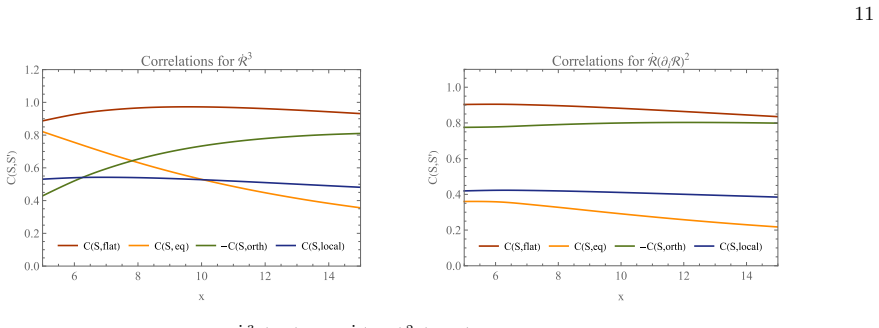
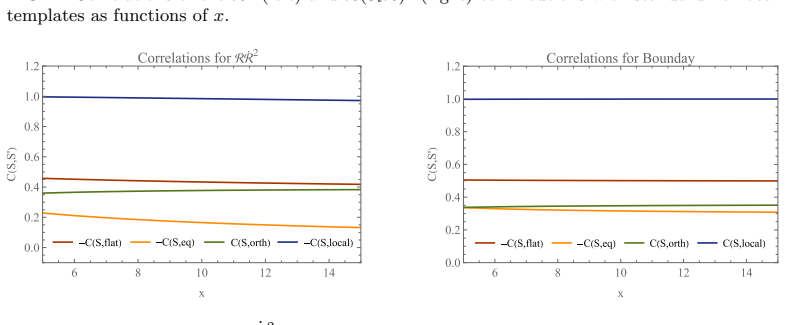
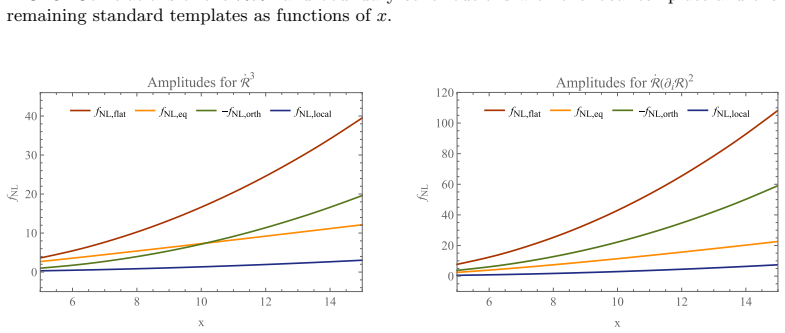
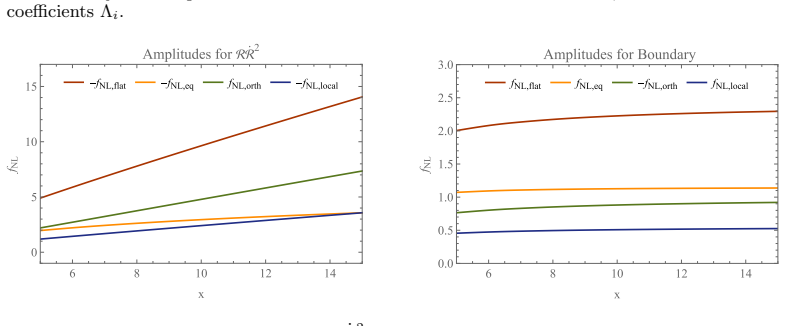
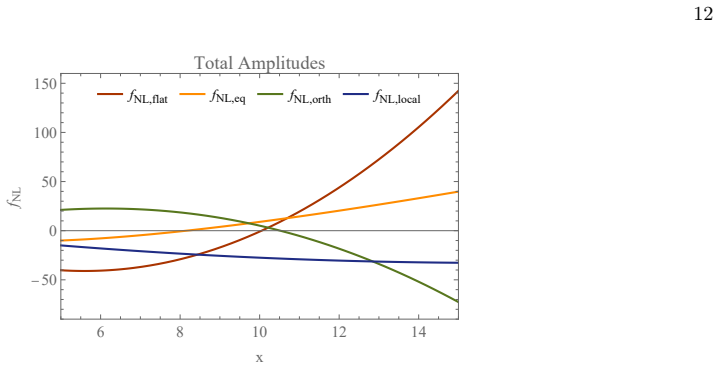
For h much greater than one the entropic perturbation is integrated out to obtain a low-energy effective theory for the curvature mode, which then has an imaginary sound speed and undergoes transient growth before horizon crossing. In addition to the known flattened-enhanced signals scaling as h cubed, this yields a flattened-enhanced signal scaling as h squared and a pronounced local projection scaling as h. Their competition produces a local-dominated bispectrum for intermediate h and a flattened-dominated signal at larger h.
What carries the argument
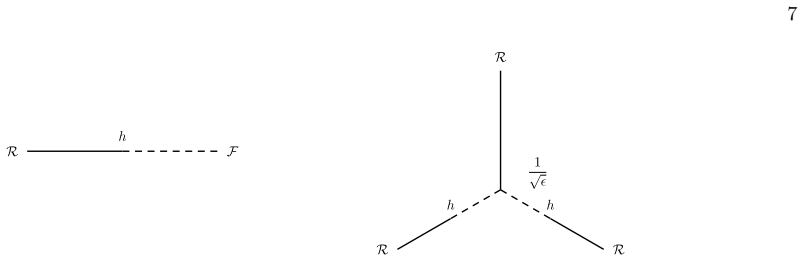
The parameter h measuring the vector kinetic contribution relative to the scalar field, together with the low-energy EFT obtained by integrating out the heavy entropic perturbation.
If this is right
- In the large-h regime the bispectrum receives flattened contributions scaling as h cubed and h squared in addition to a local contribution scaling as h.
- The dominant shape switches from local at intermediate h to flattened at larger h.
- This shape dependence persists even though the background remains exactly isotropic.
- The small-h regime instead produces a local-type signal enhanced by h squared N_K cubed with persistent vector transfer outside the horizon.
Where Pith is reading between the lines
- CMB bispectrum measurements could in principle bound the allowed range of h without needing to detect background anisotropy.
- The transient growth phase before horizon crossing might produce scale-dependent features in the power spectrum or higher correlators that could be searched for separately.
- Similar EFT reductions might apply to other kinetically coupled multi-field models where one mode becomes heavy.
Load-bearing premise
For large h the entropic perturbation can be integrated out without leaving residual effects on the curvature mode.
What would settle it
A direct computation of the mode functions or the bispectrum for large but finite h that shows either no imaginary sound speed, no transient growth, or bispectrum scalings that fail to match the predicted h, h squared, and h cubed coefficients.
Figures
read the original abstract
We revisit the resulting bispectrum of inflation with kinetic-coupled vector fields by organizing the dynamics in terms of $h$, which measures the vector kinetic contribution relative to that of the scalar field. We evaluate the bispectrum in the strong-vector regime and derive a low-energy effective field theory (EFT) for the large-$h$ regime. For $h\gg1$, the entropic perturbation becomes heavy and can be integrated out; the remaining curvature mode has an imaginary sound speed and undergoes transient growth before horizon crossing. In contrast to $h\ll1$ regime, where transfer from the vector sector persists outside the horizon and produces a local-type contribution enhanced as $h^2N_K^3$, we find that in addition to the known flattened-enhanced signals scaling as $h^3$, a flattened-enhanced signal scaling as $h^2$ and a pronounced local projection scaling as $h$ are present. Their competition yields a local-dominated signal for intermediate $h$ and a flattened-dominated signal at larger $h$. The bispectrum therefore distinguishes vector-supported inflationary dynamics even for an exactly isotropic background.
Editorial analysis
A structured set of objections, weighed in public.
Referee Report
Summary. The paper revisits inflation with kinetic-coupled vector fields, organizing the dynamics in terms of the parameter h measuring the vector kinetic contribution relative to the scalar. In the h ≫ 1 regime it derives a low-energy EFT by integrating out the heavy entropic perturbation; the resulting curvature mode has an imaginary sound speed and undergoes only transient growth before horizon crossing. This produces bispectrum contributions scaling as h³ (flattened), h² (flattened), and h (local). Their competition yields a local-dominated signal at intermediate h and a flattened-dominated signal at larger h. In contrast to the h ≪ 1 regime (local-type signal enhanced by h² N_K³), these features allow the bispectrum to distinguish vector-supported inflationary dynamics even for an exactly isotropic background.
Significance. If the EFT reduction and bispectrum scalings hold, the work supplies a concrete, h-dependent set of non-Gaussianity signatures that can probe vector contributions without background anisotropy. The competition between local and flattened shapes as a function of h offers potentially distinguishable predictions from both single-field inflation and the h ≪ 1 vector case. The choice to parameterize the entire analysis by the single ratio h is a clear organizational strength that makes the scaling results falsifiable in principle.
major comments (1)
- [Abstract (EFT derivation paragraph)] Abstract (paragraph on EFT derivation): the statement that the entropic perturbation 'can be integrated out without residual effects' for h ≫ 1, leaving only transient growth despite an imaginary sound speed, is load-bearing for the reported h² flattened and h local contributions. An imaginary sound speed normally signals tachyonic instability; without explicit mode-equation solutions, growth-factor bounds, or error estimates showing that any instability remains strictly pre-horizon-crossing and does not contaminate the bispectrum, the distinction from the h ≪ 1 local-type signal cannot be verified.
minor comments (1)
- The definition of h as the ratio of kinetic terms should be written explicitly with the relevant Lagrangian terms at its first appearance in the introduction.
Simulated Author's Rebuttal
We thank the referee for their careful reading and constructive feedback. We address the single major comment below and will revise the manuscript accordingly to strengthen the presentation of the EFT analysis.
read point-by-point responses
-
Referee: [Abstract (EFT derivation paragraph)] Abstract (paragraph on EFT derivation): the statement that the entropic perturbation 'can be integrated out without residual effects' for h ≫ 1, leaving only transient growth despite an imaginary sound speed, is load-bearing for the reported h² flattened and h local contributions. An imaginary sound speed normally signals tachyonic instability; without explicit mode-equation solutions, growth-factor bounds, or error estimates showing that any instability remains strictly pre-horizon-crossing and does not contaminate the bispectrum, the distinction from the h ≪ 1 local-type signal cannot be verified.
Authors: We agree that the abstract statement is concise and that the referee's concern about explicit verification of the transient nature of the growth is well-taken. The manuscript derives the EFT by integrating out the heavy entropic mode for h ≫ 1, yielding the curvature perturbation equation with imaginary sound speed; the bispectrum is then computed via the in-in formalism within this EFT. To make the pre-horizon-crossing character fully explicit and address potential contamination concerns, the revised version will include (i) the explicit mode equation solutions in the EFT regime, (ii) analytic growth-factor bounds demonstrating that any amplification remains bounded and terminates before horizon exit, and (iii) error estimates on the EFT validity range confirming that post-horizon effects do not enter the bispectrum. These additions will also sharpen the contrast with the h ≪ 1 regime where vector transfer persists outside the horizon. revision: yes
Circularity Check
No significant circularity; bispectrum scalings derived from model dynamics
full rationale
The paper defines h directly from the Lagrangian as the ratio of vector to scalar kinetic terms and computes the bispectrum via standard cosmological perturbation theory in the h ≪ 1 and h ≫ 1 regimes. In the large-h case the EFT integration of the entropic mode produces the reported h^3, h^2 and h scalings as explicit outcomes of the mode equations and sound-speed analysis, not as redefinitions of the input parameter. No self-citation is invoked as a load-bearing uniqueness theorem, no fitted subset is relabeled as a prediction, and the derivation remains self-contained against the given action without reducing any claimed result to its own definition by construction.
Axiom & Free-Parameter Ledger
free parameters (1)
- h
axioms (1)
- domain assumption The entropic perturbation becomes heavy for h ≫ 1 and can be integrated out to obtain an effective theory for the curvature mode.
Reference graph
Works this paper leans on
-
[1]
h 8 √ 2 3 Rc ˙F+ 8 √ 2HR cF ! +h 2 −32 3 HR2 c − 16 3 Rc ˙Rc + 16HF 2 + 16 3 F ˙F # ,(A10) a−3ΠF = ˙F+ 1√ 2ϵMpl
Smallh For smallh, the cubic action can be expanded in powers ofh. The leading-order terms are L(3) h≪1 ≃ a3 Mpl √ 2ϵ L(3) 0 +hL (3) 1 +h 2L(3) 2 +O(h 3) ,(A6) 15 where L(3) 0 =− 4 3 Rc ˙F2 −8HR cF ˙F −12H 2RcF2 + 2 a2 Rc∂iF∂ iF −Ξ U Rc,(A7) L(3) 1 = 8 √ 2 3 Rc ˙Rc ˙F+ 8 √ 2HR cF ˙Rc + 16 √ 2 3 HR2 c ˙F+ 16 √ 2H2R2 cF − 4 √ 2 3 F ˙F2 −8 √ 2HF 2 ˙F −12 √ 2...
-
[2]
Largeh For large h, the heavy field can be integrated out by inserting the leading solution FLO into the cubic Lagrangian. This gives L(3) eff = a3 Mpl √ 2ϵ 216(2h3 +h) 2 (3 + 2h2)3 H2R3 c + 216(2h3 +h) 2 (3 + 2h2)3 HR2 c ˙Rc + 2(12h4 + 4h2 −3)(12h 4 + 8h2 + 3) h2(3 + 2h2)3 Rc ˙R2 c + 2(48h8 + 48h6 + 8h4 −12h 2 −9) 3h2(3 + 2h2)3 1 H ˙R3 c + 12(2h3 +h) 2 a...
-
[3]
Ratra, Astrophys
B. Ratra, Astrophys. J. Lett.391, L1 (1992)
1992
-
[4]
M. S. Turner and L. M. Widrow, Phys. Rev. D37, 2743 (1988)
1988
-
[5]
Consistent Lorentz Violation in Flat and Curved Space
G. Dvali, O. Pujolas, and M. Redi, Phys. Rev. D76, 044028 (2007), arXiv:hep-th/0702117
work page internal anchor Pith review Pith/arXiv arXiv 2007
-
[6]
Generation of Large-Scale Magnetic Fields in Single-Field Inflation
J. Martin and J. Yokoyama, JCAP01, 025 (2008), arXiv:0711.4307 [astro-ph]
work page internal anchor Pith review Pith/arXiv arXiv 2008
-
[7]
Magnetic fields from inflation?
V. Demozzi, V. Mukhanov, and H. Rubinstein, JCAP08, 025 (2009), arXiv:0907.1030 [astro-ph.CO]
work page internal anchor Pith review Pith/arXiv arXiv 2009
-
[8]
M. a. Watanabe, S. Kanno, and J. Soda, Phys. Rev. Lett.102, 191302 (2009), arXiv:0902.2833 [hep-th]
work page internal anchor Pith review Pith/arXiv arXiv 2009
-
[9]
M. a. Watanabe, S. Kanno, and J. Soda, Prog. Theor. Phys.123, 1041 (2010), arXiv:1003.0056 [astro-ph.CO]
work page internal anchor Pith review Pith/arXiv arXiv 2010
-
[10]
Anisotropic Power-law Inflation
S. Kanno, J. Soda, and M. a. Watanabe, JCAP12, 024 (2010), arXiv:1010.5307 [hep-th]
work page internal anchor Pith review Pith/arXiv arXiv 2010
-
[11]
Inflation with Multi-Vector-Hair: The Fate of Anisotropy
K. Yamamoto, M. a. Watanabe, and J. Soda, Class. Quant. Grav.29, 145008 (2012), arXiv:1201.5309 [hep-th]
work page internal anchor Pith review Pith/arXiv arXiv 2012
-
[12]
A. Maleknejad, M. M. Sheikh-Jabbari, and J. Soda, Phys. Rept.528, 161 (2013), arXiv:1212.2921 [hep-th]
work page internal anchor Pith review Pith/arXiv arXiv 2013
-
[13]
The anisotropic power spectrum and bispectrum in the f(phi) F^2 mechanism
N. Bartolo, S. Matarrese, M. Peloso, and A. Ricciardone, Phys. Rev. D87, 023504 (2013), arXiv:1210.3257 [astro-ph.CO]
work page internal anchor Pith review Pith/arXiv arXiv 2013
-
[14]
Spectrum of Perturbations in Anisotropic Inflationary Universe with Vector Hair
B. Himmetoglu, JCAP03, 023 (2010), arXiv:0910.3235 [astro-ph.CO]
work page internal anchor Pith review Pith/arXiv arXiv 2010
-
[15]
A. E. Gumrukcuoglu, B. Himmetoglu, and M. Peloso, Phys. Rev. D81, 063528 (2010), arXiv:1001.4088 [astro-ph.CO]
work page internal anchor Pith review Pith/arXiv arXiv 2010
-
[16]
A. E. Gumrukcuoglu, C. R. Contaldi, and M. Peloso, JCAP11, 005 (2007), arXiv:0707.4179 [astro-ph]
work page internal anchor Pith review Pith/arXiv arXiv 2007
-
[17]
Curvature Perturbations in Anisotropic Inflation with Symmetry Breaking
R. Emami and H. Firouzjahi, JCAP10, 041 (2013), arXiv:1301.1219 [hep-th]
work page internal anchor Pith review Pith/arXiv arXiv 2013
-
[18]
Local non-Gaussianity from inflation
D. Wands, Class. Quant. Grav.27, 124002 (2010), arXiv:1004.0818 [astro-ph.CO] . 17
work page internal anchor Pith review Pith/arXiv arXiv 2010
-
[19]
Primordial Non-Gaussianities from Inflation Models
X. Chen, Adv. Astron.2010, 638979 (2010), arXiv:1002.1416 [astro-ph.CO]
work page internal anchor Pith review Pith/arXiv arXiv 2010
-
[20]
Inflation, Cosmic Perturbations and Non-Gaussianities
Y. Wang, Commun. Theor. Phys.62, 109 (2014), arXiv:1303.1523 [hep-th]
work page internal anchor Pith review Pith/arXiv arXiv 2014
-
[21]
Primordial non-Gaussianities after Planck 2015: an introductory review
S. Renaux-Petel, Comptes Rendus Physique16, 969 (2015), arXiv:1508.06740 [astro-ph.CO]
work page internal anchor Pith review Pith/arXiv arXiv 2015
- [22]
-
[23]
Primordial Fluctuations from Inflation with a Triad of Background Gauge Fields
K. Yamamoto, Phys. Rev. D85, 123504 (2012), arXiv:1203.1071 [astro-ph.CO]
work page internal anchor Pith review Pith/arXiv arXiv 2012
-
[24]
Primordial bispectrum from inflation with background gauge fields
H. Funakoshi and K. Yamamoto, Class. Quant. Grav.30, 135002 (2013), arXiv:1212.2615 [astro-ph.CO]
work page internal anchor Pith review Pith/arXiv arXiv 2013
-
[25]
Anisotropic inflation reexamined: upper bound on broken rotational invariance during inflation
A. Naruko, E. Komatsu, and M. Yamaguchi, JCAP04, 045 (2015), arXiv:1411.5489 [astro-ph.CO]
work page internal anchor Pith review Pith/arXiv arXiv 2015
-
[26]
Does Anisotropic "Inflation" Produce a Small Statistical Anisotropy?
T. Fujita and I. Obata, JCAP01, 049 (2018), arXiv:1711.11539 [astro-ph.CO]
work page internal anchor Pith review Pith/arXiv arXiv 2018
-
[27]
C.-B. Chen and J. Soda, JCAP05, 029 (2022), arXiv:2201.03160 [hep-th]
-
[28]
Chen, JCAP11, 063 (2024), arXiv:2312.06105 [astro-ph.CO]
C.-B. Chen, JCAP11, 063 (2024), arXiv:2312.06105 [astro-ph.CO]
-
[29]
C.-B. Chen, B.-X. An, and F.-W. Shu, Phys. Rev. D112, 10 (2025), arXiv:2507.16807 [astro-ph.CO]
-
[30]
The Effective Field Theory of Inflation
C. Cheung, P. Creminelli, A. L. Fitzpatrick, J. Kaplan, and L. Senatore, JHEP03, 014 (2008), arXiv:0709.0293 [hep-th]
work page internal anchor Pith review Pith/arXiv arXiv 2008
-
[31]
Features of heavy physics in the CMB power spectrum
A. Achucarro, J. O. Gong, S. Hardeman, G. A. Palma, and S. P. Patil, JCAP01, 030 (2011), arXiv:1010.3693 [hep-ph]
work page internal anchor Pith review Pith/arXiv arXiv 2011
-
[32]
Effective theories of single field inflation when heavy fields matter
A. Achucarro, J. O. Gong, S. Hardeman, G. A. Palma, and S. P. Patil, JHEP05, 066 (2012), arXiv:1201.6342 [hep-th]
work page internal anchor Pith review Pith/arXiv arXiv 2012
-
[33]
Equilateral Non-Gaussianity and New Physics on the Horizon
D. Baumann and D. Green, JCAP09, 014 (2011), arXiv:1102.5343 [hep-th]
work page internal anchor Pith review Pith/arXiv arXiv 2011
-
[34]
A. R. Brown, Phys. Rev. Lett.121, 251601 (2018), arXiv:1705.03023 [hep-th]
work page internal anchor Pith review Pith/arXiv arXiv 2018
-
[35]
Primordial perturbations from inflation with a hyperbolic field-space
S. Mizuno and S. Mukohyama, Phys. Rev. D96, 103533 (2017), arXiv:1707.05125 [hep-th]
work page internal anchor Pith review Pith/arXiv arXiv 2017
-
[36]
T. Bjorkmo and M. C. D. Marsh, JHEP04, 172 (2019), arXiv:1901.08603 [hep-th]
work page internal anchor Pith review Pith/arXiv arXiv 2019
-
[37]
Geometrical Destabilization of Inflation
S. Renaux-Petel and K. Turzynski, Phys. Rev. Lett.117, 141301 (2016), arXiv:1510.01281 [astro-ph.CO]
work page internal anchor Pith review Pith/arXiv arXiv 2016
-
[38]
Primordial fluctuations and non-Gaussianities in sidetracked inflation
S. Garcia-Saenz, S. Renaux-Petel, and J. Ronayne, JCAP07, 057 (2018), arXiv:1804.11279 [astro-ph.CO]
work page internal anchor Pith review Pith/arXiv arXiv 2018
-
[39]
Geometrical destabilization, premature end of inflation and Bayesian model selection
S. Renaux-Petel, K. Turzynski, and V. Vennin, JCAP11, 006 (2017), arXiv:1706.01835 [astro-ph.CO]
work page internal anchor Pith review Pith/arXiv arXiv 2017
-
[40]
S. Garcia-Saenz and S. Renaux-Petel, JCAP11, 005 (2018), arXiv:1805.12563 [hep-th]
work page internal anchor Pith review Pith/arXiv arXiv 2018
-
[41]
J. Fumagalli, S. Garcia-Saenz, L. Pinol, S. Renaux-Petel, and J. Ronayne, Phys. Rev. Lett.123, 201302 (2019), arXiv:1902.03221 [hep-th]
-
[42]
S. Garcia-Saenz, L. Pinol, and S. Renaux-Petel, JHEP01, 073 (2020), arXiv:1907.10403 [hep-th]
-
[43]
M. C. Bento, O. Bertolami, P. V. Moniz, J. M. Mourao, and P. M. Sa, Class. Quant. Grav.10, 285 (1993), arXiv:gr-qc/9302034
work page internal anchor Pith review Pith/arXiv arXiv 1993
-
[44]
A. Golovnev, V. Mukhanov, and V. Vanchurin, JCAP06, 009 (2008), arXiv:0802.2068 [astro-ph]
work page internal anchor Pith review Pith/arXiv arXiv 2008
-
[45]
H. Firouzjahi, M. A. Gorji, S. A. Hosseini Mansoori, A. Karami, and T. Rostami, Phys. Rev. D100, 043530 (2019), arXiv:1812.07464 [hep-th]
-
[46]
Anisotropic Inflation with Non-Abelian Gauge Kinetic Function
K. Murata and J. Soda, JCAP06, 037 (2011), arXiv:1103.6164 [hep-th]
work page internal anchor Pith review Pith/arXiv arXiv 2011
-
[47]
C.-B. Chen and J. Soda, JCAP09, 026 (2021), arXiv:2106.04813 [hep-th]
-
[48]
The shape of non-Gaussianities
D. Babich, P. Creminelli, and M. Zaldarriaga, JCAP08, 009 (2004), arXiv:astro-ph/0405356
work page internal anchor Pith review Pith/arXiv arXiv 2004
-
[49]
J. R. Fergusson and E. P. S. Shellard, Phys. Rev. D80, 043510 (2009), arXiv:0812.3413 [astro-ph]
work page internal anchor Pith review Pith/arXiv arXiv 2009
- [50]
-
[51]
J. Fumagalli, S. Renaux-Petel, J. W. Ronayne, and L. T. Witkowski, Phys. Lett. B841, 137921 (2023), arXiv:2004.08369 [hep-th]
-
[52]
M. Braglia, D. K. Hazra, F. Finelli, G. F. Smoot, L. Sriramkumar, and A. A. Starobinsky, JCAP08, 001 (2020), arXiv:2005.02895 [astro-ph.CO]
-
[53]
J. Fumagalli, S. Renaux-Petel, and L. T. Witkowski, JCAP08, 030 (2021), arXiv:2012.02761 [astro-ph.CO]
-
[54]
J. Fumagalli, S. ´ e. Renaux-Petel, and L. T. Witkowski, JCAP08, 059 (2021), arXiv:2105.06481 [astro-ph.CO]
-
[55]
J. Fumagalli, G. A. Palma, S. Renaux-Petel, S. Sypsas, L. T. Witkowski, and C. Zenteno, JHEP03, 196 (2022), arXiv:2111.14664 [astro-ph.CO]
-
[56]
C. Chen and A. Ota, Phys. Rev. D106, 063507 (2022), arXiv:2205.07810 [astro-ph.CO]
-
[57]
Probing small-scale anisotropic inflation with stochastic gravitational-wave background
Y.-T. Kuang, J.-Z. Zhou, Z. Chang, and D. Wu, Chin. Phys. C50, 055104 (2026), arXiv:2309.06676 [astro-ph.CO]
work page internal anchor Pith review Pith/arXiv arXiv 2026
-
[58]
Exploring the statistical anisotropy of primordial curvature perturbations with pulsar timing arrays
F. Xie, Z.-C. Zhao, Q.-H. Zhu, and X. Li, (2026), arXiv:2604.21642 [gr-qc]
work page internal anchor Pith review Pith/arXiv arXiv 2026
discussion (0)
Sign in with ORCID, Apple, or X to comment. Anyone can read and Pith papers without signing in.