TeV-PeV Gamma-ray and Neutrino Emission in the Galactic Plane
Pith reviewed 2026-06-26 07:21 UTC · model grok-4.3
The pith
Diffuse Galactic plane gamma rays split into leptonic and hadronic parts yield neutrinos that match IceCube data even after ISRF variations.
A machine-rendered reading of the paper's core claim, the machinery that carries it, and where it could break.
Core claim
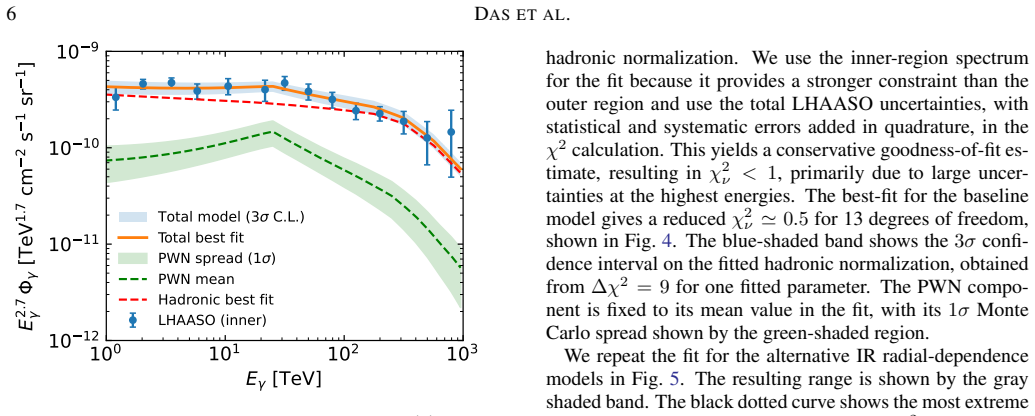
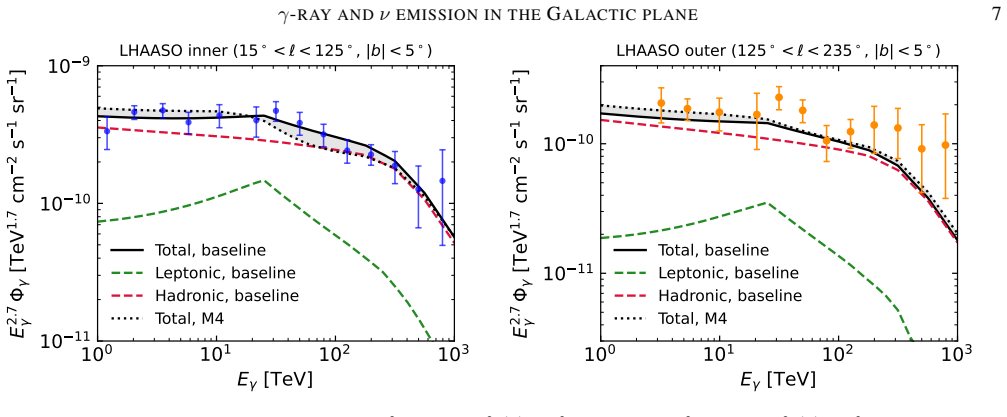
We model the LHAASO observation of diffuse TeV--PeV γ rays in the Galactic plane as the sum of unresolved leptonic emission from pulsar wind nebulae and hadronic emission from supernova-injected cosmic-ray (CR) protons. We investigate uncertainties in the radial distribution of the infrared component of the interstellar radiation field (ISRF), using profiles with enhanced photon densities in the inner Galaxy. The alternative ISRF models affect the LHAASO diffuse fit only modestly, as the analysis excludes the Galactic center direction and applies source masks in the Galactic plane. Using the hadronic normalization inferred from the LHAASO fit for various ISRF models, the associated pp neutri
What carries the argument
Decomposition of diffuse gamma-ray flux into unresolved leptonic pulsar-wind-nebula emission plus hadronic emission from cosmic-ray protons, with the infrared ISRF radial profile varied to quantify gamma-gamma attenuation changes.
If this is right
- The same ISRF variations produce noticeable changes in both hadronic and inverse-Compton gamma-ray emission above 10 TeV from sources near the central molecular zone.
- Future KM3NeT neutrino observations combined with gamma-ray data on individual sources can constrain the inner-Galaxy cosmic-ray population.
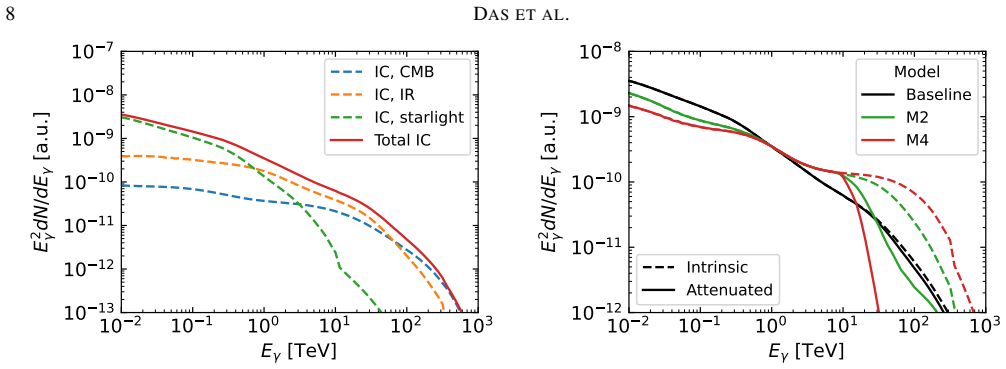
- Modified infrared profiles alter inverse-Compton emission from point sources near the central molecular zone.
Where Pith is reading between the lines
- The modest impact of ISRF changes implies that gamma-ray data outside the masked inner region can still anchor the overall hadronic normalization.
- This approach could be extended to test whether the same cosmic-ray population accounts for both diffuse and point-source emission once better inner-Galaxy ISRF maps become available.
Load-bearing premise
The observed diffuse gamma-ray emission can be cleanly separated into leptonic pulsar-wind-nebula and hadronic cosmic-ray proton contributions once known sources are masked and the Galactic-center direction is excluded.
What would settle it
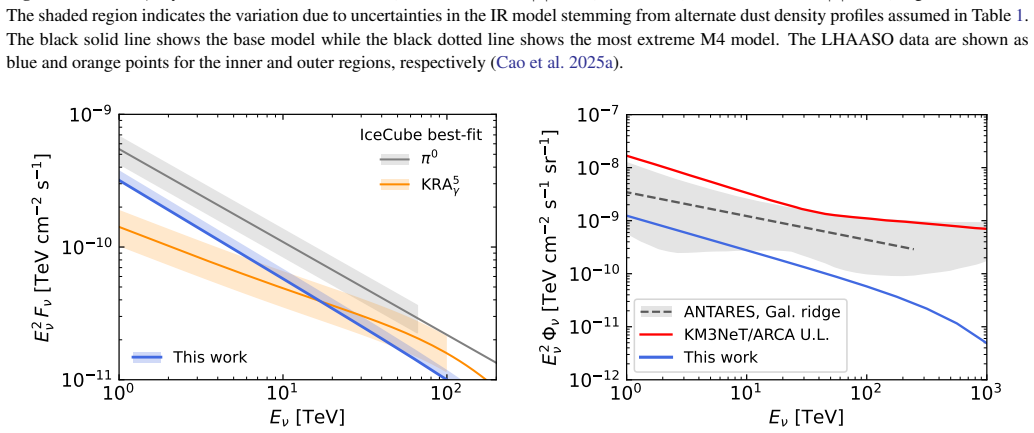
Detection of a Galactic Ridge neutrino flux above the current ANTARES or KM3NeT upper limits, or a clear mismatch between the hadronic gamma-ray normalization and the IceCube all-sky neutrino measurement, would falsify the consistency result.
Figures
read the original abstract
We model the LHAASO observation of diffuse TeV--PeV $\gamma$ rays in the Galactic plane as the sum of unresolved leptonic emission from pulsar wind nebulae and hadronic emission from supernova-injected cosmic-ray (CR) protons. We investigate uncertainties in the radial distribution of the infrared component of the interstellar radiation field (ISRF), using profiles with enhanced photon densities in the inner Galaxy. We quantify their effects on $\gamma\gamma$ attenuation of the diffuse $\gamma$-ray emission. The alternative ISRF models affect the LHAASO diffuse fit only modestly, as the analysis excludes the Galactic center direction and applies source masks in the Galactic plane. Using the hadronic normalization inferred from the LHAASO fit for various ISRF models, the associated $pp$ neutrino emission remains consistent with the IceCube all-sky measurement, while the flux from the Galactic Ridge region remains compatible with current ANTARES and KM3NeT constraints. Since the modified infrared profiles differ most strongly toward the inner Galaxy, we also examine their impact on inverse-Compton emission from point sources near the central molecular zone. These same models can noticeably modify the hadronic and inverse-Compton $\gamma$-ray emission above $\sim\!10$ TeV from sources in the central region. Future KM3NeT observations, combined with $\gamma$-ray measurements of individual sources, can probe the inner-Galaxy CR population and constrain the radial distribution of the ISRF near the Galactic Center.
Editorial analysis
A structured set of objections, weighed in public.
Referee Report
Summary. The manuscript models the LHAASO observation of diffuse TeV-PeV gamma rays in the Galactic plane as the sum of unresolved leptonic emission from pulsar wind nebulae and hadronic emission from supernova-injected cosmic-ray protons. It investigates uncertainties arising from alternative interstellar radiation field (ISRF) infrared radial profiles with enhanced inner-Galaxy densities, finding only modest effects on the LHAASO diffuse fit due to source masks and exclusion of the Galactic-center direction. Using the resulting hadronic normalizations, the associated pp neutrino emission is reported to remain consistent with the IceCube all-sky measurement, with the Galactic Ridge flux compatible with ANTARES and KM3NeT constraints. The work also examines impacts on inverse-Compton emission from sources near the central molecular zone and discusses prospects for future KM3NeT observations.
Significance. If the decomposition of the diffuse emission holds, the analysis supplies a multi-messenger consistency check linking LHAASO gamma-ray data to neutrino observations while quantifying how ISRF variations propagate to attenuation and emission predictions. The explicit variation of ISRF profiles and the modest impact under the adopted masks represent a concrete step toward addressing inner-Galaxy uncertainties.
major comments (1)
- [Modeling of diffuse emission and hadronic normalization extraction (abstract and associated fit description)] The hadronic normalization that sets the predicted neutrino flux is extracted only after subtracting an assumed leptonic contribution from unresolved PWNe, using fixed source masks and excluding the Galactic-center direction. The manuscript varies ISRF models but does not vary the PWNe spatial/spectral template or mask boundaries; any systematic error in this decomposition directly rescales the neutrino prediction and therefore underpins the claimed consistency with IceCube, ANTARES, and KM3NeT data.
minor comments (1)
- [Abstract] The abstract states that the neutrino flux 'remains consistent' but does not quote the numerical range of hadronic normalizations obtained across the ISRF models; adding this range would clarify the robustness of the consistency statement.
Simulated Author's Rebuttal
We thank the referee for the constructive feedback on our manuscript. The major comment raises an important point about the fixed nature of the PWNe template in our decomposition of the diffuse emission. We address this below and outline the revisions we will make.
read point-by-point responses
-
Referee: [Modeling of diffuse emission and hadronic normalization extraction (abstract and associated fit description)] The hadronic normalization that sets the predicted neutrino flux is extracted only after subtracting an assumed leptonic contribution from unresolved PWNe, using fixed source masks and excluding the Galactic-center direction. The manuscript varies ISRF models but does not vary the PWNe spatial/spectral template or mask boundaries; any systematic error in this decomposition directly rescales the neutrino prediction and therefore underpins the claimed consistency with IceCube, ANTARES, and KM3NeT data.
Authors: We acknowledge that the hadronic normalization is obtained after subtracting a fixed leptonic contribution from unresolved PWNe, with fixed spatial/spectral templates and mask boundaries. These choices are motivated by established pulsar population models and the need to exclude regions (including the Galactic center) where source confusion and modeling uncertainties are highest; the masks follow those used in the LHAASO diffuse analysis itself. The manuscript's primary goal is to quantify the propagation of ISRF uncertainties through the attenuation and emission modeling while holding the decomposition fixed, so that the modest impact of alternative ISRF profiles can be isolated. Because the same PWNe subtraction is applied uniformly across all ISRF cases, the relative changes in the hadronic component (and thus the neutrino predictions) remain robust. We agree, however, that a dedicated sensitivity study varying the PWNe template would further strengthen the multi-messenger consistency claims. We will therefore add an explicit discussion of this systematic in the revised manuscript, including a qualitative assessment of how plausible variations in the PWNe normalization would rescale the neutrino flux while preserving the reported consistency with IceCube, ANTARES, and KM3NeT data. revision: partial
Circularity Check
No significant circularity; neutrino consistency is an external check on independent data
full rationale
The paper fits a hadronic normalization to LHAASO gamma-ray data after modeling a leptonic PWNe component, then computes the associated pp neutrino flux via standard pion-decay kinematics and compares the result to separate IceCube, ANTARES, and KM3NeT measurements. This constitutes a consistency test between two distinct observables linked by known particle physics, not a reduction of one result to the other by construction. No self-citation chains, uniqueness theorems, or ansatzes imported from prior author work are invoked as load-bearing steps. The derivation remains self-contained against external benchmarks.
Axiom & Free-Parameter Ledger
free parameters (2)
- hadronic normalization
- ISRF infrared radial profile parameters
axioms (2)
- domain assumption Diffuse TeV-PeV gamma-ray emission is the sum of unresolved leptonic PWNe emission and hadronic emission from SN-injected CR protons
- standard math Gamma-gamma attenuation is dominated by the infrared component of the ISRF
Reference graph
Works this paper leans on
-
[1]
Dermer, C. D. and Razzaque, S. and Finke, J. D. and Atoyan, A. Ultrahigh Energy Cosmic Rays from Black Hole Jets of Radio Galaxies. New J. Phys. 2009. doi:10.1088/1367-2630/11/6/065016. arXiv:0811.1160
work page internal anchor Pith review Pith/arXiv arXiv doi:10.1088/1367-2630/11/6/065016 2009
-
[2]
The Pierre Auger Cosmic Ray Observatory
Pierre Auger Collaboration. The Pierre Auger Cosmic Ray Observatory. Nucl. Instrum. Meth. A. 2015. doi:10.1016/j.nima.2015.06.058. arXiv:1502.01323
work page internal anchor Pith review Pith/arXiv arXiv doi:10.1016/j.nima.2015.06.058 2015
-
[3]
Combined fit of spectrum and composition data as measured by the Pierre Auger Observatory
Pierre Auger Collaboration. Combined fit of spectrum and composition data as measured by the Pierre Auger Observatory. JCAP. 2017. doi:10.1088/1475-7516/2017/04/038. arXiv:1612.07155
work page internal anchor Pith review Pith/arXiv arXiv doi:10.1088/1475-7516/2017/04/038 2017
-
[4]
Anchordoqui, Luis A. Ultra-High-Energy Cosmic Rays. Phys. Rept. 2019. doi:10.1016/j.physrep.2019.01.002. arXiv:1807.09645
work page internal anchor Pith review Pith/arXiv arXiv doi:10.1016/j.physrep.2019.01.002 2019
-
[5]
The Astrophysics of Ultrahigh Energy Cosmic Rays
The Astrophysics of Ultrahigh-Energy Cosmic Rays. , keywords =. doi:10.1146/annurev-astro-081710-102620 , archivePrefix =. 1101.4256 , primaryClass =
work page internal anchor Pith review Pith/arXiv arXiv doi:10.1146/annurev-astro-081710-102620
-
[6]
Telescope Array Collaboration. The energy spectrum of cosmic rays above 10 ^ 17.2 eV measured by the fluorescence detectors of the Telescope Array experiment in seven years. Astropart. Phys. 2016. doi:10.1016/j.astropartphys.2016.04.002. arXiv:1511.07510
work page internal anchor Pith review Pith/arXiv arXiv doi:10.1016/j.astropartphys.2016.04.002 2016
-
[7]
Transition from galactic to extragalactic cosmic rays
Aloisio, R. and Berezinsky, V. and Gazizov, A. Transition from galactic to extragalactic cosmic rays. Astropart. Phys. 2012. doi:10.1016/j.astropartphys.2012.09.007. arXiv:1211.0494
work page internal anchor Pith review Pith/arXiv arXiv doi:10.1016/j.astropartphys.2012.09.007 2012
-
[8]
Abbasi , R. U. and others. Indications of Proton-Dominated Cosmic-Ray Composition above 1.6 EeV. , keywords =. doi:10.1103/PhysRevLett.104.161101 , archivePrefix =. 0910.4184 , primaryClass =
work page internal anchor Pith review Pith/arXiv arXiv doi:10.1103/physrevlett.104.161101
-
[9]
Bird, D. J. and others. Detection of a cosmic ray with measured energy well beyond the expected spectral cutoff due to cosmic microwave radiation. Astrophys. J. 1995. doi:10.1086/175344. arXiv:astro-ph/9410067
work page internal anchor Pith review Pith/arXiv arXiv doi:10.1086/175344 1995
-
[10]
An extremely energetic cosmic ray observed by a surface detector array
Telescope Array Collaboration. An extremely energetic cosmic ray observed by a surface detector array. Science. 2023. doi:10.1126/science.abo5095. arXiv:2311.14231
-
[11]
Our Peculiar Motion Away from the Local Void
Tully, R. Brent and Shaya, Edward J. and Karachentsev, Igor D. and Courtois, H. M. and Kocevski, Dale D. and Rizzi, Luca and Peel, Alan. Our Peculiar Motion Away from the Local Void. Astrophys. J. 2008. doi:10.1086/527428. arXiv:0705.4139
work page internal anchor Pith review Pith/arXiv arXiv doi:10.1086/527428 2008
-
[12]
UHECR Clustering: Lightest Nuclei from Local Sheet Galaxies
Fargion, Daniele and De Sanctis Lucentini, Pier Giorgio and Khlopov, Maxim Yu. UHECR Clustering: Lightest Nuclei from Local Sheet Galaxies. Universe. 2024. doi:10.3390/universe10080323. arXiv:2408.07172
work page internal anchor Pith review Pith/arXiv arXiv doi:10.3390/universe10080323 2024
-
[13]
Theodore and Murase, Kohta and Ekanger, Nick and Bhattacharya, Mukul and Horiuchi, Shunsaku
Zhang, B. Theodore and Murase, Kohta and Ekanger, Nick and Bhattacharya, Mukul and Horiuchi, Shunsaku. Ultraheavy Ultrahigh-Energy Cosmic Rays. 2024. arXiv:2405.17409
Pith/arXiv arXiv 2024
-
[14]
Binary Neutron Star Mergers as the Source of the Highest Energy Cosmic Rays
Farrar, Glennys R. Binary Neutron Star Mergers as the Source of the Highest Energy Cosmic Rays. Phys. Rev. Lett. 2025. doi:10.1103/PhysRevLett.134.081003. arXiv:2405.12004
-
[15]
New physics as a possible explanation for the Amaterasu particle
Lang, Rodrigo Guedes. New physics as a possible explanation for the Amaterasu particle. JCAP. 2024. doi:10.1088/1475-7516/2024/11/023. arXiv:2405.03528
-
[16]
Pierre Auger Collaboration. Testing effects of Lorentz invariance violation in the propagation of astroparticles with the Pierre Auger Observatory. JCAP. 2022. doi:10.1088/1475-7516/2022/01/023. arXiv:2112.06773
-
[17]
, year = 1966, month = apr, volume =
End to the Cosmic-Ray Spectrum?. , year = 1966, month = apr, volume =. doi:10.1103/PhysRevLett.16.748 , adsurl =
-
[18]
Soviet Journal of Experimental and Theoretical Physics Letters , year = 1966, month = aug, volume =
Upper Limit of the Spectrum of Cosmic Rays. Soviet Journal of Experimental and Theoretical Physics Letters , year = 1966, month = aug, volume =
1966
-
[19]
doi:10.3847/1538-4365/ab6bcb , arxivId =
Fermi-LAT Collaboration. Fermi Large Area Telescope Fourth Source Catalog. Astrophys. J. Suppl. 2020. doi:10.3847/1538-4365/ab6bcb. arXiv:1902.10045
-
[20]
Giant AGN Flares and Cosmic Ray Bursts
Farrar, Glennys R. and Gruzinov, Andrei. Giant AGN Flares and Cosmic Ray Bursts. Astrophys. J. 2009. doi:10.1088/0004-637X/693/1/329. arXiv:0802.1074
work page internal anchor Pith review Pith/arXiv arXiv doi:10.1088/0004-637x/693/1/329 2009
-
[21]
Electron Injection by Relativistic Protons in Active Galactic Nuclei. , keywords =. doi:10.1086/184980 , adsurl =
-
[22]
High-energy neutrino astronomy: a probe of galactic nuclei?. , keywords =. doi:10.1086/157269 , adsurl =
-
[23]
, keywords =
Neutrinos from flat-spectrum radio quasars. , keywords =
-
[24]
Szabo, A. P. and Protheroe, R. J. Implications of particle acceleration in active galactic nuclei for cosmic rays and high-energy neutrino astronomy. Astropart. Phys. 1994. doi:10.1016/0927-6505(94)90027-2. arXiv:astro-ph/9405020
work page internal anchor Pith review Pith/arXiv arXiv doi:10.1016/0927-6505(94)90027-2 1994
-
[25]
On high-energy neutrino radiation of quasars and active galactic nuclei. , keywords =. doi:10.1093/mnras/194.1.3 , adsurl =
-
[26]
High-Energy Neutrinos from Photomeson Processes in Blazars
Atoyan, Armen and Dermer, Charles D. High-energy neutrinos from photomeson processes in blazars. Phys. Rev. Lett. 2001. doi:10.1103/PhysRevLett.87.221102. arXiv:astro-ph/0108053
work page internal anchor Pith review Pith/arXiv arXiv doi:10.1103/physrevlett.87.221102 2001
-
[27]
High-energy neutrinos from active galactic nuclei. , keywords =. doi:10.1103/PhysRevLett.66.2697 , adsurl =
-
[28]
Das, Saikat and Razzaque, Soebur and Gupta, Nayantara. Modeling the spectrum and composition of ultrahigh-energy cosmic rays with two populations of extragalactic sources. Eur. Phys. J. C. 2021. doi:10.1140/epjc/s10052-021-08885-4. arXiv:2004.07621
-
[29]
Ehlert, Domenik and van Vliet, Arjen and Oikonomou, Foteini and Winter, Walter. Constraints on the proton fraction of cosmic rays at the highest energies and the consequences for cosmogenic neutrinos and photons. JCAP. 2024. doi:10.1088/1475-7516/2024/02/022. arXiv:2304.07321
-
[30]
Progress towards characterizing ultrahigh energy cosmic ray sources
Muzio, Marco Stein and Unger, Michael and Farrar, Glennys R. Progress towards characterizing ultrahigh energy cosmic ray sources. Phys. Rev. D. 2019. doi:10.1103/PhysRevD.100.103008. arXiv:1906.06233
-
[31]
Murase, Kohta and Inoue, Yoshiyuki and Dermer, Charles D. Diffuse Neutrino Intensity from the Inner Jets of Active Galactic Nuclei: Impacts of External Photon Fields and the Blazar Sequence. Phys. Rev. D. 2014. doi:10.1103/PhysRevD.90.023007. arXiv:1403.4089
work page internal anchor Pith review Pith/arXiv arXiv doi:10.1103/physrevd.90.023007 2014
-
[32]
Chapter 10: High-Energy Neutrinos from Active Galactic Nuclei
Murase, Kohta and Stecker, Floyd W. Chapter 10: High-Energy Neutrinos from Active Galactic Nuclei. 2023. doi:10.1142/9789811282645_0010. arXiv:2202.03381
-
[33]
Gamma Ray Astronomy with LHAASO
Vernetto, S. Gamma Ray Astronomy with LHAASO. J. Phys. Conf. Ser. 2016. doi:10.1088/1742-6596/718/5/052043
-
[34]
The Cherenkov Telescope Array: layout, design and performance
Gueta, Orel. The Cherenkov Telescope Array: layout, design and performance. Proceedings of 37th International Cosmic Ray Conference PoS(ICRC2021). doi:10.22323/1.395.0885
-
[35]
Neutrino emission from the direction of the blazar TXS 0506+056 prior to the IceCube-170922A alert
IceCube Collaboration. Neutrino emission from the direction of the blazar TXS 0506+056 prior to the IceCube-170922A alert. Science. 2018. doi:10.1126/science.aat2890. arXiv:1807.08794
work page internal anchor Pith review Pith/arXiv arXiv doi:10.1126/science.aat2890 2018
-
[36]
Ansoldi, S. and others. The blazar TXS 0506+056 associated with a high-energy neutrino: insights into extragalactic jets and cosmic ray acceleration. Astrophys. J. Lett. 2018. doi:10.3847/2041-8213/aad083. arXiv:1807.04300
-
[37]
Multimessenger observations of a flaring blazar coincident with high-energy neutrino IceCube-170922A
IceCube Collaboration and Fermi-LAT Collaboration and MAGIC Collaboration and others. Multimessenger observations of a flaring blazar coincident with high-energy neutrino IceCube-170922A. Science. 2018. doi:10.1126/science.aat1378. arXiv:1807.08816
-
[38]
Keivani, A. and others. A Multimessenger Picture of the Flaring Blazar TXS 0506+056: implications for High-Energy Neutrino Emission and Cosmic Ray Acceleration. Astrophys. J. 2018. doi:10.3847/1538-4357/aad59a. arXiv:1807.04537
work page internal anchor Pith review Pith/arXiv arXiv doi:10.3847/1538-4357/aad59a 2018
-
[39]
GAMERA - a new modeling package for non-thermal spectral modeling
Hahn, Joachim. GAMERA - a new modeling package for non-thermal spectral modeling. PoS. 2016. doi:10.22323/1.236.0917
-
[40]
Stecker, F. W. Effect of photomeson production by the universal radiation field on high-energy cosmic rays. Phys. Rev. Lett. 1968. doi:10.1103/PhysRevLett.21.1016
-
[41]
Reaction rate and energy-loss rate for photopair production by relativistic nuclei. , keywords =. doi:10.1086/171984 , adsurl =
-
[42]
Computer Physics Communications , eprint =
Monte Carlo simulations of photohadronic processes in astrophysics. Computer Physics Communications , eprint =. doi:10.1016/S0010-4655(99)00446-4 , adsurl =
-
[43]
Kelner, S. R. and Aharonian, F. A. Energy spectra of gamma-rays, electrons and neutrinos produced at interactions of relativistic protons with low energy radiation. Phys. Rev. D. 2008. doi:10.1103/PhysRevD.82.099901. arXiv:0803.0688
work page internal anchor Pith review Pith/arXiv arXiv doi:10.1103/physrevd.82.099901 2008
-
[44]
Implications of multiwavelength spectrum on cosmic-ray acceleration in blazar TXS 0506+056
Das, Saikat and Gupta, Nayantara and Razzaque, Soebur. Implications of multiwavelength spectrum on cosmic-ray acceleration in blazar TXS 0506+056. Astron. Astrophys. 2022. doi:10.1051/0004-6361/202244653. arXiv:2208.00838
-
[45]
Dissecting the broadband emission from -ray blazar PKS 0735+178 in search of neutrinos
Prince, Raj and Das, Saikat and Gupta, Nayantara and Majumdar, Pratik and Czerny, Bo\.zena. Dissecting the broadband emission from -ray blazar PKS 0735+178 in search of neutrinos. Mon. Not. Roy. Astron. Soc. 2024. doi:10.1093/mnras/stad3804. arXiv:2301.06565
-
[46]
Pair Production in Photon-Photon Collisions , author =. Phys. Rev. , volume =. 1967 , month =. doi:10.1103/PhysRev.155.1404 , url =
-
[47]
Leptonic and Hadronic Modeling of Fermi-Detected Blazars
Boettcher, M. and Reimer, A. and Sweeney, K. and Prakash, A. Leptonic and Hadronic Modeling of Fermi-Detected Blazars. Astrophys. J. 2013. doi:10.1088/0004-637X/768/1/54. arXiv:1304.0605
work page internal anchor Pith review Pith/arXiv arXiv doi:10.1088/0004-637x/768/1/54 2013
-
[48]
The Pair Production Spectrum from Photon-Photon Annihilation
The pair production spectrum from photon-photon annihilation. , keywords =. doi:10.48550/arXiv.astro-ph/9703069 , archivePrefix =. astro-ph/9703069 , primaryClass =
work page internal anchor Pith review Pith/arXiv arXiv doi:10.48550/arxiv.astro-ph/9703069
-
[49]
Anisotropies of ultra-high energy cosmic rays diffusing from extragalactic sources
Harari, Diego and Mollerach, Silvia and Roulet, Esteban. Anisotropies of ultrahigh energy cosmic rays diffusing from extragalactic sources. Phys. Rev. D. 2014. doi:10.1103/PhysRevD.89.123001. arXiv:1312.1366
work page internal anchor Pith review Pith/arXiv arXiv doi:10.1103/physrevd.89.123001 2014
-
[50]
Muzio, Marco Stein and Farrar, Glennys R. and Unger, Michael. Probing the environments surrounding ultrahigh energy cosmic ray accelerators and their implications for astrophysical neutrinos. Phys. Rev. D. 2022. doi:10.1103/PhysRevD.105.023022. arXiv:2108.05512
-
[51]
Globus, N. and Allard, D. and Parizot, E. Propagation of high-energy cosmic rays in extragalactic turbulent magnetic fields: resulting energy spectrum and composition. Astron. Astrophys. 2008. doi:10.1051/0004-6361:20078653. arXiv:0709.1541
work page internal anchor Pith review Pith/arXiv arXiv doi:10.1051/0004-6361:20078653 2008
-
[52]
Britzen, S. and others. icecube AGN neutrino candidate PKS\,1717+177: dark deflector bends nuclear jet. Mon. Not. Roy. Astron. Soc. 2024. doi:10.1093/mnras/stae2373. arXiv:2410.18184
-
[53]
PKS 1510-089: a rare example of a flat spectrum radio quasar with a very high-energy emission
Barnacka, Anna and Moderski, Rafal and Behera, Bagmeet and Brun, Pierre and Wagner, Stefan. PKS 1510-089: a rare example of a flat spectrum radio quasar with a very high-energy emission. Astron. Astrophys. 2014. doi:10.1051/0004-6361/201322205. arXiv:1307.1779
work page internal anchor Pith review Pith/arXiv arXiv doi:10.1051/0004-6361/201322205 2014
-
[54]
TXS 0506+056, the first cosmic neutrino source, is not a BL Lac
Padovani, P. and Oikonomou, F. and Petropoulou, M. and Giommi, P. and Resconi, E. TXS 0506+056, the first cosmic neutrino source, is not a BL Lac. Mon. Not. Roy. Astron. Soc. 2019. doi:10.1093/mnrasl/slz011. arXiv:1901.06998
work page internal anchor Pith review Pith/arXiv arXiv doi:10.1093/mnrasl/slz011 2019
-
[55]
Ultra-High Energy Cosmic Ray Probes of Large Scale Structure and Magnetic Fields
Sigl, Gunter and Miniati, Francesco and Ensslin, Torsten A. Ultrahigh energy cosmic ray probes of large scale structure and magnetic fields. Phys. Rev. D. 2004. doi:10.1103/PhysRevD.70.043007. arXiv:astro-ph/0401084
work page internal anchor Pith review Pith/arXiv arXiv doi:10.1103/physrevd.70.043007 2004
-
[56]
Gilmore, R. C. and Somerville, R. S. and Primack, J. R. and Dominguez, A. Semi-analytic modeling of the EBL and consequences for extragalactic gamma-ray spectra. Mon. Not. Roy. Astron. Soc. 2012. doi:10.1111/j.1365-2966.2012.20841.x. arXiv:1104.0671
-
[57]
IceCube Collaboration. Search for steady point-like sources in the astrophysical muon neutrino flux with 8 years of IceCube data. Eur. Phys. J. C. 2019. doi:10.1140/epjc/s10052-019-6680-0. arXiv:1811.07979
work page internal anchor Pith review Pith/arXiv arXiv doi:10.1140/epjc/s10052-019-6680-0 2019
-
[58]
Measurement of the Diffuse Astrophysical Muon-Neutrino Spectrum with Ten Years of IceCube Data
Stettner, J. Measurement of the Diffuse Astrophysical Muon-Neutrino Spectrum with Ten Years of IceCube Data. PoS. 2020. doi:10.22323/1.358.1017. arXiv:1908.09551
-
[59]
Fermi Large Area Telescope Fourth Source Catalog Data Release 4 (4FGL-DR4)
Fermi-LAT Collaboration. Fermi Large Area Telescope Fourth Source Catalog Data Release 4 (4FGL-DR4). arXiv e-prints , keywords =. doi:10.48550/arXiv.2307.12546 , archivePrefix =. 2307.12546 , primaryClass =
work page internal anchor Pith review Pith/arXiv arXiv doi:10.48550/arxiv.2307.12546
-
[60]
CRATES: An All-Sky Survey of Flat-Spectrum Radio Sources
CRATES: An All-Sky Survey of Flat-Spectrum Radio Sources. , keywords =. doi:10.1086/513742 , archivePrefix =. astro-ph/0702346 , primaryClass =
work page internal anchor Pith review Pith/arXiv arXiv doi:10.1086/513742
-
[61]
Astronomical Data Analysis Software and Systems III , year = 1994, editor =
The VLA's FIRST Survey. Astronomical Data Analysis Software and Systems III , year = 1994, editor =
1994
-
[62]
37 GHz observations of a large sample of BL Lacertae objects
37 GHz Observations of a Large Sample of BL Lacertae Objects. , keywords =. doi:10.1086/512609 , archivePrefix =. 0705.0887 , primaryClass =
work page internal anchor Pith review Pith/arXiv arXiv doi:10.1086/512609
-
[63]
Bulletin d'Information du Centre de Donnees Stellaires , year = 1992, month = jul, volume =
PKSCAT90: The southern radio source database. Bulletin d'Information du Centre de Donnees Stellaires , year = 1992, month = jul, volume =
1992
-
[64]
Planck 2013 results. XXVIII. The Planck Catalogue of Compact Sources. , keywords =. doi:10.1051/0004-6361/201321524 , archivePrefix =. 1303.5088 , primaryClass =
work page internal anchor Pith review Pith/arXiv arXiv doi:10.1051/0004-6361/201321524 2013
-
[65]
VizieR Online Data Catalog: The Westerbork Northern Sky Survey (Leiden, 1998)
1998
-
[66]
The Wide-field Infrared Survey Explorer (WISE): Mission Description and Initial On-orbit Performance
The Wide-field Infrared Survey Explorer (WISE): Mission Description and Initial On-orbit Performance. , keywords =. doi:10.1088/0004-6256/140/6/1868 , archivePrefix =. 1008.0031 , primaryClass =
work page internal anchor Pith review Pith/arXiv arXiv doi:10.1088/0004-6256/140/6/1868
-
[67]
GALEX catalogs of UV sources: statistical properties and sample science applications: hot white dwarfs in the Milky Way. , keywords =. doi:10.1007/s10509-010-0581-x , adsurl =
-
[68]
Simultaneous Planck, Swift, and Fermi observations of X-ray and gamma-ray selected blazars
Simultaneous Planck, Swift, and Fermi observations of X-ray and -ray selected blazars. , keywords =. doi:10.1051/0004-6361/201117825 , archivePrefix =. 1108.1114 , primaryClass =
work page internal anchor Pith review Pith/arXiv arXiv doi:10.1051/0004-6361/201117825
-
[69]
The 7-year MAXI/GSC X-ray Source Catalog in the High Galactic-Latitude Sky (3MAXI)
Kawamuro, T. and others. The 7-year MAXI/GSC X-ray Source Catalog in the High Galactic-Latitude Sky (3MAXI). Astrophys. J. Suppl. 2018. doi:10.3847/1538-4365/aad1ef. arXiv:1807.00874
work page internal anchor Pith review Pith/arXiv arXiv doi:10.3847/1538-4365/aad1ef 2018
-
[70]
Fermi Large Area Telescope First Source Catalog
Fermi Large Area Telescope First Source Catalog. , keywords =. doi:10.1088/0067-0049/188/2/405 , archivePrefix =. 1002.2280 , primaryClass =
work page internal anchor Pith review Pith/arXiv arXiv doi:10.1088/0067-0049/188/2/405
-
[71]
Fermi Large Area Telescope Second Source Catalog
Fermi Large Area Telescope Second Source Catalog. , keywords =. doi:10.1088/0067-0049/199/2/31 , archivePrefix =. 1108.1435 , primaryClass =
work page internal anchor Pith review Pith/arXiv arXiv doi:10.1088/0067-0049/199/2/31
-
[72]
The Fourth Catalog of Active Galactic Nuclei Detected by the Fermi Large Area Telescope: Data Release 3. , keywords =. doi:10.3847/1538-4365/ac9523 , archivePrefix =. 2209.12070 , primaryClass =
-
[73]
TeV BL Lac objects at the dawn of the Fermi era. , keywords =. doi:10.1111/j.1365-2966.2009.15784.x , archivePrefix =. 0909.0651 , primaryClass =
-
[74]
Gamma-Ray Emission from AGNS (special Focus on BL Lac Objects). International Journal of Modern Physics D , keywords =. doi:10.1142/S0218271810017081 , archivePrefix =. 1001.4015 , primaryClass =
work page internal anchor Pith review Pith/arXiv arXiv doi:10.1142/s0218271810017081
-
[75]
A New Model of the Galactic Magnetic Field
Jansson, Ronnie and Farrar, Glennys R. A New Model of the Galactic Magnetic Field. Astrophys. J. 2012. doi:10.1088/0004-637X/757/1/14. arXiv:1204.3662
work page internal anchor Pith review Pith/arXiv arXiv doi:10.1088/0004-637x/757/1/14 2012
-
[76]
The ASDC SED Builder Tool description and Tutorial. arXiv e-prints , keywords =. doi:10.48550/arXiv.1103.0749 , archivePrefix =. 1103.0749 , primaryClass =
-
[77]
Neutrino astronomy with the next generation IceCube Neutrino Observatory
IceCube Collaboration. Neutrino astronomy with the next generation IceCube Neutrino Observatory. 2019. arXiv:1911.02561
arXiv 2019
-
[78]
IceCube-Gen2: the window to the extreme Universe
IceCube Collaboration. IceCube-Gen2: the window to the extreme Universe. J. Phys. G. 2021. doi:10.1088/1361-6471/abbd48. arXiv:2008.04323
-
[79]
Abbasi, R. and others. The first search for extremely-high energy cosmogenic neutrinos with the IceCube Neutrino Observatory. Phys. Rev. D. 2010. doi:10.1103/PhysRevD.82.072003. arXiv:1009.1442
work page internal anchor Pith review Pith/arXiv arXiv doi:10.1103/physrevd.82.072003 2010
-
[80]
Letter of Intent for KM3NeT 2.0
KM3NeT Collaboration. Letter of intent for KM3NeT 2.0. J. Phys. G. 2016. doi:10.1088/0954-3899/43/8/084001. arXiv:1601.07459
work page internal anchor Pith review Pith/arXiv arXiv doi:10.1088/0954-3899/43/8/084001 2016
discussion (0)
Sign in with ORCID, Apple, or X to comment. Anyone can read and Pith papers without signing in.