REVIEW 1 major objections 4 minor 11 cited by
Two-particle scattering of gluons and gravitons generically creates quantum magic, and the amount of magic falls as the spin of the scattered qubits rises.
Reviewed by Pith at T0; open to challenge. T0 means a machine referee read the full paper against a public rubric. the ladder, T0–T4 →
For 2 to 2 scattering of massless spin-1/2 to spin-2 particles, the averaged generated magic decreases monotonically with spin, with maxima well below the two-qubit upper bound.
T0 review reviewed 2026-08-05 challenge →
load-bearing objection Solid case study with a reproducible typo: the spin-3/2 gravitino magic formula in Eq. (4.9) is dimensionally inconsistent as printed, so the headline monotonic-decrease claim rests on a datapoint you cannot yet trust. the 1 major comments →
Spin versus Magic: Lessons from Gluon and Graviton Scattering
The pith
A machine-rendered reading of the paper's core claim, the machinery that carries it, and where it could break.
The reading
Core claim
The paper's central claim is that non-stabiliserness (magic) is generically produced by 2 to 2 scattering of massless particles with two helicity states, and that the typical amount produced decreases as the spin of the scattered qubits increases. Working with tree-level helicity amplitudes, the paper derives closed-form expressions for the second stabilizer Renyi entropy M2 as a function of Mandelstam invariants: for the |+−> initial state, gluons give −log2[(t^16+14t^8u^8+u^16)/(t^4+u^4)^4] and gravitons the same expression with all powers doubled. Averaging over all 60 two-qubit stabilizer initial states defines the magic power, whose integral over scattering angle is 0.407 for spin-1/2 g
What carries the argument
The central machinery is the helicity-basis amplitude matrix built from Parke-Taylor MHV amplitudes, decomposed in the Del Duca–Dixon–Maltoni colour basis, with the KLT relation turning gluon amplitudes into graviton amplitudes. Magic is measured by the second stabilizer Renyi entropy of the normalized final two-qubit helicity state. Supersymmetric Ward identities map gluon amplitudes to gluino amplitudes and then, via the same KLT product, to gravitino amplitudes, completing a spin ladder from 1/2 to 2. This chain reduces scattering data to closed-form functions of s, t, and u whose powers double at each step up the spin ladder.
Load-bearing premise
All reported magic numbers assume the scattered particles' final spin state does not depend on which colour labels are chosen—a property the paper says it verified for the 60 stabilizer initial states, but whose proof it does not reproduce, and which fails for superpositions of colour states.
What would settle it
Compute the magic power for spin-5/2 or spin-3 massless scattering amplitudes built from the same KLT/double-copy product rules; if the integrated magic power does not continue to fall below 0.208, the claimed monotonic decrease of typical magic with spin is false.
If this is right
- Magic is generically created in both Yang–Mills and gravitational 2 to 2 scattering even when the initial helicity state is a stabilizer state with zero magic.
- The integrated magic power decreases monotonically with spin across gluino, gluon, gravitino, and graviton scattering: 0.407, 0.245, 0.220, and 0.208.
- Maximal magic in both theories (0.530 for gluons, 0.415 for gravitons) sits well below the conjectured two-qubit upper bound log(16/7) ≈ 0.827.
- The KLT/double-copy squaring of amplitudes doubles the powers of Mandelstam invariants in the magic formula, concentrating the magic profile toward small scattering angles and lowering typical magic.
- Magic and entanglement provide different information: for the |+−> initial state, magic vanishes at θ=0 and θ=π/2 while concurrence rises to maximal in the central region.
Where Pith is reading between the lines
- A reader could extend the same amplitude-to-magic pipeline to other double-copy theories, predicting that every squaring step doubles Mandelstam powers and therefore concentrates and lowers the magic profile.
- The colour-universality caveat suggests a testable boundary: for initial colour superpositions, magic should become colour-dependent, so a general resource theory of scattering magic would need to track colour rather than trace it out.
- The magic-power formulas are rational functions of s, t, and u, so they could be folded with parton distribution functions into a collider observable; the paper does not perform that convolution, but the numbers it gives are the required input.
- If the spin-versus-magic trend is generic, it provides a design heuristic: lower-spin qubit platforms are better targets for generating magic through scattering, which is relevant for tabletop or condensed-matter analogues.
Editorial analysis
A structured set of objections, weighed in public.
Referee Report
Summary. This paper studies the quantum-information property of magic (non-stabiliserness), measured by the second Stabilizer Rényi entropy, in 2→2 scattering of massless particles of spin 1/2 (gluinos), spin 1 (gluons), spin 3/2 (gravitinos), and spin 2 (gravitons). The helicity states of the two particles are treated as a two-qubit system. Using Parke-Taylor MHV amplitudes, KLT double-copy relations, and supersymmetric Ward identities, the authors compute the final-state magic and concurrence for initial stabilizer states, define a magic power averaged over the 60 two-qubit stabilizer states, and obtain the integrated values 0.407, 0.245, 0.220, and 0.208 for s=1/2,1,3/2,2. They also find maximal magic 0.530 (gluons) and 0.415 (gravitons), below the conjectured two-qubit bound log(16/7)≈0.827. The paper interprets the decreasing magic with increasing spin and the different angular profiles in terms of the KLT/double-copy structure of the amplitudes.
Significance. If the results hold, this is a valuable concrete case study of magic generation in relativistic scattering, complementing existing work on top quarks and QED. The calculations are explicit, based on standard and external inputs (MHV amplitudes, KLT relations, SUSY Ward identities), with no fitted parameters. The paper thus provides well-defined quantitative predictions for magic profiles in gauge theory, gravity, and their supersymmetric extensions, and offers an interesting connection between quantum-information resources and the double copy. The identified dimensional inconsistency in Eq. (4.9) affects one of the central datapoints, so the quantitative spin-dependence claim needs verification after correction.
major comments (1)
- [Sec. 4, Eq. (4.9)] The first logarithm in the gravitino magic-power formula contains the term s^8 t^4 (t^3 + u^4)^4. Since s, t, and u all have mass dimension 2, t^3 has mass dimension 6 while u^4 has dimension 8, so t^3+u^4 is dimensionally inconsistent and the argument of the logarithm is not scale-invariant. The same term's denominator uses (t^3+u^3)^2, and the neighboring terms in (4.9) are homogeneous, so the natural correction is t^3+u^3. As printed, Eq. (4.9) cannot be the formula that produces the integrated gravitino value 0.220 in Eq. (4.10), which is the spin-3/2 point of the central monotonicity claim. The authors must correct Eq. (4.9), recompute the integrated value, and update Figs. 8 and 9 if necessary.
minor comments (4)
- [Sec. 3, Eq. (3.24)] The third term in the Yang-Mills magic power uses '8 log' without the base 2, unlike the other terms in the same expression. If interpreted as a natural logarithm, the numerical values in Eq. (3.26) would change. Please replace with '8 log2'.
- [Sec. 2, after Eq. (2.12)] The 'universality' property is load-bearing for the 60-state magic-power average, but the paper only states that it was verified, and that it fails for superpositions of color states. Since this is a key assumption, a short proof or a more explicit reference to the theorem in ref. [113] would make the paper self-contained.
- [Sec. 4, Eq. (4.8)] The formula is introduced as valid 'for massless particles of any spins', but the paper only computes s=1/2,1,3/2,2. If this is a general statement, a derivation or at least a clear scope limitation is needed; otherwise it should be presented as an observed pattern.
- [Various] Minor typos: 'Gottesmann-Knill' should be 'Gottesman-Knill' (Sec. 2); 'non-stabliserness' in the Conclusion. Please also check the log base consistency in Eq. (3.24) and the notation in Eq. (4.9).
Circularity Check
No circularity: the magic results follow from independently established QFT amplitudes and standard magic definitions; no fitted parameter or self-citation chain forces the conclusions.
full rationale
The paper's derivation chain is self-contained. Inputs are standard, externally established results: Parke-Taylor MHV amplitudes (ref [117], eq (3.4)), KLT double-copy relations (ref [98], eq (3.12)), and SUSY Ward identities (refs [119-122], eqs (4.1)-(4.4)). The final-state helicity state is obtained by normalizing the S-matrix projection (eqs (2.10)-(2.12)), and magic is evaluated using the standard stabilizer Rényi entropy definition from ref [84] (eq (2.6)). None of the target quantities (maximum magic, magic power, integrated magic power) is used as an input or fitted parameter; the coupling constants cancel in the normalization, and the Mandelstam variables are fixed by the external kinematics (eq (3.16)). The color-universality assumption is an external result (ref [113]), explicitly acknowledged and independently verified by the authors for their states, so it is not a self-citation chain. Self-citations (e.g., refs [25,31]) are used only for context/comparison and are not load-bearing. The only notable issue identified in review is a likely typo/dimensional inconsistency in the printed gravitino magic-power formula (eq (4.9), where t^3+u^4 mixes mass dimensions), which affects the reproducibility of the spin-3/2 integrated value but is a correctness concern, not circularity. Under the defined criteria, the central claims—magic is generated and typically decreases with qubit spin—are derived, not definitionally imposed.
Axiom & Free-Parameter Ledger
axioms (7)
- standard math Parke-Taylor formula for MHV tree amplitudes (eq 3.4)
- domain assumption KLT relations equating graviton amplitudes to products of color-ordered gauge amplitudes (eq 3.12)
- domain assumption Supersymmetric Ward identities relating gluino amplitudes to gluon amplitudes (eq 4.1)
- domain assumption Universality: the normalized helicity out-state does not depend on the color indices when the initial color state is a computational basis state
- domain assumption Conjectured upper bound log(16/7) for two-qubit SSRE (ref [26])
- standard math Gottesman-Knill theorem and SRE definition (ref [84])
- domain assumption Tree-level truncation of the S-matrix, so that only four-point MHV amplitudes contribute
Cite this review
Pith. "Pith review of Spin versus Magic: Lessons from Gluon and Graviton Scattering." pith.science (2026). https://pith.science/paper/GBGO3DWH
@misc{pith2026250814967,
  author       = {Pith},
  title        = {Pith review of: Spin versus Magic: Lessons from Gluon and Graviton Scattering},
  year         = {2026},
  howpublished = {\url{https://pith.science/paper/GBGO3DWH}},
  note         = {Machine review of arXiv:2508.14967}
}
read the original abstract
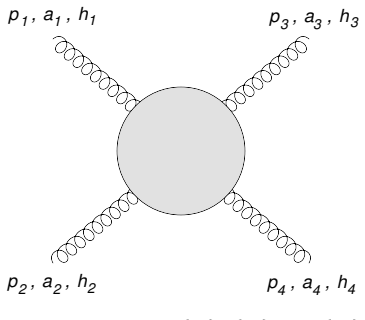
The quantum property of non-stabiliserness, also known as magic, plays a key role in designing quantum computing systems. How to produce, manipulate and enhance magic remains mysterious, such that concrete examples of physical systems that manifest magic behaviour are sought after. In this paper, we study two-particle scattering of gluons and gravitons in Yang--Mills theory and General Relativity, as well as their supersymmetric extensions. This provides an interesting case of two-qubit systems, differing only in the physical spin of the qubits. We show that magic is generically produced in both theories, and also show that magic typically decreases as the spin of the qubits increases. The maximal magic in each case is found to be substantially less than the known upper bound. Differences in the profile of magic generation can be traced to the known physics of each theory, as manifested in relations between their respective scattering amplitudes. Our case study may provide useful insights into understanding magic in other systems.
Figures


Forward citations
Cited by 11 Pith papers
-
Qubit-qubit-qutrit quantum correlations in $H \to f \bar f V$
In h→τ^-τ^+ Z decays, the spin state is genuinely qubit-qubit-qutrit entangled almost everywhere, violates Bell inequalities throughout, and carries up to 1.95 bits of non-local magic.
-
Magic without a phase: phase-independent stabilizer R\'enyi entropy in gluon scattering
A phase-averaged stabilizer Rényi entropy is introduced for tree-level gluon scattering, with color-independent phase-independent magic that is larger in 3→2 than 2→2 and has a soft-limit lower bound in 2→3.
-
Quantum Information of Photon Pairs at Lepton Colliders
A factorization framework and two-qubit description allow photon pairs at lepton colliders to be treated as qubits for measuring Bell inequality violation, quantum discord, and nonstabilizerness using Belle data.
-
Automated computation of spin-density matrices and quantum observables for collider physics
An automated framework in MadGraph5_aMC@NLO computes tree-level production spin-density matrices and quantum observables for generic collider processes, with validation on ttbar and VV and new applications to multi-to...
-
High Energy Photon Polarimetry at Lepton Colliders: Quantum Information from Converted Photons
Converted photons in Belle II enable high-significance measurements of Bell nonlocality, discord, concurrence, magic and steerability for macroscopically separated GeV diphotons, provided opening-angle resolution reac...
-
Exclusive Scattering Channels from Entanglement Structure in Real-Time Simulations
Introduces an entanglement-based technique using Schmidt decompositions to isolate exclusive scattering channels in Matrix Product State simulations of quantum field theories, demonstrated for heavy particle detection...
-
Extracting a Toponium Signal at the LHC with Spin and Quantum Information Tools
Spin and quantum-information observables add only marginal statistical power beyond kinematic variables for isolating toponium in near-threshold top-pair events, but improve interpretability.
-
Entanglement, Yang-Mills, and the Scattering Matrix as an SU(N)-equivariant Kernel
SU(N) symmetry fixes the entangling power of 2→2 scattering: Yang-Mills adjoint scattering has a group-only entanglement maximum at 90° (3/4 for SU(2), ≈0.91 for SU(3)), and maximal-entanglement preservation selects t...
-
Correlation is magic in electronic structure Hamiltonians
For weakly- and moderately-correlated molecular Hamiltonians, 2-stabilizer Renyi entropy of ground states scales linearly with both Hartree-Fock overlap and recovered correlation energy, with the link holding under co...
-
Quantum Resources and Wigner Symmetry in Nucleon-Nucleon Scattering from Effective Field Theory
Under Wigner's SU(4) symmetry the neutron-proton scattering amplitude generates no new quantum resources while same-nucleon channels do due to identical-particle constraints.
-
Gauge and diffeomorphism invariance from quantum information principles
Within a one-parameter family of quartic-vertex deformations, the gauge- and diffeomorphism-invariant interactions are the only points combining maximal entanglement with minimal nonzero magic.
Reference graph
Works this paper leans on
-
[1]
M. A. Nielsen and I. L. Chuang,Quantum Computation and Quantum Information. Cambridge University Press, 6, 2012
2012
-
[2]
Entanglement and quantum tomography with top quarks at the LHC,
Y. Afik and J. R. M. n. de Nova, “Entanglement and quantum tomography with top quarks at the LHC,”Eur. Phys. J. Plus136 (2021), no. 9, 907,2003.02280
Pith/arXiv arXiv 2021
-
[3]
When the Machine Chimes the Bell: Entanglement and Bell Inequalities with Boostedt¯t,
Z. Dong, D. Gonçalves, K. Kong, and A. Navarro, “When the Machine Chimes the Bell: Entanglement and Bell Inequalities with Boostedt¯t,” 2305.07075
-
[4]
Quantum SMEFT tomography: Top quark pair production at the LHC,
R. Aoude, E. Madge, F. Maltoni, and L. Mantani, “Quantum SMEFT tomography: Top quark pair production at the LHC,”Phys. Rev. D106 (2022), no. 5, 055007,2203.05619
Pith/arXiv arXiv 2022
-
[5]
Testing Bell Inequalities at the LHC with Top-Quark Pairs,
M. Fabbrichesi, R. Floreanini, and G. Panizzo, “Testing Bell Inequalities at the LHC with Top-Quark Pairs,”Phys. Rev. Lett.127 (2021), no. 16, 161801,2102.11883
Pith/arXiv arXiv 2021
-
[6]
Quantum tops at the LHC: from entanglement to Bell inequalities,
C. Severi, C. D. E. Boschi, F. Maltoni, and M. Sioli, “Quantum tops at the LHC: from entanglement to Bell inequalities,”Eur. Phys. J. C82 (2022), no. 4, 285,2110.10112
Pith/arXiv arXiv 2022
-
[7]
Quantum information with top quarks in QCD,
Y. Afik and J. R. M. n. de Nova, “Quantum information with top quarks in QCD,”Quantum 6 (2022) 820, 2203.05582
Pith/arXiv arXiv 2022
-
[8]
Improved tests of entanglement and Bell inequalities with LHC tops,
J. A. Aguilar-Saavedra and J. A. Casas, “Improved tests of entanglement and Bell inequalities with LHC tops,”Eur. Phys. J. C82 (2022), no. 8, 666,2205.00542
Pith/arXiv arXiv 2022
-
[9]
Constraining new physics in entangled two-qubit systems: top-quark, tau-lepton and photon pairs,
M. Fabbrichesi, R. Floreanini, and E. Gabrielli, “Constraining new physics in entangled two-qubit systems: top-quark, tau-lepton and photon pairs,”Eur. Phys. J. C83 (2023), no. 2, 162, 2208.11723
Pith/arXiv arXiv 2023
-
[10]
Quantum Discord and Steering in Top Quarks at the LHC,
Y. Afik and J. R. M. n. de Nova, “Quantum Discord and Steering in Top Quarks at the LHC,” Phys. Rev. Lett.130 (2023), no. 22, 221801,2209.03969
Pith/arXiv arXiv 2023
-
[11]
Quantum entanglement and top spin correlations in SMEFT at higher orders,
C. Severi and E. Vryonidou, “Quantum entanglement and top spin correlations in SMEFT at higher orders,” JHEP 01 (2023) 148, 2210.09330
Pith/arXiv arXiv 2023
-
[12]
Postdecay quantum entanglement in top pair production,
J. A. Aguilar-Saavedra, “Postdecay quantum entanglement in top pair production,”Phys. Rev. D 108 (2023), no. 7, 076025,2307.06991
Pith/arXiv arXiv 2023
-
[13]
Quantum Entanglement and Bell Inequality Violation in Semi-Leptonic Top Decays,
T. Han, M. Low, and T. A. Wu, “Quantum Entanglement and Bell Inequality Violation in Semi-Leptonic Top Decays,”2310.17696
-
[14]
E. L. Simpson,A new spin on top-quark physics: using angular distributions to probe top-quark properties, and make the first observation of entanglement between quarks. PhD thesis, Glasgow U., 2024
2024
-
[15]
A closer look at post-decayt¯t entanglement,
J. A. Aguilar-Saavedra, “A closer look at post-decayt¯t entanglement,” Phys. Rev. D109 (2024), no. 9, 096027,2401.10988
Pith/arXiv arXiv 2024
-
[16]
Quantum tops at circular lepton colliders,
F. Maltoni, C. Severi, S. Tentori, and E. Vryonidou, “Quantum tops at circular lepton colliders,” 2404.08049. 21
-
[17]
Observation of quantum entanglement in top-quark pair production using pp collisions of √s = 13 TeV with the ATLAS detector,
A TLASCollaboration, “Observation of quantum entanglement in top-quark pair production using pp collisions of √s = 13 TeV with the ATLAS detector,”
-
[18]
Observation of quantum entanglement in top-quark pairs using the ATLAS detector,
A TLASCollaboration, G. Aadet al., “Observation of quantum entanglement in top-quark pairs using the ATLAS detector,”2311.07288
-
[19]
Probing entanglement in top quark production with the CMS detector,
CMS Collaboration, “Probing entanglement in top quark production with the CMS detector,”
-
[20]
Quantum entanglement and Bell inequality violation at colliders,
A. J. Barr, M. Fabbrichesi, R. Floreanini, E. Gabrielli, and L. Marzola, “Quantum entanglement and Bell inequality violation at colliders,”2402.07972
-
[21]
Testing locality at colliders via Bell’s inequality?,
S. A. Abel, M. Dittmar, and H. K. Dreiner, “Testing locality at colliders via Bell’s inequality?,” Phys. Lett. B280 (1992) 304–312
1992
-
[22]
S. A. Abel, H. K. Dreiner, R. Sengupta, and L. Ubaldi, “Colliders are Testing neither Locality via Bell’s Inequality nor Entanglement versus Non-Entanglement,”2507.15949
-
[23]
A critical appraisal of tests of locality and of entanglement versus non-entanglement at colliders,
P. Bechtle, C. Breuning, H. K. Dreiner, and C. Duhr, “A critical appraisal of tests of locality and of entanglement versus non-entanglement at colliders,”2507.15947
-
[24]
Addressing Local Realism through Bell Tests at Colliders,
M. Low, “Addressing Local Realism through Bell Tests at Colliders,”2508.10979
-
[25]
C. D. White and M. J. White, “Magic states of top quarks,”Phys. Rev. D110 (2024), no. 11, 116016, 2406.07321
Pith/arXiv arXiv 2024
-
[26]
Maximal Magic for Two-qubit States,
Q. Liu, I. Low, and Z. Yin, “Maximal Magic for Two-qubit States,”2502.17550
-
[27]
Quantum Magic in Quantum Electrodynamics,
Q. Liu, I. Low, and Z. Yin, “Quantum Magic in Quantum Electrodynamics,”2503.03098
-
[28]
The trace distance between density matrices, a nifty tool in new-physics searches,
M. Fabbrichesi, M. Low, and L. Marzola, “The trace distance between density matrices, a nifty tool in new-physics searches,”2501.03311
-
[29]
Observation of magic states of top quark pairs produced in proton-proton collisions at√s = 13 TeV,
CMS Collaboration, “Observation of magic states of top quark pairs produced in proton-proton collisions at√s = 13 TeV,”
-
[30]
Y. Afiket al., “Quantum Information meets High-Energy Physics: Input to the update of the European Strategy for Particle Physics,”2504.00086
-
[31]
Probing new physics in the top sector using quantum information,
R. Aoude, H. Banks, C. D. White, and M. J. White, “Probing new physics in the top sector using quantum information,”2505.12522
-
[32]
Bell-type inequalities for systems of relativistic vector bosons,
A. J. Barr, P. Caban, and J. Rembieliński, “Bell-type inequalities for systems of relativistic vector bosons,” Quantum 7 (2023) 1070, 2204.11063
Pith/arXiv arXiv 2023
-
[33]
R. Ashby-Pickering, A. J. Barr, and A. Wierzchucka, “Quantum state tomography, entanglement detection and Bell violation prospects in weak decays of massive particles,” JHEP 05 (2023) 020, 2209.13990
arXiv 2023
-
[34]
Testing entanglement and Bell inequalities inH → ZZ,
J. A. Aguilar-Saavedra, A. Bernal, J. A. Casas, and J. M. Moreno, “Testing entanglement and Bell inequalities inH → ZZ,” Phys. Rev. D107 (2023), no. 1, 016012,2209.13441. 22
Pith/arXiv arXiv 2023
-
[35]
Laboratory-frame tests of quantum entanglement inH → W W,
J. A. Aguilar-Saavedra, “Laboratory-frame tests of quantum entanglement inH → W W,” Phys. Rev. D107 (2023), no. 7, 076016,2209.14033
Pith/arXiv arXiv 2023
-
[36]
Isolating semi-leptonicH → W W∗ decays for Bell inequality tests,
F. Fabbri, J. Howarth, and T. Maurin, “Isolating semi-leptonicH → W W∗ decays for Bell inequality tests,”Eur. Phys. J. C84 (2024), no. 1, 20,2307.13783
Pith/arXiv arXiv 2024
-
[37]
Probing new physics through entanglement in diboson production,
R. Aoude, E. Madge, F. Maltoni, and L. Mantani, “Probing new physics through entanglement in diboson production,”JHEP 12 (2023) 017, 2307.09675
Pith/arXiv arXiv 2023
-
[38]
M. Fabbrichesi, R. Floreanini, E. Gabrielli, and L. Marzola, “Bell inequalities and quantum entanglement in weak gauge boson production at the LHC and future colliders,”Eur. Phys. J. C 83 (2023), no. 9, 823,2302.00683
Pith/arXiv arXiv 2023
-
[39]
Three-Body Entanglement in Particle Decays,
K. Sakurai and M. Spannowsky, “Three-Body Entanglement in Particle Decays,”Phys. Rev. Lett. 132 (2024), no. 15, 151602,2310.01477
Pith/arXiv arXiv 2024
-
[40]
Quantum state-channel duality for the calculation of Standard Model scattering amplitudes,
C. Altomonte and A. J. Barr, “Quantum state-channel duality for the calculation of Standard Model scattering amplitudes,”Phys. Lett. B847 (2023) 138303, 2312.02242
Pith/arXiv arXiv 2023
-
[41]
Entanglement and Bell nonlocality with bottom-quark pairs at hadron colliders,
Y. Afik, Y. Kats, J. R. M. n. de Nova, A. Soffer, and D. Uzan, “Entanglement and Bell nonlocality with bottom-quark pairs at hadron colliders,”2406.04402
-
[42]
Full quantum tomography of top quark decays,
J. A. Aguilar-Saavedra, “Full quantum tomography of top quark decays,”Phys. Lett. B855 (2024) 138849, 2402.14725
Pith/arXiv arXiv 2024
-
[43]
Tripartite entanglement inH → ZZ, W Wdecays,
J. A. Aguilar-Saavedra, “Tripartite entanglement inH → ZZ, W Wdecays,” Phys. Rev. D109 (2024), no. 11, 113004,2403.13942
Pith/arXiv arXiv 2024
-
[44]
An improved Bell-CHSH observable for gauge boson pairs,
R. Grabarczyk, “An improved Bell-CHSH observable for gauge boson pairs,”2410.18022
-
[45]
Tripartite entanglement and Bell non-locality in loop-induced Higgs boson decays,
R. A. Morales, “Tripartite entanglement and Bell non-locality in loop-induced Higgs boson decays,” Eur. Phys. J. C84 (2024), no. 6, 581,2403.18023
Pith/arXiv arXiv 2024
-
[46]
Prospects for quantum process tomography at high energies,
C. Altomonte, A. J. Barr, M. Eckstein, P. Horodecki, and K. Sakurai, “Prospects for quantum process tomography at high energies,”2412.01892
-
[47]
Measuring quantum discord at the LHC,
T. Han, M. Low, N. McGinnis, and S. Su, “Measuring quantum discord at the LHC,”JHEP 05 (2025) 081, 2412.21158
Pith/arXiv arXiv 2025
-
[48]
Quantum Tomography at Colliders: With or Without Decays,
K. Cheng, T. Han, and M. Low, “Quantum Tomography at Colliders: With or Without Decays,” 2410.08303
-
[49]
Looking into the quantum entanglement in H → ZZ ⋆ at LHC within SMEFT framework,
A. Subba, R. K. Singh, and R. M. Godbole, “Looking into the quantum entanglement in H → ZZ ⋆ at LHC within SMEFT framework,”2411.19171
-
[50]
On bipartite and tripartite entanglement at present and future particle colliders,
A. Subba and R. Rahaman, “On bipartite and tripartite entanglement at present and future particle colliders,” 2404.03292
-
[51]
Three-Body Non-Locality in Particle Decays,
P. Horodecki, K. Sakurai, A. S. Shaleena, and M. Spannowsky, “Three-Body Non-Locality in Particle Decays,” 2502.19470. 23
-
[52]
Quantum properties of H → V V∗: precise predictions in the SM and sensitivity to new physics,
M. Del Gratta, F. Fabbri, P. Lamba, F. Maltoni, and D. Pagani, “Quantum properties of H → V V∗: precise predictions in the SM and sensitivity to new physics,”2504.03841
-
[53]
Spin Correlations int¯t Production and Decay at the LHC in QCD Perturbation Theory,
P. Nason, E. Re, and L. Rottoli, “Spin Correlations int¯t Production and Decay at the LHC in QCD Perturbation Theory,”2505.00096
-
[54]
From angular coefficients to quantum observables: a phenomenological appraisal in di-boson systems,
M. Grossi, G. Pelliccioli, and A. Vicini, “From angular coefficients to quantum observables: a phenomenological appraisal in di-boson systems,”JHEP 12 (2024) 120, 2409.16731
Pith/arXiv arXiv 2024
-
[55]
K. Cheng and B. Yan, “Bell Inequality Violation of Light Quarks in Back-to-Back Dihadron Pair Production at Lepton Colliders,”2501.03321
-
[56]
Momentum-space entanglement and renormalization in quantum field theory,
V. Balasubramanian, M. B. McDermott, and M. Van Raamsdonk, “Momentum-space entanglement and renormalization in quantum field theory,”Phys. Rev. D86 (2012) 045014, 1108.3568
Pith/arXiv arXiv 2012
-
[57]
Variation of Entanglement Entropy in Scattering Process,
S. Seki, I. Y. Park, and S.-J. Sin, “Variation of Entanglement Entropy in Scattering Process,” Phys. Lett. B743 (2015) 147–153, 1412.7894
Pith/arXiv arXiv 2015
-
[58]
Entanglement Entropy of Scattering Particles,
R. Peschanski and S. Seki, “Entanglement Entropy of Scattering Particles,”Phys. Lett. B758 (2016) 89–92, 1602.00720
Pith/arXiv arXiv 2016
-
[59]
Scattering and momentum space entanglement
G. Grignani and G. W. Semenoff, “Scattering and momentum space entanglement,”Phys. Lett. B 772 (2017) 699–702, 1612.08858
work page internal anchor Pith review Pith/arXiv arXiv 2017
-
[60]
Deep inelastic scattering as a probe of entanglement,
D. E. Kharzeev and E. M. Levin, “Deep inelastic scattering as a probe of entanglement,”Phys. Rev. D 95 (2017), no. 11, 114008,1702.03489
Pith/arXiv arXiv 2017
-
[61]
Variation of entanglement entropy and mutual information in fermion-fermion scattering,
J. Fan, Y. Deng, and Y.-C. Huang, “Variation of entanglement entropy and mutual information in fermion-fermion scattering,”Phys. Rev. D95 (2017), no. 6, 065017,1703.07911
Pith/arXiv arXiv 2017
-
[62]
Relativistic effect of entanglement in fermion-fermion scattering,
J. Fan and X. Li, “Relativistic effect of entanglement in fermion-fermion scattering,”Phys. Rev. D 97 (2018), no. 1, 016011,1712.06237
Pith/arXiv arXiv 2018
-
[63]
Maximal Entanglement in High Energy Physics,
A. Cervera-Lierta, J. I. Latorre, J. Rojo, and L. Rottoli, “Maximal Entanglement in High Energy Physics,”SciPost Phys. 3 (2017), no. 5, 036,1703.02989
Pith/arXiv arXiv 2017
-
[64]
Entanglement Suppression and Emergent Symmetries of Strong Interactions,
S. R. Beane, D. B. Kaplan, N. Klco, and M. J. Savage, “Entanglement Suppression and Emergent Symmetries of Strong Interactions,”Phys. Rev. Lett.122 (2019), no. 10, 102001, 1812.03138
Pith/arXiv arXiv 2019
-
[65]
Entanglement generation in (1+1)D QED scattering processes,
M. Rigobello, S. Notarnicola, G. Magnifico, and S. Montangero, “Entanglement generation in (1+1)D QED scattering processes,”Phys. Rev. D104 (2021), no. 11, 114501,2105.03445
Pith/arXiv arXiv 2021
-
[66]
Symmetry from entanglement suppression,
I. Low and T. Mehen, “Symmetry from entanglement suppression,”Phys. Rev. D104 (2021), no. 7, 074014,2104.10835
Pith/arXiv arXiv 2021
-
[67]
Minimal entanglement and emergent symmetries in low-energy QCD,
Q. Liu, I. Low, and T. Mehen, “Minimal entanglement and emergent symmetries in low-energy QCD,” Phys. Rev. C107 (2023), no. 2, 025204,2210.12085
Pith/arXiv arXiv 2023
-
[68]
Tree-level entanglement in quantum electrodynamics,
S. Fedida and A. Serafini, “Tree-level entanglement in quantum electrodynamics,”Phys. Rev. D 107 (2023), no. 11, 116007,2209.01405. 24
Pith/arXiv arXiv 2023
-
[69]
Entropy growth in perturbative scattering,
C. Cheung, T. He, and A. Sivaramakrishnan, “Entropy growth in perturbative scattering,” Phys. Rev. D108 (2023), no. 4, 045013,2304.13052
Pith/arXiv arXiv 2023
-
[70]
Entanglement suppression, enhanced symmetry, and a standard-model-like Higgs boson,
M. Carena, I. Low, C. E. M. Wagner, and M.-L. Xiao, “Entanglement suppression, enhanced symmetry, and a standard-model-like Higgs boson,”Phys. Rev. D109 (2024), no. 5, L051901, 2307.08112
Pith/arXiv arXiv 2024
-
[71]
Positivity in Amplitudes from Quantum Entanglement,
R. Aoude, G. Elor, G. N. Remmen, and O. Sumensari, “Positivity in Amplitudes from Quantum Entanglement,” 2402.16956
-
[72]
An Area Law for Entanglement Entropy in Particle Scattering,
I. Low and Z. Yin, “An Area Law for Entanglement Entropy in Particle Scattering,” 2405.08056
-
[73]
Elastic cross section is entanglement entropy,
I. Low and Z. Yin, “Elastic cross section is entanglement entropy,”Phys. Rev. D111 (2025), no. 6, 065027,2410.22414
Pith/arXiv arXiv 2025
-
[74]
Flavor patterns of fundamental particles from quantum entanglement?,
J. Thaler and S. Trifinopoulos, “Flavor patterns of fundamental particles from quantum entanglement?,” Phys. Rev. D111 (2025), no. 5, 056021,2410.23343
Pith/arXiv arXiv 2025
-
[75]
Symmetry, entanglement, and theS-matrix,
N. McGinnis, “Symmetry, entanglement, and theS-matrix,” 2504.21079
-
[76]
Entanglement maximization and mirror symmetry in two-Higgs-doublet models,
M. Carena, G. Coloretti, W. Liu, M. Littmann, I. Low, and C. E. M. Wagner, “Entanglement maximization and mirror symmetry in two-Higgs-doublet models,”JHEP 08 (2025) 016, 2505.00873
Pith/arXiv arXiv 2025
-
[77]
Scattering entanglement entropy and its implications for electroweak phase transitions,
J. Liu, M. Tanaka, X.-P. Wang, J.-J. Zhang, and Z. Zheng, “Scattering entanglement entropy and its implications for electroweak phase transitions,”Phys. Rev. D112 (2025), no. 1, 015028, 2505.06001
arXiv 2025
-
[78]
Entanglement Suppression, Quantum Statistics and Symmetries in Spin-3/2 Baryon Scatterings,
T.-R. Hu, K. Sone, F.-K. Guo, T. Hyodo, and I. Low, “Entanglement Suppression, Quantum Statistics and Symmetries in Spin-3/2 Baryon Scatterings,”2506.08960
-
[79]
Entanglement features from heavy particle scattering,
C. M. Sou, Y. Wang, and X. Zhang, “Entanglement features from heavy particle scattering,” 2507.03555
-
[80]
Lower bounds on the non-clifford resources for quantum computations,
M. Beverland, E. Campbell, M. Howard, and V. Kliuchnikov, “Lower bounds on the non-clifford resources for quantum computations,”Quantum Science and Technology5 (may,
This paper was first reviewed by deepseek-v4-flash on August 5, 2026.
discussion (0)
Sign in with ORCID, Apple, or X to comment. Anyone can read and Pith papers without signing in.