REVIEW 3 major objections 5 minor 21 cited by
Oscillating scalar fields and the Hubble tension: a resolution with novel signatures
T0 review · 3 major / 5 minor · reviewed 2026-08-14 · deepseek-v4-flash
Pith's one-line read A scalar field that peaks at about 10% of cosmic energy near matter-radiation equality can resolve the Hubble tension, the paper argues, and predicts detectable signatures in CMB polarization and in the field's own perturbations.
desk verdict The paper that made early dark energy the default explanation to beat for the Hubble tension; rigorous and honest, with the caveat that the fit is SH0ES-dependent and quietly assumes r≲5e-3. read the letter →
The pith
A machine-rendered reading of the paper's core claim, the machinery that carries it, and where it could break.
The reading
What carries the argument
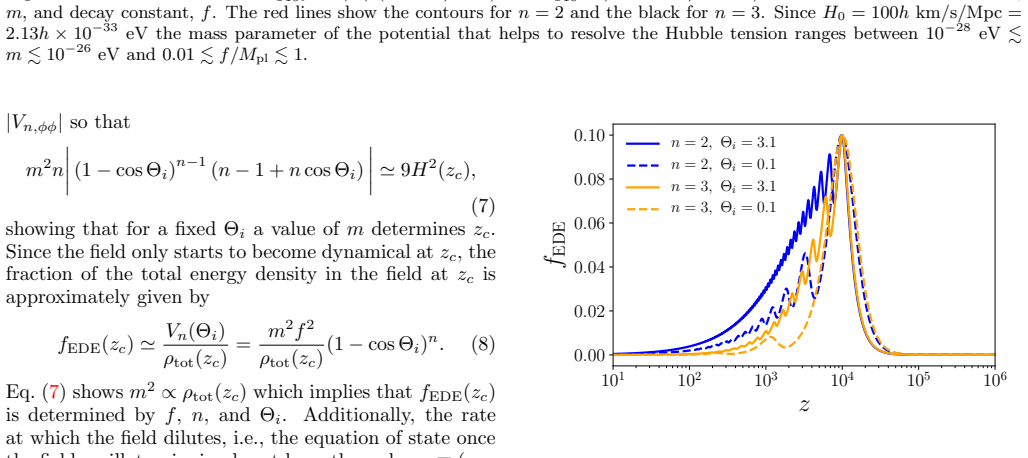
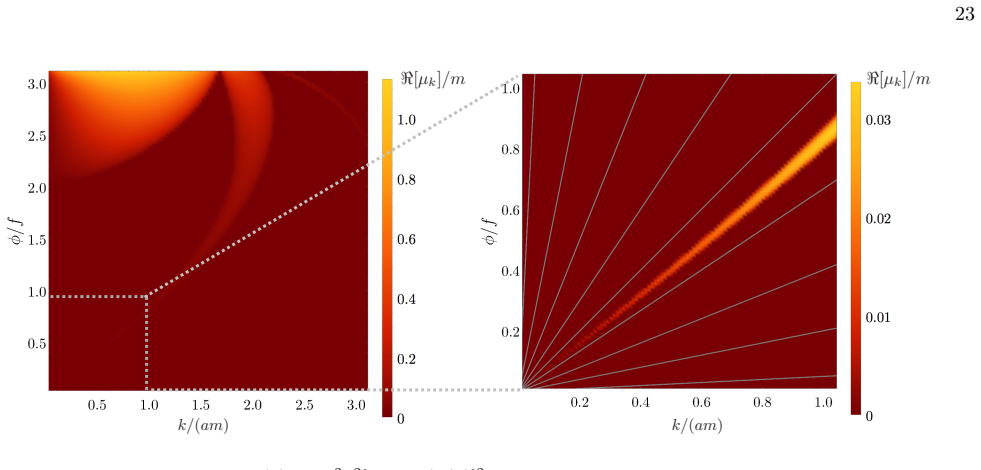
The load-bearing object is the anharmonic oscillating scalar field itself, implemented without fluid approximations through the linearized Klein-Gordon equation $\delta\varphi''_k + 2\mathcal{H}\delta\varphi'_k + [k^2+a^2V_{,\varphi\varphi}]\delta\varphi_k = -h'\varphi'/2$. The key mechanism is Hubble friction freezing the field until its effective mass $|V_{,\varphi\varphi}|^{1/2}$ drops to about $3H$, after which it oscillates; the oscillation determines both the background dilution, $w_\phi=(n-1)/(n+1)$, and, through the effective sound speed $c_s^2=[2(n-1)\varpi^2 a^2+k^2]/[2(n+1)\varpi^2 a^2+k^2]$, the perturbation evolution that Planck polarization constrains. The parameter $\Theta_i=\phi_i/f$ controls the flattening of the potential at large displacement and hence how many sub-horizon modes have $c_s^2<0.9$, which is what makes the model fit the CMB. For $n\approx2$, the oscillating background acts as a periodic pump, producing a narrow resonance band in wavenumber that stays frozen for a given co-moving mode, leading to exponential growth and nonlinearity.
What would settle it
Measure the local expansion rate with a Cepheid-independent method that is accurate to better than 1 km/s/Mpc: if the true value is near 69.8 km/s/Mpc, the SH0ES prior disappears and the EDE fraction should be consistent with zero in the combined fit. Conversely, CMB-S4 can search for the predicted scale-localized E-mode polarization deviations at multipoles $50\lesssim\ell\lesssim1000$, whose absence would rule out the scenario.
Extended reading notes
Core claim
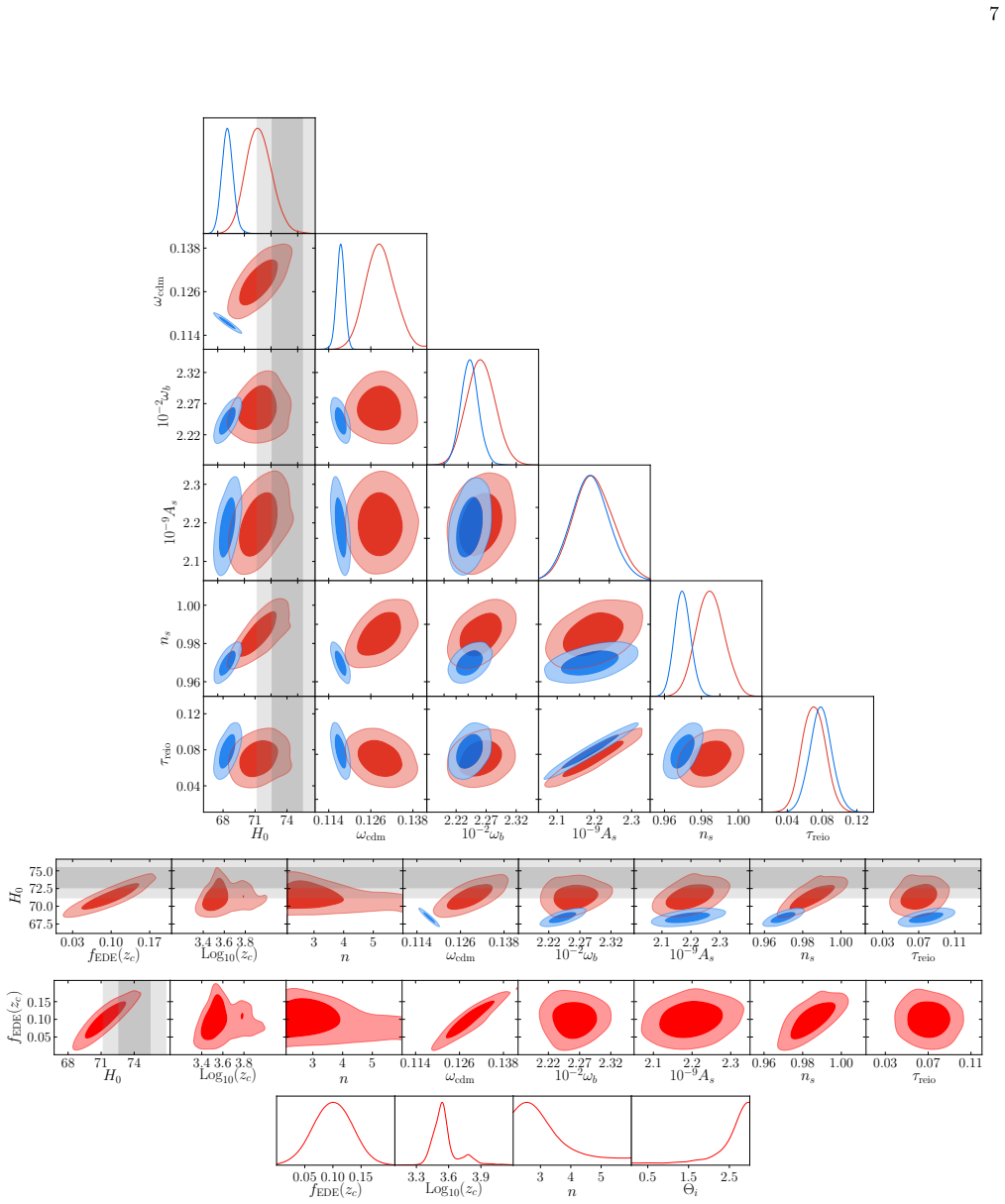
The central claim is that an oscillating scalar field with potential $V_n(\phi)=m^2f^2[1-\cos(\phi/f)]^n$ can resolve the Hubble tension when it is frozen until $\log_{10} z_c \sim 3.5$, peaks at $f_{\rm EDE}(z_c)\sim 0.10$, and then dilutes with equation of state $w_\phi=(n-1)/(n+1)$, faster than matter. With Planck temperature and polarization, lensing, BAO, Pantheon, and SH0ES data, the field is preferred at about $3.5\sigma$, with $n=3.16^{+0.18}_{-1.16}$, $\log_{10} z_c = 3.56$, $f_{\rm EDE}=0.103$, and a large initial displacement $\Theta_i\simeq2.5$; the SH0ES $\chi^2$ improves by about 15 while the Planck fit is essentially unchanged. The same analysis shows that Planck data alone cannot distinguish the EDE from $\Lambda$CDM because of a sampling-volume degeneracy, whereas mock CMB-S4 data would detect the field at very high significance through $E$-mode polarization. The paper also identifies two signatures: isocurvature modes whose amplitude is set by the tensor-to-scalar ratio $r$, and parametric self-resonance in the $n\approx2$ case that can make field perturbations nonlinear and spatially inhomogeneous.
Load-bearing premise
The load-bearing premise is that the Hubble tension is a genuine cosmological mismatch rather than a systematic error in the Cepheid-calibrated distance ladder; the paper only argues for EDE when the SH0ES value is included as a prior.
Editorial extensions
If this is right
- If the model is correct, the CMB-inferred $H_0$ shifts to about 71.5 km/s/Mpc, bringing early- and late-universe probes into agreement without degrading the Planck fit (total $\Delta\chi^2 \simeq -20$).
- Planck polarization constrains $\Theta_i$ to be large (excluding $\Theta_i < 1.8$ at 95% C.L.), predicting scale-localized residuals in the $TE$ and $EE$ power spectra around multipoles $50\lesssim \ell \lesssim 1000$.
- CMB-S4 would detect the EDE at roughly $10\sigma$ from $E$-mode polarization alone, independently of SH0ES, providing a decisive consistency test.
- The scenario predicts a modest upward shift in $S_8$, increasing the $S_8$ tension with KiDS from about $2.3\sigma$ to $2.5\sigma$.
- If $r > 5\times 10^{-3}$, isocurvature perturbations from the EDE field would be visible in the CMB and could place constraints on the scenario.
Reading between the lines
- If the $n\approx2$ resonant growth turns nonlinear, the field's equation of state on those scales could approach $w\simeq1/3$, generating a stochastic gravitational-wave background and small-scale matter-power features that are not computed in this paper.
- The Planck-only degeneracy suggests that any future CMB experiment that sees the predicted polarization pattern will effectively be measuring the scalar-field potential shape directly, not just $H_0$.
- The same potential family could arise from a broad distribution of light axion-like fields, making EDE one member of a spectrum rather than a single tuned component; that connection is not developed in the paper.
- A decisive independent check is a local $H_0$ measurement with accuracy below 1 km/s/Mpc: if it lands near 69.8 km/s/Mpc, the statistical case for EDE weakens substantially, which the paper itself acknowledges.
Signed reviews
Editorial analysis
A structured set of objections, weighed in public.
Referee Report
Summary. This paper studies an oscillating scalar field with potential V_n(phi)=m^2 f^2 [1-cos(phi/f)]^n as an early-dark-energy (EDE) resolution of the Hubble tension. The authors implement the exact homogeneous and linearized perturbation equations in CLASS, run MCMC fits against Planck 2015 temperature, polarization and lensing, BAO, Pantheon supernovae, and the SH0ES H0 prior, and report that an EDE with fEDE(zc)~10%, log10(zc)~3.5, and n~3 brings these data into agreement while improving the total chi^2 by about 20 relative to LCDM. They further forecast that CMB-S4 can detect the EDE cosmology from CMB data alone, and they identify two new signatures: isocurvature perturbations whose amplitude is controlled by the tensor-to-scalar ratio r, and self-resonance of scalar-field perturbations for n~2 that can become nonlinear.
Significance. If the central claim holds, the paper is a significant contribution to the Hubble-tension literature: it goes beyond fluid approximations, provides per-dataset chi^2 tables, verifies analytic initial conditions and Floquet predictions against the Boltzmann code, and produces falsifiable forecasts for CMB-S4 and for isocurvature signatures. The treatment of the perturbation dynamics and the identification of the large-Theta_i preference from Planck polarization are substantive. However, the resolution is conditional in two important ways that the paper itself discloses: the statistical preference for EDE comes from fits that include the SH0ES prior, and the analysis assumes r <~ 5e-3 so that EDE-induced isocurvature perturbations are negligible. These conditionality statements are present in the text, but they are not reflected in the abstract's unqualified wording, and the isocurvature restriction is a load-bearing assumption that is not tested against current bounds.
major comments (3)
- [Sec. II B and Sec. IV A] The central MCMC claim is conditional on the assumption r <~ 5e-3, which is not sampled or constrained in the analysis. Eq. (16) and Fig. 13 show that the EDE isocurvature power is proportional to r and is exponentially amplified for the large Theta_i values preferred by the data (Table I, Theta_i ~ 2.6). With the current Planck 95% upper limit r < 0.056, an order of magnitude above the assumed threshold, most of the currently allowed r range would generate isocurvature power exceeding the ~10% cosmic-variance limit quoted in Sec. IV A, potentially ruling out the same EDE parameters that resolve the Hubble tension. Because the likelihood never includes the isocurvature sector, the reported Delta chi^2 and significance values (Tables II, V, VI) describe only the adiabatic sector. I request either that r be included in the Monte Carlo sampling with the Planck isocurvature likelihood, or that the authors derive and present the upper limit on r that the EDE+Planck fit implies, so that the final claim is not conditional on an untested inflationary parameter.
- [Sec. III B, Table I, and Sec. IV B] The reported 68% interval for the potential index, n = 3.16+0.18/-1.16 from Table I, has its lower edge at the prior boundary n=2, and the region n in [1,2] is excluded from the MCMC for computational tractability. At the same time, Sec. IV B and Appendix C demonstrate that for n ~ 2 the scalar-field perturbations undergo parametric self-resonance and become nonlinear, so the linearized CLASS treatment used for the constraints is not valid over part of the posterior support. The abstract's claim that 2 <~ n <~ 3.4 is preferred at 68% confidence therefore rests on a regime where the perturbation equations break down. Please either extend the analysis to n < 2 with a controlled approximation (for example the fluid approximation of Ref. [16], as the authors themselves suggest) or provide a quantitative demonstration that the regions where resonance/nonlinearity occur are excluded by the data, before quoting a lower bound on n.
- [Sec. III B and Sec. V] The statement in Sec. V that the EDE is 'indicated at ~3.5 sigma' is derived only from fits that include the SH0ES likelihood. Table II shows that the total Delta chi^2 of -20.3 is dominated by the SH0ES chi^2 dropping from 16.80 to 1.68, while the Planck chi^2 improves by only ~4. The authors explicitly do not present a Planck-only real-data MCMC because of the acknowledged sampling-volume issue (Sec. III B), and the synthetic Planck analysis in Sec. III D yields fEDE < 0.14 at 95% with Delta chi^2 = -7.8, i.e., consistent with no EDE at about 1 sigma. The statistical preference for EDE is thus a statement about the combined dataset conditional on the SH0ES prior, not about Planck data alone. The abstract and conclusions should state this conditioning more prominently, especially in the sentence 'can bring CMB, BAO, supernovae, and the SH0ES estimate of the Hubble constant into agreement.'
minor comments (5)
- [Sec. II A] The heading contains a typo: 'reivew' should be 'review'.
- [Sec. I] The introduction contains 'the the long-standing' and later 'the stadard six' in Sec. V; these should be corrected.
- [Fig. 14] The caption of Fig. 14 states that the shape and magnitude near n~2 'should be trusted only qualitatively.' Since this figure is used to motivate the special status of n=2 and the nonlinearity criterion, please provide a numerical verification or a convergence test for the integral in Eq. (C9) near n=2.
- [Sec. IV A, Eq. (16)] The expression P_phi(k)/P_zeta(k) = r (k/k0)^(-r/8-(1-n_s)) is stated without derivation or a direct reference; a one-line derivation or citation would help the reader understand the origin of the tilt terms.
- [Sec. III A] The analysis uses Planck 2015 likelihoods with a footnote stating that a baseline n=3 run was checked against the new Planck 2018 release. Given that the paper was completed in 2019, consider reporting the numerical result of that check or providing a reference where it is documented; as written, the claim is not auditable.
Circularity Check
No significant circularity: EDE parameters are fitted, not predicted; the new isocurvature and self-resonance signatures follow from independent physics and are checked against CLASS.
full rationale
The central EDE claim is a parameter fit, not a prediction: the MCMC samples {log10(zc), fEDE(zc), Θi, n} against CMB+BAO+SNe+SH0ES, so agreement with SH0ES is a fitted outcome. This is standard model selection, not circular reasoning, and the paper explicitly discloses that Planck alone cannot detect the EDE and that the preference is driven by the SH0ES likelihood. The predictive elements—the isocurvature amplitude set by the external tensor-to-scalar ratio r through Eq. (16), and the self-resonance growth derived from Floquet theory and verified in CLASS—do not reduce to the fitted EDE parameters. Self-citations to Refs. [12,16] are motivational and comparative; the background and linear perturbations are re-derived from the Klein-Gordon equation and implemented in a modified CLASS code, so the conclusions do not rest on an unverified self-citation chain. The disclosed limitations (implicit r≲5×10^-3, and breakdown of linear theory near n=2) are robustness caveats, not circular steps.
Assumptions & free parameters
free parameters (10)
- fEDE(zc) =
0.103 ± 0.035 (n free, best-fit 0.132); 0.107 ± 0.035 (n=3)
- log10(zc) =
3.558 (+0.053/-0.110) (n free); 3.568 (+0.056/-0.140) (n=3)
- Θi =
2.49 (+0.52/-0.01) (n free); 2.64 (+0.36/-0.04) (n=3)
- n =
3.16 (+0.18/-1.16), 95% C.L. n<5
- ωb =
0.02261 ± 0.00024 (n free)
- ωcdm =
0.1290 (+0.0041/-0.0045) (n free)
- 100θs =
1.04139 (+0.00041/-0.00036) (n free)
- 10^9 As =
2.196 ± 0.055 (n free)
- ns =
0.9853 (+0.0073/-0.0079) (n free)
- τreio =
0.070 ± 0.014 (n free)
assumptions (6)
- standard math Friedmann-Robertson-Walker background and general relativity
- standard math Linear scalar perturbation theory in synchronous gauge
- domain assumption Scalar field is initially homogeneous and isotropic, established before the end of inflation
- domain assumption Potential has the form V_n(φ)=m^2 f^2 [1-cos(φ/f)]^n with n in [2,6]
- domain assumption Spectator scalar field during inflation produces isocurvature perturbations with amplitude set by r
- domain assumption Neutrino sector: two massless plus one massive species with Mν=0.06 eV
invented entities (1)
-
Oscillating scalar field (early dark energy) with potential V_n(φ)=m^2 f^2 [1-cos(φ/f)]^n
Cite this review
Pith. "Pith review of Oscillating scalar fields and the Hubble tension: a resolution with novel signatures." pith.science (2026). https://pith.science/paper/GF6SFNEB
@misc{pith2026190806995,
  author       = {Pith},
  title        = {Pith review of: Oscillating scalar fields and the Hubble tension: a resolution with novel signatures},
  year         = {2026},
  howpublished = {\url{https://pith.science/paper/GF6SFNEB}},
  note         = {Machine review of arXiv:1908.06995}
}
abstract
We present a detailed investigation of a sub-dominant oscillating scalar field ('early dark energy', EDE) in the context of resolving the Hubble tension. Consistent with earlier work, but without relying on fluid approximations, we find that a scalar field frozen due to Hubble friction until ${\rm log}_{10}(z_c)\sim3.5$, reaching $\rho_{\rm EDE}(z_c)/\rho_{\rm tot}\sim10$%, and diluting faster than matter afterwards can bring cosmic microwave background (CMB), baryonic acoustic oscillations, supernovae luminosity distances, and the late-time estimate of the Hubble constant from the SH0ES collaboration into agreement. A scalar field potential which scales as $V(\phi) \propto \phi^{2n}$ with $2\lesssim n\lesssim 3.4$ around the minimum is preferred at the 68% confidence level, and the {\em Planck} polarization places additional constraints on the dynamics of perturbations in the scalar field. In particular, the data prefers a potential which flattens at large field displacements. An MCMC analysis of mock data shows that the next-generation CMB observations (i.e., CMB-S4) can unambiguously detect the presence of the EDE at very high significance. This projected sensitivity to the EDE dynamics is mainly driven by improved measurements of the $E$-mode polarization. We also explore new observational signatures of EDE scalar field dynamics: (i) We find that depending on the strength of the tensor-to-scalar ratio, the presence of the EDE might imply the existence of isocurvature perturbations in the CMB. (ii) We show that a strikingly rapid, scale-dependent growth of EDE field perturbations can result from parametric resonance driven by the anharmonic oscillating field for $n\approx 2$. This instability and ensuing potentially nonlinear, spatially inhomogenoues, dynamics may provide unique signatures of this scenario.
Figures

Figures from the paper (19 more)




Forward citations
Cited by 21 Pith papers
-
Fuzzy Axions and Associated Relics
In explicit string theory compactifications, fuzzy axion dark matter is rare and typically requires fine-tuning of initial axion displacements or a non-standard reheating epoch to avoid overproducing heavier axions.
-
CAMB v2: cosmological power spectra for high-precision surveys
CAMB v2's default settings produce lensed CMB and matter power spectra converged to 10^-3 over survey-relevant scales, using a new flat-Bessel mapping for hyperspherical Bessel functions.
-
Hubble tension: the shape wall
Late-time modifications to the expansion history can raise H0 by at most about 2% (conservative) to 3.7% (permissive) if the CMB acoustic scale is fixed.
-
Cosmological Evidence for Dark Axion-Dark Baryon Interactions from Apparent Phantom Crossing
Dark axion–dark baryon interactions improve the fit to CMB+DESI+SNe by Δχ²=-14.5 over ΛCDM, via a non-monotonic dark-matter mass that mimics phantom crossing, while leaving the Hubble tension unresolved.
-
The $H_0$ world cup. II. A comprehensive competition between proposed Hubble tension solutions
Against a common 2025-26 dataset (Planck PR4, ACT DR6, SPT-3G, DESI DR2, Pantheon+), early dark energy and early modified gravity models win the H0 competition (~3σ residual tension), while radiation and late-time sol...
-
A sound horizon independent measurement of $H_0$ from BOSS, DESI and DES Y3
Combining BOSS power spectrum and bispectrum with DESI and DES lensing data yields a sound-horizon-free H0 = 70.2 ± 2.3 km/s/Mpc, with a 1.8σ BAO scale deviation that is scale-cut dependent.
-
Impact of ACT DR6 and DESI DR2 for Early Dark Energy and the Hubble tension
With ACT DR6 and DESI DR2, early dark energy still reconciles CMB and local Hubble measurements to about 2 sigma, and a profile likelihood shows prior-volume effects in Bayesian limits.
-
$\Lambda$CDM and early dark energy in latent space: a data-driven parametrization of the CMB temperature power spectrum
A variational autoencoder compresses CMB temperature spectra into 5 (LambdaCDM) or 8 (with early dark energy) latent parameters that reconstruct the data within Planck errors and can be constrained with Planck observations.
-
Free streaming of warm wave dark matter in modified expansion histories
Warm wave dark matter free streaming can shift by up to roughly 40% in a very early dark energy cosmology, while early matter domination moves the signal to unobservably small scales.
-
General parametrization for energy density of quintessence field
A step-like parametrization of quintessence energy density reproduces all three known dark energy dynamics across redshifts, but cosmological data still prefer ΛCDM except in the CPL model.
-
Atomic Dark Matter, Interacting Dark Radiation, and the Hubble Tension
nuADaM, a model of atomic dark matter plus self-interacting dark radiation, improves cosmological fits and raises the inferred Hubble constant to about 72.6 km/s/Mpc.
-
hi_class: Background Evolution, Initial Conditions and Approximation Schemes
hi_class now evolves the background from covariant Horndeski Lagrangians, provides consistent radiation-era initial conditions for scalar perturbations, and applies a quasi-static approximation automatically where it is safe.
-
The Hubble Hunter's Guide
The least unlikely fixes to the Hubble tension raise the expansion rate in the decade before recombination, and these fixes generically leave oscillatory residuals in CMB spectra that resemble Planck's A_L and matter-...
-
Background-level reconstruction of scalar-field potentials from dark-energy histories and comparison with analytic potential families
A background reconstruction maps prescribed ρ_de(z) histories to V(φ) and ranks analytic potentials by Bayesian evidence, with exponential preferred for CPL and shifted-tanh for sign-switching targets.
-
The $H_0$ World Cup. I. Summary of the baseline group stage results
In a systematic head-to-head analysis, early dark energy and early modified gravity models reduce the Hubble tension to about 3σ and are favored over ΛCDM, while radiation and late-time alternatives are not.
-
Can the universe experience an AdS landscape since matter-radiation equality?
A universe with an AdS (negative cosmological constant) phase at recombination and another at low redshift is compatible with Planck, DESI, Pantheon Plus and SH0ES data, though not preferred by them.
-
Can the sound horizon-free measurement of $H_0$ constrain early new physics?
Mock galaxy-survey analyses show that sound-horizon-free H0 measurements do not currently rule out BAO-compatible early dark energy models, and LambdaCDM-derived priors can bias the result.
-
Hubble tension: a short review of theoretical explanations
A comprehensive review finds no theoretical Hubble-tension solution yet passes all consistency tests; new early-dark-energy chains reach high H0 only when the SH0ES calibration is added.
-
Imprint of swampland-inspired coupled early dark energy
A swampland-inspired DM-EDE coupling is tested against DESI DR2 BAO data, showing the EDE potential construction affects late-time dark energy constraints.
-
The Hubble tension: A decade review
Pure early or late fixes to the Hubble tension are tightly constrained; remaining options are combined early-late interacting dark energy or new physics at the local-to-homogeneous transition.
-
Ultralight fuzzy dark matter review
A review of fuzzy dark matter that surveys the models, wave phenomenology, numerical methods, and current observational mass constraints of ultralight dark matter.
Reference graph
Works this paper leans on
- [16]
-
[1]
Instead, the small-scale polarization measurements place a tight constraint on the initial field displacement, Θi
Temperature-vs-polarization data Relative to several previous attempts at resolving the Hubble tension the EDE scenario presented here is not degraded when we add the small-scale Planck polariza- tion measurements. Instead, the small-scale polarization measurements place a tight constraint on the initial field displacement, Θi. Here we explore this in deta...
-
[2]
First, as is demonstrated in Fig
The preference for a large initial field displacement The initial field value, Θi, has two main effects on the EDE phenomenology. First, as is demonstrated in Fig. 2, at fixed zc andfEDE(zc) the initial field value affects the asymmetry in the rise and fall of the fractional energy density contained within the EDE. In particular, smaller values of m and f requi...
-
[3]
Parametric resonance preliminaries Parametric resonance occurs when the effective fre- quency of a harmonic oscillator varies at such a rate so as to pump energy into the oscillation. The phenomena is well-known by anyone who has been on a swing: as we pump our legs we change the moment of inertia of the pendulum and if we pump at the right rate we can in-...
-
[4]
S8 tension
A CLASS comparison Using our modified version of CLASS, which includes the effects from self-resonance in the φ field as well as gravitational effects from other components, we can check our analytic estimates for the resonant wavenumbers as well as growth-rate of perturbations. First, we have con- firmed that for n & 2 (but not too close to n = 2), the pertur...
2019
-
[5]
A detailed instability analysis of parametric resonance in power law potentials Vn∝ φ2n in an expanding uni- verse was carried out in Ref
Analytic approximations, general n. A detailed instability analysis of parametric resonance in power law potentials Vn∝ φ2n in an expanding uni- verse was carried out in Ref. [19] 9. In that work, the Floquet exponents as a function of wavenumber and am- plitude were provided for differentn. We quote the main results necessary here without re-deriving them...
-
[6]
flow-lines
n = 2 case and Floquet charts We have performed an analysis for the n = 2 case for two reasons. First, the growth of perturbations due to parametric resonance discussed in Sec. IV B is strongest in this case. Second, this case is particularly compelling, given that the field evolves with a potential V = λφ4/4 around its minimum, which has been well studied...
-
[7]
Current constraints to n = 2 We perform the same analysis as in Sec. III C and run a MCMC analysis with flat priors on {ωb,ω cdm,θs,As,ns,τ reio,f EDE(zc), log10(zc), Θi} and setting n = 2. We include all previously mentioned datasets and compare the use of high- 𝓁 TT and TT,TE,EE data. Our results are reported in Table VII together with the ∆χ2 min. We sh...
Show all 89 references
-
[8]
W. L. Freedman, Nat. Astron. 1, 0121 (2017), arXiv:1706.02739 [astro-ph.CO]
2017 arXiv
-
[9]
A. G. Riess, S. Casertano, W. Yuan, L. M. Macri, and D. Scolnic, (2019), arXiv:1903.07603 [astro-ph.CO]
2019 arXiv
- [10]
-
[11]
T. M. C. Abbott et al. (DES), Mon. Not. Roy. Astron. Soc. 480, 3879 (2018), arXiv:1711.00403 [astro-ph.CO]
2018 arXiv
-
[12]
K. C. Wong et al. , (2019), arXiv:1907.04869 [astro- ph.CO]
2019 arXiv
- [13]
- [14]
-
[15]
J. L. Bernal, L. Verde, and A. G. Riess, JCAP 1610, 019 (2016), arXiv:1607.05617 [astro-ph.CO]
2016 arXiv
-
[17]
Aylor, M
K. Aylor, M. Joy, L. Knox, M. Millea, S. Raghunathan, and W. L. K. Wu, (2018), arXiv:1811.00537 [astro- ph.CO]
2018 arXiv
-
[18]
M.-X. Lin, M. Raveri, and W. Hu, (2018), arXiv:1810.02333 [astro-ph.CO]
2018 arXiv
-
[19]
Poulin, T
V. Poulin, T. L. Smith, T. Karwal, and M. Kamionkowski, Phys. Rev. Lett. 122, 221301 (2019), arXiv:1811.04083 [astro-ph.CO]
2019 arXiv
-
[20]
C. D. Kreisch, F.-Y. Cyr-Racine, and O. Dor´ e, (2019), arXiv:1902.00534 [astro-ph.CO]
2019 arXiv
-
[21]
M.-X. Lin, G. Benevento, W. Hu, and M. Raveri, (2019), arXiv:1905.12618 [astro-ph.CO]
2019 arXiv
-
[22]
Karwal and M
T. Karwal and M. Kamionkowski, Phys. Rev. D94, 103523 (2016), arXiv:1608.01309 [astro-ph.CO]
2016 arXiv
-
[23]
Poulin, T
V. Poulin, T. L. Smith, D. Grin, T. Karwal, and M. Kamionkowski, Phys. Rev. D98, 083525 (2018), arXiv:1806.10608 [astro-ph.CO]
2018 arXiv
-
[24]
M. S. Turner, Phys. Rev. D28, 1243 (1983)
1983
-
[25]
Agrawal, F.-Y
P. Agrawal, F.-Y. Cyr-Racine, D. Pinner, and L. Ran- dall, (2019), arXiv:1904.01016 [astro-ph.CO]
2019 arXiv
-
[26]
K. D. Lozanov and M. A. Amin, Phys. Rev. D97, 023533 (2018), arXiv:1710.06851 [astro-ph.CO]
2018 arXiv
-
[27]
Rigault et al
M. Rigault et al. , Astrophys. J. 802, 20 (2015), arXiv:1412.6501 [astro-ph.CO]
2015 arXiv
-
[28]
Rigault et al
M. Rigault et al. (Nearby Supernova Factory), (2018), arXiv:1806.03849 [astro-ph.CO]
2018 arXiv
-
[29]
D. O. Jones et al. , Astrophys. J. 867, 108 (2018), arXiv:1805.05911 [astro-ph.CO]
2018 arXiv
-
[30]
B. M. Rose, P. M. Garnavich, and M. A. Berg, Astro- phys. J. 874, 32 (2019), arXiv:1902.01433 [astro-ph.CO]
2019 arXiv
-
[31]
W. Yuan, A. G. Riess, L. M. Macri, S. Casertano, and D. Scolnic, (2019), arXiv:1908.00993 [astro-ph.GA]
2019 arXiv
-
[32]
Taubenberger, S
S. Taubenberger, S. H. Suyu, E. Komatsu, I. Jee, S. Bir- rer, V. Bonvin, F. Courbin, C. E. Rusu, A. J. Shajib, and K. C. Wong, (2019), arXiv:1905.12496 [astro-ph.CO]
2019 arXiv
-
[33]
Collett, F
T. Collett, F. Montanari, and S. Rasanen, (2019), arXiv:1905.09781 [astro-ph.CO]
2019 arXiv
-
[34]
B. F. Schutz, Nature 323, 310 (1986)
1986
-
[35]
D. E. Holz and S. A. Hughes, Astrophys. J. 629, 15 (2005), arXiv:astro-ph/0504616 [astro-ph]
2005 arXiv
-
[36]
B. P. Abbott et al. (LIGO Scientific, Virgo, 1M2H, Dark Energy Camera GW-E, DES, DLT40, Las Cum- bres Observatory, VINROUGE, MASTER), Nature551, 25 3.3 3.5 3.7 Log10(zc) 0.05 0.10 0.15 0.20 f (zc) 0.5 1.5 2.5 Θ i 68 71 75 H0 0.115 0.130 0.145 ωcdm TT TT, TE, EE Figure 22. 2D po...
2017 arXiv
-
[37]
D. J. Mortlock, S. M. Feeney, H. V. Peiris, A. R. Williamson, and S. M. Nissanke, (2018), arXiv:1811.11723 [astro-ph.CO]
2018 arXiv
-
[38]
Arvanitaki, S
A. Arvanitaki, S. Dimopoulos, S. Dubovsky, N. Kaloper, and J. March-Russell, Phys. Rev. D81, 123530 (2010), arXiv:0905.4720 [hep-th]
2010 arXiv
-
[39]
D. J. E. Marsh, Phys. Rept. 643, 1 (2016), arXiv:1510.07633 [astro-ph.CO]
2016 arXiv
-
[40]
Kappl, H
R. Kappl, H. P. Nilles, and M. W. Winkler, Phys. Lett. B753, 653 (2016), arXiv:1511.05560 [hep-th]
2016 arXiv
-
[41]
X. Dong, B. Horn, E. Silverstein, and A. Westphal, Phys. Rev. D84, 026011 (2011), arXiv:1011.4521 [hep-th]
2011 arXiv
- [42]
-
[43]
J. J. M. Carrasco, R. Kallosh, and A. Linde, JHEP 10, 147 (2015), arXiv:1506.01708 [hep-th]
2015 arXiv
-
[44]
Griest, Phys
K. Griest, Phys. Rev. D66, 123501 (2002), arXiv:astro- ph/0202052 [astro-ph]
2002
-
[45]
D. J. E. Marsh and P. G. Ferreira, Phys. Rev. D82, 103528 (2010), arXiv:1009.3501 [hep-ph]
2010 arXiv
-
[46]
Lesgourgues, (2011), arXiv:1104.2932 [astro-ph.IM]
J. Lesgourgues, (2011), arXiv:1104.2932 [astro-ph.IM]
2011 arXiv
-
[47]
D. Blas, J. Lesgourgues, and T. Tram, JCAP 1107, 034 (2011), arXiv:1104.2933 [astro-ph.CO]
2011 arXiv
-
[48]
Ratra and P
B. Ratra and P. J. E. Peebles, Phys. Rev. D37, 3406 (1988)
1988
-
[49]
A. R. Liddle and R. J. Scherrer, Phys. Rev. D59, 023509 (1999), arXiv:astro-ph/9809272 [astro-ph]
1999 arXiv
-
[50]
Hu, Astrophys
W. Hu, Astrophys. J. 506, 485 (1998), arXiv:astro- ph/9801234 [astro-ph]
1998
-
[51]
Ma and E
C.-P. Ma and E. Bertschinger, Astrophys. J. 455, 7 (1995), arXiv:astro-ph/9506072 [astro-ph]
1995 arXiv
-
[52]
Audren, J
B. Audren, J. Lesgourgues, K. Benabed, and S. Prunet, JCAP 1302, 001 (2013), arXiv:1210.7183 [astro-ph.CO]
2013 arXiv
-
[53]
Brinckmann and J
T. Brinckmann and J. Lesgourgues, (2018), arXiv:1804.07261 [astro-ph.CO]
2018 arXiv
-
[54]
Aguirre et al
J. Aguirre et al. (Simons Observatory), JCAP 1902, 056 (2019), arXiv:1808.07445 [astro-ph.CO]
2019 arXiv
-
[55]
Aghanim et al
N. Aghanim et al. (Planck), Astron. Astrophys.594, A11 (2016), arXiv:1507.02704 [astro-ph.CO]
2016 arXiv
-
[56]
Beutler, C
F. Beutler, C. Blake, M. Colless, D. H. Jones, L. Staveley- Smith, L. Campbell, Q. Parker, W. Saunders, and F. Watson, Mon. Not. Roy. Astron. Soc. 416, 3017 (2011), arXiv:1106.3366 [astro-ph.CO]
2011 arXiv
-
[57]
A. J. Ross, L. Samushia, C. Howlett, W. J. Percival, A. Burden, and M. Manera, Mon. Not. Roy. Astron. Soc. 449, 835 (2015), arXiv:1409.3242 [astro-ph.CO]
2015 arXiv
-
[58]
Alam et al
S. Alam et al. (BOSS), Mon. Not. Roy. Astron. Soc. 470, 2617 (2017), arXiv:1607.03155 [astro-ph.CO]
2017 arXiv
-
[59]
D. M. Scolnic et al. , Astrophys. J. 859, 101 (2018), arXiv:1710.00845 [astro-ph.CO]
2018 arXiv
- [60]
-
[61]
Gelman and D
A. Gelman and D. B. Rubin, Statist. Sci. 7, 457 (1992)
1992
-
[62]
W. Hu, R. Barkana, and A. Gruzinov, Phys. Rev. Lett. 85, 1158 (2000), arXiv:astro-ph/0003365 [astro-ph]
2000 arXiv
-
[63]
Hwang and H
J.-c. Hwang and H. Noh, Phys. Lett. B680, 1 (2009), arXiv:0902.4738 [astro-ph.CO]
2009 arXiv
-
[64]
Park, J.-c
C.-G. Park, J.-c. Hwang, and H. Noh, Phys. Rev. D86, 083535 (2012), arXiv:1207.3124 [astro-ph.CO]
2012 arXiv
-
[65]
Hlozek, D
R. Hlozek, D. Grin, D. J. E. Marsh, and P. G. Ferreira, Phys. Rev. D91, 103512 (2015), arXiv:1410.2896 [astro- ph.CO]
2015 arXiv
-
[66]
Noh, J.-c
H. Noh, J.-c. Hwang, and C.-G. Park, Astrophys. J. 846, 1 (2017), arXiv:1707.08568 [gr-qc]
2017 arXiv
-
[67]
M. C. Johnson and M. Kamionkowski, Phys. Rev. D78, 063010 (2008), arXiv:0805.1748 [astro-ph]
2008 arXiv
-
[68]
Aghanim et al
N. Aghanim et al. (Planck), Astron. Astrophys.607, A95 (2017), arXiv:1608.02487 [astro-ph.CO]
2017 arXiv
-
[69]
G. E. Addison, Y. Huang, D. J. Watts, C. L. Bennett, M. Halpern, G. Hinshaw, and J. L. Weiland, Astrophys. J. 818, 132 (2016), arXiv:1511.00055 [astro-ph.CO]
2016 arXiv
-
[70]
D. H. Lyth and D. Wands, Phys. Lett. B524, 5 (2002), arXiv:hep-ph/0110002 [hep-ph]
2002 arXiv
-
[71]
Kobayashi, F
T. Kobayashi, F. Takahashi, T. Takahashi, and M. Yam- aguchi, JCAP 1310, 042 (2013), arXiv:1303.6255 [astro- ph.CO]
2013 arXiv
-
[72]
Hlozek, D
R. Hlozek, D. J. E. Marsh, and D. Grin, Mon. Not. Roy. Astron. Soc. 476, 3063 (2018), arXiv:1708.05681 [astro- ph.CO]
2018 arXiv
- [73]
-
[74]
K. D. Lozanov and M. A. Amin, Phys. Rev. Lett. 119, 061301 (2017), arXiv:1608.01213 [astro-ph.CO]
2017 arXiv
-
[75]
M. A. Amin, P. Zukin, and E. Bertschinger, Phys. Rev. D85, 103510 (2012), arXiv:1108.1793 [astro-ph.CO]
2012 arXiv
-
[76]
M. A. Amin, M. P. Hertzberg, D. I. Kaiser, and J. Karouby, Int. J. Mod. Phys. D24, 1530003 (2014), arXiv:1410.3808 [hep-ph]
2014 arXiv
- [77]
- [78]
-
[79]
T. M. C. Abbott et al. (DES), Phys. Rev. D98, 043526 (2018), arXiv:1708.01530 [astro-ph.CO]
2018 arXiv
-
[80]
S. Yu. Khlebnikov and I. I. Tkachev, Phys. Rev. Lett. 77, 219 (1996), arXiv:hep-ph/9603378 [hep-ph]
1996 arXiv
-
[81]
M. A. Amin, R. Easther, H. Finkel, R. Flauger, and 26 M. P. Hertzberg, Phys. Rev. Lett. 108, 241302 (2012), arXiv:1106.3335 [astro-ph.CO]
2012 arXiv
-
[82]
K. D. Lozanov and M. A. Amin, Phys. Rev. D99, 123504 (2019), arXiv:1902.06736 [astro-ph.CO]
2019 arXiv
-
[83]
S. Y. Khlebnikov and I. I. Tkachev, Phys. Rev. D56, 653 (1997), arXiv:hep-ph/9701423 [hep-ph]
1997 arXiv
- [84]
-
[85]
Cicoli, M
M. Cicoli, M. Goodsell, and A. Ringwald, JHEP 10, 146 (2012), arXiv:1206.0819 [hep-th]
2012 arXiv
-
[86]
M. J. Stott, D. J. E. Marsh, C. Pongkitivanichkul, L. C. Price, and B. S. Acharya, Phys. Rev. D96, 083510 (2017), arXiv:1706.03236 [astro-ph.CO]
2017 arXiv
-
[87]
Kamionkowski, J
M. Kamionkowski, J. Pradler, and D. G. E. Walker, Phys. Rev. Lett. 113, 251302 (2014), arXiv:1409.0549 [hep-ph]
2014 arXiv
-
[88]
Ballesteros and J
G. Ballesteros and J. Lesgourgues, JCAP 1010, 014 (2010), arXiv:1004.5509 [astro-ph.CO]
2010 arXiv
-
[89]
P. B. Greene, L. Kofman, A. D. Linde, and A. A. Starobinsky, Phys. Rev. D56, 6175 (1997), arXiv:hep- ph/9705347 [hep-ph]
1997
Reviewed August 14, 2026 · model on record in the stance chip above.
Discussion (0). Continue with ORCID to comment.