Multiparameter Quantum Estimation and Degeneracy Structure in Three-Flavor Neutrino Oscillations
Pith reviewed 2026-06-30 05:13 UTC · model grok-4.3
The pith
Degenerate neutrino oscillation parameters can still produce distinguishable quantum states.
A machine-rendered reading of the paper's core claim, the machinery that carries it, and where it could break.
Core claim
Parameter degeneracies in neutrino oscillation probabilities do not necessarily imply indistinguishability of the underlying quantum states. By employing quantum fidelity and the QFIM, degenerate parameter sets can exhibit distinct quantum-information characteristics that remain hidden at the probability level, revealing quantum-state differences between probability-degenerate solutions.
What carries the argument
The quantum Fisher information matrix (QFIM) and the quantum fidelity between evolved neutrino states, which together quantify distinguishability of the full quantum state beyond what appears in the oscillation probability.
Load-bearing premise
The neutrino system is modeled as a quantum state whose distinguishability is fully captured by the quantum Fisher information matrix and fidelity, with no additional decoherence or environmental effects altering the mapping from parameters to states.
What would settle it
Finding two parameter sets that produce exactly the same oscillation probabilities yet also produce identical quantum fidelity values and identical QFIM spectra would falsify the claim that distinguishability survives at the quantum level.
Figures
read the original abstract
Achieving precision measurements of neutrino oscillation parameters and resolving parameter degeneracies remain central challenges in neutrino physics. This work presents a systematic investigation of three-flavor neutrino oscillations within the framework of quantum estimation theory using the quantum Fisher information matrix (QFIM). The behavior of all six independent elements of the QFIM associated with the parameters theta23, deltaCP, and Delta(m31)^2 is analyzed, and the impact of parameter correlations on the quantum Cram\'er-Rao bound is studied. Furthermore, we demonstrate that parameter degeneracies in neutrino oscillation probabilities do not necessarily imply indistinguishability of the underlying quantum states. By employing quantum fidelity and the QFIM, we show that degenerate parameter sets can exhibit distinct quantum-information characteristics that remain hidden at the probability level, revealing quantum-state differences between probability-degenerate solutions.
Editorial analysis
A structured set of objections, weighed in public.
Referee Report
Summary. The paper applies quantum estimation theory to three-flavor neutrino oscillations, computing all six independent elements of the QFIM for the parameters θ23, δCP, and Δm31² and examining their impact on the quantum Cramér-Rao bound. It further claims that parameter degeneracies appearing in the oscillation probability P(ν_η → ν_η'; L, E) do not imply indistinguishability of the underlying states, as shown by nonzero differences in quantum fidelity and in the QFIM elements between such degenerate solutions.
Significance. If the central distinction between probability-level degeneracy and quantum-state distinguishability survives scrutiny, the work supplies a concrete illustration that quantum-information quantities can resolve ambiguities invisible to classical likelihood analysis, which is potentially useful for designing future precision neutrino experiments.
major comments (1)
- [Abstract and §1] Abstract and §1 (model definition): the demonstration that probability-degenerate parameter sets produce distinct pure states with |⟨ψ(θ)|ψ(θ')⟩|² < 1 and differing QFIM entries rests on the ideal coherent evolution generated by the vacuum or constant-density Hamiltonian. The abstract explicitly states the model contains “no additional decoherence or environmental effects.” Any realistic wave-packet separation or stochastic matter-density fluctuations would replace the pure-state fidelity and QFIM with a mixed-state Helstrom bound or classical Fisher information computed from the same P, rendering the reported distinction conditional on an idealization whose domain of validity is not quantified.
minor comments (1)
- [Abstract] The abstract supplies no equations, numerical values, or error analysis, making it impossible to assess the magnitude of the fidelity or QFIM differences without the full derivations.
Simulated Author's Rebuttal
We thank the referee for the detailed and constructive report. We address the single major comment below.
read point-by-point responses
-
Referee: [Abstract and §1] Abstract and §1 (model definition): the demonstration that probability-degenerate parameter sets produce distinct pure states with |⟨ψ(θ)|ψ(θ')⟩|² < 1 and differing QFIM entries rests on the ideal coherent evolution generated by the vacuum or constant-density Hamiltonian. The abstract explicitly states the model contains “no additional decoherence or environmental effects.” Any realistic wave-packet separation or stochastic matter-density fluctuations would replace the pure-state fidelity and QFIM with a mixed-state Helstrom bound or classical Fisher information computed from the same P, rendering the reported distinction conditional on an idealization whose domain of validity is not quantified.
Authors: We agree that the analysis is performed under the ideal coherent pure-state evolution generated by the vacuum or constant-density Hamiltonian, as stated in the abstract. This idealization is standard in quantum estimation studies of neutrino oscillations to isolate the distinction between classical probability degeneracies and quantum-state distinguishability. We will revise the manuscript by adding a dedicated paragraph in the conclusions (and a brief clarifying sentence in §1) that explicitly states the domain of validity: the reported nonzero fidelity difference and QFIM distinctions hold in the coherent regime, which remains a good approximation for the baselines and energies where wave-packet separation is negligible. We acknowledge that realistic decoherence would require mixed-state bounds, but a quantitative mapping of that transition lies outside the present scope. revision: partial
Circularity Check
No circularity: standard QFIM/fidelity application to oscillation model is self-contained
full rationale
The paper applies the quantum Fisher information matrix and fidelity to the standard three-flavor neutrino oscillation Hamiltonian and probabilities. The central claim—that probability degeneracies need not imply state indistinguishability—follows directly from the definitions of these quantities under the pure-state evolution model stated in the abstract, without any reduction to fitted parameters renamed as predictions, self-citations as load-bearing premises, or ansatzes smuggled via prior work. No equations or steps in the provided abstract or description exhibit the enumerated circular patterns; the derivation remains independent of its own outputs.
Axiom & Free-Parameter Ledger
Reference graph
Works this paper leans on
-
[1]
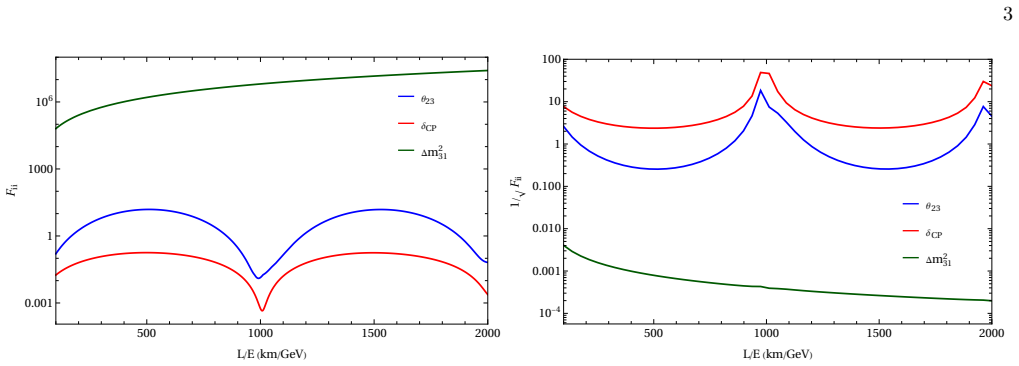
The com- paratively large sensitivity to ∆m 2 31 reflects its direct contribution to the oscillation phase governing neutrino propagation
The en- hanced sensitivity near these regions originates from the oscillatory phase structure of neutrino flavor evolution, where small variations in the oscillation parameters pro- duce significant changes in the quantum state. The com- paratively large sensitivity to ∆m 2 31 reflects its direct contribution to the oscillation phase governing neutrino pr...
2000
-
[2]
The pair (θ 23,∆m 2
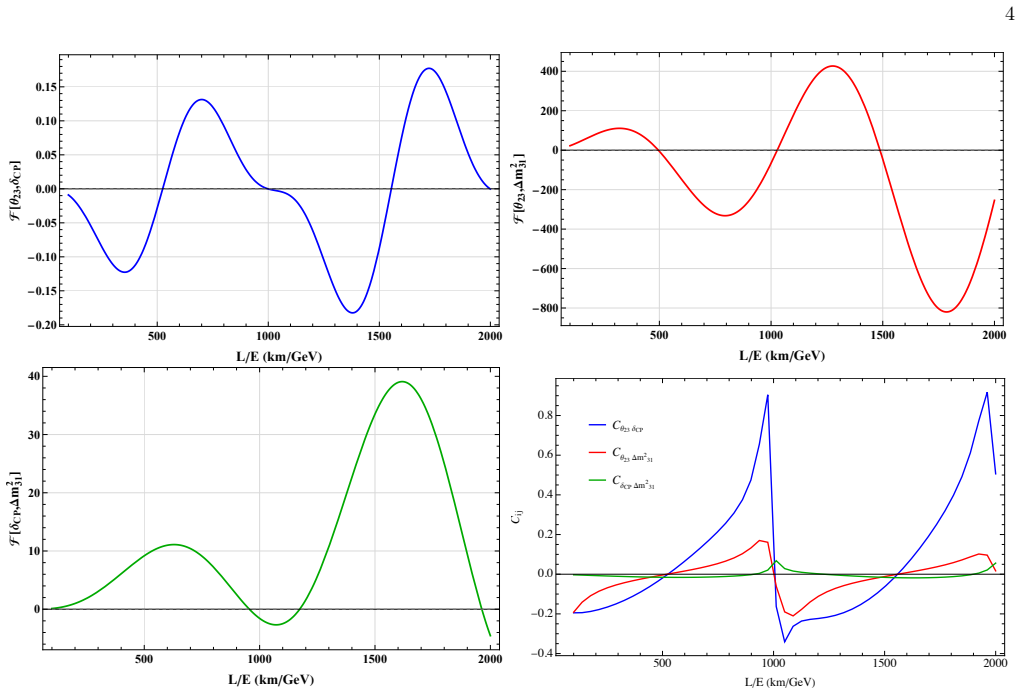
remains comparatively weak over most of the considered range, implying a rel- atively independent influence of these parameters on the quantum evolution. The pair (θ 23,∆m 2
-
[3]
The present analysis may also have implications for future long-baseline accelerator ex- periments, which rely primarily on theν µ →ν e appear- ance channel
exhibits mod- erate correlations with noticeable sign changes, reflect- ing transitions between aligned and opposing parameter- induced state variations. The present analysis may also have implications for future long-baseline accelerator ex- periments, which rely primarily on theν µ →ν e appear- ance channel. Since these experiments probe specific re- gi...
-
[4]
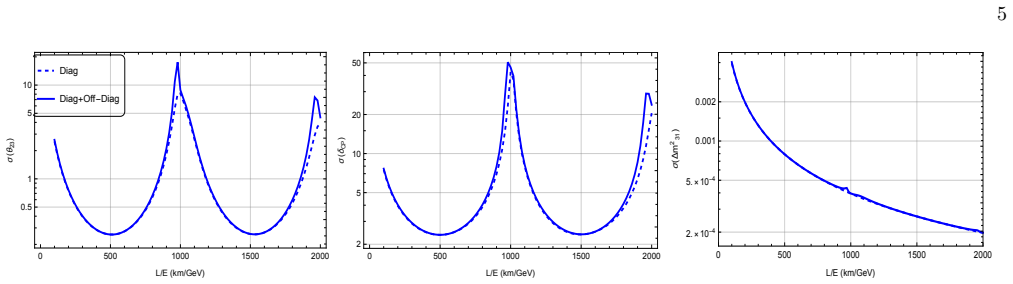
Consequently, the QFIM framework may serve as a complementary tool for identifying regions of en- hanced sensitivity and reduced parameter correlations in future oscillation studies. To connect our results with a 5 Diag Diag+Off-Diag 0 500 1000 1500 2000 0.5 1 5 10 L/E(km/GeV) σ(θ23) 0 500 1000 1500 2000 2 5 10 20 50 L/E(km/GeV) σ(δCP) 0 500 1000 1500 200...
2000
-
[5]
Such regions are expected to be favorable for simultaneous parameter estimation, highlighting the potential utility of the QFIM framework in identifying operating regimes with enhanced sensitiv- ity and reduced parameter correlations for future long- baseline accelerator experiments. Since the complete parameter uncertainties are gov- erned by the inverse...
-
[6]
This behavior reflects the dominant contribution of ∆m 2 31 to the oscillation phase, which leads to a continuous growth of F∆m2 31 with increasingL/E
decreases monotonically throughout the consideredL/Einterval, and the diagonal-only and full-QFIM estimates remain nearly indistinguishable across the entire range. This behavior reflects the dominant contribution of ∆m 2 31 to the oscillation phase, which leads to a continuous growth of F∆m2 31 with increasingL/E. V. RESOL VING P ARAMETER DEGENERACIES VI...
2000
-
[7]
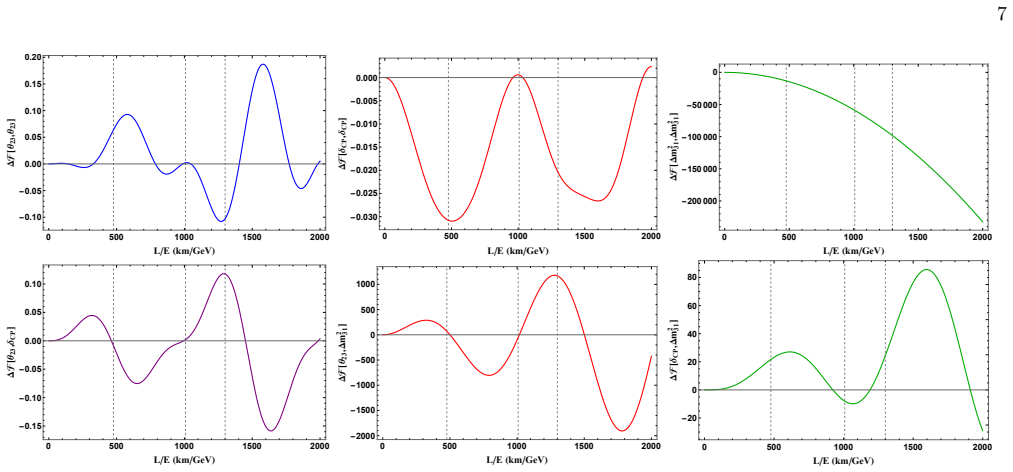
The quantityF θ23δCP exhibits an oscil- latory structure within the range [−0.20,+0.16], with multiple sign reversals over the consideredL/Einterval. The elementF θ23∆m2 31 possesses the largest magnitude among the off-diagonal entries, spanning approximately [−800,+400], whileF δCP∆m2 31 shows an intermediate be- 7 0 500 1000 1500 2000 -0.10 -0.05 0.00 0...
2000
-
[8]
Finally, we exploit the QFI of all six elements in or- der to break the degeneracy of neutrino oscillations
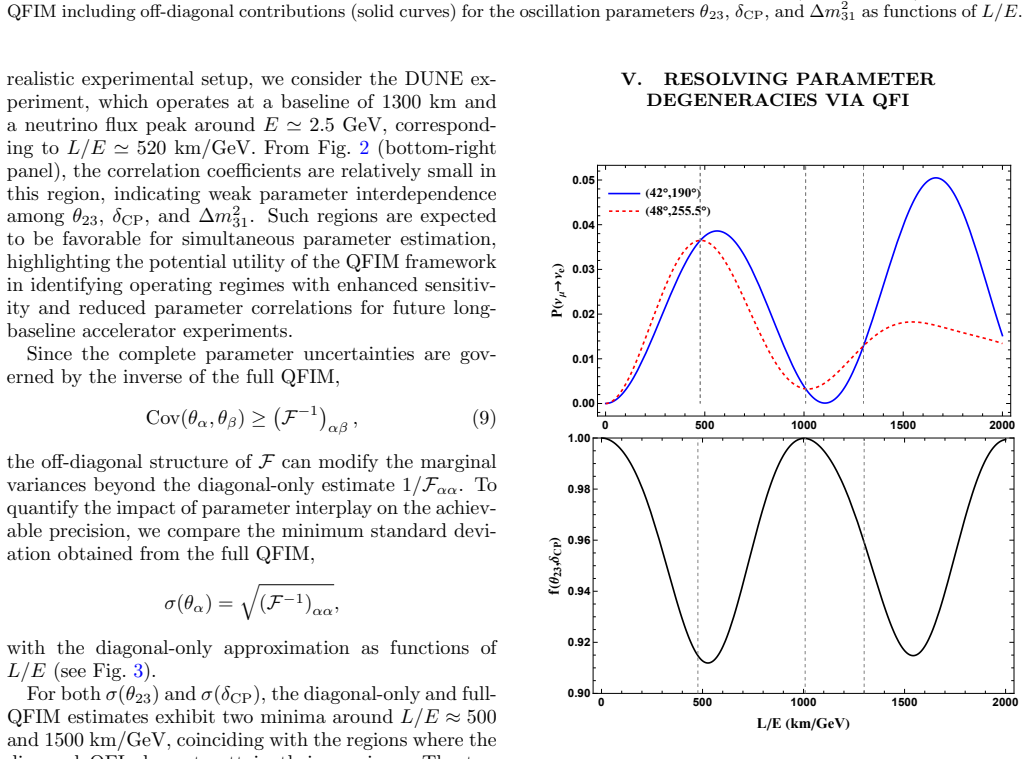
It implies that having a large raw QFI doesn’t necessarily mean a strong correlations among pa- rameters. Finally, we exploit the QFI of all six elements in or- der to break the degeneracy of neutrino oscillations. We choose two set of parameter space onθ 23 −δCP space and shown that the probability indeed have multiple degener- acy point in theL/Eregion ...
-
[9]
Weinberg, A Model of Leptons, Phys
S. Weinberg, A Model of Leptons, Phys. Rev. Lett.19, 1264 (1967)
1967
-
[10]
Davis, Jr., D
R. Davis, Jr., D. S. Harmer, and K. C. Hoffman, Search for neutrinos from the sun, Phys. Rev. Lett.20, 1205 (1968)
1968
-
[11]
Z. Maki, M. Nakagawa, and S. Sakata, Remarks on the unified model of elementary particles, Prog. Theor. Phys. 28, 870 (1962)
1962
-
[12]
Pontecorvo, Neutrino Experiments and the Problem of Conservation of Leptonic Charge, Sov
B. Pontecorvo, Neutrino Experiments and the Problem of Conservation of Leptonic Charge, Sov. Phys. JETP 26, 984 (1968)
1968
-
[13]
V. N. Gribov and B. Pontecorvo, Neutrino astronomy and lepton charge, Phys. Lett. B28, 493 (1969)
1969
-
[14]
Evidence for oscillation of atmospheric neutrinos
Y. Fukudaet al.(Super-Kamiokande), Evidence for os- cillation of atmospheric neutrinos, Phys. Rev. Lett.81, 1562 (1998), arXiv:hep-ex/9807003. 8
work page internal anchor Pith review Pith/arXiv arXiv 1998
-
[15]
Q. R. Ahmadet al.(SNO), Direct evidence for neutrino flavor transformation from neutral current interactions in the Sudbury Neutrino Observatory, Phys. Rev. Lett.89, 011301 (2002), arXiv:nucl-ex/0204008
work page internal anchor Pith review Pith/arXiv arXiv 2002
-
[16]
T. Arakiet al.(KamLAND), Measurement of neutrino oscillation with KamLAND: Evidence of spectral dis- tortion, Phys. Rev. Lett.94, 081801 (2005), arXiv:hep- ex/0406035
-
[17]
Abeet al.(Super-Kamiokande), Solar Neutrino Mea- surements in Super-Kamiokande-IV, Phys
K. Abeet al.(Super-Kamiokande), Solar Neutrino Mea- surements in Super-Kamiokande-IV, Phys. Rev. D94, 052010 (2016), arXiv:1606.07538 [hep-ex]
-
[18]
S. M. Bilenky and B. Pontecorvo, Lepton Mixing and Neutrino Oscillations, Phys. Rept.41, 225 (1978)
1978
-
[19]
F. Capozzi, E. Di Valentino, E. Lisi, A. Marrone, A. Mel- chiorri, and A. Palazzo, Unfinished fabric of the three neutrino paradigm, Phys. Rev. D104, 083031 (2021), arXiv:2107.00532 [hep-ph]
-
[20]
NuFit-6.0: Updated global analysis of three-flavor neutrino oscillations
I. Esteban, M. C. Gonzalez-Garcia, M. Maltoni, I. Martinez-Soler, J. P. Pinheiro, and T. Schwetz, NuFit- 6.0: updated global analysis of three-flavor neutrino os- cillations, JHEP12, 216, arXiv:2410.05380 [hep-ph]
work page internal anchor Pith review Pith/arXiv arXiv
-
[21]
S. K. Agarwalla, S. S. Chatterjee, and A. Palazzo, De- generacy betweenθ 23 octant and neutrino non-standard interactions at DUNE, Phys. Lett. B762, 64 (2016), arXiv:1607.01745 [hep-ph]
work page internal anchor Pith review Pith/arXiv arXiv 2016
-
[22]
U. Rahaman, S. Razzaque, and S. U. Sankar, A Review of the Tension between the T2K and NOνA Appearance Data and Hints to New Physics, Universe8, 109 (2022), arXiv:2201.03250 [hep-ph]
-
[23]
Di Lodovico, R
F. Di Lodovico, R. B. Patterson, M. Shiozawa, and E. Worcester, Experimental Considerations in Long- Baseline Neutrino Oscillation Measurements, Ann. Rev. Nucl. Part. Sci.73, 69 (2023)
2023
-
[24]
S. Abubakaret al.(T2K, NOvA), Joint neutrino oscil- lation analysis from the T2K and NOvA experiments, Nature646, 818 (2025), arXiv:2510.19888 [hep-ex]
-
[25]
Breaking Eight-fold Degeneracies in Neutrino CP Violation, Mixing, and Mass Hierarchy
V. Barger, D. Marfatia, and K. Whisnant, Breaking eight fold degeneracies in neutrino CP violation, mix- ing, and mass hierarchy, Phys. Rev. D65, 073023 (2002), arXiv:hep-ph/0112119
work page internal anchor Pith review Pith/arXiv arXiv 2002
-
[26]
Exploring Neutrino Mixing with Low Energy Superbeams
H. Minakata and H. Nunokawa, Exploring neutrino mixing with low-energy superbeams, JHEP10, 001, arXiv:hep-ph/0108085
work page internal anchor Pith review Pith/arXiv arXiv
-
[27]
T. Kajita, H. Minakata, S. Nakayama, and H. Nunokawa, Resolving eight-fold neutrino parameter degeneracy by two identical detectors with different baselines, Phys. Rev. D75, 013006 (2007), arXiv:hep-ph/0609286
work page internal anchor Pith review Pith/arXiv arXiv 2007
-
[28]
Resolving theta_{23} Degeneracy by Accelerator and Reactor Neutrino Oscillation Experiments
K. Hiraide, H. Minakata, T. Nakaya, H. Nunokawa, H. Sugiyama, W. J. C. Teves, and R. Z. Funchal, Resolv- ingθ 23 degeneracy by accelerator and reactor neutrino oscillation experiments, Phys. Rev. D73, 093008 (2006), arXiv:hep-ph/0601258
work page internal anchor Pith review Pith/arXiv arXiv 2006
-
[29]
Parameter Degeneracy in Neutrino Oscillation -- Solution Network and Structural Overview --
H. Minakata and S. Uchinami, Parameter Degeneracy in Neutrino Oscillation – Solution Network and Structural Overview –, JHEP04, 111, arXiv:1001.4219 [hep-ph]
work page internal anchor Pith review Pith/arXiv arXiv
-
[30]
M. Ghosh, P. Ghoshal, S. Goswami, N. Nath, and S. K. Raut, New look at the degeneracies in the neutrino oscillation parameters, and their resolution by T2K, NOνA and ICAL, Phys. Rev. D93, 013013 (2016), arXiv:1504.06283 [hep-ph]
work page internal anchor Pith review Pith/arXiv arXiv 2016
-
[31]
N. Nath, M. Ghosh, and S. Goswami, The physics of antineutrinos in DUNE and determination of octant and δCP , Nucl. Phys. B913, 381 (2016), arXiv:1511.07496 [hep-ph]
work page internal anchor Pith review Pith/arXiv arXiv 2016
-
[32]
C. R. Das, J. Maalampi, J. Pulido, and S. Vihonen, De- termination of theθ 23 octant in lbno, Journal of High Energy Physics2015, 10.1007/jhep02(2015)048 (2015)
-
[33]
Neutrino oscillations: the rise of the PMNS paradigm
C. Giganti, S. Lavignac, and M. Zito, Neutrino oscilla- tions: The rise of the PMNS paradigm, Prog. Part. Nucl. Phys.98, 1 (2018), arXiv:1710.00715 [hep-ex]
work page internal anchor Pith review Pith/arXiv arXiv 2018
-
[34]
S. Sugama and O. Yasuda, Octant degeneracy and plots of parameter degeneracy in neutrino oscillations revis- ited, Phys. Rev. D109, 035007 (2024), arXiv:2308.15071 [hep-ph]
-
[35]
R. A. Fisher, Theory of Statistical Estimation, Math. Proc. Cambridge Phil. Soc.22, 700 (1925)
1925
-
[36]
Cram´ er,Mathematical Methods of Statistics(Prince- ton University Press, Princeton, NJ, 1946) reprinted 1999, Princeton Landmarks in Mathematics and Physics
H. Cram´ er,Mathematical Methods of Statistics(Prince- ton University Press, Princeton, NJ, 1946) reprinted 1999, Princeton Landmarks in Mathematics and Physics
1946
-
[37]
E. T. Jaynes, Information Theory and Statistical Me- chanics, Phys. Rev.106, 620 (1957)
1957
-
[38]
C. W. Helstrom, Quantum detection and estimation the- ory, J. Statist. Phys.1, 231 (1969)
1969
-
[39]
M. G. A. Paris, Quantum Estimation for Quan- tum Technology, Int. J. Quant. Inf.07, 125 (2009), arXiv:0804.2981 [quant-ph]
work page internal anchor Pith review Pith/arXiv arXiv 2009
-
[40]
X.-M. Lu, X. Wang, and C. P. Sun, Quantum Fisher in- formation flow and non-Markovian processes of open sys- tems, Phys. Rev. A82, 042103 (2010), arXiv:0912.0587 [quant-ph]
work page internal anchor Pith review Pith/arXiv arXiv 2010
-
[41]
Quantum metrology from a quantum information science perspective
G. T´ oth and I. Apellaniz, Quantum metrology from a quantum information science perspective, J. Phys. A47, 424006 (2014), arXiv:1405.4878 [quant-ph]
work page internal anchor Pith review Pith/arXiv arXiv 2014
-
[42]
Quantum theory of phase estimation
L. Pezze’ and A. Smerzi, Quantum theory of phase esti- mation (2014), arXiv:1411.5164 [quant-ph]
work page internal anchor Pith review Pith/arXiv arXiv 2014
- [43]
-
[44]
E. C. Nogueira, G. de Souza, A. D. Varizi, and M. D. Sampaio, Quantum estimation in neutrino oscillations, Int. J. Quant. Inf.15, 1750045 (2017), arXiv:1610.05388 [quant-ph]
work page internal anchor Pith review Pith/arXiv arXiv 2017
- [45]
- [46]
-
[47]
C. Frugiuele, M. G. Genoni, M. Ignoti, and M. G. A. Paris, Quantum Estimation Theory Limits in Neutrino Oscillation Experiments (2026), arXiv:2602.16534 [hep- ph]
- [48]
- [49]
-
[50]
N. R. S. Chundawat, L. A. Delgadillo, and Y.-F. Li, Lep- tonic CP Phase Determination from Fisher Information in NOvA and T2K (2026), arXiv:2605.30404 [hep-ph]
work page internal anchor Pith review Pith/arXiv arXiv 2026
-
[51]
J. W. F. Valle, Neutrino physics overview, J. Phys. Conf. Ser.53, 473 (2006), arXiv:hep-ph/0608101. 9
work page internal anchor Pith review Pith/arXiv arXiv 2006
-
[52]
T. Ohlsson and H. Snellman, Three flavor neutrino os- cillations in matter, J. Math. Phys.41, 2768 (2000), [Erratum: J.Math.Phys. 42, 2345 (2001)], arXiv:hep- ph/9910546
-
[53]
Giunti and C
C. Giunti and C. W. Kim,Fundamentals of Neutrino Physics and Astrophysics(2007)
2007
-
[54]
Jozsa, Fidelity for Mixed Quantum States, J
R. Jozsa, Fidelity for Mixed Quantum States, J. Mod. Opt.41, 2315 (1994)
1994
discussion (0)
Sign in with ORCID, Apple, or X to comment. Anyone can read and Pith papers without signing in.