REVIEW 3 major objections 4 minor 44 references
A hybrid neural network predicts spatial-ALD coverage in milliseconds and reveals that kinetic-inversion precision is set by parameter degeneracy, not fitting power.
Reviewed by Pith at T0; open to challenge. T0 means a machine referee read the full paper against a public rubric. the ladder, T0–T4 →
T0 review · deepseek-v4-flash
2026-08-04 01:00 UTC pith:GXYJYVPR
load-bearing objection Careful, self-critical hybrid-surrogate plus identifiability paper on a synthetic SALD benchmark; the analytic slope law is a real increment, but the diagnostic's statistical calibration is weaker than the abstract claims and there is no experimental validation. the 3 major comments →
A Physics-Chemistry-Informed Neural Network (PCINN) for Real-Time Spatial-ALD Coverage Prediction and Reliable Kinetics Inversion
The pith
A machine-rendered reading of the paper's core claim, the machinery that carries it, and where it could break.
Core claim
PCINN divides the inverse problem between a small neural network that learns the operating-condition to near-wall concentration closure and a hard-coded Langmuir–Arrhenius chemistry layer integrated along the substrate trajectory, compressing the data-driven freedom to a single scalar. The central discovery is that at a single temperature the adsorption rate k_ads is not separately identifiable (only the product k_ads·c_wall is), and across multiple temperatures the prefactor ν and adsorption energy E_ads remain bound along a weakly identifiable degeneracy valley whose slope is predicted analytically as k_B T_eff ln10 — about 0.065 eV/decade for the 300–360 K window. The slope persists under
What carries the argument
The central object is the PCINN hybrid architecture: a tiny MLP physics branch that maps (v_sub, U_curtain, T) to an effective near-wall concentration C*_s, coupled to a hard-coded, trainable Langmuir kinetics layer that integrates coverage along the substrate trajectory. The key identity is the analytic degeneracy slope dE_ads/dlog10ν = k_B T_eff ln10, derived directly from the Arrhenius form with T_eff the harmonic mean of the sampled temperatures; this slope fixes the geometry of the ν–E_ads valley and doubles as a reliability diagnostic.
Load-bearing premise
The entire identifiability boundary and slope diagnostic rest on the premise that the real SALD surface chemistry is well described by the same single-site Langmuir–Arrhenius kinetics used to generate and invert the data; if coverage-dependent barriers, adsorption-side nonlinearity, site heterogeneity, or temperature-dependent transport are present in reality, the reported parameters and the slope threshold could shift.
What would settle it
Measure the multi-temperature degeneracy slope from real spatial-ALD coverage data (or from a well-characterized surface with known two-site heterogeneity) using the same PCINN profile-likelihood pipeline; if the empirical slope stays within the single-Arrhenius band µ±1.64σ while an independent spectroscopic measure confirms site heterogeneity, the slope diagnostic's specificity fails. Conversely, a clean single-site surface whose measured slope departs from k_B T_eff ln10 beyond the threshold would falsify the law.
If this is right
- Coverage can be predicted in about 7 ms per query, roughly 5×10^4 times faster than a high-fidelity CFD solve, with test R²_log ≈ 0.998 from only 30 training cases, enabling real-time operating-window scans and control-loop deployment.
- At a single temperature, k_ads is not separately identifiable; only the product k_ads·c_wall is constrained. At multiple temperatures ν and E_ads remain bound along a weak valley, and E_ads is recovered to within 0.3% only when ν is conditioned on.
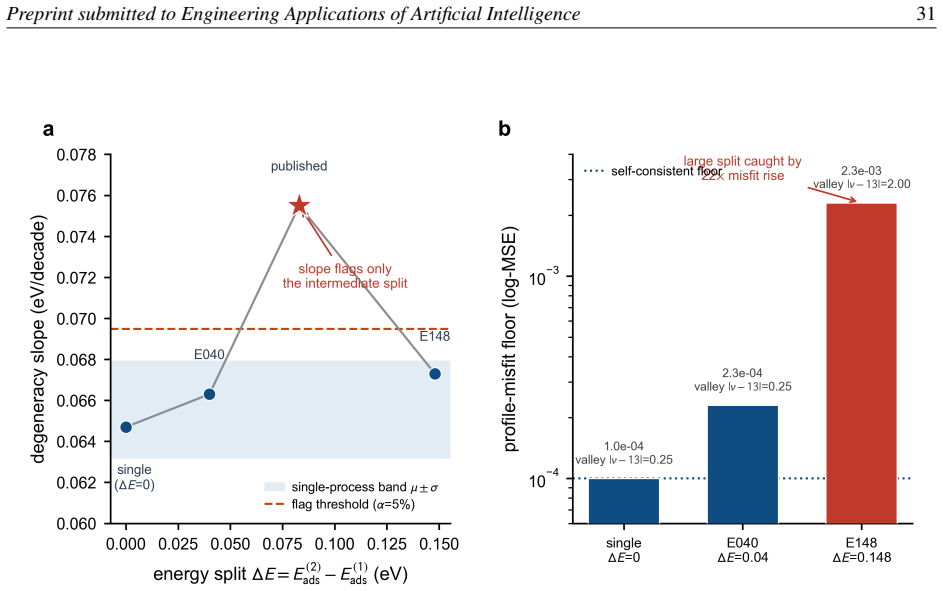
- A measured degeneracy slope departing from k_B T_eff ln10 is a falsifiable flag for unmodelled site heterogeneity or another thermally activated process, even when the surrogate fit remains excellent.
- The embedded physics provides extrapolation gains only along the structurally known residence-time axis, not along the data-driven transport axis, delineating precisely where the learned closure does and does not help.
- The identifiability conclusions and the slope diagnostic persist under moderate model mismatch, including desorption-side coverage dependence, adsorption-side nonlinearity, and non-Fickian transport, with the valley flattening and conditional E_ads degrading by only about 1%.
Where Pith is reading between the lines
- The slope law is likely to transfer to any single-channel activated-rate inversion beyond ALD surface kinetics, offering a design tool: the harmonic-mean temperature window determines how easily a prefactor and activation energy can be separated, and widening that window directly tightens the inferable interval.
- A testable extension is to apply the slope diagnostic to real SALD thickness data: if multi-temperature coverage measurements from a production reactor give a slope within the single-Arrhenius band, that supports a single-site Langmuir model; a departure would indicate hidden site heterogeneity even if the surrogate fit is excellent.
- The single-scalar bottleneck suggests a natural route toward field-level prediction — replacing the trajectory-averaged scalar with full spatial coverage fields via a neural operator — while retaining the same per-parameter identifiability analysis on each output dimension.
- The paper's own boundary analysis implies that a temperature-dependent transport mismatch (e.g. diffusivity or viscosity varying with temperature) would shift the degeneracy slope just as a second Arrhenius process would, so the diagnostic may also catch thermal-transport errors — an inference the authors explicitly leave to future work.
Editorial analysis
A structured set of objections, weighed in public.
Referee Report
Summary. The paper proposes PCINN, a hybrid physics-chemistry-informed neural network for spatial ALD coverage prediction. A small MLP learns only the operating-condition-to-effective-near-wall-concentration closure, while a hard-coded Langmuir-Arrhenius chemistry layer integrates coverage along the substrate trajectory. From 30 CFD-generated training cases the surrogate achieves test R^2_log ≈ 0.998 and millisecond inference. The paper's main methodological contribution is an identifiability analysis (Fisher information, profile likelihood, initial-value drift) showing that k_ads is not separately identifiable at a single temperature and that, across multiple temperatures, ν and E_ads are bound along a degeneracy valley whose slope is derived analytically as k_B T_eff ln10. This slope is proposed as a diagnostic flag for unmodelled site heterogeneity, supported by a seven-chemistry mismatch matrix. The authors explicitly frame the study as a simulation-based concept verification with known Langmuir-Arrhenius ground truth and no experimental validation.
Significance. If the claims are sustained, the paper offers a useful interpretable surrogate for SALD and, more importantly, a transferable identifiability workflow for hybrid neural-ODE models. The analytic slope law is an elegant and nontrivial result: it connects the geometry of the ν–E_ads degeneracy to the temperature sampling window and is robust to the form of a known prefactor. The paper is unusually honest: it discloses the saturated-end 13–36% bias, the non-convergence of the near-wall auxiliary concentration, the parking-artifact of free-inversion point estimates, and the circularity of simulation-based validation. The LOOCV, prior-ablation, bootstrap, and coarse-grid checks strengthen confidence in the surrogate and in the basic identifiability conclusions. However, the central operational claim — the statistically calibrated false-positive rate of the slope diagnostic — is not supported by the evidence presented, and the abstract overstates the diagnostic's universality.
major comments (3)
- [§7.3, Table 7, Fig. 10] The statistical calibration of the slope diagnostic is not established. The null distribution is a convenience sample of seven hand-picked single-Arrhenius cases, not draws from a well-defined ensemble of plausible mismatches. The Gaussian tail probability (p≈1.5×10^-5) and the 5%/1% thresholds (μ+1.64σ, μ+2.33σ) assume normality and a known σ. With n=7, the sampling error in σ is large (SE(σ)≈0.0007), and a 95% tolerance bound for the 95th percentile is roughly μ+3.4σ≈0.0736 eV/decade, only ~0.002 below the dual-site signal 0.0755; for the 1% false-positive rate the bound can exceed the signal. The set of null cases also mixes exact-model and mismatched single-process cases, and the selection/exclusion of rows (e.g., excluding Temkin β=4 but including Freundlich n=0.5 with degraded R²=0.86–0.99) is ad hoc. The paper should either define a proper null ensemble and report nonparametric to
- [Abstract, §1.3, §7.3, Fig. 11a] The abstract and contribution statement claim the degeneracy slope 'shifts only when a second thermally activated process is introduced.' This is contradicted by the paper's own energy-split sweep: dual-site models with ΔE=0.04 and ΔE=0.148 eV give slopes of 0.0663 and 0.0673, both inside the single-process band (0.063–0.070). The body text later correctly states the slope is 'specific but not universally sensitive' and that absence of a slope excursion does not exclude heterogeneity. The abstract and Section 1.3 should be reworded to present the slope as a one-sided flag — a departure implies heterogeneity, but non-departure does not imply its absence — and the bi-conditional language should be removed.
- [§1.3, §8.2, Abstract] The entire quantitative validation is generated by simulation from the same Langmuir-Arrhenius kinetic form that is used for inversion. The paper discloses this clearly and positions the work as a concept verification, which is commendable. Nevertheless, the title and abstract's 'reliable kinetics inversion' overstate what is demonstrated: the reliability is established only within a simulated model world, with a mismatch matrix covering a limited selection of kinetic/transport perturbations and no experimental data or experimental uncertainty model. The authors should temper the reliability language in the title/abstract, or explicitly add a qualifier such as 'in simulation' to the reliability claim. This is not a request for new experiments, but for a scope-bound statement consistent with the evidence.
minor comments (4)
- [§4.5, Table 1] The auxiliary near-wall concentration ⟨c⟩/C0 used to anchor the learned closure does not converge under mesh refinement (0.0148→0.0123→0.0206 across m_f=2,4,8), yet the production mesh is m_f=2. The paper's argument that the identifiable E_ads is read from the temperature slope and is mesh-stable is plausible, and the coarse-grid experiment supports it. Still, the non-converged supervision is a source of uncertainty in the learned C*_s and effective k_ads; this should be acknowledged more directly as an uncertainty, not only as a benign artifact.
- [§6.1 vs §5.4] The abstract reports test R^2_log=0.998, while Section 6.1 gives 0.9975±0.0005 over 8 seeds. The former is an appropriate single-run highlight, but the abstract should note it is one representative run or a rounded summary.
- [§7.3, Table 7] The text says strong single-process mismatch (Temkin β=4, Freundlich n=0.5) causes R^2_log to fall to 0.69–0.86, but Table 7 lists Freundlich n=0.5 as 0.86–0.99. The range is inconsistent; please clarify which value corresponds to which condition and whether the reference cluster in Fig. 10 includes Freundlich n=0.5 despite its degraded fit.
- [§6.7] The LOOCV R^2_raw=0.974 and maximum log error 0.187 are mentioned; providing the corresponding worst-case condition (which appears to be v_sub=1.2) as a table or explicit text would help readers locate the saturated-corner bias.
Circularity Check
No significant circularity: the analytic degeneracy slope is derived from the Arrhenius law, and the synthetic-data inversion is explicitly framed as a self-consistency check rather than a hidden prediction.
full rationale
The paper's central derivations do not reduce to their inputs. The slope law dE_ads/dlog10 nu = k_B T_eff ln10 (Eq. 6, Section 7.2) is obtained by direct differentiation of the Arrhenius relation under the stated assumption that data constrain k_des(T0); it depends only on the sampled temperature set and the exponential activation form, not on fitted parameter values or on the neural network. The empirical slope 0.0647 is compared with this analytic prediction 0.0652, which is a legitimate model-derived check rather than a self-fulfilling fit. The surrogate accuracy claim (R2_log = 0.998 from 30 training cases) is a standard train/test evaluation on CFD-generated labels; although the chemistry layer is hard-coded from the same governing equations that generated the data, the operating-condition-to-near-wall-concentration closure is learned from data, so the accuracy claim is an empirical interpolation result. The closest-to-circular element is that the simulated data are generated from the same Langmuir-Arrhenius form used for inversion. The paper explicitly and repeatedly acknowledges this: Section 1.3 states 'the data are generated by high-fidelity simulation from known Langmuir–Arrhenius ground truth and inverted with the same kinetic form,' and Section 8.2 states 'the data are synthetic measurements without real process data.' The study is therefore framed as a self-consistency and identifiability-boundary verification, not as discovery of real kinetic parameters. The mismatch matrix (Section 7.3) tests the slope diagnostic under independently generated Temkin, Freundlich, and dual-site chemistries; these are forward simulations designed to probe whether the diagnostic responds as predicted, not fitted quantities renamed as predictions. The paper also explicitly avoids ML-based data augmentation because it 'would form a circular validation loop and add no independent information' (Section 7.4), demonstrating awareness of the circularity hazard. No load-bearing self-citations or imported uniqueness theorems were found. The main weakness is that the claimed false-positive rate (~1.5e-5) is calibrated from only seven hand-picked null models with no defined ensemble, and the energy-split sweep shows the slope is not universally sensitive. That is a statistical validity concern, not a circularity concern. Overall, the derivation chain is self-contained and the paper's claims are appropriately scoped.
Axiom & Free-Parameter Ledger
free parameters (4)
- Ground-truth kinetic constants (E_ads=0.774 eV, log10 ν=13, k_ads=0.01 m/s, k_des=1 s^-1 at 300 K) =
chosen simulation truth
- Loss weights w_C, w_m, w_p =
0.1, 0.1, 0.01
- Label noise σ =
5% relative noise on train/val labels
- Multi-temperature sampling window {300,320,340,360} K =
T_eff = 328.5 K
axioms (7)
- domain assumption Single-site Langmuir–Arrhenius surface kinetics: J_net = k_ads c_wall(1−θ) − k_des Γ_s θ, k_des=ν e^{-E_ads/k_B T}.
- ad hoc to paper Two-segment trajectory closure: uniform effective concentration C*_s·C0 across the A-zone and c_wall=0 downstream.
- ad hoc to paper Effective near-wall concentration is a single scalar function of operating conditions.
- domain assumption Steady 2-D incompressible laminar flow; temperature enters only through k_des (all transport coefficients T-independent).
- domain assumption Observed data consist of substrate-averaged coverage θ̄_A only, with i.i.d. log-normal noise (σ=5%) on training labels.
- standard math Fisher information computed as Gauss–Newton with σ^{-2} weights and profile likelihood using χ^2_1 likelihood-ratio threshold.
- standard math Multi-temperature degeneracy direction is weighted by 1/T, giving T_eff = harmonic mean.
invented entities (1)
-
Learned effective near-wall concentration scale C*_s
no independent evidence
read the original abstract
Spatial atomic layer deposition (SALD) is a leading atmospheric-pressure, high-throughput route to industrial ALD, but design and control are limited by the cost of predicting surface coverage: high-fidelity CFD is far too slow for operating-window scans, while analytic models miss transport modulation such as the gas curtain. We present a physics-chemistry-informed neural network (PCINN), a hybrid surrogate with CFD-level accuracy at real-time speed: a query returns coverage in about 7 ms, roughly 5x10^4 times faster than a CFD solve, reaching a test R^2_log = 0.998 (leave-one-out R^2_raw = 0.974) from only 30 training cases spanning four orders of magnitude in coverage. The architecture is not a black box: a small network learns only the operating-condition to near-wall concentration closure, while the known surface kinetics is a hard-coded, trainable chemistry layer integrated along the substrate trajectory. This single-scalar bottleneck keeps it accurate under sparse data, interpretable and invertible. We add a full identifiability analysis (Fisher information, profile likelihood). The adsorption energy E_ads and desorption rate k_des are robustly identifiable; k_ads is not separately identifiable at a single temperature (only k_ads*c_wall is). Across four temperatures the prefactor nu and E_ads bind along a weakly identifiable degeneracy valley of slope 0.065 eV/decade, derived analytically as k_B T_eff ln(10) and turned into a reliability diagnostic: a seven-chemistry mismatch matrix shows it is invariant under any single-Arrhenius mismatch and shifts only when a second thermally activated process appears, so a slope departure flags unmodelled site heterogeneity. Data come from simulation with known ground truth inverted by the same kinetic form, so the study verifies pipeline self-consistency and the identifiability boundary, not real parameters.
Figures



Reference graph
Works this paper leans on
-
[1]
S. M. George, Atomic layer deposition: an overview,Chem. Rev.110 (2010) 111–131. DOI: 10.1021/cr900056b
-
[2]
Poodt et al., Spatial atomic layer deposition: a route towards further industrialization,J
P. Poodt et al., Spatial atomic layer deposition: a route towards further industrialization,J. Vac. Sci. Technol. A 30 (2012) 010802. DOI: 10.1116/1.3670745
-
[3]
R. L. Puurunen, Surface chemistry of atomic layer deposition: the trimethylaluminum/water process,J. Appl. Phys.97 (2005) 121301. DOI: 10.1063/1.1940727
-
[4]
Langmuir, The adsorption of gases on plane surfaces of glass, mica and platinum,J
I. Langmuir, The adsorption of gases on plane surfaces of glass, mica and platinum,J. Am. Chem. Soc.40 (1918) 1361–1403. DOI: 10.1021/ja02242a004
-
[5]
A. Yanguas-Gil, J. W. Elam, Analytic expressions for atomic layer deposition: coverage, throughput, and ma- terials utilization,J. Vac. Sci. Technol. A32 (2014) 031504. DOI: 10.1116/1.4867441
-
[6]
M. Raissi, P. Perdikaris, G. E. Karniadakis, Physics-informed neural networks,J. Comput. Phys.378 (2019) 686–707. DOI: 10.1016/j.jcp.2018.10.045
-
[7]
G. E. Karniadakis et al., Physics-informed machine learning,Nat. Rev. Phys.3 (2021) 422–440. DOI: 10.1038/s42254-021-00314-5
-
[8]
A. Raue et al., Structural and practical identifiability analysis of partially observed dynamical models by ex- ploiting the profile likelihood,Bioinformatics25 (2009) 1923–1929. DOI: 10.1093/bioinformatics/btp358
-
[9]
C. Rackauckas et al., Universal differential equations for scientific machine learning, arXiv:2001.04385 (2020)
Pith/arXiv arXiv 2001
-
[10]
M. K. Transtrum, B. B. Machta, J. P. Sethna, Geometry of nonlinear least squares with applications to sloppy models and optimization,Phys. Rev. E83 (2011) 036701. DOI: 10.1103/PhysRevE.83.036701
-
[11]
R. T. Q. Chen, Y . Rubanova, J. Bettencourt, D. Duvenaud, Neural ordinary differential equations, in:Advances in Neural Information Processing Systems (NeurIPS), 2018, pp. 6571–6583
2018
-
[12]
R. N. Gutenkunst, J. J. Waterfall, F. P. Casey, K. S. Brown, C. R. Myers, J. P. Sethna, Univer- sally sloppy parameter sensitivities in systems biology models,PLoS Comput. Biol.3 (2007) e189. DOI: 10.1371/journal.pcbi.0030189
-
[13]
M. K. Transtrum, B. B. Machta, K. S. Brown, B. C. Daniels, C. R. Myers, J. P. Sethna, Perspective: sloppiness and emergent theories in physics, biology, and beyond,J. Chem. Phys.143 (2015) 010901. DOI: 10.1063/1.4923066. Preprint submitted to Engineering Applications of Artificial Intelligence26
-
[14]
A. Raue, M. Schilling, J. Bachmann, et al., Lessons learned from quantitative dynamical modeling in systems biology,PLoS ONE8 (2013) e74335. DOI: 10.1371/journal.pone.0074335
-
[15]
A. F. Villaverde, A. Barreiro, A. Papachristodoulou, Structural identifiability of dynamic systems biology mod- els,PLoS Comput. Biol.12 (2016) e1005153. DOI: 10.1371/journal.pcbi.1005153
-
[16]
O. Chis ¸, J. R. Banga, E. Balsa-Canto, Structural identifiability of systems biology models: a critical comparison of methods,PLoS ONE6 (2011) e27755. DOI: 10.1371/journal.pone.0027755
-
[17]
Temkin, V
M. Temkin, V . Pyzhev, Kinetics of ammonia synthesis on promoted iron catalysts,Acta Physicochim. URSS12 (1940) 327–356
1940
-
[18]
Freundlich, ¨Uber die Adsorption in L¨osungen,Z
H. Freundlich, ¨Uber die Adsorption in L¨osungen,Z. Phys. Chem.57 (1907) 385–470
1907
-
[19]
C. E. Rasmussen, C. K. I. Williams,Gaussian Processes for Machine Learning, MIT Press, Cambridge, MA, 2006
2006
-
[20]
M. D. McKay, R. J. Beckman, W. J. Conover, A comparison of three methods for selecting values of input variables in the analysis of output from a computer code,Technometrics21 (1979) 239–245. DOI: 10.1080/00401706.1979.10489755
arXiv 1979
-
[21]
Efron, Bootstrap methods: another look at the jackknife,Ann
B. Efron, Bootstrap methods: another look at the jackknife,Ann. Statist.7 (1979) 1–26. DOI: 10.1214/aos/1176344552
arXiv 1979
-
[22]
D. P. Kingma, J. Ba, Adam: a method for stochastic optimization, in:Int. Conf. on Learning Representations (ICLR), 2015. arXiv:1412.6980
Pith/arXiv arXiv 2015
-
[23]
S. Elfwing, E. Uchibe, K. Doya, Sigmoid-weighted linear units for neural network function approximation in reinforcement learning,Neural Networks107 (2018) 3–11. DOI: 10.1016/j.neunet.2017.12.012
-
[24]
L. Lu, X. Meng, Z. Mao, G. E. Karniadakis, DeepXDE: a deep learning library for solving differential equations, SIAM Review63 (2021) 208–228. DOI: 10.1137/19M1274067
-
[25]
S. L. Brunton, J. L. Proctor, J. N. Kutz, Discovering governing equations from data by sparse iden- tification of nonlinear dynamical systems,Proc. Natl. Acad. Sci. USA113 (2016) 3932–3937. DOI: 10.1073/pnas.1517384113
-
[26]
K. Champion, B. Lusch, J. N. Kutz, S. L. Brunton, Data-driven discovery of coordinates and governing equa- tions,Proc. Natl. Acad. Sci. USA116 (2019) 22445–22451. DOI: 10.1073/pnas.1906995116
-
[27]
Raissi, Deep hidden physics models: deep learning of nonlinear partial differential equations,J
M. Raissi, Deep hidden physics models: deep learning of nonlinear partial differential equations,J. Mach. Learn. Res.19 (2018) 1–24
2018
-
[28]
O. Owoyele, P. Pal, ChemNODE: a neural ordinary differential equations framework for efficient chemical kinetic solvers,Energy and AI7 (2022) 100118. DOI: 10.1016/j.egyai.2021.100118
arXiv 2022
-
[29]
Kreutz, A
C. Kreutz, A. Raue, D. Kaschek, J. Timmer, Profile likelihood in systems biology,FEBS J.280 (2013) 2564–
2013
-
[30]
G. Pang, L. Lu, G. E. Karniadakis, fPINNs: fractional physics-informed neural networks,SIAM J. Sci. Comput. 41 (2019) A2603–A2626. DOI: 10.1137/18M1229845
-
[31]
S. Cai, Z. Mao, Z. Wang, M. Yin, G. E. Karniadakis, Physics-informed neural networks (PINNs) for fluid mechanics: a review,Acta Mech. Sin.37 (2021) 1727–1738. DOI: 10.1007/s10409-021-01148-1
-
[32]
R. G. Patel, I. Manickam, N. A. Trask, et al., Thermodynamically consistent physics-informed neural networks for hyperbolic systems,J. Comput. Phys.449 (2022) 110754. DOI: 10.1016/j.jcp.2021.110754
arXiv 2022
-
[33]
E. Kharazmi, Z. Zhang, G. E. Karniadakis, hp-VPINNs: variational physics-informed neural net- works with domain decomposition,Comput. Methods Appl. Mech. Engrg.374 (2021) 113547. DOI: 10.1016/j.cma.2020.113547
arXiv 2021
-
[34]
M. Raissi, A. Yazdani, G. E. Karniadakis, Hidden fluid mechanics: learning velocity and pressure fields from flow visualizations,Science367 (2020) 1026–1030. DOI: 10.1126/science.aaw4741
-
[35]
A. Yazdani, L. Lu, M. Raissi, G. E. Karniadakis, Systems biology informed deep learning for inferring param- eters and hidden dynamics,PLoS Comput. Biol.16 (2020) e1007575. DOI: 10.1371/journal.pcbi.1007575
-
[36]
S. Wang, X. Yu, P. Perdikaris, When and why PINNs fail to train: a neural tangent kernel perspective,J. Comput. Phys.449 (2022) 110768. DOI: 10.1016/j.jcp.2021.110768
arXiv 2022
-
[37]
A. D. Jagtap, K. Kawaguchi, G. E. Karniadakis, Adaptive activation functions accelerate convergence in deep and physics-informed neural networks,J. Comput. Phys.404 (2020) 109136. DOI: 10.1016/j.jcp.2019.109136. Preprint submitted to Engineering Applications of Artificial Intelligence27
arXiv 2020
-
[38]
F.-G. Wieland, A. L. Hauber, M. Rosenblatt, C. T ¨onsing, J. Timmer, On structural and practical identifiability, Curr. Opin. Syst. Biol.25 (2021) 60–69. DOI: 10.1016/j.coisb.2021.03.005
-
[39]
D. Pan, L. Ma, Y . Xie, T. C. Jen, C. Yuan, On the physical and chemical details of alumina atomic layer deposition: a combined experimental and numerical approach,J. Vac. Sci. Technol. A33 (2015) 021511. DOI: 10.1116/1.4905726
-
[40]
M. K. Transtrum, P. Qiu, Model reduction by manifold boundaries,Phys. Rev. Lett.113 (2014) 098701. DOI: 10.1103/PhysRevLett.113.098701
-
[41]
C. Masse de la Huerta, V . H. Nguyen, J.-M. Dedulle, D. Bellet, C. Jim ´enez, D. Mu ˜noz-Rojas, Influence of the geometric parameters on the deposition mode in spatial atomic layer deposition: a novel approach to area- selective deposition,Coatings9 (2019) 5. DOI: 10.3390/coatings9010005
-
[42]
Z. Deng, W. He, C. Duan, R. Chen, B. Shan, Mechanistic modeling study on process optimization and precur- sor utilization with atmospheric spatial atomic layer deposition,J. Vac. Sci. Technol. A34 (2016) 01A108. DOI: 10.1116/1.4932564
-
[43]
D. Pan, T. C. Jen, C. Yuan, Effects of gap size, temperature and pumping pressure on the fluid dynamics and chemical kinetics of in-line spatial atomic layer deposition of Al 2O3,Int. J. Heat Mass Transf.96 (2016) 189–198. DOI: 10.1016/j.ijheatmasstransfer.2016.01.034. Preprint submitted to Engineering Applications of Artificial Intelligence28 Figure 7.Si...
-
[2571]
DOI: 10.1111/febs.12276
discussion (0)
Sign in with ORCID, Apple, or X to comment. Anyone can read and Pith papers without signing in.