REVIEW 4 major objections 5 minor 58 references
The paper argues that kNN-based demonstration selection remains optimal for subjective preference tasks, but a learned, diversity-aware policy is strictly necessary for superior performance on objective visual regression tasks.
Reviewed by Pith at T0; open to challenge. T0 means a machine referee read the full paper against a public rubric. the ladder, T0–T4 →
T0 review · deepseek-v4-flash
2026-08-04 05:40 UTC pith:HYAG7P25
load-bearing objection The RL selection method is clever but the central comparison is confounded by an extra anchor demo and inconsistent tables; the dichotomy is unsupported as-is. the 4 major comments →
Learning to Select Visual In-Context Demonstrations
The pith
A machine-rendered reading of the paper's core claim, the machinery that carries it, and where it could break.
Core claim
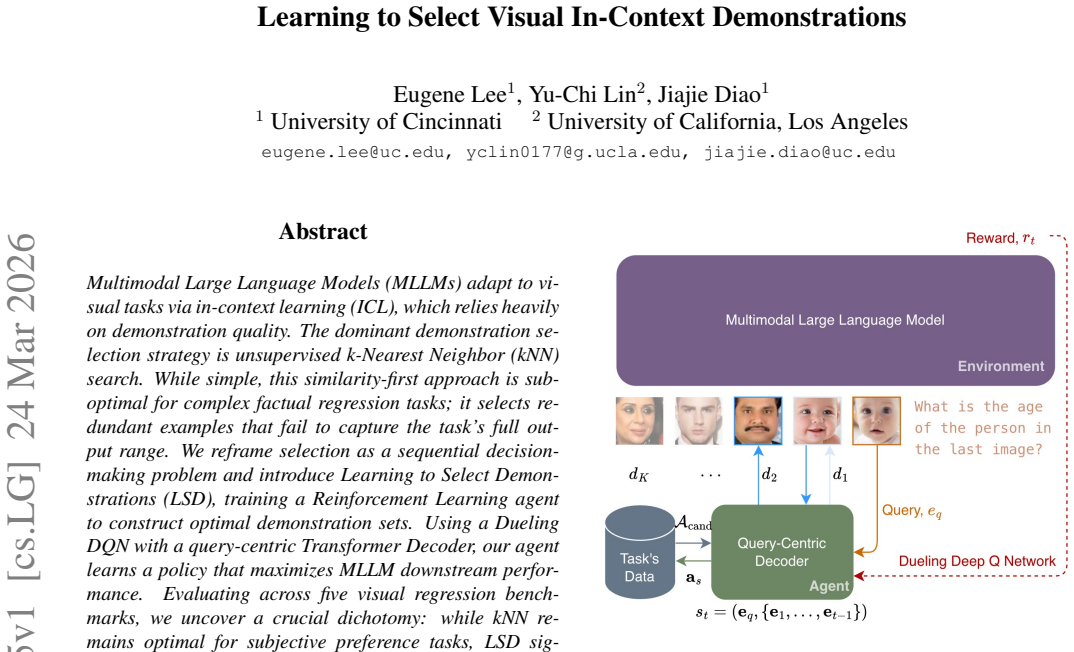
The central discovery is a task-dependent dichotomy in visual in-context learning. By formulating demonstration selection as a sequential decision-making problem and training a reinforcement-learning agent to maximize the MLLM's downstream accuracy, the authors show that a learned, diversity-aware policy is required to beat unsupervised kNN on objective regression tasks such as age and image-quality estimation. On those tasks, the best demonstrations are diverse boundary examples that span the output range. On subjective tasks such as aesthetic rating and facial beauty, simple visual similarity remains superior, and the learned diversity introduces unnecessary variance. The paper further sho
What carries the argument
The load-bearing mechanism is a Dueling DQN agent whose state is the query plus the set of previously selected demonstrations. The state is encoded by a query-centric Transformer Decoder that feeds the query embedding as the target sequence and demonstration embeddings as memory, forcing the policy to be query-specific. Q-values are computed as an inner product between a learned advantage query vector and precomputed SigLIP embeddings, and the enormous action space—the entire dataset—is handled by FAISS approximate nearest-neighbor search. The reward is the marginal improvement in the negative mean absolute error of the MLLM's prediction, which encourages the agent to select examples that pr
Load-bearing premise
The reported superiority of LSD over kNN rests on the assumption that the queries used to compute RL rewards during training are disjoint from the 1,000-query subset used for evaluation; if the same queries generated rewards, the MAE gains are fitted values rather than predictions.
What would settle it
Re-run the experiment with an explicit holdout: reserve 1,000 queries before any reward collection, train the LSD agent on rewards from the remaining pool, and evaluate on the reserved queries. If the MAE gap over kNN disappears or becomes negligible, the central claim is falsified; if it persists, the claim is supported.
If this is right
- On objective visual regression tasks, LSD's learned diversity-aware selection policy consistently outperforms kNN across shot counts, and the gap widens as the number of demonstrations increases.
- On subjective preference tasks, kNN remains the stronger selector; LSD's diversity actually hurts by introducing unnecessary variance.
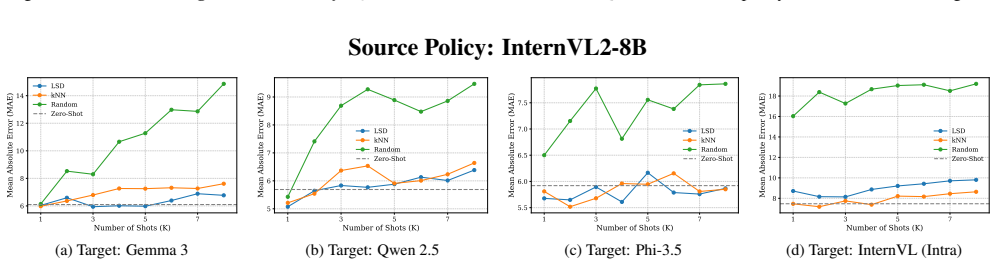
- A single LSD policy trained with one MLLM's reward signals transfers to other MLLMs, matching or beating kNN, indicating the learned heuristic is not tightly coupled to one model's architecture.
- The agent implicitly learns label-aware selection without ever seeing labels, picking demonstrations closer in label space to the query—an emergent behavior that correlates with the task's underlying structure.
- The learned selection order matters less than the set itself; shuffling the same demonstrations yields nearly identical performance, suggesting the agent's main skill is selecting a good set rather than ordering it.
- The objective/subjective dichotomy likely generalizes to text-based in-context learning: factual tasks may benefit from diverse boundary examples, while stylistic tasks favor similarity. This is testable on LLM benchmarks.
- The paper's evaluation uses MAE, which aligns with the reward; under other metrics such as correlation coefficients the same policy might behave differently, a question the paper does not address.
- The dichotomy may depend on the MLLM's perception of task objectivity; a model that treats aesthetics as objective might benefit from the diversity policy, suggesting selection should condition on model uncertainty rather than the data's label source.
Editorial analysis
A structured set of objections, weighed in public.
Referee Report
Summary. This paper proposes LSD, a reinforcement-learning approach to selecting in-context demonstrations for MLLM visual regression. Selection is cast as a finite-horizon MDP; a Dueling DQN with a query-centric Transformer decoder outputs an advantage query, and FAISS retrieves candidate demos from a large action space. The policy is trained on reward increments tied to downstream MAE. Experiments on UTKFace, AVA, SCUT-FBP5500, KonIQ-10k, and KADID-10k compare LSD against kNN and random selection and report a task-dependent dichotomy: LSD is claimed to be strictly necessary for objective regression tasks, while kNN remains best for subjective preference tasks.
Significance. If the dichotomy were established, the paper would be a useful practical contribution: it would show when learned sequential selection pays off in visual ICL and would demonstrate a scalable DQN/FAISS design for large action spaces. The authors provide a code/project page and include cross-model transfer experiments, which are strengths. However, the current evidence does not support the strong conclusion: the evaluation protocol appears to give LSD an extra demonstration, and key numbers are internally inconsistent. These issues must be resolved before the claimed dichotomy can be assessed.
major comments (4)
- [Sec. 3.1, Appendix C.5, Table 1] The MDP's initial state already includes an anchor nearest-neighbor demonstration, and each of the K actions adds one more. The final LSD prompt therefore contains K+1 demonstrations unless the anchor is counted within K. The paper never states how the anchor is handled in Table 1's LSD-K columns. If it is not counted, LSD-K is compared against K-shot kNN/Random, and the growing gap (e.g., UTKFace: 0.08 at K=1 to 1.00 at K=4) is consistent with an extra-shot advantage. If it is counted within K, LSD-K=1 should reduce to kNN-K=1 (both the nearest neighbor), yet Table 1 reports 5.90 vs 5.98. No consistent reading supports the headline comparison.
- [Table 7 vs. Table 1] The same evaluation setup reports sharply different numbers in Table 7 and Table 1 for identical conditions. For example, 0-shot MAE on KonIQ-10k is 0.78 in Table 7 but 0.42 in Table 1; SCUT-FBP5500 is 1.07 vs 0.59; KADID-10k is 1.13 vs 0.94. kNN at K=1 also differs (KonIQ 0.73 vs 0.40). No error bars or seeds are reported anywhere. These discrepancies are too large to be dismissed as sampling noise and mean the numerical superiority in Table 1 cannot be interpreted as a stable finding.
- [Appendix C.3, Sec. 4.4] The paper states that demonstrations are retrieved from an 80% pool and that 1,000 queries are sampled from the 20% query set for evaluation, but it never states that the RL agent's training rewards were computed on queries disjoint from that evaluation subset. If the same queries generated training rewards, the reported MAE gains are fitted values rather than predictions. This is load-bearing because the central claim is an empirical comparison. The authors must clarify the split and, if needed, retrain on a disjoint query set.
- [Table 6 / Figure 8] Appendix E contains a direct contradiction: the Figure 8 caption claims the Gemma-trained policy 'consistently beat[s] kNN on Qwen and InternVL,' but Table 6 shows LSD (Gemma) on InternVL2-8B with MAE 10.62 vs. kNN 7.38, i.e., substantially worse. This undermines the cross-model generalization narrative and suggests selective reporting.
minor comments (5)
- [Sec. 4.4] There is a typo: 'SCUT-FB5500' should be 'SCUT-FBP5500'. Also, a related-work paragraph uses 'IDCL' instead of 'ICL'.
- [Sec. 4.4.2, Fig. 3] The so-called 'emergent label-awareness' is not emergent: the reward is a function of label MAE, so selecting demos with close labels is a direct consequence of reward optimization rather than an unanticipated side effect.
- [Table 2] For UTKFace, shuffling the learned order improves MAE from 7.05 to 6.51; calling this 'nearly identical' is misleading and should be reworded.
- [Sec. 4.3 / C.3] No random seeds or repeated-run statistics are reported. Given the internal inconsistencies already noted, the authors should report mean and standard deviation over multiple seeds.
- [Sec. 3.1 / C.5] The counting of the anchor demonstration should be defined in the main text before any experiments. Currently Sec. 3.1 and C.5 conflict on whether the initial state is s0 or s1 and on whether the anchor is already a demonstration.
Circularity Check
LSD's reported 'K-shot' results likely include an extra anchor demonstration, making the central K-shot vs K-shot comparison confounded by shot count.
specific steps
-
self definitional
[Sec. 3.1 (MDP definition), Appendix C.5 (anchor initialization), Table 1]
"The initial state s1 contains the query and one 'anchor' demonstration found via nearest-neighbor search... The episode terminates when K demonstrations have been selected (t=K). ... To address the cold-start problem, the environment employs an anchor initialization strategy: the initial state s0 always includes the query image and its nearest neighbor (retrieved via FAISS) as the first demonstration."
The MDP defines each episode as starting with an anchor demo and then taking K actions, each adding a new demo, so the final prompt contains the anchor plus K selected demos = K+1 demonstrations. The kNN baseline selects exactly K samples. Table 1 reports 'LSD (Ours)' at K=1,4,8,16 against kNN at the same K, but the LSD numbers are, by construction, K+1-shot. At K=1, LSD would equal kNN if the anchor were counted within K, yet Table 1 reports different MAEs (5.90 vs 5.98), confirming that K in Table 1 is not the total number of demonstrations for LSD. Thus the claimed superiority on objective tasks is confounded with an extra demonstration, and the conclusion that the learned policy is 'strictly necessary' reduces to an asymmetric shot count.
full rationale
The paper contains no load-bearing self-citations and no uniqueness theorem imported from the authors' prior work; the cross-MLLM and cross-dataset transfer experiments provide some independent grounding. However, the central in-domain comparison in Table 1 is undermined by the anchor initialization: the MDP in Sec. 3.1 and the appendix's description of s0 imply that LSD final prompts contain the nearest-neighbor anchor plus K agent-selected demonstrations, i.e., K+1 demos, while the kNN and Random baselines use K demos. The inconsistency at K=1 (LSD ≠ kNN when both should be just the nearest neighbor if the anchor is counted within K) indicates that the reported LSD-K columns are not K-shot by the same definition as the baselines. This makes the paper's central dichotomy ('kNN optimal for subjective, LSD strictly necessary for objective') rest at least partly on an extra-shot effect rather than on the learned selection policy. In addition, the paper explicitly selects MAE as the evaluation metric because it is the training reward, which is a limitation but not itself circular; and the training/evaluation query split is not fully specified, leaving open the possibility of reward overfitting, though this is not demonstrated. Weighing the construction-level shot-count confound against the independent transfer evidence, the partial circularity score is 6.
Axiom & Free-Parameter Ledger
free parameters (6)
- Reward scaling lambda =
10.0
- Task-specific reward multipliers =
10 (aesthetic), 20 (quality/beauty)
- FAISS candidate count N =
200
- Anchor initialization count =
1 extra demo
- Dataset cap N_max =
25,000
- Evaluation query sample size =
1,000
axioms (4)
- domain assumption SigLIP embeddings and top-200 FAISS retrieval cover all actions the policy can ever select.
- domain assumption The MLLM's MAE on individual queries is a stable, informative reward for sequential selection.
- domain assumption Training reward queries and evaluation queries are drawn from separate distributions.
- domain assumption Dueling DQN with ANN-approximated max converges to a policy that maximizes prompt quality.
read the original abstract
Multimodal Large Language Models (MLLMs) adapt to visual tasks via in-context learning (ICL), which relies heavily on demonstration quality. The dominant demonstration selection strategy is unsupervised k-Nearest Neighbor (kNN) search. While simple, this similarity-first approach is sub-optimal for complex factual regression tasks; it selects redundant examples that fail to capture the task's full output range. We reframe selection as a sequential decision-making problem and introduce Learning to Select Demonstrations (LSD), training a Reinforcement Learning agent to construct optimal demonstration sets. Using a Dueling DQN with a query-centric Transformer Decoder, our agent learns a policy that maximizes MLLM downstream performance. Evaluating across five visual regression benchmarks, we uncover a crucial dichotomy: while kNN remains optimal for subjective preference tasks, LSD significantly outperforms baselines on objective, factual regression tasks. By balancing visual relevance with diversity, LSD better defines regression boundaries, illuminating when learned selection is strictly necessary for visual ICL.
Figures




Reference graph
Works this paper leans on
-
[1]
Phi-4 technical report.arXiv preprint arXiv:2412.08905, 2024
Marah Abdin, Jyoti Aneja, Harkirat Behl, S ´ebastien Bubeck, Ronen Eldan, Suriya Gunasekar, Michael Harrison, Russell J Hewett, Mojan Javaheripi, Piero Kauffmann, et al. Phi-4 technical report.arXiv preprint arXiv:2412.08905, 2024. 5
Pith/arXiv arXiv 2024
-
[2]
Shengnan An, Zeqi Lin, Qiang Fu, Bei Chen, Nanning Zheng, Jian-Guang Lou, and Dongmei Zhang. How do in- context examples affect compositional generalization?arXiv preprint arXiv:2305.04835, 2023. 2
Pith/arXiv arXiv 2023
-
[3]
Shuai Bai, Keqin Chen, Xuejing Liu, Jialin Wang, Wenbin Ge, Sibo Song, Kai Dang, Peng Wang, Shijie Wang, Jun Tang, et al. Qwen2. 5-vl technical report.arXiv preprint arXiv:2502.13923, 2025. 5
Pith/arXiv arXiv 2025
-
[4]
Editing factual knowledge in language models.arXiv preprint arXiv:2104.08164, 2021
Nicola De Cao, Wilker Aziz, and Ivan Titov. Editing factual knowledge in language models.arXiv preprint arXiv:2104.08164, 2021. 1
Pith/arXiv arXiv 2021
-
[5]
Is gpt-3 a good data annotator?arXiv preprint arXiv:2212.10450, 2022
Bosheng Ding, Chengwei Qin, Linlin Liu, Yew Ken Chia, Shafiq Joty, Boyang Li, and Lidong Bing. Is gpt-3 a good data annotator?arXiv preprint arXiv:2212.10450, 2022. 1
Pith/arXiv arXiv 2022
-
[6]
A survey on in-context learning.arXiv preprint arXiv:2301.00234, 2022
Qingxiu Dong, Lei Li, Damai Dai, Ce Zheng, Jingyuan Ma, Rui Li, Heming Xia, Jingjing Xu, Zhiyong Wu, Tianyu Liu, et al. A survey on in-context learning.arXiv preprint arXiv:2301.00234, 2022. 1
Pith/arXiv arXiv 2022
-
[7]
The faiss library
Matthijs Douze, Alexandr Guzhva, Chengqi Deng, Jeff Johnson, Gergely Szilvasy, Pierre-Emmanuel Mazar´e, Maria Lomeli, Lucas Hosseini, and Herv´e J´egou. The faiss library
-
[8]
Towards multimodal in-context learning for vi- sion and language models
Sivan Doveh, Shaked Perek, M Jehanzeb Mirza, Wei Lin, Amit Alfassy, Assaf Arbelle, Shimon Ullman, and Leonid Karlinsky. Towards multimodal in-context learning for vi- sion and language models. InEuropean Conference on Com- puter Vision, pages 250–267. Springer, 2024. 3
2024
-
[9]
Deep reinforcement learning in large discrete action spaces
Gabriel Dulac-Arnold, Richard Evans, Hado van Hasselt, Peter Sunehag, Timothy Lillicrap, Jonathan Hunt, Timothy Mann, Theophane Weber, Thomas Degris, and Ben Coppin. Deep reinforcement learning in large discrete action spaces. arXiv preprint arXiv:1512.07679, 2015. 12
Pith/arXiv arXiv 2015
-
[10]
In-context learning enables multimodal large language models to classify cancer pathology images.Na- ture Communications, 15(1):10104, 2024
Dyke Ferber, Georg W ¨olflein, Isabella C Wiest, Marta Ligero, Srividhya Sainath, Narmin Ghaffari Laleh, Omar SM El Nahhas, Gustav M ¨uller-Franzes, Dirk J ¨ager, Daniel Truhn, et al. In-context learning enables multimodal large language models to classify cancer pathology images.Na- ture Communications, 15(1):10104, 2024. 2
2024
-
[11]
What makes good few-shot examples for vision-language models?arXiv preprint arXiv:2405.13532,
Zhaojun Guo, Jinghui Lu, Xuejing Liu, Rui Zhao, ZhenXing Qian, and Fei Tan. What makes good few-shot examples for vision-language models?arXiv preprint arXiv:2405.13532,
-
[12]
Yaru Hao, Yutao Sun, Li Dong, Zhixiong Han, Yux- ian Gu, and Furu Wei. Structured prompting: Scaling in-context learning to 1,000 examples.arXiv preprint arXiv:2212.06713, 2022. 2
Pith/arXiv arXiv 2022
-
[13]
Koniq-10k: An ecologically valid database for deep learning of blind image quality assessment.IEEE Transactions on Image Processing, 29:4041–4056, 2020
Vlad Hosu, Hanhe Lin, Tamas Sziranyi, and Dietmar Saupe. Koniq-10k: An ecologically valid database for deep learning of blind image quality assessment.IEEE Transactions on Image Processing, 29:4041–4056, 2020. 5
2020
-
[14]
Hanieh Khorashadizadeh, Nandana Mihindukulasooriya, Sanju Tiwari, Jinghua Groppe, and Sven Groppe. Explor- ing in-context learning capabilities of foundation models for generating knowledge graphs from text.arXiv preprint arXiv:2305.08804, 2023. 1
Pith/arXiv arXiv 2023
-
[15]
Hyuhng Joon Kim, Hyunsoo Cho, Junyeob Kim, Taeuk Kim, Kang Min Yoo, and Sang-goo Lee. Self-generated in-context learning: Leveraging auto-regressive language models as a demonstration generator.arXiv preprint arXiv:2206.08082,
-
[16]
In-context compositional general- ization for large vision-language models
Chuanhao Li, Chenchen Jing, Zhen Li, Mingliang Zhai, Yuwei Wu, and Yunde Jia. In-context compositional general- ization for large vision-language models. InProceedings of the 2024 Conference on Empirical Methods in Natural Lan- guage Processing, pages 17954–17966, 2024. 2
2024
-
[17]
Deep instance-level hard negative min- ing model for histopathology images
Meng Li, Lin Wu, Arnold Wiliem, Kun Zhao, Teng Zhang, and Brian Lovell. Deep instance-level hard negative min- ing model for histopathology images. InInternational con- ference on medical image computing and computer-assisted intervention, pages 514–522. Springer, 2019. 2
2019
-
[18]
Advancing multimodal in-context learning in large vision-language models with task-aware demonstra- tions
Yanshu Li. Advancing multimodal in-context learning in large vision-language models with task-aware demonstra- tions. InWorkshop on Reasoning and Planning for Large Language Models. 2
-
[19]
Scut-fbp5500: A diverse benchmark dataset for multi-paradigm facial beauty prediction
Lingyu Liang, Luojun Lin, Lianwen Jin, Duorui Xie, and Mengru Li. Scut-fbp5500: A diverse benchmark dataset for multi-paradigm facial beauty prediction. In2018 24th In- ternational conference on pattern recognition (ICPR), pages 1598–1603. IEEE, 2018. 5
2018
-
[20]
Kadid-10k: A large-scale artificially distorted iqa database
Hanhe Lin, Vlad Hosu, and Dietmar Saupe. Kadid-10k: A large-scale artificially distorted iqa database. In2019 Eleventh International Conference on Quality of Multimedia Experience (QoMEX), pages 1–3. IEEE, 2019. 5
2019
-
[21]
What makes good in-context examples for gpt-3?arXiv preprint arXiv:2101.06804, 2021
Jiachang Liu, Dinghan Shen, Yizhe Zhang, Bill Dolan, Lawrence Carin, and Weizhu Chen. What makes good in-context examples for gpt-3?arXiv preprint arXiv:2101.06804, 2021. 1, 2, 3, 4, 5
Pith/arXiv arXiv 2021
-
[22]
Yinpeng Liu, Jiawei Liu, Xiang Shi, Qikai Cheng, Yong Huang, and Wei Lu. Let’s learn step by step: Enhancing in-context learning ability with curriculum learning.arXiv preprint arXiv:2402.10738, 2024. 1, 2, 4
Pith/arXiv arXiv 2024
-
[23]
Katerina Margatina, Timo Schick, Nikolaos Aletras, and Jane Dwivedi-Yu. Active learning principles for in-context learning with large language models.arXiv preprint arXiv:2305.14264, 2023. 2
Pith/arXiv arXiv 2023
-
[24]
Using in-context learning to improve dialogue safety.arXiv preprint arXiv:2302.00871, 2023
Nicholas Meade, Spandana Gella, Devamanyu Hazarika, Prakhar Gupta, Di Jin, Siva Reddy, Yang Liu, and Dilek Hakkani-T¨ur. Using in-context learning to improve dialogue safety.arXiv preprint arXiv:2302.00871, 2023. 1
Pith/arXiv arXiv 2023
-
[25]
Ava: A large-scale database for aesthetic visual analysis
Naila Murray, Luca Marchesotti, and Florent Perronnin. Ava: A large-scale database for aesthetic visual analysis. In2012 IEEE conference on computer vision and pattern recognition, pages 2408–2415. IEEE, 2012. 5
2012
-
[26]
Differentially private in-context learning
Ashwinee Panda, Tong Wu, Jiachen Wang, and Prateek Mit- tal. Differentially private in-context learning. InThe 61st Annual Meeting Of The Association For Computational Lin- guistics, 2023. 1
2023
-
[27]
A call to reflect on eval- uation practices for age estimation: Comparative analysis of the state-of-the-art and a unified benchmark
Jakub Paplh ´am, V ojt Franc, et al. A call to reflect on eval- uation practices for age estimation: Comparative analysis of the state-of-the-art and a unified benchmark. InProceedings of the IEEE/CVF Conference on Computer Vision and Pat- tern Recognition, pages 1196–1205, 2024. 6
2024
-
[28]
Sample efficient demonstration selection for in-context learning
Kiran Purohit, V Venktesh, Sourangshu Bhattacharya, and Avishek Anand. Sample efficient demonstration selection for in-context learning. InForty-second International Con- ference on Machine Learning. 2
-
[29]
In-context learning with iterative demon- stration selection.arXiv preprint arXiv:2310.09881, 2023
Chengwei Qin, Aston Zhang, Chen Chen, Anirudh Dagar, and Wenming Ye. In-context learning with iterative demon- stration selection.arXiv preprint arXiv:2310.09881, 2023. 1, 2
Pith/arXiv arXiv 2023
-
[30]
In- context retrieval-augmented language models.Transactions of the Association for Computational Linguistics, 11:1316– 1331, 2023
Ori Ram, Yoav Levine, Itay Dalmedigos, Dor Muhlgay, Am- non Shashua, Kevin Leyton-Brown, and Yoav Shoham. In- context retrieval-augmented language models.Transactions of the Association for Computational Linguistics, 11:1316– 1331, 2023. 1
2023
-
[31]
Learn- ing to retrieve prompts for in-context learning.arXiv preprint arXiv:2112.08633, 2021
Ohad Rubin, Jonathan Herzig, and Jonathan Berant. Learn- ing to retrieve prompts for in-context learning.arXiv preprint arXiv:2112.08633, 2021. 2, 3
Pith/arXiv arXiv 2021
-
[32]
Eshaan Tanwar, Subhabrata Dutta, Manish Borthakur, and Tanmoy Chakraborty. Multilingual llms are better cross- lingual in-context learners with alignment.arXiv preprint arXiv:2305.05940, 2023. 1
Pith/arXiv arXiv 2023
-
[33]
Gemma 3 technical report.arXiv preprint arXiv:2503.19786, 2025
Gemma Team, Aishwarya Kamath, Johan Ferret, Shreya Pathak, Nino Vieillard, Ramona Merhej, Sarah Perrin, Ta- tiana Matejovicova, Alexandre Ram ´e, Morgane Rivi `ere, et al. Gemma 3 technical report.arXiv preprint arXiv:2503.19786, 2025. 5
Pith/arXiv arXiv 2025
-
[34]
Regres- sion or classification? new methods to evaluate no-reference picture and video quality models
Zhengzhong Tu, Chia-Ju Chen, Li-Heng Chen, Yilin Wang, Neil Birkbeck, Balu Adsumilli, and Alan C Bovik. Regres- sion or classification? new methods to evaluate no-reference picture and video quality models. InICASSP 2021-2021 IEEE International Conference on Acoustics, Speech and Signal Processing (ICASSP), pages 2085–2089. IEEE, 2021. 6
2021
-
[35]
Attention is all you need.Advances in neural information processing systems, 30, 2017
Ashish Vaswani, Noam Shazeer, Niki Parmar, Jakob Uszko- reit, Llion Jones, Aidan N Gomez, Łukasz Kaiser, and Illia Polosukhin. Attention is all you need.Advances in neural information processing systems, 30, 2017. 4
2017
-
[36]
In-context example retrieval from multi- perspectives for few-shot aspect-based sentiment analysis
Qianlong Wang, Hongling Xu, Keyang Ding, Bin Liang, and Ruifeng Xu. In-context example retrieval from multi- perspectives for few-shot aspect-based sentiment analysis. In Proceedings of the 2024 Joint International Conference on Computational Linguistics, Language Resources and Evalu- ation (LREC-COLING 2024), pages 8975–8985, 2024. 1
2024
-
[37]
Want to reduce labeling cost? gpt-3 can help.arXiv preprint arXiv:2108.13487, 2021
Shuohang Wang, Yang Liu, Yichong Xu, Chenguang Zhu, and Michael Zeng. Want to reduce labeling cost? gpt-3 can help.arXiv preprint arXiv:2108.13487, 2021. 1
Pith/arXiv arXiv 2021
-
[38]
Large language models are im- plicitly topic models: Explaining and finding good demon- strations for in-context learning
Xinyi Wang, Wanrong Zhu, Michael Saxon, Mark Steyvers, and William Yang Wang. Large language models are im- plicitly topic models: Explaining and finding good demon- strations for in-context learning. InWorkshop on efficient systems for foundation models@ icml2023, 2023. 1, 2, 3
2023
-
[39]
Xubin Wang, Jianfei Wu, Yichen Yuan, Deyu Cai, Mingzhe Li, and Weijia Jia. Demonstration selection for in- context learning via reinforcement learning.arXiv preprint arXiv:2412.03966, 2024. 2, 3
Pith/arXiv arXiv 2024
-
[40]
Dueling network architectures for deep reinforcement learning
Ziyu Wang, Tom Schaul, Matteo Hessel, Hado Hasselt, Marc Lanctot, and Nando Freitas. Dueling network architectures for deep reinforcement learning. InInternational conference on machine learning, pages 1995–2003. PMLR, 2016. 3
1995
-
[41]
Chain-of-thought prompting elicits reasoning in large lan- guage models.Advances in neural information processing systems, 35:24824–24837, 2022
Jason Wei, Xuezhi Wang, Dale Schuurmans, Maarten Bosma, Fei Xia, Ed Chi, Quoc V Le, Denny Zhou, et al. Chain-of-thought prompting elicits reasoning in large lan- guage models.Advances in neural information processing systems, 35:24824–24837, 2022. 1
2022
-
[42]
Wenxiao Wu, Jing-Hao Xue, Chengming Xu, Chen Liu, Xin- wei Sun, Changxin Gao, Nong Sang, and Yanwei Fu. To- wards reliable and holistic visual in-context learning prompt selection.arXiv preprint arXiv:2509.25989, 2025. 2
arXiv 2025
-
[43]
The role of diversity in in-context learning for large language models
Wenyang Xiao, Haoyu Zhao, and Lingxiao Huang. The role of diversity in in-context learning for large language models. arXiv preprint arXiv:2505.19426, 2025. 2
Pith/arXiv arXiv 2025
-
[44]
Improving in-context learning with prediction feedback for sentiment analysis
Hongling Xu, Qianlong Wang, Yice Zhang, Min Yang, Xi Zeng, Bing Qin, and Ruifeng Xu. Improving in-context learning with prediction feedback for sentiment analysis. arXiv preprint arXiv:2406.02911, 2024. 1
Pith/arXiv arXiv 2024
-
[45]
Transferring rich deep features for facial beauty prediction.arXiv preprint arXiv:1803.07253, 2018
Lu Xu, Jinhai Xiang, and Xiaohui Yuan. Transferring rich deep features for facial beauty prediction.arXiv preprint arXiv:1803.07253, 2018. 6
Pith/arXiv arXiv 2018
-
[46]
Auto-icl: In- context learning without human supervision.arXiv preprint arXiv:2311.09263, 2023
Jinghan Yang, Shuming Ma, and Furu Wei. Auto-icl: In- context learning without human supervision.arXiv preprint arXiv:2311.09263, 2023. 2
Pith/arXiv arXiv 2023
-
[47]
Li Yang, Zengzhi Wang, Ziyan Li, Jin-Cheon Na, and Jian- fei Yu. An empirical study of multimodal entity-based sen- timent analysis with chatgpt: Improving in-context learning via entity-aware contrastive learning.Information Process- ing & Management, 61(4):103724, 2024. 1
2024
-
[48]
Representative demonstration selection for in-context learning with two-stage determinantal point pro- cess
Zhao Yang, Yuanzhe Zhang, Dianbo Sui, Cao Liu, Jun Zhao, and Kang Liu. Representative demonstration selection for in-context learning with two-stage determinantal point pro- cess. InProceedings of the 2023 Conference on Empirical Methods in Natural Language Processing, pages 5443–5456,
2023
-
[49]
Large language models are contrastive reasoners
Liang Yao. Large language models are contrastive reasoners. arXiv preprint arXiv:2403.08211, 2024. 3
arXiv 2024
-
[50]
Compositional exemplars for in-context learn- ing
Jiacheng Ye, Zhiyong Wu, Jiangtao Feng, Tao Yu, and Ling- peng Kong. Compositional exemplars for in-context learn- ing. InInternational Conference on Machine Learning, pages 39818–39833. PMLR, 2023. 2
2023
-
[51]
Sigmoid loss for language image pre-training
Xiaohua Zhai, Basil Mustafa, Alexander Kolesnikov, and Lucas Beyer. Sigmoid loss for language image pre-training. InProceedings of the IEEE/CVF international conference on computer vision, pages 11975–11986, 2023. 3
2023
-
[52]
Wenxuan Zhang, Yue Deng, Bing Liu, Sinno Jialin Pan, and Lidong Bing. Sentiment analysis in the era of large language models: A reality check.arXiv preprint arXiv:2305.15005,
-
[53]
Active ex- ample selection for in-context learning.arXiv preprint arXiv:2211.04486, 2022
Yiming Zhang, Shi Feng, and Chenhao Tan. Active ex- ample selection for in-context learning.arXiv preprint arXiv:2211.04486, 2022. 2, 3
Pith/arXiv arXiv 2022
-
[54]
What makes good examples for visual in-context learning?Advances in Neural Information Processing Systems, 36:17773–17794,
Yuanhan Zhang, Kaiyang Zhou, and Ziwei Liu. What makes good examples for visual in-context learning?Advances in Neural Information Processing Systems, 36:17773–17794,
-
[55]
Age progres- sion/regression by conditional adversarial autoencoder
Zhifei Zhang, Yang Song, and Hairong Qi. Age progres- sion/regression by conditional adversarial autoencoder. In IEEE Conference on Computer Vision and Pattern Recogni- tion (CVPR). IEEE, 2017. 5
2017
-
[56]
Zheng Zhang, Shaocheng Lan, Lei Song, Jiang Bian, Yexin Li, and Kan Ren. Learning to select in-context demon- stration preferred by large language model.arXiv preprint arXiv:2505.19966, 2025. 2
Pith/arXiv arXiv 2025
-
[57]
Visual in-context learning for large vision-language models.arXiv preprint arXiv:2402.11574, 2024
Yucheng Zhou, Xiang Li, Qianning Wang, and Jianbing Shen. Visual in-context learning for large vision-language models.arXiv preprint arXiv:2402.11574, 2024. 2
Pith/arXiv arXiv 2024
-
[58]
Age:< y i >
Yan Zhu, Huan Ma, and Changqing Zhang. Exploring task- level optimal prompts for visual in-context learning. InPro- ceedings of the AAAI Conference on Artificial Intelligence, pages 11031–11039, 2025. 1 Learning to Select Visual In-Context Demonstrations Supplementary Material A. Prompt Construction and In-Context Learning We utilize a multimodal few-shot...
2025
discussion (0)
Sign in with ORCID, Apple, or X to comment. Anyone can read and Pith papers without signing in.