REVIEW 2 major objections 6 minor 300 references
Reviewed by Pith at T0; open to challenge.
T0 means a machine referee read the full paper against a public rubric. The mark states how deep the mechanical check went, never who wrote it. the ladder, T0–T4 →
T0 review · glm-5.2
Gamma-ray bursts reveal hidden star formation driving cosmic reionization
2026-07-09 05:01 UTC pith:IDF4NVXW
load-bearing objection LGRB-inferred SFRD at z=4-10 from 20 years of Swift data; reionization agreement depends on a log-linear fit that is poorly constrained at z>6.5 the 2 major comments →
Gamma-ray bursts reveal the history and faint contributors of cosmic reionization
The pith
A machine-rendered reading of the paper's core claim, the machinery that carries it, and where it could break.
Core claim
The central object is the LGRB-inferred cosmic star formation rate density at 4<z<10, derived by treating LGRBs as unbiased tracers of total star formation and calibrating their rate against known SFRD at z~4. This SFRD is higher than galaxy-survey estimates at z>6, and when used as input to the reionization equations with moderate fiducial parameters (xi_ion = 10^25.3 Hz erg^-1, f_esc = 0.1), it reproduces the full observed reionization history — neutral fraction evolution, ionizing emissivity, and CMB optical depth tau_e = 0.0544 ± 0.0073 — without requiring extreme ionizing efficiencies or escape fractions. The discrepancy between the LGRB-inferred SFRD and the galaxy-survey SFRD quantit3
What carries the argument
The ratio N_LGRB(z1,z2) / N_LGRB(3.5,4.5) scaled by the well-calibrated SFRD at z~4 and corrected for comoving volume and time dilation, yielding the SFRD at higher redshifts without requiring detailed modeling of the LGRB luminosity function. This SFRD then feeds the standard ionization equation dQ_HII/dt = n_ion/<n_H> - Q_HII/t_rec, where n_ion = f_esc * xi_ion * rho_UV and rho_UV is derived from the SFRD via the UV-to-SFR conversion K_UV.
Load-bearing premise
The entire argument rests on the assumption that LGRBs are unbiased tracers of total star formation at z>3, meaning the ratio of LGRB rate to SFRD is constant across redshift. If LGRB production efficiency evolves with redshift — for example because of changing metallicity distributions, jet opening angles, or progenitor physics — the calibration constant would not be redshift-independent and the inferred SFRD at z>6 would be systematically biased. With only 2-5 LGRBs per bin
What would settle it
If a future, larger LGRB sample at z>6 yields SFRD estimates that diverge from the reionization-consistent values derived here, or if LGRB host galaxy studies reveal that LGRB production efficiency evolves with redshift due to metallicity or progenitor physics, the calibration constant A would be redshift-dependent and the inferred high-z SFRD would be biased.
If this is right
- If faint galaxies below current detection limits contribute more than 50% of star formation at z>8, then current galaxy-survey-based SFRD measurements at high redshift are systematically underestimating the true cosmic star formation budget by a factor of two or more.
- The moderate fiducial parameters (xi_ion = 10^25.3, f_esc = 0.1) that successfully reproduce reionization remove the need for exotic stellar populations or extreme feedback-free escape channels, constraining the allowed parameter space for reionization models.
- Future GRB missions (THESEUS, Einstein Probe, SVOM) will substantially increase the high-redshift LGRB sample, tightening the SFRD constraints and testing whether LGRBs remain unbiased tracers of star formation at z>6.
- The evolving faint-end limiting magnitude (M_lim shifting from ~-14 at z~6 to ~-10 at z~10) makes a specific, testable prediction for the depth of galaxy luminosity functions that future deep JWST lensing surveys can directly verify.
Where Pith is reading between the lines
- If LGRB host galaxy luminosity functions at z>6 are measured and compared to the UV luminosity functions from galaxy surveys, the ratio of star formation in detected vs. undetected hosts would provide an independent cross-check of the faint-galaxy fraction inferred here.
- The claim that star formation in low-mass halos is increasingly suppressed at lower redshifts by UV background feedback could be tested by comparing the LGRB-inferred SFRD evolution with simulations that vary the strength of reionization feedback on small halos.
- If future LGRB samples at z>8 show the same SFRD as inferred here but with reduced Poisson errors, the consistency of the reionization prediction would either solidify or reveal systematic deviations in the LGRB-to-SFRD calibration that are currently hidden by small-number statistics.
Editorial analysis
A structured set of objections, weighed in public.
Referee Report
Summary. This Letter uses Swift LGRBs detected over ~20 years to estimate the cosmic SFRD at 4<z<10, treating LGRBs as unbiased tracers of star formation at z≳3. The SFRD is calibrated at z~4 against galaxy survey measurements and scaled to higher redshifts via observed LGRB counts. The resulting SFRD, parameterized as a log-linear decline (k=-0.15±0.02), is then used to compute the hydrogen reionization history (Q_HII, ionizing emissivity, CMB optical depth τ_e) with fiducial ξ_ion=10^25.3 Hz erg^-1 and f_esc=0.1. The authors find consistency with Planck τ_e and neutral fraction constraints, and further use the LGRB-inferred SFRD to constrain the faint-end limiting magnitudes of galaxy UV luminosity functions, finding M_lim evolving from ~-14 at z~6 to ~-10 at z~10.
Significance. The approach of using LGRBs as tracers of total star formation—including faint galaxies below direct detection limits—is a well-motivated independent probe of the high-redshift SFRD. The calibration method (Eq. 1) is clean and the reionization physics (Eqs. 4-8) is standard. The paper provides falsifiable predictions: specific τ_e and Q_HII histories tied to moderate ξ_ion and f_esc, and concrete M_lim values as a function of redshift. The use of the latest JWST constraints on ξ_ion (Begley et al. 2025; Pahl et al. 2025) grounds the reionization calculation in current data. The systematic compilation of 76 LGRBs at z≥3.5 (Table 1) is a useful community resource. However, the central quantitative claim—that the LGRB-inferred SFRD 'naturally' explains reionization—rests on a log-linear fit that is poorly constrained by the data at z>6.5, where individual bins contain 1-3 LGRBs.
major comments (2)
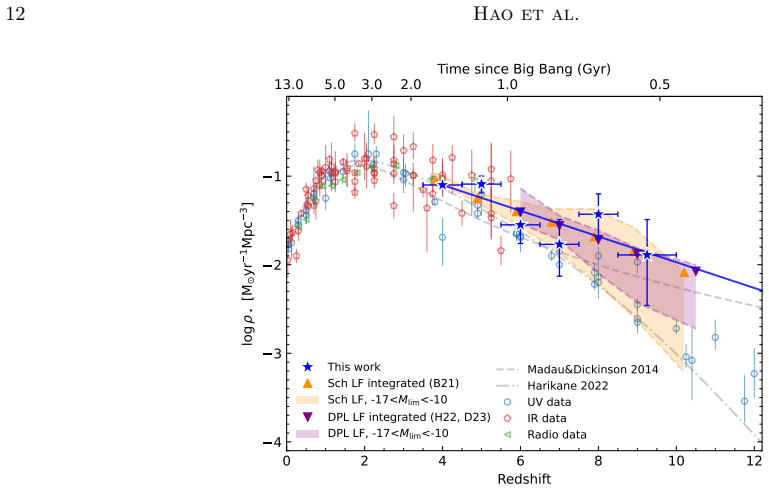
- §3, Eqs. (4)-(8): The reionization calculations use the log-linear fit (k=-0.15±0.02), not the individual binned SFRD measurements. This fit is driven by the z=4-6 bins where statistics are adequate (~15-20 events per bin), but at z>6.5 the bins contain 1-3 LGRBs each (z=6.5-7.5: 2 events; z=7.5-8.5: 3; z=8.5-10: 1). The Poisson errors (~0.3-0.5 dex) are consistent with substantially steeper decline rates (k~-0.3) that would reduce the z>8 SFRD by ~0.6 dex and likely break the reionization agreement with moderate ξ_ion and f_esc. The paper should explicitly quantify how sensitive the reionization predictions (τ_e, Q_HII midpoint) are to the fit slope k, e.g., by showing results for k=-0.25 or k=-0.30 within the Poisson-allowed range. Without this, the claim that the SFRD 'naturally' explains reionization is a consistency check of the fit rather than of the data at z>6.5.
- §2, Figure 2: The z=7.5-8.5 bin shows log SFRD=-1.43, which is higher (more star formation) than the z=6.5-7.5 bin at -1.77. This unphysical uptick is within Poisson errors but illustrates that the high-z data cannot constrain the SFRD shape. The log-linear fit smooths over this, but the fit's goodness-of-fit at z>6.5 is not reported. Please provide a quantitative fit-quality metric (e.g., χ² or equivalent) for the log-linear model restricted to z>6.5, or acknowledge more explicitly that the fit is an extrapolation from lower redshifts rather than a data-driven result at z>6.5. This is load-bearing because the reionization predictions depend entirely on the fit, not the binned data.
minor comments (6)
- §2: The statement 'our inferred SFRD values should be considered as conservative estimates' because 'any excess detections of LGRBs at z>6 only lead to even higher star formation rates' is not self-evidently true—if the calibration constant A evolves with redshift due to metallicity or progenitor physics, the bias could go in either direction. A brief clarification would help.
- §2, Eq. (2): The k-correction formula k(z)=[(1+z)/(1+2)]^(Γ-2) appears to use a fixed rest-frame energy band reference (2 keV?) without explicit definition. Please clarify the meaning of the constant '2' in this expression.
- Figure 1: The luminosity threshold L_lim(z) is described as approximate. It would help to state explicitly how the luminosity cuts applied to each redshift bin (described in the text) relate to this threshold, perhaps by marking the cut values on the figure.
- §3: The choice of η=1 for z>4 and η=2 for z≤4 for helium ionization is a simplification. Given that the paper claims precision agreement with τ_e, a brief note on the sensitivity of τ_e to this prescription would be appropriate.
- §4, Eq. (12): The dust attenuation relation uses the IRX-β formalism from Meurer et al. (1999). At z>8 where the β-M_UV relation is extrapolated, the dust correction may be uncertain. A brief note on how this affects the derived M_lim values would strengthen the discussion.
- Table 1: The redshift of GRB090423 is listed as 8.23, while in the text it is sometimes referenced as z~8.2. Please verify consistency of all quoted redshift values between Table 1 and the bin assignments.
Simulated Author's Rebuttal
We thank the referee for a careful and constructive review. Both major comments are well-taken and address a genuine limitation of the current manuscript: the high-redshift LGRB statistics are sparse, and the reionization predictions rely on the log-linear fit rather than the individual binned measurements. We agree that quantifying the sensitivity of our reionization predictions to the fit slope, and providing an explicit goodness-of-fit metric at z>6.5, are necessary additions. We address each comment below.
read point-by-point responses
-
Referee: §3, Eqs. (4)-(8): The reionization calculations use the log-linear fit (k=-0.15±0.02), not the individual binned SFRD measurements. This fit is driven by the z=4-6 bins where statistics are adequate (~15-20 events per bin), but at z>6.5 the bins contain 1-3 LGRBs each. The Poisson errors (~0.3-0.5 dex) are consistent with substantially steeper decline rates (k~-0.3) that would reduce the z>8 SFRD by ~0.6 dex and likely break the reionization agreement with moderate ξ_ion and f_esc. The paper should explicitly quantify how sensitive the reionization predictions (τ_e, Q_HII midpoint) are to the fit slope k, e.g., by showing results for k=-0.25 or k=-0.30 within the Poisson-allowed range. Without this, the claim that the SFRD 'naturally' explains reionization is a consistency check of the fit rather than of the data at z>6.5.
Authors: The referee is correct that the reionization predictions depend on the log-linear fit and that the high-redshift bins (z>6.5) contain too few LGRBs to independently constrain the slope. We accept this point and will add the requested sensitivity analysis in the revised manuscript. Specifically, we will recompute τ_e and the Q_HII history for k = -0.20, -0.25, and -0.30, holding the normalization at z~4 fixed (log ρ̇⋆(z~4) = -1.10) and keeping the fiducial ξ_ion = 10^{25.3} Hz erg^{-1} and f_esc = 0.1. We will present these as additional curves in Figures 3 and 4, and will state quantitatively how the reionization midpoint and τ_e shift. We expect that steeper slopes will reduce τ_e and delay the reionization midpoint, and we will report honestly whether k = -0.25 or k = -0.30 remains consistent with Planck τ_e and the neutral fraction constraints within their respective uncertainties. We will also revise the language in the abstract and Section 3 to qualify the word 'naturally' — making clear that the agreement with reionization observables holds for the best-fit slope and that steeper slopes within the Poisson-allowed range at z>6.5 would degrade this agreement, so the conclusion is contingent on the SFRD decline being genuinely shallow as suggested by (but not uniquely determined by) the current LGRB data. revision: yes
-
Referee: §2, Figure 2: The z=7.5-8.5 bin shows log SFRD=-1.43, which is higher than the z=6.5-7.5 bin at -1.77. This unphysical uptick is within Poisson errors but illustrates that the high-z data cannot constrain the SFRD shape. The log-linear fit smooths over this, but the fit's goodness-of-fit at z>6.5 is not reported. Please provide a quantitative fit-quality metric (e.g., χ² or equivalent) for the log-linear model restricted to z>6.5, or acknowledge more explicitly that the fit is an extrapolation from lower redshifts rather than a data-driven result at z>6.5.
Authors: We agree. The uptick in the z=7.5-8.5 bin is a direct consequence of having only 3 LGRBs in that bin, and it does illustrate that the binned data at z>6.5 cannot meaningfully constrain the SFRD shape. In the revised manuscript, we will (1) add a quantitative goodness-of-fit metric for the log-linear model computed over all bins and separately for the z>6.5 bins, and (2) add explicit language stating that the log-linear fit at z>6.5 should be regarded as an extrapolation anchored by the better-sampled z~4-6 data, not a data-driven result at those redshifts. We will also note that the Poisson errors on the z>6.5 bins are large enough (~0.3-0.5 dex) that the binned data are statistically consistent with the fit, but also with substantially different slopes, which connects directly to the sensitivity analysis we will add in response to the first major comment. revision: yes
Circularity Check
No significant circularity; one load-bearing self-citation for the unbiased-tracer assumption, supported by external evidence
full rationale
The paper's derivation chain is largely self-contained against external data. The SFRD calibration (Eq. 1) uses external galaxy-survey SFRD measurements at z~4 (not the authors' own result) and independent LGRB counts at higher redshifts. The reionization calculation (Eqs. 4-8) uses the LGRB-inferred SFRD combined with ξ_ion and f_esc values drawn from independent JWST studies (Begley et al. 2025; Simmonds et al. 2024; Cullen et al. 2024), and standard physics equations. The τ_e prediction is compared against the external Planck measurement, not fitted to it. The faint-galaxy magnitude limits (§4) are derived by comparing the LGRB-inferred SFRD against independently fitted UV luminosity functions (Bouwens et al. 2021; Harikane et al. 2022; Donnan et al. 2023). The one load-bearing self-citation is Hao et al. 2020 for the claim that LGRBs are unbiased tracers of SFRD at z≳3 (Section 1), which underpins the redshift-independence of calibration constant A. However, this claim is also supported by external citations (Greiner et al. 2015; Sears et al. 2024) comparing LGRB host galaxy luminosity functions to Lyman break galaxies, and the assumption is explicitly stated and discussed rather than hidden. The log-linear fit (k=-0.15) used in the reionization calculation is a parameterization of the authors' own SFRD data points, not a fit to reionization observables, so using it in §3 is not circular. No step reduces to its inputs by construction.
Axiom & Free-Parameter Ledger
free parameters (4)
- A =
calibrated to z=3.5-4.5 SFRD and LGRB counts
- k =
-0.15±0.02
- ξ_ion =
10^25.3 Hz erg^-1
- f_esc =
0.1
axioms (5)
- domain assumption LGRBs are unbiased tracers of total star formation at z≳3
- standard math Standard ΛCDM cosmology with Planck 2020 parameters
- domain assumption Salpeter IMF for SFR-UV luminosity conversion
- standard math Standard case B recombination at T=10^4 K
- domain assumption Clumping factor C_HII = 2.9[(1+z)/6]^-1.1
read the original abstract
Star-forming galaxies are generally believed to be the main drivers of cosmic reionization. However, the relative contributions of bright and faint galaxies to this process remain unclear. As the most luminous transient phenomena in the universe, long gamma-ray bursts (LGRBs) provide a unique opportunity to probe star formation occurring in both detectable and undetectable galaxies. In this Letter, we present new estimates of the cosmic star formation rate density (SFRD) at $4<z<10$ using Swift LGRBs detected over the past two decades, by considering LGRBs as unbiased tracers of total star formation at high redshifts. Crucially, we find that the new LGRB-inferred SFRD can naturally explain current measurements of hydrogen reionization without invoking extreme ionizing photon production efficiencies or escape fractions from galaxies. Using these LGRB-inferred SFRD values, we further investigate the faintest magnitude limits of high-redshift galaxies, finding a redshift evolution of the limiting magnitudes from $M_{\mathrm{lim}}\sim-14$ to $-15$ at $z\sim6$ to $M_{\mathrm{lim}}\sim-10$ to $-11$ at $z\sim10$. This result provides one independent piece of evidence for the presence of a large population of faint galaxies at redshifts $z\gtrsim6$, as an important complement to our understanding of the ionizing photon budget in the early universe.
Figures



Reference graph
Works this paper leans on
-
[1]
The Forbidden Abundance of Oxygen in the Sun , journal =. 2001 , volume =. doi:10.1086/322874 , eprint =
-
[2]
I - Spectral diversity , journal =
BATSE observations of gamma-ray burst spectra. I - Spectral diversity , journal =. 1993 , volume =. doi:10.1086/172995 , keywords =
-
[3]
Morphology and surface brightness profiles
Detecting reionization in the star formation histories of high-redshift galaxies , journal =. 2006 , volume =. doi:10.1111/j.1365-2966.2006.10674.x , eprint =
-
[4]
The Average Star Formation Histories of Galaxies in Dark Matter Halos from z=0-8
The Average Star Formation Histories of Galaxies in Dark Matter Halos from z = 0-8 , journal =. 2013 , volume =. arXiv , doi =:1207.6105 , keywords =
work page internal anchor Pith review Pith/arXiv arXiv 2013
-
[5]
The metallicity and star formation activity of long gamma-ray burst hosts for z 3: insights from the Illustris simulation , journal =. 2017 , volume =. arXiv , doi =:1706.03772 , keywords =
work page internal anchor Pith review Pith/arXiv arXiv 2017
-
[6]
The Prompt Energy Release of Gamma-Ray Bursts using a Cosmological k-Correction , journal =. 2001 , volume =. doi:10.1086/321093 , eprint =
-
[7]
The observed ionization rate of the intergalactic medium and the ionizing emissivity at z. , year =. doi:10.1111/j.1365-2966.2007.12372.x , eprint =
-
[8]
Resolving Cosmic Structure Formation with the Millennium-II Simulation
Resolving cosmic structure formation with the Millennium-II Simulation , journal =. 2009 , volume =. arXiv , doi =:0903.3041 , keywords =
work page internal anchor Pith review Pith/arXiv arXiv 2009
-
[9]
The Expected Redshift Distribution of Gamma-Ray Bursts , journal =. 2002 , volume =. doi:10.1086/341189 , eprint =
-
[10]
The Cosmic Rate, Luminosity Function and Intrinsic Correlations of Long GRBs
The Cosmic Rate, Luminosity Function, and Intrinsic Correlations of Long Gamma-Ray Bursts , journal =. 2010 , volume =. arXiv , doi =:0910.3341 , file =
work page internal anchor Pith review Pith/arXiv arXiv 2010
-
[11]
A Complete Catalog of Swift Gamma-Ray Burst Spectra and Durations: Demise of a Physical Origin for Pre-Swift High-Energy Correlations , journal =. 2007 , volume =. arXiv , doi =:0706.1275 , keywords =
work page internal anchor Pith review Pith/arXiv arXiv 2007
-
[12]
Redshift distribution and luminosity function of long gamma-ray bursts from cosmological simulations
Redshift distribution and luminosity function of long gamma-ray bursts from cosmological simulations , journal =. 2010 , volume =. arXiv , doi =:1005.3700 , file =
work page internal anchor Pith review Pith/arXiv arXiv 2010
-
[13]
How common are long Gamma-Ray Bursts in the Local Universe?
, title =. 2007 , month = nov, pages =. arXiv , doi =:0708.2106 , keywords =
work page internal anchor Pith review Pith/arXiv arXiv 2007
-
[14]
Updating reionization scenarios after recent data , journal =. 2006 , volume =. doi:10.1111/j.1745-3933.2006.00207.x , eprint =
-
[15]
The 2dF galaxy redshift survey: near-infrared galaxy luminosity functions , journal =. 2001 , volume =. doi:10.1046/j.1365-8711.2001.04591.x , eprint =
-
[16]
A Stochastic Approach to Chemical Evolution , journal =. 1997 , volume =. doi:10.1086/304627 , eprint =
-
[17]
Monthly Notices of the Royal Astronomical Society , eprint =
The many lives of active galactic nuclei: cooling flows, black holes and the luminosities and colours of galaxies , journal =. 2006 , volume =. doi:10.1111/j.1365-2966.2005.09675.x , eprint =
-
[18]
Unveiling the Secrets of Metallicity and Massive Star Formation Using DLAs along Gamma-ray Bursts
Unveiling the Secrets of Metallicity and Massive Star Formation Using DLAs along Gamma-Ray Bursts , journal =. 2015 , volume =. arXiv , doi =:1408.3578 , keywords =
work page internal anchor Pith review Pith/arXiv arXiv 2015
-
[19]
A Photometric Redshift of z ~ 9.4 for GRB 090429B
A Photometric Redshift of z \. , year =. arXiv , doi =:1105.4915 , keywords =
work page internal anchor Pith review Pith/arXiv arXiv
-
[20]
Hierarchical Growth and Cosmic Star Formation: Enrichment, Outflows, and Supernova Rates , journal =. 2006 , volume =. doi:10.1086/503092 , eprint =
-
[21]
Morphology and surface brightness profiles
The redshift distribution of Swift gamma-ray bursts: evidence for evolution , journal =. 2006 , volume =. doi:10.1111/j.1365-2966.2006.10837.x , eprint =
-
[22]
Morphology and surface brightness profiles
The hierarchical formation of the brightest cluster galaxies , journal =. 2007 , volume =. doi:10.1111/j.1365-2966.2006.11287.x , eprint =
-
[23]
Cosmic Evolution of Long Gamma-Ray Burst Luminosity
, title =. 2016 , month = mar, pages =. arXiv , doi =:1601.07645 , keywords =
work page internal anchor Pith review Pith/arXiv arXiv 2016
-
[24]
The contribution of star formation and merging to stellar mass buildup in galaxies
The Contribution of Star Formation and Merging to Stellar Mass Buildup in Galaxies , journal =. 2008 , volume =. arXiv , doi =:0803.1489 , keywords =
work page internal anchor Pith review Pith/arXiv arXiv 2008
-
[25]
The long gamma-ray burst rate and the correlation with host galaxy properties
The long. , year =. arXiv , doi =:1202.1225 , keywords =
work page internal anchor Pith review Pith/arXiv arXiv
-
[26]
The First Billion Years project: gamma-ray bursts at z>5
, title =. 2015 , month = feb, pages =. arXiv , doi =:1408.2526 , keywords =
work page internal anchor Pith review Pith/arXiv arXiv 2015
-
[27]
IPAW 2020 Preprint: Efficient Computation of Provenance for Query Result Exploration
Observational Constraints on Cosmic Reionization , journal =. 2006 , volume =. doi:10.1146/annurev.astro.44.051905.092514 , eprint =
work page internal anchor Pith review Pith/arXiv arXiv doi:10.1146/annurev.astro.44.051905.092514 2006
-
[28]
The ultra-long Gamma-Ray Burst 111209A: the collapse of a blue supergiant?
, title =. 2013 , month = mar, pages =. arXiv , doi =:1212.2392 , keywords =
work page internal anchor Pith review Pith/arXiv arXiv 2013
-
[29]
The Relative Rate of LGRB Formation as a Function of Metallicity
The Relative Rate of LGRB Formation as a Function of Metallicity , journal =. 2017 , volume =. arXiv , doi =:1511.01079 , keywords =
work page internal anchor Pith review Pith/arXiv arXiv 2017
-
[30]
, title =. 2013 , month = sep, pages =. arXiv , doi =:1211.7068 , keywords =
work page internal anchor Pith review Pith/arXiv arXiv 2013
-
[31]
Unusually High Metallicity Host Of The Dark LGRB 051022
Unusually High Metallicity Host Of The Dark LGRB 051022 , booktitle =. 2009 , editor =. arXiv , doi =:0903.5544 , keywords =
work page internal anchor Pith review Pith/arXiv arXiv 2009
-
[32]
Gamma-Ray Bursts Trace UV Metrics of Star Formation over 3 < z < 5
Gamma-Ray Bursts Trace UV Metrics of Star Formation over 3 z 5 , journal =. 2015 , volume =. arXiv , doi =:1503.05323 , keywords =
work page internal anchor Pith review Pith/arXiv arXiv 2015
-
[33]
The nature of "dark" gamma-ray bursts
The nature of ``dark'' gamma-ray bursts , journal =. 2011 , volume =. arXiv , doi =:1011.0618 , keywords =
work page internal anchor Pith review Pith/arXiv arXiv 2011
-
[34]
Revisiting the Relationship between the Long GRB Rate and Cosmic Star Formation History Based on a Large Swift Sample , journal =. 2020 , volume =. arXiv , doi =:2005.07630 , keywords =
work page internal anchor Pith review Pith/arXiv arXiv 2020
-
[35]
Is the metallicity of the progenitor of long gamma-ray bursts really low?
Is the Metallicity of the Progenitor of Long Gamma-Ray Bursts Really Low? , journal =. 2013 , volume =. arXiv , doi =:1305.5165 , keywords =
work page internal anchor Pith review Pith/arXiv arXiv 2013
-
[36]
The optically unbiased GRB host (TOUGH) survey. I. Survey design and catalogs
, title =. 2012 , month = sep, pages =. arXiv , doi =:1205.3162 , keywords =
work page internal anchor Pith review Pith/arXiv arXiv 2012
-
[37]
A very energetic supernova associated with the. , year =. doi:10.1038/nature01750 , eprint =
-
[38]
Constraining the rate and luminosity function of Swift gamma-ray bursts
Constraining the rate and luminosity function of Swift gamma-ray bursts , journal =. 2014 , volume =. arXiv , doi =:1407.2333 , keywords =
work page internal anchor Pith review Pith/arXiv arXiv 2014
-
[39]
New light on gamma-ray burst host galaxies with Herschel
New light on gamma-ray burst host galaxies with Herschel , journal =. 2014 , volume =. arXiv , doi =:1402.4006 , keywords =
work page internal anchor Pith review Pith/arXiv arXiv 2014
-
[40]
Self-regulated reionization , journal =. 2007 , volume =. doi:10.1111/j.1365-2966.2007.11482.x , eprint =
-
[41]
Formation rates of core-collapse supernovae and gamma-ray bursts , journal =. 2004 , volume =. doi:10.1111/j.1365-2966.2004.07436.x , eprint =
-
[42]
Are long gamma-ray bursts biased tracers of star formation? Clues from the host galaxies of the Swift/BAT6 complete sample of bright LGRBs. II. Star formation rates and metallicities at z 1 , journal =. 2016 , volume =. arXiv , doi =:1604.01034 , keywords =
work page internal anchor Pith review Pith/arXiv arXiv 2016
- [43]
-
[44]
The Star Formation Rate in the Reionization Era as Indicated by Gamma-ray Bursts
The Star Formation Rate in the Reionization Era as Indicated by Gamma-Ray Bursts , journal =. 2009 , volume =. arXiv , doi =:0906.0590 , file =
work page internal anchor Pith review Pith/arXiv arXiv 2009
-
[45]
An Unexpectedly Swift Rise in the Gamma-ray Burst Rate
An Unexpectedly Swift Rise in the Gamma-Ray Burst Rate , journal =. 2008 , volume =. arXiv , doi =:0709.0381 , file =
work page internal anchor Pith review Pith/arXiv arXiv 2008
-
[46]
Metallicities of 0.3 z 1.0 Galaxies in the GOODS-North Field , journal =. 2004 , volume =. doi:10.1086/425299 , eprint =
-
[47]
Modeling The GRB Host Galaxy Mass Distribution: Are GRBs Unbiased Tracers of Star Formation?
Modeling the GRB Host Galaxy Mass Distribution: Are GRBs Unbiased Tracers of Star Formation? , journal =. 2009 , volume =. arXiv , doi =:0905.1953 , keywords =
work page internal anchor Pith review Pith/arXiv arXiv 2009
-
[48]
Far-infrared observations of an unbiased sample of gamma-ray burst host galaxies
Far-infrared observations of an unbiased sample of gamma-ray burst host galaxies , journal =. 2015 , volume =. arXiv , doi =:1501.01004 , keywords =
work page internal anchor Pith review Pith/arXiv arXiv 2015
-
[49]
Seven-Year Wilkinson Microwave Anisotropy Probe (WMAP) Observations: Cosmological Interpretation
Seven-year Wilkinson Microwave Anisotropy Probe (WMAP) Observations: Cosmological Interpretation , journal =. 2011 , volume =. arXiv , doi =:1001.4538 , keywords =
work page internal anchor Pith review Pith/arXiv arXiv 2011
-
[50]
Identification of two classes of gamma-ray bursts , journal =. 1993 , volume =. doi:10.1086/186969 , keywords =
-
[51]
The SEDs and Host Galaxies of the dustiest GRB afterglows
The SEDs and host galaxies of the dustiest GRB afterglows , journal =. 2011 , volume =. arXiv , doi =:1108.0674 , keywords =
work page internal anchor Pith review Pith/arXiv arXiv 2011
-
[52]
GRB hosts through cosmic time. VLT/X-Shooter emission-line spectroscopy of 96. , year =. arXiv , doi =:1505.06743 , keywords =
work page internal anchor Pith review Pith/arXiv arXiv
-
[53]
On the Collapsar Model of Long Gamma-Ray Bursts:Constraints from Cosmic Metallicity Evolution , journal =. 2006 , volume =. doi:10.1086/500363 , eprint =
-
[54]
A Turnover in the Galaxy Main Sequence of Star Formation at M _. , year =. arXiv , doi =:1501.01080 , keywords =
work page internal anchor Pith review Pith/arXiv arXiv
-
[55]
The Stellar Ages and Masses of Short Gamma-ray Burst Host Galaxies: Investigating the Progenitor Delay Time Distribution and the Role of Mass and Star Formation in the Short Gamma-ray Burst Rate , journal =. 2010 , volume =. arXiv , doi =:1009.1147 , keywords =
work page internal anchor Pith review Pith/arXiv arXiv 2010
-
[56]
A new population of ultra-long duration gamma-ray bursts
, title =. 2014 , month = jan, pages =. arXiv , doi =:1302.2352 , keywords =
work page internal anchor Pith review Pith/arXiv arXiv 2014
-
[57]
The Host Galaxies of Long-Duration Gamma-Ray Bursts
The Host Galaxies of Long-Duration Gamma-Ray Bursts , journal =. 2014 , volume =. arXiv , doi =:1302.4741 , primaryclass =
work page internal anchor Pith review Pith/arXiv arXiv 2014
-
[58]
The Host Galaxies of Gamma-ray Bursts. II. A Mass-metallicity Relation for Long-duration Gamma-ray Burst Host Galaxies , journal =. 2010 , volume =. arXiv , doi =:1006.3560 , file =
work page internal anchor Pith review Pith/arXiv arXiv 2010
-
[59]
A High-Metallicity Host Environment for the Long-Duration GRB 020819
A High-metallicity Host Environment for the Long-duration GRB 020819 , journal =. 2010 , volume =. arXiv , doi =:1001.0970 , keywords =
work page internal anchor Pith review Pith/arXiv arXiv 2010
-
[60]
No Correlation Between Host Galaxy Metallicity and Gamma-ray Energy Release for Long-duration Gamma-ray Bursts , journal =. 2010 , volume =. arXiv , doi =:1007.0439 , file =
work page internal anchor Pith review Pith/arXiv arXiv 2010
-
[61]
, title =. 2007 , month = jun, pages =. doi:10.1086/517959 , eprint =
-
[62]
The Third Swift Burst Alert Telescope Gamma-Ray Burst Catalog
, title =. 2016 , month = sep, pages =. arXiv , doi =:1606.01956 , keywords =
work page internal anchor Pith review Pith/arXiv arXiv 2016
-
[63]
Probing the Cosmic Gamma-Ray Burst Rate with Trigger Simulations of the Swift Burst Alert Telescope
, title =. 2014 , month = mar, pages =. arXiv , doi =:1311.4567 , keywords =
work page internal anchor Pith review Pith/arXiv arXiv 2014
-
[64]
Star formation history up to z = 7.4: implications for gamma-ray bursts and cosmic metallicity evolution , journal =. 2008 , volume =. arXiv , doi =:0710.3587 , keywords =
work page internal anchor Pith review Pith/arXiv arXiv 2008
-
[65]
Selection Effects on the Observed Redshift Dependence of GRB Jet Opening Angles
, title =. 2012 , month = feb, pages =. arXiv , doi =:1110.4943 , keywords =
work page internal anchor Pith review Pith/arXiv arXiv 2012
-
[66]
The host galaxies and explosion sites of long-duration gamma ray bursts: Hubble Space Telescope near-infrared imaging , journal =. 2017 , volume =. arXiv , doi =:1701.05925 , keywords =
work page internal anchor Pith review Pith/arXiv arXiv 2017
-
[67]
Collapsars - Gamma-Ray Bursts and Explosions in "Failed Supernovae"
Collapsars: Gamma-Ray Bursts and Explosions in ``Failed Supernovae'' , journal =. 1999 , volume =. doi:10.1086/307790 , eprint =
work page internal anchor Pith review doi:10.1086/307790 1999
- [68]
-
[69]
Radiation Backgrounds at Cosmic Dawn: X-Rays from Compact Binaries
Radiation Backgrounds at Cosmic Dawn: X-Rays from Compact Binaries , journal =. 2017 , volume =. arXiv , doi =:1606.07887 , keywords =
work page internal anchor Pith review Pith/arXiv arXiv 2017
-
[70]
The Optically Unbiased GRB Host (TOUGH) Survey. VI. Radio Observations at z. , year =. arXiv , doi =:1205.4239 , keywords =
work page internal anchor Pith review Pith/arXiv arXiv
-
[71]
Measured Metallicities at the Sites of Nearby Broad-Lined Type Ic Supernovae and Implications for the Supernovae Gamma-Ray Burst Connection , journal =. 2008 , volume =. doi:10.1088/0004-6256/135/4/1136 , eprint =
-
[72]
Constraining the Minimum Mass of High-redshift Galaxies and their Contribution to the Ionization State of the Intergalactic Medium , journal =. 2011 , volume =. arXiv , doi =:1010.2260 , keywords =
work page internal anchor Pith review Pith/arXiv arXiv 2011
-
[73]
Gamma-ray bursts as the death throes of massive binary stars , journal =. 1992 , volume =. doi:10.1086/186493 , eprint =
-
[74]
Spectral properties of 438 GRBs detected by Fermi/GBM
, title =. 2011 , month = jun, pages =. arXiv , doi =:1012.2863 , keywords =
work page internal anchor Pith review Pith/arXiv arXiv 2011
-
[75]
Revisiting the metallicity of long-duration gamma-ray burst host galaxies: the role of chemical inhomogeneity within galaxies , journal =. 2011 , volume =. arXiv , doi =:1103.1293 , keywords =
work page internal anchor Pith review Pith/arXiv arXiv 2011
-
[76]
The VLA-COSMOS 3 GHz Large Project: Cosmic star formation history since z 5 , journal =. 2017 , volume =. doi:10.1051/0004-6361/201629436 , keywords =
-
[77]
Expanded Search for z \. , year =. arXiv , doi =:1105.2297 , keywords =
work page internal anchor Pith review Pith/arXiv arXiv
-
[78]
The mass function of the stellar component of galaxies in the Sloan Digital Sky Survey , journal =. 2004 , volume =. doi:10.1111/j.1365-2966.2004.08355.x , eprint =
-
[79]
Pereira, E. S. and Miranda, O. D. , title =. , year =. arXiv , doi =:0909.4252 , keywords =
work page internal anchor Pith review Pith/arXiv arXiv
-
[80]
The Host Galaxies of Swift Dark Gamma-ray Bursts: Observational Constraints on Highly Obscured and Very High Redshift GRBs , journal =. 2009 , volume =. arXiv , doi =:0905.0001 , keywords =
work page internal anchor Pith review Pith/arXiv arXiv 2009
discussion (0)
Sign in with ORCID, Apple, or X to comment. Anyone can read and Pith papers without signing in.