REVIEW 2 major objections 1 minor 35 references
Dilaton-coupled anomaly in two-dimensional regular black hole evaporation forces endpoints to fixed radius √2 ℓ or one constrained null branch.
Reviewed by Pith at T0; open to challenge. T0 means a machine referee read the full paper against a public rubric. the ladder, T0–T4 →
T0 review · grok-4.3
2026-06-27 15:18 UTC pith:J557DIL7
load-bearing objection The paper pins finite-radius endpoints to r_∞=√2 ℓ under the FFN model and excludes most null branches, but the exclusions rest on imposed state-tail assumptions rather than derived ones. the 2 major comments →
Anomaly-driven evaporation endpoints of a two-dimensional regular black hole
The pith
A machine-rendered reading of the paper's core claim, the machinery that carries it, and where it could break.
Core claim
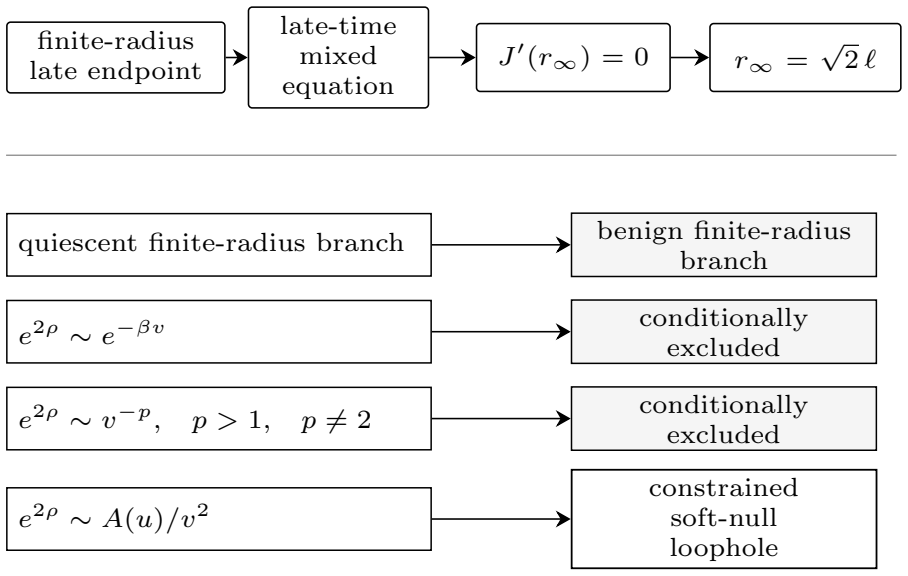
Replacing the Polyakov quantum sector by the dilaton-coupled anomaly model of Fabbri, Farese, and Navarro-Salas yields semiclassical equations whose late-time mixed equation enforces J prime of r infinity equals zero and hence r infinity equals √2 ℓ for any quiescent finite-radius branch with finite nonzero conformal factor. Finite-radius null branches satisfying the state-tail assumptions exclude the ordinary strong-cosmic-censorship-restoring exponential null boundary, and generic power-law branches e to the 2 rho proportional to v to the minus p with p greater than 1 are likewise excluded except for the borderline p equals 2 case, which in the FFN model requires the stronger state-tail de
What carries the argument
The FFN dilaton-coupled anomaly model from spherical reduction of four-dimensional minimally coupled matter, which replaces the Polyakov sector and supplies the semiclassical field equations whose late-time mixed equation classifies the allowed asymptotic branches.
Load-bearing premise
The classification of allowed branches rests on the state-tail assumptions for the quantum fields together with modeling the quantum sector via the FFN dilaton-coupled anomaly from spherical reduction.
What would settle it
A late-time solution of the FFN semiclassical equations that reaches a quiescent finite-radius endpoint with r infinity not equal to √2 ℓ while keeping the conformal factor finite and nonzero, or that realizes an exponential null boundary or a power-law branch with p not equal to 2.
If this is right
- Quiescent finite-radius branches are fixed at r infinity equals √2 ℓ independently of the local dilaton-anomaly convention.
- Ordinary strong-cosmic-censorship-restoring exponential null boundaries are excluded for finite-radius null branches.
- Generic power-law branches with p greater than 1 are excluded under the state-tail assumptions.
- The sole surviving null loophole is the p equals 2 case, which requires s phi of order v to the minus 2 and carries finite affine flux in the FFN model.
Where Pith is reading between the lines
- The fixed finite-radius endpoint suggests that remnants can form and persist in these reduced models rather than evaporating completely.
- The requirement of stronger state-tail decay for the null loophole may be checked by examining the late-time falloff of the dilaton flux in numerical integrations of the FFN equations.
- Because the anomaly originates from four-dimensional spherical reduction, the same branch restrictions could appear in higher-dimensional regular black hole models that retain the dilaton coupling after reduction.
Editorial analysis
A structured set of objections, weighed in public.
Referee Report
Summary. The manuscript derives the semiclassical equations for a two-dimensional regular Bardeen-like black hole using the Fabbri-Farese-Navarro-Salas (FFN) dilaton-coupled anomaly model obtained from spherical reduction of four-dimensional minimally coupled matter. It classifies the asymptotically allowed late-time branches at finite radius, showing that any quiescent finite-radius branch with finite nonzero conformal factor satisfies J'(r_∞)=0 and thus r_∞=√2 ℓ independently of the local dilaton-anomaly convention; ordinary exponential null boundaries and generic power-law branches e^{2ρ}∼v^{-p} (p>1) are excluded under the stated state-tail assumptions, leaving only the borderline p=2 null branch (which in the FFN model requires s_φ=O(v^{-2}) and carries finite affine flux). The natural outcome is described as remnant-like or a highly constrained soft-null alternative.
Significance. If the central classification holds, the work supplies a concrete, model-specific prediction for evaporation endpoints that distinguishes the FFN anomaly from the Polyakov case and isolates the role of quantum state tails. The reported independence of r_∞=√2 ℓ from the anomaly convention, together with the explicit exclusion of standard strong-cosmic-censorship-restoring null boundaries, constitutes a falsifiable claim within the semiclassical 2D framework. The analysis also underscores that the correct anomaly model arising from dimensional reduction is essential for endpoint statements.
major comments (2)
- [Abstract / late-time branch classification] Abstract and late-time analysis section: the exclusions of the ordinary exponential null boundary and of generic p>1 power-law branches rest entirely on the imposed state-tail assumptions (in particular s_φ=O(v^{-2}) for the surviving null case). These tails are not shown to be attractors of the coupled FFN system; without an independent consistency check or derivation from the semiclassical equations, the force of the mixed-equation analysis is limited. This assumption is load-bearing for the central classification.
- [Abstract] Abstract: the claim that the late-time mixed equation enforces J'(r_∞)=0 and hence r_∞=√2 ℓ 'independently of the local dilaton-anomaly convention' requires the explicit form of that equation (and of any normalizations entering J) to be displayed and verified; without it, it remains unclear whether the independence survives all choices of local counterterms or self-consistent normalizations.
minor comments (1)
- [Notation and definitions] The notation for the conformal factor ρ, the flux functions, and the state-tail parameters s_φ could be introduced with a single consolidated table or equation block to improve readability of the branch classification.
Simulated Author's Rebuttal
We thank the referee for the careful reading and for highlighting the model-specific aspects of the FFN analysis. We respond point-by-point to the major comments below.
read point-by-point responses
-
Referee: [Abstract / late-time branch classification] Abstract and late-time analysis section: the exclusions of the ordinary exponential null boundary and of generic p>1 power-law branches rest entirely on the imposed state-tail assumptions (in particular s_φ=O(v^{-2}) for the surviving null case). These tails are not shown to be attractors of the coupled FFN system; without an independent consistency check or derivation from the semiclassical equations, the force of the mixed-equation analysis is limited. This assumption is load-bearing for the central classification.
Authors: We agree that the state-tail assumptions are load-bearing for the exclusions. The manuscript classifies branches under these explicitly stated assumptions rather than claiming they are dynamical attractors. A full consistency check deriving the tails from the coupled equations would require a separate dynamical study, which is beyond the present scope of asymptotic classification. We will revise the abstract and discussion to stress the assumption-dependence and flag attractor verification as future work. revision: partial
-
Referee: [Abstract] Abstract: the claim that the late-time mixed equation enforces J'(r_∞)=0 and hence r_∞=√2 ℓ 'independently of the local dilaton-anomaly convention' requires the explicit form of that equation (and of any normalizations entering J) to be displayed and verified; without it, it remains unclear whether the independence survives all choices of local counterterms or self-consistent normalizations.
Authors: We will add the explicit late-time mixed equation together with the definition of J(r) (including normalizations) to the revised manuscript. This will make transparent that the condition J'(r_∞)=0 and the resulting r_∞=√2 ℓ follow from the structure of the FFN anomaly and hold independently of local counterterm choices. revision: yes
- Demonstrating that the imposed state-tail assumptions are dynamical attractors of the full coupled FFN system
Circularity Check
No circularity; derivation follows from explicit model and assumptions
full rationale
The paper replaces the Polyakov sector with the FFN dilaton-coupled anomaly, derives semiclassical equations, and classifies late branches under explicit state-tail hypotheses on the quantum stress tensor. The central claim that the mixed equation enforces J'(r_∞)=0 hence r_∞=√2 ℓ is presented as independent of the local anomaly convention and follows directly from the late-time equation rather than any fitted parameter or self-citation. No load-bearing step reduces by construction to its inputs; the exclusions of exponential null boundaries and p>1 power laws are logical consequences of the stated assumptions, not tautologies. The derivation is therefore self-contained against the external FFN model.
Axiom & Free-Parameter Ledger
free parameters (1)
- ℓ
axioms (1)
- domain assumption Spherical reduction of four-dimensional minimally coupled matter yields a two-dimensional theory with dilaton-coupled matter rather than minimally coupled conformal matter.
Cite this review
Pith. "Pith review of Anomaly-driven evaporation endpoints of a two-dimensional regular black hole." pith.science (2026). https://pith.science/paper/J557DIL7
@misc{pith2026260609983,
  author       = {Pith},
  title        = {Pith review of: Anomaly-driven evaporation endpoints of a two-dimensional regular black hole},
  year         = {2026},
  howpublished = {\url{https://pith.science/paper/J557DIL7}},
  note         = {Machine review of arXiv:2606.09983}
}
read the original abstract
Spherical reduction of four-dimensional minimally coupled matter yields a two-dimensional theory with dilaton-coupled matter rather than minimally coupled conformal matter. We use this distinction to revisit the backreacted late-time endpoint problem for the regular two-dimensional Bardeen-like black hole considered by Barenboim, Frolov, and Kunstatter. Replacing the Polyakov quantum sector by the dilaton-coupled anomaly model of Fabbri, Farese, and Navarro-Salas (FFN), we derive the corresponding semiclassical field equations and classify the asymptotically allowed late branches at finite radius. For any quiescent finite-radius branch with finite nonzero conformal factor, the late-time mixed equation enforces $J'(r_\infty)=0$, and hence $r_\infty=\sqrt{2}\,\ell$, independently of the local dilaton-anomaly convention. For finite-radius null branches satisfying the stated state-tail assumptions, the ordinary strong-cosmic-censorship-restoring exponential null boundary is excluded. Generic power-law branches $e^{2\rho}\sim v^{-p}$ with $p>1$ are likewise excluded, except for the borderline case $p=2$, which is the only remaining null loophole of this type. In the FFN model, the settled realization of this loophole carries finite affine flux and requires the stronger state-tail decay $s_\phi=O(v^{-2})$. The natural finite-radius outcome is remnant-like, while the surviving null branch is a highly constrained soft-null alternative.
Figures
Reference graph
Works this paper leans on
-
[1]
If e2ρ∼e−βv, β >0,(36) and the ingoing state tail satisfiestv =o(1), this branch is excluded
-
[2]
If e2ρ∼v−p, p>1,(37) and the ingoing state tail satisfiestv =o(v−2), this branch is excluded for allp̸= 2. Within this finite-radius exponential/power-law class, the only surviving null-boundary loop- hole is the specialp= 2branch, e2ρ∼A(u) v2 .(38) Proof.For the exponential case, e2ρ∼e−βv=⇒ρv→−β 2, ρ vv→0.(39) By the regularity and state-tail hypotheses,...
-
[3]
J. M. Bardeen, Non-singular general-relativistic gravitational collapse, inProceedings of the International Conference GR5(Tbilisi, USSR, 1968)
1968
-
[4]
The Bardeen Model as a Nonlinear Magnetic Monopole
E. Ayón-Beato and A. García, The Bardeen Model as a Nonlinear Magnetic Monopole, Phys. Lett. B493, 149 (2000), arXiv:gr-qc/0009077
work page internal anchor Pith review Pith/arXiv arXiv 2000
-
[5]
S. A. Hayward, Formation and Evaporation of Non-Singular Black Holes, Phys. Rev. Lett. 96, 031103 (2006), arXiv:gr-qc/0506126
work page internal anchor Pith review Pith/arXiv arXiv 2006
-
[6]
C. G. Callan, S. B. Giddings, J. A. Harvey, and A. Strominger, Evanescent Black Holes, Phys. Rev. D45, R1005 (1992), arXiv:hep-th/9111056
work page internal anchor Pith review Pith/arXiv arXiv 1992
-
[7]
J. G. Russo, L. Susskind, and L. Thorlacius, The endpoint of hawking evaporation, Phys. Rev. D46, 3444 (1992), arXiv:hep-th/9206070 [hep-th]
work page internal anchor Pith review Pith/arXiv arXiv 1992
-
[8]
Evaporation of regular black holes in 2D dilaton gravity
J. Barenboim, A. V. Frolov, and G. Kunstatter, Evaporation of Regular Black Holes in 2D Dilaton Gravity, arXiv e-prints , arXiv:2503.03191 (2025), arXiv:2503.03191 [gr-qc]
work page Pith review arXiv 2025
-
[9]
A. M. Polyakov, Quantum Geometry of Bosonic Strings, Phys. Lett. B103, 207 (1981). 17
1981
-
[10]
On 4D-Hawing Radiation from Effective Action
V. Mukhanov, A. Wipf, and A. Zelnikov, On 4D Hawking Radiation from Effective Action, Phys. Lett. B332, 283 (1994), arXiv:hep-th/9403018
work page internal anchor Pith review Pith/arXiv arXiv 1994
-
[11]
Hawking Radiation for Non-minimally Coupled Matter from Generalized 2D Black Hole Models
W. Kummer, H. Liebl, and D. V. Vassilevich, Hawking Radiation for Non-Minimally Cou- pled Matter from Generalized 2D Black Hole Models, Mod. Phys. Lett. A12, 2683 (1997), arXiv:hep-th/9707041
work page internal anchor Pith review Pith/arXiv arXiv 1997
-
[12]
Dilaton Gravity in Two Dimensions
D. Grumiller, W. Kummer, and D. V. Vassilevich, Dilaton Gravity in Two Dimensions, Phys. Rept.369, 327 (2002), arXiv:hep-th/0204253
work page internal anchor Pith review Pith/arXiv arXiv 2002
- [13]
-
[14]
D. A. Lowe and L. Thorlacius, Breakdown of Semiclassical Gravity in Four-Dimensional Black Hole Evaporation (2026), arXiv:2605.00780 [hep-th]
work page internal anchor Pith review Pith/arXiv arXiv 2026
-
[15]
D. A. Easson, Fate of Schwarzschild–de Sitter black holes: Nonequilibrium evaporation, Phys. Rev. D113, 084014 (2026), arXiv:2511.11873 [hep-th]
work page internal anchor Pith review Pith/arXiv arXiv 2026
-
[16]
D. A. Easson, The fate of Reissner–Nordström–de Sitter black holes: nonequilibrium discharge and evaporation (2026), arXiv:2605.20349 [hep-th]
work page internal anchor Pith review Pith/arXiv arXiv 2026
-
[17]
Generalized Virasoro anomaly and stress tensor for dilaton coupled theories
A. Fabbri, S. Farese, and J. Navarro-Salas, Generalized Virasoro Anomaly and Stress Tensor for Dilaton Coupled Theories, Phys. Lett. B574, 309 (2003), arXiv:hep-th/0309160
work page internal anchor Pith review Pith/arXiv arXiv 2003
-
[18]
N. D. Birrell and P. C. W. Davies,Quantum Fields in Curved Space, Cambridge Monographs on Mathematical Physics (Cambridge University Press, Cambridge, UK, 1982)
1982
-
[19]
S. M. Christensen and S. A. Fulling, Trace anomalies and the hawking effect, Phys. Rev. D 15, 2088 (1977)
2088
-
[20]
Trace Anomaly of Dilaton Coupled Scalars in Two Dimensions
R. Bousso and S. W. Hawking, Trace Anomaly of Dilaton Coupled Scalars in Two Dimensions, Phys. Rev. D56, 7788 (1997), arXiv:hep-th/9705236
work page internal anchor Pith review Pith/arXiv arXiv 1997
-
[21]
Comment on: ``Trace anomaly of dilaton coupled scalars in two dimensions''
W. Kummer, H. Liebl, and D. V. Vassilevich, Comment on: ‘Trace anomaly of dilaton coupled scalars in two-dimensions’, Phys. Rev. D58, 108501 (1998), arXiv:hep-th/9801122
work page internal anchor Pith review Pith/arXiv arXiv 1998
-
[22]
S. Nojiri and S. D. Odintsov, Trace Anomaly and Non-Local Effective Action for 2D Con- formally Invariant Scalar Interacting with Dilaton, Mod. Phys. Lett. A12, 2083 (1997), arXiv:hep-th/9706009
work page internal anchor Pith review Pith/arXiv arXiv 2083
-
[23]
Trace anomaly induced effective action for 2D and 4D dilaton coupled scalars
S. Nojiri and S. D. Odintsov, Trace Anomaly Induced Effective Action for 2D and 4D Dilaton Coupled Scalars, Phys. Rev. D57, 2363 (1998), arXiv:hep-th/9706143
work page internal anchor Pith review Pith/arXiv arXiv 1998
- [24]
-
[25]
Poisson and W
E. Poisson and W. Israel, Internal structure of black holes, Phys. Rev. D41, 1796 (1990)
1990
-
[26]
Ori, Inner structure of a charged black hole: An exact mass-inflation solution, Phys
A. Ori, Inner structure of a charged black hole: An exact mass-inflation solution, Phys. Rev. Lett.67, 789 (1991)
1991
-
[27]
The interior of charged black holes and the problem of uniqueness in general relativity
M. Dafermos, The interior of charged black holes and the problem of uniqueness in general relativity, Commun. Pure Appl. Math.58, 0445 (2005), arXiv:gr-qc/0307013
work page internal anchor Pith review Pith/arXiv arXiv 2005
-
[28]
D. A. Easson, Cauchy-horizon flux coefficients in the reduced Polyakov model (2025), arXiv:2511.05656 [gr-qc]
work page internal anchor Pith review Pith/arXiv arXiv 2025
- [29]
-
[30]
D. A. Easson, Hawking radiation of nonsingular black holes in two-dimensions, JHEP02, 037, arXiv:hep-th/0210016
work page internal anchor Pith review Pith/arXiv arXiv
-
[31]
P. C. W. Davies, D. A. Easson, and P. B. Levin, Nonsingular Black Holes as Dark Matter, arXiv e-prints , arXiv:2410.21577 (2024), arXiv:2410.21577 [hep-th]
work page Pith review arXiv 2024
-
[32]
Primordial regular black holes as all the dark matter. I. Time-radial-symmetric metrics
M. Calzà, D. Pedrotti, and S. Vagnozzi, Primordial regular black holes as all the dark matter. I. Time-radial-symmetric metrics, Phys. Rev. D111, 024009 (2025), arXiv:2409.02804 [gr-qc]
work page Pith review arXiv 2025
-
[33]
M. Calzà, D. Pedrotti, and S. Vagnozzi, Primordial regular black holes as all the dark matter. II. Non-time-radial-symmetric and loop quantum gravity-inspired metrics, Phys. Rev. D111, 024010 (2025), arXiv:2409.02807 [gr-qc]
work page Pith review arXiv 2025
-
[34]
M. Calzà, D. Pedrotti, G.-W. Yuan, and S. Vagnozzi, Primordial regular black holes as all the dark matter. III. Covariant canonical quantum gravity models, Phys. Rev. D112, 124015 (2025), arXiv:2507.02396 [gr-qc]
-
[35]
Primordial Black Holes as Dark Matter Candidates
B. Carr and F. Kühnel, Primordial Black Holes as Dark Matter Candidates, SciPost Phys. Lect. Notes48, 1 (2022), arXiv:2110.02821 [astro-ph.CO]. 19
work page Pith review arXiv 2022
discussion (0)
Sign in with ORCID, Apple, or X to comment. Anyone can read and Pith papers without signing in.