REVIEW 4 major objections 5 minor 63 references
An attack on retrieval-augmented generation can tell whether a given document sits in the system's hidden retrieval database, by measuring how much the 'yes' confidence drops when the query is perturbed.
Reviewed by Pith at T0; open to challenge. T0 means a machine referee read the full paper against a public rubric. the ladder, T0–T4 →
T0 review · deepseek-v4-flash
2026-08-05 04:36 UTC pith:JN72IUBQ
load-bearing objection A real empirical attack with an overclaimed theory; worth refereeing, but Section 4.1 should be reframed as an empirical hypothesis, not a proof. the 4 major comments →
DCMI: A Differential Calibration Membership Inference Attack Against Retrieval-Augmented Generation
The pith
A machine-rendered reading of the paper's core claim, the machinery that carries it, and where it could break.
Core claim
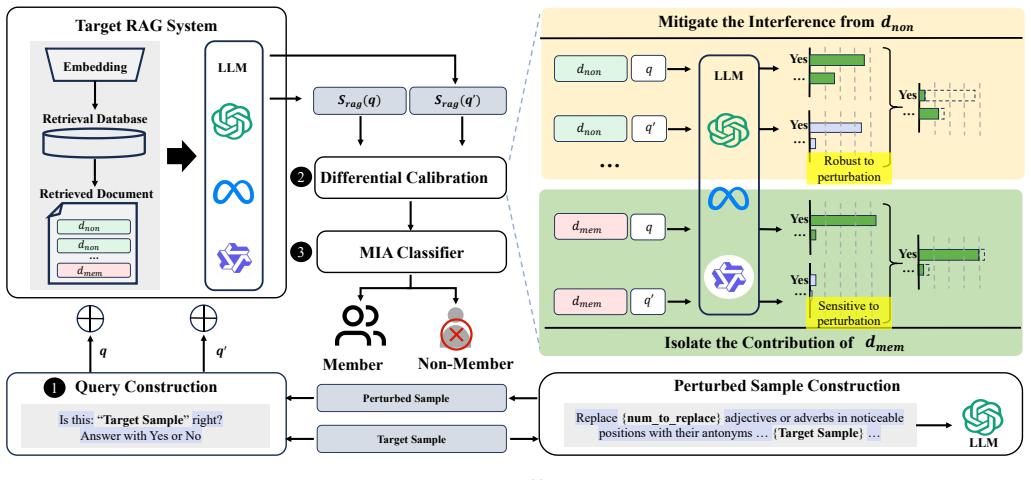
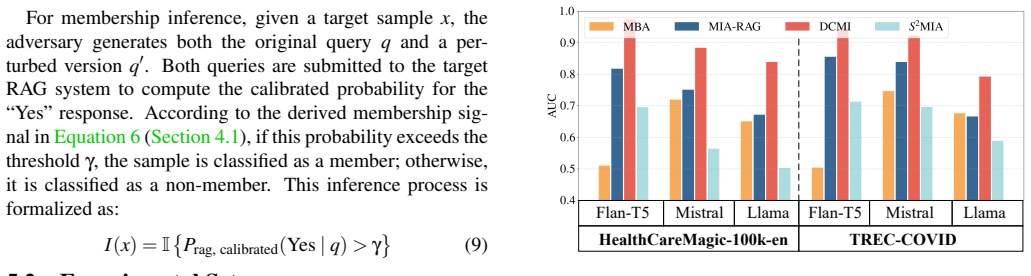
The paper's central claim is the calibrated membership identity of Equation 6: subtracting the 'yes' probability for a perturbed query from the original leaves approximately I{q∈M}·p_η(d*|q)·p_θ(Yes|q,d*) — near zero for non-members, positive for members. The mechanism is a sensitivity gap: an exactly matching database document loses much of its push toward 'yes' under light perturbation, while non-member documents hold constant, so subtraction cancels their interference. It holds in gray-box, distribution-only, and black-box settings, where a 'yes'-to-'no' flip marks membership, yielding up to 97.42% AUC and 74% accuracy on real platforms.
What carries the argument
Differential calibration: the score P_rag,calibrated(Yes|q) = P_rag(Yes|q) − P_rag(Yes|q′), the subtraction of the RAG system's 'yes' probability on an adversarially perturbed query from the original. Its derivation starts from the standard factorization of RAG generation as a weighted sum over retrieved documents (Equation 1); the score collapses to Equation 6, P_rag,calibrated(Yes|q) ≈ I{q∈M}·p_η(d*|q)·p_θ(Yes|q,d*), a membership indicator times the most-similar document's retrieval weight and conditional 'yes' probability. Two assumptions carry the identity: query perturbation barely changes retrieval weights (Appendix B bounds the cosine-similarity shift by 2‖δ‖/‖q‖), and the sensitivity
Load-bearing premise
The attack assumes a sensitivity gap — a document that exactly matches the query loses much of its influence on the 'yes' answer when the query is lightly perturbed, while every similar-but-nonmatching retrieved document keeps its influence nearly unchanged — and this gap was verified only in the single-document setting; if non-member documents also respond to perturbation, or the gap shrinks when four or more documents are retrieved, the calibrated difference no longer isola
What would settle it
Measure the calibrated score P_rag(Yes|q) − P_rag(Yes|q′) on a held-out set of non-member queries in a system that retrieves four or more documents with a third-party LLM doing the perturbation. If non-member scores spread as widely as member scores — pushing AUC toward 0.5 instead of the reported ~0.75–0.97 — the sensitivity gap does not survive its ideal-case assumptions. A second check: replace antonym replacement with synonym substitution or character-level noise; if the member/non-member gap collapses, the mechanism depends on semantic-contrast perturbation specifically, not on perturbati
If this is right
- Membership of a target text in a RAG retrieval database becomes testable with just two queries — original and perturbed — with no access to the database itself; Equation 6 makes the calibrated score a direct membership indicator.
- The attack transfers to fully black-box settings: member samples flip from 'Yes' to 'No' under perturbation, non-members stay on the same side of the decision boundary, so binary responses alone leak membership.
- The attack's accuracy holds within about 2% AUC as the number of retrieved documents grows from 2 to 6, the regime where raw-confidence baselines visibly degrade (e.g., RAG-MIA-gray drops from 66.1% to 61.8% accuracy).
- Production RAG platforms are currently vulnerable: on Dify and MaxKB the attack keeps a 10–20% accuracy advantage over the RAG-MIA baseline, reaching 74% accuracy on MaxKB.
- Three countermeasures reduce the attack's effectiveness — instruction-based refusal (AUC −4%), query paraphrasing (−20%), and post-retrieval conversion of documents to entity-relation triples (down to ~50% AUC) — but each trades off some generative utility.
Where Pith is reading between the lines
- If the sensitivity gap is a property of exact-match identity rather than of language, the same two-query probe should work on any retrieval pipeline whose output averages over retrieved items — rerankers, database-backed QA, even image or genomic databases; the paper's genomic-data result (95.5% AUC by flipping one strand identifier) is evidence in that direction.
- The real-world results suggest the practical weak point is retrieval overlap: any sample that surfaces in the top-k as an exact match leaks. A defense that guarantees no exact textual match — chunking to break document identity, hashing, or injecting controlled noise into stored vectors — would target the mechanism more directly than the tested instruction-based defense.
- A testable hardening question follows from the perturbation design: if synonym substitution or character-level noise produces a comparable sensitivity gap, the effect is perturbation-generic and harder to defend; if only antonymic semantic contrast works, defenders can focus on detecting semantic-contrast queries.
Editorial analysis
A structured set of objections, weighed in public.
Referee Report
Summary. The paper proposes DCMI, a membership inference attack (MIA) against the retrieval database of retrieval-augmented generation (RAG) systems. The attack formulates a yes/no verification query from a target sample, constructs an adversarially perturbed version of that query, and subtracts the RAG system's output confidence (or binary response) for the perturbed query from that for the original query. The central theoretical claim, expressed in Eq. (6) of Section 4.1, is that this differential calibration cancels the contribution of non-member retrieved documents and leaves a signal proportional to the indicator of membership in the retrieval database. The paper evaluates the method under three progressively weaker adversary models, across two datasets, multiple generative models, retrievers, RAG frameworks, numbers of retrieved documents, and two real-world RAG platforms (Dify and MaxKB). It reports consistent improvements over prior RAG-targeted MIAs, with the strongest gray-box results reaching 97.42% AUC on a Flan-T5-based system, and 74% accuracy on MaxKB in the black-box setting. The paper also proposes three defenses and shows that they partially degrade the attack.
Significance. If the theoretical derivation were fully established, the paper would make a significant contribution to the privacy analysis of RAG systems: it identifies a RAG-specific source of interference (non-member retrieved documents), proposes a calibration mechanism to remove it, and provides an unusually broad evaluation spanning gray-box, distribution-aware, and black-box adversaries. The empirical breadth is a clear strength: the attack is tested over multiple generators, retrievers, frameworks, retrieval counts, and real-world platforms, and the ablation study consistently attributes a 6–9% AUC improvement to the differential calibration module. The code is publicly available. However, the load-bearing theoretical result in Eq. (6) is not actually proven by the arguments given; it rests on unverified assumptions about softmax-weight stability and about the sensitivity gap persisting in multi-document retrieval and in binary-response settings. These gaps matter because the paper's explanation of why the attack works is built on Eq. (6), and the black-box decision-reversal argument in Appendix C requires an additional threshold-crossing condition that is asserted rather than demonstrat
major comments (4)
- [Section 4.1, Eq. (5) to Eq. (6); Appendix B] The move from Eq. (5) to Eq. (6) requires p_eta(d|q) ≈ p_eta(d|q') for all retrieved documents. Appendix B only bounds |exp(s(d,q')) - exp(s(d,q))| for each document; it does not bound the normalized softmax weights p_eta(d|q) = exp(s(d,q))/Σ_j exp(s(d_j,q)). Even small per-document changes in exponent can shift softmax weights non-negligibly when scores are close, so the cancellation of the non-member terms Δε is not established. Since Eq. (6) is the foundation of the membership signal, this is a load-bearing gap. The authors should either prove a bound on the softmax weights under the stated perturbation model or explicitly reframe Eq. (6) as a heuristic assumption and validate it directly with per-document retrieval-weight measurements for k>1.
- [Section 4.1, Figure 3; Appendix C, Figure 20] The claimed sensitivity gap—p_θ(Yes|q,d*) ≫ p_θ(Yes|q',d*) for member documents and p_θ(Yes|q,d) ≈ p_θ(Yes|q',d) for non-member documents—is empirically verified only in the Basic RAG Setting with a single retrieved document, where p_eta(d|q)=1 by construction. In multi-document retrieval (k=4), the reported Figure 20 measures P_rag(Yes|q) before and after perturbation, which is a mixture of p_eta shifts and p_θ sensitivity, so it does not isolate the claimed gap. The derivation of Eq. (6) requires the gap to persist when multiple documents are retrieved and when the third-party LLM performs the perturbation. Please provide direct per-document measurements of p_θ for k>1, or otherwise state explicitly that the sensitivity gap is a hypothesis validated only in the k=1 case.
- [Section 4.1 and Appendix C (black-box decision reversal)] The black-box attack requires that for member samples the perturbation-induced drop in P_rag(Yes|q) crosses the decision boundary α, i.e., P_rag(Yes|q)>α and P_rag(Yes|q')<α. The paper only shows that the probability drops; it does not prove or quantify the crossing condition. Figure 20 displays aggregate distributions, not per-sample decision reversals, and the reported black-box accuracies (e.g., 65–75% in Table 4) imply that reversal is not universal. The deterministic statement in Appendix C that 'member samples yield a score of 1 due to decision reversal' is therefore too strong. Please provide per-sample statistics on the fraction of members exhibiting reversal, and either weaken the theoretical claim to a probabilistic statement or prove a margin condition.
- [Section 4.1, 'Based on the above proof'] The derivation of Eq. (6) is presented as a proof, but the two assumptions stated immediately before it are essentially the content of the conclusion. The first assumption (p_eta stability) is unverified in the relevant multi-document regime, and the second (sensitivity gap) is a hypothesis 'inspired by [39]' that is verified only in a degenerate single-document setting. Calling this a proof overstates the result. The authors should relabel Section 4.1 as 'Theoretical Motivation' or 'Derivation under Assumptions', and make the dependence on these assumptions explicit in the abstract and contributions.
minor comments (5)
- [Appendix C, Eq. (14)] Typo: 'defied' should be 'defined'.
- [Section 8.2 (and Appendix K)] The baseline is referred to as both 'RAG-MIA' and 'MIA-RAG'. Please unify the terminology.
- [Figure 3] The caption says 'Pre- and Post-Perturbation' but does not define whether 'pre' refers to the original query q and 'post' to the perturbed query q'. Please clarify in the caption.
- [Section 5.1, Eq. (8)] The calibration formula is written both as Eq. (5) and Eq. (8) with identical content. This duplication is unnecessary; one equation would suffice, or the second occurrence should reference the first.
- [Table 2 and Table 4] Standard deviations or confidence intervals are not reported for the accuracy/AUC numbers. Given the substantial reported advantages over baselines, a small number of repeated runs with variance estimates would strengthen the empirical claims.
Circularity Check
No significant circularity: the derivation rests on explicit assumptions that are empirically tested, and the attack is evaluated on held-out data against baselines.
full rationale
The paper's central derivation (Eq. 4 → Eq. 6) is a conditional argument: it assumes (i) retrieval-weight stability under perturbation, p_η(d|q) ≈ p_η(d|q′), and (ii) a sensitivity gap whereby p_θ('Yes'|q,d) is more perturbable for member-retrieved documents than for non-member ones. Both assumptions are stated explicitly — the second is even introduced as 'we hypothesize' and is verified in a controlled k=1 setting (Figure 3) where ε=0 and p_η=1. The resulting calibrated score is then not defined in terms of membership; it is defined as a difference of two observable RAG confidences, and Eq. 6 follows algebraically from the stated assumptions. The main experimental claims are evaluated on held-out test samples that are disjoint from the reference data used to tune the perturbation magnitude and threshold, so the reported AUC/accuracy numbers are not forced by construction. The Appendix B bound only addresses unnormalized exp(similarity) rather than the softmax weights p_η, which is a legitimate rigor concern about the transfer from k=1 to k=4, but it is a soundness gap, not a circularity: nothing in the derivation clandestinely assumes the target result. No load-bearing self-citation is present; the cited works on perturbation robustness and neighborhood-based MIAs are external and used only as motivation. Therefore, the paper exhibits no significant circularity under the defined criteria.
Axiom & Free-Parameter Ledger
free parameters (3)
- perturbation magnitude θ =
0.06
- classification threshold γ =
grid 0.1-1.0 (A1); Q3 of reference non-member calibrated scores (A2); score==1 rule (A3)
- retrieval document count k =
4 (default)
axioms (4)
- domain assumption RAG token probabilities factor as a weighted mixture over retrieved documents (Equation 1, after Cuconasu et al. [10]).
- domain assumption Query perturbation leaves retrieval similarity weights nearly unchanged, p_η(d|q) ≈ p_η(d|q').
- ad hoc to paper Sensitivity gap: member documents' yes-probability drops sharply under perturbation while non-member documents stay stable.
- ad hoc to paper For the black-box case, the perturbation-induced drop crosses the 0.5 decision boundary for members but not for non-members.
Cite this review
Pith. "Pith review of DCMI: A Differential Calibration Membership Inference Attack Against Retrieval-Augmented Generation." pith.science (2026). https://pith.science/paper/JN72IUBQ
@misc{pith2026250906026,
  author       = {Pith},
  title        = {Pith review of: DCMI: A Differential Calibration Membership Inference Attack Against Retrieval-Augmented Generation},
  year         = {2026},
  howpublished = {\url{https://pith.science/paper/JN72IUBQ}},
  note         = {Machine review of arXiv:2509.06026}
}
read the original abstract
While Retrieval-Augmented Generation (RAG) effectively reduces hallucinations by integrating external knowledge bases, it introduces vulnerabilities to membership inference attacks (MIAs), particularly in systems handling sensitive data. Existing MIAs targeting RAG's external databases often rely on model responses but ignore the interference of non-member-retrieved documents on RAG outputs, limiting their effectiveness. To address this, we propose DCMI, a differential calibration MIA that mitigates the negative impact of non-member-retrieved documents. Specifically, DCMI leverages the sensitivity gap between member and non-member retrieved documents under query perturbation. It generates perturbed queries for calibration to isolate the contribution of member-retrieved documents while minimizing the interference from non-member-retrieved documents. Experiments under progressively relaxed assumptions show that DCMI consistently outperforms baselines--for example, achieving 97.42% AUC and 94.35% Accuracy against the RAG system with Flan-T5, exceeding the MBA baseline by over 40%. Furthermore, on real-world RAG platforms such as Dify and MaxKB, DCMI maintains a 10%-20% advantage over the baseline. These results highlight significant privacy risks in RAG systems and emphasize the need for stronger protection mechanisms. We appeal to the community's consideration of deeper investigations, like ours, against the data leakage risks in rapidly evolving RAG systems. Our code is available at https://github.com/Xinyu140203/RAG_MIA.
Figures




Reference graph
Works this paper leans on
-
[1]
SoK: Reducing the Vulnerability of Fine-tuned Language Models to Membership Inference Attacks
Guy Amit, Abigail Goldsteen, and Ariel Farkash. Sok: Reducing the vulnerability of fine-tuned language mod- els to membership inference attacks.arXiv preprint arXiv:2403.08481, 2024. 1
work page internal anchor Pith review Pith/arXiv arXiv 2024
-
[2]
Maya Anderson, Guy Amit, and Abigail Goldsteen. Is my data in your retrieval database? membership in- ference attacks against retrieval augmented generation. arXiv preprint arXiv:2405.20446, 2024. 2, 3, 4, 7, 8, 10, 12, 13, 21
Pith/arXiv arXiv 2024
-
[3]
Palm 2 technical report.arXiv preprint arXiv:2305.10403, 2023
Rohan Anil, Andrew M Dai, Orhan Firat, Melvin Johnson, Dmitry Lepikhin, Alexandre Passos, Sia- mak Shakeri, Emanuel Taropa, Paige Bailey, Zhifeng Chen, et al. Palm 2 technical report.arXiv preprint arXiv:2305.10403, 2023. 1
Pith/arXiv arXiv 2023
-
[4]
Improving language models by retrieving from trillions of tokens
Sebastian Borgeaud, Arthur Mensch, Jordan Hoffmann, Trevor Cai, Eliza Rutherford, Katie Millican, George Bm Van Den Driessche, Jean-Baptiste Lespiau, Bogdan Damoc, Aidan Clark, et al. Improving language models by retrieving from trillions of tokens. InInternational Conference on Machine Learning, pages 2206–2240. PMLR, 2022. 1
work page 2022
-
[5]
Language models are few-shot learners
Tom Brown, Benjamin Mann, Nick Ryder, Melanie Subbiah, Jared D Kaplan, Prafulla Dhariwal, Arvind Neelakantan, Pranav Shyam, Girish Sastry, Amanda Askell, Sandhini Agarwal, Ariel Herbert-V oss, Gretchen Krueger, Tom Henighan, Rewon Child, Aditya Ramesh, Daniel Ziegler, Jeffrey Wu, Clemens Winter, Chris Hesse, Mark Chen, Eric Sigler, Mateusz Litwin, Scott G...
work page 1901
-
[6]
Member- ship inference attacks from first principles
Nicholas Carlini, Steve Chien, Milad Nasr, Shuang Song, Andreas Terzis, and Florian Tramer. Member- ship inference attacks from first principles. In2022 IEEE Symposium on Security and Privacy (SP), pages 1897–1914. IEEE, 2022. 1, 3
work page 1914
-
[7]
Extracting training data from large language models
Nicholas Carlini, Florian Tramer, Eric Wallace, Matthew Jagielski, Ariel Herbert-V oss, Katherine Lee, Adam Roberts, Tom Brown, Dawn Song, Ulfar Erlings- son, et al. Extracting training data from large language models. In30th USENIX Security Symposium (USENIX Security 21), pages 2633–2650, 2021. 3
work page 2021
-
[8]
Label-only membership inference attacks
Christopher A Choquette-Choo, Florian Tramer, Nicholas Carlini, and Nicolas Papernot. Label-only membership inference attacks. InInternational confer- ence on machine learning, pages 1964–1974. PMLR,
work page 1964
-
[9]
Chi, Jeff Dean, Jacob Devlin, Adam Roberts, Denny Zhou, Quoc V
Hyung Won Chung, Le Hou, Shayne Longpre, Barret Zoph, Yi Tay, William Fedus, Eric Li, Xuezhi Wang, Mostafa Dehghani, Siddhartha Brahma, Albert Web- son, Shixiang Shane Gu, Zhuyun Dai, Mirac Suzgun, Xinyun Chen, Aakanksha Chowdhery, Sharan Narang, Gaurav Mishra, Adams Yu, Vincent Zhao, Yanping Huang, Andrew Dai, Hongkun Yu, Slav Petrov, Ed H. Chi, Jeff Dea...
work page 2022
-
[10]
The power of noise: Redefining retrieval for rag systems
Florin Cuconasu, Giovanni Trappolini, Federico Si- ciliano, Simone Filice, Cesare Campagnano, Yoelle Maarek, Nicola Tonellotto, and Fabrizio Silvestri. The power of noise: Redefining retrieval for rag systems. InProceedings of the 47th International ACM SIGIR Conference on Research and Development in Informa- tion Retrieval, pages 719–729, 2024. 4
work page 2024
-
[11]
Membership inference attacks against fine-tuned large language models via self-prompt calibration
Wenjie Fu, Huandong Wang, Chen Gao, Guanghua Liu, Yong Li, and Tao Jiang. Membership inference attacks against fine-tuned large language models via self-prompt calibration. InThe Thirty-eighth Annual Conference on Neural Information Processing Systems,
-
[12]
Yasmina Al Ghadban, Huiqi Yvonne Lu, Uday Adavi, Ankita Sharma, Sridevi Gara, Neelanjana Das, Bhaskar Kumar, Renu John, Praveen Devarsetty, and Jane E Hirst. Transforming healthcare education: Harnessing large language models for frontline health worker ca- pacity building using retrieval-augmented generation. medRxiv, pages 2023–12, 2023. 1
work page 2023
-
[13]
Jamie Hayes, Luca Melis, George Danezis, and Emil- iano De Cristofaro. Logan: Evaluating information leakage of generative models using generative adver- sarial networks.arXiv preprint arXiv:1705.07663, 18,
-
[14]
Membership-Doctor: Comprehensive Assessment of Membership Inference Against Machine Learning Models
Xinlei He, Zheng Li, Weilin Xu, Cory Cornelius, and Yang Zhang. Membership-doctor: Comprehensive assessment of membership inference against machine learning models.arXiv preprint arXiv:2208.10445,
work page internal anchor Pith review Pith/arXiv arXiv
- [15]
-
[16]
On the ro- bustness of self-attentive models
Yu-Lun Hsieh, Minhao Cheng, Da-Cheng Juan, Wei Wei, Wen-Lian Hsu, and Cho-Jui Hsieh. On the ro- bustness of self-attentive models. InProceedings of the 57th Annual Meeting of the Association for Computa- tional Linguistics, pages 1520–1529, 2019. 5
work page 2019
-
[17]
Hongsheng Hu, Zoran Salcic, Lichao Sun, Gillian Dob- bie, Philip S Yu, and Xuyun Zhang. Membership in- 15 ference attacks on machine learning: A survey.ACM Computing Surveys (CSUR), 54(11s):1–37, 2022. 1, 3
work page 2022
-
[18]
Membership inference attacks against vision-language models.arXiv preprint arXiv:2501.18624, 2025
Yuke Hu, Zheng Li, Zhihao Liu, Yang Zhang, Zhan Qin, Kui Ren, and Chun Chen. Membership inference attacks against vision-language models.arXiv preprint arXiv:2501.18624, 2025. 3
Pith/arXiv arXiv 2025
-
[19]
Gpt-4o system card.arXiv preprint arXiv:2410.21276,
Aaron Hurst, Adam Lerer, Adam P Goucher, Adam Perelman, Aditya Ramesh, Aidan Clark, AJ Ostrow, Akila Welihinda, Alan Hayes, Alec Radford, et al. Gpt-4o system card.arXiv preprint arXiv:2410.21276,
-
[20]
Mistral 7b.arXiv preprint arXiv:2310.06825, 2023
Albert Q Jiang, Alexandre Sablayrolles, Arthur Men- sch, Chris Bamford, Devendra Singh Chaplot, Diego de las Casas, Florian Bressand, Gianna Lengyel, Guil- laume Lample, Lucile Saulnier, et al. Mistral 7b.arXiv preprint arXiv:2310.06825, 2023. 7
Pith/arXiv arXiv 2023
-
[21]
Changyue Jiang, Xudong Pan, Geng Hong, Chenfu Bao, and Min Yang. Rag-thief: Scalable extraction of private data from retrieval-augmented generation ap- plications with agent-based attacks.arXiv preprint arXiv:2411.14110, 2024. 4
Pith/arXiv arXiv 2024
-
[22]
Huiqiang Jiang, Qianhui Wu, Xufang Luo, Dong- sheng Li, Chin-Yew Lin, Yuqing Yang, and Lili Qiu. Longllmlingua: Accelerating and enhancing llms in long context scenarios via prompt compression.arXiv preprint arXiv:2310.06839, 2023. 7, 21, 22
Pith/arXiv arXiv 2023
-
[23]
Jiajie Jin, Yutao Zhu, Xinyu Yang, Chenghao Zhang, and Zhicheng Dou. Flashrag: A modular toolkit for ef- ficient retrieval-augmented generation research.arXiv preprint arXiv:2405.13576, 2024. 7
Pith/arXiv arXiv 2024
-
[24]
Dense passage retrieval for open-domain question answering
Vladimir Karpukhin, Barlas Oguz, Sewon Min, Patrick Lewis, Ledell Wu, Sergey Edunov, Danqi Chen, and Wen tau Yih. Dense passage retrieval for open-domain question answering. In2020 Conference on Empiri- cal Methods in Natural Language Processing, EMNLP 2020, pages 6769–6781. Association for Computa- tional Linguistics (ACL), 2020. 1, 2
work page 2020
-
[25]
Chain of reference prompting helps llm to think like a lawyer, 2023
Aditya Kuppa, Nikon Rasumov-Rahe, and Marc V oses. Chain of reference prompting helps llm to think like a lawyer, 2023. 1
work page 2023
-
[26]
Stolen memo- ries: Leveraging model memorization for calibrated white-box membership inference
Klas Leino and Matt Fredrikson. Stolen memo- ries: Leveraging model memorization for calibrated white-box membership inference. InUSENIX Secu- rity Symposium (USENIX Security), pages 1605–1622. USENIX, 2020. 7
work page 2020
-
[27]
Patrick Lewis, Ethan Perez, Aleksandra Piktus, Fabio Petroni, Vladimir Karpukhin, Naman Goyal, Heinrich Kuttler, Mike Lewis, Wen tau Yih, Tim Rocktaschel, et al. Retrieval-augmented generation for knowledge- intensive nlp tasks.Advances in Neural Information Processing Systems, 33:9459–9474, 2020. 1, 2
work page 2020
-
[28]
Se- qmia: sequential-metric based membership inference attack
Hao Li, Zheng Li, Siyuan Wu, Chengrui Hu, Yutong Ye, Min Zhang, Dengguo Feng, and Yang Zhang. Se- qmia: sequential-metric based membership inference attack. InProceedings of the 2024 on ACM SIGSAC Conference on Computer and Communications Secu- rity, pages 3496–3510, 2024. 3
work page 2024
-
[29]
En- hanced{Label-Only}membership inference attacks with fewer queries
Hao Li, Zheng Li, Siyuan Wu, Yutong Ye, Min Zhang, Dengguo Feng, and Yang Zhang. En- hanced{Label-Only}membership inference attacks with fewer queries. In34th USENIX Security Sympo- sium (USENIX Security 25), pages 5465–5483, 2025. 3
work page 2025
-
[30]
Yucheng Li, Bo Dong, Chenghua Lin, and Frank Guerin. Compressing context to enhance inference efficiency of large language models.arXiv preprint arXiv:2310.06201, 2023. 7, 21, 22
Pith/arXiv arXiv 2023
-
[31]
Yuying Li, Gaoyang Liu, Yang Yang, and Chen Wang. Seeing is believing: Black-box membership inference attacks against retrieval augmented generation.arXiv preprint arXiv:2406.19234, 2024. 2, 3, 4, 7, 8, 10, 12, 21
Pith/arXiv arXiv 2024
-
[32]
Membership Inference Attack Against Masked Image Modeling
Zheng Li, Xinlei He, Ning Yu, and Yang Zhang. Mem- bership inference attack against masked image model- ing.arXiv preprint arXiv:2408.06825, 2024. 3
work page internal anchor Pith review Pith/arXiv arXiv 2024
-
[33]
Auditing membership leak- ages of multi-exit networks
Zheng Li, Yiyong Liu, Xinlei He, Ning Yu, Michael Backes, and Yang Zhang. Auditing membership leak- ages of multi-exit networks. InProceedings of the 2022 ACM SIGSAC Conference on Computer and Communi- cations Security, pages 1917–1931, 2022. 3
work page 2022
-
[34]
Lan Liu, Yi Wang, Gaoyang Liu, Kai Peng, and Chen Wang. Membership inference attacks against ma- chine learning models via prediction sensitivity.IEEE Transactions on Dependable and Secure Computing, 20(3):2341–2347, 2022. 1, 7
work page 2022
-
[35]
Mingrui Liu, Sixiao Zhang, and Cheng Long. Mask-based membership inference attacks for retrieval-augmented generation.arXiv preprint arXiv:2410.20142, 2024. 2, 3, 4, 7, 8, 10, 12, 21
Pith/arXiv arXiv 2024
-
[36]
Yunhui Long, Vincent Bindschaedler, Lei Wang, Diyue Bu, Xiaofeng Wang, Haixu Tang, Carl A Gunter, and Kai Chen. Understanding membership inferences on well-generalized learning models.arXiv preprint arXiv:1802.04889, 2018. 3
Pith/arXiv arXiv 2018
-
[37]
Making llms worth every penny: Resource-limited text classification in banking
Lefteris Loukas, Ilias Stogiannidis, Odysseas Diaman- topoulos, Prodromos Malakasiotis, and Stavros Vassos. Making llms worth every penny: Resource-limited text classification in banking. InProceedings of the Fourth ACM International Conference on AI in Finance, pages 392–400, 2023. 1
work page 2023
-
[38]
AutoLAW: Augmented Legal Reasoning through Legal Precedent Prediction
Robert Zev Mahari. Autolaw: augmented legal reason- ing through legal precedent prediction.arXiv preprint arXiv:2106.16034, 2021. 1
work page internal anchor Pith review Pith/arXiv arXiv 2021
-
[39]
Justus Mattern, Fatemehsadat Mireshghallah, Zhijing Jin, Bernhard Schölkopf, Mrinmaya Sachan, and Tay- lor Berg-Kirkpatrick. Membership inference attacks against language models via neighbourhood compari- son.arXiv preprint arXiv:2305.18462, 2023. 1, 3, 5 16
Pith/arXiv arXiv 2023
-
[40]
Ali Naseh, Yuefeng Peng, Anshuman Suri, Harsh Chaudhari, Alina Oprea, and Amir Houmansadr. Riddle me this! stealthy membership inference for retrieval-augmented generation.arXiv preprint arXiv:2502.00306, 2025. 2, 3, 4, 8, 10, 12, 21
Pith/arXiv arXiv 2025
-
[41]
Milad Nasr, Reza Shokri, and Amir Houmansadr. Com- prehensive privacy analysis of deep learning: Passive and active white-box inference attacks against central- ized and federated learning. In2019 IEEE symposium on security and privacy (SP), pages 739–753. IEEE,
-
[42]
Ori Ram, Yoav Levine, Itay Dalmedigos, Dor Muhl- gay, Amnon Shashua, Kevin Leyton-Brown, and Yoav Shoham. In-context retrieval-augmented language models.Transactions of the Association for Compu- tational Linguistics, 11:1316–1331, 2023. 1, 7, 21, 22
work page 2023
-
[43]
Ori Ram, Yoav Levine, Itay Dalmedigos, Dor Muhl- gay, Amnon Shashua, Kevin Leyton-Brown, and Yoav Shoham. In-context retrieval-augmented language models.Transactions of the Association for Compu- tational Linguistics, 11:1316–1331, 2023. 2, 3
work page 2023
-
[44]
White-box vs black-box: Bayes optimal strategies for member- ship inference
Alexandre Sablayrolles, Matthijs Douze, Cordelia Schmid, Yann Ollivier, and Hervé Jégou. White-box vs black-box: Bayes optimal strategies for member- ship inference. InInternational Conference on Machine Learning, pages 5558–5567. PMLR, 2019. 7
work page 2019
-
[45]
Genomic privacy and lim- its of individual detection in a pool.Nature genetics, 41(9):965–967, 2009
Sriram Sankararaman, Guillaume Obozinski, Michael I Jordan, and Eran Halperin. Genomic privacy and lim- its of individual detection in a pool.Nature genetics, 41(9):965–967, 2009. 7
work page 2009
-
[46]
Detecting pretraining data from large language models.arXiv preprint arXiv:2310.16789, 2023
Weijia Shi, Anirudh Ajith, Mengzhou Xia, Yangsibo Huang, Daogao Liu, Terra Blevins, Danqi Chen, and Luke Zettlemoyer. Detecting pretraining data from large language models.arXiv preprint arXiv:2310.16789, 2023. 3
Pith/arXiv arXiv 2023
-
[47]
Replug: Retrieval-augmented black-box language models.arXiv preprint arXiv:2301.12652,
Weijia Shi, Sewon Min, Michihiro Yasunaga, Minjoon Seo, Rich James, Mike Lewis, Luke Zettlemoyer, and Wen-tau Yih. Replug: Retrieval-augmented black-box language models.arXiv preprint arXiv:2301.12652,
-
[48]
Replug: Retrieval-augmented black- box language models
Weijia Shi, Sewon Min, Michihiro Yasunaga, Minjoon Seo, Richard James, Mike Lewis, Luke Zettlemoyer, and Wen tau Yih. Replug: Retrieval-augmented black- box language models. InProceedings of the 2024 Con- ference of the North American Chapter of the Associa- tion for Computational Linguistics: Human Language Technologies (Volume 1: Long Papers), pages 836...
work page 2024
-
[49]
Membership inference attacks against machine learning models
Reza Shokri, Marco Stronati, Congzheng Song, and Vi- taly Shmatikov. Membership inference attacks against machine learning models. In2017 IEEE Symposium on Security and Privacy (SP), pages 3–18. IEEE, 2017. 3
work page 2017
-
[50]
Systematic evaluation of privacy risks of machine learning models
Liwei Song and Prateek Mittal. Systematic evaluation of privacy risks of machine learning models. In30th USENIX Security Symposium (USENIX Security 21), pages 2615–2632, 2021. 7
work page 2021
-
[51]
BEIR: A het- erogeneous benchmark for zero-shot evaluation of in- formation retrieval models
Nandan Thakur, Nils Reimers, Andreas Rücklé, Ab- hishek Srivastava, and Iryna Gurevych. BEIR: A het- erogeneous benchmark for zero-shot evaluation of in- formation retrieval models. InThirty-fifth Conference on Neural Information Processing Systems Datasets and Benchmarks Track (Round 2), 2021. 7, 21
work page 2021
-
[52]
Lamda: Language models for dialog applications
Romal Thoppilan, Daniel De Freitas, Jamie Hall, Noam Shazeer, Apoorv Kulshreshtha, Heng-Tze Cheng, Ali- cia Jin, Taylor Bos, Leslie Baker, Yu Du, et al. Lamda: Language models for dialog applications. arXiv preprint arXiv:2201.08239, 2022. 1
Pith/arXiv arXiv 2022
-
[53]
Llama 2: Open foundation and fine- tuned chat models.arXiv preprint arXiv:2307.09288,
Hugo Touvron, Louis Martin, Kevin Stone, Peter Albert, Amjad Almahairi, Yasmine Babaei, Nikolay Bashlykov, Soumya Batra, Prajjwal Bhargava, Shruti Bhosale, et al. Llama 2: Open foundation and fine- tuned chat models.arXiv preprint arXiv:2307.09288,
-
[54]
Harsh Trivedi, Niranjan Balasubramanian, Tushar Khot, and Ashish Sabharwal. Interleaving retrieval with chain-of-thought reasoning for knowledge-intensive multi-step questions.arXiv preprint arXiv:2212.10509,
-
[55]
Towards demystifying membership inference attacks.arXiv preprint arXiv:1807.09173,
Stacey Truex, Ling Liu, Mehmet Emre Gursoy, Lei Yu, and Wenqi Wei. Towards demystifying membership inference attacks.arXiv preprint arXiv:1807.09173,
-
[56]
Dave Van Veen, Cara Van Uden, Louis Blankemeier, Jean-Benoit Delbrouck, Asad Aali, Christian Blueth- gen, Anuj Pareek, Malgorzata Polacin, Eduardo Pontes Reis, Anna Seehofnerova, et al. Adapted large lan- guage models can outperform medical experts in clini- cal text summarization.Nature Medicine, 30(4):1134– 1142, 2024. 1
work page 2024
-
[57]
Calvin Wang, Joshua Ong, Chara Wang, Hannah Ong, Rebekah Cheng, and Dennis Ong. Potential for gpt technology to optimize future clinical decision- making using retrieval-augmented generation.Annals of Biomedical Engineering, 52(5):1115–1118, 2024. 1
work page 2024
-
[58]
Lauren Watson, Chuan Guo, Graham Cormode, and Alex Sablayrolles. On the importance of difficulty cali- bration in membership inference attacks.arXiv preprint arXiv:2111.08440, 2021. 3
Pith/arXiv arXiv 2021
-
[59]
Membership inference attacks against in-context learn- ing
Rui Wen, Zheng Li, Michael Backes, and Yang Zhang. Membership inference attacks against in-context learn- ing. InProceedings of the 2024 on ACM SIGSAC Con- ference on Computer and Communications Security, pages 3481–3495, 2024. 14
work page 2024
-
[60]
Yixin Wu, Ning Yu, Zheng Li, Michael Backes, and Yang Zhang. Membership inference attacks against text-to-image generation models.arXiv preprint arXiv:2210.00968, 2022. 3 17
Pith/arXiv arXiv 2022
-
[61]
Privacy risk in machine learn- ing: Analyzing the connection to overfitting
Samuel Yeom, Irene Giacomelli, Matt Fredrikson, and Somesh Jha. Privacy risk in machine learn- ing: Analyzing the connection to overfitting. In2018 IEEE 31st Computer Security Foundations Symposium (CSF), pages 268–282. IEEE, 2018. 3, 7
work page 2018
-
[62]
Yutao Zhu, Zhaoheng Huang, Zhicheng Dou, and Ji- Rong Wen. One token can help! learning scalable and pluggable virtual tokens for retrieval-augmented large language models.arXiv preprint arXiv:2405.19670,
work page internal anchor Pith review Pith/arXiv arXiv
-
[2024]
7, 21, 22 18 A Notation of symbols Table 7: Notation of symbols in the paper. Notation Description SThe target RAG system RD The external retrieval database of RAG RThe retriever of RAG GThe generative module of RAG xA target sample for membership inference qThe user query q′ The adversarially perturbed query derived fromq Dr ={d 1,d 2, . . . ,dk}Document...
discussion (0)
Sign in with ORCID, Apple, or X to comment. Anyone can read and Pith papers without signing in.