GADA: Geometry-Aware Deformable Aggregation for Image-Based Gaussian Splatting
Pith reviewed 2026-07-03 21:34 UTC · model grok-4.3
The pith
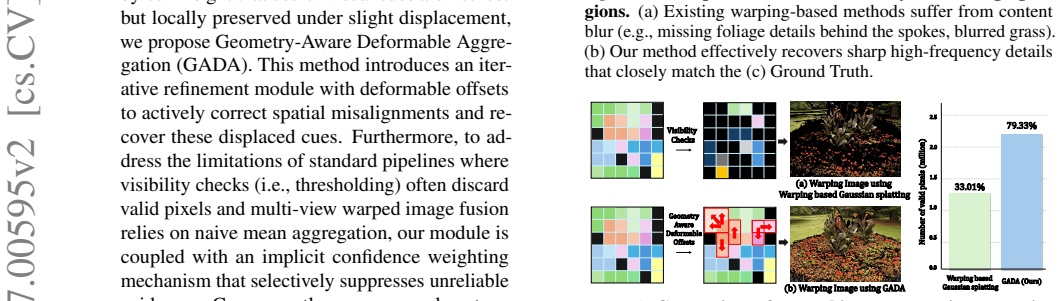
Deformable offsets correct geometry-induced misalignments to recover high-frequency details in Gaussian Splatting.
A machine-rendered reading of the paper's core claim, the machinery that carries it, and where it could break.
Core claim
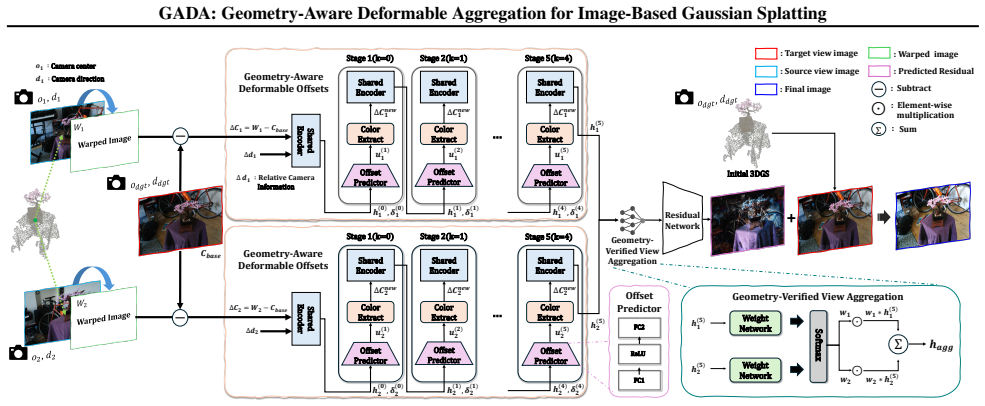
GADA adds an iterative refinement module that predicts deformable offsets to actively realign spatially misaligned warped images, recovering the displaced visual cues, and couples this with an implicit confidence weighting mechanism that selectively suppresses unreliable evidence from multi-view fusion, thereby outperforming prior warping-based Gaussian Splatting while preserving high-frequency quality and running at 2.13 times higher FPS.
What carries the argument
Geometry-Aware Deformable Aggregation (GADA) module that performs iterative refinement with deformable offsets for misalignment correction and implicit confidence weighting for selective multi-view evidence fusion.
If this is right
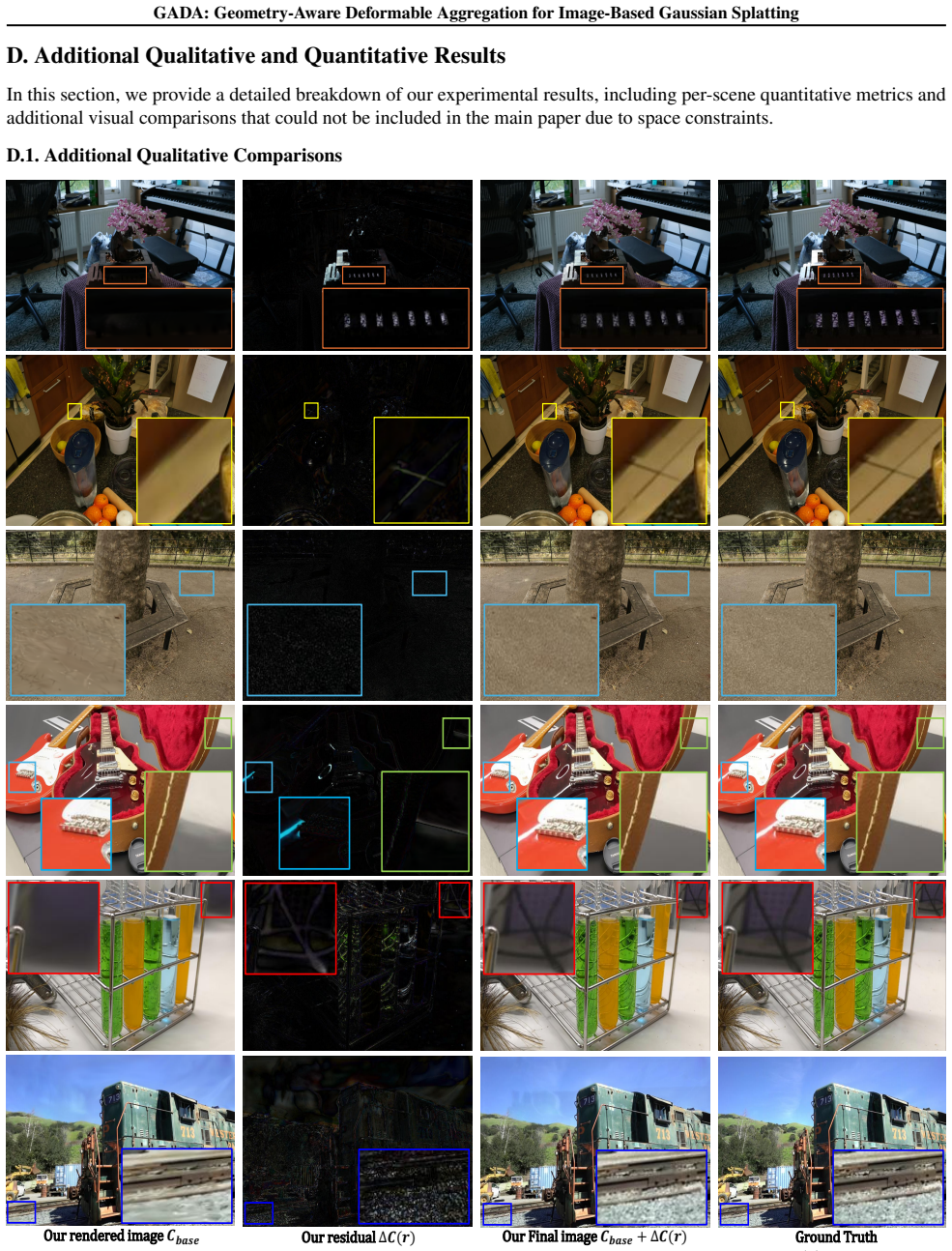
- High-frequency details and thin structures survive the warping stage better than in prior methods.
- Rendering speed reaches 2.13 times the FPS of earlier warping-based Gaussian Splatting.
- Residual learning operates on corrected rather than misaligned features.
- Hard visibility thresholding is replaced by learned confidence weighting that keeps more valid pixels.
Where Pith is reading between the lines
- The same offset-and-weighting pattern could be tested in other multi-view fusion pipelines that suffer from approximate geometry.
- Real-time rendering applications could adopt the module to trade less quality for speed.
- The confidence mechanism suggests a general alternative to binary visibility checks across neural rendering methods.
Load-bearing premise
Useful visual cues are not lost but remain locally preserved under the slight displacements produced by geometry uncertainty.
What would settle it
A controlled experiment on scenes with deliberately large geometry errors where the deformable offsets produce no measurable recovery of high-frequency detail or thin-structure quality.
Figures





read the original abstract
Gaussian Splatting has achieved significant improvements by incorporating warping-based techniques. However, such methods suffer from pixel-level inaccuracies due to uncertain geometry. This uncertainty leads to spatial misalignments in the warped images, which disrupt residual learning used in warping-based methods and fundamentally limit the gains of correction, particularly on thin structures and high-frequency details. Driven by our insight that useful visual cues are not lost but locally preserved under slight displacement, we propose Geometry-Aware Deformable Aggregation (GADA). This method introduces an iterative refinement module with deformable offsets to actively correct spatial misalignments and recover these displaced cues. Furthermore, to address the limitations of standard pipelines where visibility checks (i.e., thresholding) often discard valid pixels and multi-view warped image fusion relies on naive mean aggregation, our module is coupled with an implicit confidence weighting mechanism that selectively suppresses unreliable evidence. Consequently, our approach outperforms prior warping-based Gaussian Splatting, preserving high-frequency quality while achieving 2.13 times faster FPS.
Editorial analysis
A structured set of objections, weighed in public.
Referee Report
Summary. The manuscript proposes Geometry-Aware Deformable Aggregation (GADA) for image-based Gaussian Splatting. It identifies spatial misalignments from uncertain geometry in warping-based methods as limiting residual learning and high-frequency detail recovery. The approach adds an iterative refinement module with deformable offsets to correct misalignments, coupled with implicit confidence weighting to suppress unreliable pixels, claiming to outperform prior warping-based Gaussian Splatting while preserving high-frequency quality at 2.13 times faster FPS.
Significance. If the empirical results and the local-preservation assumption hold under quantitative scrutiny, the work could offer a practical efficiency-quality tradeoff for Gaussian Splatting pipelines, particularly for thin structures. The combination of deformable correction and confidence weighting addresses a concrete pipeline limitation, but the absence of visible supporting data, baselines, or displacement-scale analysis in the provided material leaves the magnitude of the advance difficult to assess.
major comments (2)
- [Abstract] Abstract: The central claim that the method 'outperforms prior warping-based Gaussian Splatting, preserving high-frequency quality' rests on the stated insight that 'useful visual cues are not lost but locally preserved under slight displacement.' No quantitative validation of displacement magnitudes, cue-preservation rates before/after the module, or failure cases on high-uncertainty regions is supplied, which is load-bearing for the justification of moving beyond naive warping.
- [Abstract] The reported performance numbers (2.13x FPS, high-frequency preservation) are stated without accompanying tables, baselines, error bars, or ablation results visible in the manuscript, preventing direct verification against the paper's own evidence.
Simulated Author's Rebuttal
We thank the referee for the constructive feedback on our manuscript. We address the two major comments point-by-point below and will revise the paper to strengthen the quantitative support for our claims where needed.
read point-by-point responses
-
Referee: [Abstract] Abstract: The central claim that the method 'outperforms prior warping-based Gaussian Splatting, preserving high-frequency quality' rests on the stated insight that 'useful visual cues are not lost but locally preserved under slight displacement.' No quantitative validation of displacement magnitudes, cue-preservation rates before/after the module, or failure cases on high-uncertainty regions is supplied, which is load-bearing for the justification of moving beyond naive warping.
Authors: We agree that explicit quantitative validation of displacement magnitudes, cue-preservation rates, and failure cases would strengthen the justification. The current manuscript provides qualitative before/after alignment visualizations and ablations in Section 4.3 demonstrating local cue recovery, but lacks the requested metrics. We will add a new analysis subsection with displacement histograms, feature-matching-based preservation rates, and high-uncertainty failure cases. revision: yes
-
Referee: [Abstract] The reported performance numbers (2.13x FPS, high-frequency preservation) are stated without accompanying tables, baselines, error bars, or ablation results visible in the manuscript, preventing direct verification against the paper's own evidence.
Authors: The 2.13x FPS and high-frequency results are reported with supporting evidence in the full manuscript (Table 1 for overall metrics vs. baselines, Table 2 for FPS, Figure 5 for high-frequency details, and error bars from repeated runs). However, we acknowledge the abstract does not cross-reference these clearly. We will revise the abstract to include explicit references to the tables/figures and ensure all numbers are traceable. revision: partial
Circularity Check
No circularity; method is architectural with no derivation chain
full rationale
The paper proposes an image-based Gaussian Splatting method (GADA) whose core is an iterative deformable aggregation module justified by a stated empirical insight rather than any first-principles derivation or prediction. No equations, fitted parameters renamed as predictions, self-citations used as load-bearing uniqueness theorems, or ansatzes smuggled via prior work appear in the provided text. The insight that cues are locally preserved under slight displacement is presented as motivation, not as a result derived from the method itself; the performance claims (2.13x FPS, high-frequency preservation) are empirical outcomes of the architecture, not quantities forced by construction from inputs. The derivation chain is therefore self-contained and non-circular.
Axiom & Free-Parameter Ledger
Reference graph
Works this paper leans on
- [1]
-
[2]
Proceedings of the IEEE/CVF conference on computer vision and pattern recognition , pages=
Mip-splatting: Alias-free 3d gaussian splatting , author=. Proceedings of the IEEE/CVF conference on computer vision and pattern recognition , pages=
-
[3]
2025 IEEE/CVF Conference on Computer Vision and Pattern Recognition (CVPR) , pages=
3d-hgs: 3d half-gaussian splatting , author=. 2025 IEEE/CVF Conference on Computer Vision and Pattern Recognition (CVPR) , pages=. 2025 , organization=
work page 2025
-
[4]
Proceedings of the IEEE/CVF International Conference on Computer Vision , pages=
AAA-Gaussians: Anti-Aliased and Artifact-Free 3D Gaussian Rendering , author=. Proceedings of the IEEE/CVF International Conference on Computer Vision , pages=
-
[5]
Proceedings of the 32nd ACM International Conference on Multimedia , pages=
Absgs: Recovering fine details in 3d gaussian splatting , author=. Proceedings of the 32nd ACM International Conference on Multimedia , pages=
-
[6]
European Conference on Computer Vision , pages=
Revising densification in gaussian splatting , author=. European Conference on Computer Vision , pages=. 2024 , organization=
work page 2024
-
[7]
SVGS: Enhancing Gaussian Splatting Using Primitives with Spatially Varying Colors
SuperGaussians: Enhancing Gaussian Splatting Using Primitives with Spatially Varying Colors , author=. arXiv preprint arXiv:2411.18966 , year=
work page internal anchor Pith review Pith/arXiv arXiv
-
[8]
Advances in Neural Information Processing Systems , volume=
3d gaussian splatting as markov chain monte carlo , author=. Advances in Neural Information Processing Systems , volume=
-
[9]
Advances in Neural Information Processing Systems , volume=
IBGS: Image-Based Gaussian Splatting , author=. Advances in Neural Information Processing Systems , volume=
-
[10]
Proceedings of the IEEE/CVF conference on computer vision and pattern recognition , pages=
Mip-nerf 360: Unbounded anti-aliased neural radiance fields , author=. Proceedings of the IEEE/CVF conference on computer vision and pattern recognition , pages=
-
[11]
ACM Transactions on Graphics (ToG) , volume=
Tanks and temples: Benchmarking large-scale scene reconstruction , author=. ACM Transactions on Graphics (ToG) , volume=. 2017 , publisher=
work page 2017
-
[12]
ACM Transactions on Graphics (ToG) , volume=
Deep blending for free-viewpoint image-based rendering , author=. ACM Transactions on Graphics (ToG) , volume=. 2018 , publisher=
work page 2018
-
[13]
Proceedings of the IEEE/CVF Conference on Computer Vision and Pattern Recognition , pages=
Nex: Real-time view synthesis with neural basis expansion , author=. Proceedings of the IEEE/CVF Conference on Computer Vision and Pattern Recognition , pages=
-
[14]
Adam: A Method for Stochastic Optimization
Adam: A method for stochastic optimization , author=. arXiv preprint arXiv:1412.6980 , year=
work page internal anchor Pith review Pith/arXiv arXiv
-
[15]
ACM transactions on graphics (TOG) , volume=
Instant neural graphics primitives with a multiresolution hash encoding , author=. ACM transactions on graphics (TOG) , volume=. 2022 , publisher=
work page 2022
-
[16]
ACM SIGGRAPH 2024 conference papers , pages=
2d gaussian splatting for geometrically accurate radiance fields , author=. ACM SIGGRAPH 2024 conference papers , pages=
work page 2024
-
[17]
IEEE Transactions on Visualization and Computer Graphics , year=
Pgsr: Planar-based gaussian splatting for efficient and high-fidelity surface reconstruction , author=. IEEE Transactions on Visualization and Computer Graphics , year=
-
[18]
SIGGRAPH Asia 2024 Conference Papers , pages=
Taming 3dgs: High-quality radiance fields with limited resources , author=. SIGGRAPH Asia 2024 Conference Papers , pages=
work page 2024
-
[19]
IEEE Transactions on Pattern Analysis & Machine Intelligence , number=
Octree-GS: Towards Consistent Real-time Rendering with LOD-Structured 3D Gaussians , author=. IEEE Transactions on Pattern Analysis & Machine Intelligence , number=. 2025 , publisher=
work page 2025
-
[20]
Proceedings of the IEEE/CVF Conference on Computer Vision and Pattern Recognition , pages=
Scaffold-gs: Structured 3d gaussians for view-adaptive rendering , author=. Proceedings of the IEEE/CVF Conference on Computer Vision and Pattern Recognition , pages=
-
[21]
Communications of the ACM , volume=
Nerf: Representing scenes as neural radiance fields for view synthesis , author=. Communications of the ACM , volume=. 2021 , publisher=
work page 2021
-
[22]
Proceedings of the IEEE/CVF international conference on computer vision , pages=
Mip-nerf: A multiscale representation for anti-aliasing neural radiance fields , author=. Proceedings of the IEEE/CVF international conference on computer vision , pages=
-
[23]
Proceedings of the IEEE/CVF conference on computer vision and pattern recognition , pages=
Ibrnet: Learning multi-view image-based rendering , author=. Proceedings of the IEEE/CVF conference on computer vision and pattern recognition , pages=
-
[24]
Mukund Varma T and Peihao Wang and Xuxi Chen and Tianlong Chen and Subhashini Venugopalan and Zhangyang Wang , booktitle=. Is Attention All That Ne. 2023 , url=
work page 2023
-
[25]
Proceedings of the IEEE/CVF conference on computer vision and pattern recognition , pages=
pixelnerf: Neural radiance fields from one or few images , author=. Proceedings of the IEEE/CVF conference on computer vision and pattern recognition , pages=
-
[26]
Proceedings of the European conference on computer vision (ECCV) , pages=
Mvsnet: Depth inference for unstructured multi-view stereo , author=. Proceedings of the European conference on computer vision (ECCV) , pages=
-
[27]
Proceedings of the IEEE/CVF Conference on Computer Vision and Pattern Recognition , pages=
Sugar: Surface-aligned gaussian splatting for efficient 3d mesh reconstruction and high-quality mesh rendering , author=. Proceedings of the IEEE/CVF Conference on Computer Vision and Pattern Recognition , pages=
-
[28]
ACM Transactions on Graphics (TOG) , volume=
Stopthepop: Sorted gaussian splatting for view-consistent real-time rendering , author=. ACM Transactions on Graphics (TOG) , volume=. 2024 , publisher=
work page 2024
-
[29]
Proceedings of the IEEE/CVF conference on computer vision and pattern recognition , pages=
Deformable 3d gaussians for high-fidelity monocular dynamic scene reconstruction , author=. Proceedings of the IEEE/CVF conference on computer vision and pattern recognition , pages=
-
[30]
Proceedings of the IEEE/CVF conference on computer vision and pattern recognition , pages=
4d gaussian splatting for real-time dynamic scene rendering , author=. Proceedings of the IEEE/CVF conference on computer vision and pattern recognition , pages=
-
[31]
European conference on computer vision , pages=
Raft: Recurrent all-pairs field transforms for optical flow , author=. European conference on computer vision , pages=. 2020 , organization=
work page 2020
-
[32]
Proceedings of the 28th annual conference on Computer graphics and interactive techniques , pages=
Unstructured lumigraph rendering , author=. Proceedings of the 28th annual conference on Computer graphics and interactive techniques , pages=
-
[33]
IEEE Transactions on Visualization and Computer Graphics , volume=
EWA splatting , author=. IEEE Transactions on Visualization and Computer Graphics , volume=. 2002 , publisher=
work page 2002
-
[34]
Proceedings of the IEEE conference on computer vision and pattern recognition , pages=
Structure-from-motion revisited , author=. Proceedings of the IEEE conference on computer vision and pattern recognition , pages=
-
[35]
Proceedings of the IEEE conference on computer vision and pattern recognition , pages=
The unreasonable effectiveness of deep features as a perceptual metric , author=. Proceedings of the IEEE conference on computer vision and pattern recognition , pages=
-
[36]
IEEE transactions on image processing , volume=
Image quality assessment: from error visibility to structural similarity , author=. IEEE transactions on image processing , volume=. 2004 , publisher=
work page 2004
-
[37]
Verbin, Dor and Hedman, Peter and Mildenhall, Ben and Zickler, Todd and Barron, Jonathan T. and Srinivasan, Pratul P. , title =. Proceedings of the IEEE/CVF Conference on Computer Vision and Pattern Recognition (CVPR) , month =. 2022 , pages =
work page 2022
-
[38]
2023 IEEE/CVF International Conference on Computer Vision (ICCV) , pages=
Zip-NeRF: Anti-Aliased Grid-Based Neural Radiance Fields , author=. 2023 IEEE/CVF International Conference on Computer Vision (ICCV) , pages=. 2023 , organization=
work page 2023
-
[39]
Proceedings of the IEEE/CVF Conference on Computer Vision and Pattern Recognition (CVPR) , month =
Xu, Qiangeng and Xu, Zexiang and Philip, Julien and Bi, Sai and Shu, Zhixin and Sunkavalli, Kalyan and Neumann, Ulrich , title =. Proceedings of the IEEE/CVF Conference on Computer Vision and Pattern Recognition (CVPR) , month =. 2022 , pages =
work page 2022
-
[40]
Proceedings of the IEEE/CVF International Conference on Computer Vision (ICCV) , month =
Chen, Anpei and Xu, Zexiang and Zhao, Fuqiang and Zhang, Xiaoshuai and Xiang, Fanbo and Yu, Jingyi and Su, Hao , title =. Proceedings of the IEEE/CVF International Conference on Computer Vision (ICCV) , month =. 2021 , pages =
work page 2021
-
[41]
IEEE/CVF Conference on Computer Vision and Pattern Recognition (CVPR 2020) , pages=
Differentiable Volumetric Rendering: Learning Implicit 3D Representations without 3D Supervision , author=. IEEE/CVF Conference on Computer Vision and Pattern Recognition (CVPR 2020) , pages=. 2020 , organization=
work page 2020
-
[42]
Advances in Neural Information Processing Systems , volume=
Multiview neural surface reconstruction by disentangling geometry and appearance , author=. Advances in Neural Information Processing Systems , volume=
-
[43]
Advances in Neural Information Processing Systems , volume=
Spec-Gaussian: Anisotropic View-Dependent Appearance for 3D Gaussian Splatting , author=. Advances in Neural Information Processing Systems , volume=
-
[44]
ACM Transactions on Graphics (ToG) , volume=
Local light field fusion: Practical view synthesis with prescriptive sampling guidelines , author=. ACM Transactions on Graphics (ToG) , volume=. 2019 , publisher=
work page 2019
-
[45]
European Conference on Computer Vision , pages=
Flexiedit: Frequency-aware latent refinement for enhanced non-rigid editing , author=. European Conference on Computer Vision , pages=. 2024 , organization=
work page 2024
-
[46]
European Conference on Computer Vision , pages=
Dni: Dilutional noise initialization for diffusion video editing , author=. European Conference on Computer Vision , pages=. 2024 , organization=
work page 2024
-
[47]
International Conference on Machine Learning , pages=
FlowDrag: 3D-aware Drag-based Image Editing with Mesh-guided Deformation Vector Flow Fields , author=. International Conference on Machine Learning , pages=. 2025 , organization=
work page 2025
-
[48]
FLUX.1 Kontext: Flow Matching for In-Context Image Generation and Editing in Latent Space
FLUX. 1 Kontext: Flow Matching for In-Context Image Generation and Editing in Latent Space , author=. arXiv preprint arXiv:2506.15742 , year=
work page internal anchor Pith review Pith/arXiv arXiv
-
[49]
International Conference on Learning Representations , volume=
Sdxl: Improving latent diffusion models for high-resolution image synthesis , author=. International Conference on Learning Representations , volume=
discussion (0)
Sign in with ORCID, Apple, or X to comment. Anyone can read and Pith papers without signing in.