REVIEW 3 major objections 6 minor 2 cited by
Visuospatial Cognitive Assistant
T0 review · 3 major / 6 minor · reviewed 2026-08-15 · deepseek-v4-flash
Pith's one-line read A 7B model trained on 322K spatial QA pairs outperforms much larger models on all eight VSI-Bench tasks.
desk verdict A genuinely useful 322K spatial-QA dataset and a credible average VSI-Bench gain, but the 'all eight tasks' claim is contradicted by their own Table 1 and the VSI-Bench decontamination procedure is asserted, not documented. read the letter →
The pith
A machine-rendered reading of the paper's core claim, the machinery that carries it, and where it could break.
The reading
What carries the argument
The load-bearing object is the ViCA-322K training mixture: 281,359 base question-answer pairs whose answers can be computed exactly from 3D bounding-box metadata (object count, relative and absolute distance, object size, appearance order, room size) plus 40,644 complex-reasoning pairs generated from video frames and metadata, covering conversations, furniture placement, occupancy, wheelchair access, and spatial description. The design deliberately omits training questions for relative direction and route planning, so gains on those VSI-Bench tasks serve as evidence of transfer. The fine-tuning base is an existing 7B video-language model, and the comparison benchmark is VSI-Bench's eight tasks.
What would settle it
Check every VSI-Bench test video against the sourcing logs of ARKitScenes, ScanNet, and ScanNet++ used to build ViCA-322K; if any test scene appears in training, or if the model scores much above chance on rephrased questions and shuffled answer templates from the same scenes, the generalization claim is weakened. The cleanest version is to retrain on the same 322K data after removing all videos from scenes that appear in VSI-Bench and see whether the 26.1-point absolute-distance margin survives.
Extended reading notes
Core claim
The paper's central claim is that a 7B vision-language model fine-tuned on a purpose-built spatial QA dataset can set a new top performance on VSI-Bench's eight video-based spatial tasks, outperforming not only similar-size open models but also 72B-scale models and proprietary systems. On the absolute-distance task it reports 57.0 versus 30.9 for the next best model, a 26.1-point margin, and its average is 60.6. The authors attribute the numerical-task gains to supervision generated directly from 3D oriented bounding boxes, and the appearance-order gain to temporal first-appearance detection used during data preparation. They further report that excluding complex reasoning data lowers the average to 55.4, and that a variant trained to articulate explicit thoughts drops to 38.5 while producing readable step-by-step reasoning.
Load-bearing premise
The load-bearing premise is that VSI-Bench measures generalization rather than memorization: the paper asserts strict filtering to exclude benchmark videos but never specifies the filtering procedure, and if any benchmark scenes or answer-format cues leaked into the 322K training data, the reported margins could partly reflect overlap.
Editorial extensions
If this is right
- A 7B open model can surpass much larger and proprietary models on a video spatial-reasoning benchmark after targeted fine-tuning, so parameter count is not the limiting factor for this capability.
- Six supervised spatial tasks transfer to two held-out tasks, relative direction and route planning, suggesting the learned representation is spatial rather than task-specific.
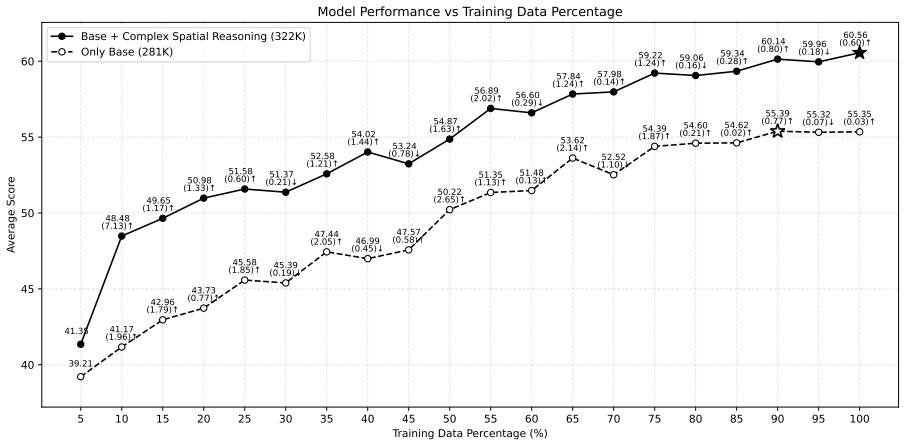
- Complex Spatial Reasoning data adds about five average points over base-only data and widens the gap as data grows, so language-grounded structural supervision complements exact geometric supervision.
- Adding timestamps or doubling input frames does not improve scores, so current architectures are not exploiting extra temporal information as provided.
- Explicit reasoning supervision makes model decisions inspectable but costs 22.1 average points, concentrated in numerical tasks, implying an accuracy-interpretability tradeoff in single-stream decoding.
Reading between the lines
- If the transfer result is real, the six-task base could be pruned further: holding out other task families and measuring transfer would reveal which spatial skills are genuinely shared.
- The failure of extra frames and timestamps may indicate a fixed visual-token bottleneck rather than a lack of temporal information; a testable next step is variable token allocation or temporal pooling before the language model.
- Because the complex-reasoning data is generated by an LLM from metadata or frames, its benefit could come from linguistic structure rather than new visual perception; training on the same CSR text with scrambled frame order would separate these.
- The paper's own limitation section restricts generalization to indoor scenes and notes the LLM-generated data may carry biases, so a natural extension is to test the same training recipe on outdoor or egocentric robot video.
Signed reviews
Editorial analysis
A structured set of objections, weighed in public.
Referee Report
Summary. The paper presents ViCA-322K, a 322,003-pair video QA dataset built from the training splits of ARKitScenes, ScanNet, and ScanNet++, covering six metadata-grounded 'Base Data' tasks and a 'Complex Spatial Reasoning' subset generated with GPT-4o-mini. The authors fine-tune LLaVA-Video-7B-Qwen2 on this dataset to obtain ViCA-7B, and report VSI-Bench results with an average score of 60.6, including a 26.1-point gain on Absolute Distance over prior models. They also construct ViCA-Thinking-2.68K from Gemini 2.5 Pro outputs, fine-tune ViCA-7B-Thinking, and show that structured reasoning improves interpretability at a substantial accuracy cost. The abstract and introduction claim new state-of-the-art performance on all eight VSI-Bench tasks, and the conclusion frames the gains as evidence that targeted spatial supervision transfers to held-out spatial reasoning tasks.
Significance. If the headline claims were fully supported, the contribution would be significant: it would demonstrate that a 7B open model can surpass much larger open and proprietary systems on video-based spatial reasoning through targeted 3D-grounded instruction data, with direct implications for embodied AI and robotics. The released dataset, models, training logs, scaling curves, and structured-reasoning examples are genuinely useful resources and appear reproducible in principle. However, the paper's own Table 1 contradicts the per-task state-of-the-art claim, and the absence of any operational description of the VSI-Bench overlap filtering leaves the central generalization claim unverified. With corrected claims and documented filtering, this could become a solid dataset-and-model study; as written, the central claim is not supported.
major comments (3)
- [§3.1 and §4.1.2] The claim that 'strict filtering' removes all videos overlapping with VSI-Bench is not operationalized anywhere in the paper. The authors should provide the exact procedure (e.g., scan-ID matching, hash-based deduplication, official split membership), the number of candidate videos considered and excluded, and a statement of whether any VSI-Bench video IDs appear in the released ViCA-322K. Since VSI-Bench and ViCA-322K are drawn from the same ARKitScenes/ScanNet/ScanNet++ sources, a scene-level leak would directly explain the large Absolute Distance gain (57.0 vs 30.9) without implying improved spatial cognition; this is the load-bearing uncertainty for the paper's central generalization claim.
- [Abstract, §1, §4.2, Table 1] The statement 'new state-of-the-art on all eight VSI-Bench tasks' is contradicted by Table 1, where Gemini-1.5 Pro obtains 46.3 on Relative Direction and 36.0 on Route Planning versus ViCA-7B's 42.6 and 34.5. Section 4.2 acknowledges this, but the margins reported for these two tasks ('+0.2' and '+0.5') are computed against the best 7B/8B open-source model, not against the true best system, which is misleading in a state-of-the-art claim. Please revise the abstract and contributions to state 'best average score and best on six of eight tasks' (or equivalent), and report per-task margins against the actual best-performing model.
- [§3.2 and §4.2] The transfer interpretation for the two held-out tasks (Relative Direction and Route Planning) is not supported by the reported numbers. The gains over the best comparable open model are +0.2 and +0.5 percentage points, which are within the run-to-run variation shown in Figure 4 (annotated differences range from 0.03 to 2.65), and no standard errors or multiple-seed results are provided for the main ViCA-7B evaluation. Please either provide repeated runs with confidence intervals and a significance test, or explicitly characterize these as near-zero transfer effects rather than evidence of learned generalization; the shared answer formats with VSI-Bench make format-calibration effects a plausible alternative explanation.
minor comments (6)
- [Table 1 caption] The gray shading is applied to ViCA-7B across all columns, but the per-column best for Relative Direction and Route Planning is Gemini-1.5 Pro; please shade per column or reword the caption so it does not imply ViCA-7B is best on every metric.
- [Throughout] The text contains a recurring 'LLaV A' artifact (e.g., Table 1 and the references) that should be corrected to 'LLaVA'.
- [Appendix B, Table 3 caption] The cross-reference to 'Section 5.5' is invalid; the intended target appears to be Section 5.2 or Appendix C.
- [§5.1] The abbreviation 'MRA' (matching rate) is used without definition; please define it and state the threshold used to select numeric answers.
- [Appendix B] The text says 'we process all 5,130 valid examples' while Table 2 reports valid-output counts around 4,400-4,600; clarify whether the difference corresponds to examples failing format extraction and why the numbers do not match.
- [§3.3 and §4.1] Please specify how many frames are used as visual input for the Base Data and Complex Spatial Reasoning training samples, since the generation conditions (metadata-only vs 16 frames) differ from the 64-frame evaluation setting and this affects reproducibility.
Circularity Check
No circularity: VSI-Bench is an external benchmark and the reported scores are measurements, not fitted outputs; the train/eval scene-overlap risk is a soundness concern, not derivation circularity.
full rationale
The paper's core chain is: construct ViCA-322K from 3D metadata of ARKitScenes/ScanNet/ScanNet++, fine-tune LLaVA-Video-7B-Qwen2 on it, and measure accuracy on VSI-Bench. VSI-Bench is a pre-existing external benchmark (Yang et al., 2024) with its own task definitions and ground truth; none of the paper's equations or construction steps define the VSI-Bench scores in terms of ViCA-322K. The Abs. Dist. improvement (+26.1) is a reported difference between the fine-tuned model's measured accuracy (57.0) and the next-best model's measured accuracy (30.9), not a parameter fitted to force that number. Thus the central empirical claim does not reduce to its inputs by construction. Section 3.1 states: 'We exclusively use the training splits of these datasets and conduct strict filtering to ensure that no videos overlap with those used in VSI-Bench,' but gives no filtering procedure; if this is false, the result would be data leakage/benchmark contamination, which is a validity threat, not a logical circularity. The benchmark tasks and the training-base tasks overlap in format and source datasets, so generalization is not proven, but overlap is not equivalence. The paper's own Table 1 contradicts the abstract's 'all eight tasks' wording (Gemini-1.5 Pro scores 46.3 vs 42.6 on Rel. Dir. and 36.0 vs 34.5 on Route Plan; the text computes those margins only against 7B/8B open models), and the Limitations section concedes trade-offs and indoor-domain scope; these are correctness/reporting issues. No load-bearing self-citation, uniqueness theorem, or ansatz-via-citation appears: the only self-references are releases of the dataset/models. The VSI-Bench-Thinking analysis is a separate probe of interpretability and explicitly reports degraded scores, further showing the authors did not redefine the benchmark outcome to match their method. Accordingly, no step meets the standard of a quoted reduction of a claimed result to its inputs.
Assumptions & free parameters
assumptions (4)
- domain assumption 3D oriented bounding box annotations from ARKitScenes, ScanNet, and ScanNet++ are accurate enough to serve as ground truth for distance, size, count, and room-size labels.
- domain assumption GPT-4o-mini and Gemini 2.5 Pro generated answers are sufficiently correct and unbiased to be used as training targets.
- domain assumption VSI-Bench is a valid and correctly scored measure of video-based spatial cognition.
- domain assumption The claimed strict filtering actually removes every VSI-Bench video from the ViCA-322K training set.
Cite this review
Pith. "Pith review of Visuospatial Cognitive Assistant." pith.science (2026). https://pith.science/paper/JPEG5GFY
@misc{pith2026250512312,
  author       = {Pith},
  title        = {Pith review of: Visuospatial Cognitive Assistant},
  year         = {2026},
  howpublished = {\url{https://pith.science/paper/JPEG5GFY}},
  note         = {Machine review of arXiv:2505.12312}
}
read the original abstract
Video-based spatial cognition is vital for robotics and embodied AI but challenges current Vision-Language Models (VLMs). This paper makes two key contributions. First, we introduce ViCA (Visuospatial Cognitive Assistant)-322K, a diverse dataset of 322,003 QA pairs from real-world indoor videos (ARKitScenes, ScanNet, ScanNet++), offering supervision for 3D metadata-grounded queries and video-based complex reasoning. Second, we develop ViCA-7B, fine-tuned on ViCA-322K, which achieves new state-of-the-art on all eight VSI-Bench tasks, outperforming existing models, including larger ones (e.g., +26.1 on Absolute Distance). For interpretability, we present ViCA-Thinking-2.68K, a dataset with explicit reasoning chains, and fine-tune ViCA-7B to create ViCA-7B-Thinking, a model that articulates its spatial reasoning. Our work highlights the importance of targeted data and suggests paths for improved temporal-spatial modeling. We release all resources to foster research in robust visuospatial intelligence.
Figures


Figures from the paper (7 more)



Forward citations
Cited by 2 Pith papers
-
Ouroboros-Spatial: Closing the Data-Model Loop for Spatial Reasoning
A self-evolving training loop that generates its own spatial QA data with executable code and difficulty feedback lifts Qwen3-VL-4B/8B to 62.7/63.3 on VSI-Bench using an order of magnitude less data.
-
SpaR3D-MoE: Adaptive 3D Spatial Reasoning from Sparse Views Meets Geometry-Inductive Mixture-of-Experts
Adaptive manifold keyframe sampling plus an instruction-pose-aware geometry MoE raises sparse-RGB 3D spatial reasoning to 63.5 average on VSI-Bench, beating strong baselines by 7.8 points.
Reference graph
Works this paper leans on
-
[1]
The video shows a person entering a room and panning around.,→
**Understand the Goal:** The request asks for the number of cabinets *in the room*. The video shows a person entering a room and panning around.,→
-
[2]
**Define ""Cabinet"":** I need a working definition of ""cabinet"" for this context. Generally, a cabinet is a piece of furniture with shelves or drawers, enclosed by doors or open. This could include kitchen cabinets, bathroom cabinets, dressers, chests of drawers, storage units, etc. I need to be consistent in applying this definition. ,→ ,→ ,→
-
[3]
There's a comic book on the floor
**Analyze the Video Frame by Frame (or segment by segment):** * **0:00 - 0:05:** The camera looks down at the floor (black and white tiles) and feet wearing blue shoe covers. There's a comic book on the floor. The view then transitions to looking forward into a room with wood flooring. No cabinets visible yet, just the doorway area. ,→ ,→ ,→ * **0:05 - 0:...
-
[4]
* Cabinet 2: White cube storage unit (seen multiple times, e.g., 0:12, 0:46, 0:52, 1:11)
**Consolidate and Count:** * Cabinet 1: White chest of drawers/dresser (seen multiple times, e.g., 0:11, 0:45, 1:20). * Cabinet 2: White cube storage unit (seen multiple times, e.g., 0:12, 0:46, 0:52, 1:11). * Cabinet 3: Tall, narrow wooden bookshelf/shelving unit (seen near the radiator/crib, e.g., 0:39).,→ * Cabinet 4: Low white storage chest/box (seen ...
-
[5]
**Final Check:** Review the list against the video segments. Did I miss any? Did I double-count? The identified items seem distinct and fit the definition of cabinets/storage furniture. The count is 5. ,→ ,→
-
[6]
The low white chest/box (Cabinet 4) is visible again near the door
and the door again. The low white chest/box (Cabinet 4) is visible again near the door. ,→ ,→ * **1:27 - 1:38:** The camera moves back out of the room, showing the doorway and the patterned rug/mat outside the room, then back towards the entrance area with the black and white tiles. ,→ ,→ * **1:38 - 1:41:** The camera focuses back on the starting point, l...
-
[7]
**Re-evaluate Cabinet Definition:** Is the ""cabinet"" the structure seen initially, or could it refer to something else? No other cabinet is prominently featured. The initial structure seems the most likely candidate. It appears to be built into the wall/eaves space *between* the bedroom and the bathroom entrance area. ,→ ,→ ,→
-
[8]
**Refine Proximity Comparison:** * The cabinet is structurally part of the wall separating the bedroom/hallway from the bathroom entrance.,→ * The bed is in the bedroom, adjacent to this wall/cabinet. * The sink is in the bathroom, adjacent to the opposite side of the doorway near the cabinet.,→ * The toilet and bathtub are much further away. Looking clos...
Show all 72 references
-
[9]
**Formulate the Answer:** State the final count clearly." --- ### Example 2
-
[10]
"cabinet
**Analyze the Request:** The user wants to know which object (sink, bathtub, bed, or toilet) is nearest to the ""cabinet"" shown in the video. The answer format requires the letter followed by the full option. ,→ ,→
-
[11]
"Cabinet
**Identify the ""Cabinet"":** The video starts focused on a white, built-in structure that looks like a cabinet or perhaps access to storage/utilities under the eaves of the roof (common in loft conversions). It has double doors. Let's assume this is the ""cabinet"" referred t...
-
[12]
The camera is positioned *outside* the bathroom, near the cabinet.,→ * 0:05-0:07: Camera pans left, moving *into* the bathroom
**Track the Camera Movement:** * 0:00-0:04: Close-up of the cabinet door opening, looking *into* the bathroom. The camera is positioned *outside* the bathroom, near the cabinet.,→ * 0:05-0:07: Camera pans left, moving *into* the bathroom. The sink comes into view on the left w...
-
[13]
**Assess Proximity:** * **Cabinet Location:** The cabinet is located just outside the main bathroom area, near the entrance door, under a sloped ceiling.,→ * **Sink:** The sink is immediately to the left as you enter the bathroom, making it very close to the entrance and thus ...
-
[14]
* The sink is just inside the entrance
**Compare Distances:** * The cabinet is right by the entrance. * The sink is just inside the entrance. * The toilet and bathtub are at the far end. * The bed is in another room
-
[15]
Comparing the sink to the bed requires considering the threshold
**Conclusion:** The sink is the closest object *within the bathroom* to the location of the cabinet (which is just outside/at the entrance). Comparing the sink to the bed requires considering the threshold. The cabinet is right next to the door frame leading into the bedroom. ...
-
[18]
The bed is also in the bedroom (seen clearly through the door at 1:02-1:04)
**Final Check:** The video shows the cabinet is in the bedroom space, right next to the bathroom door frame (visible from 0:01-0:03 and 1:02-1:04). The bed is also in the bedroom (seen clearly through the door at 1:02-1:04). The sink is just inside the bathroom. Given the cabi...
-
[19]
"bed""." --- ### Example 3
**Format the Answer:** The letter is C, and the full option is ""bed""." --- ### Example 3 "The user wants to identify the first appearance time of four specific categories (refrigerator, chair, tv_monitor, oven) in the video and determine their sequence.,→
-
[20]
It's the large stainless steel appliance on the left around 03:08
**Refrigerator:** Appears early, visible through the doorway around 0:01-0:02, more clearly seen as the camera moves forward around 0:06-0:07. It's the large stainless steel appliance on the left around 03:08. Let's pinpoint the first *clear* view. It's partially visible from ...
-
[21]
The dining chairs around the table are clearly seen starting around 0:05-0:06
**Chair:** Chairs are visible almost immediately. The dining chairs around the table are clearly seen starting around 0:05-0:06. There's also an armchair near the window visible from 0:08-0:09. A computer chair appears later around 1:31. The dining chairs are the first type se...
-
[22]
**TV Monitor:** An iMac computer monitor is visible on a desk around 1:31-1:32. Is there another TV earlier? Yes, there appears to be a screen, maybe a TV or large monitor, mounted on the wall or sitting high up near the red LED strip, visible from around 0:07-0:08. Let's conf...
-
[23]
,→ --- ### Example 4
**Oven:** An oven (part of a range cooker, looks like an AGA or similar) is visible in the kitchen area. It's black and noticeable from around 0:07 when the kitchen area comes into view. It's more clearly seen later, around 03:03 and especially 03:40. The first appearance is a...
-
[24]
This means I need to identify the longest dimension of the sofa visible in the video and estimate its measurement
**Understand the Goal:** The request asks for the length of the *largest side* of the sofa in centimeters. This means I need to identify the longest dimension of the sofa visible in the video and estimate its measurement. ,→ ,→
-
[25]
"Blackmail
**Analyze the Video:** * The video starts with a close-up of the floor, showing a movie poster printout (""Blackmail"") and someone's feet wearing blue shoe covers. This doesn't help with the sofa measurement yet. ,→ ,→ * The camera pans up and moves through a doorway into a l...
-
[26]
Its largest side is clearly its length, running parallel to the wall
**Identify the Sofa and its Largest Side:** The sofa is the long, dark grey piece of furniture pushed against the light grey wall. Its largest side is clearly its length, running parallel to the wall. ,→ ,→
-
[27]
"Fenêtre sur Cour
**Find Reference Objects:** To estimate the sofa's length, I need objects with known or easily estimated dimensions within the same frame or perspective. Potential reference objects: ,→ ,→ * **Floorboards:** The floor appears to be laminate or wood plank flooring. Standard pla...
-
[28]
It looks like the sofa spans approximately 10-12 full floorboard widths
**Select the Best References and Estimate:** * **Floorboards:** Let's count the floorboards along the length of the sofa (around 0:18-0:20). It looks like the sofa spans approximately 10-12 full floorboard widths. If we assume an average width of 15 cm per board: 10 * 15 cm = ...
-
[29]
A common size for this type of sofa would be around 190 cm or 200 cm
**Refine the Estimate:** The different reference points (floorboards, coffee table, armchair, typical sofa size) seem to converge on a range roughly between 170 cm and 220 cm. A common size for this type of sofa would be around 190 cm or 200 cm. The perspective makes it look q...
-
[30]
This makes visual estimation less accurate
**Consider Potential Issues:** * **Lens Distortion:** The video uses a wide-angle (fisheye) lens, which distorts perspective, especially near the edges. This makes visual estimation less accurate. Objects closer to the camera appear larger, and straight lines can appear curved...
-
[31]
I'll state a specific number within this range as the best estimate, acknowledging it's an approximation
**Formulate the Answer:** Based on the visual estimation using reference objects like the floorboards and the likely size of a typical 3-seater sofa/sofa bed, the largest side (length) appears to be approximately 190-210 cm. I'll state a specific number within this range as th...
-
[32]
,→ --- ### Example 5
**Final Check:** Does 200 cm (2 meters) look reasonable for the sofa shown in the context of the room? Yes, it fits the visual scale relative to the other furniture and the room size.",→ --- ### Example 5 "Here's my thought process for determining the distance between the tabl...
-
[33]
**Understand the Goal:** The request asks for the distance in meters between the *closest points* of the dining table and the shelf (specifically the bookshelf visible further down the room). ,→ ,→
-
[34]
We see a long room with a dining table in the foreground and kitchen elements further back
**Analyze the Video:** * **Starting Point (0:00-0:04):** The video starts looking through a doorway with frosted glass panels. We see a long room with a dining table in the foreground and kitchen elements further back. The camera moves forward down a few steps into the room. ,...
-
[35]
* **Shelf:** The shelving unit visible through the doorway at the far end of the kitchen area (the pantry).,→
**Identify the Objects:** * **Table:** The prominent wooden dining table in the foreground/middle of the long room. * **Shelf:** The shelving unit visible through the doorway at the far end of the kitchen area (the pantry).,→
-
[36]
"Closest Points
**Determine the ""Closest Points"":** * The closest point of the *table* to the shelf would be the end of the table nearest the kitchen area.,→ * The closest point of the *shelf* to the table would be the front edge of the shelves within the pantry doorway.,→
-
[37]
It appears to be an open-plan kitchen/diner.,→ * **Break Down the Distance:** 23 * From the end of the dining table to the *start* of the kitchen island/peninsula
**Estimate the Distance:** * **Visualize the Space:** The room is long and relatively narrow. It appears to be an open-plan kitchen/diner.,→ * **Break Down the Distance:** 23 * From the end of the dining table to the *start* of the kitchen island/peninsula. This looks like may...
-
[38]
Counting boards is difficult due to perspective and movement, but it suggests a significant length.,→ * **Doors:** Standard door height is ~2m
**Consider Scale Clues:** * **Floorboards:** Standard floorboards are often around 10-15 cm wide. Counting boards is difficult due to perspective and movement, but it suggests a significant length.,→ * **Doors:** Standard door height is ~2m. The pantry doorway looks standard. ...
-
[39]
The pantry door is at the far end (8-9m)
**Refine based on Scale:** If the whole room (dining + kitchen) is ~8-9m long, and the table takes up maybe 2.5m of that length, starting maybe 1m from the window wall, then the end of the table is roughly 3.5m into the room. The pantry door is at the far end (8-9m). The dista...
-
[40]
Let's re-examine the middle ground.,→ * Look at 0:10
**Reconcile Estimates:** My first estimate was ~7m, my second based on rough room dimensions is ~5m. Let's re-examine the middle ground.,→ * Look at 0:10. The table ends. * Look at 0:15. The camera has moved forward. The kitchen area starts properly. * Look at 0:48. We are nea...
-
[41]
It's a considerable walk/pan
**Final Check:** View the transition from 0:11 (near table end) to 0:48 (near pantry). It's a considerable walk/pan. 6-7 meters seems reasonable for the space shown, accounting for the kitchen island and walkways. ,→ ,→
-
[42]
,→ --- ## Guide for Writing “Thoughts
**Format the Answer:** State the estimated distance clearly in meters, acknowledging it's an estimate based on visual cues.",→ --- ## Guide for Writing “Thoughts” (Step-by-Step Reasoning for Video QA) **Purpose:** These “thoughts” are written to show a clear, step-by-step reas...
-
[43]
The goal is to determine which object appears first in the video
**Clarify the Question** 24 - Start by rephrasing or clearly identifying what the question is asking. - Example: *“The goal is to determine which object appears first in the video.”*
-
[44]
At 00:15, the sink becomes visible
**Observe the Video and Gather Evidence** - Mention specific timestamps (e.g., *“At 00:15, the sink becomes visible”*). - Describe what is seen, including spatial positions, sizes, and context. - Use clear bullet points or numbered lists if multiple observations are needed
-
[45]
Standard kitchen counters are about 60 cm deep, so the sink appears slightly shorter than that
**Use Common Knowledge and Estimation** - Use real-world dimensions or typical object sizes for scale comparisons. - Example: *“Standard kitchen counters are about 60 cm deep, so the sink appears slightly shorter than that.”*,→
-
[46]
The stool is at the foot of the bed, so it's farther from the toilet than the bed's head, which is near the door
**Compare and Reason** - Compare objects, locations, appearances, or distances based on what is seen. - Discuss alternatives and edge cases. - Example: *“The stool is at the foot of the bed, so it's farther from the toilet than the bed's head, which is near the door.”*,→
-
[47]
Option A lists the oven before the table, but the oven appears much later
**Rule Out Incorrect Options (if applicable)** - If a multiple-choice question is given, explain why incorrect choices can be eliminated. - Example: *“Option A lists the oven before the table, but the oven appears much later.”*
-
[48]
Therefore, the correct order is: sofa, table, TV monitor, oven
**State a Final Answer** - Conclude clearly and confidently. - Example: *“Therefore, the correct order is: sofa, table, TV monitor, oven.”* --- ### Style and Tone - Write in **clear, logical English**. - Keep the tone **neutral and analytical**. - Use **present tense** when de...
-
[49]
**Define "Chair":** I need to identify objects designed for seating one person, typically with a back and legs or a base
**Understand the Goal:** The user wants to know the total number of chairs visible in the room shown in thevideo.2. **Define "Chair":** I need to identify objects designed for seating one person, typically with a back and legs or a base. This includes dining chairs, office cha...
-
[50]
* Chair 2: A brown chair at the small round table near the TV/desk.5
**Consolidate Findings:** I identified two distinct chairs: * Chair 1: A brown chair under the tall wooden cabinet next to the oven. * Chair 2: A brown chair at the small round table near the TV/desk.5. **Final Count:** There are 2 chairs visible in the room. response Based on...
-
[51]
At approximately 0:16, a brown chair is visible tucked under a tall wooden cabinet next to the oven
-
[52]
No other chairs are clearly visible in the room
At approximately 0:20, a second brown chair is visible at a small round table near the TV and desk. No other chairs are clearly visible in the room. Therefore, there are 2 chairs in the room. final \[ \boxed{2}\] Figure 7: A representativeThought-Response-Final Answerexample g...
-
[53]
**Understand the Goal:** The question asks to identify which of the four listed objects (bed, chair, trash bin,radiator) is closest to the door shown in the video, measuring from the closest points of each object to the door
-
[54]
* **Bed:** A loft bed is positioned along the wall opposite the door (e.g., 0:00-0:02, 0:17-0:19)
**Identify the Objects and Door:** * **Door:** A white door is visible on the left side of the room, near the start and end of the pan (e.g., 0:03-0:04, 0:28-0:29). * **Bed:** A loft bed is positioned along the wall opposite the door (e.g., 0:00-0:02, 0:17-0:19). * **Chair:** ...
-
[55]
* The door is on one wall
**Analyze Spatial Relationships:** * The video pans across the room, showing the layout. * The door is on one wall. * The bed is on the opposite wall, further down the room from the door. * The desk, chair, and trash bin are grouped together near the window, which is on the sa...
-
[56]
* **Chair/Trash Bin/Radiator:** These three items are clustered together near the window
**Estimate Relative Distances to the Door:** * **Bed:** The bed is clearly the furthest object from the door among the options. * **Chair/Trash Bin/Radiator:** These three items are clustered together near the window. The distance from the door to the chair, trash bin, or radi...
-
[57]
However, the chair is positioned at the desk, which is closer to the door than the bed is
**Compare Closest Points:** All three items (chair, trash bin, radiator) are relatively close to the door. However, the chair is positioned at the desk, which is closer to the door than the bed is. The chair's back edge seems to be theclosest point among the three options to the door
-
[58]
response The video shows a room containing a bed, a desk with a chair, a trash bin, and a radiator
**Conclusion:** Based on the visual layout and relative positions, the chair is the closest object to the door amongthe given choices. response The video shows a room containing a bed, a desk with a chair, a trash bin, and a radiator. The door is located on one wall. The bed i...
-
[59]
**Understand the Goal:** The question asks to identify which of the four listed objects (closet, bed, trash bin,mirror) is closest to the TV monitor shown in the video, measuring from the closest points
-
[60]
It's clearly visible at timestamps like 0:25-0:26 and 1:08-1:10
**Identify the TV Monitor:** The TV monitor is a black flat-screen television located on top of a wooden dresser. It's clearly visible at timestamps like 0:25-0:26 and 1:08-1:10
-
[61]
* **Bed:** The bed is positioned next to the dresser, along the same wall
**Locate the Objects Relative to the TV:** * **TV Location:** On top of a wooden dresser. * **Bed:** The bed is positioned next to the dresser, along the same wall. The side of the bed frame is very close to the dresser where the TV sits (visible at 0:25, 1:08). * **Closet:** ...
-
[62]
Thisappears to be a very small gap, likely less than half a meter
**Compare Distances from the TV:** * **TV to Bed:** The distance is primarily horizontal, between the side of the bed and the side of the dresser. Thisappears to be a very small gap, likely less than half a meter. * **TV to Trash Bin:** The distance involves both horizontal an...
-
[63]
* The mirror is immediately adjacent to the TV via the dresser
**Determine the Closest Object:** Comparing the closest points: * The bed frame is immediately adjacent to the dresser. * The mirror is immediately adjacent to the TV via the dresser. * The trash bin is further away horizontally and vertically. * The closet is furthest away. B...
-
[64]
response The video shows a bedroom containing a bed, a dresser with a TV on top, a closet, and a trash bin
**Select the Correct Option:** Based on the visual evidence, the bed is the closest object to the TV among the given choices. response The video shows a bedroom containing a bed, a dresser with a TV on top, a closet, and a trash bin. The TV is located onthe dresser (visible at...
-
[65]
**TV Location:** The TV is on top of a dresser
-
[66]
The side of the bed frame is very close to the dresser
**Bed Location:** The bed is positioned immediately next to the dresser, along the same wall (visible at 0:25,1:08). The side of the bed frame is very close to the dresser
-
[67]
**Trash Bin Location:** The trash bin is on the floor near the dresser, closer to the foot of the bed (visible at 0:24, 1:07)
**Closet Location:** The closet is located further down the room, near the window (visible at 0:17-0:19), which issignificantly farther from the TV than the bed or the dresser.4. **Trash Bin Location:** The trash bin is on the floor near the dresser, closer to the foot of the ...
-
[68]
**Understand the Goal:** The user wants to determine the chronological order in which four specific categories ofobjects (refrigerator, closet, door, table) first appear in the video
-
[69]
* Closet: A storage space, often built-in or freestanding, for clothes and other items
**Define Categories:** * Refrigerator: An appliance for cooling food. * Closet: A storage space, often built-in or freestanding, for clothes and other items. * Door: A hinged or sliding panel used to enclose or separate spaces. * Table: A piece of furniture with a flat top and...
-
[70]
**Compare with Options:** * A
**Order the Items:** The observed sequence is: Refrigerator, Closet, Door, Table.6. **Compare with Options:** * A. closet, table, door, refrigerator - Incorrect. * B. refrigerator, closet, door, table - Correct. Matches the observed sequence. * C. refrigerator, table, closet, ...
-
[71]
The **closet** (a wooden wardrobe) first appears around 0:09
The **refrigerator** (a mini-fridge) first appears around 0:07.2. The **closet** (a wooden wardrobe) first appears around 0:09
-
[72]
The **table** (the desk) first appears around 0:13
The **door** (the entrance door) first appears around 0:11.4. The **table** (the desk) first appears around 0:13. The chronological order of first appearance is: refrigerator, closet, door, table. This corresponds to option B. final \[\boxed{B. refrigerator, closet, door, tabl...
-
[2017]
Scannet: Richly-annotated 3d reconstructions of indoor scenes. InProc. Computer Vision and Pattern Recognition (CVPR), IEEE. Chaoyou Fu, Yuhan Dai, Yongdong Luo, Lei Li, Shuhuai Ren, Renrui Zhang, Zihan Wang, Chenyu Zhou, Yunhang Shen, Mengdan Zhang, et al. 2024. Video-mme: Th...
2024 arXiv
-
[2024]
A. xxx",
Gemini 1.5: Unlocking multimodal under- standing across millions of tokens of context.arXiv preprint arXiv:2403.05530. Xinlong Wang, Xiaosong Zhang, Zhengxiong Luo, Quan Sun, Yufeng Cui, Jinsheng Wang, Fan Zhang, Yueze Wang, Zhen Li, Qiying Yu, et al. 2024. Emu3: Next-token pr...
2024 arXiv
Reviewed August 15, 2026 · model on record in the stance chip above.
Discussion (0). Continue with ORCID to comment.