REVIEW 3 major objections 5 minor 3 cited by
A simple blend of pre-trained and instruction-tuned weights can beat both parent models on accuracy while recovering much of the calibration that instruction tuning destroyed.
Reviewed by Pith at T0; open to challenge. T0 means a machine referee read the full paper against a public rubric. the ladder, T0–T4 →
Mixing a pre-trained model's weights with its instruction-tuned version at an intermediate ratio yields models that are more accurate than the instructed model and substantially better calibrated.
T0 review reviewed 2026-08-04 challenge →
load-bearing objection Real calibration-recovery effect, but the Pareto-superiority claim is inflated by post-hoc λ* selection; worth reviewing with a demand for out-of-sample validation. the 3 major comments →
Navigating the Alignment-Calibration Trade-off: A Pareto-Superior Frontier via Model Merging
The pith
A machine-rendered reading of the paper's core claim, the machinery that carries it, and where it could break.
The reading
Core claim
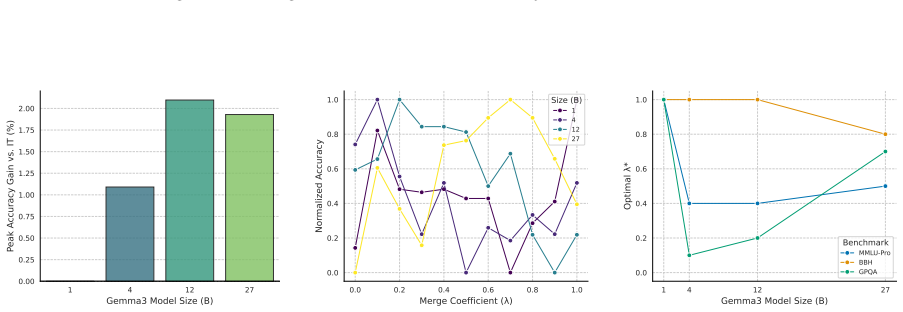
The paper's central claim is that for the Gemma-3 and Qwen2.5 families, interpolating between pre-trained (PT) and instruction-tuned (IT) weights with a coefficient λ in [0,1] produces a Pareto-optimal frontier: merged models exist that score higher than either parent on MMLU-Pro, GPQA, BBH, MATH, and IFEval, while their Expected Calibration Error (ECE) is far below the IT model's. The authors trace the calibration loss to a confidence surge—mean prediction confidence on GPQA jumps from about 40% to over 90% after instruction tuning—without a commensurate accuracy gain. They further find that the peak accuracy gain, the smoothness of the accuracy-versus-λ curve, and the predictability of the
What carries the argument
The central object is the one-parameter family of merged models θ(λ) obtained by interpolating the weights of a pre-trained model and its instruction-tuned twin, with λ from 0 (pure PT) to 1 (pure IT), implemented via SLERP, linear interpolation, or DARE-TIES. Tracing λ sweeps out what the paper calls the alignment-calibration frontier. The load-bearing mechanism is that instruction tuning inflates confidence without improving correctness, so a partial interpolation pulls confidence back into line while preserving the skills gained during alignment. The optimal coefficient λ* marks the point where the merged model Pareto-dominates both parents.
Load-bearing premise
The load-bearing premise is that the optimal mixing coefficient λ* is a stable, discoverable property of the model pair rather than a value fitted to the evaluation set—the paper selects λ* as the maximum-accuracy point on the test grid, so without a held-out selection rule the result describes the test curve, not a recipe for obtaining a Pareto-superior model.
What would settle it
Take one model pair (e.g., Gemma-3-27B), fix λ* using only a validation split or a fixed rule such as λ=0.5, then evaluate on a held-out benchmark. If the merged model does not reach accuracy at least as high as both parents while keeping ECE well below the instruction-tuned parent's, the Pareto-superior claim fails. Alternatively, find a model family whose instruction-tuned version is already well-calibrated (ECE close to the base): the predicted large calibration gap—and with it the free lunch—should disappear.
If this is right
- Practitioners with open weights can recover much of the calibration lost during instruction tuning with a single weight interpolation, requiring no retraining and no extra inference cost beyond evaluation.
- The merged sweet-spot models can exceed the instruction-tuned parent's accuracy by more than 4 percentage points on 12B and 27B models, with smaller but still positive gains at smaller scales.
- The optimal mixing coefficient becomes more stable and predictable as model size grows, converging to roughly 0.4–0.5 on knowledge-heavy benchmarks, making the recipe more reliable for larger models.
- Restoring calibration through merging also improves generative output diversity and distributional prediction (SimBench score 20.4 vs 18.2 for IT and 7.7 for PT), linking the calibration tax to mode collapse.
- Extrapolating past the instruction-tuned model (λ>1) is catastrophically destructive, so the benefit is specific to interpolation between the two parents rather than task-vector amplification.
Where Pith is reading between the lines
- Editorial inference: if λ* is stable across benchmarks for a given model pair, the recipe could be run without labels on the target task by picking λ from a small precomputed set—but the paper does not demonstrate such a zero-shot selection rule, since λ* is chosen on the test grid itself.
- Editorial inference: the same interpolation idea may extend to other post-training dimensions such as safety-refusal behavior or stylistic alignment, though the paper explicitly cautions that merging can dilute safety guardrails and that safety re-testing is mandatory.
- Editorial inference: a sharper test of the mechanism would decompose ECE into overconfidence versus underconfidence per λ to confirm that interpolation specifically removes the confidence inflation, which the paper does not report.
- Editorial inference: the Pareto-superior frontier is demonstrated on two open model families; if a model's instruction-tuned parent is already well-calibrated, the accuracy advantage of merging would likely shrink or vanish, so the free lunch may be specific to large calibration gaps.
Editorial analysis
A structured set of objections, weighed in public.
Referee Report
Summary. The paper studies the 'alignment tax' as a simultaneous loss of task accuracy and calibration (rising ECE) after instruction tuning. Using Gemma-3 (1B–27B) and Qwen2.5 (1.5B–7B) pre-trained/instruction-tuned pairs, it constructs merged models by weight interpolation (SLERP, linear, DARE-TIES) and evaluates accuracy and ECE on MMLU-Pro, BBH, GPQA, IFEval, and MATH Level 5, with additional diversity results on NoveltyBench and SimBench. The central claim is that merging consistently reveals a Pareto-superior frontier: at an optimal coefficient λ* the merged model improves accuracy beyond both parents while substantially recovering calibration. The paper attributes the calibration cost to confidence inflation and argues that merging is a cheap post-hoc mitigation.
Significance. If the central claim held as stated, the paper would provide a practical, training-free intervention for recovering calibration in open-weight models, with a broad empirical sweep: two model families, four scales, three merge methods, and five benchmarks plus generative diversity. Table 2 is a substantial public resource, and the calibration recovery is large and systematic, as is the documented confidence inflation. However, the headline Pareto-dominance claim is oversold: it does not hold on IFEval or MATH L5, and the operating point λ* is selected from the same test data used to report the gains. The paper is therefore a promising empirical characterization of the calibration–accuracy frontier, but not yet a demonstrated recipe for obtaining a Pareto-superior model without access to target-benchmark labels.
major comments (3)
- [§4 and Fig. 3c; Table 2] The central 'consistently reveals Pareto-optimal interpolations' claim depends on λ* being an identifiable property of the model pair, but λ* is chosen as the maximum-accuracy point on the evaluated test grid (Fig. 3c) and then used to report accuracy/ECE on the same data. This is ex-post selection. Without a held-out or validation-based rule, the result describes the test curve rather than a procedure. The issue is amplified because many gains are small (e.g., Qwen2.5-1.5B BBH: 42.54 vs IT 42.37; Qwen2.5-3B BBH: 47.98 vs 46.59) and no error bars or repeated runs are given, so winner's-curse inflation cannot be assessed. Please add out-of-sample λ selection (fixed λ, validation split, or a criterion based only on calibration) and uncertainty estimates.
- [Abstract and §4; Table 2] The abstract claims merges 'improve accuracy beyond both parents,' and §4 states a sweet spot 'improves upon both the base and instruction-tuned models.' Table 2 contradicts this on IFEval and MATH L5 for every model family: e.g., Gemma-3-12B SLERP reaches at most 76.16 IFEval vs IT 77.08 and 55.06 MATH L5 vs IT 55.82; Qwen2.5-7B reaches 58.04 IFEval vs 71.35 IT. On Gemma-3-4B BBH all merges are below the IT parent (48.90 vs 49.96). The Pareto-superiority claim should be restricted to benchmarks where dominance holds (MMLU-Pro, GPQA, partly BBH) or reformulated as a trade-off-frontier result, not universal accuracy dominance.
- [Appendix A] The calibration measurements are load-bearing but the ECE protocol is incomplete. The paper does not state the number of bins, confidence normalization (softmax over options? token probabilities? verbalized confidence?), or how ECE is computed for generative benchmarks such as IFEval and MATH. The sentence 'we do not perform accuracy normalization' is insufficient to reproduce the order-of-magnitude ECE differences in Tables 1–2. Since the entire alignment-calibration trade-off rests on these numbers, the protocol must be specified exactly.
minor comments (5)
- [§3] The definition of λ for SLERP and the exact merging formula are not given. Please provide equations or pseudocode so the interpolation is reproducible.
- [Figures 1–2] The 'naïve linear interpolation' dotted line is not defined; if it is an interpolation in the accuracy/ECE objective space, define its endpoints and construction.
- [Table 2] Qwen2.5-7B DARE-TIES rows begin at λ=0.2, unlike other configurations that include λ=0.1. Please state whether this is intentional or an omission.
- [§4, Fig. 4] The term 'mean confirmation' is used without a precise definition. Specify whether it is the mean softmax probability of the chosen option and how it relates to the ECE protocol.
- [Limitations] Add a bullet acknowledging that λ* is benchmark-dependent and that selecting it on the test data may overstate the achievable gains in a deployment setting.
Circularity Check
No significant circularity: empirical frontier measurement against external benchmarks; λ* selection is a generalization caveat, not a circular step.
full rationale
This is an empirical measurement study rather than a derivation. The central quantities, accuracy on MMLU-Pro/GPQA/BBH/MATH/IFEval and ECE, are computed from external benchmarks using standard evaluation harnesses, and the merged models are defined by an explicit weight interpolation formula θ(λ) with λ∈[0,1] under SLERP, linear, and DARE-TIES. The claims of a Pareto-superior frontier and a 'sweet spot' are descriptive summaries of the measured accuracy/ECE curves, not results derived from the definitions of those metrics. The λ* sweet spot is selected as the best point on the evaluated grid for each benchmark; this is a potential selection-bias or winner's-curse limitation if one wants to generalize to held-out data, but it does not make the empirical observation equivalent to its inputs: the reported accuracy and ECE values are measured, not constructed by the selection procedure. Self-citations (e.g., Zhou et al. 2025; Hu et al. 2025a,b; Ma et al. 2024) appear only as contextual references or benchmark descriptions and are not load-bearing for the merging result. No equation in the paper defines a target quantity in terms of the quantity it is claimed to predict. Hence there is no definitional circularity, no fitted parameter renamed as a prediction, and no self-citation chain forcing the conclusion.
Axiom & Free-Parameter Ledger
free parameters (3)
- Optimal merge coefficient λ* =
e.g., ≈0.4–0.5 for MMLU-Pro/GPQA, ≈0.8+ for BBH (Gemma-3 family)
- λ grid increment =
0.1 steps over [0,1]
- DARE-TIES density =
0.9
axioms (4)
- domain assumption Expected Calibration Error computed on the benchmark answer set (using raw accuracy without length/choice normalization) is a valid measure of model calibration.
- domain assumption The released PT and IT checkpoints for a given model family share the same architecture and weight space, so interpolation is well-defined.
- domain assumption Accuracy and ECE on the selected benchmarks capture the relevant alignment-calibration trade-off.
- ad hoc to paper The optimal mixing coefficient λ* found on test data is a stable model property and can be identified without access to test labels.
Cite this review
Pith. "Pith review of Navigating the Alignment-Calibration Trade-off: A Pareto-Superior Frontier via Model Merging." pith.science (2026). https://pith.science/paper/JPNTHLXH
@misc{pith2026251017426,
  author       = {Pith},
  title        = {Pith review of: Navigating the Alignment-Calibration Trade-off: A Pareto-Superior Frontier via Model Merging},
  year         = {2026},
  howpublished = {\url{https://pith.science/paper/JPNTHLXH}},
  note         = {Machine review of arXiv:2510.17426}
}
read the original abstract
The "alignment tax" of post-training is typically framed as a drop in task accuracy. We show it also involves a severe loss of calibration, making models overconfident, less reliable, and model outputs less diverse. We show that this trade-off can be navigated effectively via a simple post-hoc intervention: interpolating between a model's weights before and after alignment. Crucially, this is not a strict trade-off. We find that the process consistently reveals Pareto-optimal interpolations - models that improve accuracy beyond both parents while substantially recovering the calibration lost during alignment. Our work demonstrates that simple model merging provides a computationally efficient method for mitigating the full scope of the alignment tax, yielding models that are more capable and more reliable.
Figures




Forward citations
Cited by 3 Pith papers
-
When Calibration Rankings Reverse: Accuracy-Controlled Evaluation for Fair Comparison of LLMs
Global calibration metrics like ECE are confounded by accuracy; the proposed ACE framework with three accuracy-controlled views shows many prior calibration advantages weaken or reverse.
-
Hallucination as Commitment Failure: Larger LLMs Misfire Despite Knowing the Answer
Larger LLMs hallucinate more often despite having the correct concept available because instruction tuning causes probability mass to disperse across alternative surface forms instead of concentrating on one.
-
Demystifying Multi-Agent Debate: The Role of Confidence and Diversity
Starting debates with diverse answers and having agents share calibrated confidence turns multi-agent LLM debate from a no-gain martingale into a process that drifts toward correct answers and beats majority vote.
Reference graph
Works this paper leans on
-
[1]
Josh Achiam, Steven Adler, Sandhini Agarwal, Lama Ahmad, Ilge Akkaya, Florencia Leoni Aleman, Diogo Almeida, Janko Altenschmidt, Sam Altman, Shyamal Anadkat, and 1 others. 2023. Gpt-4 technical report. arXiv preprint arXiv:2303.08774
Pith/arXiv arXiv 2023
-
[2]
Sheng Cao, Mingrui Wu, Karthik Prasad, Yuandong Tian, and Zechun Liu. 2025. https://openreview.net/forum?id=vqbd2OQnGp Param\ delta\ for direct mixing: Post-train large language model at zero cost . In The Thirteenth International Conference on Learning Representations
2025
-
[3]
Pala Tej Deep, Rishabh Bhardwaj, and Soujanya Poria. 2024. https://arxiv.org/abs/2406.11617 Della-merging: Reducing interference in model merging through magnitude-based sampling . Preprint, arXiv:2406.11617
Pith/arXiv arXiv 2024
-
[4]
Clémentine Fourrier, Nathan Habib, Alina Lozovskaya, Konrad Szafer, and Thomas Wolf. 2024. Open llm leaderboard v2. https://huggingface.co/spaces/open-llm-leaderboard/open_llm_leaderboard
2024
-
[5]
Tingchen Fu, Deng Cai, Lemao Liu, Shuming Shi, and Rui Yan. 2024. https://doi.org/10.18653/v1/2024.findings-acl.175 Disperse-then-merge: Pushing the limits of instruction tuning via alignment tax reduction . In Findings of the Association for Computational Linguistics: ACL 2024, pages 2967--2985, Bangkok, Thailand. Association for Computational Linguistics
-
[6]
Leo Gao, Jonathan Tow, Stella Biderman, Sid Black, Anthony DiPofi, Charles Foster, Laurence Golding, Jeffrey Hsu, Kyle McDonell, Niklas Muennighoff, Jason Phang, Laria Reynolds, Eric Tang, Anish Thite, Ben Wang, Kevin Wang, and Andy Zou. 2021. https://doi.org/10.5281/zenodo.5371628 A framework for few-shot language model evaluation
-
[7]
Charles Goddard, Shamane Siriwardhana, Malikeh Ehghaghi, Luke Meyers, Vladimir Karpukhin, Brian Benedict, Mark McQuade, and Jacob Solawetz. 2024. https://doi.org/10.18653/V1/2024.EMNLP-INDUSTRY.36 Arcee's mergekit: A toolkit for merging large language models . In Proceedings of the 2024 Conference on Empirical Methods in Natural Language Processing: EMNLP...
-
[8]
Chuan Guo, Geoff Pleiss, Yu Sun, and Kilian Q Weinberger. 2017. On calibration of modern neural networks. In International conference on machine learning, pages 1321--1330. PMLR
2017
-
[9]
Dan Hendrycks, Collin Burns, Saurav Kadavath, Akul Arora, Steven Basart, Eric Tang, Dawn Song, and Jacob Steinhardt. 2021. https://openreview.net/forum?id=7Bywt2mQsCe Measuring mathematical problem solving with the MATH dataset . In Thirty-fifth Conference on Neural Information Processing Systems Datasets and Benchmarks Track (Round 2)
2021
-
[10]
Tiancheng Hu, Joachim Baumann, Lorenzo Lupo, Nigel Collier, Dirk Hovy, and Paul Röttger. 2025 a . https://arxiv.org/abs/2510.17516 Simbench: Benchmarking the ability of large language models to simulate human behaviors . Preprint, arXiv:2510.17516
Pith/arXiv arXiv 2025
-
[11]
Tiancheng Hu, Yara Kyrychenko, Steve Rathje, Nigel Collier, Sander van der Linden, and Jon Roozenbeek. 2025 b . https://doi.org/10.1038/s43588-024-00741-1 Generative language models exhibit social identity biases . Nature Computational Science, 5(1):65--75
-
[12]
Gabriel Ilharco, Marco Tulio Ribeiro, Mitchell Wortsman, Ludwig Schmidt, Hannaneh Hajishirzi, and Ali Farhadi. 2023. https://openreview.net/forum?id=6t0Kwf8-jrj Editing models with task arithmetic . In The Eleventh International Conference on Learning Representations
2023
-
[13]
Robert Kirk, Ishita Mediratta, Christoforos Nalmpantis, Jelena Luketina, Eric Hambro, Edward Grefenstette, and Roberta Raileanu. 2024. https://openreview.net/forum?id=PXD3FAVHJT Understanding the effects of RLHF on LLM generalisation and diversity . In The Twelfth International Conference on Learning Representations
2024
-
[14]
Ziniu Li, Congliang Chen, Tian Xu, Zeyu Qin, Jiancong Xiao, Zhi-Quan Luo, and Ruoyu Sun. 2025. https://openreview.net/forum?id=NQEe7B7bSw Preserving diversity in supervised fine-tuning of large language models . In The Thirteenth International Conference on Learning Representations
2025
-
[15]
Yong Lin, Hangyu Lin, Wei Xiong, Shizhe Diao, Jianmeng Liu, Jipeng Zhang, Rui Pan, Haoxiang Wang, Wenbin Hu, Hanning Zhang, Hanze Dong, Renjie Pi, Han Zhao, Nan Jiang, Heng Ji, Yuan Yao, and Tong Zhang. 2024. https://doi.org/10.18653/v1/2024.emnlp-main.35 Mitigating the alignment tax of RLHF . In Proceedings of the 2024 Conference on Empirical Methods in ...
-
[16]
Keming Lu, Bowen Yu, Fei Huang, Yang Fan, Runji Lin, and Chang Zhou. 2024. Online merging optimizers for boosting rewards and mitigating tax in alignment. arXiv preprint arXiv:2405.17931
Pith/arXiv arXiv 2024
-
[17]
Hedderich, Barbara Plank, and Frauke Kreuter
Bolei Ma, Xinpeng Wang, Tiancheng Hu, Anna-Carolina Haensch, Michael A. Hedderich, Barbara Plank, and Frauke Kreuter. 2024. https://doi.org/10.18653/v1/2024.findings-emnlp.513 The potential and challenges of evaluating attitudes, opinions, and values in large language models . In Findings of the Association for Computational Linguistics: EMNLP 2024, pages...
-
[18]
Mahdi Pakdaman Naeini, Gregory Cooper, and Milos Hauskrecht. 2015. Obtaining well calibrated probabilities using bayesian binning. In Proceedings of the AAAI conference on artificial intelligence, volume 29
2015
-
[19]
Long Ouyang, Jeff Wu, Xu Jiang, Diogo Almeida, Carroll L. Wainwright, Pamela Mishkin, Chong Zhang, Sandhini Agarwal, Katarina Slama, Alex Ray, John Schulman, Jacob Hilton, Fraser Kelton, Luke Miller, Maddie Simens, Amanda Askell, Peter Welinder, Paul Christiano, Jan Leike, and Ryan Lowe. 2022. Training language models to follow instructions with human fee...
2022
-
[20]
David Rein, Betty Li Hou, Asa Cooper Stickland, Jackson Petty, Richard Yuanzhe Pang, Julien Dirani, Julian Michael, and Samuel R. Bowman. 2024. https://openreview.net/forum?id=Ti67584b98 GPQA : A graduate-level google-proof q&a benchmark . In First Conference on Language Modeling
2024
-
[21]
Ken Shoemake. 1985. https://doi.org/10.1145/325334.325242 Animating rotation with quaternion curves . In Proceedings of the 12th Annual Conference on Computer Graphics and Interactive Techniques, SIGGRAPH '85, page 245–254, New York, NY, USA. Association for Computing Machinery
arXiv 1985
-
[22]
Mark Steyvers, Heliodoro Tejeda, Aakriti Kumar, Catarina Belem, Sheer Karny, Xinyue Hu, Lukas W. Mayer, and Padhraic Smyth. 2025. https://doi.org/10.1038/s42256-024-00976-7 What large language models know and what people think they know . Nature Machine Intelligence, 7(2):221--231
-
[23]
Mirac Suzgun, Nathan Scales, Nathanael Sch \" a rli, Sebastian Gehrmann, Yi Tay, Hyung Won Chung, Aakanksha Chowdhery, Quoc V. Le, Ed H. Chi, Denny Zhou, and Jason Wei. 2023. https://doi.org/10.18653/V1/2023.FINDINGS-ACL.824 Challenging big-bench tasks and whether chain-of-thought can solve them . In Findings of the Association for Computational Linguisti...
-
[24]
Gemma Team, Aishwarya Kamath, Johan Ferret, Shreya Pathak, Nino Vieillard, Ramona Merhej, Sarah Perrin, Tatiana Matejovicova, Alexandre Ram \'e , Morgane Rivi \`e re, and 1 others. 2025 a . Gemma 3 technical report. arXiv preprint arXiv:2503.19786
Pith/arXiv arXiv 2025
-
[25]
Qwen Team, An Yang, Baosong Yang, Beichen Zhang, Binyuan Hui, Bo Zheng, Bowen Yu, Chengyuan Li, Dayiheng Liu, Fei Huang, Haoran Wei, Huan Lin, Jian Yang, Jianhong Tu, Jianwei Zhang, Jianxin Yang, Jiaxi Yang, Jingren Zhou, Junyang Lin, and 24 others. 2025 b . https://arxiv.org/abs/2412.15115 Qwen2.5 technical report . Preprint, arXiv:2412.15115
Pith/arXiv arXiv 2025
-
[26]
Joachim Utans. 1996. Weight averaging for neural networks and local resampling schemes. Citeseer
1996
-
[27]
Yubo Wang, Xueguang Ma, Ge Zhang, Yuansheng Ni, Abhranil Chandra, Shiguang Guo, Weiming Ren, Aaran Arulraj, Xuan He, Ziyan Jiang, Tianle Li, Max Ku, Kai Wang, Alex Zhuang, Rongqi Fan, Xiang Yue, and Wenhu Chen. 2024. https://openreview.net/forum?id=y10DM6R2r3 MMLU -pro: A more robust and challenging multi-task language understanding benchmark . In The Thi...
2024
-
[28]
Morcos, Hongseok Namkoong, Ali Farhadi, Yair Carmon, Simon Kornblith, and Ludwig Schmidt
Mitchell Wortsman, Gabriel Ilharco, Samir Yitzhak Gadre, Rebecca Roelofs, Raphael Gontijo Lopes, Ari S. Morcos, Hongseok Namkoong, Ali Farhadi, Yair Carmon, Simon Kornblith, and Ludwig Schmidt. 2022. https://proceedings.mlr.press/v162/wortsman22a.html Model soups: averaging weights of multiple fine-tuned models improves accuracy without increasing inferen...
2022
-
[29]
Fan Wu, Emily Black, and Varun Chandrasekaran. 2025 a . https://openreview.net/forum?id=yZ7sn9pyqb Generative monoculture in large language models . In The Thirteenth International Conference on Learning Representations
2025
-
[30]
Taiqiang Wu, Runming Yang, Jiayi Li, Pengfei Hu, Ngai Wong, and Yujiu Yang. 2025 b . Shadow-ft: Tuning instruct via base. arXiv preprint arXiv:2505.12716
arXiv 2025
-
[31]
Miao Xiong, Zhiyuan Hu, Xinyang Lu, YIFEI LI, Jie Fu, Junxian He, and Bryan Hooi. 2024. https://openreview.net/forum?id=gjeQKFxFpZ Can LLM s express their uncertainty? an empirical evaluation of confidence elicitation in LLM s . In The Twelfth International Conference on Learning Representations
2024
-
[32]
Prateek Yadav, Derek Tam, Leshem Choshen, Colin Raffel, and Mohit Bansal. 2023. https://openreview.net/forum?id=xtaX3WyCj1 TIES -merging: Resolving interference when merging models . In Thirty-seventh Conference on Neural Information Processing Systems
2023
-
[33]
Enneng Yang, Li Shen, Guibing Guo, Xingwei Wang, Xiaochun Cao, Jie Zhang, and Dacheng Tao. 2024. Model merging in llms, mllms, and beyond: Methods, theories, applications and opportunities. arXiv preprint arXiv:2408.07666
Pith/arXiv arXiv 2024
-
[34]
Le Yu, Bowen Yu, Haiyang Yu, Fei Huang, and Yongbin Li. 2024 a . Extend model merging from fine-tuned to pre-trained large language models via weight disentanglement. arXiv preprint arXiv:2408.03092
Pith/arXiv arXiv 2024
-
[35]
Le Yu, Bowen Yu, Haiyang Yu, Fei Huang, and Yongbin Li. 2024 b . Language models are super mario: absorbing abilities from homologous models as a free lunch. In Proceedings of the 41st International Conference on Machine Learning, ICML'24. JMLR.org
2024
-
[36]
Yiming Zhang, Harshita Diddee, Susan Holm, Hanchen Liu, Xinyue Liu, Vinay Samuel, Barry Wang, and Daphne Ippolito. 2025. https://openreview.net/forum?id=XZm1ekzERf Noveltybench: Evaluating creativity and diversity in language models . In Second Conference on Language Modeling
2025
-
[37]
Ej Zhou, Caiqi Zhang, Tiancheng Hu, Chengzu Li, Nigel Collier, Ivan Vuli \'c , and Anna Korhonen. 2025. Beyond the final layer: Intermediate representations for better multilingual calibration in large language models. arXiv preprint arXiv:2510.03136
arXiv 2025
-
[38]
Jeffrey Zhou, Tianjian Lu, Swaroop Mishra, Siddhartha Brahma, Sujoy Basu, Yi Luan, Denny Zhou, and Le Hou. 2023. https://arxiv.org/abs/2311.07911 Instruction-following evaluation for large language models . Preprint, arXiv:2311.07911
Pith/arXiv arXiv 2023
-
[39]
online" 'onlinestring :=
ENTRY address archivePrefix author booktitle chapter edition editor eid eprint eprinttype howpublished institution journal key month note number organization pages publisher school series title type volume year doi pubmed url lastchecked label extra.label sort.label short.list INTEGERS output.state before.all mid.sentence after.sentence after.block STRING...
-
[40]
write newline
" write newline "" before.all 'output.state := FUNCTION n.dashify 't := "" t empty not t #1 #1 substring "-" = t #1 #2 substring "--" = not "--" * t #2 global.max substring 't := t #1 #1 substring "-" = "-" * t #2 global.max substring 't := while if t #1 #1 substring * t #2 global.max substring 't := if while FUNCTION word.in bbl.in capitalize " " * FUNCT...
This paper was first reviewed by deepseek-v4-flash on August 4, 2026.
discussion (0)
Sign in with ORCID, Apple, or X to comment. Anyone can read and Pith papers without signing in.