TransitionListener v2.0 -- Robust gravitational wave predictions for cosmological phase transitions
Pith reviewed 2026-05-19 16:00 UTC · model grok-4.3
The pith
TransitionListener v2.0 tracks the true-vacuum fraction and mean bubble separation to produce consistent gravitational wave predictions from phase transitions.
A machine-rendered reading of the paper's core claim, the machinery that carries it, and where it could break.
Core claim
Version 2 introduces a self-consistent treatment of the transition dynamics, including the evolution of the true-vacuum fraction and its backreaction on the Hubble expansion, as well as a consistent description of reheating during percolation, and computes the mean bubble separation directly to map onto gravitational wave templates from bubble collisions, sound waves, and turbulence.
What carries the argument
self-consistent evolution of the true-vacuum fraction together with direct computation of mean bubble separation
If this is right
- Numerical stability improves for transitions that are strongly supercooled or ultraslow.
- Large parameter scans can now be performed with consistent physical modeling of the expansion history and reheating.
- Signal-to-noise ratios for detectors such as LISA and pulsar timing arrays become more reliable across a wider range of models.
- Built-in interfaces support Bayesian inference on the underlying scalar potential parameters.
Where Pith is reading between the lines
- If the new predictions differ noticeably from older codes in the supercooled regime, existing upper limits from pulsar timing arrays may need re-evaluation.
- The reheating description could be tested by checking whether the predicted peak frequency and amplitude line up with future LISA data for a given model.
- Users could extend the framework to include additional sources such as magnetohydrodynamic turbulence once the core dynamics are validated.
Load-bearing premise
The templates derived from existing simulations of bubble collisions, sound waves, and turbulence remain accurate when applied to the strongly supercooled and ultraslow regimes targeted by the new code.
What would settle it
A direct numerical simulation of bubble nucleation and expansion in a strongly supercooled model whose gravitational wave spectrum is then compared to the spectrum predicted by TransitionListener v2.0 using the same input potential.
Figures




read the original abstract
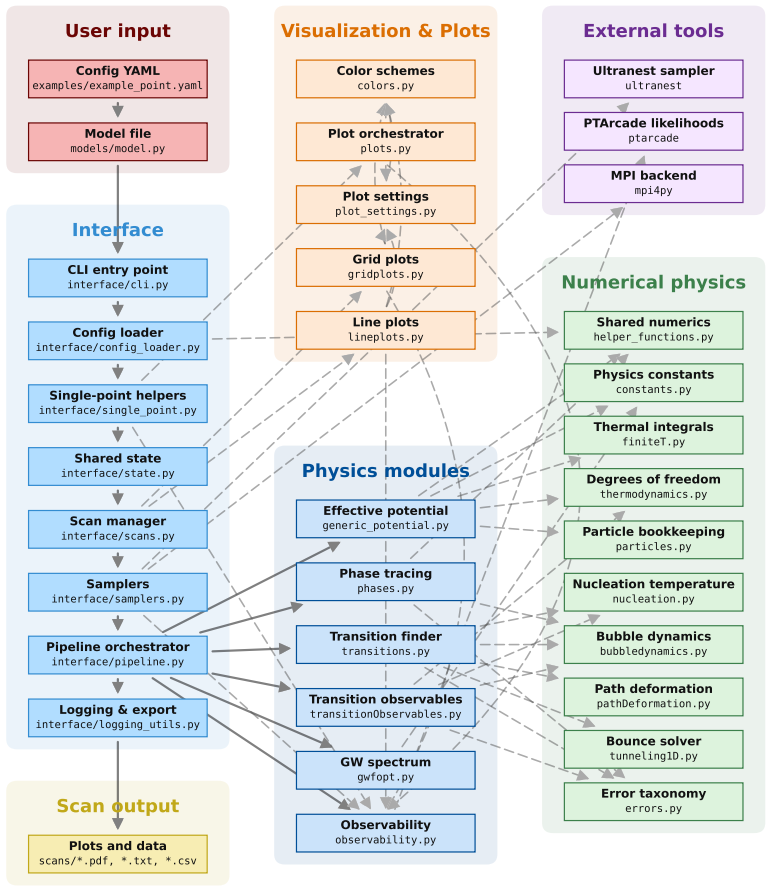
Gravitational wave backgrounds from strong first-order cosmological phase transitions are key observational targets predicted by many SM extensions and might be observed by current and future observatories like LISA, the Einstein Telescope or pulsar timing arrays (PTAs). Still, their precise forecast given a specific model remains a challenge. In this article, we present TransitionListener v2.0, a Python framework for precision studies of cosmological phase transitions and their associated gravitational wave (GW) signals. The code provides an end-to-end pipeline from a user-defined scalar potential to GW spectra and signal-to-noise ratios, enabling both benchmark studies and large-scale parameter scans. Version 2 introduces a self-consistent treatment of the transition dynamics, including the evolution of the true-vacuum fraction and its backreaction on the Hubble expansion, as well as a consistent description of reheating during percolation. A direct computation of the mean bubble separation allows to faithfully map to the GW spectral templates from bubble collisions, sound waves, and turbulence stemming from state-of-the-art simulations. TransitionListener includes built-in sensitivity curves for space- and ground-based detectors and PTAs, interfaces to PTA likelihoods, and wrappers for Bayesian model inference and high-dimensional parameter scans. Compared to existing public tools, TransitionListener v2.0 improves the physical consistency and numerical stability of GW predictions across a wide range of models, with particular emphasis on the strongly supercooled and ultraslow transition regime where conventional approximations break down and the most promising GW signals are expected.
Editorial analysis
A structured set of objections, weighed in public.
Referee Report
Summary. The manuscript presents TransitionListener v2.0, a Python framework providing an end-to-end pipeline from a user-defined scalar potential to gravitational wave (GW) spectra and signal-to-noise ratios for cosmological phase transitions. Version 2 introduces self-consistent treatment of transition dynamics, including evolution of the true-vacuum fraction with backreaction on Hubble expansion, consistent reheating during percolation, and direct computation of mean bubble separation to map onto spectral templates for bubble collisions, sound waves, and turbulence. The code includes built-in sensitivity curves for LISA, Einstein Telescope, and PTAs, interfaces to PTA likelihoods, and wrappers for Bayesian inference and parameter scans, with emphasis on the strongly supercooled and ultraslow regime.
Significance. If the self-consistent dynamics and mapping procedure hold under scrutiny, the package would offer a useful advance for precision GW forecasts in models predicting strong first-order transitions. The focus on regimes where conventional approximations break down aligns with the parameter space expected to yield the most detectable signals at LISA and PTAs. Explicit support for reproducible scans and likelihood interfaces strengthens its potential community impact.
major comments (1)
- [Abstract and GW spectrum section] Abstract (final paragraph) and the description of the GW mapping procedure: the central claim of 'robust' and 'faithful' predictions rests on applying state-of-the-art simulation templates for bubble collisions, sound waves, and turbulence to the strongly supercooled and ultraslow regimes targeted by the new dynamics. The manuscript does not provide validation, error budgets, or tests demonstrating that the template functional forms and normalizations remain accurate when the altered expansion history modifies wall velocities, sound-wave lifetimes, and turbulence injection scales. This assumption is load-bearing for the robustness claim.
minor comments (2)
- Notation for the mean bubble separation and its mapping to the template parameters could be clarified with an explicit equation relating the computed quantity to the peak frequency and amplitude in each channel.
- The manuscript would benefit from a dedicated validation subsection comparing v2.0 outputs to known analytic limits or previous codes in the weakly supercooled regime before presenting results in the ultraslow limit.
Simulated Author's Rebuttal
We thank the referee for their careful reading of the manuscript and for recognizing the potential utility of TransitionListener v2.0 for precision GW forecasts in challenging regimes. We address the single major comment below.
read point-by-point responses
-
Referee: [Abstract and GW spectrum section] Abstract (final paragraph) and the description of the GW mapping procedure: the central claim of 'robust' and 'faithful' predictions rests on applying state-of-the-art simulation templates for bubble collisions, sound waves, and turbulence to the strongly supercooled and ultraslow regimes targeted by the new dynamics. The manuscript does not provide validation, error budgets, or tests demonstrating that the template functional forms and normalizations remain accurate when the altered expansion history modifies wall velocities, sound-wave lifetimes, and turbulence injection scales. This assumption is load-bearing for the robustness claim.
Authors: We agree that the robustness claim is load-bearing and that the manuscript does not contain dedicated validation or quantitative error budgets for the application of existing simulation templates under the modified expansion histories that arise in strongly supercooled transitions. The new dynamics module computes a self-consistent mean bubble separation and reheating history that serve as improved inputs to the templates, but the functional forms and normalizations themselves originate from simulations performed in standard cosmologies. We will revise the manuscript by adding a dedicated paragraph in the GW spectrum section (and a corresponding note in the abstract) that explicitly states the assumptions inherited from the templates, discusses how altered wall velocities and sound-wave lifetimes could affect the spectra, and provides a qualitative error estimate drawn from the existing literature on non-standard expansion. This will qualify the language of 'robust' and 'faithful' predictions accordingly. revision: yes
Circularity Check
No significant circularity; derivation is self-contained from user potential
full rationale
The framework computes transition quantities (true-vacuum fraction evolution, Hubble backreaction, reheating, mean bubble separation) directly from a user-defined scalar potential using self-consistent dynamics. These feed into a mapping onto pre-existing GW templates from external state-of-the-art simulations. No self-definitional loops, fitted parameters renamed as predictions, or load-bearing self-citations appear in the derivation chain. The pipeline remains independent of the target GW spectra themselves and is externally falsifiable via the input potential and simulation templates.
Axiom & Free-Parameter Ledger
axioms (2)
- standard math Standard Friedmann-Lemaître-Robertson-Walker cosmology and general relativity govern the background expansion during the transition.
- domain assumption Gravitational-wave spectral templates from existing bubble-collision, sound-wave, and turbulence simulations remain applicable in the strongly supercooled and ultraslow regimes.
Lean theorems connected to this paper
-
IndisputableMonolith/Foundation/RealityFromDistinction.leanreality_from_one_distinction unclear?
unclearRelation between the paper passage and the cited Recognition theorem.
self-consistent treatment of the true-vacuum fraction and its backreaction on the Hubble expansion, as well as a consistent description of reheating during percolation. A direct computation of the mean bubble separation allows to faithfully map to the GW spectral templates
-
IndisputableMonolith/Cost/FunctionalEquation.leanwashburn_uniqueness_aczel unclear?
unclearRelation between the paper passage and the cited Recognition theorem.
Iterative percolation with true-vacuum fraction backreaction on H(T); mean bubble separation as default GW length scale
What do these tags mean?
- matches
- The paper's claim is directly supported by a theorem in the formal canon.
- supports
- The theorem supports part of the paper's argument, but the paper may add assumptions or extra steps.
- extends
- The paper goes beyond the formal theorem; the theorem is a base layer rather than the whole result.
- uses
- The paper appears to rely on the theorem as machinery.
- contradicts
- The paper's claim conflicts with a theorem or certificate in the canon.
- unclear
- Pith found a possible connection, but the passage is too broad, indirect, or ambiguous to say the theorem truly supports the claim.
Forward citations
Cited by 1 Pith paper
-
Natural Supercooling and Reheating along Supersymmetric Flat Directions and Observable Gravitational Waves at the Einstein Telescope and the Cosmic Explorer
Radiative barriers in SUSY flat directions enable supercooled PTs yielding Ω_GW h² up to ~3e-10 for M_λ̃/v_X in 0.05-0.23, with the hidden sector also reproducing Ω_CDM h²=0.12 for m_q ~30-800 keV.
Reference graph
Works this paper leans on
-
[1]
Planck 2018 results. VI. Cosmological parameters
N. Aghanim et al. “Planck 2018 results. VI. Cosmological parameters”. In:Astron. As- trophys.641 (2020), A6.doi:10 . 1051 / 0004 - 6361 / 201833910. arXiv:1807 . 06209 [astro-ph.CO]
work page 2018
-
[2]
Cosmological Backgrounds of Gravitational Waves
Chiara Caprini and Daniel G. Figueroa. “Cosmological Backgrounds of Gravitational Waves”. In:Class. Quant. Grav.35.16 (2018), p. 163001.doi:10.1088/1361-6382/aac
-
[3]
arXiv:1801.04268 [astro-ph.CO]
work page internal anchor Pith review Pith/arXiv arXiv
-
[4]
Laser Interferometer Space Antenna
Pau Amaro-Seoane et al. “Laser Interferometer Space Antenna”. In: (Feb. 2017). arXiv: 1702.00786 [astro-ph.IM]
work page internal anchor Pith review Pith/arXiv arXiv 2017
-
[5]
Science Case for the Einstein Telescope
Michele Maggiore et al. “Science Case for the Einstein Telescope”. In:JCAP03 (2020), p. 050.doi:10.1088/1475-7516/2020/03/050. arXiv:1912.02622 [astro-ph.CO]
work page internal anchor Pith review Pith/arXiv arXiv doi:10.1088/1475-7516/2020/03/050 2020
-
[6]
J. Antoniadis et al. “The International Pulsar Timing Array second data release: Search for an isotropic gravitational wave background”. In:Mon. Not. Roy. Astron. Soc. 510.4 (2022), pp. 4873–4887.doi:10 . 1093 / mnras / stab3418. arXiv:2201 . 03980 [astro-ph.HE]
work page 2022
-
[7]
The NANOGrav 15-year Data Set: Evidence for a Gravitational-Wave Background
Gabriella Agazie et al. “The NANOGrav 15-year Data Set: Evidence for a Gravitational- Wave Background”. In:Astrophys. J. Lett.951.1 (2023).doi:10.3847/2041-8213/acd ac6. arXiv:2306.16213 [astro-ph.HE]
work page internal anchor Pith review Pith/arXiv arXiv doi:10.3847/2041-8213/acd 2023
-
[8]
J. Antoniadis et al. “The second data release from the European Pulsar Timing Array III. Search for gravitational wave signals”. In:Astron. Astrophys.678 (2023), A50.doi: 10.1051/0004-6361/202346844. arXiv:2306.16214 [astro-ph.HE]
work page internal anchor Pith review Pith/arXiv arXiv doi:10.1051/0004-6361/202346844 2023
-
[9]
Heng Xu et al. “Searching for the Nano-Hertz Stochastic Gravitational Wave Back- ground with the Chinese Pulsar Timing Array Data Release I”. In:Res. Astron. As- trophys.23.7 (2023), p. 075024.doi:10.1088/1674-4527/acdfa5. arXiv:2306.16216 [astro-ph.HE]
work page internal anchor Pith review Pith/arXiv arXiv doi:10.1088/1674-4527/acdfa5 2023
-
[10]
Search for an isotropic gravitational-wave background with the Parkes Pulsar Timing Array
Daniel J. Reardon et al. “Search for an Isotropic Gravitational-wave Background with the Parkes Pulsar Timing Array”. In:Astrophys. J. Lett.951.1 (2023), p. L6.doi:10.3 847/2041-8213/acdd02. arXiv:2306.16215 [astro-ph.HE]
work page internal anchor Pith review Pith/arXiv arXiv 2023
-
[11]
Matthew T. Miles et al. “The MeerKAT Pulsar Timing Array: The first search for grav- itational waves with the MeerKAT radio telescope”. In: (Dec. 2024).doi:10.1093/mnr as/stae2571. arXiv:2412.01153 [astro-ph.HE]
work page doi:10.1093/mnr 2024
-
[12]
Weinberg model in the hot universe
D. A. Kirzhnits. “Weinberg model in the hot universe”. In:JETP Lett.15 (1972), pp. 529– 531
work page 1972
-
[13]
L. Dolan and R. Jackiw. “Symmetry Behavior at Finite Temperature”. In:Phys. Rev. D 9 (1974), pp. 3320–3341.doi:10.1103/PhysRevD.9.3320
-
[14]
Gauge and Global Symmetries at High Temperature,
Steven Weinberg. “Gauge and Global Symmetries at High Temperature”. In:Phys. Rev. D9 (1974), pp. 3357–3378.doi:10.1103/PhysRevD.9.3357
-
[15]
Symmetry Behavior in Gauge Theories
D. A. Kirzhnits and Andrei D. Linde. “Symmetry Behavior in Gauge Theories”. In: Annals Phys.101 (1976), pp. 195–238.doi:10.1016/0003-4916(76)90279-7
-
[16]
Is There a Hot Electroweak Phase Transition at $m_H\gsim m_W$?
K. Kajantie et al. “Is there a hot electroweak phase transition atm H ≳m W ?” In: Phys. Rev. Lett.77 (1996), pp. 2887–2890.doi:10.1103/PhysRevLett.77.2887. arXiv: hep-ph/9605288. 59
work page internal anchor Pith review Pith/arXiv arXiv doi:10.1103/physrevlett.77.2887 1996
-
[17]
The QCD transition temperature: results with physical masses in the continuum limit II
Y. Aoki et al. “The QCD transition temperature: results with physical masses in the continuum limit II.” In:JHEP06 (2009), p. 088.doi:10.1088/1126-6708/2009/06/08
-
[18]
arXiv:0903.4155 [hep-lat]
work page internal anchor Pith review Pith/arXiv arXiv
-
[19]
Violation of CP Invariance, C asymmetry, and baryon asymmetry of the universe
A. D. Sakharov. “Violation of CP Invariance, C asymmetry, and baryon asymmetry of the universe”. In:Pisma Zh. Eksp. Teor. Fiz.5 (1967), pp. 32–35.doi:10.1070/PU1991 v034n05ABEH002497
-
[20]
Zwicky, Die Rotverschiebung von extragalaktischen Nebeln, Helv
F. Zwicky. “Die Rotverschiebung von extragalaktischen Nebeln”. In:Helv. Phys. Acta6 (1933), pp. 110–127.doi:10.1007/s10714-008-0707-4
-
[21]
Vera C. Rubin and W. Kent Ford Jr. “Rotation of the Andromeda Nebula from a Spec- troscopic Survey of Emission Regions”. In:Astrophys. J.159 (1970), pp. 379–403.doi: 10.1086/150317
-
[22]
Steven Weinberg. “Implications of Dynamical Symmetry Breaking”. In:Phys. Rev. D13 (1976), pp. 974–996.doi:10.1103/PhysRevD.19.1277
-
[23]
Dynamics of Spontaneous Symmetry Breaking in the Weinberg- Salam Theory
Leonard Susskind. “Dynamics of Spontaneous Symmetry Breaking in the Weinberg- Salam Theory”. In:Phys. Rev. D20 (1979), pp. 2619–2625.doi:10 . 1103 / PhysRevD .20.2619
work page 1979
-
[24]
Peter Minkowski. “µ→eγat a Rate of One Out of 10 9 Muon Decays?” In:Phys. Lett. B67 (1977), pp. 421–428.doi:10.1016/0370-2693(77)90435-X
-
[25]
Horizontal gauge symmetry and masses of neutrinos
Tsutomu Yanagida. “Horizontal gauge symmetry and masses of neutrinos”. In:Conf. Proc. C7902131 (1979). Ed. by Osamu Sawada and Akio Sugamoto, pp. 95–99
work page 1979
-
[26]
A Theory of Spontaneous T Violation
T. D. Lee. “A Theory of Spontaneous T Violation”. In:Phys. Rev. D8 (1973). Ed. by G. Feinberg, pp. 1226–1239.doi:10.1103/PhysRevD.8.1226
-
[27]
Lepton Number as the Fourth Color
Jogesh C. Pati and Abdus Salam. “Lepton Number as the Fourth Color”. In:Phys. Rev. D10 (1974), pp. 275–289.doi:10.1103/PhysRevD.10.275
-
[28]
Supersymmetry, supergravity and particle physics
Hans Peter Nilles. “Supersymmetry, Supergravity and Particle Physics”. In:Phys. Rept. 110 (1984), pp. 1–162.doi:10.1016/0370-1573(84)90008-5
-
[29]
Unity of All Elementary Part icle Forces,
H. Georgi and S. L. Glashow. “Unity of All Elementary Particle Forces”. In:Phys. Rev. Lett.32 (1974), pp. 438–441.doi:10.1103/PhysRevLett.32.438
-
[30]
Bob Holdom. “Two U(1)’s and Epsilon Charge Shifts”. In:Phys. Lett. B166 (1986), pp. 196–198.doi:10.1016/0370-2693(86)91377-8
-
[31]
Gravitational waves from a dark phase transition,
Pedro Schwaller. “Gravitational Waves from a Dark Phase Transition”. In:Phys. Rev. Lett.115.18 (2015), p. 181101.doi:10.1103/PhysRevLett.115.181101. arXiv:1504.0 7263 [hep-ph]
-
[32]
On the Anomalous Electroweak Baryon Number Nonconservation in the Early Universe,
V. A. Kuzmin, V. A. Rubakov, and M. E. Shaposhnikov. “On the Anomalous Electroweak Baryon Number Nonconservation in the Early Universe”. In:Phys. Lett. B155 (1985), p. 36.doi:10.1016/0370-2693(85)91028-7
-
[33]
Baryogenesis via relativistic bubble expansion
Iason Baldes et al. “Baryogenesis via relativistic bubble expansion”. In:Phys. Rev. D 104.11 (2021), p. 115029.doi:10 . 1103 / PhysRevD . 104 . 115029. arXiv:2106 . 15602 [hep-ph]
work page 2021
-
[34]
Leptogenesis via bubble collisions
Martina Cataldi and Bibhushan Shakya. “Leptogenesis via bubble collisions”. In:JCAP 11 (2024), p. 047.doi:10.1088/1475-7516/2024/11/047. arXiv:2407.16747 [hep-ph]
-
[35]
Standard Model Baryon Number Violation at Zero Temperature from Higgs Bubble Collisions
Nabeen Bhusal et al. “Standard Model Baryon Number Violation at Zero Temperature from Higgs Bubble Collisions”. In: (Aug. 2025). arXiv:2508.21825 [hep-ph]. 60
work page internal anchor Pith review Pith/arXiv arXiv 2025
-
[36]
Boltzmann transport and resid ual conductivity in bilayer graphene
Michael J. Baker, Joachim Kopp, and Andrew J. Long. “Filtered Dark Matter at a First Order Phase Transition”. In:Phys. Rev. Lett.125.15 (2020), p. 151102.doi:10.1103/P hysRevLett.125.151102. arXiv:1912.02830 [hep-ph]
work page doi:10.1103/p 2020
-
[37]
Dark Matter production from relativistic bubble walls
Aleksandr Azatov, Miguel Vanvlasselaer, and Wen Yin. “Dark Matter production from relativistic bubble walls”. In:JHEP03 (2021), p. 288.doi:10.1007/JHEP03(2021)288. arXiv:2101.05721 [hep-ph]
-
[38]
Hunting WIMPs with LISA: correlating dark matter and gravitational wave signals
Torsten Bringmann et al. “Hunting WIMPs with LISA: correlating dark matter and gravitational wave signals”. In:JCAP05 (2024), p. 065.doi:10.1088/1475-7516/202 4/05/065. arXiv:2311.06346 [astro-ph.CO]
-
[39]
Sowmiya Balan et al. “Sub-GeV Dark Matter and Nano-Hertz Gravitational Waves from a Classically Conformal Dark Sector”. In:Journal of Cosmology and Astroparticle Physics 2025.08 (Aug. 2025), p. 062.issn: 1475-7516.doi:10.1088/1475-7516/2025/08/062. arXiv:2502.19478 [hep-ph]. (Visited on 09/19/2025)
-
[40]
Witten, Cosmic Separation of Phases, Phys
Edward Witten. “Cosmic Separation of Phases”. In:Phys. Rev. D30 (1984), pp. 272–285. doi:10.1103/PhysRevD.30.272
-
[41]
Gravitational radiation from cosmological phase transitions
C. J. Hogan. “Gravitational radiation from cosmological phase transitions”. In:Mon. Not. Roy. Astron. Soc.218.4 (1986), pp. 629–636.doi:10.1093/mnras/218.4.629
-
[42]
The NANOGrav 15-year Data Set: Search for Signals from New Physics
Adeela Afzal et al. “The NANOGrav 15-year Data Set: Search for Signals from New Physics”. In:Astrophys. J. Lett.951.1 (2023).doi:10.3847/2041-8213/acdc91. arXiv: 2306.16219 [astro-ph.HE]
work page internal anchor Pith review Pith/arXiv arXiv doi:10.3847/2041-8213/acdc91 2023
-
[43]
Challenges and opportunities of gravitational-wave searches above 10 kHz
Nancy Aggarwal et al. “Challenges and opportunities of gravitational-wave searches above 10 kHz”. In:Living Rev. Rel.28.1 (2025), p. 10.doi:10.1007/s41114-025-00060-5. arXiv:2501.11723 [gr-qc]
-
[44]
Cosmological phase transitions: From perturbative particle physics to gravitational waves
Peter Athron et al. “Cosmological phase transitions: From perturbative particle physics to gravitational waves”. In:Prog. Part. Nucl. Phys.135 (2024), p. 104094.doi:10.1016 /j.ppnp.2023.104094. arXiv:2305.02357 [hep-ph]
-
[45]
Fate of the false vacuum: Semiclassical theory
Sidney Coleman. “Fate of the false vacuum: Semiclassical theory”. In:Phys. Rev. D15 (10 May 1977), pp. 2929–2936.doi:10.1103/PhysRevD.15.2929.url:https://link .aps.org/doi/10.1103/PhysRevD.15.2929
work page doi:10.1103/physrevd.15.2929.url:https://link 1977
-
[46]
Decay of the False Vacuum at Finite Temperature
A.D. Linde. “Decay of the False Vacuum at Finite Temperature”. In:Nuclear Physics B 216.2 (May 1983), pp. 421–445.issn: 05503213.doi:10.1016/0550-3213(83)90293-6. (Visited on 01/09/2023)
-
[47]
Cosmological Consequences of a First Order Phase Transition in the SU(5) Grand Unified Model
Alan H. Guth and Erick J. Weinberg. “Cosmological Consequences of a First Order Phase Transition in the SU(5) Grand Unified Model”. In:Phys. Rev. D23 (1981), p. 876.doi: 10.1103/PhysRevD.23.876
-
[48]
Bubble nucleation in first order inflation and other cosmological phase transitions
Michael S. Turner, Erick J. Weinberg, and Lawrence M. Widrow. “Bubble nucleation in first order inflation and other cosmological phase transitions”. In:Phys. Rev. D46 (1992), pp. 2384–2403.doi:10.1103/PhysRevD.46.2384
-
[49]
Gravitational Radiation from First-Order Phase Transitions
Marc Kamionkowski, Arthur Kosowsky, and Michael S. Turner. “Gravitational radiation from first order phase transitions”. In:Phys. Rev. D49 (1994), pp. 2837–2851.doi: 10.1103/PhysRevD.49.2837. arXiv:astro-ph/9310044
work page internal anchor Pith review Pith/arXiv arXiv doi:10.1103/physrevd.49.2837 1994
-
[50]
Energy Budget of Cosmological First-order Phase Transitions
Jose R. Espinosa et al. “Energy Budget of Cosmological First-order Phase Transitions”. In:JCAP06 (2010), p. 028.doi:10.1088/1475-7516/2010/06/028. arXiv:1004.4187 [hep-ph]. 61
work page internal anchor Pith review Pith/arXiv arXiv doi:10.1088/1475-7516/2010/06/028 2010
-
[51]
Andreas Ekstedt et al.How Fast Does the WallGo? A Package for Computing Wall Ve- locities in First-Order Phase Transitions. Nov. 2024.doi:10.48550/arXiv.2411.04970. eprint:2411.04970(hep-ph). (Visited on 01/07/2025)
-
[53]
General Properties of the Gravitational Wave Spectrum from Phase Transitions
Chiara Caprini et al. “General Properties of the Gravitational Wave Spectrum from Phase Transitions”. In:Phys. Rev. D79 (2009), p. 083519.doi:10.1103/PhysRevD.79.083519. arXiv:0901.1661 [astro-ph.CO]
work page internal anchor Pith review Pith/arXiv arXiv doi:10.1103/physrevd.79.083519 2009
-
[54]
Gravitational waves from the sound of a first order phase tran- sition
Mark Hindmarsh et al. “Gravitational waves from the sound of a first order phase tran- sition”. In:Phys. Rev. Lett.112 (2014), p. 041301.doi:10.1103/PhysRevLett.112.04
-
[55]
arXiv:1304.2433 [hep-ph]
work page internal anchor Pith review Pith/arXiv arXiv
-
[56]
Mark Hindmarsh et al. “Numerical simulations of acoustically generated gravitational waves at a first order phase transition”. In:Phys. Rev. D92.12 (2015), p. 123009.doi: 10.1103/PhysRevD.92.123009. arXiv:1504.03291 [astro-ph.CO]
work page internal anchor Pith review Pith/arXiv arXiv doi:10.1103/physrevd.92.123009 2015
-
[57]
Gravitational waves from bubble collisions: analytic derivation
Ryusuke Jinno and Masahiro Takimoto. “Gravitational waves from bubble collisions: An analytic derivation”. In:Phys. Rev. D95.2 (2017), p. 024009.doi:10.1103/PhysRevD .95.024009. arXiv:1605.01403 [astro-ph.CO]
work page internal anchor Pith review Pith/arXiv arXiv doi:10.1103/physrevd 2017
-
[58]
Mark Hindmarsh et al. “Shape of the acoustic gravitational wave power spectrum from a first order phase transition”. In:Phys. Rev. D96.10 (2017), p. 103520.doi:10.1103 /PhysRevD.96.103520. arXiv:1704.05871 [astro-ph.CO]
-
[59]
Daniel Cutting, Mark Hindmarsh, and David J. Weir. “Vorticity, kinetic energy, and suppressed gravitational wave production in strong first order phase transitions”. In: Phys. Rev. Lett.125.2 (2020), p. 021302.doi:10 . 1103 / PhysRevLett . 125 . 021302. arXiv:1906.00480 [hep-ph]
-
[61]
Ryusuke Jinno et al. “Higgsless simulations of cosmological phase transitions and gravi- tational waves”. In:JCAP02 (2023), p. 011.doi:10.1088/1475-7516/2023/02/011. arXiv:2209.04369 [astro-ph.CO]
-
[62]
Chiara Caprini et al. “Gravitational waves from decaying sources in strong phase transi- tions”. In: (Sept. 2024). arXiv:2409.03651 [gr-qc]
-
[64]
John Ellis, Marek Lewicki, and Jos´ e Miguel No. “On the Maximal Strength of a First- Order Electroweak Phase Transition and its Gravitational Wave Signal”. In:JCAP04 (2019), p. 003.doi:10.1088/1475-7516/2019/04/003. arXiv:1809.08242 [hep-ph]
-
[66]
Tuning the Violins: Dark Sector Phase Transition Models for the PTA Signal
Torsten Bringmann et al. “Tuning the Violins: Dark Sector Phase Transition Models for the PTA Signal”. In: arXiv:2602.09092 (Feb. 2026).doi:10.48550/arXiv.2602.09092. arXiv:2602.09092 [hep-ph]. (Visited on 03/31/2026)
-
[67]
Philipp Basler and Margarete M¨ uhlleitner. “BSMPT (Beyond the Standard Model Phase Transitions): A tool for the electroweak phase transition in extended Higgs sectors”. In: Comput. Phys. Commun.237 (2019), pp. 62–85.doi:10.1016/j.cpc.2018.11.006. arXiv:1803.02846 [hep-ph]
work page internal anchor Pith review Pith/arXiv arXiv doi:10.1016/j.cpc.2018.11.006 2019
-
[68]
Philipp Basler, Margarete M¨ uhlleitner, and Jonas M¨ uller. “BSMPT v2 a tool for the electroweak phase transition and the baryon asymmetry of the universe in extended Higgs Sectors”. In:Comput. Phys. Commun.269 (2021), p. 108124.doi:10.1016/j.cp c.2021.108124. arXiv:2007.01725 [hep-ph]
-
[69]
BSMPT v3 a tool for phase transitions and primordial gravitational waves in extended Higgs sectors
Philipp Basler et al. “BSMPT v3 a tool for phase transitions and primordial gravitational waves in extended Higgs sectors”. In:Comput. Phys. Commun.316 (2025), p. 109766. doi:10.1016/j.cpc.2025.109766. arXiv:2404.19037 [hep-ph]
-
[70]
PhaseTracer: tracing cosmological phases and calculating transition properties
Peter Athron et al. “PhaseTracer: tracing cosmological phases and calculating transition properties”. In:Eur. Phys. J. C80.6 (2020), p. 567.doi:10.1140/epjc/s10052-020-8 035-2. arXiv:2003.02859 [hep-ph]
-
[72]
Francesco Costa et al. “ELENA: a software for fast and precise computation of first order phase transitions and gravitational waves production in particle physics models”. In: (Sept. 2025). arXiv:2510.00289 [hep-ph]
-
[73]
PT2GWFinder : A package for cosmological first-order phase transi- tions and gravitational waves
Vedran Brdar et al. “PT2GWFinder : A package for cosmological first-order phase transi- tions and gravitational waves”. In:Comput. Phys. Commun.323 (2026), p. 110119.doi: 10.1016/j.cpc.2026.110119. arXiv:2505.04744 [hep-ph]
-
[74]
Turn up the volume: listening to phase transitions in hot dark sectors
Fatih Ertas, Felix Kahlhoefer, and Carlo Tasillo. “Turn up the volume: listening to phase transitions in hot dark sectors”. In:JCAP02.02 (2022), p. 014.doi:10.1088/1475-75 16/2022/02/014. arXiv:2109.06208 [astro-ph.CO]
-
[75]
Torsten Bringmann et al. “Does NANOGrav observe a dark sector phase transition?” In: JCAP11 (2023), p. 053.doi:10.1088/1475-7516/2023/11/053. arXiv:2306.09411 [astro-ph.CO]
-
[76]
DRalgo: A package for effective field theory approach for thermal phase transitions
Andreas Ekstedt, Philipp Schicho, and Tuomas V. I. Tenkanen. “DRalgo: A package for effective field theory approach for thermal phase transitions”. In:Comput. Phys. Commun.288 (2023), p. 108725.doi:10.1016/j.cpc.2023.108725. arXiv:2205.08815 [hep-ph]
-
[77]
Boundary layer flashback limits a nd flame dynamics of turbulent pre- mixed hydrogen-air flames
Victor Guada, Miha Nemevˇ sek, and Matevˇ z Pintar. “FindBounce: Package for multi-field bounce actions”. In:Comput. Phys. Commun.256 (2020), p. 107480.doi:10.1016/j.c pc.2020.107480. arXiv:2002.00881 [hep-ph]
work page doi:10.1016/j.c 2020
-
[78]
SimpleBounce : a simple package for the false vacuum decay
Ryosuke Sato. “SimpleBounce : a simple package for the false vacuum decay”. In:Comput. Phys. Commun.258 (2021), p. 107566.doi:10.1016/j.cpc.2020.107566. arXiv:1908 .10868 [hep-ph]. 63
-
[79]
BubbleDet: a Python package to compute functional determinants for bubble nucleation
Andreas Ekstedt, Oliver Gould, and Joonas Hirvonen. “BubbleDet: a Python package to compute functional determinants for bubble nucleation”. In:JHEP12 (2023), p. 056. doi:10.1007/JHEP12(2023)056. arXiv:2308.15652 [hep-ph]
-
[80]
Detecting gravitational waves from cosmological phase transitions with LISA: an update
Chiara Caprini et al. “Detecting gravitational waves from cosmological phase transitions with LISA: an update”. In:JCAP03 (2020), p. 024.doi:10.1088/1475-7516/2020/03 /024. arXiv:1910.13125 [astro-ph.CO]
-
[81]
Peter Athron et al. “SpecBit, DecayBit and PrecisionBit: GAMBIT modules for com- puting mass spectra, particle decay rates and precision observables”. In:Eur. Phys. J. C78.1 (2018), p. 22.doi:10.1140/epjc/s10052- 017- 5390- 8. arXiv:1705.07936 [hep-ph]
-
[82]
CosmoBit: A GAMBIT module for computing cosmological ob- servables and likelihoods
Janina J. Renk et al. “CosmoBit: A GAMBIT module for computing cosmological ob- servables and likelihoods”. In:JCAP02 (2021), p. 022.doi:10.1088/1475-7516/2021 /02/022. arXiv:2009.03286 [astro-ph.CO]
-
[83]
Wen-Yuan Ai, Benoit Laurent, and Jorinde van de Vis.Bounds on the Bubble Wall Velocity. Nov. 2024.doi:10.48550/arXiv.2411.13641. arXiv:2411.13641 [hep-ph]. (Visited on 01/13/2025)
-
[84]
Model-independent bubble wall velocities in local thermal equilibrium
Wen-Yuan Ai, Benoit Laurent, and Jorinde van de Vis. “Model-independent bubble wall velocities in local thermal equilibrium”. In:JCAP07 (2023), p. 002.doi:10.1088/147 5-7516/2023/07/002. arXiv:2303.10171 [astro-ph.CO]
work page doi:10.1088/147 2023
- [85]
discussion (0)
Sign in with ORCID, Apple, or X to comment. Anyone can read and Pith papers without signing in.