REVIEW 3 major objections 6 minor 110 references
Path sampling challenges in large biomolecular systems: RETIS and REPPTIS for ABL-imatinib kinetics
T0 review · 3 major / 6 minor · reviewed 2026-08-16 · deepseek-v4-flash
Pith's one-line read This paper claims that for imatinib dissociation from ABL kinase, a one-dimensional order parameter cannot resolve the metastable states and parallel pathways, so RETIS and REPPTIS do not converge to dependable kinetics.
desk verdict An honest negative result that tells the path-sampling community what it needs to hear, even though the causal story is tangled up with initialization choices. read the letter →
The pith
A machine-rendered reading of the paper's core claim, the machinery that carries it, and where it could break.
The reading
What carries the argument
The central object is the interface-ensemble construction of TIS-family methods: states $A$ and $B$ are separated by hypersurfaces of constant $\lambda$, and the rate is built from a flux $f_A$ times a product of local crossing probabilities $P_A(\lambda_{i+1}|\lambda_i)$. RETIS adds replica exchange between the ensembles, $\infty$RETIS extends this to asynchronous infinite swapping, and REPPTIS cuts paths short at neighboring interfaces, introducing a Markovian approximation. The argument turns on what this machinery cannot see: barriers and metastable states that lie orthogonal to $\lambda$ confine paths to a single channel, produce extremely long or one-phase-point paths, frustrate the swap moves, and leave the local crossing probabilities zero in 'problematic' ensembles. In short, the mechanism that carries the paper's argument is the mismatch between a one-dimensional progress variable and the genuinely multidimensional dissociation network.
What would settle it
Run the same RETIS/REPPTIS protocol with initial paths taken from a converged long unbiased dissociation trajectory (or from a multidimensional collective-variable map) for wild-type ABL, and compare with the experimental range $10^{-4}$–$10$ s$^{-1}$; if the rate converges to experiment, the paper's claim that one-dimensional $\lambda$ cannot resolve the kinetics is falsified, whereas repeated failure across independent initialization strategies would confirm it.
Extended reading notes
Core claim
The central claim is that for ABL-imatinib dissociation, a one-dimensional order parameter $\lambda$ (distance between imatinib's center of mass and its average bound position) cannot resolve the metastable states and parallel dissociation channels, and that this is why RE(PP)TIS and $\infty$RETIS fail to converge. In the paper's own words, the separation of timescales introduced by these states 'might fundamentally not be resolvable by a one-dimensional $\lambda$-based approach.' The evidence offered is the pattern of stuck path ensembles near the binding pocket, the dependence of the crossing-probability profile on poorly sampled orthogonal degrees of freedom such as the Y253–N322 hydrogen bond in the wild type, and the large discontinuity in the $\infty$RETIS crossing probability. The authors do not conclude that TIS-family methods are useless; they conclude that as currently initialized and moved, they are not yet a reliable tool for residence-time prediction in such high-dimensional systems.
Load-bearing premise
The paper's diagnosis assumes that the initial paths produced by 50 ns steered molecular dynamics are representative enough of true unbiased dissociation pathways, so that the failure to converge reflects the landscape rather than bad starting points; the authors themselves suspect this is false for wild-type ABL, whose steered path was pulled along a barrier orthogonal to $\lambda$.
Editorial extensions
If this is right
- If the diagnosis is correct, standard RETIS and REPPTIS runs on a simple distance order parameter cannot yet supply trustworthy $k_{\mathrm{off}}$ values for kinase–drug systems.
- Converged-looking error bars can be misleading: for E255V and T315I the block-averaging errors were modest although many ensembles had failed, so error estimates cannot substitute for checking per-ensemble crossing statistics.
- A hybrid $\infty$RETIS inner region plus REPPTIS outer region remains insufficient; the paper's combined wild-type estimate is $1.98\times 10^{-18}$ s$^{-1}$, more than ten orders below the experimental range.
- For the six mutants whose initial paths exit under the $\alpha$C-helix, even a converged simulation would likely report only that channel's rate, not the net rate over all pathways.
- Future work would need multidimensional or learned collective variables, and moves that transfer orthogonal exploration into the path ensembles, before drug-residence-time prediction can rely on these methods.
Reading between the lines
- An implicit testable consequence: if the orthogonal barriers are generic, then other one-dimensional rare-event estimators (milestoning with a single progress variable, one-dimensional metadynamics) applied to ABL-imatinib should show similar channel-locking artifacts; comparing committor distributions along $\lambda$ would expose them.
- The paper's negative result suggests a practical screening order: first use cheap biased sampling to map metastable states and exit channels, then define a network or path collective variable from that map before spending compute on path sampling.
- Because the wild-type dominant hinge route requires breaking the Y253–N322 hydrogen bond orthogonal to $\lambda$, mutation effects on that bond's stability could be read out from equilibrium fluctuations alone, giving a fast qualitative predictor of kinetic resistance that path sampling can later refine.
- A direct extension would replace the single distance with a learned low-dimensional coordinate and re-run the same $\infty$RETIS/REPPTIS pipeline; the paper's claim predicts convergence would improve, and that is a testable benchmark.
Signed reviews
Editorial analysis
A structured set of objections, weighed in public.
Referee Report
Summary. This paper reports an attempt to compute imatinib dissociation kinetics from wild-type and seven mutant ABL kinase domains using RETIS, REPPTIS, and ∞RETIS, with a one-dimensional distance order parameter λ (Eq. 2) and 46 interfaces. The central empirical result is negative: none of the REPPTIS simulations converges to a reliable rate, many path ensembles have zero or near-zero local crossing probabilities, and the WT ∞RETIS run over λ∈[1,6] Å shows discontinuous crossing probability profiles despite improved sampling. The authors attribute the failure to long-lived metastable states, barriers orthogonal to λ, parallel dissociation pathways, and non-representative steered-MD initial paths, and they propose improved initialization, multidimensional order parameters, and advanced shooting moves as remedies. The paper is explicitly transparent about the limitations: the single reported combined rate of 1.98×10^-18 s^-1 is labeled as more than ten orders of magnitude below experiment and is accompanied by a warning that the error estimates are overoptimistic for unconverged simulations.
Significance. If the negative finding is robust, this is a valuable case study for the path-sampling and drug-discovery communities: it documents that RE(PP)TIS-family methods, as currently initialized and parameterized, cannot yet be used as a black box for residence-time prediction in a large biomolecular system. The manuscript is unusually transparent: no converged rate is claimed, problematic ensembles are tabulated, and configuration/topology files are deposited on Zenodo. The main open question is whether the failure demonstrates a fundamental limitation of one-dimensional order parameters for this system or, more narrowly, a failure of the specific λ, initialization, and protocol settings chosen here. Because the authors themselves suspect that the WT initial path was not representative of the dominant hinge-route pathway, the stronger 'fundamental' interpretation is not yet established. The paper's practical value lies less in the rate estimates than in the detailed diagnostics and the clear agenda for methodological development.
major comments (3)
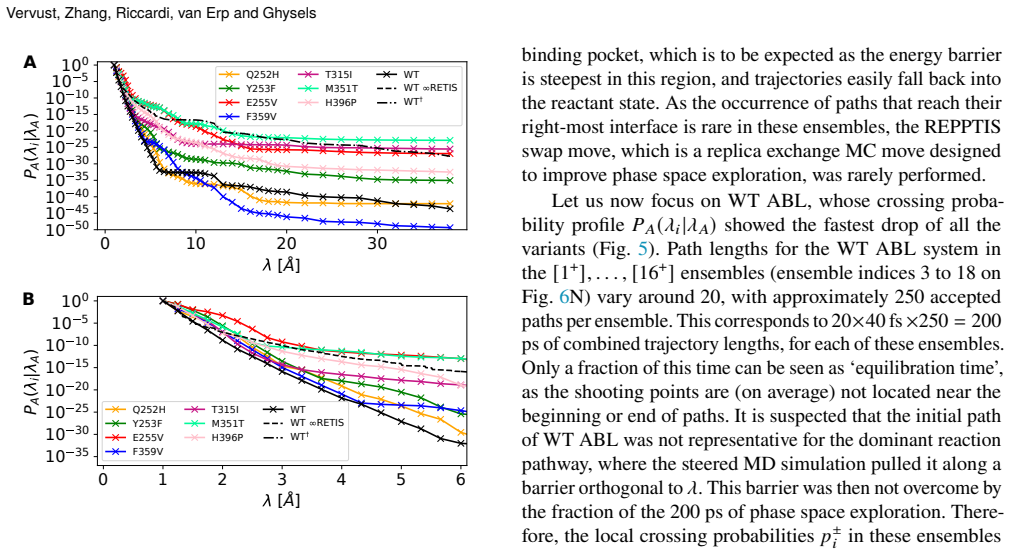
- [Results, 'Causes of REPPTIS sampling issues'; Discussion] The central claim that a one-dimensional λ cannot resolve the metastable states and parallel pathways of ABL-imatinib is not yet separable from the initialization confound you raise. In 'Causes of REPPTIS sampling issues' you write that 'the initial path of WT ABL was not representative for the dominant reaction pathway,' and in the Discussion you note that the WT steered-MD path escaped under the αC-helix whereas Shekhar et al. (Ref. 80) found the dominant WT route via the hinge after breaking the Y253–N322 hydrogen bond, a coordinate orthogonal to λ. Because the REPPTIS paths in the problematic ensembles are short (about 20 phase points, roughly 0.8 ps) and successive paths are correlated through the same reaction channel, a non-representative start can produce exactly the observed zero local crossing probabilities even if a one-dimensional λ would suffice for the true dominant route. I ask for a concrete test: initialize REPPTIS from a hinge-route path or from several diverse steered paths and compare the local crossing probabilities; alternatively, analyze the existing WT trajectories for the Y253–N322 hydrogen bond to evidence whether the hinge channel is present at all in the sampled path ensemble. Until one of these tests is provided, the wording in the Abstract and Conclusion should retrench from a landscape-based failure to 'not resolvable with the specific λ, initial paths, and protocol used here.'
- [Results, '∞RETIS simulations'] The evidence presented for the 'fundamentally not resolvable' statement in the ∞RETIS results is weaker than the claim. The discontinuities in Fig. 7A are explained in the text as undersampling: the first nine positive ensembles have average path lengths of one phase point, and the λ≥4.5 Å region has fewer than 100 accepted paths (Fig. 8A). These are practical sampling limitations of this particular run (frame-saving rate n_subcycles = 500, maximum path length 100 ns, and the chosen interface spacing), not a demonstrated failure of the order parameter to separate metastable states. The long path lengths for λ beyond 6 Å show that transitions are rare and slow, but they do not exclude a better-chosen one-dimensional coordinate, such as the contact-map parameter you propose in the Discussion, from resolving the relevant states. Please either soften the 'fundamentally' language to a hypothesis, or add supporting analysis (for instance, committor estimates for λ, or a test on one variant with an alternative 1D coordinate).
- [Discussion] The Discussion states that 'a one-dimensional order parameter is fundamentally not sufficient' for ABL-imatinib dissociation. As written, this reads as a conclusion of the present work, but the supporting evidence in that paragraph comes from Refs. (79) and (80) (milestoning with average Voronoi connectivity 2.93 and a 5-dimensional metadynamics model), not from the simulations reported here. Your own data demonstrate non-convergence for one specific distance coordinate with one initialization protocol, which is an important but narrower result. Please mark the fundamental-insufficiency statement explicitly as a literature-supported hypothesis, or provide additional evidence from this study to support it.
minor comments (6)
- [Table 2] The variant label 'Y53F' should be 'Y253F' to be consistent with Table 1 and the text.
- [Causes of REPPTIS sampling issues] The text refers to 'the E225V and T315I rates'; this should be 'E255V'.
- [References] References 23 and 24 appear to be the same article (Bolhuis and Swenson, Adv. Theory Simul. 4:2000237, 2021); please merge or remove the duplicate.
- [Results, '∞RETIS simulations'] The sentence 'This means that, for these 1-phase point paths, the configuration remains identical as only the momenta are modified' is confusing; a one-phase-point path has no internal dynamics, so please rephrase to say that shooting from such a path generates a new trajectory from the same configuration with new momenta.
- [Methods, Pulling simulations] The claim that the pulling force was 'non-directional' is not self-evident because the moving restraint on λ exerts a force along the instantaneous direction of the ligand displacement vector; please clarify the intended meaning or provide quantitative support for this statement.
- [Code availability] The statement that the custom version of ∞REPPTIS is 'available on request' is weaker than the rest of the reproducibility package (Zenodo deposition of configurations); please deposit the code in a public repository as well.
Circularity Check
No circularity: the paper is a self-contained failure report with no fitted-input-as-prediction or load-bearing self-citation.
full rationale
This paper reports non-convergence of RETIS/REPPTIS simulations for ABL-imatinib dissociation and hypothesizes that a one-dimensional order parameter is insufficient. There is no fitted parameter that is then renamed as a prediction: the experimental k_off values are used only as external benchmarks, not as inputs to any calibration. The methodological choices (46 interfaces, 4 ns maximum path length, steered-MD initial paths, COM-distance order parameter) are stated inputs, not quantities tuned to reproduce the target rate. The combined ∞RETIS+REPPTIS rate estimate is an explicitly ad hoc construction, not a derivation that reduces to its own inputs. The central claim that metastable states and orthogonal barriers limit a 1D-λ description is presented as a hypothesis ('might fundamentally not be resolvable') and is corroborated by independent external studies (Refs. 79, 80), not by self-citation. Self-citations to PyRETIS and ∞RETIS concern software and method provenance and are not load-bearing for the scientific conclusion. The paper is honestly self-critical about the initialization confound, which is a correctness risk, not circularity. No step reduces to its inputs by construction, so the circularity score is 0.
Assumptions & free parameters
free parameters (7)
- Order parameter λ =
COM distance to r_bound_COM; λ_A=1 Å, λ_B=38 Å (REPPTIS) or 6 Å (∞RETIS)
- Interface set =
46 interfaces (REPPTIS); 51 interfaces spaced 0.1 Å for WT ∞RETIS
- Maximum path length =
4 ns (REPPTIS), 100 ns (∞RETIS)
- Steered MD pulling parameters =
50 ns, v=0.76 Å/ns, moving restraint κ=250 kJ mol^-1 nm^-2, Cα restraints κ=5000 kJ mol^-1 nm^-2
- Frame-saving rate (n_subcycles) =
REPPTIS: n_subcycles=20 (40 fs); ∞RETIS: n_subcycles=500 (1 ps)
- Swap move probability =
25% replica exchange, 75% shooting
- Rigid Cα set =
variant-specific sets from 50 ns equilibrium RMSF (Table S1)
assumptions (5)
- standard math Converged TIS and RETIS ensembles reconstruct exact kinetics; PPTIS/REPPTIS reconstruct approximate kinetics under a Markovian assumption on crossing probabilities.
- domain assumption The Markovian approximation in REPPTIS holds for the chosen distance order parameter λ.
- ad hoc to paper Steered MD initial paths are representative of unbiased dissociation pathways.
- domain assumption The force field (CHARMM36m, TIP3P, imatinib parameters from Ref. 63) accurately describes the relevant interactions.
- ad hoc to paper A single distance coordinate λ is an adequate reaction coordinate for the TIS interface ensembles.
Cite this review
Pith. "Pith review of Path sampling challenges in large biomolecular systems: RETIS and REPPTIS for ABL-imatinib kinetics." pith.science (2026). https://pith.science/paper/L27EMZTH
@misc{pith2026250414722,
  author       = {Pith},
  title        = {Pith review of: Path sampling challenges in large biomolecular systems: RETIS and REPPTIS for ABL-imatinib kinetics},
  year         = {2026},
  howpublished = {\url{https://pith.science/paper/L27EMZTH}},
  note         = {Machine review of arXiv:2504.14722}
}
read the original abstract
Predicting the kinetics of drug-protein interactions is crucial for understanding drug efficacy, particularly in personalized medicine, where protein mutations can significantly alter drug residence times. This study applies Replica Exchange Transition Interface Sampling (RETIS) and its Partial Path variant (REPPTIS) to investigate the dissociation kinetics of imatinib from Abelson nonreceptor tyrosine kinase (ABL) and mutants relevant to chronic myeloid leukemia therapy. These path-sampling methods offer a bias-free alternative to conventional approaches requiring qualitative predefined reaction coordinates. Nevertheless, the complex free-energy landscape of ABL-imatinib dissociation presents significant challenges. Multiple metastable states and orthogonal barriers lead to parallel unbinding pathways, complicating convergence in TIS-based methods. Despite employing computational efficiency strategies such as asynchronous replica exchange, full convergence remained elusive. This work provides a critical assessment of path sampling in high-dimensional biological systems, discussing the need for enhanced initialization strategies, advanced Monte Carlo path generation moves, and machine learning-derived reaction coordinates to improve kinetic predictions of drug dissociation with minimal prior knowledge.
Figures


Figures from the paper (4 more)


Reference graph
Works this paper leans on
-
[1]
Lipinski, C. A., F. Lombardo, B. W. Dominy, and P. J. Feeney, 2012. Experimental and computational ap- proaches to estimate solubility and permeability in drug discovery and development settings.Adv. Drug Deliv. Rev.64:4–17
2012
-
[2]
L., 2004
Jorgensen, W. L., 2004. The many roles of computation in drug discovery.Science303:1813–1818
2004
-
[3]
Claveria-Gimeno, R., S. Vega, O. Abian, and A. Velazquez-Campoy, 2017. A look at ligand bind- ing thermodynamics in drug discovery.Expert Opin. Drug Discov.12:363–377
2017
-
[4]
L., and M
Mobley, D. L., and M. K. Gilson, 2017. Predicting binding free energies: frontiers and benchmarks.Annu. Rev. Biophys.46:531–558
2017
-
[5]
Drug–target residence time and its implications for lead optimization
Copeland,R.A.,D.L.Pompliano,andT.D.Meek,2006. Drug–target residence time and its implications for lead optimization. Nat. Rev. Drug Discov. 5:730–739
2006
-
[6]
Biochem.47:5481–5492
Tummino,P.J.,andR.A.Copeland,2008.Residencetime of receptor- ligand complexes and its effect on biological function. Biochem.47:5481–5492
2008
-
[7]
A., 2010
Copeland, R. A., 2010. The dynamics of drug-target interactions: drug-target residence time and its impact on efficacy and safety.Expert Opin. Drug Discov. 5:305– 310
2010
-
[8]
Drug–targetresidencetime: critical information for lead optimization.Curr
Lu,H.,andP.J.Tonge,2010. Drug–targetresidencetime: critical information for lead optimization.Curr. Opin. Chem. Biol. 14:467–474
2010
Show all 110 references
-
[9]
A., 2016
Copeland, R. A., 2016. The drug–target residence time model: a 10-year retrospective.Nat. Rev. Drug Discov. 15:87–95
2016
-
[10]
Genomics and drug response.New England Journal of Medicine364:1144–1153
Wang,L.,H.L.McLeod,andR.M.Weinshilboum,2011. Genomics and drug response.New England Journal of Medicine364:1144–1153
2011
-
[11]
V., and W
Relling, M. V., and W. E. Evans, 2015. Pharmacoge- nomics in the clinic.Nature526:343–350
2015
-
[12]
ChapterSeven - Molecular Dynamics: New Frontier in Personalized Medicine
Sneha,P.,andC.GeorgePriyaDoss,2016. ChapterSeven - Molecular Dynamics: New Frontier in Personalized Medicine. In R. Donev, editor, Personalized Medicine, Academic Press, volume 102 ofAdvances in Protein Chemistry and Structural Biology, 181–224
2016
-
[13]
Georgoulia, P. S., G. Todde, S. Bjelic, and R. Fried- man, 2019. The catalytic activity of Abl1 single and compound mutations: Implications for the mechanism of drug resistance mutations in chronic myeloid leukaemia. Biochimica et Biophysica Acta (BBA)-General Subjects 1863:73...
2019
-
[14]
O’hare, T., M. S. Zabriskie, A. M. Eiring, and M. W. Deininger, 2012. Pushing the limits of targeted therapy in chronic myeloid leukaemia.Nat. Rev. Cancer 12:513– 526
2012
-
[15]
Warmuth, W
Stegmeier, F., M. Warmuth, W. Sellers, and M. Dorsch, 2010.Targetedcancertherapiesinthetwenty-firstcentury: lessons from imatinib.Clin. Pharmacol. Ther. 87:543– 552
2010
-
[16]
Theinsandouts of bcr-abl inhibition.Genes & cancer 3:447–454
Reddy,E.P.,andA.K.Aggarwal,2012. Theinsandouts of bcr-abl inhibition.Genes & cancer 3:447–454
2012
-
[17]
K., 2004
Shoichet, B. K., 2004. Virtual screening of chemical libraries. Nature432:862–865
2004
-
[18]
Futatsugi, H
Okimoto, N., N. Futatsugi, H. Fuji, A. Suenaga, G. Mo- rimoto, R. Yanai, Y. Ohno, T. Narumi, and M. Taiji,
-
[19]
Efficientdrugleaddiscoveryand optimization
Jorgensen,W.L.,2009. Efficientdrugleaddiscoveryand optimization. Accounts of chemical research42:724–733
2009
-
[20]
Areviewonapplications of computational methods in drug screening and design
Lin,X.,X.Li,andX.Lin,2020. Areviewonapplications of computational methods in drug screening and design. Molecules 25:1375
2020
-
[21]
Dellago, C., P. G. Bolhuis, F. S. Csajka, and D. Chandler,
-
[22]
Bolhuis,P.G.,D.Chandler,C.Dellago,andP.L.Geissler,
-
[23]
Transitionpath sampling as Markov chain Monte Carlo of trajectories: Recent algorithms, software, applications, and future outlook
Bolhuis,P.G.,andD.W.Swenson,2021. Transitionpath sampling as Markov chain Monte Carlo of trajectories: Recent algorithms, software, applications, and future outlook. Adv. Theory Simul. 4:2000237
2021
-
[24]
G., and D
Bolhuis, P. G., and D. W. H. Swenson, 2021. Transition Path Sampling as Markov Chain Monte Carlo of Trajec- tories: Recent Algorithms, Software, Applications, and Future Outlook. Adv. Theory Simul. 4:2000237
2021
-
[25]
Van Erp, T. S., D. Moroni, and P. G. Bolhuis, 2003. A novel path sampling method for the calculation of rate constants. J. Chem. Phys. 118:7762–7774
2003
-
[26]
S., 2012
Van Erp, T. S., 2012. Dynamical rare event simulation techniques for equilibrium and nonequilibrium systems. Adv. Chem. Phys. 151:27
2012
-
[27]
K., and R
Faradjian, A. K., and R. Elber, 2004. Computing time scalesfromreactioncoordinatesbymilestoning. J. Chem. Phys.120:10880–10889
2004
-
[28]
Ojha, A. A., L. W. Votapka, and R. E. Amaro, 2024. Advances and Challenges in Milestoning Simulations for Drug–Target Kinetics.Journal of Chemical Theory and Computation 20:9759–9769. PMID: 39508322
2024
-
[29]
Moroni, D., P. G. Bolhuis, and T. S. van Erp, 2004. Rate constantsfordiffusiveprocessesbypartialpathsampling. J. Chem. Phys. 120:4055–4065
2004
-
[30]
Reactionratecalculationbyparallel path swapping.Phys
vanErp,T.S.,2007. Reactionratecalculationbyparallel path swapping.Phys. Rev. Lett. 98:268301
2007
-
[31]
G., 2008
Bolhuis, P. G., 2008. Rare events via multiple reaction channels sampled by path replica exchange.J. Chem. Phys.129
2008
-
[32]
Cabriolu,R.,K.M.SkjelbredRefsnes,P.G.Bolhuis,and T. S. van Erp, 2017. Foundations and latest advances in replica exchange transition interface sampling.J. Chem. Phys.147
2017
-
[33]
Vervust, W., D. T. Zhang, T. S. Van Erp, and A. Ghysels,
-
[34]
Zhang, D. T., L. Baldauf, S. Roet, A. Lervik, and T. S. van Erp, 2024. Highly parallelizable path sampling with minimal rejections using asynchronous replica ex- change and infinite swaps.Proc. Natl. Acad. Sci. U.S.A. 121:e2318731121
2024
-
[35]
Riccardi, T
Moqadam, M., E. Riccardi, T. T. Trinh, A. Lervik, and T. S. van Erp, 2017. Rare event simulations reveal subtle key steps in aqueous silicate condensation.Phys. Chem. Chem. Phys. 19:13361–13371
2017
-
[36]
Lervik, E
Moqadam, M., A. Lervik, E. Riccardi, V. Venkatraman, B. K. Alsberg, and T. S. van Erp, 2018. Local initiation conditions for water autoionization.Proc. Nat. Acad. Sci. U.S.A.115:E4569–E4576
2018
-
[37]
Daub, C. D., E. Riccardi, V. Hänninen, and L. Halonen,
-
[38]
Riccardi, T
Aarøen, O., E. Riccardi, T. S. van Erp, and M. Sletmoen,
-
[39]
Zhang, D. T., E. Riccardi, and T. S. van Erp, 2023. EnhancedpathsamplingusingsubtrajectoryMonteCarlo moves. J. Chem. Phys. 158
2023
-
[40]
Svenum, Z
Lervik, A., I.-H. Svenum, Z. Wang, R. Cabriolu, E. Ric- cardi, S. Andersson, and T. S. van Erp, 2022. The role 14 Manuscript submitted to Biophysical Journal Path sampling in ABL-imatinib kinetics of pressure and defects in the wurtzite to rock salt tran- sition in cadmium sel...
2022
-
[41]
Riccardi, E., E. C. van Mastbergen, W. W. Navarre, and J. Vreede, 2019. Predicting the mechanism and rate of H-NS binding to AT-rich DNA.PLoS Comput. Biol. 15:e1006845
2019
-
[42]
Krämer, T
Riccardi, E., A. Krämer, T. S. van Erp, and A. Ghysels,
-
[43]
Ghysels, A., S. Roet, S. Davoudi, and T. S. van Erp,
-
[44]
Panjarian, S., R. E. Iacob, S. Chen, J. R. Engen, and T. E. Smithgall, 2013. Structure and dynamic regulation of Abl kinases.J. Biol. Chem. 288:5443–5450
2013
-
[45]
Christensen, H
Simpson,G.L.,S.M.Bertrand,J.A.Borthwick,N.Cam- pobasso,J.Chabanet,S.Chen,J.Coggins,J.Cottom,S.B. Christensen, H. C. Dawson, et al., 2019. Identification and optimization of novel small c-Abl kinase activators using fragment and HTS methodologies.J. Med. Chem. 62:2154–2171
2019
-
[46]
Saleh, P
Xie, T., T. Saleh, P. Rossi, and C. G. Kalodimos, 2020. Conformationalstatesdynamicallypopulatedbyakinase determine its function.Science370:eabc2754
2020
-
[47]
L., et al., 2002
DeLano, W. L., et al., 2002. Pymol: An open-source molecular graphics tool.CCP4 Newsl. Protein Crystal- logr 40:82–92
2002
-
[48]
Shah, N. P., J. M. Nicoll, B. Nagar, M. E. Gorre, R. L. Paquette, J. Kuriyan, and C. L. Sawyers, 2002. Multiple BCR-ABLkinasedomainmutationsconferpolyclonalre- sistancetothetyrosinekinaseinhibitorimatinib(STI571) inchronicphaseandblastcrisischronicmyeloidleukemia. Cancer cell ...
2002
-
[49]
Permeation rates of oxygen through a lipid bilayer using replica exchange transition interface sampling.J. Phys. Chem. B 125:193–201
-
[50]
Howfarcanwestretchthetimescale with RETIS? EPL 143:30001
vanErp,T.S.,2023. Howfarcanwestretchthetimescale with RETIS? EPL 143:30001
2023
-
[51]
Dellago, and P
Grünwald, M., C. Dellago, and P. L. Geissler, 2008. Precision shooting: Sampling long transition pathways. J. Chem. Phys. 129
2008
-
[52]
R., and P
Gingrich, T. R., and P. L. Geissler, 2015. Preserving cor- relations between trajectories for efficient path sampling. J. Chem. Phys. 142
2015
-
[53]
Transition path sampling of rare events by shooting from the top.J
Jung,H.,K.-i.Okazaki,andG.Hummer,2017. Transition path sampling of rare events by shooting from the top.J. Chem. Phys. 147
2017
-
[54]
Singraber, and C
Menzl, G., A. Singraber, and C. Dellago, 2016. S- shooting: a Bennett–Chandler-like method for the com- putation of rate constants from committor trajectories. Faraday Discussions195:345–364
2016
-
[55]
E., and C
Borrero, E. E., and C. Dellago, 2016. Avoiding traps in trajectory space: Metadynamics enhanced transition path sampling. Eur. Phys. J. Spec. Top. 225:1609–1620
2016
-
[56]
Dahlen, and T
Riccardi, E., O. Dahlen, and T. S. van Erp, 2017. Fast Decorrelating Monte Carlo Moves for Efficient Path Sampling. J. Phys. Chem. Lett. 8:4456–4460
2017
-
[57]
Shah, N. P., B. J. Skaggs, S. Branford, T. P. Hughes, J. M. Nicoll, R. L. Paquette, C. L. Sawyers, et al., 2007. Sequential ABL kinase inhibitor therapy selects for com- pound drug-resistant BCR-ABL mutations with altered oncogenic potency.The Journal of clinical investigation...
2007
-
[58]
Jo, S., T. Kim, V. G. Iyer, and W. Im, 2008. CHARMM- GUI:aweb-basedgraphicaluserinterfaceforCHARMM. J. Comput. Chem. 29:1859–1865
2008
-
[59]
Ensinger, T
Chan,W.W.,S.C.Wise,M.D.Kaufman,Y.M.Ahn,C.L. Ensinger, T. Haack, M. M. Hood, J. Jones, J. W. Lord, W.P.Lu,etal.,2011.Conformationalcontrolinhibitionof the BCR-ABL1 tyrosine kinase, including the gatekeeper T315I mutant, by the switch-control inhibitor DCC-2036. Cancer cell 19:556–568
2011
-
[60]
Abraham, M. J., T. Murtola, R. Schulz, S. Páll, J. C. Smith,B.Hess,andE.Lindahl,2015. GROMACS:High performance molecular simulations through multi-level parallelism from laptops to supercomputers.SoftwareX 1:19–25
2015
-
[61]
Rauscher, G
Huang, J., S. Rauscher, G. Nawrocki, T. Ran, M. Feig, B. L. De Groot, H. Grubmüller, and A. D. MacKerell Jr,
-
[62]
Jorgensen, W. L., J. Chandrasekhar, J. D. Madura, R. W. Impey, and M. L. Klein, 1983. Comparison of simple potential functions for simulating liquid water.J. Chem. Phys.79:926–935
1983
-
[63]
Lin, Y.-L., Y. Meng, L. Huang, and B. Roux, 2014. Com- putational study of Gleevec and G6G reveals molecular determinants of kinase inhibitor selectivity.J. Am. Chem. Soc.136:14753–14762. Manuscript submitted to Biophysical Journal15 Vervust, Zhang, Riccardi, van Erp and Ghysels
2014
-
[64]
Roux, 2013
Huang, L., and B. Roux, 2013. Automated force field pa- rameterization for nonpolarizable and polarizable atomic models based on ab initio target data.J. Chem. Theory Comput. 9:3543–3556
2013
-
[65]
Roet,S.,D.T.Zhang,andT.S.vanErp,2022.Exchanging replicas with unequal cost, infinitely and permanently.J. Phys. Chem. A 126:8878–8886
2022
-
[66]
Thomas, and B
Paul, F., T. Thomas, and B. Roux, 2020. Diversity of long-lived intermediates along the binding pathway of imatinib to Abl kinase revealed by MD simulations.J. Chem. Theory Comput. 16:7852–7865
2020
-
[67]
Simonson, 2010
Aleksandrov, A., and T. Simonson, 2010. A molecu- lar mechanics model for imatinib and imatinib: kinase binding. J. Comput. Chem. 31:1550–1560
2010
-
[68]
Bussi,G.,D.Donadio,andM.Parrinello,2007.Canonical sampling through velocity rescaling.J. Chem. Phys. 126
2007
-
[69]
Rahman, 1981
Parrinello, M., and A. Rahman, 1981. Polymorphic transitions in single crystals: A new molecular dynamics method. J. Appl. Phys. 52:7182–7190
1981
-
[70]
Bekker, H
Hess, B., H. Bekker, H. J. Berendsen, and J. G. Fraaije,
-
[71]
Dalke, and K
Humphrey, W., A. Dalke, and K. Schulten, 1996. VMD: visual molecular dynamics.J. Mol. Graph. 14:33–38
1996
-
[72]
PLUMED2:Newfeathersforanold bird
Tribello,G.A.,M.Bonomi,D.Branduardi,C.Camilloni, andG.Bussi,2014. PLUMED2:Newfeathersforanold bird. Comput. Phys. Commun. 185:604–613
2014
-
[73]
PyRETIS 2: an improbability drive for rare events
Riccardi,E.,A.Lervik,S.Roet,O.Aarøen,andT.S.van Erp, 2020. PyRETIS 2: an improbability drive for rare events. Journal of computational chemistry 41:370–377
2020
-
[74]
Huang, C
Boulanger, E., L. Huang, C. Rupakheti, A. D. MacK- erell Jr, and B. Roux, 2018. Optimized Lennard-Jones parametersfordruglikesmallmolecules. J. Chem. Theory Comput. 14:3121–3131
2018
-
[75]
Vervust, W., D. T. Zhang, A. Ghysels, S. Roet, T. S. van Erp,andE.Riccardi,2024. PyRETIS3:Conqueringrare and slow events without boundaries.J. Comput. Chem
2024
-
[76]
Kuriyan, 2007
Seeliger,M.A.,B.Nagar,F.Frank,X.Cao,M.N.Hender- son, and J. Kuriyan, 2007. c-Src binds to the cancer drug imatinib with an inactive Abl/c-Kit conformation and a distributed thermodynamic penalty.Structure 15:299– 311
2007
-
[77]
Berger, A
Lyczek, A., B.-T. Berger, A. M. Rangwala, Y. Paung, J. Tom, H. Philipose, J. Guo, S. K. Albanese, M. B. Robers,S.Knapp,J.D.Chodera,andM.A.Seeliger,2021. MutationinAblkinasewithaltereddrug-bindingkinetics indicatesanovelmechanismofimatinibresistance. Proc. Natl. Acad. Sci. U.S....
2021
-
[78]
Agafonov, R. V., C. Wilson, R. Otten, V. Buosi, and D. Kern, 2014. Energetic dissection of Gleevec’s selec- tivity toward human tyrosine kinases.Nat. Struct. Mol. Biol. 21:848–853
2014
-
[79]
Computer simulations of the dissociation mechanism of Gleevec from Abl Kinase with milestoning.J
Narayan,B.,N.-V.Buchete,andR.Elber,2021. Computer simulations of the dissociation mechanism of Gleevec from Abl Kinase with milestoning.J. Phys. Chem. B 125:5706–5715
2021
-
[80]
Proteinflexibilityanddissociationpathwaydifferentiation can explain onset of resistance mutations in kinases
Shekhar,M.,Z.Smith,M.A.Seeliger,andP.Tiwary,2022. Proteinflexibilityanddissociationpathwaydifferentiation can explain onset of resistance mutations in kinases. Angew. Chem. Int. Ed. 61:e202200983
2022
-
[81]
S., 2006
van Erp, T. S., 2006. Efficiency analysis of reaction rate calculation methods using analytical models I: The two-dimensional sharp barrier.J. Chem. Phys. 125
2006
-
[82]
Allen, R. J., C. Valeriani, and P. R. Ten Wolde, 2009. Forwardfluxsamplingforrareeventsimulations. J. Phys.: Condens. Matter 21:463102
2009
-
[83]
Understandingmolecular simulation: from algorithms to applications
Frenkel,D.,andB.Smit,2023. Understandingmolecular simulation: from algorithms to applications. Elsevier
2023
-
[84]
https: //github.com/infretis/, gitHub repository
InfRETIS:Pythonlibrariesforrunning ∞RETIS. https: //github.com/infretis/, gitHub repository
-
[85]
Guyader, T
Cérou, F., A. Guyader, T. Lelievre, and D. Pommier,
-
[86]
van Heesch, T., P. G. Bolhuis, and J. Vreede, 2023. Decodingdissociationofsequence-specificprotein–DNA complexes with non-equilibrium simulations.Nucleic Acids Research51:12150–12160
2023
-
[87]
String method for the study of rare events.Physical Review B 66:052301
Weinan,E.,W.Ren,andE.Vanden-Eijnden,2002. String method for the study of rare events.Physical Review B 66:052301
2002
-
[88]
String method in collective variables: Mini- mum free energy paths and isocommittor surfaces.The Journal of chemical physics 125
Maragliano,L.,A.Fischer,E.Vanden-Eijnden,andG.Ci- ccotti, 2006. String method in collective variables: Mini- mum free energy paths and isocommittor surfaces.The Journal of chemical physics 125
2006
-
[89]
Anextended autoencoder model for reaction coordinate discovery in rare event molecular dynamics datasets.The Journal of Chemical Physics 155
Frassek,M.,A.Arjun,andP.Bolhuis,2021. Anextended autoencoder model for reaction coordinate discovery in rare event molecular dynamics datasets.The Journal of Chemical Physics 155
2021
-
[90]
Gkeka, T
Belkacemi, Z., P. Gkeka, T. Lelièvre, and G. Stoltz,
-
[91]
Bonati, V
Fröhlking, T., L. Bonati, V. Rizzi, and F. L. Gervasio,
-
[92]
Ayaz,P.,A.Lyczek,Y.Paung,V.R.Mingione,R.E.Iacob, P. W. de Waal, J. R. Engen, M. A. Seeliger, Y. Shan, and D. E. Shaw, 2023. Structural mechanism of a drug- binding process involving a large conformational change of the protein target.Nat. Commun. 14:1885
2023
-
[93]
Rogal,J.,andP.G.Bolhuis,2008.Multiplestatetransition path sampling. J. Chem. Phys. 129
2008
-
[94]
A., and S
Huber, G. A., and S. Kim, 1996. Weighted-ensemble Brownian dynamics simulations for protein association reactions. Biophysical journal 70:97–110
1996
-
[95]
Advanced Molecular Dynamics Sim- ulation Techniques for Kinetic Analysis of Biological Systems
Vervust, W., 2024. Advanced Molecular Dynamics Sim- ulation Techniques for Kinetic Analysis of Biological Systems. Doctoral dissertation, Ghent University, Fac- ulty of Engineering and Architecture, Department of Electronics and Information Systems
2024
-
[96]
Coretti, and C
Falkner, S., A. Coretti, and C. Dellago, 2024. Enhanced Sampling of Configuration and Path Space in a General- ized Ensemble by Shooting Point Exchange.Phys. Rev. Lett.132:128001
2024
-
[97]
Vervust, W., T. D. Zhang, E. Riccardi, T. S. van Erp, and A. Ghysels. ABL configurations. Dataset on Zenodo. https://doi.org/10.5281/zenodo.14833469. Manuscript submitted to Biophysical Journal17
-
[102]
16 Manuscript submitted to Biophysical Journal Path sampling in ABL-imatinib kinetics
Chasing collective variables using autoencoders and biased trajectories.Journal of chemical theory and computation 18:59–78. 16 Manuscript submitted to Biophysical Journal Path sampling in ABL-imatinib kinetics
-
[107]
Noé, 2020
Wu, H., and F. Noé, 2020. Variational approach for learningMarkovprocessesfromtimeseriesdata. Journal of Nonlinear Science 30:23–66
2020
-
[1997]
LINCS: A linear constraint solver for molecular simulations. J. Comput. Chem. 18:1463–1472
-
[1998]
Transition path sampling and the calculation of rate constants.J. Chem. Phys. 108:1964–1977
1964
-
[2002]
Transition path sampling: Throwing ropes over rough mountain passes, in the dark.Annu. Rev. Phys. Chem.53:291–318
-
[2009]
PLoS Comput
High-performance drug discovery: computational screeningbycombiningdockingandmoleculardynamics simulations. PLoS Comput. Biol. 5:e1000528
-
[2011]
A multiple replica approach to simulate reactive trajectories. J. Chem. Phys. 134
-
[2017]
CHARMM36m: an improved force field for folded andintrinsicallydisorderedproteins. Nat. Methods14:71– 73
-
[2020]
PeerJ Phys
Path sampling for atmospheric reactions: formic acidcatalysedconversionofSO3+H2OtoH2SO4. PeerJ Phys. Chem. 2:e7
-
[2021]
Exactnon-Markovianpermeabilityfromrareevent simulations. Phys. Rev. Res. 3:033068
-
[2022]
A Physicochem
Thin film breakage in oil–in–water emulsions, a multidisciplinary study.Colloids Surf. A Physicochem. Eng. Asp. 632:127808
-
[2023]
Path sampling with memory reduction and replica exchange to reach long permeation timescales.Biophys. J. 122:2960–2972
-
[2024]
Deep learning path-like collective variable for enhanced sampling molecular dynamics.The Journal of Chemical Physics 160
Reviewed August 16, 2026 · model on record in the stance chip above.
Discussion (0). Continue with ORCID to comment.