Gravitational Waves from Primordial Black Holes: Connecting Low-Frequency Scalar-Induced Signatures to High-Frequency Binary Mergers
Pith reviewed 2026-07-03 06:58 UTC · model grok-4.3
The pith
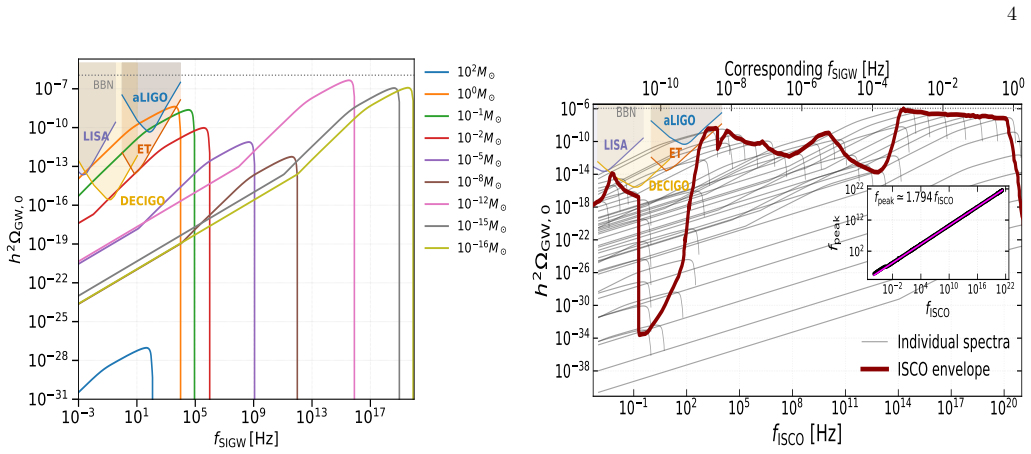
For monochromatic primordial black holes, scalar-induced gravitational waves connect directly to binary merger signals through the ISCO frequency, with the merger peak at 1.79 times that frequency independent of mass.
A machine-rendered reading of the paper's core claim, the machinery that carries it, and where it could break.
Core claim
For a monochromatic PBH mass function, the SIGW frequency corresponds to the ISCO frequency of the binaries, and the peak of the merger GW spectrum satisfies f_peak = 1.79 f_ISCO independent of binary masses, unifying the low-frequency scalar-induced background with the high-frequency merger signal from the same primordial fluctuations.
What carries the argument
The mass-independent relation f_peak = 1.79 f_ISCO arising from maximal GW emission near the ISCO, which maps the SIGW frequency scale onto the binary merger spectrum.
If this is right
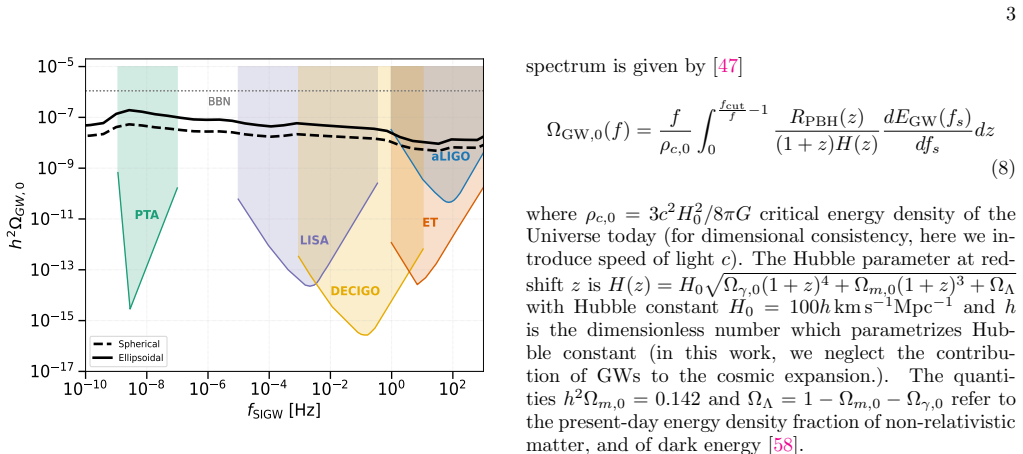
- Ellipsoidal collapse yields a substantially stronger SIGW background than spherical collapse under the same PBH abundance constraints.
- PBH abundance limits on the primordial curvature power spectrum translate directly into predictions for both the low-frequency SIGW amplitude and the high-frequency merger rate.
- The same set of primordial fluctuations can be constrained simultaneously in low-frequency and high-frequency GW bands.
- The ISCO-to-peak relation holds regardless of the specific binary masses as long as the mass function remains monochromatic.
Where Pith is reading between the lines
- Multi-band GW observations could test whether a single early-universe fluctuation spectrum accounts for both signals without additional assumptions about PBH clustering.
- Relaxing the monochromatic assumption would likely decorrelate the two frequency bands, offering a way to bound the width of the PBH mass function from joint non-detections.
- The framework suggests that SIGW upper limits could already restrict the expected merger rate in the high-frequency band even before direct merger detections.
Load-bearing premise
The PBH mass function must be monochromatic to keep the SIGW frequency tied to the binary ISCO frequency in a consistent, model-independent way.
What would settle it
A measured merger spectrum whose peak deviates from 1.79 times the ISCO frequency inferred from an observed SIGW background, or signals from the two channels that cannot be produced by any single monochromatic PBH population consistent with abundance bounds.
Figures
read the original abstract
Formation of primordial black holes (PBHs) requires a significant enhancement of curvature perturbations. This mechanism leaves a twofold gravitational-wave (GW) signature: a \emph{low-frequency} stochastic background of scalar-induced GWs (SIGWs) and a distinct \emph{high-frequency} signal from subsequent PBH binary mergers. We leverage this shared origin to establish a consistent, \emph{model-independent} connection between these two observables for a monochromatic PBH mass function. Using PBH abundance constraints on the primordial curvature power spectrum, we evaluate the stochastic SIGW background for spherical and ellipsoidal collapse models, demonstrating that the ellipsoidal scenario yields a significantly stronger signal. Furthermore, we analyze the GW signal from PBH binary mergers and find a direct correspondence between the SIGW frequency and the innermost stable circular orbit (ISCO) frequency of the binaries. Because GW emission is nearly maximal near the ISCO, we additionally show that the peak of the full merger GW spectrum relates to the ISCO frequency via $f_{\text{peak}} = 1.79 \, f_{\text{ISCO}}$, a relation that is independent of the binary masses. Remarkably, this unified framework connects these distinct GW channels, enabling the same primordial fluctuations to be probed across widely separated frequency bands.
Editorial analysis
A structured set of objections, weighed in public.
Referee Report
Summary. The manuscript claims that primordial curvature perturbations enhanced enough to form PBHs produce both a low-frequency stochastic SIGW background and a high-frequency GW signal from subsequent PBH binary mergers. For a monochromatic PBH mass function, it establishes a direct frequency correspondence between the SIGW peak (set by the comoving scale k) and the ISCO frequency of the binaries, evaluates the SIGW amplitude for spherical versus ellipsoidal collapse using PBH abundance constraints (finding the ellipsoidal case stronger), and derives that the peak of the full merger spectrum satisfies f_peak = 1.79 f_ISCO independent of binary mass because emission is maximal near ISCO.
Significance. If the frequency mapping and numerical relation hold, the work supplies a concrete multi-band probe of the same primordial fluctuations, linking SIGW constraints on the curvature power spectrum to observable high-frequency merger signals. The explicit comparison of collapse models and the mass-independent ratio are concrete strengths that could guide future observational strategies.
major comments (1)
- [Abstract / derivation of Eq. for f_peak] Abstract and §3 (or equivalent derivation section): the factor 1.79 in f_peak = 1.79 f_ISCO is presented as following from maximal emission near ISCO plus dimensional scaling, but the precise numerical coefficient requires an explicit integral or fitting procedure over the merger waveform; without the intermediate steps shown, it is impossible to verify whether the value is robust or sensitive to waveform modeling choices.
minor comments (2)
- [Abstract] The repeated use of 'model-independent' should be qualified in the abstract and introduction to emphasize that the frequency correspondence is derived under the monochromatic mass-function assumption stated later in the text.
- [Figures] Figure captions and axis labels for the SIGW spectra should explicitly state the PBH mass (or k-scale) chosen for each curve so that the frequency correspondence to the ISCO can be read off directly.
Simulated Author's Rebuttal
We thank the referee for the positive assessment and recommendation for minor revision. We address the single major comment below.
read point-by-point responses
-
Referee: [Abstract / derivation of Eq. for f_peak] Abstract and §3 (or equivalent derivation section): the factor 1.79 in f_peak = 1.79 f_ISCO is presented as following from maximal emission near ISCO plus dimensional scaling, but the precise numerical coefficient requires an explicit integral or fitting procedure over the merger waveform; without the intermediate steps shown, it is impossible to verify whether the value is robust or sensitive to waveform modeling choices.
Authors: We agree that the explicit steps leading to the coefficient 1.79 were not shown. The value follows from the peak of the GW energy spectrum for circular binaries, obtained by integrating the quadrupole formula (or standard phenomenological waveforms) over the inspiral-to-merger transition, where emission peaks near the ISCO. In the revised manuscript we will add the intermediate calculation (or the fitting formula from the Phenom/EOBNR family) in §3, together with a brief statement on robustness to waveform modeling within current uncertainties. This will make the result verifiable. revision: yes
Circularity Check
No significant circularity detected
full rationale
The paper's central result is a frequency correspondence between SIGW and PBH binary signals that follows directly from both observables tracing the same primordial curvature scale k under the explicitly stated monochromatic mass-function assumption; this is a model feature rather than a hidden self-definition or fitted input renamed as prediction. The additional mass-independent ratio f_peak = 1.79 f_ISCO is obtained from standard scaling (both frequencies ∝ 1/M) plus the known near-ISCO peak of GW emission, without any reduction to prior self-citations, ansatzes, or uniqueness theorems imported from the authors. No load-bearing steps in the provided abstract or description reduce by construction to the inputs; the derivation remains self-contained once the monochromatic assumption is granted.
Axiom & Free-Parameter Ledger
axioms (1)
- domain assumption PBH abundance constraints on the primordial curvature power spectrum are used to normalize the SIGW amplitude
Reference graph
Works this paper leans on
-
[1]
Non-spherical effects during collapse are incorpo- rated by defining an ellipsoidal thresholdδ ec ≃δ th[1 + 9σ/( √ 10πδth)] [53, 57], which replacesδ th in Eq
cos(x/ √ 3)]/(x/ √ 3)3 withx= krm. Non-spherical effects during collapse are incorpo- rated by defining an ellipsoidal thresholdδ ec ≃δ th[1 + 9σ/( √ 10πδth)] [53, 57], which replacesδ th in Eq. (1). We consider a narrow-peaked log-normal type primordial power spectrum Pζ(k) = Ap√ 2π∆ exp −ln2(k/kp) 2∆2 ,(3) whereA p,k p, and ∆ denote the amplitude, posit...
-
[2]
[41], this appendix summarizes the expressions and numerical values used to evaluate the GW energy spectrum,dE GW/d fs, appearing in the main text
Details on Energy spectrum of GWs Following Refs. [41], this appendix summarizes the expressions and numerical values used to evaluate the GW energy spectrum,dE GW/d fs, appearing in the main text. dEGW(fs) d fs = (Gπ) 2 3 M 5 3 c 3 f − 1 3 s fs < f1, w1 f 2 3 s f1 ≤f s < f2, w2 σ4f 2 s (σ2+4(fs−f2)2)2 f2 ≤f s < f3 , 0f 3 ≤f s. (A5) whereM 5...
-
[3]
Y. B. Zel’dovich and I. D. Novikov, Sov. Astron.10, 602 (1967)
1967
-
[4]
Hawking, Mon
S. Hawking, Mon. Not. Roy. Astron. Soc.152, 75 (1971)
1971
-
[5]
B. J. Carr and S. W. Hawking, Mon. Not. Roy. Astron. Soc.168, 399 (1974)
1974
-
[6]
G. F. Chapline, Nature253, 251 (1975)
1975
-
[7]
M. Y. Khlopov, Res. Astron. Astrophys.10, 495 (2010), arXiv:0801.0116 [astro-ph]
work page internal anchor Pith review Pith/arXiv arXiv 2010
-
[8]
B. Carr, F. Kuhnel, and M. Sandstad, Phys. Rev. D94, 083504 (2016), arXiv:1607.06077 [astro-ph.CO]
work page internal anchor Pith review Pith/arXiv arXiv 2016
-
[9]
Primordial Black Holes - Perspectives in Gravitational Wave Astronomy -
M. Sasaki, T. Suyama, T. Tanaka, and S. Yokoyama, Class. Quant. Grav.35, 063001 (2018), arXiv:1801.05235 [astro- ph.CO]
work page internal anchor Pith review Pith/arXiv arXiv 2018
-
[10]
B. Carr, K. Kohri, Y. Sendouda, and J. Yokoyama, Reports on Progress in Physics84, 116902 (2021)
2021
-
[11]
A. M. Green and B. J. Kavanagh, J. Phys. G48, 043001 (2021), arXiv:2007.10722 [astro-ph.CO]. 7
work page internal anchor Pith review Pith/arXiv arXiv 2021
-
[12]
A. Escriv` a, F. Kuhnel, and Y. Tada, (2022), 10.1016/B978-0-32-395636-9.00012-8, arXiv:2211.05767 [astro-ph.CO]
-
[13]
Primordial Black Holes: A Review of Formation and Evolution
S. Shankaranarayanan, S. Bhattacharya, and A. Vidyarthi, (2026), arXiv:2606.23846 [gr-qc]
work page internal anchor Pith review Pith/arXiv arXiv 2026
-
[14]
Density Perturbations and Black Hole Formation in Hybrid Inflation
J. Garcia-Bellido, A. D. Linde, and D. Wands, Phys. Rev. D54, 6040 (1996), arXiv:astro-ph/9605094
work page internal anchor Pith review Pith/arXiv arXiv 1996
-
[15]
Chaotic new inflation and formation of primordial black holes
J. Yokoyama, Phys. Rev. D58, 083510 (1998), arXiv:astro-ph/9802357
work page internal anchor Pith review Pith/arXiv arXiv 1998
-
[16]
Black hole formation and slow-roll inflation
K. Kohri, D. H. Lyth, and A. Melchiorri, JCAP04, 038 (2008), arXiv:0711.5006 [hep-ph]
work page internal anchor Pith review Pith/arXiv arXiv 2008
-
[17]
Primordial black hole formation from an axion-like curvaton model
M. Kawasaki, N. Kitajima, and T. T. Yanagida, Phys. Rev. D87, 063519 (2013), arXiv:1207.2550 [hep-ph]
work page internal anchor Pith review Pith/arXiv arXiv 2013
-
[18]
Primordial black holes from single field models of inflation
J. Garcia-Bellido and E. Ruiz Morales, Phys. Dark Univ.18, 47 (2017), arXiv:1702.03901 [astro-ph.CO]
work page internal anchor Pith review Pith/arXiv arXiv 2017
-
[19]
Inflationary Primordial Black Holes as All Dark Matter
K. Inomata, M. Kawasaki, K. Mukaida, Y. Tada, and T. T. Yanagida, Phys. Rev. D96, 043504 (2017), arXiv:1701.02544 [astro-ph.CO]
work page internal anchor Pith review Pith/arXiv arXiv 2017
-
[20]
B. Carr, K. Dimopoulos, C. Owen, and T. Tenkanen, Phys. Rev. D97, 123535 (2018), arXiv:1804.08639 [astro-ph.CO]
work page internal anchor Pith review Pith/arXiv arXiv 2018
-
[21]
C. T. Byrnes, P. S. Cole, and S. P. Patil, JCAP06, 028 (2019), arXiv:1811.11158 [astro-ph.CO]
work page internal anchor Pith review Pith/arXiv arXiv 2019
-
[22]
K. Inomata, M. Kawasaki, K. Mukaida, and T. T. Yanagida, Phys. Rev. D97, 043514 (2018), arXiv:1711.06129 [astro- ph.CO]
work page internal anchor Pith review Pith/arXiv arXiv 2018
-
[23]
N. Bhaumik and R. K. Jain, JCAP01, 037 (2020), arXiv:1907.04125 [astro-ph.CO]
-
[24]
M. Braglia, D. K. Hazra, F. Finelli, G. F. Smoot, L. Sriramkumar, and A. A. Starobinsky, JCAP08, 001 (2020), arXiv:2005.02895 [astro-ph.CO]
- [25]
-
[26]
Cosmological Backgrounds of Gravitational Waves
C. Caprini and D. G. Figueroa, Class. Quant. Grav.35, 163001 (2018), arXiv:1801.04268 [astro-ph.CO]
work page internal anchor Pith review Pith/arXiv arXiv 2018
-
[27]
Gravitational waves induced by scalar perturbations as probes of the small-scale primordial spectrum
K. Inomata and T. Nakama, Phys. Rev. D99, 043511 (2019), arXiv:1812.00674 [astro-ph.CO]
work page internal anchor Pith review Pith/arXiv arXiv 2019
-
[28]
Scalar induced gravitational waves review
G. Dom` enech, Universe7, 398 (2021), arXiv:2109.01398 [gr-qc]
work page internal anchor Pith review Pith/arXiv arXiv 2021
-
[29]
Gravitational Wave Experiments and Early Universe Cosmology
M. Maggiore, Phys. Rept.331, 283 (2000), arXiv:gr-qc/9909001
work page internal anchor Pith review Pith/arXiv arXiv 2000
-
[30]
G. S. Bisnovatyi-Kogan and V. N. Rudenko, Class. Quant. Grav.21, 3347 (2004), arXiv:gr-qc/0406089
work page internal anchor Pith review Pith/arXiv arXiv 2004
-
[31]
B. S. Sathyaprakash and B. F. Schutz, Living Rev. Rel.12, 2 (2009), arXiv:0903.0338 [gr-qc]
work page internal anchor Pith review Pith/arXiv arXiv 2009
-
[32]
Maggiore,Gravitational Waves
M. Maggiore,Gravitational Waves. Vol. 2: Astrophysics and Cosmology(Oxford University Press, 2018)
2018
-
[33]
The NANOGrav Nine-year Data Set: Limits on the Isotropic Stochastic Gravitational Wave Background
Z. Arzoumanianet al.(NANOGrav), Astrophys. J.821, 13 (2016), arXiv:1508.03024 [astro-ph.GA]
work page internal anchor Pith review Pith/arXiv arXiv 2016
-
[34]
R. M. Shannonet al., Science349, 1522 (2015), arXiv:1509.07320 [astro-ph.CO]
work page internal anchor Pith review Pith/arXiv arXiv 2015
-
[35]
European Pulsar Timing Array Limits On An Isotropic Stochastic Gravitational-Wave Background
L. Lentatiet al.(EPTA), Mon. Not. Roy. Astron. Soc.453, 2576 (2015), arXiv:1504.03692 [astro-ph.CO]
work page internal anchor Pith review Pith/arXiv arXiv 2015
-
[36]
B. P. Abbottet al.(KAGRA, LIGO Scientific, Virgo), Living Rev. Rel.19, 1 (2016), arXiv:1304.0670 [gr-qc]
work page internal anchor Pith review Pith/arXiv arXiv 2016
-
[37]
E. Barausseet al., Gen. Rel. Grav.52, 81 (2020), arXiv:2001.09793 [gr-qc]
-
[38]
Current status of space gravitational wave antenna DECIGO and B-DECIGO
S. Kawamuraet al., PTEP2021, 05A105 (2021), arXiv:2006.13545 [gr-qc]
work page internal anchor Pith review Pith/arXiv arXiv 2021
-
[39]
Science Case for the Einstein Telescope
M. Maggioreet al.(ET), JCAP03, 050 (2020), arXiv:1912.02622 [astro-ph.CO]
work page internal anchor Pith review Pith/arXiv arXiv 2020
-
[40]
Stochastic Gravitational-Wave Background due to Primordial Binary Black Hole Mergers
V. Mandic, S. Bird, and I. Cholis, Phys. Rev. Lett.117, 201102 (2016), arXiv:1608.06699 [astro-ph.CO]
work page internal anchor Pith review Pith/arXiv arXiv 2016
-
[41]
Gravitational Waves from Primordial Black Hole Mergers
M. Raidal, V. Vaskonen, and H. Veerm¨ ae, JCAP09, 037 (2017), arXiv:1707.01480 [astro-ph.CO]
work page internal anchor Pith review Pith/arXiv arXiv 2017
-
[42]
Formation and Evolution of Primordial Black Hole Binaries in the Early Universe
M. Raidal, C. Spethmann, V. Vaskonen, and H. Veerm¨ ae, JCAP02, 018 (2019), arXiv:1812.01930 [astro-ph.CO]
work page internal anchor Pith review Pith/arXiv arXiv 2019
- [43]
- [44]
-
[45]
V. Vaskonen and H. Veerm¨ ae, Phys. Rev. D101, 043015 (2020), arXiv:1908.09752 [astro-ph.CO]
- [46]
-
[47]
O. Pujolas, V. Vaskonen, and H. Veerm¨ ae, Phys. Rev. D104, 083521 (2021), arXiv:2107.03379 [astro-ph.CO]
- [48]
-
[49]
Aggarwalet al., (2025), arXiv:2501.11723 [gr-qc]
N. Aggarwalet al., (2025), arXiv:2501.11723 [gr-qc]
-
[50]
B. P. Abbottet al.(LIGO Scientific, Virgo), Phys. Rev. Lett.116, 061102 (2016), arXiv:1602.03837 [gr-qc]
work page internal anchor Pith review Pith/arXiv arXiv 2016
-
[51]
S. Bird, I. Cholis, J. B. Mu˜ noz, Y. Ali-Ha¨ ımoud, M. Kamionkowski, E. D. Kovetz, A. Raccanelli, and A. G. Riess, Phys. Rev. Lett.116, 201301 (2016), arXiv:1603.00464 [astro-ph.CO]
work page internal anchor Pith review Pith/arXiv arXiv 2016
-
[52]
S. Clesse and J. Garc´ ıa-Bellido, Phys. Dark Univ.15, 142 (2017), arXiv:1603.05234 [astro-ph.CO]
work page internal anchor Pith review Pith/arXiv arXiv 2017
-
[53]
Primordial Black Hole Scenario for the Gravitational-Wave Event GW150914
M. Sasaki, T. Suyama, T. Tanaka, and S. Yokoyama, Phys. Rev. Lett.117, 061101 (2016), [Erratum: Phys.Rev.Lett. 121, 059901 (2018)], arXiv:1603.08338 [astro-ph.CO]
work page internal anchor Pith review Pith/arXiv arXiv 2016
- [54]
-
[55]
A. Kushwaha and T. Suyama, (2026), arXiv:2603.23025 [astro-ph.CO]
-
[56]
W. H. Press and P. Schechter, Astrophys. J.187, 425 (1974)
1974
-
[57]
A. Kushwaha and T. Suyama, Phys. Rev. D113, 063561 (2026), arXiv:2509.25871 [astro-ph.CO]
- [58]
-
[59]
On Ellipsoidal Collapse and Primordial Black-Hole Formation
F. K¨ uhnel and M. Sandstad, Phys. Rev. D94, 063514 (2016), arXiv:1602.04815 [astro-ph.CO]
work page internal anchor Pith review Pith/arXiv arXiv 2016
-
[60]
Durrer,The Cosmic Microwave Background(Cambridge University Press, 2020)
R. Durrer,The Cosmic Microwave Background(Cambridge University Press, 2020)
2020
-
[61]
G. H¨ utsi, M. Raidal, V. Vaskonen, and H. Veerm¨ ae, JCAP03, 068 (2021), arXiv:2012.02786 [astro-ph.CO]
-
[62]
Byrnes, G
C. Byrnes, G. Franciolini, T. Harada, P. Pani, and M. Sasaki, eds.,Primordial Black Holes, Springer Series in Astrophysics and Cosmology (Springer, 2025)
2025
-
[63]
A. M. Cruise and R. M. J. Ingley, Class. Quant. Grav.23, 6185 (2006)
2006
-
[64]
A. Nishizawaet al., Phys. Rev. D77, 022002 (2008), arXiv:0710.1944 [gr-qc]
work page internal anchor Pith review Pith/arXiv arXiv 2008
-
[65]
A. M. Cruise, Class. Quant. Grav.29, 095003 (2012)
2012
-
[66]
A. S. Chouet al.(Holometer), Phys. Rev. D95, 063002 (2017). 8
2017
-
[67]
Domcke and C
V. Domcke and C. Garcia-Cely, Phys. Rev. Lett.126, 021104 (2021)
2021
- [68]
-
[69]
T. Bringmann, V. Domcke, E. Fuchs, and J. Kopp, Phys. Rev. D108, L061303 (2023), arXiv:2304.10579 [hep-ph]
-
[70]
A. Kushwaha, S. Malik, and S. Shankaranarayanan, Mon. Not. Roy. Astron. Soc.527, 4378 (2023), arXiv:2202.00032 [astro-ph.HE]
-
[71]
A. Kushwaha, S. Malik, and S. Shankaranarayanan, Int. J. Mod. Phys. D32, 2342010 (2023), arXiv:2311.11150 [gr-qc]
- [72]
- [73]
- [74]
- [75]
-
[76]
A. Kushwaha and R. K. Jain, Phys. Rev. D112, L021301 (2025), arXiv:2502.12517 [astro-ph.CO]
- [77]
-
[78]
Search for high-frequency gravitational waves via re-analysis of cavity axion data
Y. Kimet al., (2025), arXiv:2511.17817 [hep-ex]
work page internal anchor Pith review Pith/arXiv arXiv 2025
-
[79]
H. Matsuo, A. Ito, K. Kohri, T. Suyama, and R. Tomomatsu, (2026), arXiv:2606.19757 [gr-qc]
work page internal anchor Pith review Pith/arXiv arXiv 2026
-
[80]
Inspiral-merger-ringdown waveforms for black-hole binaries with non-precessing spins
P. Ajithet al., Phys. Rev. Lett.106, 241101 (2011), arXiv:0909.2867 [gr-qc]
work page internal anchor Pith review Pith/arXiv arXiv 2011
discussion (0)
Sign in with ORCID, Apple, or X to comment. Anyone can read and Pith papers without signing in.