REVIEW 1 major objections 30 references
Office Comprehension Benchmark
T0 review · 1 major / 0 minor · reviewed 2026-07-04 · grok-4.3
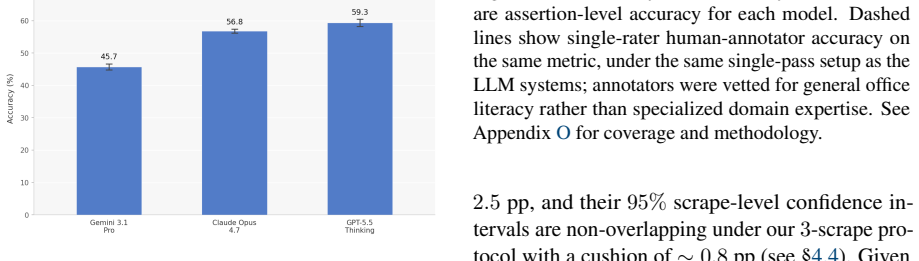
Pith's one-line read Even the strongest frontier LLMs reach only 59.3 percent on expert-level reasoning over real office documents.
desk verdict OCB is a genuinely new benchmark for native office files with useful releases, but the LLM judge scoring lacks the validation needed to trust the headline numbers. read the letter →
The pith
A machine-rendered reading of the paper's core claim, the machinery that carries it, and where it could break.
The reading
What carries the argument
Office Comprehension Bench with its two tracks and atomic-claim scoring by an LLM-judge ensemble
What would settle it
A new model scoring well above 59.3 percent on Domain Q&A under the same atomic-claim evaluation, or human raters showing large systematic disagreement with the LLM judge ensemble on the same set of responses.
Extended reading notes
Core claim
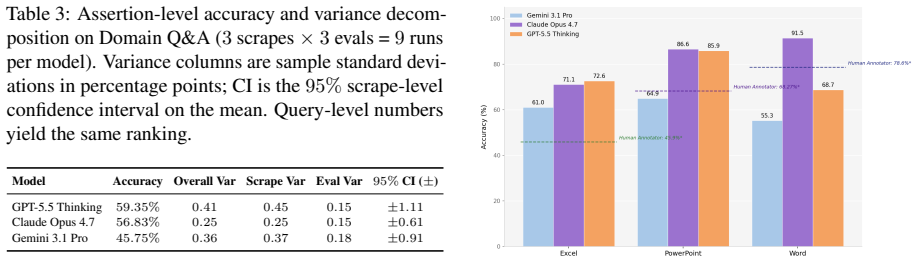
The Office Comprehension Bench is the first public benchmark for LLM comprehension of Word, Excel, and PowerPoint over native file formats. It consists of File Fidelity Q&A for structural and visual perception of office artifacts and Domain Q&A for expert-level reasoning grounded in real-world documents across 12 professional domains. Each reference answer is decomposed into atomic, binary-gradable claims scored independently by an ensemble of LLM judges. Even the strongest frontier system reaches only about 59.3 percent on Domain Q&A.
Load-bearing premise
The ensemble of LLM judges produces reliable, unbiased scores when evaluating model responses against independently scored atomic claims derived from reference answers.
Editorial extensions
If this is right
- Increasing thinking depth within a model tier does not move Domain Q&A performance materially.
- Moving to a higher product tier yields only modest gains on domain reasoning.
- Current systems still have large gaps on multi-step synthesis across native office artifacts.
- The public dataset, tooling, and leaderboard enable standardized tracking of progress on office file comprehension.
Reading between the lines
- Specialized parsing or embedding layers for binary office formats may be needed to close the remaining gap.
- The atomic-claim decomposition method could transfer to benchmarks for other structured document types.
- The modest tier gains suggest that raw scale or inference budget alone will not solve the comprehension limits observed.
Signed reviews
Editorial analysis
A structured set of objections, weighed in public.
Referee Report
Summary. The paper introduces the Office Comprehension Benchmark (OCB), the first public benchmark for LLM evaluation on native Word, Excel, and PowerPoint files (.docx, .xlsx, .pptx). It defines two tracks—File Fidelity Q&A for structural and visual perception of document elements and Domain Q&A for expert-level multi-step reasoning across 12 professional domains—where reference answers are decomposed into atomic binary claims scored independently by an ensemble of LLM judges. The central empirical claim is that even the strongest frontier system reaches only 59.3% on Domain Q&A in default mode, with negligible gains from increased thinking depth within a tier and only modest gains from higher product tiers. The dataset, evaluation tooling, judge prompt, and leaderboard are released.
Significance. If the judge pipeline proves reliable, OCB would be a valuable addition to the field by exposing concrete limitations in current LLMs' handling of complex, multi-document office reasoning tasks. The explicit release of the full dataset, tooling, judge prompt, and public leaderboard is a clear strength that supports reproducibility and follow-on work.
major comments (1)
- [Abstract / Evaluation pipeline description] The 59.3% Domain Q&A result and the claims about reasoning depth versus tier effects are produced by decomposing references into atomic claims and scoring via an LLM judge ensemble. No human calibration data, inter-judge agreement statistics, or ablation on judge model choice or prompt variants are reported, making the headline numbers and downstream conclusions load-bearing on an unvalidated component of the evaluation pipeline.
Simulated Author's Rebuttal
We thank the referee for highlighting a key aspect of our evaluation pipeline. We address the major comment below and will incorporate the requested validations in the revised manuscript.
read point-by-point responses
-
Referee: [Abstract / Evaluation pipeline description] The 59.3% Domain Q&A result and the claims about reasoning depth versus tier effects are produced by decomposing references into atomic claims and scoring via an LLM judge ensemble. No human calibration data, inter-judge agreement statistics, or ablation on judge model choice or prompt variants are reported, making the headline numbers and downstream conclusions load-bearing on an unvalidated component of the evaluation pipeline.
Authors: We agree that the LLM judge ensemble is a load-bearing component of the reported results and that the submitted manuscript lacks explicit validation of this pipeline. In the revised version we will add a dedicated subsection under Evaluation Methodology that reports: (1) human calibration results on a stratified sample of 250 atomic claims (with inter-annotator agreement and agreement with the judge ensemble), (2) pairwise and ensemble-level agreement statistics (percentage agreement and Fleiss’ kappa), and (3) ablation tables comparing judge performance across model families and prompt variants. These additions will directly support the 59.3 % Domain Q&A figure and the reasoning-depth versus tier conclusions. We have already begun the human annotation effort and expect to complete it within the revision window. revision: yes
Circularity Check
No circularity: empirical benchmark with independent evaluation pipeline
full rationale
The paper introduces an empirical benchmark (OCB) and reports performance numbers obtained by decomposing reference answers into atomic claims and scoring via an LLM judge ensemble. No mathematical derivations, equations, fitted parameters, or predictions appear in the provided text. No self-citations are invoked as load-bearing premises, and the central claims (e.g., 59.3% Domain Q&A) are direct empirical outputs rather than reductions by construction to the paper's own inputs. The work is self-contained as a benchmark release against external model evaluations.
Assumptions & free parameters
Cite this review
Pith. "Pith review of Office Comprehension Benchmark." pith.science (2026). https://pith.science/paper/LIWMYURY
@misc{pith2026260701245,
  author       = {Pith},
  title        = {Pith review of: Office Comprehension Benchmark},
  year         = {2026},
  howpublished = {\url{https://pith.science/paper/LIWMYURY}},
  note         = {Machine review of arXiv:2607.01245}
}
read the original abstract
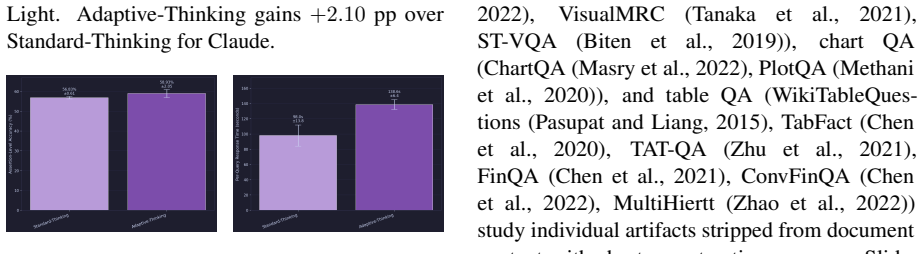
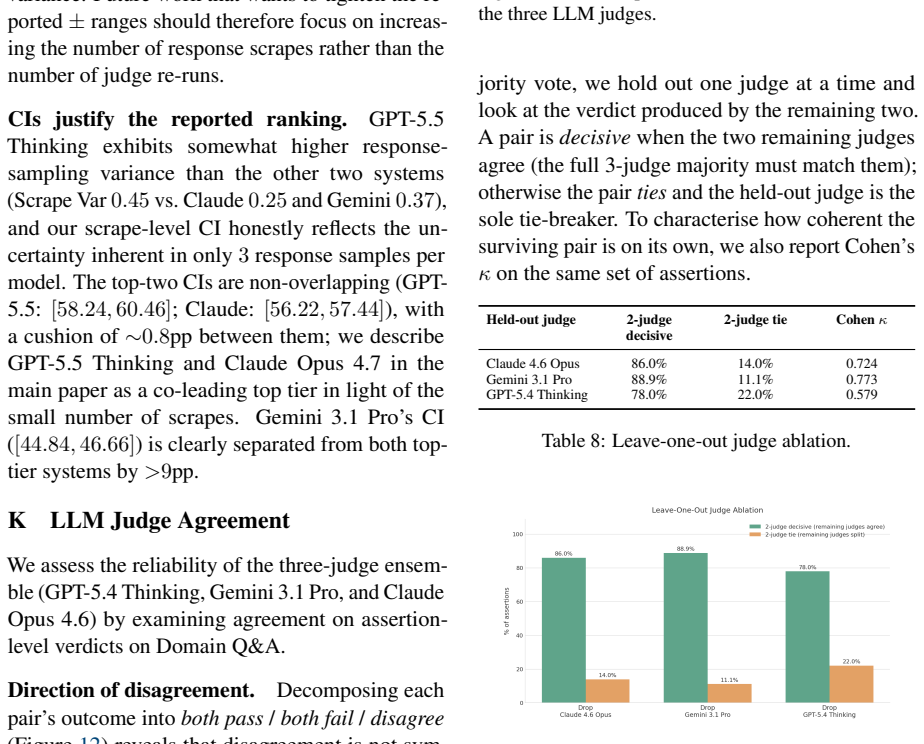
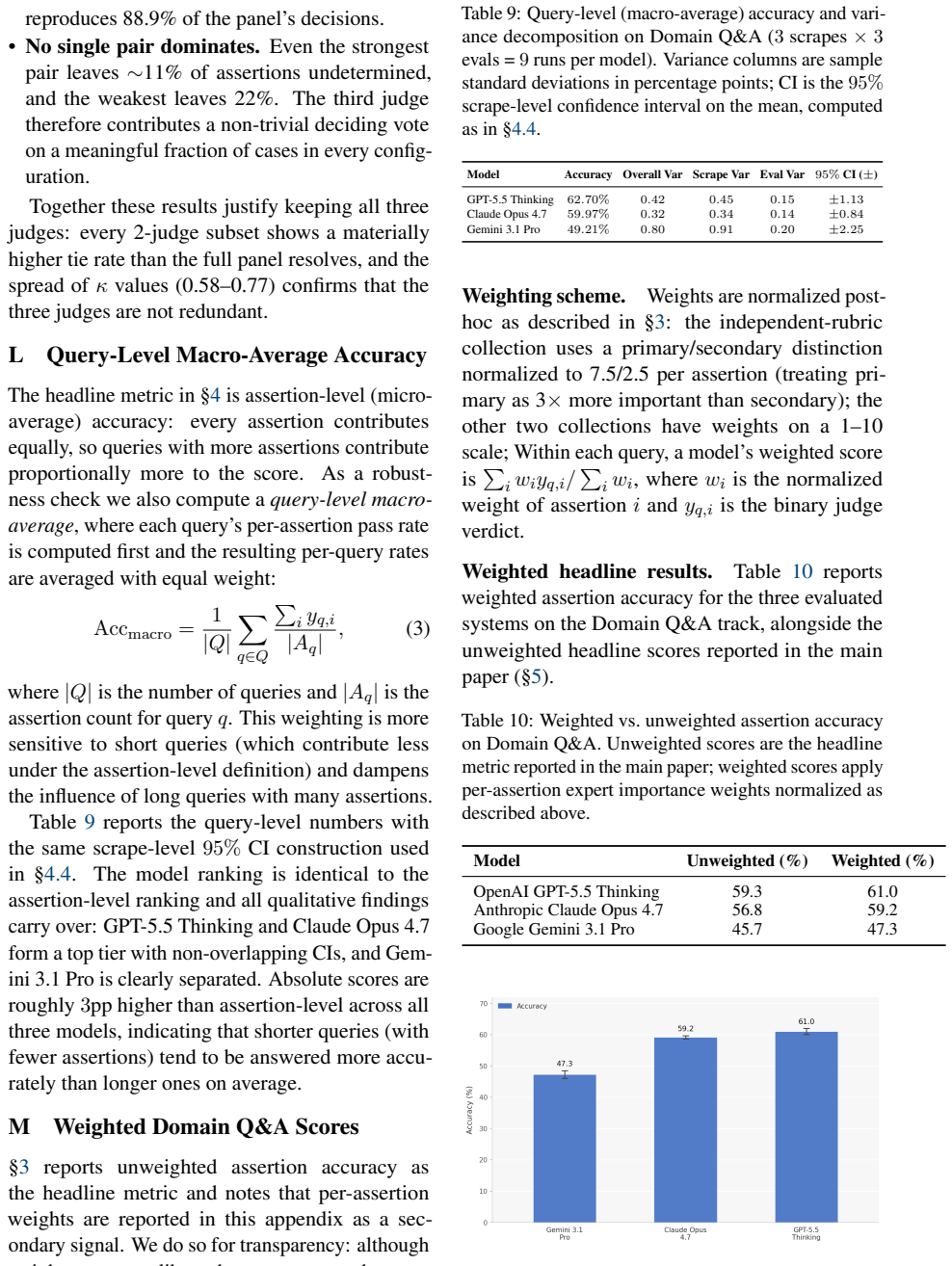
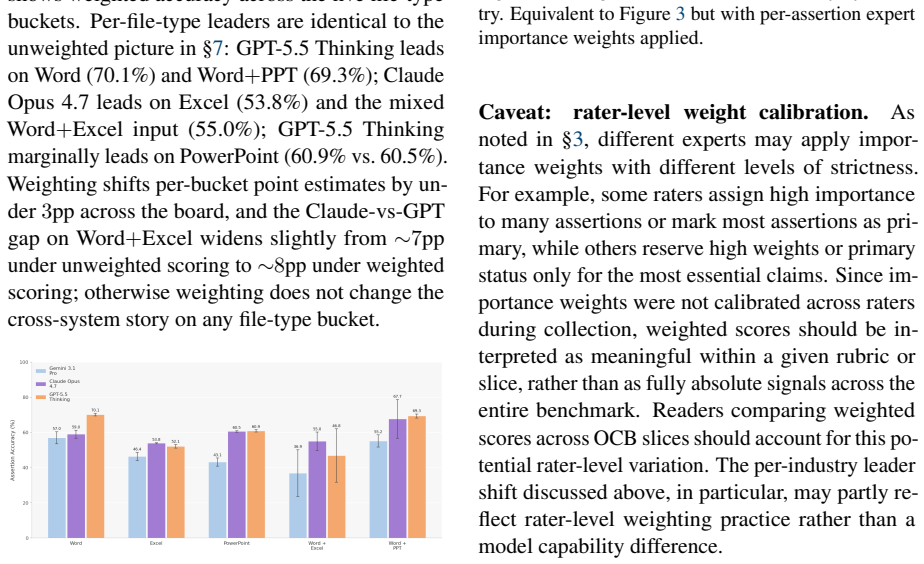
We introduce Office Comprehension Bench (OCB), the first public benchmark to jointly evaluate LLM systems on Word, Excel, and PowerPoint comprehension over native file formats (.docx, .xlsx, .pptx) and their variants. OCB consists of two tracks. File Fidelity Q&A tests structural and visual perception of office artifacts - tables, charts, embedded images, formulas, and app-specific elements such as headers, speaker notes, and named ranges. Domain Q&A tests expert-level reasoning grounded in real-world industry documents across 12 professional domains, with queries requiring multi-step analysis and synthesis across documents. Each reference answer is decomposed into atomic, binary-gradable claims, and an ensemble of LLM judges scores responses against each claim independently. Even the strongest frontier system in its default reasoning mode reaches only about 59.3% on Domain Q&A; increasing thinking depth within a tier does not move performance materially, while moving to a higher product tier yields modest gains. We release the dataset, evaluation tooling, judge prompt, and a public leaderboard.
Figures

Figures from the paper (14 more)






Reference graph
Works this paper leans on
-
[1]
Dan Hendrycks, Collin Burns, Anya Chen, and Spencer Ball
LegalBench: A collaboratively built benchmark for measuring legal reasoning in large language models.Ad- vances in neural information processing systems, 36:44123– 44279. Dan Hendrycks, Collin Burns, Anya Chen, and Spencer Ball
-
[2]
FinanceBench: A New Benchmark for Financial Question Answering
Cuad: An expert-annotated nlp dataset for legal con- tract review.Advances in Neural Information Processing Systems. Pranab Islam, Anand Kannappan, Douwe Kiela, Rebecca Qian, Nino Scherrer, and Bertie Vidgen. 2023. Fi- nancebench: A new benchmark for financial question an- swering.arXiv preprint arXiv:2311.11944. Yuta Koreeda and Christopher D Manning. 20...
work page Pith review arXiv 2023
-
[3]
Adding Error Bars to Evals: A Statistical Approach to Language Model Evaluations
Docvqa: A dataset for vqa on document images. InProceedings of the IEEE/CVF Winter Conference on Applications of Computer Vision (WACV). Nitesh Methani, Pritha Ganguly, Mitesh M. Khapra, and Pratyush Kumar. 2020. PlotQA: Reasoning over scientific plots. InProceedings of the IEEE/CVF Winter Confer- ence on Applications of Computer Vision (WACV), pages 1527...
work page Pith review arXiv 2020
-
[4]
Hierarchical multimodal transformers for multi-page docvqa.Pattern Recognition, 144:109834. Jordy Van Landeghem, Rubèn Tito, Łukasz Borchmann, Michał Pietruszka, Pawel Joziak, Rafal Powalski, Dawid Jurkiewicz, Mickaël Coustaty, Bertrand Anckaert, Ernest Valveny, and 1 others. 2023. Document understanding dataset and evaluation (DUDE). InProceedings of the...
work page Pith review arXiv 2023
-
[5]
TAT-QA: A question answering benchmark on a hybrid of tabular and textual content in finance. InPro- ceedings of the 59th annual meeting of the Association for Computational Linguistics and the 11th international joint conference on natural language processing (volume 1: long papers), pages 3277–3287. Fengbin Zhu, Ziyang Liu, Xiang Yao Ng, Haohui Wu, Wenj...
-
[6]
Model revenue, EBITDA, D&A, EBIT, tax, net income, capex, de- preciation, integration costs (cash vs
Calculate HealthDataCo’s standalone Free Cash Flow for 2024, then build a projection of Free Cash Flow pro forma with synergies for 2025–2027. Model revenue, EBITDA, D&A, EBIT, tax, net income, capex, de- preciation, integration costs (cash vs. non- cash), working capital (using AR, AP, in- ventory), and free cash flow. Present free cash flow as a simple ...
work page 2024
-
[7]
Model recursive interest expense (interest based on average debt balance)
Layer in debt funding: $3B new debt at IQVIA’s weighted average interest rate. Model recursive interest expense (interest based on average debt balance). Show im- pact on net income. Use IQVIA’s FY2024 effective tax rate for the interest tax shield; keep the 25% tax rate for HealthDataCo operating taxes
-
[8]
Compute ROIC (2027) as NOPAT (2027) divided by average invested capital across 2026–2027. Define invested capital as $6,000M plus the working-capital balance tied to revenue synergies (cumulative). Ex- clude goodwill and any debt tax shield. Cal- culate EV A (2027) using WACC = 8.0% and the same average invested capital used for ROIC.” Source file.IQVIA H...
work page 2027
Show all 30 references
-
[9]
Interpret the context of the <assertion> based on the <question> provided
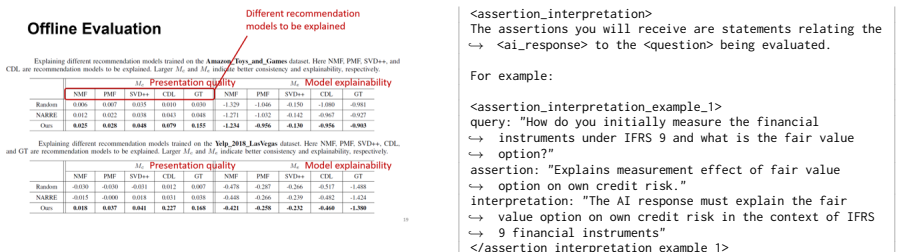
Read the <question>, <ai_response> and <assertion> provided thoroughly. Interpret the context of the <assertion> based on the <question> provided. Make sure you understand what needs the ground truth from the assertion that needs to be evaluated. ,→ ,→ ,→ ,→
-
[10]
Analyze the <ai_response> and locate evidence relevant to the <assertion>, either to support or refute it.,→
-
[11]
Analyze the <question> and locate the relevant context that qualifies the <assertion> in order to clarify its requirement. ,→ ,→
-
[12]
response should contain at least X out of Y conditions
Evaluate the <assertion> based on the evidence you identified.,→ - Consider partial fulfillment: if the <ai_response> meets some but not all criteria, requirements or expectations in the <assertion>, check if the <assertion> allows for partial correctness (e.g., "response shou...
-
[13]
Compose your reasoning using the following structure xml-like structure:,→ <assertion> Restate the <assertion> verbatim as provided </assertion> <interpretation> Interpretation of the assertion in the context of the <question> asked as a single statement.,→ </interpretation> <...
-
[14]
reasoning
Fill in the final output as a valid JSON object (without markdown code blocks) with your reasoning and score. Only valid JSON is allowed in the output. ,→ ,→ </reasoning_instructions> <output> { "reasoning": "Structured explanation as described above",,→ "score": "0 if assert ...
2021
-
[15]
Sources span SEC filings, slide decks, spread- sheets, and operational documents
Source curation.Domain practitioners select or compile authoritative source documents that a qualified professional would consult. Sources span SEC filings, slide decks, spread- sheets, and operational documents
-
[16]
Each Q&A is au- thored by 2-3 domain experts
Question and answer authoring.Experts draft realistic prompts grounded in the source documents and produce reference answers that a qualified practitioner would recognize as correct and complete. Each Q&A is au- thored by 2-3 domain experts
-
[17]
Rubric construction.Each Q&A pair is paired with a rubric composed of atomic as- sertions - single, verifiable claims that a cor- rect response should satisfy. We use multi- ple authoring approaches: rubrics authored independently of the reference answer (captur- ing what any ...
-
[18]
Model evaluation against these rubrics is not part of the construction pipeline; it is the downstream evaluation procedure described in §4
Quality assurance.A separate reviewer, dis- tinct from the original prompt and rubric au- thors, verifies prompt construction, rubric de- sign, and consistency across items. Model evaluation against these rubrics is not part of the construction pipeline; it is the downstream e...
-
[19]
The LLM output a structured flag set (e.g., {compound: true, ambiguous: false, ...}) and a brief justification per flag
Automated triage.Every candidate asser- tion was scored by a frontier LLM along the failure-mode dimensions enumerated below. The LLM output a structured flag set (e.g., {compound: true, ambiguous: false, ...}) and a brief justification per flag. We did not act on these flags ...
-
[20]
Expert decision.A domain expert (the rubric author or a peer reviewer) examined each flagged assertion and selected one of:keep (false positive),modify(rewrite for clarity or specificity),split(decompose a compound assertion into multiple atomic ones),merge (collapse parallel ...
-
[21]
Rubrics typically required two to three loop iterations to stabilize
Cross-check.An independent reviewer re- ran the automated triage on the revised rubric and resolved any remaining flags. Rubrics typically required two to three loop iterations to stabilize. E.2 Failure mode taxonomy with examples Examples below are drawn from real rubrics acr...
-
[22]
Skip anything,→ that requires inference
Identify facts explicitly stated in the document (timelines, named,→ entities, roles, system features, numeric values). Skip anything,→ that requires inference
-
[23]
Generate up to {{QUESTIONS_PER_CHUNK}} high-quality questions.,→ Prioritize questions that: - Are unambiguous with clear scope - Are answerable from the provided text alone - Target high-value content: KPIs, financial figures, technical,→ specifications, research findings, act...
-
[24]
qas": []}. </restrictions> <output> {
For each question, draft three candidate answers: - Detailed: thorough explanation with context - TL;DR: concise factual one-liner - Balanced: key fact plus brief rationale Reconcile via majority vote. Final answer is short (one sentence,→ or a few words). </task> <restriction...
-
[25]
Fig. 3",
atomic answers tied to specific visual content. Each pair is emitted in two question forms (with and without an explicit figure reference) to support both retrieval-style and reading-comprehension- style framings downstream. <role> You generate vision-grounded QA pairs for ima...
-
[26]
______",
Subject text must be meaningful. If a fact references placeholder,→ content ("______", "..."), describe the element by purpose ("the,→ signature line", "the location number field") rather than quoting,→ the placeholder
-
[27]
red" not
Color answers must be human-readable names, not hex codes ("red" not "#FF0000")
-
[28]
Skip low-value facts: CUSTOM_PROPERTY entries (SharePoint metadata,,→ ContentTypeId) and trivial hyperlinks where the URL matches the,→ display text
-
[29]
CORE_PROPERTY metadata (author, title, created date) and hyperlinks where the URL meaningfully differs from display text,→ are in scope
-
[30]
What is the largest font size used,→ in the document?
Comparative or aggregate questions are encouraged when multiple,→ related facts support them ("What is the largest font size used,→ in the document?"). </quality_rules> <output> { "qas": [ { "question": "...", "answer": "...", "question_type": "<one of the types above>", "fact...
2024
Reviewed July 4, 2026 · model on record in the stance chip above.
Discussion (0). Continue with ORCID to comment.