REVIEW 3 major objections 4 minor 78 references
Semantics-aware Predictive Inspection Path Planning
T0 review · 3 major / 4 minor · reviewed 2026-08-07 · deepseek-v4-flash
Pith's one-line read Inspection robots that detect repeated object layouts in a scene graph and predict where those objects lie in unexplored space finish 25–60% faster in simulation and up to 23% faster in real ballast tanks, with equal or better coverage.
desk verdict Solid engineering contribution with genuine field validation, but the headline 23% gain rests on a selective metric; total mission times say 12–19%. read the letter →
The pith
A machine-rendered reading of the paper's core claim, the machinery that carries it, and where it could break.
The reading
What carries the argument
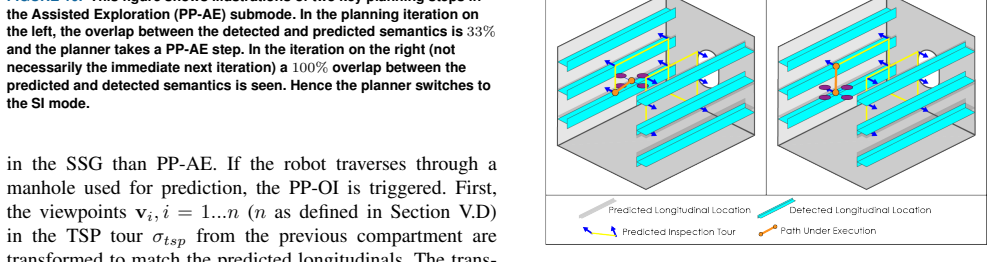
The load-bearing machinery is the pair of a scene-graph pattern detector and prediction-anchored planning. The scene graph is a directed graph whose vertices are the mission-relevant objects together with their 3D poses and bounding boxes. Pattern detection extends SUBDUE, a graph-mining algorithm that finds a repeated substructure by the compression it achieves under the Minimum Description Length principle, with pose-aware inexact graph matching in which a rigid 3D alignment computes a pose cost $C_P$ between corresponding vertices, and with degree-scaled transformation costs $\gamma_{d,i}=1+\eta/\eta_{\max}$ that penalize mismatches at high-degree vertices such as compartments. Graph prediction treats manholes as entry vertices, inserts complementary entry vertices so the substructure can be fitted at loose entry vertices, and scores candidate fits by bounding-box overlap with the existing graph. Planning then exploits the prediction: the PP-AE submode replaces the volumetric information gain with $\Upsilon_{AE}(\nu_j)=(\alpha+\delta)\Upsilon_S(\nu_j)+(1-\alpha)\Upsilon_{VE}(\nu_j)$, where $\alpha$ is the overlap ratio between detected and predicted longitudinals, while the PP-OI submode transforms the previous compartment's TSP viewpoint tour to the predicted coordinates and follows it so long as the expected objects are detected.
What would settle it
Build or simulate a ballast tank whose compartments deliberately violate the detected substructure, for instance by rotating the longitudinals by 90 degrees or shifting them to positions the pattern cannot fit, and compare the per-compartment inspection time of PP-AE, PP-OI, and the non-predictive baseline; if the central claim is right only under regularity, the predictive submodes should lose most of their margin and possibly fall below the baseline in those compartments. The paper's own ablation, which removes one longitudinal per compartment, shows only a small degradation, so the distinguishing test is a spatial rearrangement rather than a missing instance.
Extended reading notes
Core claim
The central claim is that semantically structured environments are predictable, and that a planner which predicts instead of purely exploring can inspect them far more efficiently. Concretely, the paper argues that the scene graph of a partly mapped ballast tank contains enough structure to detect the repeating spatial arrangement of longitudinals, walls, compartments, and manholes, and that the detected substructure can be anchored to loose entry vertices at manholes so the graph extends into unseen compartments. On the planning side, the paper claims that its two predictive submodes convert those predicted locations into action: PP-AE biases the exploration information gain toward predicted semantic regions until the detected objects overlap the predicted ones by a threshold, while PP-OI reuses the previous compartment's viewpoint tour, transformed to the predicted longitudinal locations, and follows it as long as the expected objects are actually detected. The evidence offered is the 25–60% inspection-time improvement over the baselines in two simulated environments, the limited degradation of the gain when up to five compartments are missing a longitudinal, and the up-to-23% improvement over the non-predictive semantics-aware baseline in six real-world missions across two ships.
Load-bearing premise
The entire time saving rests on the assumption that the unexplored parts of the environment continue the same spatial arrangement of the objects of interest as the parts already mapped, so the predicted object locations really exist.
Editorial extensions
If this is right
- In environments with repetitive semantics, inspection time per compartment drops by 25–38% relative to a semantics-aware non-predictive baseline in simulation, and by up to 23% in field tests on real ships, without sacrificing semantic surface coverage.
- PP-OI is the faster submode when patterns repeat nearly exactly, whereas PP-AE's overlap-ratio mechanism keeps it effective when predictions are loose, so the regularity observed in the scene graph can guide the choice between them.
- The modified pattern detector finds the correct substructure even when up to 31.25% of its instances are imperfect, a regime where the original algorithm mis-groups high-level vertices, which makes prediction usable with noisy real-world perception.
- Removing one longitudinal from up to five compartments erodes only a few seconds of the per-compartment gain, and both predictive submodes still beat the non-predictive baseline by more than 25% in inspection time.
- All planning, pattern detection, and prediction run onboard a 1.45 kg collision-tolerant aerial robot, so the paradigm needs no off-board computation during the mission.
Reading between the lines
- The paradigm should transfer to any environment assembled from near-identical spatial modules, such as factory piping, warehouse racks, or tunnel arches, provided a detectable entry structure exists; the paper's factory-pipe simulation is its own first step in that direction.
- The paper notes that its pattern detection currently ignores detection probabilities and earlier predictions; a probabilistic extension with confidence tracking over detected patterns could decide when to trust, re-check, or abandon a prediction mid-mission.
- The reported per-compartment times for the predictive submodes count only the compartments where prediction was actually exploited, so the mission-level gain depends on the share of the environment that is pattern-regular, and the headline improvement would shrink in tanks with many irregular compartments.
- A natural next step the paper leaves open is active pattern search: planning trajectories that deliberately gather evidence for or against a suspected repeating substructure, rather than waiting for the pattern to appear passively in the scene graph.
Editorial analysis
A structured set of objections, weighed in public.
Referee Report
Summary. The paper proposes "Semantics-aware Predictive Planning" (SPP), a paradigm that detects spatially repeating patterns of semantic objects in a Semantic Scene Graph (SSG), predicts how the graph extends into unseen space, and exploits those predictions in two inspection planning modes: Assisted Exploration (PP-AE) and Opportunistic Inspection (PP-OI). The method is evaluated in simulation against Baseline, GVI, GBPlanner, and FUEL, with an additional ablation study for missing semantics, and in field experiments aboard two ships using a collision-tolerant aerial robot. The authors claim up to 23% inspection-time improvement over a semantics-aware Baseline in the field and 25–60% improvement over the baselines in simulation, while maintaining equal or better semantic surface coverage.
Significance. The underlying idea is novel and practically motivated: exploiting repeated semantic structure in industrial environments such as ship ballast tanks is a sensible route to faster inspection, and the paper provides a fairly complete algorithmic pipeline, including SSG construction, pattern detection via an extended SUBDUE algorithm, graph prediction, and two planning strategies. The release of source code, the inclusion of simulation and field experiments, and the ablation for missing semantics are strengths that make the contributions checkable. However, the central quantitative claim is currently supported by an asymmetric evaluation metric: inspection time for the predictive modes is reported only for compartments in which prediction was used, while baselines are averaged over all compartments. This inflates the reported improvements and must be corrected before the paper's headline claims can be accepted.
major comments (3)
- [§VI.A, Table 2 and metric definition] The 'Inspection time per compartment / room' metric is applied asymmetrically. The text explicitly states that for PP-AE and PP-OI only the compartments/rooms in which the respective submode was used are accounted for, while the Baseline, GVI, GBPlanner, and FUEL are averaged over all compartments/rooms. Since the predictive submodes are triggered only after initial non-predictive exploration in the field tests, and likely also after several non-predictive compartments in simulation, this choice systematically favors the proposed method and makes the reported 25–60% improvements non-comparable. Please report, for every method, the total mission time, the per-compartment time averaged over all compartments, and the number of compartments in which prediction was actually exploited.
- [§VII.B–C, Table 5 and §VII.D] The field-experiment claim of 'up to 23%' improvement over Baseline rests on the same selective window: for PP-AE and PP-OI the per-compartment times are computed only over the last two predictive compartments, whereas the Baseline per-compartment time is averaged over the whole mission. The total mission times reported in the text give a different picture: in Field Deployment 1, PP-AE takes 279 s and PP-OI 258 s versus 318 s for Baseline (12.3% and 18.9% improvements); in Field Deployment 2, PP-AE takes 276 s and PP-OI 267 s versus 314 s for Baseline (12.1% and 15.0% improvements). These total-time numbers, or a full-mission per-compartment metric, should be the basis of the central efficiency claim; as it stands, the 'up to 23%' claim is not supported by an apples-to-apples comparison.
- [§VI.A, Table 2] The text says that five missions are conducted for each planner in both simulation environments, but Table 2 reports only a single value per metric with no variance, error bars, or statistical significance testing. Without per-mission results or mean±std values, the reader cannot assess whether the observed differences among PP-AE, PP-OI, and the baselines are meaningful or within run-to-run variability. Please provide the distribution of results over the five runs, or justify why a single representative run is sufficient.
minor comments (4)
- [Abstract and Section I] The URL for the code repository contains spaces in the printed text ('predictive planning ros' instead of 'predictive_planning_ros'); please correct it in the abstract, the introduction, and any other occurrence.
- [§VII.D] The summary states that the Baseline 'uses only the VE and PP-OI modes'; this should read 'VE and SI modes', since the Baseline does not use predictive planning.
- [§VII.B, Mission 1] The phrase 'planed a path towards that viewpoint' should be 'planned a path towards that viewpoint'.
- [§V.C] The text contains the typo 'on the other had' in the description of GBPlanner's local planner; it should be 'on the other hand'.
Circularity Check
No circularity found: the predictive planning claim is an empirical benchmark against a within-paper Baseline and external planners, not a definitional reduction or a fitted-input-as-prediction.
full rationale
The paper's central claim is an empirical engineering comparison. The graph prediction is generated from patterns detected by the modified SUBDUE algorithm using only previously observed semantics, and it is used before the robot enters the unseen compartment; it is not fitted to the mission outcome or to the reported inspection times. The Baseline uses the same VE and SI components as the predictive submodes, so the comparison isolates the effect of the prediction rather than encoding it. The authors' prior works (GBPlanner, GVI, manhole traversal, RMF-Owl, CompSLAM, MPC) appear as system components, but none of these citations is used to justify the efficiency result or to forbid alternative planning choices; the efficiency result is supported by in-paper simulation and field runs against a within-paper Baseline and external planners. The skeptical concern about asymmetrically reporting per-compartment times only for compartments where PP submodes were active is a legitimate evaluation-fairness or statistical-support issue, but it is not a definitional equivalence, a fitted parameter renamed as a prediction, or a self-citation chain that forces the result. Therefore, under the stated circularity criteria, no circular step is exhibited and the circularity score is 0.
Assumptions & free parameters
free parameters (7)
- t_thr (max graph matching cost) =
0.2
- Vertex label substitution cost =
4.0
- gamma_p (pose cost weight) =
1.0
- d_min and d_max =
0.5 m, 4.0 m
- delta (PP-AE bias) =
0.2
- alpha_thr (overlap ratio threshold) =
0.9
- r_C (camera max viewing distance) =
3.0 m (sim) / 1.0 m (field)
assumptions (4)
- domain assumption Industrial environments such as ballast tanks contain spatially repeating arrangements of semantics.
- domain assumption The detected patterns in the seen SSG extend to unseen compartments.
- domain assumption SSG vertices and edges are accurately detected from LiDAR with thresholds n_W_thr, n_Q_thr, n_L_thr.
- domain assumption Collision-free paths and manhole traversal are feasible with the robot.
Cite this review
Pith. "Pith review of Semantics-aware Predictive Inspection Path Planning." pith.science (2026). https://pith.science/paper/LM2UZ3OU
@misc{pith2026250606560,
  author       = {Pith},
  title        = {Pith review of: Semantics-aware Predictive Inspection Path Planning},
  year         = {2026},
  howpublished = {\url{https://pith.science/paper/LM2UZ3OU}},
  note         = {Machine review of arXiv:2506.06560}
}
read the original abstract
This paper presents a novel semantics-aware inspection path planning paradigm called "Semantics-aware Predictive Planning" (SPP). Industrial environments that require the inspection of specific objects or structures (called "semantics"), such as ballast water tanks inside ships, often present structured and repetitive spatial arrangements of the semantics of interest. Motivated by this, we first contribute an algorithm that identifies spatially repeating patterns of semantics - exact or inexact - in a semantic scene graph representation and makes predictions about the evolution of the graph in the unseen parts of the environment using these patterns. Furthermore, two inspection path planning strategies, tailored to ballast water tank inspection, that exploit these predictions are proposed. To assess the performance of the novel predictive planning paradigm, both simulation and experimental evaluations are performed. First, we conduct a simulation study comparing the method against relevant state-of-the-art techniques and further present tests showing its ability to handle imperfect patterns. Second, we deploy our method onboard a collision-tolerant aerial robot operating inside the ballast tanks of two real ships. The results, both in simulation and field experiments, demonstrate significant improvement over the state-of-the-art in terms of inspection time while maintaining equal or better semantic surface coverage. A set of videos describing the different parts of the method and the field deployments is available at https://tinyurl.com/spp-videos. The code for this work is made available at https://github.com/ntnu-arl/predictive_planning_ros.
Figures


Figures from the paper (22 more)




Reference graph
Works this paper leans on
-
[1]
Graph-based subterranean exploration path planning using aerial and legged robots,
T. Dang, M. Tranzatto, S. Khattak, F. Mascarich, K. Alexis, and M. Hutter, “Graph-based subterranean exploration path planning using aerial and legged robots,”Journal of Field Robotics, vol. 37, no. 8, pp. 1363–1388, 2020
2020
-
[2]
A. Agha, K. Otsu, B. Morrell, D. D. Fan, R. Thakker, A. Santamaria- Navarro, S.-K. Kim, A. Bouman, X. Lei, J. Edlundet al., “Nebula: Quest for robotic autonomy in challenging environments; team costar at the darpa subterranean challenge,”arXiv preprint arXiv:2103.11470, 2021
arXiv 2021
-
[3]
A. Bircher, K. Alexis, M. Burri, P. Oettershagen, S. Omari, T. Mantel and R. Siegwart, “Structural inspection path planning via iterative viewpoint resampling with application to aerial robotics,” inIEEE International Conference on Robotics and Automation (ICRA), May 2015, pp. 6423–6430. [Online]. Available: https://github.com/ethz-asl/StructuralInspectionPlanner
work page 2015
-
[4]
Tare: A hierarchical framework for efficiently exploring complex 3d environments
C. Cao, H. Zhu, H. Choset, and J. Zhang, “Tare: A hierarchical framework for efficiently exploring complex 3d environments.” in Robotics: Science and Systems, 2021
work page 2021
-
[5]
Application of robotics in onshore oil and gas industry—a review part i,
A. Shukla and H. Karki, “Application of robotics in onshore oil and gas industry—a review part i,”Robotics and Autonomous Systems, vol. 75, pp. 490–507, 2016
work page 2016
-
[6]
Vertical infrastructure inspection using a quad- copter and shared autonomy control,
I. Sa and P. Corke, “Vertical infrastructure inspection using a quad- copter and shared autonomy control,” inField and service robotics. Springer, 2014, pp. 219–232
work page 2014
-
[7]
C. Gehring, P. Fankhauser, L. Isler, R. Diethelm, S. Bachmann, M. Potz, L. Gerstenberg, and M. Hutter, “Anymal in the field: Solving industrial inspection of an offshore hvdc platform with a quadrupedal robot,” in12th Conference on Field and Service Robotics (FSR 2019), 2019
work page 2019
-
[8]
Highly compact robots for inspection of power plants,
G. Caprari, A. Breitenmoser, W. Fischer, C. H ¨urzeler, F. T ˆache, R. Siegwart, O. Nguyen, R. Moser, P. Schoeneich, and F. Mondada, “Highly compact robots for inspection of power plants,”Journal of Field Robotics, vol. 29, no. 1, pp. 47–68, 2012
work page 2012
Show all 78 references
-
[9]
Towards uav-based bridge inspection systems: A review and an application perspective,
B. Chan, H. Guan, J. Jo, and M. Blumenstein, “Towards uav-based bridge inspection systems: A review and an application perspective,” Structural Monitoring and Maintenance, vol. 2, no. 3, pp. 283–300, 2015
2015
-
[10]
Fast multi-uav decentralized exploration of forests,
L. Bartolomei, L. Teixeira, and M. Chli, “Fast multi-uav decentralized exploration of forests,”IEEE Robotics and Automation Letters, 2023
2023
-
[11]
Cerberus in the darpa subterranean challenge,
M. Tranzatto, T. Miki, M. Dharmadhikari, L. Bernreiter, M. Kulkarni, F. Mascarich, O. Andersson, S. Khattak, M. Hutter, R. Siegwart, and K. Alexis, “Cerberus in the darpa subterranean challenge,”Science Robotics, vol. 7, no. 66, p. eabp9742, 2022
2022
-
[12]
Team cerberus wins the darpa subterranean challenge: Technical overview and lessons learned,
M. Tranzatto, M. Dharmadhikari, L. Bernreiter, M. Camurri, S. Khat- tak, F. Mascarich, P. Pfreundschuh, D. Wisth, S. Zimmermann, M. Kulkarniet al., “Team cerberus wins the darpa subterranean challenge: Technical overview and lessons learned,”arXiv preprint arXiv:2207.04914, 2022
2022 arXiv
-
[13]
Autonomous teamed exploration of subterranean environments using legged and aerial robots,
M. Kulkarni, M. Dharmadhikari, M. Tranzatto, S. Zimmermann, V . Reijgwart, P. De Petris, H. Nguyen, N. Khedekar, C. Papachristos, L. Ott, R. Siegwart, M. Hutter, and K. Alexis, “Autonomous teamed exploration of subterranean environments using legged and aerial robots,” in2022 ...
2022
-
[14]
Heterogeneous ground and air platforms, homogeneous sensing: Team csiro data61’s approach to the darpa subterranean challenge,
N. Hudson, F. Talbot, M. Cox, J. Williams, T. Hines, A. Pitt, B. Wood, D. Frousheger, K. L. Surdo, T. Molnaret al., “Heterogeneous ground and air platforms, homogeneous sensing: Team csiro data61’s approach to the darpa subterranean challenge,”arXiv preprint arXiv:2104.09053, 2021
2021 arXiv
-
[15]
Darpa subterranean challenge: Multi-robotic exploration of underground environments,
T. Rou ˇcek, M. Pecka, P. ˇC´ıˇzek, T. Pet ˇr´ıˇcek, J. Bayer, V . ˇSalansk`y, D. He ˇrt, M. Petrl ´ık, T. B ´aˇca, V . Spurn`yet al., “Darpa subterranean challenge: Multi-robotic exploration of underground environments,” inInternational Conference on Modelling and Simulation ...
2019
-
[16]
Resilient and modular subterranean exploration with a team of roving and flying robots,
S. Scherer, V . Agrawal, G. Best, C. Cao, K. Cujic, R. Darnley, R. DeBortoli, E. Dexheimer, B. Drozd, R. Garg, I. Higgins, J. Keller, D. Kohanbash, L. Nogueira, R. Pradhan, M. Tatum, V . K. Viswanathan, S. Willits, S. Zhao, H. Zhu, D. Abad, T. Angert, G. Armstrong, R. Boirum, ...
2021
-
[17]
Hydra: A real-time spatial perception system for 3D scene graph construction and optimization,
N. Hughes, Y . Chang, and L. Carlone, “Hydra: A real-time spatial perception system for 3D scene graph construction and optimization,” 2022
2022
-
[18]
Foundations of spatial perception for robotics: Hierarchical representations and real-time systems,
N. Hughes, Y . Chang, S. Hu, R. Talak, R. Abdulhai, J. Strader, and L. Carlone, “Foundations of spatial perception for robotics: Hierarchical representations and real-time systems,”The International Journal of Robotics Research, 2024. [Online]. Available: https: //doi.org/10.1...
2024 doi
-
[19]
Scenegraph- fusion: Incremental 3d scene graph prediction from rgb-d sequences,
S.-C. Wu, J. Wald, K. Tateno, N. Navab, and F. Tombari, “Scenegraph- fusion: Incremental 3d scene graph prediction from rgb-d sequences,” inProceedings of the IEEE/CVF Conference on Computer Vision and Pattern Recognition (CVPR), June 2021, pp. 7515–7525
2021
-
[20]
Panoptic multi-tsdfs: a flexible represen- tation for online multi-resolution volumetric mapping and long-term dynamic scene consistency,
L. Schmid, J. Delmerico, J. Sch ¨onberger, J. Nieto, M. Pollefeys, R. Siegwart, and C. Cadena, “Panoptic multi-tsdfs: a flexible represen- tation for online multi-resolution volumetric mapping and long-term dynamic scene consistency,” in2022 IEEE International Conference on Ro...
2022
-
[21]
Semantic- aware informative path planning for efficient object search using mobile robot,
C. Wang, J. Cheng, W. Chi, T. Yan, and M. Q.-H. Meng, “Semantic- aware informative path planning for efficient object search using mobile robot,”IEEE Transactions on Systems, Man, and Cybernetics: Systems, vol. 51, no. 8, pp. 5230–5243, 2021
2021
-
[22]
Finding things in the unknown: Semantic object- centric exploration with an MA V,
S. Papatheodorou, N. Funk, D. Tzoumanikas, C. Choi, B. Xu, and S. Leutenegger, “Finding things in the unknown: Semantic object- centric exploration with an MA V,” inIEEE International Conference on Robotics and Automation, London, United Kingdom, May 2023
2023
-
[23]
Robotic explo- ration through semantic topometric mapping,
S. Fredriksson, A. Saradagi, and G. Nikolakopoulos, “Robotic explo- ration through semantic topometric mapping,” in2024 IEEE Inter- national Conference on Robotics and Automation (ICRA), 2024, pp. 9404–9410
2024
-
[24]
Semantic belief behavior graph: Enabling autonomous robot inspection in unknown environments,
M. F. Ginting, D. D. Fan, S.-K. Kim, M. J. Kochenderfer, and A. akbar Agha-mohammadi, “Semantic belief behavior graph: Enabling autonomous robot inspection in unknown environments,”
-
[25]
Viplanner: Visual semantic imperative learning for local navigation,
P. Roth, J. Nubert, F. Yang, M. Mittal, and M. Hutter, “Viplanner: Visual semantic imperative learning for local navigation,”2024 IEEE International Conference on Robotics and Automation (ICRA), May 2023
2024
-
[26]
Kimera: an open- source library for real-time metric-semantic localization and mapping,
A. Rosinol, M. Abate, Y . Chang, and L. Carlone, “Kimera: an open- source library for real-time metric-semantic localization and mapping,” in2020 IEEE International Conference on Robotics and Automation (ICRA). IEEE, 2020, pp. 1689–1696
2020
-
[27]
Clio: Real-time task-driven open-set 3d scene graphs,
D. Maggio, Y . Chang, N. Hughes, M. Trang, D. Griffith, C. Dougherty, E. Cristofalo, L. Schmid, and L. Carlone, “Clio: Real-time task-driven open-set 3d scene graphs,”arXiv preprint arXiv:2404.13696, 2024
2024 arXiv
-
[28]
Situational graphs for robot navigation in structured indoor environ- ments,
H. Bavle, J. L. Sanchez-Lopez, M. Shaheer, J. Civera, and H. V oos, “Situational graphs for robot navigation in structured indoor environ- ments,”IEEE Robotics and Automation Letters, vol. 7, no. 4, pp. 9107– 9114, 2022
2022
-
[29]
Semantics-aware exploration and inspection path planning,
M. Dharmadhikari and K. Alexis, “Semantics-aware exploration and inspection path planning,” in2023 IEEE International Conference on Robotics and Automation (ICRA), 2023, pp. 3360–3367
2023
-
[30]
Seek: Semantic reasoning for object goal navigation in real world inspection tasks,
M. F. Ginting, S.-K. Kim, D. D. Fan, M. Palieri, M. J. Kochenderfer, and A. akbar Agha-mohammadi, “Seek: Semantic reasoning for object goal navigation in real world inspection tasks,” inRobotics: Science and Systems, 2024. 26 VOLUME , Semantics−aware P redictive Inspection P a...
2024
-
[31]
V oxblox: Incremental 3d euclidean signed distance fields for on-board mav planning,
H. Oleynikova, Z. Taylor, M. Fehr, R. Siegwart, and J. Nieto, “V oxblox: Incremental 3d euclidean signed distance fields for on-board mav planning,” inIEEE/RSJ International Conference on Intelligent Robots and Systems (IROS), 2017
2017
-
[32]
3d scene graph: A structure for unified semantics, 3d space, and camera,
I. Armeni, Z.-Y . He, J. Gwak, A. R. Zamir, M. Fischer, J. Malik, and S. Savarese, “3d scene graph: A structure for unified semantics, 3d space, and camera,” inProceedings of the IEEE International Conference on Computer Vision, 2019
2019
-
[33]
3-d scene graph: A sparse and semantic representation of physical environments for intelligent agents,
U.-H. Kim, J.-M. Park, T.-j. Song, and J.-H. Kim, “3-d scene graph: A sparse and semantic representation of physical environments for intelligent agents,”IEEE Transactions on Cybernetics, vol. 50, no. 12, pp. 4921–4933, 2020
2020
-
[34]
3d dynamic scene graphs: Actionable spatial perception with places, objects, and humans,
A. Rosinol, A. Gupta, M. Abate, J. Shi, and L. Carlone, “3d dynamic scene graphs: Actionable spatial perception with places, objects, and humans,”Robotics: Science and Systems, 2020
2020
-
[35]
Rmf-owl: A collision-tolerant flying robot for autonomous subterranean exploration,
P. D. Petris, H. Nguyen, M. Dharmadhikari, M. Kulkarni, N. Khedekar, F. Mascarich, and K. Alexis, “Rmf-owl: A collision-tolerant flying robot for autonomous subterranean exploration,” in2022 International Conference on Unmanned Aircraft Systems (ICUAS), 2022, pp. 536– 543
2022
-
[36]
Embodied active domain adaptation for semantic segmentation via informative path planning,
R. Zurbr ¨ugg, H. Blum, C. Cadena, R. Siegwart, and L. Schmid, “Embodied active domain adaptation for semantic segmentation via informative path planning,”IEEE Robotics and Automation Letters, vol. 7, no. 4, pp. 8691–8698, 2022
2022
-
[37]
Dformer: Rethinking rgbd representation learning for semantic segmentation,
B. Yin, X. Zhang, Z. Li, L. Liu, M.-M. Cheng, and Q. Hou, “Dformer: Rethinking rgbd representation learning for semantic segmentation,” arXiv preprint arXiv:2309.09668, 2023
2023 arXiv
-
[38]
Geminifusion: Efficient pixel-wise multimodal fusion for vision trans- former,
D. Jia, J. Guo, K. Han, H. Wu, C. Zhang, C. Xu, and X. Chen, “Geminifusion: Efficient pixel-wise multimodal fusion for vision trans- former,” 2024
2024
-
[39]
Cmx: Cross-modal fusion for rgb-x semantic segmentation with transform- ers,
J. Zhang, H. Liu, K. Yang, X. Hu, R. Liu, and R. Stiefelhagen, “Cmx: Cross-modal fusion for rgb-x semantic segmentation with transform- ers,”IEEE Transactions on Intelligent Transportation Systems, 2023
2023
-
[40]
Rayfronts: Open-set semantic ray frontiers for online scene understanding and exploration,
O. Alama, A. Bhattacharya, H. He, S. Kim, Y . Qiu, W. Wang, C. Ho, N. Keetha, and S. Scherer, “Rayfronts: Open-set semantic ray frontiers for online scene understanding and exploration,” 2025. [Online]. Available: https://arxiv.org/abs/2504.06994
2025 arXiv
-
[41]
An actionable hierarchical scene representation enhancing autonomous inspection missions in unknown environments,
V . K. Viswanathan, M. A. V . Saucedo, S. G. Satpute, C. Kanellakis, and G. Nikolakopoulos, “An actionable hierarchical scene representation enhancing autonomous inspection missions in unknown environments,” 2024. [Online]. Available: https://arxiv.org/abs/2412.19582
2024 arXiv
-
[42]
Hypermap mapping framework and its application to autonomous semantic exploration,
T. Zaenker, F. Verdoja, and V . Kyrki, “Hypermap mapping framework and its application to autonomous semantic exploration,” in2020 IEEE International Conference on Multisensor Fusion and Integration for Intelligent Systems (MFI), 2020, pp. 133–139
2020
-
[43]
Semantically informed next best view planning for autonomous aerial 3d reconstruction,
S. A. Kay, S. Julier, and V . M. Pawar, “Semantically informed next best view planning for autonomous aerial 3d reconstruction,” in2021 IEEE/RSJ International Conference on Intelligent Robots and Systems (IROS), 2021, pp. 3125–3130
2021
-
[44]
Segue: Semantic guided exploration for mobile robots,
C. Simons, A. Samanta, A. K. Roy-Chowdhury, and K. Karydis, “Segue: Semantic guided exploration for mobile robots,” 2025. [Online]. Available: https://arxiv.org/abs/2504.03629
2025 arXiv
-
[45]
Exploration for object mapping guided by environmental semantics using uavs,
R. Ashour, T. Taha, J. M. M. Dias, L. Seneviratne, and N. Almoosa, “Exploration for object mapping guided by environmental semantics using uavs,”Remote Sensing, vol. 12, no. 5, 2020. [Online]. Available: https://www.mdpi.com/2072-4292/12/5/891
2020
-
[46]
Semantic-aware next-best-view for multi-dofs mobile system in search-and-acquisition based visual perception,
X. Yu and C.-W. Chen, “Semantic-aware next-best-view for multi-dofs mobile system in search-and-acquisition based visual perception,”
-
[47]
Asep: An autonomous seman- tic exploration planner with object labeling,
A. Milas, A. Ivanovic, and T. Petrovic, “Asep: An autonomous seman- tic exploration planner with object labeling,”IEEE Access, vol. 11, pp. 107 169–107 183, 2023
2023
-
[48]
Available: https://arxiv.org/abs/2404.16507
[Online]. Available: https://arxiv.org/abs/2404.16507
-
[49]
Adaptive path planning for uavs for multi-resolution semantic segmentation,
F. Stache, J. Westheider, F. Magistri, C. Stachniss, and M. Popovi ´c, “Adaptive path planning for uavs for multi-resolution semantic segmentation,”Robotics and Autonomous Systems, vol. 159, p. 104288, 2023. [Online]. Available: https://www.sciencedirect.com/ science/article/p...
2023
-
[50]
Semantics- aware receding horizon planner for object-centric active mapping,
L. Lu, Y . Zhang, P. Zhou, J. Qi, Y . Pan, C. Fu, and J. Pan, “Semantics- aware receding horizon planner for object-centric active mapping,” IEEE Robotics and Automation Letters, vol. 9, no. 4, pp. 3838–3845, 2024
2024
-
[51]
Active metric-semantic mapping by multiple aerial robots,
X. Liu, A. Prabhu, F. Cladera, I. D. Miller, L. Zhou, C. J. Taylor, and V . Kumar, “Active metric-semantic mapping by multiple aerial robots,” in2023 IEEE International Conference on Robotics and Automation (ICRA), 2023, pp. 3282–3288
2023
-
[52]
An informative path planning framework for active learning in uav-based semantic mapping,
J. R ¨uckin, F. Magistri, C. Stachniss, and M. Popovi ´c, “An informative path planning framework for active learning in uav-based semantic mapping,”IEEE Transactions on Robotics, vol. 39, no. 6, pp. 4279– 4296, 2023
2023
-
[53]
Challenges and opportunities for large-scale exploration with air-ground teams using semantics,
F. Cladera, I. D. Miller, Z. Ravichandran, V . Murali, J. Hughes, M. A. Hsieh, C. J. Taylor, and V . Kumar, “Challenges and opportunities for large-scale exploration with air-ground teams using semantics,” 2024. [Online]. Available: https://arxiv.org/abs/2405.07169
2024 arXiv
-
[54]
Air- ground collaboration with spomp: Semantic panoramic online mapping and planning,
I. D. Miller, F. Cladera, T. Smith, C. J. Taylor, and V . Kumar, “Air- ground collaboration with spomp: Semantic panoramic online mapping and planning,”IEEE Transactions on Field Robotics, pp. 1–1, 2024
2024
-
[55]
Semantic navigation for automated robotic inspection and indoor environment quality monitoring,
D. Hu and V . J. Gan, “Semantic navigation for automated robotic inspection and indoor environment quality monitoring,”Automation in Construction, vol. 170, p. 105949, 2025. [Online]. Available: https: //www.sciencedirect.com/science/article/pii/S092658052400685X
2025
-
[56]
Semantic-aware active perception for uavs using deep reinforcement learning,
L. Bartolomei, L. Teixeira, and M. Chli, “Semantic-aware active perception for uavs using deep reinforcement learning,” in2021 IEEE/RSJ International Conference on Intelligent Robots and Systems (IROS), 2021, pp. 3101–3108
2021
-
[57]
Rsmpnet: Relationship guided semantic map prediction,
J. Sun, J. Wu, Z. Ji, and Y .-K. Lai, “Rsmpnet: Relationship guided semantic map prediction,” in2024 IEEE/CVF Winter Conference on Applications of Computer Vision (WACV), 2024, pp. 302–311
2024
-
[58]
Rspmp: real-time semantic perception and motion planning for autonomous navigation of unmanned ground vehicle in off-road environments
D. Chen, M. Zhuang, X. Zhong, W. Wu, and Q. Liu, “Rspmp: real-time semantic perception and motion planning for autonomous navigation of unmanned ground vehicle in off-road environments.” Applied Intelligence, 2023
2023
-
[59]
Sscnav: Confidence-aware semantic scene completion for visual semantic navigation,
Y . Liang, B. Chen, and S. Song, “Sscnav: Confidence-aware semantic scene completion for visual semantic navigation,” in2021 IEEE International Conference in Robotics and Automation (ICRA), 2021
2021
-
[60]
Learning object relation graph and tentative policy for visual navigation,
H. Du, X. Yu, and L. Zheng, “Learning object relation graph and tentative policy for visual navigation,” inComputer Vision – ECCV
-
[61]
Learning hierarchical rela- tionships for object-goal navigation,
Y . Qiu, A. Pal, and H. I. Christensen, “Learning hierarchical rela- tionships for object-goal navigation,” in2020 Conference on Robot Learning (CoRL), 2020
2020
-
[62]
Spine: Online semantic planning for missions with incomplete natural language specifications in unstructured environments,
Z. Ravichandran, V . Murali, M. Tzes, G. J. Pappas, and V . Kumar, “Spine: Online semantic planning for missions with incomplete natural language specifications in unstructured environments,” 2025. [Online]. Available: https://arxiv.org/abs/2410.03035
2025 arXiv
-
[63]
Visual semantic navigation using scene priors,
W. Yang, X. Wang, A. Farhadi, A. Gupta, and R. Mottaghi, “Visual semantic navigation using scene priors,” inProceedings of (ICLR) International Conference on Learning Representations, May 2019
2019
-
[64]
Seer: Safe efficient exploration for aerial robots using learning to predict information gain,
Y . Tao, Y . Wu, B. Li, F. Cladera, A. Zhou, D. Thakur, and V . Kumar, “Seer: Safe efficient exploration for aerial robots using learning to predict information gain,” in2023 IEEE International Conference on Robotics and Automation (ICRA), 2023, pp. 1235–1241
2023
-
[65]
Predictive exploration consid- ering previously mapped environments,
D. P. Str ¨om, F. Nenci, and C. Stachniss, “Predictive exploration consid- ering previously mapped environments,” in2015 IEEE International Conference on Robotics and Automation (ICRA), 2015, pp. 2761–2766
2015
-
[66]
Learned map prediction for enhanced mobile robot exploration,
R. Shrestha, F.-P. Tian, W. Feng, P. Tan, and R. Vaughan, “Learned map prediction for enhanced mobile robot exploration,” in2019 International Conference on Robotics and Automation (ICRA), 2019, pp. 1197–1204
2019
-
[67]
Holder, D
L. Holder, D. Cook, J. Gonzalez, and I. Jonyer,Structural Pattern Recognition in Graphs. Boston, MA: Springer US, 2002, pp. 255–
2002
-
[68]
Manhole detection and traversal for exploration of ballast water tanks using micro aerial vehicles,
M. Dharmadhikari, P. De Petris, H. Nguyen, M. Kulkarni, N. Khedekar, and K. Alexis, “Manhole detection and traversal for exploration of ballast water tanks using micro aerial vehicles,” in2023 International Conference on Unmanned Aircraft Systems (ICUAS), 2023, pp. 103–109
2023
-
[69]
3d semantic scene completion: A survey,
L. Rold ˜ao, R. de Charette, and A. Verroust-Blondet, “3d semantic scene completion: A survey,”International Journal of Computer Vision, 2022
2022
-
[70]
Incremental sampling-based algorithms for optimal motion planning,
S. Karaman and E. Frazzoli, “Incremental sampling-based algorithms for optimal motion planning,” 2010
2010
-
[71]
Autonomous exploration and general visual inspection of ship ballast water tanks using aerial robots,
M. Dharmadhikari, P. De Petris, M. Kulkarni, N. Khedekar, H. Nguyen, A. E. Stene, E. Sjøvold, K. Solheim, B. Gussiaas, and VOLUME , 27 : K. Alexis, “Autonomous exploration and general visual inspection of ship ballast water tanks using aerial robots,” in2023 21st International...
2023
-
[72]
Fuel: Fast uav exploration using incremental frontier structure and hierarchical planning,
B. Zhou, Y . Zhang, X. Chen, and S. Shen, “Fuel: Fast uav exploration using incremental frontier structure and hierarchical planning,”IEEE Robotics and Automation Letters, vol. 6, no. 2, pp. 779–786, 2021
2021
-
[73]
An effective implementation of the lin–kernighan trav- eling salesman heuristic,
K. Helsgaun, “An effective implementation of the lin–kernighan trav- eling salesman heuristic,”European journal of operational research, vol. 126, no. 1, pp. 106–130, 2000
2000
-
[74]
Model predictive control for trajectory tracking of unmanned aerial vehicles using ros,
M. Kamel, T. Stastny, K. Alexis, and R. Siegwart, “Model predictive control for trajectory tracking of unmanned aerial vehicles using ros,” Springer Book on Robot Operating System (ROS). 28 VOLUME ,
-
[77]
Complementary multi–modal sensor fusion for resilient robot pose estimation in subterranean environments,
S. Khattak, H. Nguyen, F. Mascarich, T. Dang, and K. Alexis, “Complementary multi–modal sensor fusion for resilient robot pose estimation in subterranean environments,” in2020 International Con- ference on Unmanned Aircraft Systems (ICUAS). IEEE, 2020, pp. 1024–1029
2020
-
[279]
Available: https://doi.org/10.1007/978-1-4613-0231-5 10
[Online]. Available: https://doi.org/10.1007/978-1-4613-0231-5 10
-
[2020]
Cham: Springer International Publishing, 2020, pp. 19–34
2020
-
[2024]
Available: https://arxiv.org/abs/2401.17191
[Online]. Available: https://arxiv.org/abs/2401.17191
Reviewed August 7, 2026 · model on record in the stance chip above.
Discussion (0). Sign in to comment.