REVIEW 4 major objections 10 minor 36 references
Long-horizon planning is acquired by world-model CoT and a little clean long data, shaped more reliably by on-policy distillation than sparse RL, and merged only when teachers share compatible patterns.
Reviewed by Pith at T0; open to challenge. T0 means a machine referee read the full paper against a public rubric. the ladder, T0–T4 →
T0 review · grok-4.5
2026-07-31 06:52 UTC pith:MDB2RPOW
load-bearing objection Solid controlled empirical map of multi-turn planning across pretrain/OPD/MOPD; the OPD-vs-GRPO “broader region” claim is partly a dense-vs-sparse confound, and everything stays inside a 100M synthetic gym. the 4 major comments →
The Physics of Multi-Turn Long-Horizon Planning: From Pre-training to Post-training via Single- and Multi-Teacher On-Policy Agentic Distillation
The pith
A machine-rendered reading of the paper's core claim, the machinery that carries it, and where it could break.
Core claim
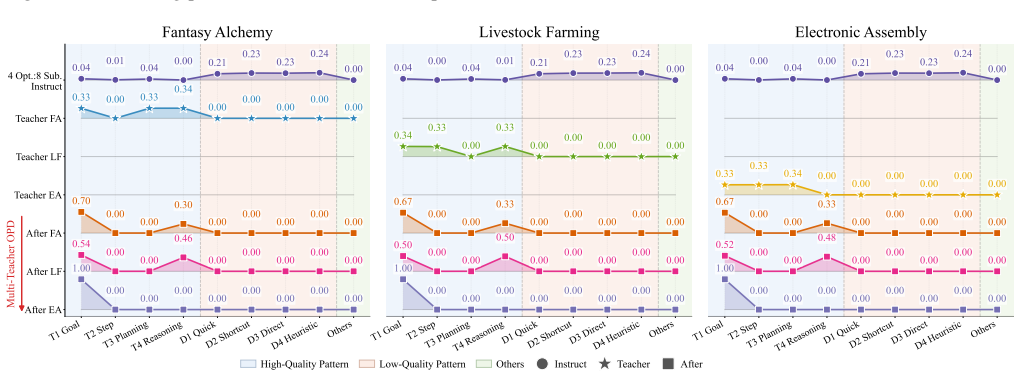
Across pre-training, single-teacher post-training, and multi-teacher consolidation in one controlled multi-turn environment, long-horizon planning is acquired by explicit world-model CoT plus minimal high-quality long-horizon data (atomic skills alone do not compose), shaped over a broader regime by on-policy distillation than by sparse-outcome GRPO when the target is general planning patterns, and integrated by multi-teacher OPD only when teachers share compatible planning-pattern distributions; fully conflicting patterns produce severe cross-environment interference.
What carries the argument
A controllable hierarchical skill-graph gym (AND/OR synthesis rules, short/mid/long horizons, optimal vs suboptimal CoT patterns) paired with the mutual-information split between planning patterns (reusable low-I(T;P) skeletons) and planning knowledge (sample-specific high-I(T;K) procedures), evaluated under GRPO, on-policy distillation (OPD), and cascaded multi-teacher OPD (MOPD).
Load-bearing premise
Findings from tiny randomly initialized models trained only on synthetic toy skill-graph environments will tell us how real foundation models acquire and shape multi-turn planning on opaque internet data and real agent worlds.
What would settle it
Train the same world-model vs direct-action and OPD vs GRPO comparisons on a real multi-turn agent benchmark with natural long-horizon tasks and mixed-quality trajectories; if atomic-skill pre-training alone composes, or if GRPO matches OPD under long noisy horizons, or if MOPD merges fully conflicting domain teachers without interference, the central staged picture fails.
If this is right
- Pre-training mixtures for agents should include explicit state-transition CoT and a non-zero long-horizon fraction; pure short atomic skill data will not yield long-horizon competence.
- Suboptimal trajectories must be filtered or heavily down-weighted for long-horizon agents because early errors amplify and collapse later success.
- Prefer on-policy distillation over sparse-outcome GRPO when pre-training quality is low and horizons are long, provided the teacher’s planning pattern is trustworthy.
- Do not use OPD to force-transfer unseen multi-path procedural knowledge from a mismatched teacher; align world-model recipes first or risk ID collapse.
- Multi-teacher consolidation works when patterns are shared and compatible; when they fully conflict, expect catastrophic forgetting rather than seamless integration.
Where Pith is reading between the lines
- Agent pre-training curricula may need an explicit “composition trigger” stage with sparse long rollouts rather than assuming scale alone composes skills.
- Process-level dense supervision (token or step KL) is likely more load-bearing for long-horizon agents than final-success RL rewards as horizons grow.
- Production multi-expert agent stacks should audit planning-pattern overlap across domains before cascading distillation, or schedule shared-pattern teachers first.
- The pattern/knowledge mutual-information split suggests SFT for recipe injection and RL/OPD mainly for selecting reusable search styles already latent in pre-training.
Editorial analysis
A structured set of objections, weighed in public.
Referee Report
Summary. The paper introduces a synthetic, fully controllable multi-turn planning gym (hierarchical AND/OR skill graphs instantiated in three toy domains) and uses randomly initialized ~100M Qwen2.5-architecture models to study long-horizon planning across three training stages. At pre-training, it reports that explicit world-model CoT outperforms direct action prediction (Fig. 3–4), that atomic skills alone do not compose but ~5% long-horizon data unlocks large gains (Fig. 5, Table 1), and that suboptimal trajectories catastrophically degrade long-horizon performance (Fig. 6). At post-training, it divides planning into low-MI "patterns" and high-MI "knowledge," maps GRPO vs. Top-k OPD into unnecessary/effective/unsupported regions (Fig. 7, Table 3), supports this with SVD gradient-direction and KL analyses (Figs. 9–10, 13–15), and shows mismatched-procedure distillation collapses ID knowledge (Table 4). Finally, it studies cascaded multi-teacher OPD (MOPD) under three pattern-compatibility regimes, finding generalization, continual learning, or interference depending on shared/conflicting templates (Tables 6–7, Figs. 17–21).
Significance. If the results hold, this is a useful controlled testbed contribution: the gym, tokenizer, code, datasets, and checkpoints are all publicly released, the ablation ladders (data ratios, optimal/suboptimal mixes, matched/mismatched recipes, three MOPD regimes) are systematic, and several claims are crisply falsifiable within the environment (e.g., the 5% long-horizon unlock in Table 1, the recipe-mismatch collapse in Table 4). The world-model-vs-direct and minimal-long-horizon-data findings are clean and well-supported. However, the significance is bounded by the setup: all evidence comes from ~100M randomly initialized models with a 3000-token vocabulary trained on counterfactual synthetic rules, so the paper's "physics of planning" framing and its prescriptive takeaways for foundation-model training are extrapolations the experiments do not directly test. The GRPO-vs-OPD and MOPD conclusions additionally rest on design choices (binary reward, ideal teachers, template-frequency measurement) that partly build the conclusions into the experiment.
major comments (4)
- [§5.2.1, Fig. 7, Table 3] The headline claim that 'OPD has a broader effective region than GRPO' is confounded by supervision density, not isolated as an algorithmic property. OPD receives dense token-level KL supervision from a teacher at 100.00 accuracy everywhere (Table 4), while GRPO receives only a binary final-outcome reward (§5.2.1). The 'unsupported region' (Region C) is therefore defined partly by the reward design the authors chose: in the 4 Opt.:8 Sub × long cell, GRPO's −1.58 vs. OPD's +18.59 may demonstrate the value of dense credit assignment rather than an intrinsic applicability boundary of GRPO. A process-reward or step-level-reward GRPO baseline is the natural control and is absent. Compounding this, GRPO is trained for only 75 steps (Fig. 8), with visible entropy collapse in the 4:8 Sub row, and GRPO actually beats OPD on pass@8 in the 4 Opt.:4 Sub mix (+9.4/+11.3/+10.7 vs +3.5/+2.7/+2.4, Table
- [§6.2, Figs. 17–19, Table 6] The central MOPD mechanism — 'MOPD integrates capabilities by converging to shared planning-pattern distributions' — is close to constructed. In Type I, the three teachers are built to share the T1 template by design (§6.2 Task Setup: 'Three expert teachers share one planning template'), planning patterns are operationalized as eight discrete textual templates, and the pattern distribution is measured by template frequency. The finding that sequential distillation converges to T1 at probability 1.00 across all domains (Fig. 18) is then largely a restatement of reverse-KL mode-seeking over a hand-built common mode, not a discovered mechanism. The load-bearing question — does MOPD find shared structure when it is not explicitly planted? — is untested. A control in which the shared template is withheld from one teacher, or in which which-template-is-shared is randomized, would show the effe
- [§5.1, Eq. (10); §5.2.1 region definitions] The mutual-information framing that organizes the entire post-training analysis is never operationalized. I(T;P) < I(T;K) is asserted from intuition ('Due to the abstract and reusable characteristics...') but no estimator, measurement, or even proxy is reported — despite the gym making this estimable (e.g., template entropy vs. recipe-token entropy conditioned on task ID across the corpus). The three applicability regions (unnecessary/effective/unsupported) are then post-hoc labels on observed avg@8 deltas in Fig. 7 rather than regions predicted from measured MI. Since the pattern/knowledge dichotomy and the region taxonomy are among the paper's main conceptual contributions, the authors should either provide an actual MI (or surrogate) analysis supporting the low/high-MI assignment, or present the MI language explicitly as interpretive framing and the regions as descriptive.
- [§1, §8 (framing); §3–4 (setup)] The title and introduction promise a 'physics' of how foundation models acquire long-horizon planning, but every experiment uses randomly initialized ~100M models, a 3000-token BPE vocabulary retrained per chapter (App. A.1), counterfactual synthesis rules, and gold plans capped at 13 steps (Table 11). Several takeaways are stated as prescriptive guidance for real pipelines (e.g., 'Training pipelines need error state prefixes'; 'planning knowledge is better suited for SFT'). The internal results are sound, but the manuscript needs an explicit threats-to-validity discussion: which findings are expected to transfer to internet-scale pre-training and real agent environments, which are gym-specific (e.g., the exact 5% unlock threshold, the 75-step RL dynamics), and at minimum a softening of 'fundamentally improve ... foundation models' claims to match the evidence.
minor comments (10)
- [Abstract/§1] Typos and grammar: 'a litte long-horizon data' (abstract), 'It allows systematically study' (abstract), 'Planning' run together with 'is' in the first line, 'Directi output' in Fig. 2, 'ong-Horizon' in the Fig. 1 header. A careful proofread is needed throughout.
- [Table 1] The long-horizon results are non-monotonic in the data ladder: S/M/L = 100/100/50 gives long avg@8 74.84, but 100/100/100 drops to 68.52, and the middle mean also drops (88.07→85.86). This is unexplained and no variance across seeds is reported anywhere in the paper; please report seed counts and standard deviations, or explain the inversion.
- [§5.2.1, Fig. 8] The entropy collapse visible in the GRPO 4 Opt.:8 Sub row of Fig. 8 is not discussed, though it directly bears on the Region C interpretation (collapse vs. credit-assignment failure). Please add entropy-regularization or KL-control ablations, or discuss.
- [§2.2, Eqs. (2)–(5)] Eq. (2) (Agent-OPD) and Eq. (5) (Full-Vocabulary OPD) are identical; the experiments actually use Top-k OPD with k=100 (§5.2.1). Please state clearly which objective is used where, and avoid overloading K (turn count K in §2.2, top-k K, and evaluation sample count K=8 in §3.3 are three different quantities).
- [App. A.1] The tokenizer is retrained separately per chapter because the corpus varies. Since tokenization affects sequence length and optimization, please confirm that cross-chapter comparisons (e.g., §4 vs. §5 baselines) never rely on absolute loss/token statistics across tokenizers, or quantify the effect.
- [Table 4] Teacher A/B rows report 100.00 for all domains of the evaluated columns but '–' for LF/EA; given that §6 teachers are domain-locked (0.00 out of domain, Table 6), clarify whether the §5.3 teachers are single-domain or multi-domain, and why the 100.00 entries differ from the Table 6 teacher pattern.
- [Table 11] The dataset statistics are numerically identical across the three domains for every split (same sample counts per step length). State explicitly that the generator uses fixed seeds/templates across domains, and discuss whether this determinism affects the generality of the difficulty bins.
- [§5.3, Fig. 11–12] The knowledge-mismatch collapse is shown for a single recipe pair (A vs. B), one domain (FA), and one difficulty (mid). Given that this is a headline claim ('OPD requires aligned procedural knowledge'), at least one additional domain or recipe pair would strengthen it; the current n=1 configuration should be acknowledged.
- [Fig. 3 caption] 'a most total of 11,520 inference runs' should read 'at most'; also state whether the 160 instances per subset are disjoint across checkpoints and whether pass@8/avg@8 use the same 8 samples.
- [§7] The related-work section is thorough, but please add a sentence contrasting with process-reward / step-level credit assignment work for multi-turn RL (e.g., agent PRM lines the authors themselves cite), since that literature is the most direct alternative explanation for the Region C result.
Circularity Check
No significant circularity: empirical systems map of pre-training/RL/MOPD effects in a synthetic gym, not a closed derivation that redefines its target as an input.
full rationale
This paper reports controlled ablation results (world-model CoT vs direct actions; short/mid/long data mixes; optimal vs suboptimal trajectory ratios; GRPO vs OPD deltas; multi-teacher pattern sharing) on randomly initialized ~100M models in a synthetic hierarchical skill-graph environment. Claims are comparative performance measurements (avg@8, pass@8, gradient cosine similarity, pattern histograms), not first-principles predictions forced by fitted constants or self-defined uniqueness. The mutual-information distinction between planning patterns and planning knowledge (§5.1) is conceptual framing that motivates experiments; it does not algebraically force the later region map. The unnecessary/effective/unsupported regions (§5.2, Figure 7) are post-hoc labels for observed performance deltas under horizon × data-quality cells—standard empirical cartography, not a prediction that reduces to its own fit. MOPD Type I/II/III modes are likewise defined by experimental construction of shared vs conflicting pattern supports and then measured. Self-citations (e.g., prior Men et al. agent/reward work) are background, not load-bearing uniqueness theorems. No equation equates a fitted input to a claimed out-of-sample prediction by construction. Skeptic concerns about OPD-vs-GRPO confounds (dense ideal-teacher KL vs binary outcome reward; 75-step budgets) are correctness/identification issues, not circularity. Score 0; steps empty.
Axiom & Free-Parameter Ledger
free parameters (5)
- Long-horizon data fraction ladder (0/5/50/100%) =
e.g. 5% middle/long
- Optimal:suboptimal pattern mix ratios (1 Opt; 4 Opt; 4:4; 4:8) =
4 Opt : 8 Sub highlighted
- Horizon bins (short 1–5, mid 6–8, long ≥9 steps) =
1–5 / 6–8 / 9+
- Model scale and train budget (~100M params, 9000 pretrain steps, OPD/GRPO ~75 steps) =
Qwen2.5-100M; 9000 SFT steps
- Top-k OPD k=100 and evaluation temperature 0.4, K=8 samples =
k=100; temp=0.4; avg@8/pass@8
axioms (5)
- domain assumption A synthetic hierarchical skill-graph gym with counterfactual AND/OR recipes is a valid controlled proxy for studying multi-turn long-horizon planning mechanisms in foundation-model agents.
- ad hoc to paper Planning ability decomposes into low-mutual-information reusable planning patterns versus high-mutual-information task-specific planning knowledge.
- domain assumption On-policy reverse-KL token distillation (Agent-OPD) with an ideal teacher supplies denser, more consistent credit than sparse binary outcome GRPO on long trajectories.
- domain assumption Cascaded single-teacher sequential MOPD is representative of multi-teacher consolidation used in foundation-model pipelines.
- standard math Standard next-token LM training, KL, SVD subspace similarity, and PCA on parameters are appropriate instruments for ‘physics-like’ mechanism claims.
invented entities (3)
-
Controllable Planning Gym (hierarchical skill graphs → multi-turn gym)
no independent evidence
-
Three RL applicability regions (unnecessary / effective / unsupported)
no independent evidence
-
MOPD compatibility modes (shared-compatible, shared-conflict, no-shared-conflict)
no independent evidence
read the original abstract
Multi-turn long-horizon planning is critical for foundation model agents, yet how to fundamentally improve it remains unclear. Existing models are trained on uncontrollable and opaque Internet data, making it difficult to identify how planning ability is acquired, shaped, and integrated. To address this challenge, we introduce a unified and controlled multi-turn environment that enables precise control. It allows systematically study long-horizon planning across three stages. (1) Planning ability acquisition during pre-training. We study data format, distribution, and quality. Explicit world model construction through CoT state transition modeling yields stronger long-horizon generalization. Atomic skills alone are insufficient for compositional generalization, whereas a litte long-horizon data works. Moreover, suboptimal trajectories severely impair performance because errors amplify over long horizons. (2) Planning ability shaping via GRPO and OPD post-training. Through mutual information, we distinguish general planning patterns from task-specific planning knowledge. For planning patterns, we identify three application regions of post-training: unnecessary, effective, and unsupported. OPD has a broader effective region than GRPO under low-quality and long-horizon settings, as it provides more consistent update directions. For planning knowledge, distilling unseen procedures from a teacher with different knowledge may impair student's prior world modeling without fully establishing new knowledge. (3) Planning ability integration through MOPD post-training. We show that multi-teacher on-policy distillation (MOPD) integrates capabilities by converging to shared planning-pattern across environments. Compatible patterns enable cross-environment generalization, partially shared patterns support continual learning, while completely conflicting patterns cause severe interference.
Figures




Reference graph
Works this paper leans on
-
[1]
On-policydistillationoflanguagemodels: Learningfromself-generatedmistakes
Rishabh Agarwal, Nino Vieillard, Yongchao Zhou, Piotr Stanczyk, Sabela Ramos Garea, Matthieu Geist, and Olivier Bachem. On-policydistillationoflanguagemodels: Learningfromself-generatedmistakes. InInternationalConference on Learning Representations, volume 2024, pages 21246–21263,
2024
-
[4]
Pengfei Cao, Tianyi Men, Wencan Liu, Jingwen Zhang, Xuzhao Li, Xixun Lin, Dianbo Sui, Yanan Cao, Kang Liu, and Jun Zhao. Large language models for planning: A comprehensive and systematic survey.arXiv preprint arXiv:2505.19683,
-
[6]
Shengda Fan, Xuyan Ye, Yupeng Huo, Zhi-Yuan Chen, Yiju Guo, Shenzhi Yang, Wenkai Yang, Shuqi Ye, Jingwen Chen, Haotian Chen, et al. Agentprocessbench: Diagnosing step-level process quality in tool-using agents.arXiv preprint arXiv:2603.14465,
-
[7]
Weak-to-strong generalization via direct on-policy distillation.arXiv preprint arXiv:2607.05394,
Shiyuan Feng, Huan-ang Gao, Haohan Chi, Hanlin Wu, Zhilong Zhang, Zheng Jiang, Bingxiang He, Wei-Ying Ma, Ya-Qin Zhang, and Hao Zhou. Weak-to-strong generalization via direct on-policy distillation.arXiv preprint arXiv:2607.05394,
-
[8]
Yuqian Fu, Haohuan Huang, Kaiwen Jiang, Jiacai Liu, Zhuo Jiang, Yuanheng Zhu, and Dongbin Zhao. Revisiting on-policy distillation: Empirical failure modes and simple fixes.arXiv preprint arXiv:2603.25562,
-
[9]
Loris Gaven, Thomas Carta, Clément Romac, Cédric Colas, Sylvain Lamprier, Olivier Sigaud, and Pierre-Yves Oudeyer. Magellan: Metacognitive predictions of learning progress guide autotelic llm agents in large goal spaces.arXiv preprint arXiv:2502.07709,
-
[10]
Co-evolving policy distillation.arXiv preprint arXiv:2604.27083,
Naibin Gu, Chenxu Yang, Qingyi Si, Chuanyu Qin, Dingyu Yao, Peng Fu, Zheng Lin, Weiping Wang, Nan Duan, and Jiaqi Wang. Co-evolving policy distillation.arXiv preprint arXiv:2604.27083,
-
[11]
Minillm: Knowledge distillation of large language models
Yuxian Gu, Li Dong, Furu Wei, and Minlie Huang. Minillm: Knowledge distillation of large language models. In International Conference on Learning Representations, volume 2024, pages 32694–32717,
2024
-
[12]
Reasoning with language model is planning with world model
Shibo Hao, Yi Gu, Haodi Ma, Joshua Jiahua Hong, Zhen Wang, Daisy Zhe Wang, and Zhiting Hu. Reasoning with language model is planning with world model. InThe 2023 Conference on Empirical Methods in Natural Language Processing,
2023
-
[14]
Wenjin Hou, Shangpin Peng, Weinong Wang, Zheng Ruan, Yue Zhang, Zhenglin Zhou, Mingqi Gao, Yifei Chen, Kaiqi Wang, Hongming Yang, et al. Uni-opd: Unifying on-policy distillation with a dual-perspective recipe.arXiv preprint arXiv:2605.03677, 2026a. 33 The Physics of Multi-Turn Long-Horizon Planning Zhenyu Hou, Yujiang Li, Jie Tang, and Yuxiao Dong. Single...
-
[15]
Stable on-policy distillation through adaptive target reformulation
Ijun Jang, Jewon Yeom, Juan Yeo, Hyunggyu Lim, and Taesup Kim. Stable on-policy distillation through adaptive target reformulation. InFindings of the Association for Computational Linguistics: ACL 2026, pages 42217–42227,
2026
-
[16]
Rag-rewardbench: Benchmarking reward models in retrieval augmented generation for preference alignment
Zhuoran Jin, Hongbang Yuan, Tianyi Men, Pengfei Cao, Yubo Chen, Jiexin Xu, Huaijun Li, Xiaojian Jiang, Kang Liu, and Jun Zhao. Rag-rewardbench: Benchmarking reward models in retrieval augmented generation for preference alignment. InFindings of the Association for Computational Linguistics: ACL 2025, pages 17061–17090,
2025
-
[17]
Scaling reasoning efficiently via relaxed on-policy distillation.arXiv preprint arXiv:2603.11137,
Jongwoo Ko, Sara Abdali, Young Jin Kim, Tianyi Chen, and Pashmina Cameron. Scaling reasoning efficiently via relaxed on-policy distillation.arXiv preprint arXiv:2603.11137,
-
[18]
Gengsheng Li, Tianyu Yang, Junfeng Fang, Mingyang Song, Mao Zheng, Haiyun Guo, Dan Zhang, Jinqiao Wang, and Tat-Seng Chua. Unifying group-relative and self-distillation policy optimization via sample routing.arXiv preprint arXiv:2604.02288, 2026a. Jiachun Li, Zhuoran Jin, Tianyi Men, Yupu Hao, Kejian Zhu, Lingshuai Wang, Dongqi Huang, Longxiang Wang, Shen...
-
[19]
https://thinkingmachines.ai/blog/on-policy-distillation
doi: 10.64434/tml.20251026. https://thinkingmachines.ai/blog/on-policy-distillation. Bohan Lyu, Yucheng Yang, Siqiao Huang, Jiaru Zhang, Qixin Xu, Xinghan Li, Xinyang Han, Yicheng Zhang, Huaqing Zhang, Runhan Huang, et al. Mls-bench: A holistic and rigorous assessment of ai systems on building better ai.arXiv preprint arXiv:2605.08678,
-
[20]
Unlocking the future: Exploring look-ahead planning mechanistic interpretability in large language models
Tianyi Men, Pengfei Cao, Zhuoran Jin, Yubo Chen, Kang Liu, and Jun Zhao. Unlocking the future: Exploring look-ahead planning mechanistic interpretability in large language models. InProceedings of the 2024 Conference on Empirical Methods in Natural Language Processing, pages 7713–7724,
2024
-
[21]
Privileged information distillation for language models.arXiv preprint arXiv:2602.04942,
Emiliano Penaloza, Dheeraj Vattikonda, Nicolas Gontier, Alexandre Lacoste, Laurent Charlin, and Massimo Caccia. Privileged information distillation for language models.arXiv preprint arXiv:2602.04942,
-
[22]
Yuxiao Qu, Amrith Setlur, Virginia Smith, Ruslan Salakhutdinov, and Aviral Kumar. Pope: Learning to reason on hard problems via privileged on-policy exploration.arXiv preprint arXiv:2601.18779,
-
[23]
Rl’s razor: Why online reinforcement learning forgets less.arXiv preprint arXiv:2509.04259,
Idan Shenfeld, Jyothish Pari, and Pulkit Agrawal. Rl’s razor: Why online reinforcement learning forgets less.arXiv preprint arXiv:2509.04259,
-
[24]
Self-distillation enables continual learning.arXiv preprint arXiv:2601.19897,
Idan Shenfeld, Mehul Damani, Jonas Hübotter, and Pulkit Agrawal. Self-distillation enables continual learning.arXiv preprint arXiv:2601.19897,
-
[25]
A survey of on-policy distillation for large language models.arXiv preprint arXiv:2604.00626,
Mingyang Song and Mao Zheng. A survey of on-policy distillation for large language models.arXiv preprint arXiv:2604.00626,
-
[26]
Hao Wang, Guozhi Wang, Han Xiao, Yufeng Zhou, Yue Pan, Jichao Wang, Ke Xu, Yafei Wen, Xiaohu Ruan, Xiaoxin Chen, et al. Skill-sd: Skill-conditioned self-distillation for multi-turn llm agents.arXiv preprint arXiv:2604.10674, 2026a. Jianze Wang, Ying Liu, Jinlong Chen, Xuchun Hu, Qilong Zhang, Yu Cao, Jun Wang, Hua Yang, Yong Xie, and Qianglong Chen. Mad-o...
-
[27]
Mimo-v2-flash technical report.arXiv preprint arXiv:2601.02780,
Bangjun Xiao, Bingquan Xia, Bo Yang, Bofei Gao, Bowen Shen, Chen Zhang, Chenhong He, Chiheng Lou, Fuli Luo, Gang Wang, et al. Mimo-v2-flash technical report.arXiv preprint arXiv:2601.02780,
-
[28]
Trust region on-policy distillation.arXiv preprint arXiv:2606.01249,
Xingrun Xing, Haoqing Wang, Boyan Gao, Ziheng Li, and Yehui Tang. Trust region on-policy distillation.arXiv preprint arXiv:2606.01249,
-
[29]
Anyi Xu, Bangcai Lin, Bing Xue, Bingxuan Wang, Bingzheng Xu, Bochao Wu, Bowei Zhang, Chaofan Lin, Chen Dong, Chenchen Ling, et al. Deepseek-v4: Towards highly efficient million-token context intelligence.arXiv preprint arXiv:2606.19348,
-
[30]
Self-distilled rlvr.arXiv preprint arXiv:2604.03128, 2026a
Chenxu Yang, Chuanyu Qin, Qingyi Si, Minghui Chen, Naibin Gu, Dingyu Yao, Zheng Lin, Weiping Wang, Jiaqi Wang, and Nan Duan. Self-distilled rlvr.arXiv preprint arXiv:2604.03128, 2026a. 35 The Physics of Multi-Turn Long-Horizon Planning Wenkai Yang, Weijie Liu, Ruobing Xie, Kai Yang, Saiyong Yang, and Yankai Lin. Learning beyond teacher: Generalized on-pol...
Pith/arXiv arXiv 2025
-
[31]
Lifan Yuan, Weize Chen, Yuchen Zhang, Ganqu Cui, Hanbin Wang, Ziming You, Ning Ding, Zhiyuan Liu, Maosong Sun, and Hao Peng. From𝑓(𝑥) and𝑔(𝑥) to𝑓(𝑔(𝑥)) : Llms learn new skills in rl by composing old ones.arXiv preprint arXiv:2509.25123,
-
[32]
Mengqi Yuan, Zilong Zhou, Xinzhuang Xiong, Weiming Wu, Jiayang Sun, Jiamin Song, Kaiqian Cui, Bowen Wang, Haoyuan Wu, Yitong Li, et al. Osworld2. 0: Benchmarking computer use agents on long-horizon real-world tasks. arXiv preprint arXiv:2606.29537,
-
[33]
Glm-5: from vibe coding to agentic engineering.arXiv preprint arXiv:2602.15763,
Aohan Zeng, Xin Lv, Zhenyu Hou, Zhengxiao Du, Qinkai Zheng, Bin Chen, Da Yin, Chendi Ge, Chenghua Huang, Chengxing Xie, et al. Glm-5: from vibe coding to agentic engineering.arXiv preprint arXiv:2602.15763,
-
[34]
Charlie Zhang, Graham Neubig, and Xiang Yue. On the interplay of pre-training, mid-training, and rl on reasoning language models.arXiv preprint arXiv:2512.07783, 2025a. Kai Zhang, Xiangchao Chen, Bo Liu, Tianci Xue, Zeyi Liao, Zhihan Liu, Xiyao Wang, Yuting Ning, Zhaorun Chen, Xiaohan Fu, et al. Agent learning via early experience.arXiv preprint arXiv:251...
-
[35]
Deyao Zhu, Xin Zhou, Shengling Qin, Xuekai Zhu, Hangliang Ding, Shu Zhong, Zixin Wen, Zhonglin Xie, Chenhui Gou, Linxuan Ren, et al. Edgebench: Unveiling scaling laws of learning from real-world environments.arXiv preprint arXiv:2607.05155, 2026a. Siqi Zhu, Xuyan Ye, Hongyu Lu, Weiye Shi, and Ge Liu. The many faces of on-policy distillation: Pitfalls, mec...
Pith/arXiv arXiv 2048
-
[36]
The row label Category gives the synthetic domain
Table rows follow the file naming convention used by the dataset builder. The row label Category gives the synthetic domain. The row label Split summarizes the recipe split and dataset subset. The token A or B identifies which recipe graph produces the gold trajectory. The token pretrain denotes samples from the pretraining pool, posttrain denotes samples...
2000
-
[2023]
Self-distillation zero: Self-revision turns binary rewards into dense supervision
Yinghui He, Simran Kaur, Adithya Bhaskar, Yongjin Yang, Jiarui Liu, Narutatsu Ri, Liam Fowl, Abhishek Panigrahi, Danqi Chen, and Sanjeev Arora. Self-distillation zero: Self-revision turns binary rewards into dense supervision. arXiv preprint arXiv:2604.12002,
-
[2024]
Lei Bai, Zongsheng Cao, Yang Chen, Zhiyao Cui, Shangheng Du, Yue Fan, Shiyang Feng, Zijie Guo, Haonan He, Liang He, et al. Scaling the horizon, not the parameters: Reaching trillion-parameter performance with a 35b agent.arXiv preprint arXiv:2606.30616,
-
[2025]
Internalizingworldmodelsviaself-playfinetuningforagenticrl.arXivpreprintarXiv:2510.15047,
Shiqi Chen, Tongyao Zhu, Zian Wang, Jinghan Zhang, Kangrui Wang, Siyang Gao, Teng Xiao, Yee Whye Teh, Junxian He, andManlingLi. Internalizingworldmodelsviaself-playfinetuningforagenticrl.arXivpreprintarXiv:2510.15047,
-
[2026]
Yuchen Cai, Ding Cao, Liang Lin, Chunxi Luo, Xin Xu, Kai Yang, Weijie Liu, Saiyong Yang, Tianxiang Zhao, Guangzhong Sun, et al. Learning to foresee: Unveiling the unlocking efficiency of on-policy distillation.arXiv preprint arXiv:2605.11739,
discussion (0)
Sign in with ORCID, Apple, or X to comment. Anyone can read and Pith papers without signing in.