REVIEW 3 major objections 6 minor 2 cited by
REALEDIT: Reddit Edits As a Large-scale Empirical Dataset for Image Transformations
T0 review · 3 major / 6 minor · reviewed 2026-08-09 · deepseek-v4-flash
Pith's one-line read REALEDIT is the first large-scale dataset whose edit requests and finished edits both come from real users; a model trained on it beats existing editors by 165 Elo points in human judgment and by 92% on the VIEScore semantic-consistency…
desk verdict Solid dataset contribution with an overstated headline; the test set and distributional analysis are genuinely useful, but the training-pair fidelity and metric naming need attention. read the letter →
The pith
A machine-rendered reading of the paper's core claim, the machinery that carries it, and where it could break.
The reading
What carries the argument
The load-bearing object is the dataset construction pipeline: each REALEDIT example is a triple of original image, refined instruction, and one to five human-edited output images extracted from Reddit comment threads, where community volunteers actually produce the edits for the requester. Noisy user prose is condensed into a clean instruction by GPT-4o, the 9,300-example test set is manually verified by two annotators (Cohen's Kappa 0.61; 78% accepted), and the training set is aligned to the model's pretraining distribution using the same CLIP-based similarity filtering as InstructPix2Pix plus a structural-similarity (SSIM) threshold. The trained model replaces the Stable Diffusion decoder with the Consistency Decoder at inference for better faces and fine detail. A GPT-4o-built taxonomy of operations (remove, enhance, add, change color, restore, replace, open-ended, formatting) is what quantifies how far real requests sit from the add-dominated synthetic datasets.
What would settle it
Take a random sample of the 48,000 algorithmically filtered training pairs and have independent coders judge whether the posted edited image visibly fulfills the refined instruction, measuring the mismatch rate. A complementary check: train the same model on REALEDIT and evaluate it on real requests gathered from a third, unseen community or from posts made after the dataset's 2021 cutoff; if the 165-point Elo advantage does not persist out-of-distribution, the gain is distributional overlap rather than editing ability.
Extended reading notes
Core claim
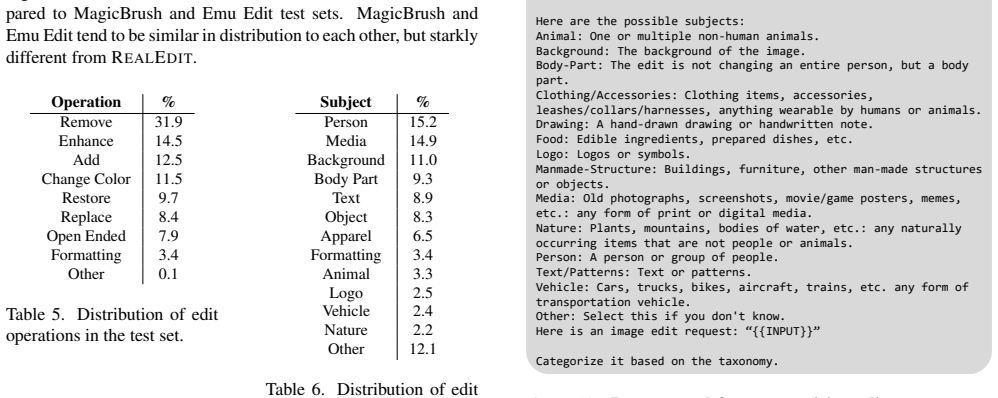
REALEDIT is the first large-scale image editing dataset in which real-world users both submit the edit requests and complete them with human-made edits: over 57,000 examples (48,000 for training, 9,300 manually verified for testing) harvested from r/PhotoshopRequest and r/estoration, totaling 151,000 images. The paper documents that this real distribution differs sharply from synthetic benchmarks — actual requests skew toward remove (31.9%), enhance (14.5%), and restore (9.7%) rather than add, and about 55% of input images center on people — and that existing models (InstructPix2Pix, MagicBrush, Emu Edit, AURORA, HIVE, SDEdit, Null-text Inversion) score poorly on these requests. Fine-tuning an InstructPix2Pix backbone (an instruction-following diffusion editing model) on the filtered REALEDIT training data, with the Stable Diffusion decoder swapped for the Consistency Decoder at inference, yields a model that reaches Elo 1184 in 4,196 human pairwise comparisons (165 points above the next best), a VIEScore semantic-consistency score of 4.61 versus 2.4, and competitive results on the synthetic MagicBrush and Emu Edit test sets. Deployed back on Reddit, the model completes new user requests with positive feedback, and the dataset's human edits improve a deepfake-detection model's F1 by 14 points on in-the-wild images.
Load-bearing premise
The load-bearing premise is that the edited image a Reddit commenter posts under a request faithfully executes the request and that GPT-4o's condensed instruction keeps the user's intent; only the 9,300 test examples were manually verified, while the 48,000 training pairs were filtered by algorithm alone, so widespread mismatched pairs would undercut the training signal behind the reported gains.
Editorial extensions
If this is right
- A model fine-tuned on REALEDIT's 48,000 training examples beats six existing editing models on real user requests by 165 Elo points in human judgment and by 92% relative on the VIEScore semantic-consistency metric, while staying competitive on the synthetic MagicBrush and Emu Edit test sets.
- The 9,300-example, manually verified test set gives the community an evaluation benchmark that reflects actual user needs, on which current models look substantially weaker than on synthetic benchmarks.
- Human-made edits from the dataset transfer to a different task: adding them to a deepfake detector's training recipe raises F1 by 45.5 points on REALEDIT's own test set and by 14 points on the detector's in-the-wild images.
- Real editing demand skews toward remove, enhance, and restore operations on people-centered photos, so training data and model designs that favor these subtle, identity-preserving operations are better aligned with real use than add-heavy synthetic data.
- The model generalizes to genuinely unseen requests: deployed live on the same subreddits after training, it completed new requests and received positive feedback from the original posters.
Reading between the lines
- If the pairing assumption holds, the same crawl-and-verify recipe should transfer to other request–edit communities; analogous datasets from non-English forums, niche restoration groups, or newer posting periods would test whether the gains generalize beyond Reddit's demographic skew, which the paper itself notes is Western, younger, and male.
- Because the 48,000 training and 9,300 test examples come from the same two subreddits and the same 2012–2021 window, part of the measured Elo advantage could come from distributional alignment rather than general editing skill; a clean test would train on REALEDIT and evaluate on real requests from a third, unseen community or from posts after the dataset's cutoff.
- The paper's observation that returning the input image unedited wins four of five standard pixel and similarity metrics implies the field should shift to task-completion metrics like VIEScore; if adopted broadly, that shift would re-rank many published editing results.
- If the reported gains replicate, consumer editing tools may be rebalanced toward subtle corrections — object removal, restoration, enhancement — because those are the operations real users request most often.
Editorial analysis
A structured set of objections, weighed in public.
Referee Report
Summary. The paper introduces REALEDIT, a large-scale image editing dataset harvested from Reddit's r/PhotoshopRequest and r/estoration. The dataset contains 48K training examples and a 9.3K test set, each consisting of an input image, a refined instruction, and one to five human-made edited outputs. The test set is manually verified with Cohen's Kappa 0.61, while the training set is filtered algorithmically using CLIP similarity and SSIM thresholds. The authors fine-tune an InstructPix2Pix backbone with a Consistency Decoder on 39K filtered training examples, and report large gains over existing editing models: a 165-point Elo improvement in human pairwise preference, a 92% relative improvement on the VIEScore semantic-consistency subscore, and competitive performance on external benchmarks. The paper also reports that adding REALEDIT data to a deepfake detection model improves F1 by 14 points on an in-the-wild edited-image test set.
Significance. If the dataset construction holds up, REALEDIT is a valuable community resource: it is the largest image editing dataset with human-made edits and real user requests, and it addresses a genuine gap relative to synthetic datasets such as InstructPix2Pix, MagicBrush, and EmuEdit. The manual verification of the test set and the human Elo evaluation are strengths, as is the external validation through Reddit deployment and the edited-image detection application. The paper also ships a reproducible collection pipeline and a trained model with detailed ablations. The main risk is that the training set's pair fidelity is not verified, and the automated evaluation is coupled to GPT-4o, which is also used in dataset construction; these issues need to be addressed before the central claims can be fully accepted.
major comments (3)
- [Section 3.1, Step 3 and Appendix E.3] The core value of REALEDIT is that each comment image is a genuine human execution of the posted request, but this is verified only for the 9.3K test examples (Section 3.1, Step 3). The 48K training examples are filtered with CLIP similarity and SSIM thresholds (Appendix E.3), which measure global similarity between input and output, not whether the output satisfies the instruction. Reddit comment threads in r/PhotoshopRequest contain non-edits, jokes, unrelated images, and partial attempts, and the pipeline collects up to five human-edited outputs per post without semantic validation. The instruction-refinement step (Section 3.1, Step 2) is also applied to training data without checking that GPT-4o preserved the requester's intent. If a non-trivial fraction of the 39K training pairs are mismatched, the reported gains on the manually curated test set could reflect learning the r/PhotoshopRequest input distribution and a bias toward high-SSIM copy-like edits rather than true instruction-following. The paper's own Table 10 shows that filtering improves VIEScore, but that filter is not a pair-alignment check, so it does not resolve this concern. I recommend that the authors provide a manual audit of a random sample of training pairs (e.g., at least 500) with inter-annotator agreement, or introduce a semantic filter based on instruction-image alignment, and report the results.
- [Section 3.1, Step 2 and Section 6.1] GPT-4o is used both to refine the instructions during dataset creation (Section 3.1, Step 2) and as the backbone of VIEScore, the paper's default automated metric (Section 6.1). Additionally, the output captions used for evaluation are generated by GPT-4o (Appendix B). This creates a potential evaluation bias: outputs that conform to GPT-4o's paraphrase style may receive higher VIEScore values independently of true task fulfillment. The human Elo evaluation (Section 6.2) partially mitigates this concern, but the headline '92% relative improvement' is reported on the automated metric. I recommend reporting VIEScore with an alternative VLM judge (e.g., an open-source model such as LLaVA or Qwen-VL) and/or correlating the automated scores with human judgments on the same 200-image sample used for Elo. Without such a check, the automated improvement may be inflated by the GPT-4o coupling.
- [Section 5 and Appendix D.1] The training set is filtered to match the InstructPix2Pix pretraining distribution using SSIM and CLIP thresholds, and the paper acknowledges that this removes 'some natural diversity of human edit requests' (Appendix D.1). This filtering means the model is trained on a distribution that is not the full real-world distribution, and the paper does not quantify how many examples are removed by each threshold or compare the filtered training distribution to the test distribution. If the filtering disproportionately removes certain edit types (e.g., structural changes, restorations with large luminance shifts), the model's reported performance on the test set may not reflect its ability on the full space of real-world requests. The authors should report the number of examples removed at each filtering stage and provide a distributional comparison (e.g., operation and subject histograms) between the filtered training set and the manually verified test set.
minor comments (6)
- [Section 6.1] The text states 'In Table 8, we show that existing models struggle,' but the table containing these results is Table 2; the reference should be corrected.
- [Abstract and Section 6.1] The abstract reports '92 percent relative improvement on the automated VIEScore metric,' but the 92% figure refers specifically to the VIESC (semantic consistency) subscore in Table 2; the overall VIEScore (VIE O) improvement is 3.68 vs 2.20, about 67% relative. Please state this distinction explicitly to avoid overstating the result.
- [Section 3 and Section 5] Section 3 states that REALEDIT contains 48K training examples, while Section 5 reports training on 39K examples after filtering. Clarify that 39K is the filtered subset and specify the amount removed.
- [Appendix E.3] The SSIM and CLIP threshold values used for filtering are not given; please include the exact thresholds so that the filtering procedure is reproducible.
- [Throughout] The paper inconsistently uses 'REALEDIT' and 'REAL EDIT' (in the title, abstract, and body); please standardize the spelling.
- [Appendix F.1] There is a typo: 'classifer-free guidance' should read 'classifier-free guidance.'
Circularity Check
No significant circularity; dataset construction and model evaluation are empirical and externally anchored by human Elo and third-party benchmarks.
full rationale
The paper's central derivation is empirical: it collects Reddit posts/comments into REALEDIT, splits off a manually verified test set, fine-tunes InstructPix2Pix on the remainder, and evaluates with human Elo plus several automated metrics. No prediction is defined in terms of a fitted parameter: the training/test split is a standard held-out evaluation, and the CLIP/SSIM filtering of training data is a preprocessing choice verified with Table 10, not a parameter fitted to the test-set labels. The use of GPT-4o to refine instructions and later as the VIEScore backbone is a potential confound (evaluation may favor outputs matching GPT-4o's expectations), but this is a metric-alignment concern, not a definitional equivalence; the human Elo study (N=4,196) and deployment on new Reddit requests provide independent external anchors. Self-citations such as TIFA [23] appear in the evaluation stack, but they are not load-bearing: the central claims are supported by external baselines (MagicBrush, EmuEdit, GenAI Arena) and by third-party deepfake detection (TrueMedia.org). Unverified fidelity of the training pairs is a data-quality/validity risk, not a circularity: the paper itself restricts manual verification to the test set, so that concern belongs under correctness risk, not circularity.
Assumptions & free parameters
free parameters (3)
- CLIP filtering threshold
- SSIM filtering threshold
- Inference guidance scales =
image guidance <= 3, text guidance varied
assumptions (4)
- domain assumption Reddit posts and comments reflect genuine editing needs
- domain assumption Human-edited images in comments are valid ground truth
- domain assumption GPT-4o instruction summarization preserves user intent
- domain assumption VIEScore with GPT-4o reliably measures editing quality
Cite this review
Pith. "Pith review of REALEDIT: Reddit Edits As a Large-scale Empirical Dataset for Image Transformations." pith.science (2026). https://pith.science/paper/NC3G3N47
@misc{pith2026250203629,
  author       = {Pith},
  title        = {Pith review of: REALEDIT: Reddit Edits As a Large-scale Empirical Dataset for Image Transformations},
  year         = {2026},
  howpublished = {\url{https://pith.science/paper/NC3G3N47}},
  note         = {Machine review of arXiv:2502.03629}
}
read the original abstract
Existing image editing models struggle to meet real-world demands. Despite excelling in academic benchmarks, they have yet to be widely adopted for real user needs. Datasets that power these models use artificial edits, lacking the scale and ecological validity necessary to address the true diversity of user requests. We introduce REALEDIT, a large-scale image editing dataset with authentic user requests and human-made edits sourced from Reddit. REALEDIT includes a test set of 9300 examples to evaluate models on real user requests. Our results show that existing models fall short on these tasks, highlighting the need for realistic training data. To address this, we introduce 48K training examples and train our REALEDIT model, achieving substantial gains - outperforming competitors by up to 165 Elo points in human judgment and 92 percent relative improvement on the automated VIEScore metric. We deploy our model on Reddit, testing it on new requests, and receive positive feedback. Beyond image editing, we explore REALEDIT's potential in detecting edited images by partnering with a deepfake detection non-profit. Finetuning their model on REALEDIT data improves its F1-score by 14 percentage points, underscoring the dataset's value for broad applications.
Figures


Figures from the paper (26 more)




Forward citations
Cited by 2 Pith papers
-
MultiRef: Controllable Image Generation with Multiple Visual References
MultiRef-bench shows that current image generators that accept multiple visual references still fail to combine them reliably, with the best tested model OmniGen reaching only 66.6% synthetic and 79.0% real-world alig...
-
KRIS-Bench: Benchmarking Next-Level Intelligent Image Editing Models
A new benchmark, KRIS-Bench, evaluates image editing models on knowledge-grounded reasoning across factual, conceptual, and procedural tasks, and finds large performance gaps in current models.
Reference graph
Works this paper leans on
-
[1]
Stability AI. Cosxl. https://huggingface.co/ stabilityai/cosxl, 2024. Accessed: 2024-11-05. 23
work page 2024
-
[2]
Blended diffusion for text-driven editing of natural images
Omri Avrahami, Dani Lischinski, and Ohad Fried. Blended diffusion for text-driven editing of natural images. In Pro- ceedings of the IEEE/CVF conference on computer vision and pattern recognition, pages 18208–18218, 2022. 3
work page 2022
-
[3]
Improving image generation with better captions
James Betker, Gabriel Goh, Li Jing, Tim Brooks, Jianfeng Wang, Linjie Li, Long Ouyang, Juntang Zhuang, Joyce Lee, Yufei Guo, et al. Improving image generation with better captions. Computer Science. https://cdn. openai. com/papers/dall-e-3. pdf, 2(3):8, 2023. 19
work page 2023
- [4]
-
[5]
Generated faces in the wild: Quantitative com- parison of stable diffusion, midjourney and dall-e 2
Ali Borji. Generated faces in the wild: Quantitative com- parison of stable diffusion, midjourney and dall-e 2. arXiv preprint arXiv:2210.00586, 2022. 3
arXiv 2022
-
[6]
In- structpix2pix: Learning to follow image editing instructions
Tim Brooks, Aleksander Holynski, and Alexei A Efros. In- structpix2pix: Learning to follow image editing instructions. In Proceedings of the IEEE/CVF Conference on Computer Vision and Pattern Recognition, pages 18392–18402, 2023. 2, 3, 4, 5, 6, 14, 18, 22, 23
work page 2023
-
[7]
Mllm-as-a-judge: Assessing multimodal llm-as-a-judge with vision-language benchmark
Dongping Chen, Ruoxi Chen, Shilin Zhang, Yinuo Liu, Yaochen Wang, Huichi Zhou, Qihui Zhang, Pan Zhou, Yao Wan, and Lichao Sun. Mllm-as-a-judge: Assessing multimodal llm-as-a-judge with vision-language benchmark. arXiv preprint arXiv:2402.04788, 2024. 3
arXiv 2024
-
[8]
Jaemin Cho, Yushi Hu, Roopal Garg, Peter Anderson, Ran- jay Krishna, Jason Baldridge, Mohit Bansal, Jordi Pont- Tuset, and Su Wang. Davidsonian scene graph: Improving reliability in fine-grained evaluation for text-image genera- tion. arXiv preprint arXiv:2310.18235, 2023. 3
Show all 77 references
-
[9]
Visual pro- gramming for step-by-step text-to-image generation and evaluation
Jaemin Cho, Abhay Zala, and Mohit Bansal. Visual pro- gramming for step-by-step text-to-image generation and evaluation. Advances in Neural Information Processing Sys- tems, 36, 2024. 3
2024
-
[10]
Redcaps: Web-curated image-text data created by the people, for the people
Karan Desai, Gaurav Kaul, Zubin Aysola, and Justin John- son. Redcaps: Web-curated image-text data created by the people, for the people. arXiv preprint arXiv:2111.11431 ,
-
[11]
Turboedit: Text-based image editing using few-step diffusion models
Gilad Deutch, Rinon Gal, Daniel Garibi, Or Patashnik, and Daniel Cohen-Or. Turboedit: Text-based image editing using few-step diffusion models. In SIGGRAPH Asia 2024 Con- ference Papers, pages 1–12, 2024. 16
2024
-
[12]
To- wards question-answering as an automatic metric for eval- uating the content quality of a summary
Daniel Deutsch, Tania Bedrax-Weiss, and Dan Roth. To- wards question-answering as an automatic metric for eval- uating the content quality of a summary. Transactions of the Association for Computational Linguistics , 9:774–789,
-
[13]
Casia image tam- pering detection evaluation database
Jing Dong, Wei Wang, and Tieniu Tan. Casia image tam- pering detection evaluation database. In 2013 IEEE China Summit and International Conference on Signal and Infor- mation Processing, pages 422–426, 2013. 7
2013
-
[14]
Esin Durmus, He He, and Mona T. Diab. Feqa: A question answering evaluation framework for faithfulness assessment in abstractive summarization. ArXiv, abs/2005.03754, 2020. 3
2005 arXiv
-
[15]
Question answering as an automatic evaluation metric for news article summarization
Matan Eyal, Tal Baumel, and Michael Elhadad. Question answering as an automatic evaluation metric for news article summarization. In North American Chapter of the Associa- tion for Computational Linguistics, 2019. 3
2019
-
[16]
Im- age style transfer using convolutional neural networks
Leon A Gatys, Alexander S Ecker, and Matthias Bethge. Im- age style transfer using convolutional neural networks. In Proceedings of the IEEE conference on computer vision and pattern recognition, pages 2414–2423, 2016. 3
2016
-
[17]
Geneval: An object-focused framework for evaluating text- to-image alignment
Dhruba Ghosh, Hannaneh Hajishirzi, and Ludwig Schmidt. Geneval: An object-focused framework for evaluating text- to-image alignment. Advances in Neural Information Pro- cessing Systems, 36, 2024. 3
2024
-
[18]
Pytorch library for cam methods
Jacob Gildenblat and contributors. Pytorch library for cam methods. https://github.com/jacobgil/ pytorch-grad-cam, 2021. 31
2021
-
[19]
Image denoising review: From classical to state-of-the-art approaches
Bhawna Goyal, Ayush Dogra, Sunil Agrawal, Bal- winder Singh Sohi, and Apoorav Sharma. Image denoising review: From classical to state-of-the-art approaches. Infor- mation fusion, 55:220–244, 2020. 3
2020
-
[20]
Visual program- ming: Compositional visual reasoning without training
Tanmay Gupta and Aniruddha Kembhavi. Visual program- ming: Compositional visual reasoning without training. In Proceedings of the IEEE/CVF Conference on Computer Vi- sion and Pattern Recognition, pages 14953–14962, 2023. 3
2023
-
[21]
Prompt-to-prompt im- age editing with cross attention control
Amir Hertz, Ron Mokady, Jay Tenenbaum, Kfir Aberman, Yael Pritch, and Daniel Cohen-Or. Prompt-to-prompt im- age editing with cross attention control. arXiv preprint arXiv:2208.01626, 2022. 3, 5, 23
2022 arXiv
-
[22]
Classifier-free diffusion guidance
Jonathan Ho and Tim Salimans. Classifier-free diffusion guidance. arXiv preprint arXiv:2207.12598, 2022. 18
2022 arXiv
-
[23]
Tifa: Accu- rate and interpretable text-to-image faithfulness evaluation with question answering
Yushi Hu, Benlin Liu, Jungo Kasai, Yizhong Wang, Mari Ostendorf, Ranjay Krishna, and Noah A Smith. Tifa: Accu- rate and interpretable text-to-image faithfulness evaluation with question answering. In Proceedings of the IEEE/CVF International Conference on Computer Vision, page...
2023
-
[24]
An edit friendly ddpm noise space: Inversion and manipulations
Inbar Huberman-Spiegelglas, Vladimir Kulikov, and Tomer Michaeli. An edit friendly ddpm noise space: Inversion and manipulations. In Proceedings of the IEEE/CVF Conference on Computer Vision and Pattern Recognition, pages 12469– 12478, 2024. 16
2024
-
[25]
Genai arena: An open eval- uation platform for generative models
Daya Jiang, Muchen Ku, Tong Li, Yajie Ni, Shu Sun, Rui Fan, and Wei Chen. Genai arena: An open eval- uation platform for generative models. arXiv preprint arXiv:2406.04485, 2024. 6, 7, 21, 23
2024 arXiv
-
[26]
Progressive growing of gans for improved quality, stability, and variation, 2018
Tero Karras, Timo Aila, Samuli Laine, and Jaakko Lehtinen. Progressive growing of gans for improved quality, stability, and variation, 2018. 7, 31
2018
-
[27]
A style-based generator architecture for generative adversarial networks
Tero Karras, Samuli Laine, and Timo Aila. A style-based generator architecture for generative adversarial networks. In Proceedings of the IEEE/CVF conference on computer vi- sion and pattern recognition, pages 4401–4410, 2019. 3, 31
2019
-
[28]
Analyzing and improving the image quality of stylegan, 2020
Tero Karras, Samuli Laine, Miika Aittala, Janne Hellsten, Jaakko Lehtinen, and Timo Aila. Analyzing and improving the image quality of stylegan, 2020. 7, 31
2020
-
[29]
Imagic: 9 Text-based real image editing with diffusion models
Bahjat Kawar, Shiran Zada, Oran Lang, Omer Tov, Huiwen Chang, Tali Dekel, Inbar Mosseri, and Michal Irani. Imagic: 9 Text-based real image editing with diffusion models. InPro- ceedings of the IEEE/CVF Conference on Computer Vision and Pattern Recognition, pages 6007–6017, 2023. 3
2023
-
[30]
Learning action and reasoning-centric image editing from videos and simulations
Benno Krojer, Dheeraj Vattikonda, Luis Lara, Varun Jam- pani, Eva Portelance, Christopher Pal, and Siva Reddy. Learning action and reasoning-centric image editing from videos and simulations. arXiv preprint arXiv:2407.03471 ,
-
[31]
Viescore: Towards explainable metrics for conditional image synthesis evaluation, 2023
Max Ku, Dongfu Jiang, Cong Wei, Xiang Yue, and Wenhu Chen. Viescore: Towards explainable metrics for conditional image synthesis evaluation, 2023. 3, 6, 18
2023
-
[32]
Imagenhub: Standardizing the evaluation of conditional image generation models
Max Ku, Tianle Li, Kai Zhang, Yujie Lu, Xingyu Fu, Wen- wen Zhuang, and Wenhu Chen. Imagenhub: Standardizing the evaluation of conditional image generation models. In The Twelfth International Conference on Learning Represen- tations, 2024. 19
2024
-
[33]
Lawrence Zitnick, and Piotr Doll ´ar
Tsung-Yi Lin, Michael Maire, Serge Belongie, Lubomir Bourdev, Ross Girshick, James Hays, Pietro Perona, Deva Ramanan, C. Lawrence Zitnick, and Piotr Doll ´ar. Microsoft coco: Common objects in context, 2015. 7, 31
2015
-
[34]
Evaluating text-to-visual generation with image-to-text gen- eration
Zhiqiu Lin, Deepak Pathak, Baiqi Li, Jiayao Li, Xide Xia, Graham Neubig, Pengchuan Zhang, and Deva Ramanan. Evaluating text-to-visual generation with image-to-text gen- eration. arXiv preprint arXiv:2404.01291, 2024. 3, 6
2024 arXiv
-
[35]
Llava-next: Im- proved reasoning, ocr, and world knowledge, 2024
Haotian Liu, Chunyuan Li, Yuheng Li, Bo Li, Yuanhan Zhang, Sheng Shen, and Yong Jae Lee. Llava-next: Im- proved reasoning, ocr, and world knowledge, 2024. 16
2024
-
[36]
Llmscore: Unveiling the power of large language models in text-to-image synthesis evaluation
Yujie Lu, Xianjun Yang, Xiujun Li, Xin Eric Wang, and William Yang Wang. Llmscore: Unveiling the power of large language models in text-to-image synthesis evaluation. Ad- vances in Neural Information Processing Systems, 36, 2024. 3
2024
-
[37]
Sdedit: Guided image synthesis and editing with stochastic differential equa- tions
Chenlin Meng, Yutong He, Yang Song, Jiaming Song, Jia- jun Wu, Jun-Yan Zhu, and Stefano Ermon. Sdedit: Guided image synthesis and editing with stochastic differential equa- tions. arXiv preprint arXiv:2108.01073, 2021. 2, 3, 6, 22, 23
2021 arXiv
-
[38]
Null-text inversion for editing real im- ages using guided diffusion models
Ron Mokady, Amir Hertz, Kfir Aberman, Yael Pritch, and Daniel Cohen-Or. Null-text inversion for editing real im- ages using guided diffusion models. In Proceedings of the IEEE/CVF Conference on Computer Vision and Pattern Recognition, pages 6038–6047, 2023. 2, 3, 6, 22
2023
-
[39]
Cohen, and Mirella Lapata
Shashi Narayan, Shay B. Cohen, and Mirella Lapata. Rank- ing sentences for extractive summarization with reinforce- ment learning. In North American Chapter of the Associa- tion for Computational Linguistics, 2018. 3
2018
-
[40]
Towards uni- versal fake image detectors that generalize across generative models, 2024
Utkarsh Ojha, Yuheng Li, and Yong Jae Lee. Towards uni- versal fake image detectors that generalize across generative models, 2024. 7
2024
-
[41]
Gpt-4 technical report, 2023
OpenAI. Gpt-4 technical report, 2023. 4, 5
2023
-
[42]
ConsistencyDecoder
OpenAI. ConsistencyDecoder. https : / / github . com / openai / consistencydecoder, 2023. Ac- cessed: April 27, 2024. 2, 6, 18
2023
-
[43]
Double jpeg detection in mixed jpeg quality factors using deep convolutional neural network
Jinseok Park, Donghyeon Cho, Wonhyuk Ahn, and Heung- Kyu Lee. Double jpeg detection in mixed jpeg quality factors using deep convolutional neural network. In Proceedings of the European conference on computer vision (ECCV), pages 636–652, 2018. 3
2018
-
[44]
Zero-shot image-to-image translation
Gaurav Parmar, Krishna Kumar Singh, Richard Zhang, Yijun Li, Jingwan Lu, and Jun-Yan Zhu. Zero-shot image-to-image translation. In ACM SIGGRAPH 2023 Conference Proceed- ings, pages 1–11, 2023. 23
2023
-
[45]
Styleclip: Text-driven manipulation of stylegan imagery
Or Patashnik, Zongze Wu, Eli Shechtman, Daniel Cohen-Or, and Dani Lischinski. Styleclip: Text-driven manipulation of stylegan imagery. In Proceedings of the IEEE/CVF inter- national conference on computer vision , pages 2085–2094,
-
[46]
Learning transferable visual models from natural language supervi- sion
Alec Radford, Jong Wook Kim, Chris Hallacy, Aditya Ramesh, Gabriel Goh, Sandhini Agarwal, Girish Sastry, Amanda Askell, Pamela Mishkin, Jack Clark, et al. Learning transferable visual models from natural language supervi- sion. In International conference on machine learning, ...
2021
-
[47]
Hierarchical text-conditional image gener- ation with CLIP latents
Aditya Ramesh, Prafulla Dhariwal, Alex Nichol, Casey Chu, and Mark Chen. Hierarchical text-conditional image gener- ation with CLIP latents. CoRR, abs/2204.06125, 2022. 2
2022 arXiv
-
[48]
High-resolution image synthesis with latent diffusion models
Robin Rombach, Andreas Blattmann, Dominik Lorenz, Patrick Esser, and Bj ¨orn Ommer. High-resolution image synthesis with latent diffusion models. In Proceedings of the IEEE/CVF conference on computer vision and pattern recognition, pages 10684–10695, 2022. 2, 3, 6
2022
-
[49]
Selvaraju, Michael Cogswell, Abhishek Das, Ramakrishna Vedantam, Devi Parikh, and Dhruv Ba- tra
Ramprasaath R. Selvaraju, Michael Cogswell, Abhishek Das, Ramakrishna Vedantam, Devi Parikh, and Dhruv Ba- tra. Grad-cam: Visual explanations from deep networks via gradient-based localization. International Journal of Com- puter Vision, 128(2):336–359, 2019. 31
2019
-
[50]
Emu edit: Precise image editing via recognition and gen- eration tasks
Shelly Sheynin, Adam Polyak, Uriel Singer, Yuval Kirstain, Amit Zohar, Oron Ashual, Devi Parikh, and Yaniv Taigman. Emu edit: Precise image editing via recognition and gen- eration tasks. In Proceedings of the IEEE/CVF Conference on Computer Vision and Pattern Recognition , pa...
2024
-
[51]
A benchmark and baseline for language-driven image editing
Jing Shi, Ning Xu, Trung Bui, Franck Dernoncourt, Zheng Wen, and Chenliang Xu. A benchmark and baseline for language-driven image editing. In Proceedings of the Asian Conference on Computer Vision, 2020. 3, 4
2020
-
[52]
Expressing visual relationships via language
Hao Tan, Franck Dernoncourt, Zhe Lin, Trung Bui, and Mo- hit Bansal. Expressing visual relationships via language. arXiv preprint arXiv:1906.07689, 2019. 3, 4
1906 arXiv
-
[53]
Stable diffusion face dataset
tobecwb. Stable diffusion face dataset. https : / / github . com / tobecwb / stable - diffusion - face-dataset, 2023. Accessed: 2024-04-02. 7, 31
2023
-
[54]
Mmfusion: Combining image forensic filters for visual manipulation detection and localization, 2024
Kostas Triaridis, Konstantinos Tsigos, and Vasileios Mezaris. Mmfusion: Combining image forensic filters for visual manipulation detection and localization, 2024. 7
2024
-
[55]
Plug-and-play diffusion features for text-driven image-to-image translation
Narek Tumanyan, Michal Geyer, Shai Bagon, and Tali Dekel. Plug-and-play diffusion features for text-driven image-to-image translation. InProceedings of the IEEE/CVF Conference on Computer Vision and Pattern Recognition , pages 1921–1930, 2023. 23
1921
-
[56]
Imagen editor and editbench: Advancing and evaluating text-guided im- age inpainting
Su Wang, Chitwan Saharia, Ceslee Montgomery, Jordi Pont- Tuset, Shai Noy, Stefano Pellegrini, Yasumasa Onoe, Sarah Laszlo, David J Fleet, Radu Soricut, et al. Imagen editor and editbench: Advancing and evaluating text-guided im- age inpainting. In Proceedings of the IEEE/CVF c...
2023
-
[57]
Image quality assessment: from error visibility to structural similarity
Zhou Wang, Alan C Bovik, Hamid R Sheikh, and Eero P Si- moncelli. Image quality assessment: from error visibility to structural similarity. IEEE transactions on image processing, 13(4):600–612, 2004. 5
2004
-
[58]
Wang, Evan Montoya, David Munechika, Haoyang Yang, Benjamin Hoover, and Duen Horng Chau
Zijie J. Wang, Evan Montoya, David Munechika, Haoyang Yang, Benjamin Hoover, and Duen Horng Chau. Diffu- siondb: A large-scale prompt gallery dataset for text-to- image generative models, 2023. 7, 31
2023
-
[59]
A latent space of stochastic diffusion models for zero-shot image editing and guidance
Chen Henry Wu and Fernando De la Torre. A latent space of stochastic diffusion models for zero-shot image editing and guidance. In Proceedings of the IEEE/CVF International Conference on Computer Vision, pages 7378–7387, 2023. 23
2023
-
[60]
Smartbrush: Text and shape guided object inpainting with diffusion model
Shaoan Xie, Zhifei Zhang, Zhe Lin, Tobias Hinz, and Kun Zhang. Smartbrush: Text and shape guided object inpainting with diffusion model. In Proceedings of the IEEE/CVF Con- ference on Computer Vision and Pattern Recognition, pages 22428–22437, 2023. 3
2023
-
[61]
Inversion-free image editing with natural language
Sihan Xu, Yidong Huang, Jiayi Pan, Ziqiao Ma, and Joyce Chai. Inversion-free image editing with natural language
-
[62]
What you see is what you read? improving text- image alignment evaluation
Michal Yarom, Yonatan Bitton, Soravit Changpinyo, Roee Aharoni, Jonathan Herzig, Oran Lang, Eran Ofek, and Idan Szpektor. What you see is what you read? improving text- image alignment evaluation. Advances in Neural Informa- tion Processing Systems, 36, 2024. 3
2024
-
[63]
Justice or prejudice? quantifying biases in llm-as-a-judge
Jiayi Ye, Yanbo Wang, Yue Huang, Dongping Chen, Qihui Zhang, Nuno Moniz, Tian Gao, Werner Geyer, Chao Huang, Pin-Yu Chen, et al. Justice or prejudice? quantifying biases in llm-as-a-judge. arXiv preprint arXiv:2410.02736, 2024. 3
-
[64]
Generative image inpainting with con- textual attention
Jiahui Yu, Zhe Lin, Jimei Yang, Xiaohui Shen, Xin Lu, and Thomas S Huang. Generative image inpainting with con- textual attention. In Proceedings of the IEEE conference on computer vision and pattern recognition, pages 5505–5514,
-
[65]
Multimodal image synthesis and editing: A survey and taxonomy
Fangneng Zhan, Yingchen Yu, Rongliang Wu, Jiahui Zhang, Shijian Lu, Lingjie Liu, Adam Kortylewski, Christian Theobalt, and Eric Xing. Multimodal image synthesis and editing: A survey and taxonomy. IEEE Transactions on Pat- tern Analysis and Machine Intelligence, 2023. 3
2023
-
[66]
Dino: Detr with improved denoising anchor boxes for end-to-end object detection
Hao Zhang, Feng Li, Shilong Liu, Lei Zhang, Hang Su, Jun Zhu, Lionel M Ni, and Heung-Yeung Shum. Dino: Detr with improved denoising anchor boxes for end-to-end object detection. arXiv preprint arXiv:2203.03605, 2022. 6
2022 arXiv
-
[67]
Magicbrush: A manually annotated dataset for instruction- guided image editing
Kai Zhang, Lingbo Mo, Wenhu Chen, Huan Sun, and Yu Su. Magicbrush: A manually annotated dataset for instruction- guided image editing. Advances in Neural Information Pro- cessing Systems, 36, 2024. 2, 3, 4, 5, 6, 7, 14, 17, 18, 19, 22, 23
2024
-
[68]
Hive: Harnessing human feedback for instructional visual editing
Shu Zhang, Xinyi Yang, Yihao Feng, Can Qin, Chia-Chih Chen, Ning Yu, Zeyuan Chen, Huan Wang, Silvio Savarese, Stefano Ermon, et al. Hive: Harnessing human feedback for instructional visual editing. In Proceedings of the IEEE/CVF Conference on Computer Vision and Pattern Recogn...
2024
-
[69]
Editguard: Versatile image watermarking for tamper localization and copyright protection, 2023
Xuanyu Zhang, Runyi Li, Jiwen Yu, Youmin Xu, Weiqi Li, and Jian Zhang. Editguard: Versatile image watermarking for tamper localization and copyright protection, 2023. 7
2023
-
[70]
A new benchmark and model for challenging image manipula- tion detection
Zhenfei Zhang, Mingyang Li, and Ming-Ching Chang. A new benchmark and model for challenging image manipula- tion detection. Proceedings of the AAAI Conference on Arti- ficial Intelligence, 38(7):7405–7413, 2024. 7
2024
-
[71]
Ultraedit: Instruction-based fine-grained im- age editing at scale
Haozhe Zhao, Xiaojian Ma, Liang Chen, Shuzheng Si, Ru- jie Wu, Kaikai An, Peiyu Yu, Minjia Zhang, Qing Li, and Baobao Chang. Ultraedit: Instruction-based fine-grained im- age editing at scale. arXiv preprint arXiv:2407.05282, 2024. 2, 3, 4
2024 arXiv
-
[72]
P Xing, Hao Zhang, Joseph E
Lianmin Zheng, Wei-Lin Chiang, Ying Sheng, Siyuan Zhuang, Zhanghao Wu, Yonghao Zhuang, Zi Lin, Zhuohan Li, Dacheng Li, Eric. P Xing, Hao Zhang, Joseph E. Gonza- lez, and Ion Stoica. Judging llm-as-a-judge with mt-bench and chatbot arena, 2023. 6 11 REAL EDIT: Reddit Edits As a...
2023
-
[73]
Dataset creation pipeline
REAL EDIT 3 3.1. Dataset creation pipeline . . . . . . . . . . . . . . . . . . . . . . . . . . . . . . . . . . . . . . . . . . . . . . 3
-
[74]
REAL EDIT dataset analysis 4
-
[75]
An editing model trained with REAL EDIT 5
-
[76]
Automated evaluations on REAL EDIT test set
Experiments 6 6.1. Automated evaluations on REAL EDIT test set . . . . . . . . . . . . . . . . . . . . . . . . . . . . . . . . . . . 6 6.2. Human evaluation on REAL EDIT test set . . . . . . . . . . . . . . . . . . . . . . . . . . . . . . . . . . . . . 6 6.3. Deploying our mod...
-
[77]
remove” and “enhance
Discussion 7 A . Data taxonomy 14 A.1 . Full taxonomy . . . . . . . . . . . . . . . . . . . . . . . . . . . . . . . . . . . . . . . . . . . . . . . . . . . 14 A.2 . Performance across edit operations . . . . . . . . . . . . . . . . . . . . . . . . . . . . . . . . . . . . . . ....
Reviewed August 9, 2026 · model on record in the stance chip above.
Discussion (0). Continue with ORCID to comment.