REVIEW 3 major objections 4 minor 1 cited by
Alleviating the Hubble Tension with a Local Void and Transitions of the Absolute Magnitude
T0 review · 3 major / 4 minor · reviewed 2026-08-16 · deepseek-v4-flash
Pith's one-line read The paper argues that the Hubble tension disappears if we live in a deep local void and supernova brightness changes in steps with distance, and that this scenario is strongly preferred by the Pantheon+ supernova and Planck CMB data.
desk verdict The claimed 'strong preference' for ΛLTB rests on an unfair baseline—ΛCDM never gets the same M-step freedom—so the central model-selection result is not yet established. read the letter →
The pith
A machine-rendered reading of the paper's core claim, the machinery that carries it, and where it could break.
The reading
What carries the argument
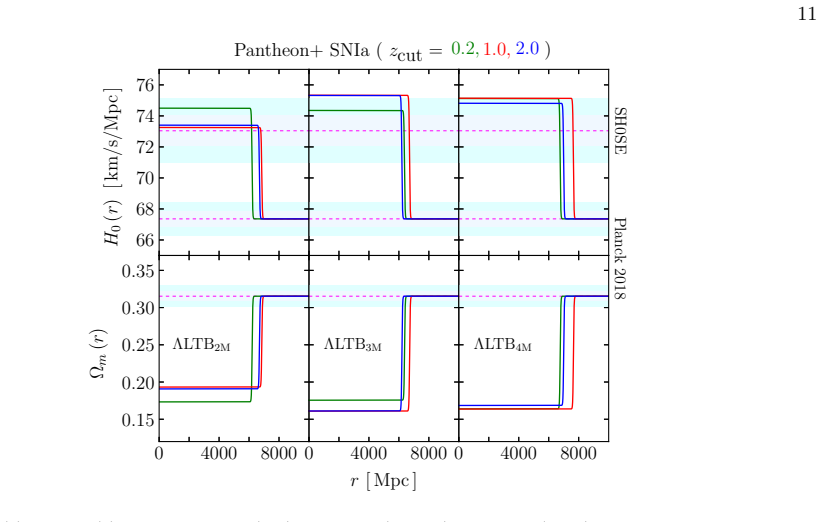
The central object is the $\Lambda$LTB void: a spherically symmetric, radially inhomogeneous cosmology with a cosmological constant, in which the matter density dips to $\Omega_m(r) \approx 0.2$ near the center through a constrained hyperbolic-tangent deficit profile and returns to the flat $\Lambda$CDM background values $\Omega_{m,\mathrm{out}}=0.3153$ and $H_{0,\mathrm{out}}=67.36$ km/s/Mpc far outside. It is paired with a piecewise-constant absolute magnitude $M$ whose transitions at $d_{\mathrm{cr}} \approx 20$, $\approx 129$, and $\approx 860$–960 Mpc are free parameters. The void changes the luminosity distance $d_L(z) = (1+z)^2 R(r(z), t(z))$ along radial null geodesics, producing a high local $H_0$ while preserving the CMB-calibrated exterior; the $M$-steps absorb distance-modulus jumps that would otherwise make the void fit worse. The model comparison is carried by $\Delta\chi^2$, $\Delta$AIC, $\Delta$BIC, and the Bayes factor.
What would settle it
Re-fit the same Pantheon+ and Planck 2018 distance-prior data to flat $\Lambda$CDM with the same number of $M$-steps at the same fitted transition distances; if the BIC gap between $\Lambda$CDM and the $\Lambda$LTB models no longer meets the paper's 'very strong' threshold, the claimed preference for a void collapses. Separately, a galaxy-cluster or peculiar-velocity measurement inside roughly 100 Mpc that rules out $\Omega_m \approx 0.2$ would falsify the specific deep void fitted here.
Extended reading notes
Core claim
The claim is that the Hubble tension is not a contradiction between datasets but a signature of our location: the Solar System sits near the center of a deep, radially inhomogeneous void described by the $\Lambda$LTB metric with a cosmological constant. Inside the void the expansion rate $H_0(r=0)$ comes out near 73 km/s/Mpc, matching the local distance-ladder measurement, while far outside the void the same model matches the Planck 2018 CMB value $67.36$ km/s/Mpc. The extra ingredient that makes this work is allowing the SNIa absolute magnitude $M$ to take several discrete values, with fitted transitions at about 20, 129, and 860–960 Mpc; the void depth is driven to $\delta_V \approx -38\%$ to $-50\%$, so the local matter density falls to $\Omega_m \approx 0.2$. With the Pantheon+ sample alone, the $\Lambda$LTB models with $M$ transitions are strongly preferred over a $\Lambda$CDM model with $\Omega_m$ and $H_0$ fixed by Planck, though not always over a fully free $\Lambda$CDM when judged by BIC. Adding Planck 2018 CMB distance priors makes the preference very strong by all criteria used ($\Delta\chi^2$, AIC, BIC, Bayes factor), with $\Delta$BIC between roughly $-9$ and $-46$.
Load-bearing premise
The argument stands on allowing the void models step transitions in the supernova absolute magnitude that the flat-$\Lambda$CDM baselines do not get; the paper never fits a $\Lambda$CDM baseline with the same step flexibility, so part of the claimed preference could be a reward for extra model flexibility.
Editorial extensions
If this is right
- If the claim holds, the local distance-ladder value and the CMB-inferred value are both the true expansion rate, measured at different places; no new early-universe physics is required.
- Distance-ladder analyses that assume a single absolute magnitude for all Type Ia supernovae would need to allow distance-dependent steps, since the data used here show transitions at about 20, 129, and 860–960 Mpc.
- The fitted void is deep, with local matter density $\Omega_m \approx 0.2$, which is testable by galaxy-cluster and peculiar-velocity surveys at scales of tens to hundreds of megaparsecs.
- The earlier failure of void models against the older Pantheon sample is attributed to missing $M$-step flexibility and the $H_0$–$M$ degeneracy of pre-Pantheon+ samples, not to the void idea itself.
Reading between the lines
- Inference: a clean stress test would give flat $\Lambda$CDM the same number of $M$-steps at the same fitted distances; if its $\Delta$BIC versus the void models becomes weak, the paper's preference is mostly about model flexibility rather than a physical void.
- Inference: because part of the 20 Mpc transition is attributed in earlier work to a volumetric redshift-scatter bias, the new steps near 129 and 860–960 Mpc should be checked against the same systematic corrections before being read as new physics.
- Inference: if the $M$-steps come from changed physics of white-dwarf explosions, such as a varying effective gravitational constant, supernova light-curve properties like stretch or color should show correlated jumps at the same distances.
- Inference: the deep-void picture predicts a coherent local expansion flow that could be looked for in bulk-flow and redshift-space distortion data independent of supernova magnitudes.
Signed reviews
Editorial analysis
A structured set of objections, weighed in public.
Referee Report
Summary. The paper tests Lemaitre-Tolman-Bondi void models with a cosmological constant (ΛLTB), supplemented by piecewise-constant transitions in the Type Ia supernova absolute magnitude M, against Pantheon+ SNIa data alone and combined with Planck 2018 distance priors. The authors report that the ΛLTB models with two, three, or four M segments yield a central expansion rate H0(r=0) near 73 km/s/Mpc while matching the Planck value H0,out = 67.36 km/s/Mpc outside the void, and they claim strong or very strong preference over flat ΛCDM baselines in terms of Δχ², ΔAIC, ΔBIC, and Bayes factors (Tables III and V). The analysis is built on MCMC fits using the Cobaya/GetDist pipeline, with constraints reported in several figures and tables.
Significance. If the model-comparison claim were robust, the paper would offer a notable phenomenological resolution of the Hubble tension: a single framework in which local and CMB determinations of H0 agree within 2σ while retaining strong statistical preference over ΛCDM. The paper is also useful in that it confirms and extends the earlier finding of an M transition at ~20 Mpc to additional transitions near 129 Mpc and 860–960 Mpc, and it makes the fitted void parameters and information criteria available in tabular form. However, the central preference claim rests on a comparison in which the ΛLTB models carry the extra flexibility of the M-step structure while the ΛCDM baselines do not, and the SN-only comparisons impose external Planck values without a corresponding CMB likelihood. These issues are load-bearing, so the significance of the claimed result is not yet established as stated.
major comments (3)
- [Sec. III B and Tables III and V] The claimed strong preference for the ΛLTB models is computed against ΛCDM baselines with a single constant absolute magnitude M, while the ΛLTB2M/3M/4M models of Eqs. (25)–(27) include extra magnitudes and freely fitted step locations. The paper itself cites Refs. [63,64] showing that such M transitions are favored in ΛCDM alone, so the comparison conflates the benefit of the void with the benefit of the extra M flexibility. A concrete test is to fit ΛCDM with the same M-step structure (one, two, or three transitions) and compare ΔBIC/ΔAIC/lnB against the ΛLTB models; in the strongest case in Table V (z<2.0, ΛLTB3M vs ΛCDM F), Δχ² = -71.4 and ΔBIC = -34.2, and a ΛCDM model with two M transitions has essentially the same number of free parameters and could plausibly recover a large part of the χ² improvement, reversing the reported preference. Because this missing baseline is directly relevant to the central claim, the model-comparison statistics in Tables III and V do not currently establish that the void, rather than the M-step flexibility, is what the data prefer.
- [Sec. III and Sec. IV] The SN-only fits in Table III impose the Planck values Ωm,out = 0.3153 and H0,out = 67.36 km/s/Mpc on the ΛLTB models without including any CMB likelihood in the fit. This is acknowledged in Sec. IV, where the authors state that it is 'unfair to impose these conditions without using the CMB data' and that when these conditions are imposed, the CMB data must also be taken into account jointly. Yet the paper still presents the SN-only comparisons of Table III as evidence, including a 'very strong' ΔBIC_P18 claim. Since the ΛCDM F baseline fits H0 and Ωm freely, the comparison embeds external Planck information into one model but not the other, and the information criteria do not account for this. The SN-only claims should either be removed, or the SN-only fits of the ΛLTB models should be repeated with H0,out and Ωm,out as free parameters.
- [Sec. III, Eq. (23), and Figs. 4 and 8] The central output H0,in ≈ 73 km/s/Mpc is not an independent prediction in the sense implied by the abstract: the Pantheon+ likelihood used in Eq. (22) includes the 77 SH0ES Cepheid-calibrated host-galaxy distance moduli in the first line of Eq. (23), which directly anchor the local distance ladder. The void depth δV and the M transitions are fitted to the same likelihood, so the agreement of H0(r=0) with the SH0ES value is partly a consequence of the calibration embedded in the data rather than a falsifiable prediction of the void model. To assess how much of the 'alleviation' is driven by this anchoring, the authors should show results with the Cepheid-host term removed (i.e., using only the SNIa distance moduli with M marginalized or fitted), or with the SH0ES anchors treated as a separate dataset whose consistency with the void model is explicitly tested.
minor comments (4)
- [Sec. V] The text in the conclusion acknowledges the increased model complexity and the risk of over-fitting, but the statement that this risk is 'quantified by the Bayesian evidence, AIC and BIC' is only accurate for comparisons against baselines that carry the same M-step flexibility; the quantified evidence in Tables III and V does not include such baselines.
- [Fig. 4 and Fig. 8 captions] The label 'SH0SE' in the figure captions appears to be a typo for 'SH0ES'; this should be corrected.
- [Sec. III, Table II] The entries for rV and Δr in Table II are reported as lower or upper limits (e.g., '> 5403.66' and 'none'), which is appropriate, but the text in Sec. III states that the constraints on the free parameters are 'fairly tight (except rV and Δr)'; it would be clearer to state explicitly that two of the six or seven void parameters are effectively unconstrained and that the reported H0(r=0) values therefore depend on the assumed prior ranges for these parameters.
- [Sec. IV, Eq. (29)] The distance-prior covariance matrix is given to high precision, but the paper does not state how the ΛLTB luminosity distance is used to compute dA(z*) for the shift parameter R in Eq. (30); since the light path to z* passes through the void, a brief clarification of whether R is evaluated with the full ΛLTB dL(z*) or with the background ΛCDM expression would improve reproducibility.
Circularity Check
No quotable circularity found: the paper fits explicit LTB/ΛCDM models to public Pantheon+ and Planck distance-prior data; the main weakness is an asymmetric model comparison, which is a correctness concern rather than a definitional reduction. H0(r=0) is a derived parameter, not an input prior.
full rationale
The paper's derivation chain is self-contained in the sense required by the circularity review. The ΛLTB luminosity distance is computed from the CGBH profile, Eqs. (11)–(16), with the outside parameters Ωm,out = 0.3153 and H0,out = 67.36 km/s/Mpc fixed to Planck values; the void depth δV is then fitted to the Pantheon+ sample and, in Sec. IV, jointly to Planck 2018 distance priors. The reported local H0,in = H0(r=0) is an output of that fit, obtained from Eq. (16), and is not imposed as a Gaussian prior or direct constraint. The paper explicitly notes that Pantheon+ provides the 77 Cepheid-calibrated host distance moduli that break the H0–M degeneracy, so the low-redshift distance scale enters through the data rather than through a pre-assigned SH0ES value. The M transitions in Eqs. (25)–(27) are free parameters fitted to the same likelihood; they are motivated by external papers [63,64], not by self-citations, and the paper does not claim them as out-of-sample predictions. The central preference claim is based on Δχ², ΔAIC, ΔBIC and lnB. A legitimate statistical weakness is that the ΛCDM baselines in Tables III and V have only one constant M, whereas the ΛLTB models carry one to three extra magnitudes and fitted step locations, so the preference does not cleanly separate the void effect from the M-step flexibility; the paper's own Sec. V flags the over-fitting risk but argues that AIC/BIC/Bayesian evidence mitigate it. That asymmetry is a model-comparison/correctness issue, not a step in which an output equals an input by definition. The self-citations present in the bibliography are background literature on LTB cosmology and varying-G mechanisms; no load-bearing uniqueness theorem or ansatz is imported from the authors' own prior work. Thus, no specific circular reduction can be quoted, and the appropriate score is 0.
Assumptions & free parameters
free parameters (5)
- δV (void depth) =
approximately -0.38 to -0.50 across models (e.g., -0.44 for ΛLTB2M, z<0.2)
- rV (void characteristic radius) =
poorly constrained; lower limits above 5400 Mpc, best fits at or above 6000 Mpc
- Δr (transition width) =
approximately 20 Mpc best fit; poorly constrained
- M0, M1, M2, M3 (absolute magnitudes in each M segment) =
e.g., -19.42, -19.23, -19.20, -19.19 for ΛLTB4M, z<2.0
- dcr1, dcr2, dcr3 (M transition distances) =
approximately 19.6, 129, and 860 to 960 Mpc
assumptions (5)
- domain assumption Void profile is the constrained Garcia-Bellido-Haugboelle tanh form, Eq. (11), with parameters δV, rV, Δr.
- domain assumption The Big Bang time is spatially uniform, tB(r) = const, applied in Eqs. (13)-(16).
- domain assumption The cosmological constant is homogeneous: ΩΛ(r) = 1 - Ωm,out, Eq. (12).
- ad hoc to paper Absolute magnitude M is a piecewise-constant function of the SH0ES distance modulus, Eqs. (25)-(27), with all step positions and amplitudes free.
- domain assumption CMB distance priors R and ℓA are evaluated with the outside-FRW values Ωm,out = 0.3153 and H0,out = 67.36 km/s/Mpc, assuming the void does not affect the CMB scale.
Cite this review
Pith. "Pith review of Alleviating the Hubble Tension with a Local Void and Transitions of the Absolute Magnitude." pith.science (2026). https://pith.science/paper/NQOQF7KG
@misc{pith2026250413380,
  author       = {Pith},
  title        = {Pith review of: Alleviating the Hubble Tension with a Local Void and Transitions of the Absolute Magnitude},
  year         = {2026},
  howpublished = {\url{https://pith.science/paper/NQOQF7KG}},
  note         = {Machine review of arXiv:2504.13380}
}
abstract
Nowadays, one of the well-known serious challenges in cosmology is the Hubble tension, namely the discrepancy between the Hubble constants from the local observation of Type Ia supernova (SNIa) and the high-$z$ observation of cosmic microwave background (CMB). Here, we are interested in alleviating the Hubble tension with a local void. The key idea is assuming that we live in a locally underdense void, where one will feel a faster expansion rate compared to the cosmic average. In the literature, it was found that a local void cannot satisfyingly alleviate the Hubble tension, since it is not preferred over the $\Lambda$CDM model by the observations such as the Pantheon SNIa sample, especially in terms of the information criteria AIC and BIC. In the present work, we try to alleviate the Hubble tension with a local void and transitions of the absolute magnitude $M$, by using the Pantheon+ SNIa sample alone or jointly with the CMB data of Planck 2018. We find that the Hubble tension can be satisfyingly alleviated, while the $\Lambda$LTB void models are strongly preferred by the observations.
Figures


Figures from the paper (5 more)


Forward citations
Cited by 1 Pith paper
-
Multipolar structure of the local expansion rate from incomplete sky data
CF4 data yield a 3.3σ excess dipole in the local expansion-rate fluctuation field at (l,b)=(290°,-4°)±5°, sourced mainly by z∈[0.03,0.05], with quadrupole/octupole consistent with ΛCDM and no multipole-vector alignments.
Reference graph
Works this paper leans on
-
[1]
E. Di Valentino et al. , Phys. Dark Univ. 49, 101965 (2025) [arXiv:2504.01669]
arXiv 2025
- [2]
-
[3]
L. Perivolaropoulos and F. Skara, New Astron. Rev. 95, 101659 (2022) [arXiv:2105.05208]
arXiv 2022
- [4]
-
[5]
Di Valentino, Universe 8, no.8, 399 (2022)
E. Di Valentino, Universe 8, no.8, 399 (2022)
2022
-
[6]
G. Efstathiou, Phil. Trans. Roy. Soc. Lond. A 383, no.2290, 20240022 (2025) [arXiv:2406.12106]
arXiv 2025
-
[7]
E. Di Valentino et al. , Class. Quant. Grav. 38, no.15, 153001 (2021) [arXiv:2103.01183]
arXiv 2021
-
[8]
R. G. Cai, L. Li and S. J. Wang, Acta Phys. Sin. 72, no.23, 239801 (2023)
2023
Show all 120 references
-
[9]
J. P. Hu and F. Y. Wang, Universe 9, no.2, 94 (2023) [arXiv:2302.05709]
2023 arXiv
-
[10]
C. L. Chang et al. , arXiv:2203.07638 [astro-ph.CO]
- [11]
-
[12]
A. G. Riess et al. , Astrophys. J. Lett. 934, no.1, L7 (2022) [arXiv:2112.04510]
2022 arXiv
-
[13]
A. G. Riess et al. , Astrophys. J. 977, no.1, 120 (2024) [arXiv:2408.11770]
2024 arXiv
-
[14]
Lema ˆ ıtre, Annales de la Soci´ et´ e Scientifique de Bruxelles A 53, 51 (1933); see Gen
G. Lema ˆ ıtre, Annales de la Soci´ et´ e Scientifique de Bruxelles A 53, 51 (1933); see Gen. Rel. Grav. 29, 641 (1997) for English translation
1933
-
[15]
R. C. Tolman, Proc. Nat. Acad. Sci. 20, 169 (1934); see Gen. Rel. Grav. 29, 935 (1997) for English translation
1934
-
[16]
Bondi, Mon
H. Bondi, Mon. Not. Roy. Astron. Soc. 107, 410 (1947)
1947
-
[17]
Zehavi, A
I. Zehavi, A. G. Riess, R. P. Kirshner and A. Dekel, Astro phys. J. 503, 483 (1998) [astro-ph/9802252]
1998 arXiv
-
[18]
M. N. Celerier, Astron. Astrophys. 353, 63 (2000) [astro-ph/9907206]
2000 arXiv
-
[19]
M. N. Celerier, New Advances in Physics 1, 29 (2007) [astro-ph/0702416]
2007 arXiv
-
[20]
R. K. Barrett and C. A. Clarkson, Class. Quant. Grav. 17, 5047 (2000) [astro-ph/9911235]
2000 arXiv
- [21]
- [22]
-
[23]
Iguchi, T
H. Iguchi, T. Nakamura and K. Nakao, Prog. Theor. Phys. 108, 809 (2002) [astro-ph/0112419]
2002 arXiv
-
[24]
T. J. Zhang, H. Wang and C. Ma, Phys. Rev. D 91, 063506 (2015) [arXiv:1210.1775]
2015 arXiv
- [25]
- [26]
- [27]
-
[28]
Garcia-Bellido and T
J. Garcia-Bellido and T. Haugboelle, JCAP 0804, 003 (2008) [arXiv:0802.1523]
2008 arXiv
-
[29]
Garcia-Bellido and T
J. Garcia-Bellido and T. Haugboelle, JCAP 0809, 016 (2008) [arXiv:0807.1326]
2008 arXiv
-
[30]
M. N. Celerier, Astron. Astrophys. 543, A71 (2012) [arXiv:1108.1373]
2012 arXiv
-
[31]
M. N. Celerier, J. Phys. Conf. Ser. 484, 012005 (2014) [arXiv:1203.2814]
2014 arXiv
-
[32]
Alnes, M
H. Alnes, M. Amarzguioui and O. Gron, Phys. Rev. D 73, 083519 (2006) [astro-ph/0512006]
2006 arXiv
-
[33]
M. N. Celerier et al. , Astron. Astrophys. 518, A21 (2010) [arXiv:0906.0905]
2010 arXiv
-
[34]
R. A. Vanderveld et al. , Phys. Rev. D 74, 023506 (2006) [astro-ph/0602476]
2006 arXiv
-
[35]
J. P. Zibin, Phys. Rev. D 78, 043504 (2008) [arXiv:0804.1787]
2008 arXiv
-
[36]
J. P. Zibin and A. Moss, Class. Quant. Grav. 28, 164005 (2011) [arXiv:1105.0909]
2011 arXiv
-
[37]
X. P. Yan, D. Z. Liu and H. Wei, Phys. Lett. B 742, 149 (2015) [arXiv:1411.6218]
2015 arXiv
-
[38]
Z. X. Yu, S. L. Li and H. Wei, Nucl. Phys. B 960, 115179 (2020) [arXiv:1907.12517]
2020 arXiv
-
[39]
Alnes and M
H. Alnes and M. Amarzguioui, Phys. Rev. D 74, 103520 (2006) [astro-ph/0607334]
2006 arXiv
-
[40]
Sundell, E
P. Sundell, E. M¨ ortsell and I. Vilja, JCAP 1508, 037 (2015) [arXiv:1503.08045]
2015 arXiv
-
[41]
E. G. Chirinos Isidro et al. , JCAP 1605, 003 (2016) [arXiv:1602.08583]
2016 arXiv
-
[42]
R. C. Keenan, A. J. Barger and L. L. Cowie, Astrophys. J. 775, 62 (2013) [arXiv:1304.2884]. 21
2013 arXiv
-
[43]
B. L. Hoscheit and A. J. Barger, Astrophys. J. 854, no.1, 46 (2018) [arXiv:1801.01890]
2018 arXiv
-
[44]
Shanks, L
T. Shanks, L. Hogarth and N. Metcalfe, Mon. Not. Roy. Ast ron. Soc. 484, L64 (2019) [arXiv:1810.02595]
2019 arXiv
-
[45]
W. D. Kenworthy, D. Scolnic and A. Riess, Astrophys. J. 875, no.2, 145 (2019) [arXiv:1901.08681]
2019 arXiv
-
[46]
V. V. Lukovi´ c et al. , Mon. Not. Roy. Astron. Soc. 491, no.2, 2075 (2020) [arXiv:1907.11219]
2020 arXiv
-
[47]
Kazantzidis and L
L. Kazantzidis and L. Perivolaropoulos, Phys. Rev. D 102, no.2, 023520 (2020) [arXiv:2004.02155]
2020 arXiv
-
[48]
R. G. Cai et al. , Phys. Rev. D 103, no.12, 123539 (2021) [arXiv:2012.08292]
2021 arXiv
-
[49]
D. M. Scolnic et al. , Astrophys. J. 859, no.2, 101 (2018) [arXiv:1710.00845]
2018 arXiv
- [50]
- [51]
-
[52]
https: / /PantheonPlusSH0ES.github.io https:/ /github.com/PantheonPlusSH0ES/DataRelease
- [53]
- [54]
- [55]
-
[56]
Lopes, A
M. Lopes, A. Bernui, C. Franco and F. Avila, Astrophys. J . 967, no.1, 47 (2024) [arXiv:2405.11077]
2024 arXiv
-
[57]
Watkins et al
R. Watkins et al. , Mon. Not. Roy. Astron. Soc. 524, no.2, 1885 (2023) [arXiv:2302.02028]
2023 arXiv
-
[58]
Y. H. Sanejouand, New Astron. 116, 102331 (2025) [arXiv:2312.05896]
2025 arXiv
-
[59]
R. G. Cai et al. , Phys. Rev. D 103, no.12, 121302 (2021) [arXiv:2102.02020]
2021 arXiv
- [60]
- [61]
- [62]
-
[63]
Perivolaropoulos and F
L. Perivolaropoulos and F. Skara, Mon. Not. Roy. Astron . Soc. 520, no.4, 5110 (2023) [arXiv:2301.01024]
2023 arXiv
-
[64]
Y. Liu, H. W. Yu and P. X. Wu, Phys. Rev. D 110, no.2, L021304 (2024) [arXiv:2406.02956]
2024 arXiv
-
[65]
A. R. Liddle, Mon. Not. Roy. Astron. Soc. 377, L74 (2007) [astro-ph/0701113]
2007 arXiv
-
[66]
A. R. Liddle, Ann. Rev. Nucl. Part. Sci. 59, 95 (2009) [arXiv:0903.4210]
2009 arXiv
-
[67]
Akaike, IEEE Trans
H. Akaike, IEEE Trans. Automatic Control 19, 716 (1974)
1974
-
[68]
Schwarz, Ann
G. Schwarz, Ann. Stat. 6, 461 (1978)
1978
-
[69]
Perivolaropoulos and F
L. Perivolaropoulos and F. Skara, Universe 8, no.10, 502 (2022) [arXiv:2208.11169]
2022 arXiv
- [70]
-
[71]
https: / /cobaya.readthedocs.org
- [72]
-
[73]
https: / /getdist.readthedocs.io
-
[74]
L. Chen, Q. G. Huang and K. Wang, JCAP 1902, 028 (2019) [arXiv:1808.05724]
2019 arXiv
-
[75]
D. J. Fixsen, Astrophys. J. 707, 916 (2009) [arXiv:0911.1955]
2009 arXiv
-
[76]
R. E. Kass and A. E. Raftery, J. Am. Statist. Assoc. 90, no.430, 773 (1995)
1995
-
[77]
Kilbinger et al
M. Kilbinger et al. , Mon. Not. Roy. Astron. Soc. 405, 2381 (2010) [arXiv:0912.1614]
2010 arXiv
-
[78]
M. D. Weinberg, arXiv:0911.1777 [astro-ph.IM]
- [79]
-
[80]
Mukherjee et al
P. Mukherjee et al. , Eur. Phys. J. Plus 134, no.4, 147 (2019) [arXiv:1710.02417]
2019 arXiv
-
[81]
Heavens et al
A. Heavens et al. , Phys. Rev. Lett. 119, no.10, 101301 (2017) [arXiv:1704.03467]
2017 arXiv
- [82]
-
[83]
https: / /github.com/yabebalFantaye/MCEvidence
-
[84]
https: / /github.com/BorisNgHL/MCEvi− mod
-
[85]
W. D. Kenworthy et al. , Astrophys. J. 935, no.2, 83 (2022) [arXiv:2204.10866]
2022 arXiv
-
[86]
Marra and L
V. Marra and L. Perivolaropoulos, Phys. Rev. D 104, no.2, L021303 (2021) [arXiv:2102.06012]
2021 arXiv
-
[87]
Alestas, I
G. Alestas, I. Antoniou and L. Perivolaropoulos, Unive rse 7, no.10, 366 (2021) [arXiv:2104.14481]
2021 arXiv
-
[88]
Sapone, S
D. Sapone, S. Nesseris and C. A. P. Bengaly, Phys. Dark Un iv. 32, 100814 (2021) [arXiv:2006.05461]
2021 arXiv
-
[89]
R. R. Caldwell et al. , Phys. Rev. D 73, 023513 (2006) [astro-ph/0507622]
2006 arXiv
-
[90]
Khosravi et al
N. Khosravi et al. , Phys. Rev. D 99, no.10, 103526 (2019) [arXiv:1710.09366]
2019 arXiv
-
[91]
Alestas et al
G. Alestas et al. , Phys. Rev. D 105, no.6, 063538 (2022) [arXiv:2110.04336]
2022 arXiv
-
[92]
Perivolaropoulos and F
L. Perivolaropoulos and F. Skara, Phys. Rev. D 106, no.4, 043528 (2022) [arXiv:2203.10374]
2022 arXiv
- [93]
-
[94]
R. R. Caldwell and A. Stebbins, Phys. Rev. Lett. 100, 191302 (2008) [arXiv:0711.3459]
2008 arXiv
-
[95]
H. K. Deng and H. Wei, Phys. Rev. D 97, no.12, 123515 (2018) [arXiv:1804.03087]
2018 arXiv
-
[96]
H. K. Deng and H. Wei, Eur. Phys. J. C 78, no.9, 755 (2018) [arXiv:1806.02773]. 22
2018 arXiv
- [97]
-
[98]
Haslbauer, I
M. Haslbauer, I. Banik and P. Kroupa, Mon. Not. Roy. Astr on. Soc. 499, 2845 (2020) [arXiv:2009.11292]
2020 arXiv
-
[99]
Mazurenko et al
S. Mazurenko et al. , Mon. Not. Roy. Astron. Soc. 527, 4388 (2024) [arXiv:2311.17988]
2024 arXiv
-
[100]
Mazurenko, I
S. Mazurenko, I. Banik and P. Kroupa, Mon. Not. Roy. Ast ron. Soc. 536, 3232 (2025) [arXiv:2412.12245]
2025 arXiv
-
[101]
Banik and V
I. Banik and V. Kalaitzidis, Mon. Not. Roy. Astron. Soc . 540, no.1, 545 (2025) [arXiv:2501.17934]
2025 arXiv
-
[102]
B. S. Haridasu, P. Salucci and G. Sharma, Mon. Not. Roy. Astron. Soc. 532, 2234 (2024) [arXiv:2403.06859]
2024 arXiv
-
[103]
P. K. Aluri et al. , Class. Quant. Grav. 40, no.9, 094001 (2023) [arXiv:2207.05765]
2023 arXiv
-
[104]
Krishnan et al
C. Krishnan et al. , Phys. Rev. D 105, no.6, 063514 (2022) [arXiv:2106.02532]
2022 arXiv
-
[105]
Mc Conville and E
R. Mc Conville and E. ´O. Colg´ ain, Phys. Rev. D 108, no.12, 123533 (2023) [arXiv:2304.02718]
2023 arXiv
- [106]
-
[107]
J. W. Moffat, arXiv:1608.00534 [astro-ph.CO]
-
[108]
J. W. Moffat and D. C. Tatarski, Phys. Rev. D 45, 3512 (1992)
1992
-
[109]
J. W. Moffat and D. C. Tatarski, Astrophys. J. 453, 17 (1995) [astro-ph/9407036]
1995 arXiv
- [110]
-
[111]
Castello, M
S. Castello, M. H¨ og ˚ as and E. M¨ ortsell, JCAP2207, 003 (2022) [arXiv:2110.04226]
2022 arXiv
-
[112]
Camarena et al
D. Camarena et al. , Class. Quant. Grav. 39, no.18, 184001 (2022) [arXiv:2205.05422]
2022 arXiv
- [113]
-
[114]
Montani, N
G. Montani, N. Carlevaro and M. G. Dainotti, Phys. Dark Univ. 48, 101847 (2025) [arXiv:2411.07060]
2025 arXiv
-
[115]
M. G. Dainotti et al. , Astrophys. J. 912, no.2, 150 (2021) [arXiv:2103.02117]
2021 arXiv
-
[116]
Schiavone et al
T. Schiavone et al. , Mon. Not. Roy. Astron. Soc. 522, no.1, L72 (2023) [arXiv:2211.16737]
2023 arXiv
-
[117]
Silva, arXiv:2312.05267 [gr-qc]
C. Silva, arXiv:2312.05267 [gr-qc]
-
[118]
Vagnozzi, Universe 9, no.9, 393 (2023) [arXiv:2308.16628]
S. Vagnozzi, Universe 9, no.9, 393 (2023) [arXiv:2308.16628]
2023 arXiv
- [119]
-
[120]
Wei and D
H. Wei and D. Z. Xue, Commun. Theor. Phys. 68, no.5, 632 (2017) [arXiv:1706.04063]
2017 arXiv
Reviewed August 16, 2026 · model on record in the stance chip above.
Discussion (0). Continue with ORCID to comment.