Radio spectral properties and aging of two tailed radio galaxies in a galaxy group at z=0.35
Pith reviewed 2026-06-26 09:46 UTC · model grok-4.3
The pith
Two tailed radio galaxies in a merging group at z=0.35 have spectral ages 7 to 20 times shorter than their dynamical ages from tail lengths.
A machine-rendered reading of the paper's core claim, the machinery that carries it, and where it could break.
Core claim
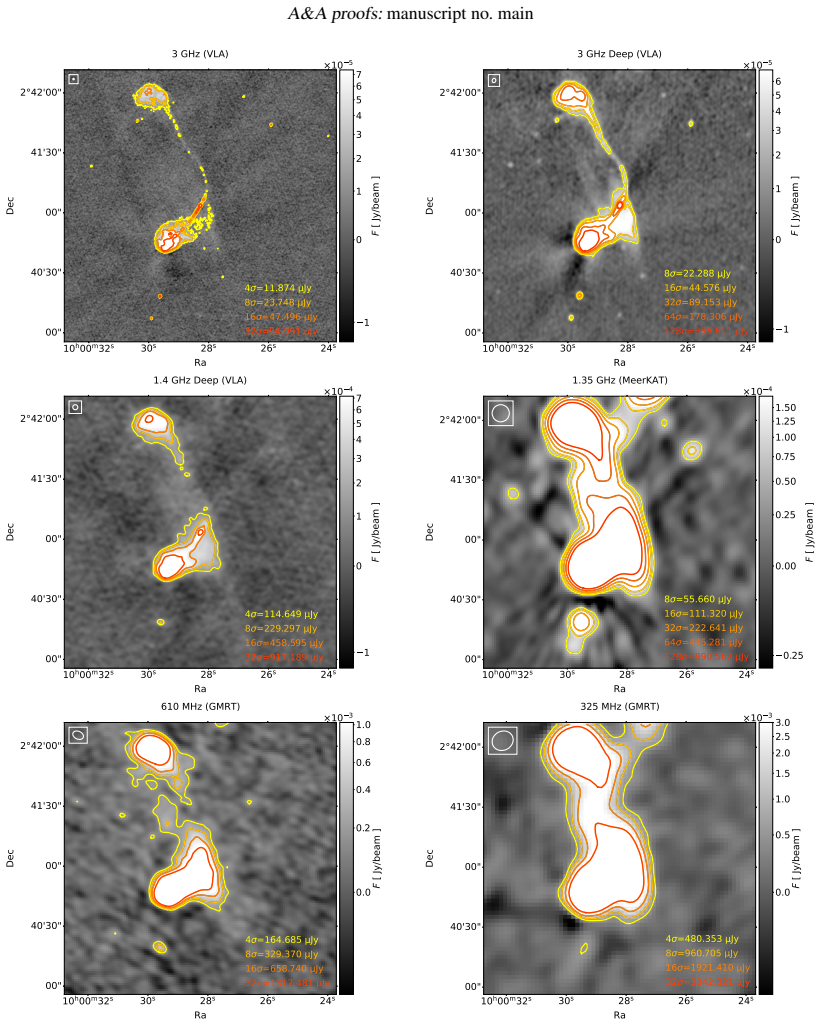
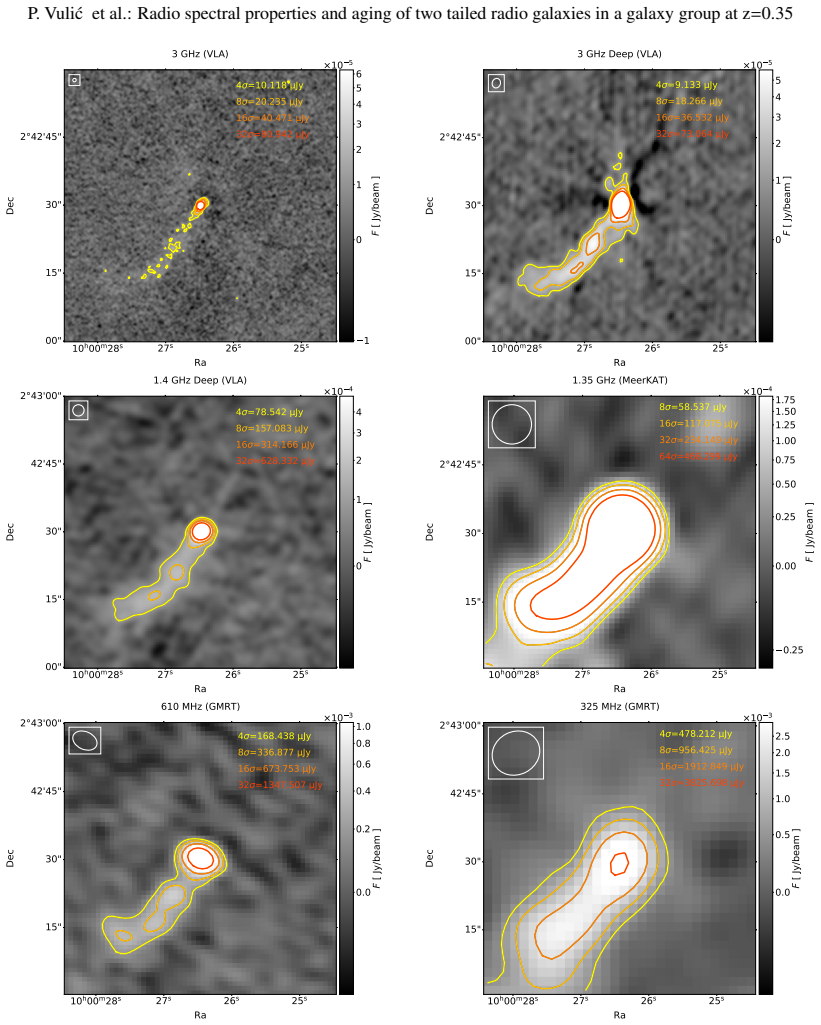
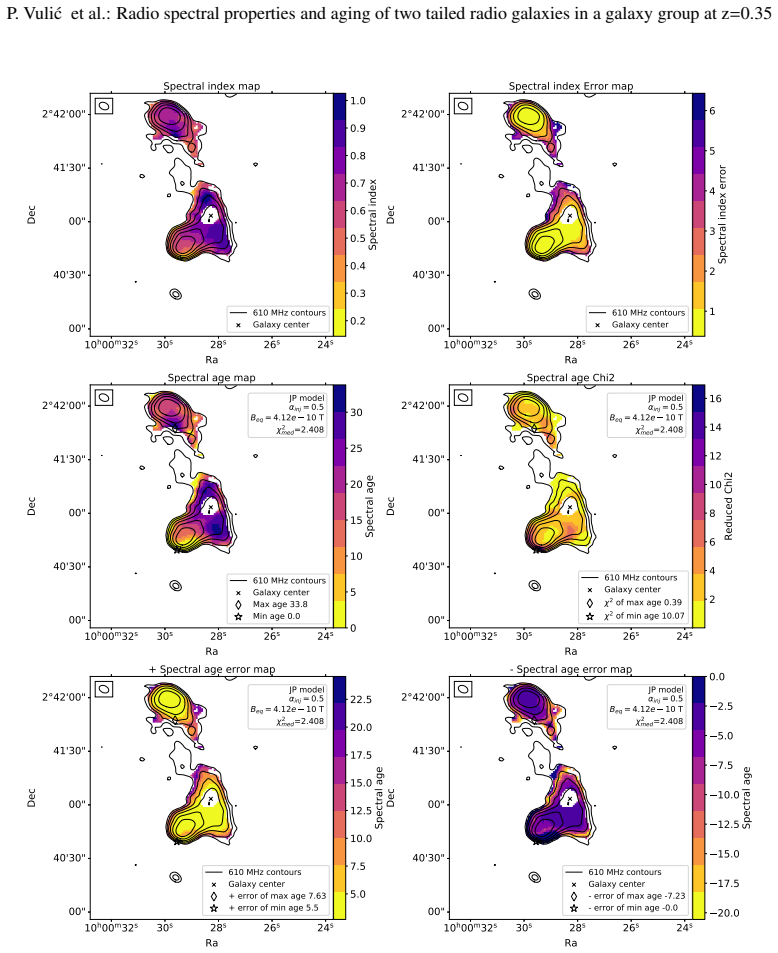
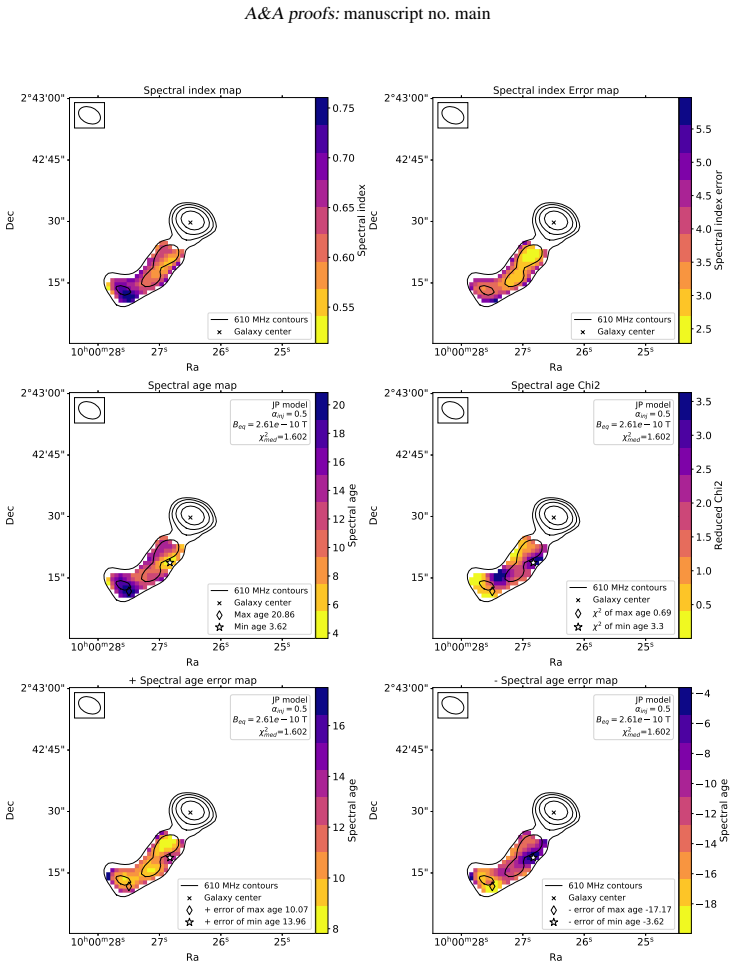
The two tailed radio galaxies exhibit spectral steepening with distance from the core and localized flattening in the WAT lobes and hotspots, yielding Jaffe-Perola spectral ages of 33.80 +7.63/-7.23 Myr for the WAT and 20.86 +10.07/-17.17 Myr for the HT. These values are lower than the dynamical ages of 420-700 Myr for the WAT and 140-280 Myr for the HT by factors of roughly 12-20 and 7-14, respectively. The discrepancy, combined with morphological evidence of IGM interaction and activity persisting for hundreds of Myr, indicates that the galaxies are actively depositing energy into their environment.
What carries the argument
The Jaffe-Perola spectral aging model fitted to multi-frequency radio maps, compared against dynamical ages computed from projected tail lengths divided by assumed advance speeds.
If this is right
- The galaxies remain active and interact with the intragroup medium over timescales of hundreds of Myr while depositing energy into it.
- Spectral ages could be refined with deeper, higher-resolution observations spanning MHz frequencies to above 3 GHz.
- Dynamical age models must incorporate IGM interactions to reduce the observed age mismatch.
- Localized spectral flattening indicates sites of re-acceleration along the jets and in the lobes.
Where Pith is reading between the lines
- Continuous jet activity rather than a single outburst may be required to maintain the observed tail lengths given the short spectral ages.
- Such sources could heat the intragroup medium more efficiently than age ratios derived from simple models imply.
- High-resolution X-ray maps of the group core would directly test whether ram-pressure and buoyancy effects alter the apparent dynamical ages.
Load-bearing premise
The Jaffe-Perola model gives unbiased ages without large effects from electron population mixing or missed re-acceleration, and the simple tail-length divided by velocity estimates give reliable dynamical ages.
What would settle it
Deep X-ray imaging that yields an IGM density and velocity field allowing a hydrodynamic dynamical-age calculation that matches the reported spectral ages within their uncertainties.
Figures
read the original abstract
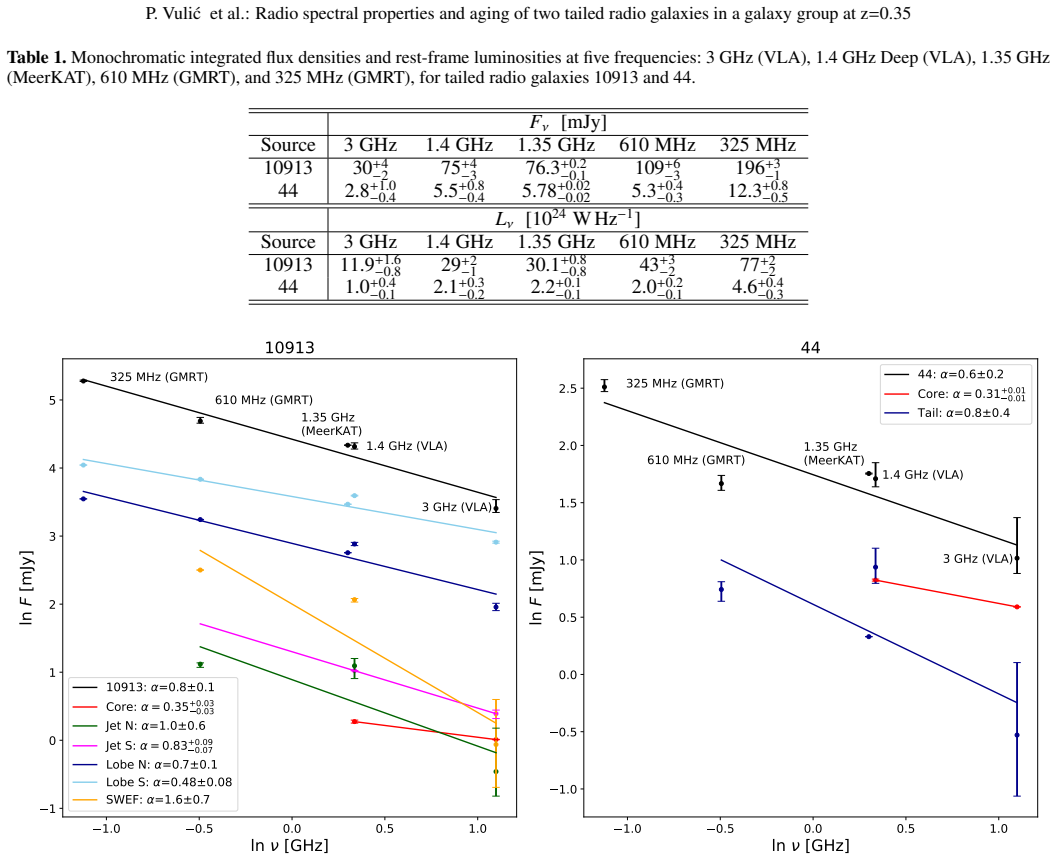
We present a study of two tailed radio galaxies in the core of a massive, dynamically young galaxy group - an early group-group merger. Using VLA (3 GHz and 1.4 GHz), MeerKAT (1.35 GHz), and GMRT (610 and 325 MHz) observations, we investigate their radio spectral properties, spectral and dynamical ages. Radio morphologies show clear evidence of interaction with the intragroup medium (IGM). One galaxy is a wide-angle tail (WAT) source, while the other is most likely a head-tail (HT) galaxy. Both galaxies exhibit high radio luminosities, and we find spectral indices of $\alpha=0.8\pm 0.1$ (WAT) and $\alpha=0.6\pm 0.2$ (HT). Spectral index analysis reveals spectral steepening with distance from the core in both galaxies, with localized flattening in the WAT lobes and hotspots along the northern jet, and indications of such flattening in the middle of the HT tail. Spectral ages derived using Jaffe-Perola model are $33.80\substack{+7.63 \\ -7.23}$ Myr (WAT) and $20.86\substack{+10.07 \\ -17.17}$ Myr (HT), significantly lower than dynamical ages of $420\pm60$ to $700\pm100$ Myr (WAT) and $140\pm20$ Myr (and possibly up to $280\pm40$ Myr, for HT), yielding dynamical-to-spectral age ratios of $\sim12-20$ and $\sim7$ (and up to $\sim14$), respectively. The discrepancy may be reduced by using more complex dynamical age models, incorporating interactions with the IGM, which requires deeper X-ray observations of the group. Spectral age estimates may be affected by mixing of electron populations, and could be better constrained with future deep, high-resolution broad-band radio observations at both MHz and frequencies above 3 GHz. The combination of extended radio structures, spectral signatures of radiative aging with localized re-acceleration, and activity timescales up to hundreds of Myr indicates that galaxies are actively interacting with, and likely depositing energy into their environment.
Editorial analysis
A structured set of objections, weighed in public.
Referee Report
Summary. The manuscript presents multi-frequency radio observations (VLA 3 GHz/1.4 GHz, MeerKAT 1.35 GHz, GMRT 610/325 MHz) of a WAT and an HT radio galaxy in a z=0.35 galaxy group. It reports integrated spectral indices of 0.8±0.1 (WAT) and 0.6±0.2 (HT), documents spectral steepening along the tails with localized flattening, derives JP-model spectral ages of 33.80 +7.63/-7.23 Myr (WAT) and 20.86 +10.07/-17.17 Myr (HT), and contrasts these with dynamical ages of 420-700 Myr (WAT) and 140-280 Myr (HT). The central result is the factor ~7-20 discrepancy between the two age estimates, which the authors attribute to possible IGM interactions or model limitations and suggest can be mitigated with deeper X-ray data and broader-band radio observations.
Significance. If the reported age discrepancy and its qualitative interpretation hold, the work adds to the literature on radio-galaxy/IGM interactions in dynamically young groups by providing resolved spectral-index maps and explicit model caveats. The multi-telescope frequency coverage enabling the steepening analysis is a clear strength; the paper appropriately frames the result as an observed tension rather than a resolved claim.
major comments (1)
- [Spectral age derivation] Spectral age section: the JP-model ages are presented with formal uncertainties, but the manuscript does not specify the adopted equipartition magnetic-field strength, the injection index, or the precise frequency points and spatial regions used in the fits. These parameters directly control the derived ages and therefore the magnitude of the reported dynamical-to-spectral age ratios.
minor comments (3)
- [Abstract] Abstract: the dynamical-age ranges are given without an explicit statement of the assumed tail velocities or projection corrections; adding one sentence would clarify the origin of the 420-700 Myr and 140-280 Myr intervals.
- [Figures and tables] Figure captions and text: ensure consistent use of the same error notation (e.g., asymmetric uncertainties) between the abstract and the main body.
- [Discussion] The discussion of possible re-acceleration is supported by the localized flattening, but a quantitative test (e.g., comparison of break frequencies in flattened vs. steepened regions) would strengthen the argument.
Simulated Author's Rebuttal
We thank the referee for the positive assessment of our work and for the constructive comment regarding the spectral age derivation. We address the point below and will incorporate the requested clarifications in the revised manuscript.
read point-by-point responses
-
Referee: Spectral age section: the JP-model ages are presented with formal uncertainties, but the manuscript does not specify the adopted equipartition magnetic-field strength, the injection index, or the precise frequency points and spatial regions used in the fits. These parameters directly control the derived ages and therefore the magnitude of the reported dynamical-to-spectral age ratios.
Authors: We agree that these parameters are essential for reproducibility and for interpreting the reported age discrepancy. In the revised manuscript we will add explicit statements of the equipartition magnetic-field strength adopted (calculated via the standard minimum-energy formula with the assumptions stated in the text), the injection index used in the JP model, and the precise frequency points together with the spatial regions (e.g., the specific tail segments) employed in the spectral fits. These additions will allow readers to assess the robustness of the derived spectral ages. revision: yes
Circularity Check
No significant circularity identified
full rationale
The paper derives spectral ages via the standard Jaffe-Perola model applied directly to measured spectral indices from VLA/MeerKAT/GMRT data at multiple frequencies, and dynamical ages from observed tail lengths combined with velocity assumptions; neither quantity is obtained by fitting a parameter to a subset of the same data and then relabeling the output as a prediction, nor does any equation reduce one age estimate to the other by construction. The reported discrepancy is an empirical comparison between two independently computed quantities, with the text explicitly noting model limitations rather than claiming an internally derived resolution. No self-citation chains, uniqueness theorems, or ansatzes imported from prior author work are invoked as load-bearing steps.
Axiom & Free-Parameter Ledger
free parameters (1)
- Spectral age (JP model) =
33.8 Myr (WAT), 20.9 Myr (HT)
axioms (1)
- domain assumption Jaffe-Perola model accurately captures electron energy losses in these sources
Reference graph
Works this paper leans on
-
[1]
The Cosmic Evolution Survey (COSMOS) -- Overview
The Cosmic Evolution Survey (COSMOS): Overview. , keywords =. doi:10.1086/516585 , archivePrefix =. astro-ph/0612305 , primaryClass =
work page internal anchor Pith review Pith/arXiv arXiv doi:10.1086/516585
-
[2]
COSMOS2020: A Panchromatic View of the Universe to z 10 from Two Complementary Catalogs. , keywords =. doi:10.3847/1538-4365/ac3078 , archivePrefix =. 2110.13923 , primaryClass =
-
[3]
2019, Publications of the Astronomical Society of Japan, 71, 114, doi: 10.1093/pasj/psz103
Second data release of the Hyper Suprime-Cam Subaru Strategic Program. , keywords =. doi:10.1093/pasj/psz103 , archivePrefix =. 1905.12221 , primaryClass =
-
[4]
Chandra centres for COSMOS X-ray galaxy groups: differences in stellar properties between central dominant and offset brightest group galaxies. , keywords =. doi:10.1093/mnras/sty3203 , archivePrefix =. 1812.01604 , primaryClass =
-
[5]
Detecting structure in two dimensions combining Voronoi tessellation and percolation. , keywords =. doi:10.1103/PhysRevE.47.704 , adsurl =
-
[6]
Cluster identification via Voronoi tessellation
Cluster Identification via Voronoi Tesselation. Observational Cosmology: The Development of Galaxy Systems , year = 1999, editor =. doi:10.48550/arXiv.astro-ph/9810124 , archivePrefix =. astro-ph/9810124 , primaryClass =
work page internal anchor Pith review Pith/arXiv arXiv doi:10.48550/arxiv.astro-ph/9810124 1999
-
[7]
The VLA-COSMOS 3 GHz Large Project: Multiwavelength counterparts and the composition of the faint radio population. , keywords =. doi:10.1051/0004-6361/201630223 , archivePrefix =. 1703.09719 , primaryClass =
work page internal anchor Pith review Pith/arXiv arXiv doi:10.1051/0004-6361/201630223
-
[8]
The VLA-COSMOS 3 GHz Large Project: Continuum data and source catalog release
The VLA-COSMOS 3 GHz Large Project: Continuum data and source catalog release. , keywords =. doi:10.1051/0004-6361/201628704 , archivePrefix =. 1703.09713 , primaryClass =
work page internal anchor Pith review Pith/arXiv arXiv doi:10.1051/0004-6361/201628704
-
[9]
The VLA-COSMOS Survey. IV. Deep Data and Joint Catalog. , keywords =. doi:10.1088/0067-0049/188/2/384 , archivePrefix =. 1005.1641 , primaryClass =
work page internal anchor Pith review Pith/arXiv arXiv doi:10.1088/0067-0049/188/2/384
-
[10]
The VLA-COSMOS Survey. II. Source Catalog of the Large Project. , keywords =. doi:10.1086/516587 , archivePrefix =. astro-ph/0612314 , primaryClass =
work page internal anchor Pith review Pith/arXiv arXiv doi:10.1086/516587
-
[11]
The MeerKAT International GHz Tiered Extragalactic Exploration (MIGHTEE) Survey
The MeerKAT International GHz Tiered Extragalactic Exploration (MIGHTEE) Survey. MeerKAT Science: On the Pathway to the SKA , year = 2016, month = jan, eid =. doi:10.22323/1.277.0006 , archivePrefix =. 1709.01901 , primaryClass =
work page internal anchor Pith review Pith/arXiv arXiv doi:10.22323/1.277.0006 2016
-
[12]
MIGHTEE: total intensity radio continuum imaging and the COSMOS/XMM-LSS Early Science fields. , keywords =. doi:10.1093/mnras/stab3021 , archivePrefix =. 2110.00347 , primaryClass =
-
[13]
The VLA-COSMOS 3 GHz Large Project: Average radio spectral energy distribution of highly star-forming galaxies. , keywords =. doi:10.1051/0004-6361/201834002 , archivePrefix =. 1812.03392 , primaryClass =
work page internal anchor Pith review Pith/arXiv arXiv doi:10.1051/0004-6361/201834002
-
[14]
Weak Lensing Calibrated M-T Scaling Relation of Galaxy Groups in the COSMOS Field
Weak Lensing Calibrated M-T Scaling Relation of Galaxy Groups in the COSMOS Field ^ sstarf. , keywords =. doi:10.1088/0004-637X/778/1/74 , archivePrefix =. 1309.3891 , primaryClass =
work page internal anchor Pith review Pith/arXiv arXiv doi:10.1088/0004-637x/778/1/74
-
[15]
The host galaxies of radio-loud active galactic nuclei: mass dependences, gas cooling and active galactic nuclei feedback. , keywords =. doi:10.1111/j.1365-2966.2005.09192.x , archivePrefix =. astro-ph/0506269 , primaryClass =
-
[16]
The many lives of active galactic nuclei: cooling flows, black holes and the luminosities and colours of galaxies. , keywords =. doi:10.1111/j.1365-2966.2005.09675.x , archivePrefix =. astro-ph/0508046 , primaryClass =
-
[17]
Breaking the hierarchy of galaxy formation. , keywords =. doi:10.1111/j.1365-2966.2006.10519.x , archivePrefix =. astro-ph/0511338 , primaryClass =
-
[18]
Observational Evidence of AGN Feedback
Observational Evidence of Active Galactic Nuclei Feedback. , keywords =. doi:10.1146/annurev-astro-081811-125521 , archivePrefix =. 1204.4114 , primaryClass =
work page internal anchor Pith review Pith/arXiv arXiv doi:10.1146/annurev-astro-081811-125521
-
[19]
X-ray Emission from the Hot ISM and SW Radio Lobe of the Nearby Radio Galaxy Centaurus A
X-Ray Emission from the Hot Interstellar Medium and Southwest Radio Lobe of the Nearby Radio Galaxy Centaurus A. , keywords =. doi:10.1086/375533 , archivePrefix =. astro-ph/0304363 , primaryClass =
work page internal anchor Pith review Pith/arXiv arXiv doi:10.1086/375533
-
[20]
A Chandra Study of the Lobe/Interstellar Medium Interactions around the Inner Radio Lobes of Centaurus A: Constraints on the Temperature Structure and Transport Processes. , keywords =. doi:10.1086/519830 , archivePrefix =. 0706.4013 , primaryClass =
work page internal anchor Pith review Pith/arXiv arXiv doi:10.1086/519830
-
[21]
Shock heating in the nearby radio galaxy NGC 3801
Shock Heating in the Nearby Radio Galaxy NGC 3801. , keywords =. doi:10.1086/513500 , archivePrefix =. astro-ph/0702094 , primaryClass =
work page internal anchor Pith review Pith/arXiv arXiv doi:10.1086/513500
-
[22]
High-energy particle acceleration at the radio-lobe shock of Centaurus A. , keywords =. doi:10.1111/j.1365-2966.2009.14715.x , archivePrefix =. 0901.1346 , primaryClass =
-
[23]
A Systematic Study of Radio-Induced X-ray Cavities in Clusters, Groups, and Galaxies
A Systematic Study of Radio-induced X-Ray Cavities in Clusters, Groups, and Galaxies. , keywords =. doi:10.1086/383519 , archivePrefix =. astro-ph/0402348 , primaryClass =
work page internal anchor Pith review Pith/arXiv arXiv doi:10.1086/383519
-
[24]
Radiative Efficiency and Content of Extragalactic Radio Sources: Toward a Universal Scaling Relation between Jet Power and Radio Power. , keywords =. doi:10.1086/591416 , archivePrefix =. 0806.1929 , primaryClass =
work page internal anchor Pith review Pith/arXiv arXiv doi:10.1086/591416 1929
-
[25]
AGN Feedback in Galaxy Group 3C 88: Cavities, Shock and Jet Reorientation
AGN feedback in galaxy group 3C 88: cavities, shock, and jet reorientation. , keywords =. doi:10.1093/mnras/stz229 , archivePrefix =. 1806.04692 , primaryClass =
work page internal anchor Pith review Pith/arXiv arXiv doi:10.1093/mnras/stz229
-
[26]
AGN feedback in the FR II galaxy 3C 220.1. , keywords =. doi:10.1093/mnras/staa005 , archivePrefix =. 2001.00506 , primaryClass =
-
[27]
On the prevalence of radio-loud active galactic nuclei in brightest cluster galaxies: implications for AGN heating of cooling flows. , keywords =. doi:10.1111/j.1365-2966.2007.11937.x , archivePrefix =. astro-ph/0611197 , primaryClass =
-
[28]
Radio AGN in 13,240 galaxy clusters from the Sloan Digital Sky Survey
Radio AGNs in 13,240 Galaxy Clusters from the Sloan Digital Sky Survey. , keywords =. doi:10.1086/522086 , archivePrefix =. 0708.0585 , primaryClass =
work page internal anchor Pith review Pith/arXiv arXiv doi:10.1086/522086
-
[29]
, year = 1974, month = may, volume =
The morphology of extragalactic radio sources of high and low luminosity. , year = 1974, month = may, volume =. doi:10.1093/mnras/167.1.31P , adsurl =
-
[30]
A wide angle tail radio galaxy in the COSMOS field: evidence for cluster formation
A Wide-Angle Tail Radio Galaxy in the COSMOS Field: Evidence for Cluster Formation. , keywords =. doi:10.1086/516583 , archivePrefix =. astro-ph/0610921 , primaryClass =
work page internal anchor Pith review Pith/arXiv arXiv doi:10.1086/516583
-
[31]
The Merger Environment of the WAT Hosting Cluster Abell 562
The Merger Environment of the Wide Angle Tail Hosting Cluster A562. , keywords =. doi:10.1088/0004-637X/743/2/199 , archivePrefix =. 1010.4297 , primaryClass =
work page internal anchor Pith review Pith/arXiv arXiv doi:10.1088/0004-637x/743/2/199
-
[32]
Shocking Features in the Merging Galaxy Cluster RXJ0334.2-0111
Shocking features in the merging galaxy cluster RXJ0334.2-0111. , keywords =. doi:10.1093/mnras/stw291 , archivePrefix =. 1602.01094 , primaryClass =
work page internal anchor Pith review Pith/arXiv arXiv doi:10.1093/mnras/stw291
-
[33]
Identifying Dynamically Young Galaxy Groups Via Wide-angle Tail Galaxies: A Case Study in the COSMOS Field at z = 0.53. , keywords =. doi:10.1088/0004-637X/713/1/484 , archivePrefix =. 1003.0675 , primaryClass =
work page internal anchor Pith review Pith/arXiv arXiv doi:10.1088/0004-637x/713/1/484
-
[34]
A twin-jet model for radio trails. , keywords =. doi:10.1038/279770a0 , adsurl =
-
[35]
, year = 1972, month = jun, volume =
Active Galaxies with Radio Trails in Clusters. , year = 1972, month = jun, volume =. doi:10.1038/237269a0 , adsurl =
-
[36]
Head-tail radio sources in clusters of galaxies. , keywords =. doi:10.1086/182030 , adsurl =
-
[37]
, year = 1976, month = apr, volume =
Radio sources with wide-angle tails in Abell clusters of galaxies. , year = 1976, month = apr, volume =. doi:10.1086/182077 , adsurl =
-
[38]
A representative survey of the dynamics and energetics of FRII radio galaxies
A representative survey of the dynamics and energetics of FR II radio galaxies. , keywords =. doi:10.1093/mnras/stx189 , archivePrefix =. 1701.05612 , primaryClass =
work page internal anchor Pith review Pith/arXiv arXiv doi:10.1093/mnras/stx189
-
[39]
Spectral ageing in the lobes of FR-II radio galaxies: new methods of analysis for broad-band radio data. , keywords =. doi:10.1093/mnras/stt1526 , archivePrefix =. 1308.4137 , primaryClass =
work page internal anchor Pith review Pith/arXiv arXiv doi:10.1093/mnras/stt1526
-
[40]
Spectral ageing in the lobes of cluster-centre FR-II radio galaxies
Spectral ageing in the lobes of cluster-centre FR II radio galaxies. , keywords =. doi:10.1093/mnras/stv2194 , archivePrefix =. 1509.06757 , primaryClass =
work page internal anchor Pith review Pith/arXiv arXiv doi:10.1093/mnras/stv2194
-
[41]
Investigating the spectral age problem with powerful radio galaxies. , keywords =. doi:10.1093/mnras/stz3396 , archivePrefix =. 1912.01028 , primaryClass =
-
[42]
FR II radio galaxies at low frequencies I: morphology, magnetic field strength and energetics
FR II radio galaxies at low frequencies - I. Morphology, magnetic field strength and energetics. , keywords =. doi:10.1093/mnras/stw638 , archivePrefix =. 1603.04438 , primaryClass =
work page internal anchor Pith review Pith/arXiv arXiv doi:10.1093/mnras/stw638
-
[43]
RAiSE II: resolved spectral evolution in radio AGN
RAiSE II: resolved spectral evolution in radio AGN. , keywords =. doi:10.1093/mnras/stx2591 , archivePrefix =. 1710.01078 , primaryClass =
work page internal anchor Pith review Pith/arXiv arXiv doi:10.1093/mnras/stx2591
-
[44]
The Feedback-regulated Growth of Black Holes and Bulges through Gas Accretion and Starbursts in Cluster Central Dominant Galaxies. , keywords =. doi:10.1086/507672 , archivePrefix =. astro-ph/0605323 , primaryClass =
work page internal anchor Pith review Pith/arXiv arXiv doi:10.1086/507672
-
[45]
AGN Jet Kinetic Power and the Energy Budget of Radio Galaxy Lobes
AGN Jet Kinetic Power and the Energy Budget of Radio Galaxy Lobes. , keywords =. doi:10.1088/0004-637X/767/1/12 , archivePrefix =. 1301.3499 , primaryClass =
work page internal anchor Pith review Pith/arXiv arXiv doi:10.1088/0004-637x/767/1/12
-
[46]
Ultracompact jets in active galactic nuclei. , keywords =. doi:10.48550/arXiv.astro-ph/9712132 , archivePrefix =. astro-ph/9712132 , primaryClass =
work page internal anchor Pith review Pith/arXiv arXiv doi:10.48550/arxiv.astro-ph/9712132
-
[47]
An Ultradeep Multiband VLA Survey of the Faint Radio Sky (COSMOS-XS): Source Catalog and Number Counts. , keywords =. doi:10.3847/1538-4357/abcaa3 , archivePrefix =. 2009.13528 , primaryClass =
-
[48]
SAOImage DS9: A utility for displaying astronomical images in the X11 window environment
-
[49]
CASA, the Common Astronomy Software Applications for Radio Astronomy
CASA, the Common Astronomy Software Applications for Radio Astronomy. , keywords =. doi:10.1088/1538-3873/ac9642 , archivePrefix =. 2210.02276 , primaryClass =
work page internal anchor Pith review Pith/arXiv arXiv doi:10.1088/1538-3873/ac9642
-
[50]
Journal of Astrophysics and Astronomy , keywords =
Jets in radio galaxies and quasars: an observational perspective. Journal of Astrophysics and Astronomy , keywords =. doi:10.1007/s12036-022-09863-2 , archivePrefix =. 2206.05803 , primaryClass =
-
[51]
, year = 1962, month = dec, volume =
Nonstationarity of Spectra of Young Sources of Nonthermal Radio Emission. , year = 1962, month = dec, volume =
1962
-
[52]
Nonthermal processes in galactic and extragalactic sources
Radio astrophysics. Nonthermal processes in galactic and extragalactic sources
-
[53]
, year = 1973, month = aug, volume =
Dynamical Models of Tailed Radio Sources in Clusters of Galaxies. , year = 1973, month = aug, volume =
1973
-
[54]
Radio spectral ageing in a random magnetic field. , keywords =. doi:10.1093/mnras/261.1.57 , adsurl =
-
[55]
Magnetic field strengths in the hotspots of 3C 33 and 111. , keywords =. doi:10.1111/j.1365-8711.1998.01159.x10.1046/j.1365-8711.1998.01159.x , archivePrefix =. astro-ph/9709228 , primaryClass =
work page doi:10.1111/j.1365-8711.1998.01159.x10.1046/j.1365-8711.1998.01159.x 1998
-
[56]
Multifrequency Radio Observations of Cygnus A: Spectral Aging in Powerful Radio Galaxies. , keywords =. doi:10.1086/170813 , adsurl =
-
[57]
Low-frequency study of two giant radio galaxies: 3C35 and 3C223
Low-frequency study of two giant radio galaxies: 3C 35 and 3C 223. , keywords =. doi:10.1051/0004-6361/200913837 , archivePrefix =. 1003.0623 , primaryClass =
work page internal anchor Pith review Pith/arXiv arXiv doi:10.1051/0004-6361/200913837
-
[58]
The acceleration of cosmic rays in shock fronts - II. , keywords =. doi:10.1093/mnras/182.3.443 , adsurl =
-
[59]
A multiwavelength study of an early galaxy group merger in COSMOS revealed by two tailed radio galaxies at z = 0.35. , keywords =. doi:10.1051/0004-6361/202556265 , archivePrefix =. 2512.19792 , primaryClass =
-
[60]
An X-ray study of magnetic field strengths and particle content in FRII radio sources
An X-Ray Study of Magnetic Field Strengths and Particle Content in the Lobes of FR II Radio Sources. , keywords =. doi:10.1086/430170 , archivePrefix =. astro-ph/0503203 , primaryClass =
work page internal anchor Pith review Pith/arXiv arXiv doi:10.1086/430170
-
[61]
Impact of supermassive black hole growth on star formation
Impact of supermassive black hole growth on star formation. Nature Astronomy , keywords =. doi:10.1038/s41550-017-0165 , archivePrefix =. 1703.06889 , primaryClass =
work page internal anchor Pith review Pith/arXiv arXiv doi:10.1038/s41550-017-0165
-
[62]
Questions and challenges of what powers galactic outflows in active galactic nuclei
Questions and challenges of what powers galactic outflows in active galactic nuclei. Nature Astronomy , keywords =. doi:10.1038/s41550-018-0409-0 , archivePrefix =. 1802.10307 , primaryClass =
work page internal anchor Pith review Pith/arXiv arXiv doi:10.1038/s41550-018-0409-0
-
[63]
A relationship between AGN jet power and radio power
A Relationship Between AGN Jet Power and Radio Power. , keywords =. doi:10.1088/0004-637X/720/2/1066 , archivePrefix =. 1006.5699 , primaryClass =
work page internal anchor Pith review Pith/arXiv arXiv doi:10.1088/0004-637x/720/2/1066
-
[64]
Mutual distance dependence drives the observed jet-power-radio-luminosity scaling relations in radio galaxies. , keywords =. doi:10.1093/mnras/stv2712 , archivePrefix =. 1511.06007 , primaryClass =
work page internal anchor Pith review Pith/arXiv arXiv doi:10.1093/mnras/stv2712
-
[65]
Numerical modelling of the lobes of radio galaxies in cluster environments
Numerical modelling of the lobes of radio galaxies in cluster environments. , keywords =. doi:10.1093/mnras/sts564 , archivePrefix =. 1301.2531 , primaryClass =
work page internal anchor Pith review Pith/arXiv arXiv doi:10.1093/mnras/sts564
-
[66]
The Energetics and Lifetimes of Local Radio Active Galactic Nuclei
Energetics and Lifetimes of Local Radio Active Galactic Nuclei. , keywords =. doi:10.1088/0004-637X/806/1/59 , archivePrefix =. 1504.05204 , primaryClass =
work page internal anchor Pith review Pith/arXiv arXiv doi:10.1088/0004-637x/806/1/59
-
[67]
A simulation-based analytic model of radio galaxies
A simulation-based analytic model of radio galaxies. , keywords =. doi:10.1093/mnras/stx3358 , archivePrefix =. 1801.00667 , primaryClass =
work page internal anchor Pith review Pith/arXiv arXiv doi:10.1093/mnras/stx3358
-
[68]
Dynamics of Powerful Radio Galaxies. Galaxies , keywords =. doi:10.3390/galaxies11040087 , archivePrefix =. 2307.08341 , primaryClass =
discussion (0)
Sign in with ORCID, Apple, or X to comment. Anyone can read and Pith papers without signing in.