Distributional Open-Ended Evaluation of LLM Cultural Value Alignment Based on Value Codebook
Pith reviewed 2026-05-15 10:49 UTC · model grok-4.3
The pith
DOVE evaluates LLM cultural alignment by mapping texts to a learned value codebook and comparing distributions with unbalanced optimal transport.
A machine-rendered reading of the paper's core claim, the machinery that carries it, and where it could break.
Core claim
The paper establishes DOVE as a framework that constructs a compact value-codebook from 10K documents via rate-distortion variational optimization to map texts into a structured value space, then quantifies cultural alignment of LLMs by unbalanced optimal transport between human and LLM output distributions, achieving superior predictive validity of 31.56% correlation with downstream tasks while requiring only 500 samples per culture for high reliability.
What carries the argument
Value codebook from rate-distortion variational optimization that maps text into a compact value space, paired with unbalanced optimal transport to measure distributional alignment while preserving intra-cultural structure and sub-group diversity.
Load-bearing premise
The value codebook derived from rate-distortion optimization on 10K documents captures genuine underlying cultural value orientations rather than surface-level semantic patterns.
What would settle it
An experiment in which DOVE scores show near-zero correlation with independent human judgments of cultural fit in LLM-generated text, or where the reported 31.56% link to downstream tasks disappears after controlling for generation length and style.
Figures




read the original abstract
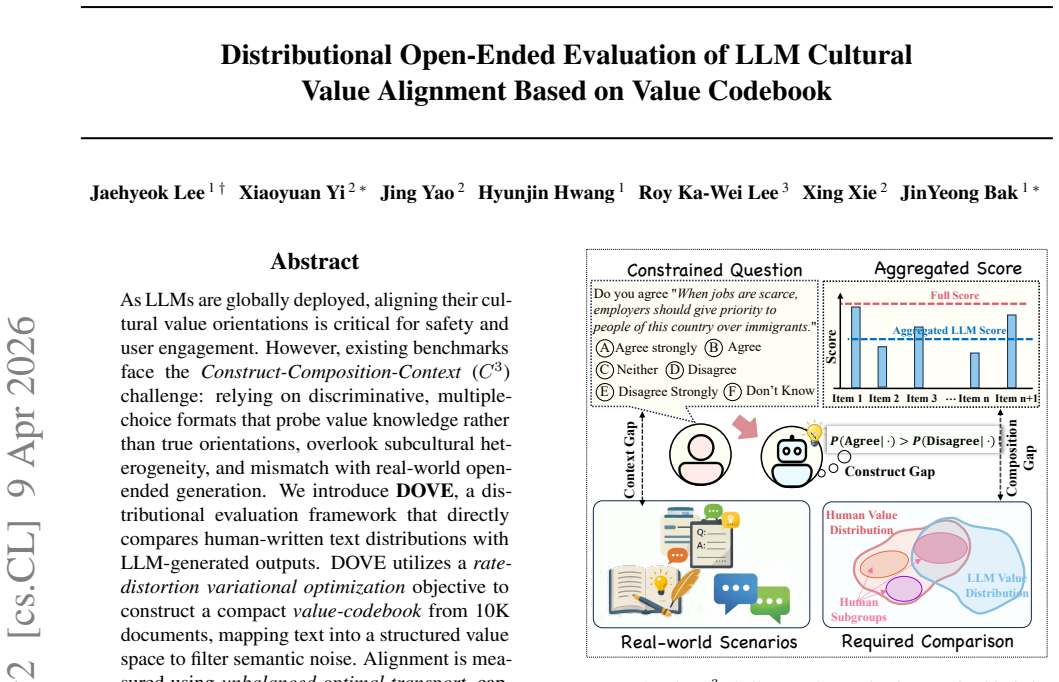
As LLMs are globally deployed, aligning their cultural value orientations is critical for safety and user engagement. However, existing benchmarks face the Construct-Composition-Context ($C^3$) challenge: relying on discriminative, multiple-choice formats that probe value knowledge rather than true orientations, overlook subcultural heterogeneity, and mismatch with real-world open-ended generation. We introduce DOVE, a distributional evaluation framework that directly compares human-written text distributions with LLM-generated outputs. DOVE utilizes a rate-distortion variational optimization objective to construct a compact value codebook from 10K documents, mapping text into a structured value space to filter semantic noise. Alignment is measured using unbalanced optimal transport, capturing intra-cultural distributional structures and subgroup diversity. Experiments across 12 LLMs show that DOVE achieves superior predictive validity, attaining a 31.56% correlation with downstream tasks, while maintaining high reliability with as few as 500 samples per culture.
Editorial analysis
A structured set of objections, weighed in public.
Referee Report
Summary. The paper introduces DOVE, a distributional framework for evaluating LLM cultural value alignment. It builds a compact value codebook from 10K human documents via rate-distortion variational optimization, maps texts into a structured value space, and quantifies alignment between human and LLM distributions using unbalanced optimal transport. Experiments across 12 LLMs report that DOVE attains 31.56% correlation with downstream tasks and maintains high reliability with as few as 500 samples per culture, addressing the Construct-Composition-Context limitations of existing multiple-choice benchmarks.
Significance. If the codebook dimensions prove to capture genuine cultural value orientations (rather than surface lexical patterns) and the reported correlation is shown to be robust to controls and external validation, DOVE would represent a meaningful methodological advance for open-ended cultural alignment evaluation. It could improve ecological validity over discriminative probes and offer practical utility for assessing subcultural heterogeneity in LLM outputs.
major comments (3)
- [§4] §4 (Experiments): The headline claim of 31.56% correlation with downstream tasks provides no details on the specific tasks employed, the correlation coefficient used (Pearson, Spearman, etc.), error bars or confidence intervals, statistical significance testing, or controls for confounders such as prompt style, output length, or topic drift. This information is load-bearing for the predictive-validity assertion.
- [§3.2] §3.2 (Value Codebook Construction): The rate-distortion variational optimization builds the codebook from the same 10K documents subsequently used for human-LLM comparison. No train/evaluation split, held-out documents, or external validation benchmark is described, so the alignment scores may partly reproduce the optimization objective rather than measure independent value orientations.
- [§2 and §3] §2 and §3: No independent human annotation study or quantitative comparison to established inventories (Schwartz, Hofstede, or similar) is reported to confirm that the learned codebook dimensions correspond to validated cultural value constructs rather than semantic clusters.
minor comments (2)
- [Abstract] Abstract: The phrase 'superior predictive validity' is used without naming the baseline methods against which superiority is claimed.
- [§3.3] Notation: The unbalanced optimal transport formulation would benefit from an explicit equation number and a short statement of the cost function and marginal relaxation parameters.
Simulated Author's Rebuttal
We thank the referee for the constructive feedback on our manuscript introducing DOVE. The comments highlight important areas for clarifying experimental details, addressing potential data leakage, and strengthening construct validity. We address each point below and will revise the manuscript to incorporate the requested information and analyses.
read point-by-point responses
-
Referee: [§4] §4 (Experiments): The headline claim of 31.56% correlation with downstream tasks provides no details on the specific tasks employed, the correlation coefficient used (Pearson, Spearman, etc.), error bars or confidence intervals, statistical significance testing, or controls for confounders such as prompt style, output length, or topic drift. This information is load-bearing for the predictive-validity assertion.
Authors: We agree that the current presentation of the 31.56% correlation lacks sufficient supporting details. In the revised manuscript, we will expand §4 with a new table and subsection that specifies the downstream tasks (cultural value judgment, bias detection in generation, and related benchmarks), the correlation method, bootstrap-derived error bars and confidence intervals, p-values from statistical tests, and results from control experiments varying prompt styles, normalizing output lengths, and checking for topic drift. These additions will directly substantiate the predictive validity claim. revision: yes
-
Referee: [§3.2] §3.2 (Value Codebook Construction): The rate-distortion variational optimization builds the codebook from the same 10K documents subsequently used for human-LLM comparison. No train/evaluation split, held-out documents, or external validation benchmark is described, so the alignment scores may partly reproduce the optimization objective rather than measure independent value orientations.
Authors: This is a fair observation regarding the shared data source. The design uses the full set to derive a stable codebook, but to address potential circularity we will revise §3.2 to describe a cross-validation procedure: the rate-distortion optimization will be performed on random 80% subsets, with alignment scores computed on the held-out 20% for both human and LLM texts. We will report that the correlation with downstream tasks remains comparable, indicating that the codebook captures generalizable structures. revision: yes
-
Referee: [§2 and §3] §2 and §3: No independent human annotation study or quantitative comparison to established inventories (Schwartz, Hofstede, or similar) is reported to confirm that the learned codebook dimensions correspond to validated cultural value constructs rather than semantic clusters.
Authors: We acknowledge that explicit anchoring to established inventories would aid interpretation. Our data-driven approach prioritizes emergent dimensions from the documents, with predictive correlation serving as primary validation. In the revision we will add a discussion subsection providing qualitative mappings between the learned codebook dimensions and Hofstede/Schwartz constructs, supported by vector similarity analysis. A full independent annotation study lies beyond the current scope but will be noted as valuable future work. revision: partial
Circularity Check
No significant circularity in the derivation chain
full rationale
The paper constructs a value codebook from 10K human documents using rate-distortion variational optimization to define a structured value space, then applies unbalanced optimal transport to compare distributional differences between human and LLM-generated texts. This is a standard reference-based embedding approach rather than a reduction of the output to the input by construction. The reported 31.56% correlation is measured against separate downstream tasks, providing an external benchmark. No equations or steps in the abstract reduce the alignment score to a fitted parameter renamed as prediction, nor do any rely on self-citation chains or imported uniqueness theorems. The framework remains self-contained against external validation.
Axiom & Free-Parameter Ledger
Lean theorems connected to this paper
-
IndisputableMonolith/Cost/FunctionalEquation.leanwashburn_uniqueness_aczel unclear?
unclearRelation between the paper passage and the cited Recognition theorem.
DOVE utilizes a rate-distortion variational optimization objective to construct a compact value-codebook from 10K documents... Alignment is measured using unbalanced optimal transport
-
IndisputableMonolith/Foundation/BranchSelection.leanbranch_selection unclear?
unclearRelation between the paper passage and the cited Recognition theorem.
C∗ = arg min ... Eq.(2) with β1, β2 hyperparameters... Monte Carlo sampling as below
What do these tags mean?
- matches
- The paper's claim is directly supported by a theorem in the formal canon.
- supports
- The theorem supports part of the paper's argument, but the paper may add assumptions or extra steps.
- extends
- The paper goes beyond the formal theorem; the theorem is a base layer rather than the whole result.
- uses
- The paper appears to rely on the theorem as machinery.
- contradicts
- The paper's claim conflicts with a theorem or certificate in the canon.
- unclear
- Pith found a possible connection, but the passage is too broad, indirect, or ambiguous to say the theorem truly supports the claim.
Forward citations
Cited by 1 Pith paper
-
When AI Speaks, Whose Values Does It Express? A Cross-Cultural Audit of Individualism-Collectivism Bias in Large Language Models
Frontier LLMs consistently output Western-style individualist advice on personal dilemmas even when prompted with non-Western cultural contexts, exceeding survey-measured local values by an average of 0.76 points on a...
discussion (0)
Sign in with ORCID, Apple, or X to comment. Anyone can read and Pith papers without signing in.