REVIEW 3 major objections 5 minor 16 references
Adaptive Stress Testing with Reward Augmentation for Autonomous Vehicle Validation
T0 review · 3 major / 5 minor · reviewed 2026-08-14 · deepseek-v4-flash
Pith's one-line read By augmenting the Adaptive Stress Testing reward with Responsibility-Sensitive Safety and trajectory-dissimilarity terms, this paper shows that simulation-based failure search can recover a broader, more relevant set of autonomous-vehicle…
desk verdict Practical AST reward tweaks with a plausible RSS demonstration, but the diversity claim needs repeated-seed evidence before it can be taken literally. read the letter →
The pith
A machine-rendered reading of the paper's core claim, the machinery that carries it, and where it could break.
The reading
What carries the argument
The load-bearing object is the augmented reward function of the AST Markov decision process. Generic AST gives $R(s)=0$ for a critical state, $-\alpha-\beta D(r_v,r_p)$ when the episode times out without a collision, and $-M(a|s)$ during the episode, where $M$ is the Mahalanobis distance penalizing unlikely environment actions. The RSS augmentation replaces the critical set with $E_\mathrm{RSS}=\{\tau \mid \tau\in E,\ f_\mathrm{imp}(\tau)>f_\mathrm{crit}\}$ and replaces the terminal distance term with a penalty proportional to the fraction of improper timesteps, biasing the solver toward collisions the vehicle could have avoided. The trajectory-dissimilarity augmentation rewards a failure trajectory with $\frac{\gamma}{\mu}\sum_i D(\tau_s,\tau_i)$, where $D$ averages the Euclidean distance between $n$ normalized segment centers of mass of the new trajectory and each previously returned failure trajectory, so the solver is pushed away from failure modes it has already found. These two mechanisms, alone or in combination, are what carry the argument that reward augmentation changes the discovered failure space.
What would settle it
Run a dense uniform random search over the same environment-action space in the same simulator and count how often the vehicle-induced pedestrian collisions and vehicle-vehicle collisions occur. If those modes appear at comparable rates under random search, then the augmented-reward result is a statement about search efficiency rather than about the existence of a larger failure space; if they never appear, the claim that these are genuine failures of the AV policy would need to be re-examined.
Extended reading notes
Core claim
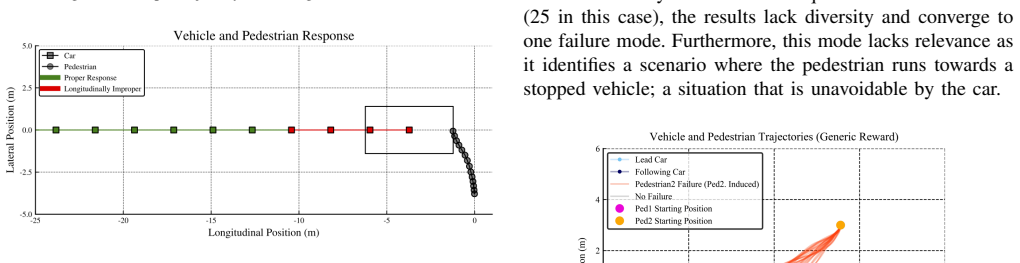
The central discovery, stated on the paper's own terms, is that the reward function in AST controls not only whether failures are found but which failures are found, and that domain knowledge can be injected through that reward to make the search return failures that matter. The RSS augmentation restricts the critical set to trajectories whose fraction of improper vehicle timesteps, $f_\mathrm{imp}(\tau)$, exceeds a threshold $f_\mathrm{crit}$, and uses $\beta f_\mathrm{imp}(\tau)$ as the penalty for trajectories that do not reach that set; in the single-pedestrian TRPO experiment, the trajectories found by this reward have substantially higher improper-response fractions than those found by generic AST. The trajectory-dissimilarity augmentation changes the reward for reaching the critical set to $\frac{\gamma}{\mu}\sum_{i=1}^{\mu} D(\tau_s,\tau_i)$, the average dissimilarity between the new failure trajectory and previously found failures, where $D$ is computed from normalized segment centers of mass. In the two-vehicle, two-pedestrian MCTS experiment, generic AST returned 25 failures, all pedestrian-induced collisions with a stopped vehicle, while the dissimilarity-augmented reward returned 15 pedestrian-induced collisions, 4 vehicle-induced vehicle/pedestrian collisions, and 6 vehicle/vehicle collisions, showing a larger and more expressive subset of the failure space.
Load-bearing premise
The RSS reward depends on the assumption that the chosen Responsibility-Sensitive Safety rules and parameters—including a zero response time and the specified acceleration bounds—correctly say when the autonomous vehicle is to blame in a collision; if that responsibility label is wrong, the 'relevant' failures it highlights are mislabeled and no more useful than the generic ones.
Editorial extensions
If this is right
- Validation runs with AST can now report a portfolio of failures across multiple modes, so an engineer learns about several weaknesses in one campaign rather than one repeated weakness.
- Failures found with the RSS reward are more likely to be cases where the autonomous vehicle's own behavior is blameworthy, which points directly at places where the driving policy needs improvement.
- The trajectory-dissimilarity term can be applied to any black-box simulator that exposes trajectories, so the diversity mechanism is not tied to the specific crosswalk scenario.
- The number of failures returned by AST is an incomplete measure of validation value; the distribution of failure types and their responsibility classification matters as much as the count.
- Combining the RSS and dissimilarity rewards in one framework should, if the paper's mechanism is right, yield a set of failures that is simultaneously diverse and vehicle-induced, which is the natural next step the authors identify.
Reading between the lines
- A testable extension the authors leave implicit is to apply the RSS reward to label the other agents' behavior as well as the AV's, so AST could be used to find failures caused by pedestrians or other vehicles, not only failures the AV should have prevented.
- The fixed coefficient $\gamma$ in the dissimilarity reward could be annealed over the search horizon; a time-varying weight would let the solver first explore broadly and then concentrate on separating the most similar remaining failure modes, which the paper's constant-weight setup does not address.
- The paper measures diversity by spatial trajectory shape; a complementary metric would define diversity by failure mechanism (sensor-noise-induced versus control-induced), which might correlate more directly with which subsystem of the autonomy stack needs fixing.
- Because the RSS parameters (including $\rho=0$ and the chosen acceleration bounds) are simulator-specific, a practical deployment would need to calibrate them to the actual vehicle and pedestrian dynamics; the set of 'relevant' failures will shift if those parameters change.
Signed reviews
Editorial analysis
A structured set of objections, weighed in public.
Referee Report
Summary. The paper addresses a known limitation of Adaptive Stress Testing (AST) for autonomous vehicle validation: generic AST tends to find unavoidable collisions and repeatedly discovers similar failure modes. The authors propose two reward augmentations: (1) an RSS-based reward that gives zero terminal reward only to collisions where the vehicle's trajectory has an improper fraction above a threshold fcrit, and (2) a trajectory dissimilarity reward that adds a bonus proportional to the average distance between a new failure trajectory and previously found top failures. They evaluate the RSS augmentation with TRPO in a single-pedestrian crosswalk scenario, reporting a shift in the distribution of the improper-timestep fraction, and evaluate the dissimilarity reward with MCTS in a two-vehicle/two-pedestrian scenario, reporting counts of failure types in Table III. The authors conclude that augmented AST discovers a larger and more expressive subset of the failure space compared with generic AST, and that these failures are more relevant for validating an autonomous vehicle policy.
Significance. If the empirical claims hold, this is a practical and useful contribution. The paper clearly identifies a genuine bottleneck of AST (mode collapse and discovery of unavoidable collisions) and proposes two well-motivated, easy-to-implement reward modifications. The specific new failure types in Table III (vehicle-induced vehicle/pedestrian and vehicle/vehicle failures) are exactly the kinds of outcomes that matter for AV validation, and the paper states a falsifiable empirical prediction: the augmented reward will discover failure modes that generic AST does not. The manuscript does not provide formal guarantees, machine-checked proofs, or a code release, but the method description is sufficiently detailed to reimplement. The main weakness is statistical: the headline comparison rests on a single run per condition, and the quantitative claims are partly evaluated using metrics that are also the optimized objectives.
major comments (3)
- [Section IV-B, Table III] The strongest claim in the paper, that generic AST 'did not discover' vehicle-induced vehicle/pedestrian or vehicle/vehicle failures, rests on counts that appear to come from a single MCTS run per reward condition. AST is stochastic: MCTS uses random rollouts and the policies or tree statistics are randomly initialized. A single run cannot establish that generic AST produces zero failures of those types. Please repeat the experiment over multiple seeds and report means with confidence intervals, or apply a statistical test (e.g., a Poisson or bootstrap comparison) to the failure-type counts. If repeated runs yield nonzero counts for generic AST, the conclusion must be softened from 'did not discover at all' to 'discovered significantly less frequently.' This is load-bearing because the abstract and Section V directly claim a larger and more expressive subset of the failure space.
- [Section IV-A, Figure 4 and Eq. (6)] The RSS reward directly optimizes the fraction of improper timesteps fimp: the terminal reward is zero only if fimp exceeds fcrit, and the non-terminal penalty is proportional to fimp. Observing that RSS-augmented AST produces trajectories with higher fimp is therefore partly a consequence of the objective rather than independent evidence of improved relevance. To support the claim that these failures are 'more useful,' evaluate relevance with a measure not contained in the reward, such as an independent avoidability label, human expert judgment, or a quantitative metric of whether the vehicle could have acted differently. In addition, Figure 4 shows aggregate histograms without error bars or a statistical comparison; statements such as 'the most common type of failure involves vehicle trajectories where the vehicle is not at fault' are not supported without repeated trials and a quantitative comparison.
- [Section III, Table I] The reported results depend on several free parameters that are not analyzed: fcrit, gamma, n, alpha, beta, and the RSS parameters in Table I (rho = 0 and the chosen acceleration bounds). These choices directly determine which trajectories are classified as improper and how much weight is placed on diversity. In particular, rho = 0 and the acceleration bounds are plausible but not validated, and the paper itself notes that 'for industrial applications, these parameters should be chosen with care.' A sensitivity analysis, or at least a discussion of how the qualitative conclusions change with these parameters, is needed to support the generality of the contribution. The stated assumption in Section III-A that higher fimp implies higher likelihood of collision is also asserted rather than tested; please provide evidence for this correlation or soften the claim.
minor comments (5)
- [Section II-B, Eq. (3)] The displayed formula for the head-on safe longitudinal distance contains ambiguous notation ('v1 +v1,rho 2 rho' appears to be a typesetting error); please re-typeset it so that the product terms are clear and consistent with the definitions of v1,rho and v2,rho.
- [Section IV-B, Table III] The decrease in pedestrian-induced failures from 25 (generic) to 15 (TD reward) is not discussed. Since the dissimilarity reward changes the composition of the returned set, a short discussion of this trade-off would help readers understand whether the augmentation sacrifices coverage of one failure mode to gain another.
- [Section IV-B] The paper states that the MCTS solver is run for 'the same number of iterations' but does not report the number of iterations, the UCT exploration constant, the rollout policy, or the TRPO network architecture and training hyperparameters. Please include these details for reproducibility.
- [Section IV-A, Figure 4] Consider presenting the fimp distributions as normalized empirical CDFs or as histograms with bin counts and error bars, rather than smoothed density curves, so that the comparison between the generic and RSS-augmented conditions is more quantitative and easier to assess.
- [Abstract and Section V] The phrases 'more expressive subset of the failure space' and 'relevant failures' are used without operational definitions. Adding a precise definition of expressiveness and a criterion for failure relevance would sharpen the claims and make them testable.
Circularity Check
RSS and TD evaluations reuse the exact quantities inserted into the reward; categorical failure modes provide partial independence.
-
self definitional
[Section III-A, Eqs. (5)-(6); Section IV-A, Fig. 4]
"We define fimp as the fraction of timesteps considered improper by RSS for the state trajectory of the autonomous vehicle. The set of critical events E is altered to only include events that result from trajectories where the AV has behaved improperly. ... RRSS(s) = 0 s∈ERSS; -α-βfimp(τ) s∉ERSS,t≥T. ... For the RSS reward function, all trajectories have a non-zero fraction of improper timesteps, and in most trajectories, the AV policy behaved improperly for more than 25% of the simulation timesteps."
The RSS-augmented reward explicitly contains -β fimp, so the RL solver is directly rewarded for maximizing fimp, the same quantity later reported as the main evidence of finding 'relevant' failures. In addition, the critical set is redefined by Eq. (5) to contain only trajectories with fimp > fcrit, so any discovered failure must, by construction, have a positive improper fraction. The observation that RSS-augmented AST yields high fimp is therefore a direct consequence of the objective, not an independent finding. The only independent content is whether these fimp-defined failures are indeed more 'relevant' in an external sense, which is not separately evaluated.
-
self definitional
[Section III-B, Eq. (8); Section IV-B, Fig. 8 and Table III]
"The reward function is then modified as follows RTD(s) = γ/μ ∑_{i=1}^{μ} D(ts,ti) for s∈E. ... By incorporating the dissimilarity metric, the solver is able to explore a larger subset of the failure space. Table III shows that the trajectories obtained now consist of other failure modes in addition to the pedestrian induced ones discovered using the generic AST reward function."
Equation (8) gives a positive reward proportional to the sum of trajectory-dissimilarity values D(ts,ti) between the current trajectory and previously found top failures. The solver is therefore explicitly selecting trajectories to maximize the same dissimilarity-based diversity metric that the paper then reports as evidence of a 'larger and more expressive subset of the failure space.' The categorical breakdown in Table III is not identical to D and provides some independent signal, but the returned set is generated and ranked under the TD objective, so the headline diversity result is substantially forced by the reward definition.
full rationale
Two evaluation claims in the paper reduce, at least in part, to the reward definitions. First, the RSS reward inserts fimp into the objective and redefines failures to require fimp > fcrit, so finding trajectories with high improper-response fractions is guaranteed by construction; the paper then uses this same fimp distribution as evidence of finding 'relevant' failures. Second, the TD reward directly rewards trajectory dissimilarity D, and the paper reports increased diversity as a central success; this is the selected objective, not an independent outcome. However, the paper also reports categorical failure types (vehicle-induced vehicle/pedestrian, vehicle/vehicle) in Table III, which are not directly encoded in the TD reward, and the RSS qualitative example in Fig. 6 demonstrates a specific improper-braking failure mode that is meaningfully different from the generic AST result. These categorical and qualitative results give the central claim some independent empirical content. The self-citations in the paper are to baseline AST work and are not load-bearing for the new augmentation claims. The single-run, no-confidence-interval issue noted by the skeptic is a correctness/robustness concern, not a circularity concern, and does not affect this score.
Assumptions & free parameters
free parameters (6)
- α (collision penalty constant) =
10000
- β (distance penalty constant) =
1000
- fcrit (RSS improper timestep threshold) =
not specified
- γ (diversity reward weight) =
not specified
- n (number of trajectory segments) =
not specified
- RSS parameters (ρ, a_acc_max, a_brk_min, a_brk_max) =
ρ=0, a_acc_max=0.1g, a_brk_min=0.05g lateral and 0.7g longitudinal, a_brk_max=0.7g
assumptions (4)
- domain assumption AST formulation as an MDP and the use of RL solvers correctly find the most likely failures of the system-under-test.
- domain assumption The RSS model is a correct formalization of safe driving responsibilities and can be applied to the pedestrian-vehicle interaction.
- ad hoc to paper Trajectories with a higher fraction of improper timesteps are more likely to end in a collision (Section III-A).
- domain assumption The simulated crosswalk scenario with IDM vehicle control is representative of real autonomous vehicle validation needs.
Cite this review
Pith. "Pith review of Adaptive Stress Testing with Reward Augmentation for Autonomous Vehicle Validation." pith.science (2026). https://pith.science/paper/PE4A4JVH
@misc{pith2026190801046,
  author       = {Pith},
  title        = {Pith review of: Adaptive Stress Testing with Reward Augmentation for Autonomous Vehicle Validation},
  year         = {2026},
  howpublished = {\url{https://pith.science/paper/PE4A4JVH}},
  note         = {Machine review of arXiv:1908.01046}
}
read the original abstract
Determining possible failure scenarios is a critical step in the evaluation of autonomous vehicle systems. Real-world vehicle testing is commonly employed for autonomous vehicle validation, but the costs and time requirements are high. Consequently, simulation-driven methods such as Adaptive Stress Testing (AST) have been proposed to aid in validation. AST formulates the problem of finding the most likely failure scenarios as a Markov decision process, which can be solved using reinforcement learning. In practice, AST tends to find scenarios where failure is unavoidable and tends to repeatedly discover the same types of failures of a system. This work addresses these issues by encoding domain relevant information into the search procedure. With this modification, the AST method discovers a larger and more expressive subset of the failure space when compared to the original AST formulation. We show that our approach is able to identify useful failure scenarios of an autonomous vehicle policy.
Figures


Figures from the paper (6 more)




Reference graph
Works this paper leans on
-
[1]
Challenges in Au- tonomous Vehicle Testing and Validation,
P. Koopman and M. Wagner, “Challenges in Au- tonomous Vehicle Testing and Validation,” in SAE World Congress, 2016
work page 2016
-
[2]
N. Kalra and S. M. Paddock, “Driving to Safety: How Many Miles of Driving Would It Take to Demonstrate Autonomous Vehicle Reliability?,” RAND Corpora- tion, 2016
work page 2016
-
[3]
Evaluation of Different Approaches to Address Safety Validation of Automated Driving,
P. Junietz, W. Wachenfeld, and H. Winner, “Evaluation of Different Approaches to Address Safety Validation of Automated Driving,” in IEEE International Con- ference on Intelligent Transportation Systems (ITSC) , 2018, pp. 491–496
work page 2018
-
[4]
Adaptive Generation of Challenging Scenarios for Testing and Evaluation of Autonomous Vehicles,
G. E. Mullins, P. G. Stankiewicz, R. C. Hawthorne, and S. K. Gupta, “Adaptive Generation of Challenging Scenarios for Testing and Evaluation of Autonomous Vehicles,”Journal of Systems and Software , vol. 137, pp. 197–215, 2018
work page 2018
-
[5]
Scalable End-to-End Autonomous Vehi- cle Testing via Rare-event Simulation,
M. O’Kelly, A. Sinha, H. Namkoong, J. C. Duchi, and R. Tedrake, “Scalable End-to-End Autonomous Vehi- cle Testing via Rare-event Simulation,” inAdvances in Neural Information Processing Systems (NIPS) , 2018
work page 2018
-
[6]
C. E. Tuncali, G. Fainekos, H. Ito, and J. Kapinski, “Simulation-based Adversarial Test Generation for Autonomous Vehicles with Machine Learning Com- ponents,” in IEEE Intelligent V ehicles Symposium (IV), 2018, pp. 1555–1562
work page 2018
-
[7]
In- telligence Testing for Autonomous Vehicles: A New Approach,
L. Li, W. Huang, Y . Liu, N. Zheng, and F. Wang, “In- telligence Testing for Autonomous Vehicles: A New Approach,” IEEE Transactions on Intelligent V ehicles, vol. 1, no. 2, pp. 158–166, 2016
work page 2016
-
[8]
Adaptive Stress Testing of Airborne Collision Avoidance Systems,
R. Lee, M. J. Kochenderfer, O. J. Mengshoel, G. P. Brat, and M. P. Owen, “Adaptive Stress Testing of Airborne Collision Avoidance Systems,” in Digital Avionics Systems Conference (DASC) , 2015
work page 2015
Show all 16 references
-
[9]
On a Formal Model of Safe and Scalable Self-Driving Cars,
S. Shalev-Shwartz, S. Shammah, and A. Shashua, “On a Formal Model of Safe and Scalable Self-Driving Cars,” ARXIV, no. 1708.06374, 2017
2017 arXiv
-
[10]
Differential Adaptive Stress Testing of Collision Avoidance Sys- tems,
R. Lee, O. Mengshoel, A. Saksena, R. Gardner, D. Genin, J. Brush, and M. J. Kochenderfer, “Differential Adaptive Stress Testing of Collision Avoidance Sys- tems,” in AIAA Modeling and Simulation Conference , 2018
2018
-
[11]
Adaptive Stress Testing for Autonomous Vehicles,
M. Koren, S. Alsaif, R. Lee, and M. J. Kochenderfer, “Adaptive Stress Testing for Autonomous Vehicles,” in IEEE Intelligent V ehicles Symposium (IV) , 2018
2018
-
[12]
Con- gested Traffic States in Empirical Observations and Microscopic Simulations,
M. Treiber, A. Hennecke, and D. Helbing, “Con- gested Traffic States in Empirical Observations and Microscopic Simulations,” Physical Review E, vol. 62, pp. 1805–1824, 2000
2000
-
[13]
On the generalized distance in statis- tics,
P. Mahalanobis, “On the generalized distance in statis- tics,” Proceedings of National Institute of Sciences (India), vol. 2, pp. 49–55, 1936
1936
-
[14]
A Survey of Monte Carlo Tree Search Methods,
C. B. Browne, E. Powley, D. Whitehouse, S. M. Lucas, P. I. Cowling, P. Rohlfshagen, S. Tavener, D. Perez, S. Samothrakis, and S. Colton, “A Survey of Monte Carlo Tree Search Methods,” IEEE Transactions on Computational Intelligence and AI in Games , vol. 4, no. 1, pp. 1–43, 2012
2012
-
[15]
Trust Region Policy Optimization,
J. Schulman, S. Levine, P. Abbeel, M. I. Jordan, and P. Moritz, “Trust Region Policy Optimization,” in In- ternational Conference on Machine Learning (ICML) , 2015
2015
-
[16]
Similarity Measurement of Moving Object Trajectories,
H. Liu and M. Schneider, “Similarity Measurement of Moving Object Trajectories,” in ACM SIGSPA- TIAL International Workshop on GeoStreaming , 2012, pp. 19–22
2012
Reviewed August 14, 2026 · model on record in the stance chip above.
Discussion (0). Continue with ORCID to comment.