REVIEW 4 major objections 4 minor 4 cited by
Peri-LN: Revisiting Normalization Layer in the Transformer Architecture
T0 review · 4 major / 4 minor · reviewed 2026-08-09 · deepseek-v4-flash
Pith's one-line read By normalizing both the input and the output of each sublayer, the Peri-LN design curbs the exponential hidden-state growth that destabilizes Pre-LN transformers, and the paper's experiments up to 3.2B parameters show it beats both Pre-LN…
desk verdict Honest, compute-heavy empirical study of output normalization that mostly delivers, with a theoretical bound that is real but loosely framed. read the letter →
The pith
A machine-rendered reading of the paper's core claim, the machinery that carries it, and where it could break.
The reading
What carries the argument
The carrying object is the Peri-LN layer formula $y_l = x_l + \mathrm{Norm}(\mathrm{Module}(\mathrm{Norm}(x_l)))$ (Eq. 3), i.e., layer normalization both before and after each attention or MLP sublayer, with the residual added outside the output normalization. Two formal pieces do the work: the variance recurrence $\mathrm{Var}(x_{l+1}) \approx \mathrm{Var}(x_l) + \beta_0$ (Eq. 4), which converts exponential hidden-state growth into linear growth, and the gradient bound of Proposition 3.1, $\|\partial L/\partial W^{(2)}_{i,j}\| \le 4\gamma\sqrt{D}\,\|h\|/\|a\|$, which shows the output normalizer introduces a damping factor $\|a\|$ that keeps final-layer gradients bounded even when the hidden state $h$ is massive. The same bound shows why Pre-LN explodes: with no output normalizer, the gradient is proportional to $\|h\|$ with no denominator to absorb it.
What would settle it
Remove the output normalizer from a trained Peri-LN model and continue training under the same schedule; if the run keeps its stable loss and does not develop Pre-LN-style gradient spikes and variance growth, the output normalizer is not the active stabilizer.
Extended reading notes
Core claim
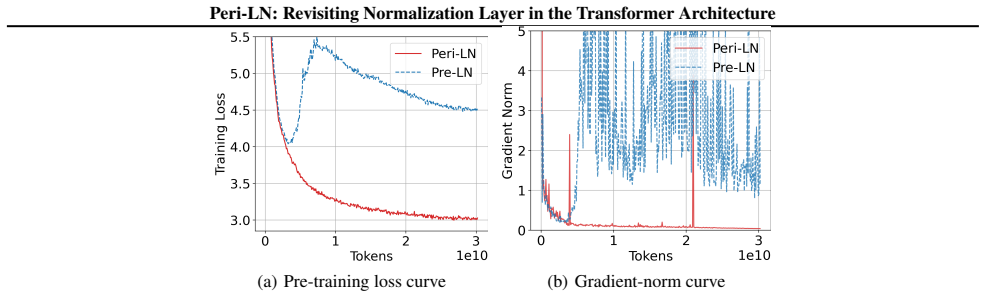
The central discovery this paper sets out to establish is that the third, largely unnamed normalization placement used by recent open-source transformers deserves to be a first-class design choice. In Peri-LN, each sublayer is wrapped by normalization on both ends: input normalization before the module and output normalization after it, followed by the residual addition, with embedding and final outputs normalized as well. The paper's analysis shows that Pre-LN's hidden-state variance, which grows only linearly at initialization, later escalates exponentially under training, because nothing damps large module outputs carried by the residual 'highway.' Peri-LN adds an output normalizer whose near-constant variance $\beta_0$ makes the per-layer variance recurrence $\mathrm{Var}(x_{l+1}) \approx \mathrm{Var}(x_l) + \beta_0$, yielding linear rather than exponential growth. Its gradient bound (Proposition 3.1) shows the output normalizer damps the final-layer gradient by a factor $\|a\|$, the norm of the module output, which Pre-LN lacks. Empirically, the paper reports that Peri-LN consistently achieves superior loss curves over the whole 400M to 3.2B range, fewer divergences across seeds, lower seed-to-seed benchmark variance, and hidden states that stay below the FP16 overflow threshold throughout training.
Load-bearing premise
The whole variance argument assumes that the output-normalized module $y_l = x_l + \mathrm{Norm}(\mathrm{Module}(\mathrm{Norm}(x_l)))$ keeps a near-constant output variance $\beta_0$ throughout training, so that hidden-state variance rises only linearly with depth; if parameter updates break that near-constant variance, the claimed difference between linear Peri-LN growth and exponential Pre-LN growth no longer holds.
Editorial extensions
If this is right
- Pretraining runs that use Peri-LN in place of Pre-LN, with all other settings fixed, are less likely to diverge and need no extra learning-rate tuning to reach the same loss.
- Peri-LN keeps the top hidden-state magnitudes below the FP16 maximum throughout a 3.2B-parameter run, so the design extends the useful lifetime of FP16 hardware and mixed-precision training.
- Because benchmark variance across training seeds drops by more than half with Peri-LN, results from a single run are more reproducible.
- The gradient bound implies that the output normalizer acts as a built-in stabilizer that protects the final layer even when earlier layers produce huge activations.
- Recent open models that already place a normalizer at the sublayer output become instances of the same mechanism, giving a unified explanation of their stability.
Reading between the lines
- The variance-tracking diagnostic the paper uses could be repurposed as an early warning: monitoring final-layer hidden-state variance during the first training steps would flag a Pre-LN-style run that is about to diverge, before the gradient spike appears.
- The gradient bound suggests output normalization should also reduce quantization outliers, since massive activations are the same values that strain low-precision formats; this connects the normalization-placement question to compression, a link the paper only gestures at.
- A testable prediction follows: at larger scales than 3.2B, the gap between Pre-LN and Peri-LN should widen, because the exponential variance growth of Pre-LN compounds with depth while Peri-LN's linear growth does not.
Editorial analysis
A structured set of objections, weighed in public.
Referee Report
Summary. The paper studies where to place layer normalization inside Transformer sublayers and identifies a third strategy, termed Peri-LN, which applies normalization both before and after each Attention/MLP module (Eq. 3). The authors claim that Peri-LN controls hidden-state variance growth, keeps gradient norms stable, and prevents the early-training divergence that can occur with Pre-LN. They support this with a theoretical analysis in §3.3–§3.4 and Appendix C, and with large-scale experiments on 400M, 1.5B, and 3.2B models trained on 30B tokens, reporting lower pre-training loss and higher benchmark scores than Pre-LN and Post-LN (Table 1). The paper also documents that several existing open models (Gemma, OLMo) already use this design, and it positions Peri-LN as a unifying term for that practice.
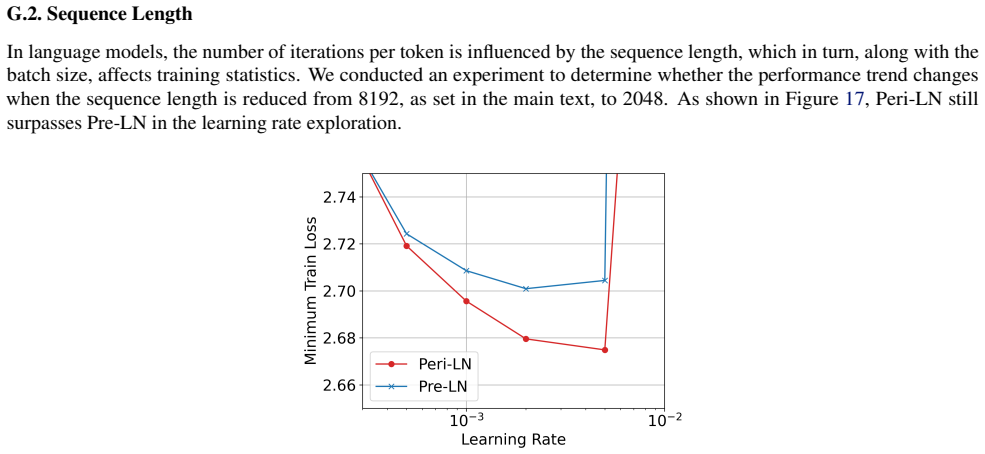
Significance. If the empirical claims hold, this is a practically useful study of a normalization design already used in production-scale open models, offering a systematic comparison that was previously missing. The experimental effort is substantial: three model sizes, five seeds, learning-rate sweeps, 30B-token pre-training, and ablations over weight decay, initialization variance, sequence length, warmup, LayerNorm vs RMSNorm, and OLMo2-style QK-Norm. The paper also gives credit where due by noting that Gemma and OLMo adopted this design earlier. However, the advertised 'comprehensive analytical foundation' is not delivered as stated: the main gradient bound is a ratio that is not uniformly bounded, and the benchmark comparison excludes diverged runs, which biases the averages in favor of the architectures that diverge.
major comments (4)
- [§3.4, Prop. 3.1(2); Appendix C.2, Eq. (21)] The proposition states that Peri-LN 'ensures that the gradient norm remains bounded,' but the bound proved in Eq. (21) is ||∂L/∂W^(2)|| ≤ 4γ√D ||h||/||a||. This is not bounded independent of activations: if ||h|| is large while ||a|| is moderate, the bound can be arbitrarily large. The 'damping factor' ||a|| only converts an absolute scale in ||h|| into a ratio; for the stated conclusion one would need a separate argument that ||a|| grows at least proportionally to ||h||, and none is provided. Because this proposition is invoked in §4.2, §5.3, §6.1, and §7.1 as the analytical explanation for Peri-LN's stability, the theoretical claim as written is an overstatement. The proposition should be rephrased as a relative bound (Peri-LN divides the Pre-LN gradient by ||a||) or supplemented with the missing condition that controls ||h||/||a||.
- [Table 1 and Appendix J.2.1] The caption of Table 1 says 'Diverged checkpoints are excluded from the evaluation score computation,' and Table 11 shows that two of the five Pre-LN 400M seeds and three of the five Pre-LN 3.2B seeds diverged. Excluding those runs from the average removes exactly the failures that the paper cites as Peri-LN's advantage ('often prevents divergence,' §7.1). As a result, the reported Pre-LN benchmark averages are optimistic and the comparison is not apples-to-apples. Please report the averages with diverged runs counted as failures, report the divergence rate for each configuration, or restrict the comparison to the subset of seeds that completed training in all architectures. This is load-bearing for the benchmark-superiority claim.
- [§3.4 and Appendix C] The formal propositions analyze a single MLP block whose output is followed directly by a softmax loss, not a multi-layer Transformer. The main text then uses these bounds to explain 'gradient spikes, and occasional divergences that arise in Pre-LN during large-scale pre-training' (§4.3) across the full stacked architecture. The transfer from the simplified one-block setting to a deep Transformer is asserted rather than derived. Please state this limitation explicitly in the main text and either provide a per-layer accumulation argument or present the bound as a heuristic motivation for the empirical results.
- [§3.3, Eq. (4)] The forward-pass argument claims that if Norm(Module(Norm(x_l))) has near-constant variance β0, then hidden-state variance grows approximately linearly with depth (Eq. 4). This near-constant-variance assumption is not derived and could fail after parameter updates; Figures 6 and 10 provide indirect empirical support, but the paper does not directly measure the per-block output variance over training. If the assumption fails, the claimed distinction between linear (Peri-LN) and exponential (Pre-LN) variance growth loses its theoretical basis. Please state this as an empirical regularity and provide a direct measurement of Norm(Module(Norm(x_l))) variance across depth and training steps.
minor comments (4)
- [Figure 3(a) caption] The caption contains a typo: 'llustrates' should be 'illustrates.'
- [§4.2] There is a missing space in 'learning rate2 × 10−3'; it should read 'learning rate 2 × 10⁻³.'
- [§3.2] The sentence beginning 'However, Recent studies have also reported...' has a capitalization inconsistency; 'Recent' should not be capitalized mid-sentence.
- [Table 1 and Appendix J.1] Some numeric entries in Table 1 appear with irregular spacing (e.g., '7 .46' and '3 .43'); please normalize the formatting for readability.
Circularity Check
No significant circularity: the theoretical bounds are derived from first principles and the empirical claims are validated on external benchmarks.
full rationale
The paper's derivation chain is self-contained. Peri-LN is defined by Eq. (3), and the variance recursion in Eq. (4) follows directly from that definition under the stated assumption that the normalized module output has near-constant variance; it is not a fitted quantity or a renamed prediction. Proposition 3.1 and its proof in Appendix C are explicit chain-rule bounds, with no parameter fitted to the data and no conclusion imported from a self-citation. The empirical comparisons use external datasets (DCLM, C4, ARC, HellaSwag, PIQA, SIQA, Winogrande) and multiple seeds, so the central claim that Peri-LN improves stability and benchmark performance is not forced by construction. The paper does cite prior work by its own authors (e.g., HyperCLOVA X, quantization papers), but these citations are background context and are not load-bearing for the variance or gradient analysis. The only notable concern is that the informal phrase 'ensures that the gradient norm remains bounded' in Proposition 3.1(2) overstates the formal inequality in Eq. (8), which scales with ||h||/||a||; however, this is a correctness or interpretation issue, not circularity, because the bound is an honest derivation rather than an input disguised as an output.
Assumptions & free parameters
assumptions (4)
- domain assumption A single MLP block with ReLU and RMSNorm (Appendix C) represents the gradient behavior of the full Attention+MLP Transformer sublayer.
- domain assumption During training, Norm(Module(Norm(x_l))) has near-constant variance β0, so Peri-LN's hidden-state variance grows additively with depth (Eq. 4).
- domain assumption RMSNorm's learnable scale γ remains strictly positive throughout training.
- standard math Standard chain rule, softmax derivative, and norm inequalities in Appendix C are accepted without proof.
Cite this review
Pith. "Pith review of Peri-LN: Revisiting Normalization Layer in the Transformer Architecture." pith.science (2026). https://pith.science/paper/PHQ7GOGA
@misc{pith2026250202732,
  author       = {Pith},
  title        = {Pith review of: Peri-LN: Revisiting Normalization Layer in the Transformer Architecture},
  year         = {2026},
  howpublished = {\url{https://pith.science/paper/PHQ7GOGA}},
  note         = {Machine review of arXiv:2502.02732}
}
abstract
Selecting a layer normalization (LN) strategy that stabilizes training and speeds convergence in Transformers remains difficult, even for today's large language models (LLM). We present a comprehensive analytical foundation for understanding how different LN strategies influence training dynamics in large-scale Transformers. Until recently, Pre-LN and Post-LN have long dominated practices despite their limitations in large-scale training. However, several open-source models have recently begun silently adopting a third strategy without much explanation. This strategy places normalization layer peripherally around sublayers, a design we term Peri-LN. While Peri-LN has demonstrated promising performance, its precise mechanisms and benefits remain almost unexplored. Our in-depth analysis delineates the distinct behaviors of LN strategies, showing how each placement shapes activation variance and gradient propagation. To validate our theoretical insight, we conduct extensive experiments on Transformers up to $3.2$B parameters, showing that Peri-LN consistently achieves more balanced variance growth, steadier gradient flow, and convergence stability. Our results suggest that Peri-LN warrants broader consideration for large-scale Transformer architectures, providing renewed insights into the optimal placement of LN.
Figures


Figures from the paper (36 more)






Forward citations
Cited by 4 Pith papers
-
Improving Neural Network Training by Decoupling the Magnitude and Direction of Weight Vectors
Splitting weight matrices into a fixed-norm direction and learnable per-row/column magnitudes improves LLM training over AdamW/Muon, removes weight decay and warmup, and transfers the optimal LR across width.
-
LoRDO: Distributed Low-Rank Optimization with Infrequent Communication
LoRDO combines global low-rank projections with full-rank quasi-hyperbolic momentum to let infrequent-synchronization distributed training match low-rank DDP at roughly 10x less communication.
-
GPAS: Accelerating Convergence of LLM Pretraining via Gradient-Preserving Activation Scaling
GPAS scales down intermediate activations while preserving backward gradients, reducing activation variance growth in Pre-LN transformers and improving pretraining convergence and downstream performance.
-
SpanNorm: Reconciling Training Stability and Performance in Deep Transformers
SpanNorm—a block-level residual with PostNorm-style normalization—trains deeper transformers more stably and outperforms PreNorm and hybrid normalization on LM benchmarks.
Reference graph
Works this paper leans on
-
[1]
write newline
" write newline "" before.all 'output.state := FUNCTION n.dashify 't := "" t empty not t #1 #1 substring "-" = t #1 #2 substring "--" = not "--" * t #2 global.max substring 't := t #1 #1 substring "-" = "-" * t #2 global.max substring 't := while if t #1 #1 substring * t #2 global.max substring 't := if while FUNCTION format.date year duplicate empty "emp...
-
[2]
Ba, L. J., Kiros, J. R., and Hinton, G. E. Layer normalization. CoRR, abs/1607.06450, 2016. URL http://arxiv.org/abs/1607.06450
arXiv 2016
-
[3]
Piqa: Reasoning about physical commonsense in natural language
Bisk, Y., Zellers, R., Gao, J., Choi, Y., et al. Piqa: Reasoning about physical commonsense in natural language. In Proceedings of the AAAI conference on artificial intelligence, volume 34, pp.\ 7432--7439, 2020
2020
-
[4]
Brock, A., De, S., Smith, S. L., and Simonyan, K. High-performance large-scale image recognition without normalization. In Meila, M. and Zhang, T. (eds.), Proceedings of the 38th International Conference on Machine Learning, ICML 2021, 18-24 July 2021, Virtual Event , volume 139 of Proceedings of Machine Learning Research, pp.\ 1059--1071. PMLR , 2021 a ....
work page 2021
-
[5]
Brock, A., De, S., Smith, S. L., and Simonyan, K. High-performance large-scale image recognition without normalization. In Meila, M. and Zhang, T. (eds.), Proceedings of the 38th International Conference on Machine Learning, ICML 2021, 18-24 July 2021, Virtual Event , volume 139 of Proceedings of Machine Learning Research, pp.\ 1059--1071. PMLR , 2021 b ....
work page 2021
-
[6]
Chung, W., Hong, J., An, N. M., Thorne, J., and Yun, S. Stable language model pre-training by reducing embedding variability. In Al - Onaizan, Y., Bansal, M., and Chen, Y. (eds.), Proceedings of the 2024 Conference on Empirical Methods in Natural Language Processing, EMNLP 2024, Miami, FL, USA, November 12-16, 2024 , pp.\ 10852--10863. Association for Com...
work page 2024
-
[7]
Think you have solved question answering? try arc, the ai2 reasoning challenge, 2018
Clark, P., Cowhey, I., Etzioni, O., Khot, T., Sabharwal, A., Schoenick, C., and Tafjord, O. Think you have solved question answering? try arc, the ai2 reasoning challenge, 2018. URL https://arxiv.org/abs/1803.05457
arXiv 2018
-
[8]
Csord \' a s, R., Irie, K., Schmidhuber, J., Potts, C., and Manning, C. D. Moeut: Mixture-of-experts universal transformers. CoRR, abs/2405.16039, 2024. doi:10.48550/ARXIV.2405.16039. URL https://doi.org/10.48550/arXiv.2405.16039
Show all 45 references
-
[9]
and Smith, S
De, S. and Smith, S. L. Batch normalization biases residual blocks towards the identity function in deep networks. In Larochelle, H., Ranzato, M., Hadsell, R., Balcan, M., and Lin, H. (eds.), Advances in Neural Information Processing Systems 33: Annual Conference on Neural Inf...
2020
-
[10]
P., Caron, M., Geirhos, R., Alabdulmohsin, I., Jenatton, R., Beyer, L., Tschannen, M., Arnab, A., Wang, X., Ruiz, C
Dehghani, M., Djolonga, J., Mustafa, B., Padlewski, P., Heek, J., Gilmer, J., Steiner, A. P., Caron, M., Geirhos, R., Alabdulmohsin, I., Jenatton, R., Beyer, L., Tschannen, M., Arnab, A., Wang, X., Ruiz, C. R., Minderer, M., Puigcerver, J., Evci, U., Kumar, M., van Steenkiste,...
2023
-
[11]
Gpt3.int8(): 8-bit matrix multiplication for transformers at scale
Dettmers, T., Lewis, M., Belkada, Y., and Zettlemoyer, L. Gpt3.int8(): 8-bit matrix multiplication for transformers at scale. In Koyejo, S., Mohamed, S., Agarwal, A., Belgrave, D., Cho, K., and Oh, A. (eds.), Advances in Neural Information Processing Systems 35: Annual Confere...
2022
-
[12]
The llama 3 herd of models
Dubey, A., Jauhri, A., Pandey, A., Kadian, A., Al-Dahle, A., Letman, A., Mathur, A., Schelten, A., Yang, A., Fan, A., et al. The llama 3 herd of models. arXiv preprint arXiv:2407.21783, 2024
2024 arXiv
- [13]
-
[14]
A framework for few-shot language model evaluation, 07 2024
Gao, L., Tow, J., Abbasi, B., Biderman, S., Black, S., DiPofi, A., Foster, C., Golding, L., Hsu, J., Le Noac'h, A., Li, H., McDonell, K., Muennighoff, N., Ociepa, C., Phang, J., Reynolds, L., Schoelkopf, H., Skowron, A., Sutawika, L., Tang, E., Thite, A., Wang, B., Wang, K., a...
2024
-
[15]
Deepseek-r1: Incentivizing reasoning capability in llms via reinforcement learning
Guo, D., Yang, D., Zhang, H., Song, J., Zhang, R., Xu, R., Zhu, Q., Ma, S., Wang, P., Bi, X., et al. Deepseek-r1: Incentivizing reasoning capability in llms via reinforcement learning. arXiv preprint arXiv:2501.12948, 2025
2025 arXiv
-
[16]
Identity mappings in deep residual networks
He, K., Zhang, X., Ren, S., and Sun, J. Identity mappings in deep residual networks. In Leibe, B., Matas, J., Sebe, N., and Welling, M. (eds.), Computer Vision - ECCV 2016 - 14th European Conference, Amsterdam, The Netherlands, October 11-14, 2016, Proceedings, Part IV , volum...
2016 doi
-
[17]
A., Welbl, J., Clark, A., Hennigan, T., Noland, E., Millican, K., van den Driessche, G., Damoc, B., Guy, A., Osindero, S., Simonyan, K., Elsen, E., Rae, J
Hoffmann, J., Borgeaud, S., Mensch, A., Buchatskaya, E., Cai, T., Rutherford, E., de Las Casas, D., Hendricks, L. A., Welbl, J., Clark, A., Hennigan, T., Noland, E., Millican, K., van den Driessche, G., Damoc, B., Guy, A., Osindero, S., Simonyan, K., Elsen, E., Rae, J. W., Vin...
-
[18]
A., Khyalia, S., Jung, J., Goka, H., and Lee, H
Kedia, A., Zaidi, M. A., Khyalia, S., Jung, J., Goka, H., and Lee, H. Transformers get stable: An end-to-end signal propagation theory for language models. In Forty-first International Conference on Machine Learning, ICML 2024, Vienna, Austria, July 21-27, 2024 . OpenReview.ne...
2024
-
[19]
Y., Bansal, H., Guha, E
Li, J., Fang, A., Smyrnis, G., Ivgi, M., Jordan, M., Gadre, S. Y., Bansal, H., Guha, E. K., Keh, S., Arora, K., Garg, S., Xin, R., Muennighoff, N., Heckel, R., Mercat, J., Chen, M., Gururangan, S., Wortsman, M., Albalak, A., Bitton, Y., Nezhurina, M., Abbas, A., Hsieh, C., Gho...
-
[20]
Mix-ln: Unleashing the power of deeper layers by combining pre-ln and post-ln
Li, P., Yin, L., and Liu, S. Mix-ln: Unleashing the power of deeper layers by combining pre-ln and post-ln. arXiv preprint arXiv:2412.13795, 2024 b
2024 arXiv
-
[21]
ngpt: Normalized transformer with representation learning on the hypersphere
Loshchilov, I., Hsieh, C., Sun, S., and Ginsburg, B. ngpt: Normalized transformer with representation learning on the hypersphere. CoRR, abs/2410.01131, 2024. doi:10.48550/ARXIV.2410.01131. URL https://doi.org/10.48550/arXiv.2410.01131
-
[22]
Pointer sentinel mixture models, 2016
Merity, S., Xiong, C., Bradbury, J., and Socher, R. Pointer sentinel mixture models, 2016
2016
-
[23]
Can a suit of armor conduct electricity? a new dataset for open book question answering
Mihaylov, T., Clark, P., Khot, T., and Sabharwal, A. Can a suit of armor conduct electricity? a new dataset for open book question answering. In EMNLP, 2018
2018
-
[24]
2 olmo 2 furious
OLMo, T., Walsh, P., Soldaini, L., Groeneveld, D., Lo, K., Arora, S., Bhagia, A., Gu, Y., Huang, S., Jordan, M., et al. 2 olmo 2 furious. arXiv preprint arXiv:2501.00656, 2024
2024 arXiv
-
[25]
L., Mishkin, P., Zhang, C., Agarwal, S., Slama, K., Ray, A., Schulman, J., Hilton, J., Kelton, F., Miller, L., Simens, M., Askell, A., Welinder, P., Christiano, P
Ouyang, L., Wu, J., Jiang, X., Almeida, D., Wainwright, C. L., Mishkin, P., Zhang, C., Agarwal, S., Slama, K., Ray, A., Schulman, J., Hilton, J., Kelton, F., Miller, L., Simens, M., Askell, A., Welinder, P., Christiano, P. F., Leike, J., and Lowe, R. Training language models t...
2022
-
[26]
Raffel, C., Shazeer, N., Roberts, A., Lee, K., Narang, S., Matena, M., Zhou, Y., Li, W., and Liu, P. J. Exploring the limits of transfer learning with a unified text-to-text transformer. The Journal of Machine Learning Research, 21 0 (1): 0 5485--5551, 2020
2020
-
[27]
G., Hardin, C., Bhupatiraju, S., Hussenot, L., Mesnard, T., Shahriari, B., Ram \' e , A., Ferret, J., Liu, P., Tafti, P., Friesen, A., Casbon, M., Ramos, S., Kumar, R., Lan, C
Rivi \` e re, M., Pathak, S., Sessa, P. G., Hardin, C., Bhupatiraju, S., Hussenot, L., Mesnard, T., Shahriari, B., Ram \' e , A., Ferret, J., Liu, P., Tafti, P., Friesen, A., Casbon, M., Ramos, S., Kumar, R., Lan, C. L., Jerome, S., Tsitsulin, A., Vieillard, N., Stanczyk, P., ...
-
[28]
L., Bhagavatula, C., and Choi, Y
Sakaguchi, K., Bras, R. L., Bhagavatula, C., and Choi, Y. Winogrande: an adversarial winograd schema challenge at scale. Commun. ACM, 64 0 (9): 0 99–106, August 2021. ISSN 0001-0782. doi:10.1145/3474381. URL https://doi.org/10.1145/3474381
2021 doi
-
[29]
L., and Choi, Y
Sap, M., Rashkin, H., Chen, D., Bras, R. L., and Choi, Y. Social iqa: Commonsense reasoning about social interactions. In Inui, K., Jiang, J., Ng, V., and Wan, X. (eds.), Proceedings of the 2019 Conference on Empirical Methods in Natural Language Processing and the 9th Interna...
2019 doi
- [30]
-
[31]
Spike no more: Stabilizing the pre-training of large language models
Takase, S., Kiyono, S., Kobayashi, S., and Suzuki, J. Spike no more: Stabilizing the pre-training of large language models. CoRR, abs/2312.16903, 2023. doi:10.48550/ARXIV.2312.16903. URL https://doi.org/10.48550/arXiv.2312.16903
-
[32]
C ommonsense QA : A question answering challenge targeting commonsense knowledge
Talmor, A., Herzig, J., Lourie, N., and Berant, J. C ommonsense QA : A question answering challenge targeting commonsense knowledge. In Proceedings of the 2019 Conference of the North A merican Chapter of the Association for Computational Linguistics: Human Language Technologi...
2019 doi
-
[33]
N., Kaiser, L., and Polosukhin, I
Vaswani, A., Shazeer, N., Parmar, N., Uszkoreit, J., Jones, L., Gomez, A. N., Kaiser, L., and Polosukhin, I. Attention is all you need. In Guyon, I., von Luxburg, U., Bengio, S., Wallach, H. M., Fergus, R., Vishwanathan, S. V. N., and Garnett, R. (eds.), Advances in Neural Inf...
2017
-
[34]
GLUE : A multi-task benchmark and analysis platform for natural language understanding
Wang, A., Singh, A., Michael, J., Hill, F., Levy, O., and Bowman, S. GLUE : A multi-task benchmark and analysis platform for natural language understanding. In Proceedings of the 2018 EMNLP Workshop B lackbox NLP : Analyzing and Interpreting Neural Networks for NLP , pp.\ 353-...
2018 doi
-
[35]
L., Gugger, S., Drame, M., Lhoest, Q., and Rush, A
Wolf, T., Debut, L., Sanh, V., Chaumond, J., Delangue, C., Moi, A., Cistac, P., Rault, T., Louf, R., Funtowicz, M., Davison, J., Shleifer, S., von Platen, P., Ma, C., Jernite, Y., Plu, J., Xu, C., Scao, T. L., Gugger, S., Drame, M., Lhoest, Q., and Rush, A. M. Transformers: St...
2020
-
[36]
J., Xiao, L., Everett, K
Wortsman, M., Liu, P. J., Xiao, L., Everett, K. E., Alemi, A. A., Adlam, B., Co - Reyes, J. D., Gur, I., Kumar, A., Novak, R., Pennington, J., Sohl - Dickstein, J., Xu, K., Lee, J., Gilmer, J., and Kornblith, S. Small-scale proxies for large-scale transformer training instabil...
2024
-
[37]
On layer normalization in the transformer architecture
Xiong, R., Yang, Y., He, D., Zheng, K., Zheng, S., Xing, C., Zhang, H., Lan, Y., Wang, L., and Liu, T. On layer normalization in the transformer architecture. In Proceedings of the 37th International Conference on Machine Learning, ICML 2020, 13-18 July 2020, Virtual Event , v...
2020
-
[38]
and Hu, E
Yang, G. and Hu, E. J. Tensor programs IV: feature learning in infinite-width neural networks. In Meila, M. and Zhang, T. (eds.), Proceedings of the 38th International Conference on Machine Learning, ICML 2021, 18-24 July 2021, Virtual Event , volume 139 of Proceedings of Mach...
2021
-
[39]
J., Babuschkin, I., Sidor, S., Liu, X., Farhi, D., Ryder, N., Pachocki, J., Chen, W., and Gao, J
Yang, G., Hu, E. J., Babuschkin, I., Sidor, S., Liu, X., Farhi, D., Ryder, N., Pachocki, J., Chen, W., and Gao, J. Tensor programs V: tuning large neural networks via zero-shot hyperparameter transfer. CoRR, abs/2203.03466, 2022. doi:10.48550/ARXIV.2203.03466. URL https://doi....
-
[40]
Tensor programs VI: feature learning in infinite depth neural networks
Yang, G., Yu, D., Zhu, C., and Hayou, S. Tensor programs VI: feature learning in infinite depth neural networks. In The Twelfth International Conference on Learning Representations, ICLR 2024, Vienna, Austria, May 7-11, 2024 . OpenReview.net, 2024. URL https://openreview.net/f...
2024
-
[41]
The super weight in large language models
Yu, M., Wang, D., Shan, Q., and Wan, A. The super weight in large language models. arXiv preprint arXiv:2411.07191, 2024
2024 arXiv
-
[42]
H ella S wag: Can a machine really finish your sentence? In Korhonen, A., Traum, D., and M \`a rquez, L
Zellers, R., Holtzman, A., Bisk, Y., Farhadi, A., and Choi, Y. H ella S wag: Can a machine really finish your sentence? In Korhonen, A., Traum, D., and M \`a rquez, L. (eds.), Proceedings of the 57th Annual Meeting of the Association for Computational Linguistics, pp.\ 4791--4...
2019 doi
-
[43]
Zhai, S., Likhomanenko, T., Littwin, E., Busbridge, D., Ramapuram, J., Zhang, Y., Gu, J., and Susskind, J. M. Stabilizing transformer training by preventing attention entropy collapse. In Krause, A., Brunskill, E., Cho, K., Engelhardt, B., Sabato, S., and Scarlett, J. (eds.), ...
2023
-
[44]
and Sennrich, R
Zhang, B. and Sennrich, R. Root mean square layer normalization. In Wallach, H. M., Larochelle, H., Beygelzimer, A., d'Alch \' e - Buc, F., Fox, E. B., and Garnett, R. (eds.), Advances in Neural Information Processing Systems 32: Annual Conference on Neural Information Process...
2019
-
[45]
LIMA: less is more for alignment
Zhou, C., Liu, P., Xu, P., Iyer, S., Sun, J., Mao, Y., Ma, X., Efrat, A., Yu, P., Yu, L., Zhang, S., Ghosh, G., Lewis, M., Zettlemoyer, L., and Levy, O. LIMA: less is more for alignment. In Oh, A., Naumann, T., Globerson, A., Saenko, K., Hardt, M., and Levine, S. (eds.), Advan...
2023
Reviewed August 9, 2026 · model on record in the stance chip above.
Discussion (0). Continue with ORCID to comment.