Motion Planning of Cooperative Nonholonomic Mobile Manipulators
Pith reviewed 2026-05-23 04:07 UTC · model grok-4.3
The pith
Ellipse-based convex regions and NMPC jointly plan base and arm motions for cooperative nonholonomic mobile manipulators in dynamic environments.
A machine-rendered reading of the paper's core claim, the machinery that carries it, and where it could break.
Core claim
The paper claims that a global planner using an ellipse-based technique to produce convex static obstacle-free regions around a path, followed by a nonlinear Model Predictive Control scheme that jointly optimizes the motions of the mobile bases and manipulator arms, produces kinodynamically feasible collision-free trajectories for cooperative object transportation in dynamic environments and runs in real time.
What carries the argument
Nonlinear Model Predictive Control operating inside ellipse-generated convex safe regions to jointly optimize base and arm trajectories.
If this is right
- The global path stays fixed while the NMPC locally adjusts trajectories for moving obstacles.
- Joint optimization of base and arm ensures the carried object follows a trajectory that satisfies nonholonomic constraints and remains collision-free.
- The lightweight ellipse construction keeps the overall method fast enough for real-time use.
- Simulation and hardware tests confirm that the resulting trajectories are both kinodynamically feasible and collision-free.
Where Pith is reading between the lines
- The same separation of global path and local NMPC might reduce total computation when many manipulators operate in the same workspace.
- Extending the prediction horizon in the NMPC could improve handling of faster-moving obstacles without changing the global planner.
- The ellipse region method could be replaced by other convex approximations if tighter fits around narrow passages are needed.
Load-bearing premise
The ellipse-based convex regions stay large enough and connected so the NMPC can always locate a feasible joint trajectory without having to recompute the global path when obstacles move.
What would settle it
An experiment in which moving obstacles reduce the usable space inside the ellipse regions until the NMPC returns no feasible solution within its time budget, while a global replanner could still succeed.
Figures




read the original abstract
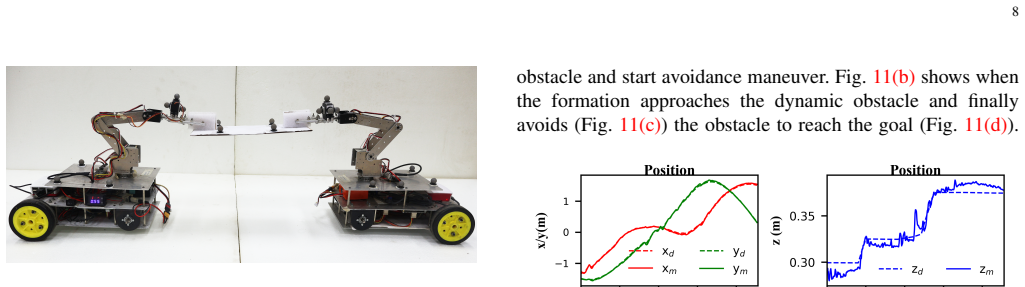
We propose a real-time implementable motion planning framework for cooperative object transportation by nonholonomic mobile manipulator robots (MMRs) in dynamic environments. Our global planner finds a path from start to goal through the static, obstacle-free regions in the environment and generates a set of convex, static, obstacle-free regions around the path using a novel, fast, and computationally lightweight ellipse-based technique. We introduce a nonlinear Model Predictive Control (NMPC) based real-time implementable planning technique that jointly plans feasible motion for the mobile base and the manipulator's arm and generates a kinodynamic feasible, collision-free trajectory for cooperative object transportation. Simulation and hardware experiments validate the efficiency of our proposed planning framework.
Editorial analysis
A structured set of objections, weighed in public.
Referee Report
Summary. The manuscript presents a motion planning framework for cooperative nonholonomic mobile manipulators performing object transportation in dynamic environments. It combines a global planner that finds paths through static obstacle-free regions and generates convex ellipse-based static regions around the path, with an NMPC-based local planner that jointly optimizes feasible base and arm motions to produce kinodynamic and collision-free trajectories. Validation is claimed via simulation and hardware experiments.
Significance. If the central claims hold, the ellipse-based region generation and joint NMPC formulation could offer a lightweight, real-time approach to cooperative planning under nonholonomic constraints, with potential utility in warehouse or service robotics. The explicit separation of global static planning from local NMPC is a clear architectural strength, though the lack of reported quantitative metrics, baselines, or failure statistics in the abstract weakens the immediate assessable impact.
major comments (2)
- [Abstract] Abstract: The central claim of operation 'in dynamic environments' relies on the ellipse-generated convex regions remaining 'sufficiently large and connected' for NMPC feasibility, yet the global planner is described as operating exclusively on 'static, obstacle-free regions' and producing 'static' regions with no mechanism stated for detecting intersections with moving obstacles or triggering global re-planning. This directly threatens the kinodynamic feasibility guarantee when a dynamic obstacle enters an ellipse.
- [Abstract] Abstract (validation paragraph): The claim that 'simulation and hardware experiments validate the efficiency' is unsupported by any reported quantitative metrics, baseline comparisons, success rates, or error statistics; without these, it is impossible to assess whether the NMPC consistently finds feasible joint trajectories under the stated weakest assumption.
minor comments (1)
- [Abstract] The abstract does not define key terms such as the precise form of the ellipse-based regions or the NMPC cost function and constraints, making it difficult to evaluate novelty or reproducibility from the summary alone.
Simulated Author's Rebuttal
We thank the referee for the constructive comments. We address each major comment below and will revise the manuscript accordingly to improve clarity.
read point-by-point responses
-
Referee: [Abstract] Abstract: The central claim of operation 'in dynamic environments' relies on the ellipse-generated convex regions remaining 'sufficiently large and connected' for NMPC feasibility, yet the global planner is described as operating exclusively on 'static, obstacle-free regions' and producing 'static' regions with no mechanism stated for detecting intersections with moving obstacles or triggering global re-planning. This directly threatens the kinodynamic feasibility guarantee when a dynamic obstacle enters an ellipse.
Authors: The framework separates global planning (static obstacle-free regions and ellipse generation) from local NMPC planning, where the NMPC jointly optimizes base and arm motions with collision-avoidance constraints that incorporate detected dynamic obstacles in real time. The NMPC is intended to maintain feasibility within the convex regions even as obstacles move, provided the regions remain sufficiently large. However, the manuscript does not detail an explicit detection mechanism or re-planning trigger when a dynamic obstacle intersects an ellipse. We agree this requires clarification and will revise the abstract and add a short discussion of assumptions and dynamic handling in the methodology section. revision: yes
-
Referee: [Abstract] Abstract (validation paragraph): The claim that 'simulation and hardware experiments validate the efficiency' is unsupported by any reported quantitative metrics, baseline comparisons, success rates, or error statistics; without these, it is impossible to assess whether the NMPC consistently finds feasible joint trajectories under the stated weakest assumption.
Authors: The manuscript body reports quantitative results including NMPC solve times, success rates, trajectory errors, and baseline comparisons in the simulation and hardware sections. The abstract summarizes these findings at a high level for brevity. To address the concern, we will revise the abstract to include key metrics (e.g., average computation time and success rate) supporting the efficiency claim. revision: yes
Circularity Check
No circularity: framework description relies on standard global/NMPC decomposition without self-referential reductions
full rationale
The provided abstract and description outline a two-stage planner (ellipse-based global path through static regions followed by NMPC for joint base-arm trajectories) but contain no equations, fitted parameters, predictions of derived quantities, or self-citations. No load-bearing step reduces a claimed result to its own inputs by construction, self-definition, or renaming. The approach is presented as a composition of existing techniques (global planning + NMPC) whose validity is asserted via simulation/hardware validation rather than internal equivalence. This is the common case of a self-contained engineering proposal with no detectable circularity in its derivation chain.
Axiom & Free-Parameter Ledger
Reference graph
Works this paper leans on
-
[1]
Coordination and decentralized cooperation of multiple mobile manip- ulators,
O. Khatib, K. Yokoi, K. Chang, D. Ruspini, R. Holmberg, and A. Casal, “Coordination and decentralized cooperation of multiple mobile manip- ulators,” Journal of Robotic Systems , vol. 13, no. 11, pp. 755–764, 1996
work page 1996
-
[2]
Modeling and coordinated control of multiple mobile manipulators with closed-chain constraints,
P. Xu, J. Zhang, Y . Cui, K. Zhang, and Q. Tang, “Modeling and coordinated control of multiple mobile manipulators with closed-chain constraints,” International Journal of Control, Automation and Systems , vol. 21, pp. 1296–1308, 4 2023
work page 2023
-
[3]
A dual-arm robot cooperation framework based on a nonlinear model predictive coopera- tive control,
X. Zhao, Y . Zhang, W. Ding, B. Tao, and H. Ding, “A dual-arm robot cooperation framework based on a nonlinear model predictive coopera- tive control,” IEEE/ASME Transactions on Mechatronics , vol. 29, no. 5, pp. 3993–4005, 2024
work page 2024
-
[4]
S. Erhart and S. Hirche, “Adaptive force/velocity control for multi- robot cooperative manipulation under uncertain kinematic parameters,” in 2013 IEEE/RSJ International Conference on Intelligent Robots and Systems, pp. 307–314, 2013
work page 2013
-
[5]
Decentralized adaptive control for collaborative manipulation,
P. Culbertson and M. Schwager, “Decentralized adaptive control for collaborative manipulation,” in 2018 IEEE International Conference on Robotics and Automation (ICRA) , pp. 278–285, 2018
work page 2018
-
[6]
C. K. Verginis, A. Nikou, and D. V . Dimarogonas, “Communication- based decentralized cooperative object transportation using nonlinear model predictive control,” in 2018 European Control Conference (ECC) , pp. 733–738, 2018
work page 2018
-
[7]
Distributed coordination and cooperation control for networked mobile manipulators,
G.-B. Dai and Y .-C. Liu, “Distributed coordination and cooperation control for networked mobile manipulators,” IEEE Transactions on Industrial Electronics, vol. 64, no. 6, pp. 5065–5074, 2017
work page 2017
-
[8]
Distributed adaptive control of networked cooperative mo- bile manipulators,
A. Marino, “Distributed adaptive control of networked cooperative mo- bile manipulators,” IEEE Transactions on Control Systems Technology , vol. 26, no. 5, pp. 1646–1660, 2018
work page 2018
-
[9]
Fully distributed cooperation for networked uncertain mobile manipulators,
Y . Ren, S. Sosnowski, and S. Hirche, “Fully distributed cooperation for networked uncertain mobile manipulators,” IEEE Transactions on Robotics, vol. 36, no. 4, pp. 984–1003, 2020
work page 2020
-
[10]
Online capability based task allocation of cooperative manipulators,
K. Patra, A. Sinha, and A. Guha, “Online capability based task allocation of cooperative manipulators,” Journal of Intelligent & Robotic Systems , vol. 110, p. 23, 3 2024
work page 2024
-
[11]
Nonholonomic motion planning for multiple mobile manipulators,
J. Desai and V . Kumar, “Nonholonomic motion planning for multiple mobile manipulators,” in Proceedings of International Conference on Robotics and Automation , vol. 4, pp. 3409–3414 vol.4, 1997
work page 1997
-
[12]
Nonholonomic navigation and control of cooperating mobile manipulators,
H. Tanner, S. Loizou, and K. Kyriakopoulos, “Nonholonomic navigation and control of cooperating mobile manipulators,” IEEE Transactions on Robotics and Automation , vol. 19, no. 1, pp. 53–64, 2003
work page 2003
-
[13]
J. Alonso-Mora, S. Baker, and D. Rus, “Multi-robot formation control and object transport in dynamic environments via constrained optimiza- tion,” The International Journal of Robotics Research , vol. 36, no. 9, pp. 1000–1021, 2017
work page 2017
-
[14]
A novel geometric transportation approach for multiple mobile manipulators in unknown environments,
Z. Cao, N. Gu, J. Jiao, S. Nahavandi, C. Zhou, and M. Tan, “A novel geometric transportation approach for multiple mobile manipulators in unknown environments,”IEEE Systems Journal, vol. 12, no. 2, pp. 1447– 1455, 2018
work page 2018
-
[15]
Trans- portation by multiple mobile manipulators in unknown environments with obstacles,
J. Jiao, Z. Cao, N. Gu, S. Nahavandi, Y . Yang, and M. Tan, “Trans- portation by multiple mobile manipulators in unknown environments with obstacles,” IEEE Systems Journal , vol. 11, no. 4, pp. 2894–2904, 2017
work page 2017
-
[16]
Motion planning for multi-mobile-manipulator payload transport systems,
R. Tallamraju, D. H. Salunkhe, S. Rajappa, A. Ahmad, K. Karlapalem, and S. V . Shah, “Motion planning for multi-mobile-manipulator payload transport systems,” in 2019 IEEE 15th International Conference on Automation Science and Engineering (CASE) , pp. 1469–1474, 2019
work page 2019
-
[17]
A. Nikou, C. Verginis, S. Heshmati-alamdari, and D. V . Dimarogonas, “A nonlinear model predictive control scheme for cooperative manipulation with singularity and collision avoidance,” in 2017 25th Mediterranean Conference on Control and Automation (MED) , pp. 707–712, 2017
work page 2017
-
[18]
F. Kennel-Maushart and S. Coros, “Payload-aware trajectory optimi- sation for non-holonomic mobile multi-robot manipulation with tip- over avoidance,” IEEE Robotics and Automation Letters , vol. 9, no. 9, pp. 7669–7676, 2024
work page 2024
-
[19]
Scalable collaborative manipulation with distributed trajectory planning,
O. Shorinwa and M. Schwager, “Scalable collaborative manipulation with distributed trajectory planning,” in 2020 IEEE/RSJ International Conference on Intelligent Robots and Systems (IROS) , pp. 9108–9115, 2020
work page 2020
-
[20]
Distributed cooperative control of redundant mobile manipulators with safety con- straints,
C. Wu, H. Fang, Q. Yang, X. Zeng, Y . Wei, and J. Chen, “Distributed cooperative control of redundant mobile manipulators with safety con- straints,” IEEE Transactions on Cybernetics , pp. 1–13, 2021
work page 2021
-
[21]
Multi-robot object transport motion planning with a deformable sheet,
J. Hu, W. Liu, H. Zhang, J. Yi, and Z. Xiong, “Multi-robot object transport motion planning with a deformable sheet,” IEEE Robotics and Automation Letters, vol. 7, no. 4, pp. 9350–9357, 2022
work page 2022
-
[22]
Collab- orative planning for catching and transporting objects in unstructured environments,
L. Pei, J. Lin, Z. Han, L. Quan, Y . Cao, C. Xu, and F. Gao, “Collab- orative planning for catching and transporting objects in unstructured environments,” IEEE Robotics and Automation Letters , vol. 9, no. 2, pp. 1098–1105, 2024
work page 2024
-
[23]
R. Mao, H. Gao, and L. Guo, “A novel collision-free navigation approach for multiple nonholonomic robots based on orca and linear mpc,” Mathematical Problems in Engineering , vol. 2020, pp. 1–16, 6 2020
work page 2020
-
[24]
Kinodynamic motion planning for collaborative object transportation by multiple mobile manipulators,
K. Patra, A. Sinha, and A. Guha, “Kinodynamic motion planning for collaborative object transportation by multiple mobile manipulators,” 2024
work page 2024
- [25]
-
[26]
CasADi – A software framework for nonlinear optimization and opti- mal control,
J. A. E. Andersson, J. Gillis, G. Horn, J. B. Rawlings, and M. Diehl, “CasADi – A software framework for nonlinear optimization and opti- mal control,” Mathematical Programming Computation , vol. 11, no. 1, pp. 1–36, 2019
work page 2019
discussion (0)
Sign in with ORCID, Apple, or X to comment. Anyone can read and Pith papers without signing in.