REVIEW 5 major objections 4 minor 22 cited by
MME-CoT: Benchmarking Chain-of-Thought in Large Multimodal Models for Reasoning Quality, Robustness, and Efficiency
T0 review · 5 major / 4 minor · reviewed 2026-08-07 · deepseek-v4-flash
Pith's one-line read MME-CoT is a benchmark that evaluates chain-of-thought in large multimodal models, claiming that reflection-equipped models reason best, CoT often degrades perception tasks, and reflective models are inefficient.
desk verdict Genuinely useful multimodal CoT evaluation suite, but the Kimi-vs-GPT-4o headline is undercut by a 150-question subset comparison. read the letter →
The pith
A machine-rendered reading of the paper's core claim, the machinery that carries it, and where it could break.
The reading
What carries the argument
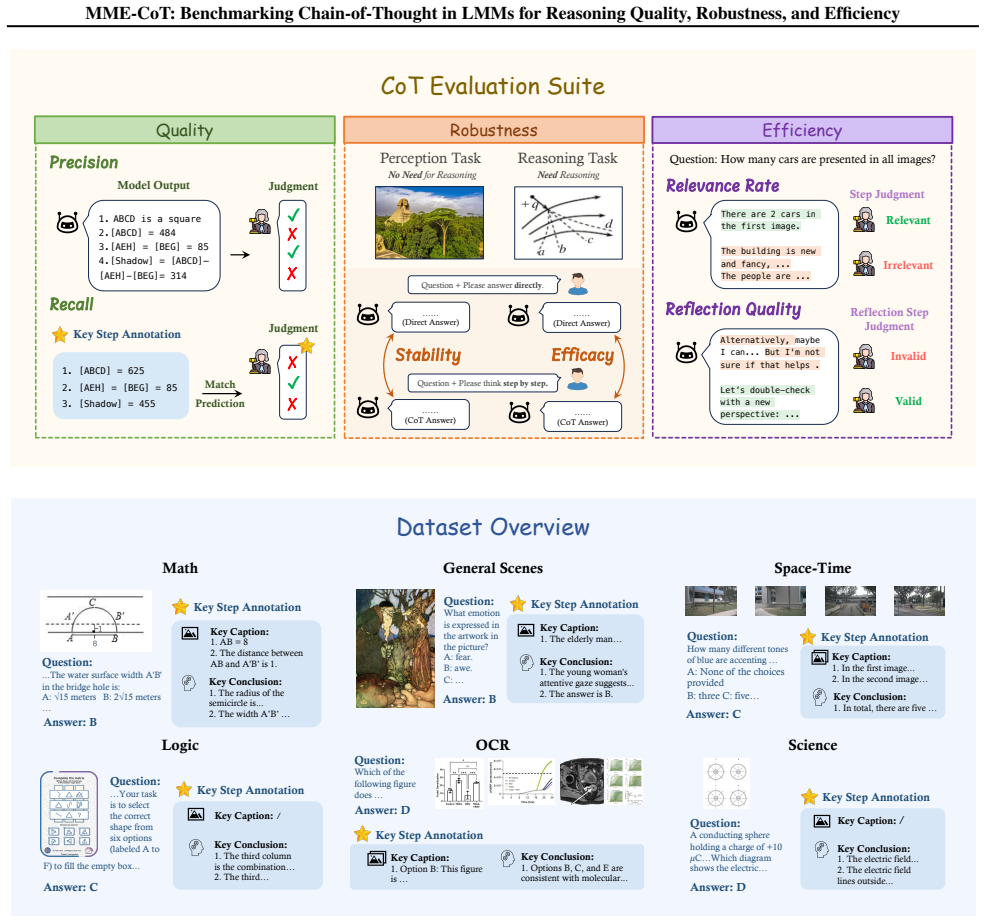
The evaluation suite is built on human-annotated key steps—inference conclusions plus image captions that a correct solution must contain—and on a GPT-4o-based step partitioner that splits each model output into atomic steps typed as logical inference, image caption, or background. Quality is recall (fraction of key steps matched) and precision (fraction of generated key steps correct), combined as F1. Robustness compares direct-answer versus step-by-step prompting on perception tasks (stability) and reasoning tasks (efficacy). Efficiency is relevance rate (share of steps that work toward the solution, rescaled with a floor of 0.8) and reflection quality (share of identified reflection steps judged valid). These three pairs of metrics are the mechanism that turns raw model outputs into the paper's findings.
What would settle it
Take a random sample of the judged outputs (say 200 model responses), have human annotators redo the step matching, relevance, and reflection-validity judgments, and measure agreement with GPT-4o's judgments; if agreement is below the paper's annotation reliability level, or if the re-judged F1 changes the Kimi k1.5 vs GPT-4o order, the central ranking claim is not settled.
Extended reading notes
Core claim
On its own terms, the paper establishes that process-level evaluation changes the ranking of vision-language models relative to answer-only benchmarks. Kimi k1.5 edges GPT-4o on CoT quality (F1 64.2 vs 64.0), mostly through precision rather than recall; GPT-4o retains the highest recall. Most tested models lose accuracy on perception tasks when asked to reason step by step (e.g., InternVL2.5-8B drops 6.8%), while only some gain on reasoning tasks. On efficiency, even the best reflective models earn low relevance rates and reflection quality around 60-72%, meaning roughly a quarter to two-fifths of reflection steps do not advance the solution. The authors interpret these as actionable failure modes: overthinking, distraction by irrelevant image detail, and reflection that repeats, degrades, or aborts.
Load-bearing premise
Every trust in the rankings rests on GPT-4o correctly partitioning outputs into steps and faithfully matching and judging those steps; if it systematically misjudges, the model order can change, especially where scores are close.
Editorial extensions
If this is right
- If step quality is the criterion, reflection-based training is a promising direction: Kimi k1.5 and QVQ outscore their non-reflective counterparts on F1.
- Deploying CoT universally is unsafe for perception-heavy workloads until stability is fixed; the paper's stability metric can be used as a regression test.
- Efficiency budgets in long-CoT systems can be set by relevance and reflection-quality scores rather than by output length alone.
- Answer-only benchmarks may overstate reasoning ability when models reach correct answers by skipping key steps.
Reading between the lines
- One testable extension is to rerun the quality metrics with a second judge (e.g., a different model or human raters) and measure judge-induced rank shifts; the close Kimi/GPT-4o gap makes this meaningful.
- The stability result suggests a potential training signal: penalizing CoT-generated steps that are irrelevant to perception questions could recover the lost accuracy; the authors do not propose this.
- The relevance-rate rescaling with alpha=0.8 amplifies small differences; a sensitivity analysis over alpha would show whether the efficiency rankings are an artifact of that choice.
- Because the benchmark samples 150 questions for Kimi k1.5, comparing its scores to models evaluated on all 1,130 questions assumes subset representativeness; re-running on a matched subset would test this.
Signed reviews
Editorial analysis
A structured set of objections, weighed in public.
Referee Report
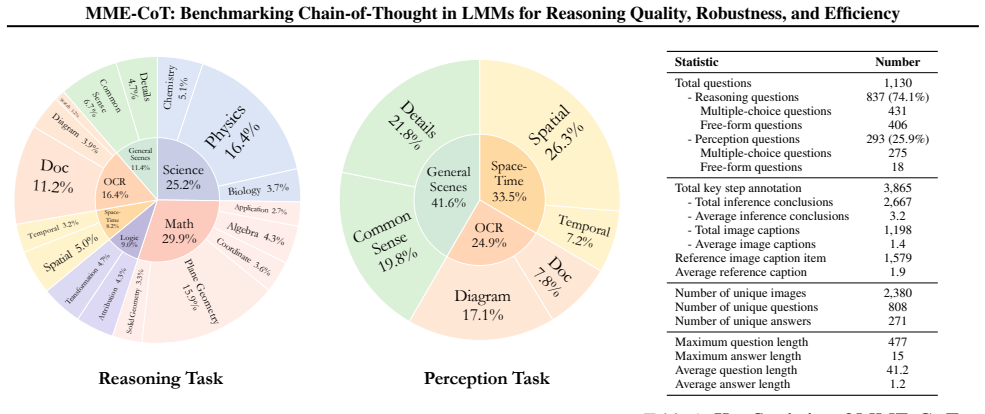
Summary. MME-CoT introduces a 1,130-question benchmark for evaluating chain-of-thought (CoT) reasoning in large multimodal models, spanning six domains (math, science, OCR, logic, space-time, general scenes) with human-verified key-step annotations and reference image captions. The paper proposes three evaluation axes: CoT quality (recall and precision of predicted steps against annotated key steps, aggregated as F1), CoT robustness (stability on perception tasks and efficacy on reasoning tasks, computed as accuracy differences between direct and CoT prompting), and CoT efficiency (relevance rate, rescaled by Eq. (10) with alpha=0.8, and reflection quality). Thirteen LMMs are evaluated, leading to three headline findings: reflection-equipped models achieve the highest CoT quality with Kimi k1.5 slightly above GPT-4o, CoT prompting degrades perception-heavy tasks for most models, and reflection models are inefficient with a large fraction of invalid reflection steps.
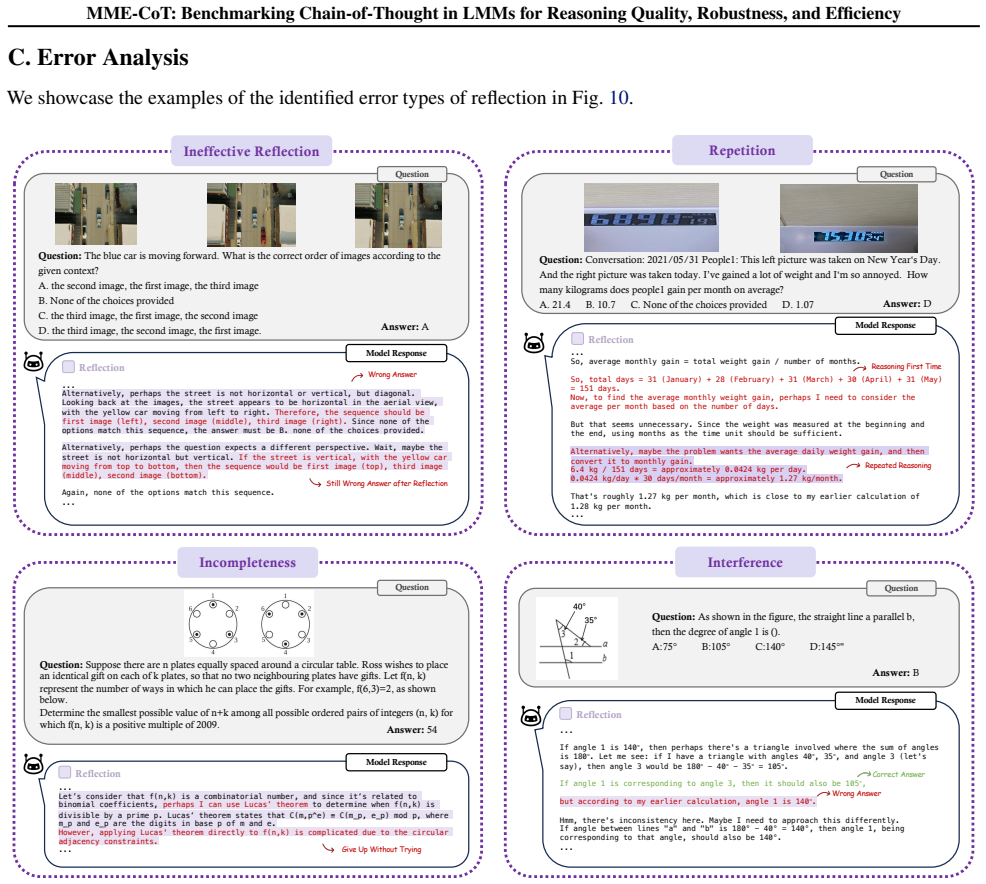
Significance. If the evaluation pipeline is trustworthy, MME-CoT would be a valuable community resource: it is the first multimodal CoT benchmark to move beyond final-answer accuracy and to measure process-level quality, robustness, and efficiency at a fine-grained step resolution. The dataset curation is a genuine strength: key steps and reference captions were human-verified, statistics are reported, and the full evaluation prompts are provided in Appendix E, which supports reproducibility. The error analysis of reflection failure modes (ineffective reflection, incompleteness, repetition, interference) is also useful and actionable. However, the paper's central ranking claim and several secondary comparisons rest on an unvalidated GPT-4o judge pipeline and on an unevaluated 150-question subset for Kimi k1.5, so the quantitative conclusions are currently not established at the claimed precision.
major comments (5)
- [Section 4.1, Table 2, abstract] The headline claim that Kimi k1.5 outperforms GPT-4o in CoT quality is not supported by the reported evidence. Section 4.1 states that Kimi k1.5 was evaluated on 150 sampled questions (115 reasoning, 35 perception) due to access limits, yet Table 2 reports Kimi's F1 of 64.2 against GPT-4o's 64.0 computed on the full benchmark. Since CoT quality is computed only on reasoning questions, this is effectively Kimi on about 115 reasoning items versus GPT-4o on 837. The sampling procedure is not described, no per-category or per-domain results for Kimi are given (Kimi is absent from Table 3), and no confidence intervals are reported. A gap of 0.2 F1 points is far smaller than the sampling error expected for roughly 115 items, so the ranking could easily be an artifact of subset selection. Please report the sampling method, per-category breakdown for Kimi, and uncertainty estimates, or remove the superiority claim from the abstract and Section 4.2.
- [Sections 3.1, 3.3, Appendix E] Every process-level metric depends on GPT-4o's ability to partition model outputs into atomic steps, match predicted steps to human key steps, judge step correctness, judge relevance, and identify and validate reflection steps. The authors validate the dataset annotations but do not report any human validation or agreement study for these GPT-4o judgments. Because the key ranking differences are small (Kimi k1.5 F1 64.2 vs GPT-4o 64.0; reflection quality 72.2 vs 61.7 for QVQ), systematic judge bias could reorder the conclusions. Please add a human agreement study on a sample of the step-matching, relevance, and reflection judgments, or at least report the judge's self-consistency and show that the qualitative findings are robust to a noisy judge.
- [Eq. (10), Section 3.3] The relevance rate is rescaled via (r - alpha)/(1 - alpha) with a hand-picked alpha=0.8, but no justification or sensitivity analysis is provided. This transform nonlinearly amplifies small differences near the top of the raw distribution and can change model rankings. Please report the raw relevance rates alongside the rescaled ones and show that the conclusions (e.g., InternVL2.5-8B having the highest relevance, long-CoT models being more distractible) are stable across a range of alpha values.
- [Section 4.2, Table 2] Reflection quality is set to 100 for all models that do not reflect, as stated in Section 4.2 ('we define the reflection quality as 100 on models incapable of reflection'). This makes 'no reflection' numerically indistinguishable from 'perfect reflection' and biases the efficiency comparison in favor of non-reflective models. The paper's third claim, that reflection models are inefficient, is thus partially built into the metric definition. Please either exclude non-reflective models from the reflection-quality analysis, report the number of reflection steps separately, or clearly relabel the 100 entries as 'not applicable' rather than a score of 100.
- [Section 4.2, Table 2 footnote] The robustness scores for Mulberry, LLaVA-CoT, Virgo, QVQ, and Kimi k1.5 are flagged with asterisks as unreliable because these models refuse to answer directly and instead generate extended rationales. Nevertheless, the paper still reports their stability and efficacy values as if comparable, and the text states that 'GPT-4o achieves the highest robustness score' after acknowledging that several other scores may be misleading. Mixing unreliable and reliable numbers in the same table and in the summary statistics can mislead readers. Please either exclude these rows from the quantitative robustness comparison and discuss them only qualitatively, or provide a corrected scoring protocol for models that ignore the direct prompt.
minor comments (4)
- [Throughout] The paper contains several typographical issues, including 'MME-C OT' in Table 1 and Table 2 captions, 'Rea.' in Section 4.2, and 'Nan-Multiple-Choice' in Appendix E.3. These should be corrected before publication.
- [Table 3] Kimi k1.5 is missing from the per-category results in Table 3, even though the overall quality and efficiency numbers for Kimi are central to the paper's claims. Adding per-category results (or a clear explanation of why they cannot be provided) is necessary to assess the 150-question subset.
- [Section 2.1] The two-stage perception/reasoning classification uses GPT-4o and Qwen2-VL-7B accuracy differences to guide the preliminary categorization, and GPT-4o later serves as the judge for the process-level metrics. This is not circular in a formal sense because final labels are human-verified, but the potential dependence of the task split on the same model family used for evaluation should be acknowledged explicitly.
- [Figure 1] Figure 1 contains many numbers and arrows in a small space and is difficult to parse; consider simplifying it or moving the detailed scores to a table.
Circularity Check
The robustness finding is partly baked into the perception/reasoning split; the CoT quality and efficiency metrics are otherwise self-contained.
-
self definitional
[Section 2.1, 'Data Composition and Categorization', with Section 3.2, Eq. (6)]
"Initially, we leverage LMMs to guide the preliminary categorization by comparing their performance with and without CoT prompting. We employ GPT-4o and Qwen2-VL-7B to answer questions using both direct and CoT approaches. Superior performance with CoT indicates a reasoning-dominant subcategory, while comparable or inferior CoT performance suggests either perception-focused content or insufficient model reasoning capabilities. ... Stability = AccP_COT − AccP_DIR."
The headline robustness finding ('CoT prompting often degrades LMM performance on perception-heavy tasks') is measured by Eq. (6) as the CoT-vs-direct accuracy gap on the perception set P. But the perception set P was preliminarily constructed by the very same comparison: subcategories where CoT is comparable or inferior to direct prompting are labeled perception-focused. For those subcategories, a negative Stability score is therefore partly a restatement of the labeling rule rather than an independent empirical discovery.
full rationale
Aside from the perception/reasoning categorization issue, the paper's CoT quality and efficiency metrics do not reduce to their inputs. The key-step annotations are human-verified; recall/precision are defined against those annotations; relevance rate is a fixed rescaling (alpha = 0.8) applied uniformly rather than a fitted parameter; reflection quality is judged against a stated validity definition. The Kimi k1.5 versus GPT-4o comparison is statistically problematic because Kimi is scored on 150 sampled questions while GPT-4o is scored on all 1,130, but this is a subset-comparability flaw, not a circular derivation. No load-bearing self-citation chain or imported uniqueness theorem appears. The central benchmark has substantial independent content, so the circularity is partial and localized rather than wholesale.
Assumptions & free parameters
free parameters (2)
- alpha (Relevance Rate scaling) =
0.8
- Reflection Quality default for non-reflecting models =
100
assumptions (5)
- domain assumption GPT-4o can reliably partition model outputs into atomic steps and judge them against human annotations.
- domain assumption GPT-4o accurately identifies relevant steps and valid reflection steps.
- domain assumption The perception vs reasoning task classification is valid for all evaluated models.
- domain assumption Models comply with the direct-answer prompt when measuring stability.
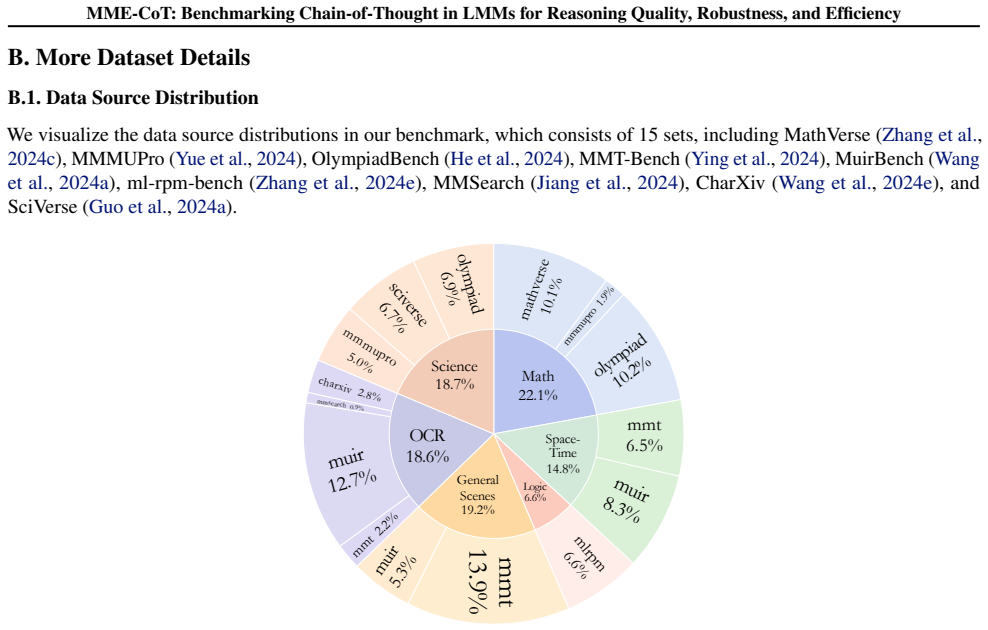
- domain assumption Ground-truth answers and key step annotations from the 15 source datasets are correct.
Cite this review
Pith. "Pith review of MME-CoT: Benchmarking Chain-of-Thought in Large Multimodal Models for Reasoning Quality, Robustness, and Efficiency." pith.science (2026). https://pith.science/paper/Q2EG34XD
@misc{pith2026250209621,
  author       = {Pith},
  title        = {Pith review of: MME-CoT: Benchmarking Chain-of-Thought in Large Multimodal Models for Reasoning Quality, Robustness, and Efficiency},
  year         = {2026},
  howpublished = {\url{https://pith.science/paper/Q2EG34XD}},
  note         = {Machine review of arXiv:2502.09621}
}
read the original abstract
Answering questions with Chain-of-Thought (CoT) has significantly enhanced the reasoning capabilities of Large Language Models (LLMs), yet its impact on Large Multimodal Models (LMMs) still lacks a systematic assessment and in-depth investigation. In this paper, we introduce MME-CoT, a specialized benchmark evaluating the CoT reasoning performance of LMMs, spanning six domains: math, science, OCR, logic, space-time, and general scenes. As the first comprehensive study in this area, we propose a thorough evaluation suite incorporating three novel metrics that assess the reasoning quality, robustness, and efficiency at a fine-grained level. Leveraging curated high-quality data and a unique evaluation strategy, we conduct an in-depth analysis of state-of-the-art LMMs, uncovering several key insights: 1) Models with reflection mechanism demonstrate a superior CoT quality, with Kimi k1.5 outperforming GPT-4o and demonstrating the highest quality results; 2) CoT prompting often degrades LMM performance on perception-heavy tasks, suggesting a potentially harmful overthinking behavior; and 3) Although the CoT quality is high, LMMs with reflection exhibit significant inefficiency in both normal response and self-correction phases. We hope MME-CoT serves as a foundation for advancing multimodal reasoning in LMMs. Project Page: https://mmecot.github.io/
Figures

Figures from the paper (17 more)




Forward citations
Cited by 22 Pith papers
-
Zoom-IQA: Image Quality Assessment with Reliable Region-Aware Reasoning
Zoom-IQA lets a vision-language model iteratively crop and zoom into image regions before giving a quality score, improving reasoning and restoration guidance over single-pass IQA models.
-
Evaluating MLLMs with Multimodal Multi-image Reasoning Benchmark
MMRB is the first benchmark combining multi-image inputs with chain-of-thought reasoning annotations, and its evaluation shows open-source MLLMs trail commercial models while multi-image reward models are unstable.
-
OpenCoF: Learning to Reason Through Video Generation
Fine-tuning a video generator on a new 17K reasoning-video dataset improves Chain-of-Frame reasoning, and adding learnable visual/textual reasoning tokens yields further gains on external benchmarks.
-
LatentChem: From Textual CoT to Latent Thinking in Chemical Reasoning
LatentChem reasons in continuous latent space for chemistry, achieving a 59.88% non-tie win rate over explicit CoT on ChemCoTBench with a 10.84x average reduction in reasoning overhead.
-
Echo-4o: Harnessing the Power of GPT-4o Synthetic Images for Improved Image Generation
A curated GPT-4o synthetic image dataset improves open-source generation models on instruction-following, surreal scenes, and multi-reference synthesis, plus two new benchmarks to measure those skills.
-
MMReason: An Open-Ended Multi-Modal Multi-Step Reasoning Benchmark for MLLMs Toward AGI
MMReason is an open-ended multimodal reasoning benchmark that filters out guessable and memorized questions and scores model answers both by final answer and by intermediate steps.
-
MIRAGE: Assessing Hallucination in Multimodal Reasoning Chains of MLLM
MIRAGE is a benchmark that separates reasoning hallucinations from perception errors in multimodal LLMs, and Logos is a curriculum reinforcement fine-tuning method that reduces logical hallucinations.
-
Seeing is Not Reasoning: MVPBench for Graph-based Evaluation of Multi-path Visual Physical CoT
A new multi-image benchmark and graph-based scoring method show that MLLMs produce weak, poorly-grounded chains of thought on visual physics tasks, and that RL post-training can degrade spatial reasoning.
-
MME-Reasoning: A Comprehensive Benchmark for Logical Reasoning in MLLMs
A new 1,188-question multimodal benchmark covering deductive, inductive, and abductive reasoning shows that leading MLLMs score around 60% and are especially weak at abductive reasoning.
-
Bridging the Dynamic Perception Gap: Training-Free Draft Chain-of-Thought for Dynamic Multimodal Spatial Reasoning
Drawing an AI's step-by-step position onto video frames, alongside text reasoning, improves its accuracy on dynamic maze-judgment and maze-navigation tasks.
-
T2I-R1: Reinforcing Image Generation with Collaborative Semantic-level and Token-level CoT
Reinforcement learning that jointly optimizes a text planning step and patch-by-patch image generation in one autoregressive model improves compositional text-to-image benchmarks by double-digit absolute percentage po...
-
Video-MMLU: A Massive Multi-Discipline Lecture Understanding Benchmark
Video-MMLU: a 1,065-video lecture benchmark where most AI video models score 10-50%, but text-only models answer 40% of quiz questions without video.
-
Chimera: Improving Generalist Model with Domain-Specific Experts
Chimera fuses frozen domain-expert encoders into a generalist multimodal LLM via routing and a 30% masking of general tokens, lifting InternVL2-8B from 61.6 to 64.9 on MathVista and from 31.3 to 32.4 on MathVerse.
-
ProLaViT: Learning Progressive Latent Visual Thoughts in Structured Latent Space
Progressive multi-step latent visual thoughts, endogenously distilled from a model's own encoder on synthetic trajectories and regularized by distance-weighted diversity, improve MLLM visual reasoning accuracy and efficiency.
-
Diagnosing Pathological Chain-of-Thought in Reasoning Models
Three log-probability-difference metrics — Necessity, Paraphrasability, Substantivity — are proposed and tested on deliberately fine-tuned 'model organisms' to detect post-hoc, encoded, and internalized chain-of-thoug...
-
M3CoTBench: Benchmark Chain-of-Thought of MLLMs in Medical Image Understanding
A medical-image benchmark that scores the step-by-step reasoning chains of multimodal LLMs shows current models explain poorly and chain-of-thought prompting frequently reduces diagnostic accuracy.
-
Mimicking or Reasoning: Rethinking Multi-Modal In-Context Learning in Vision-Language Models
Vision-language models improve little, often not at all, when given demonstrations, even when demonstrations contain explicit reasoning steps.
-
Reinforcing Video Reasoning with Focused Thinking
A GRPO variant with token-level KL weighting and partial-credit rewards improves video-QA on modified multi-answer benchmarks, but transfer to original single-answer benchmarks is not established.
-
Self-Reflective Reinforcement Learning for Diffusion-based Image Reasoning Generation
SRRL trains diffusion models to reason about images by repeatedly denoising, evaluating, and re-noising their own samples across several reflective rounds.
-
GenCLS++: Pushing the Boundaries of Generative Classification in LLMs Through Comprehensive SFT and RL Studies Across Diverse Datasets
SFT plus RL with post-hoc selection of the best training and inference prompts improves generative text classification accuracy by about 3.5% relative to a naive SFT baseline.
-
Reinforced MLLM: A Survey on RL-Based Reasoning in Multimodal Large Language Models
A structured survey of reinforcement-learning-based reasoning methods for multimodal large language models, including a taxonomy, reward design review, benchmark tables, and open challenges.
-
Reinforcement Fine-Tuning Powers Reasoning Capability of Multimodal Large Language Models
A survey-style position paper claims that reinforcement fine-tuning powers reasoning in multimodal LLMs, summarizing over a hundred recent works and proposing five future research directions.
Reference graph
Works this paper leans on
-
[1]
Problem: The original question/task
-
[2]
A Solution of a model
-
[3]
Ground Truth: Essential steps required for a correct answer MATCHING PROCESS: You need to match each ground truth middle step with the solution: Match Criteria: - The middle step should exactly match in the content or is directly entailed by a certain content in the solution - All the details must be matched, including the specific value and content - You...
-
[4]
Other - Additional error types # Input Format [Problem] {question} [Solution] {solution} 33 MME-CoT: Benchmarking Chain-of-Thought in LMMs for Reasoning Quality, Robustness, and Efficiency [Ground Truth] {gt annotation} # Output Requirements
-
[5]
Direct JSON output without any other output E.3. Direct Evaluation Prompt Answer Extraction Prompt You are an AI assistant who will help me to extract an answer of a question. You are provided with a question and a response, and you need to find the final answer of the question. Extract Rule: [Multiple choice question]
-
[6]
Only output the JSON array with no additional information
-
[7]
Judge each ground truth middle step in order without omitting any step. Here are the problem, answer, solution, and ground truth middle steps: [Problem] {question} [Answer] {answer} [Solution] {solution} [Ground Truth Information] {gt annotation} 29 MME-CoT: Benchmarking Chain-of-Thought in LMMs for Reasoning Quality, Robustness, and Efficiency Precision ...
-
[8]
Logical Inference Steps - Contains exactly one logical deduction - Must produce a new derived conclusion - Cannot be just a summary or observation
Show all 42 references
-
[9]
Image Observation Steps - Pure visual observations - Only includes directly visible elements - No inferences or assumptions
-
[10]
Background Information Steps - External knowledge or question context - No inference process involved ## Step Requirements - Each step must be atomic (one conclusion per step) - No content duplication across steps - Initial analysis counts as background information - Final ans...
-
[12]
For highly repetitive patterns, output it as a single step
-
[13]
step_type
Output maximum 40 steps. Always include the final step that contains the answer. Here is the json output format: ## Output Format [ { "step_type": "image observation|logical inference|background information", "premise": "Evidence (only for logical inference)", "conclusion": "S...
-
[14]
Logical Inference Steps - Contains exactly one logical deduction 31 MME-CoT: Benchmarking Chain-of-Thought in LMMs for Reasoning Quality, Robustness, and Efficiency - Must produce a new derived conclusion - Cannot be just a summary or observation
-
[15]
Image Description Steps - Pure visual observations - Only includes directly visible elements - No inferences or assumptions
-
[16]
IMPORTANT NOTE: Evaluate relevancy independent of correctness
Background Information Steps - External knowledge or question context - No inference process involved ## Step Requirements - Each step must be atomic (one conclusion per step) - No content duplication across steps - Initial analysis counts as background information - Final ans...
-
[17]
help to obtain a conclusion helpful to solve the question later
-
[18]
help to identify certain patterns in the image later
-
[19]
step_type
directly contributes to the answer v. Depicting or analyzing the options of the question is also relevant. vi. Repeating previous relevant steps are also considered relevant. The following behaviour is considered as irrelevant: i. Depicting image information that does not rela...
-
[20]
Reach accurate conclusions aligned with ground truth
-
[21]
Invalid reflections include:
Use new insights to find the mistake of the previous conclusion or verify its correctness. Invalid reflections include:
-
[22]
Repetition - Restating previous content or method without new insights
-
[23]
Wrong Conclusion - Reaching incorrect conclusions vs ground truth
-
[24]
Incompleteness - Proposing but not executing new analysis methods
-
[26]
The output format must be in valid JSON format without any other content
-
[27]
conclusion
Output maximum 30 reflection steps. Here is the json output format: ## Output Format [ { "conclusion": "One-sentence summary of reflection outcome", "judgment": "Correct|Wrong", "error_type": "N/A|Repetition|Wrong Conclusion|Incompleteness|Other" } ] # Rules
-
[28]
Preserve original content and order
-
[29]
No new interpretations
-
[30]
Include ALL reflection steps
-
[31]
Empty list if no reflections found
-
[33]
You should directly output the choice letter of the answer
The answer could be answering the option letter or the value. You should directly output the choice letter of the answer
-
[34]
You should output a single uppercase character in A, B, C, D, E, F, G, H, I (if they are valid options), and Z
-
[35]
[Non Multiple choice question]
If the meaning of all options are significantly different from the final answer, output Z. [Non Multiple choice question]
-
[36]
It could be hidden inside the last step of calculation or inference
Output the final value of the answer. It could be hidden inside the last step of calculation or inference. Pay attention to what the question is asking for to extract the value of the answer
-
[37]
The final answer could also be a short phrase or sentence
-
[38]
Output Format: Directly output the extracted answer of the response
If the response doesn’t give a final answer, output Z. Output Format: Directly output the extracted answer of the response. {In Context Examples} Question: {question} Answer: {response} 34 MME-CoT: Benchmarking Chain-of-Thought in LMMs for Reasoning Quality, Robustness, and Ef...
-
[39]
If the [Model Answer] is the option letter, then it must completely matches the [Standard Answer]
-
[40]
[Nan-Multiple-Choice questions]
If the [Model Answer] is not an option letter, then the [Model Answer] must completely match the option content of [Standard Answer]. [Nan-Multiple-Choice questions]
-
[41]
The [Model Answer] and [Standard Answer] should exactly match
-
[42]
Output Format: 1
If the meaning is expressed in the same way, it is also considered consistent, for example, 0.5m and 50cm. Output Format: 1. If they are consistent, output 1; if they are different, output 0
-
[43]
{In Context Examples} Question: {question} [Model Answer]: {extract answer} [Standard Answer]: {gt answer} Your output: 35
DIRECTLY output 1 or 0 without any other content. {In Context Examples} Question: {question} [Model Answer]: {extract answer} [Standard Answer]: {gt answer} Your output: 35
-
[2021]
org/CorpusID:231591445
URL https://api.semanticscholar. org/CorpusID:231591445. Sprague, Z., Yin, F., Rodriguez, J. D., Jiang, D., Wadhwa, M., Singhal, P., Zhao, X., Ye, X., Mahowald, K., and Durrett, G. To cot or not to cot? chain-of-thought helps mainly on math and symbolic reasoning. arXiv prepri...
2024 arXiv
-
[2024]
a" and "b
URL https://qwenlm.github.io/blog/ qvq-72b-preview/. Touvron, H., Lavril, T., Izacard, G., Martinet, X., Lachaux, M.-A., Lacroix, T., Rozi`ere, B., Goyal, N., Hambro, E., Azhar, F., et al. Llama: Open and efficient foundation lan- guage models. arXiv preprint arXiv:2302.13971,...
2023 arXiv
Reviewed August 7, 2026 · model on record in the stance chip above.
Discussion (0). Continue with ORCID to comment.