Chaotic behaviors of particles around the black hole with an anisotropic matter immersed in a magnetic field
Pith reviewed 2026-07-03 08:37 UTC · model grok-4.3
The pith
Anisotropic matter suppresses local chaotic particle motion around black holes while external magnetic fields drive qualitative shifts in global chaos.
A machine-rendered reading of the paper's core claim, the machinery that carries it, and where it could break.
Core claim
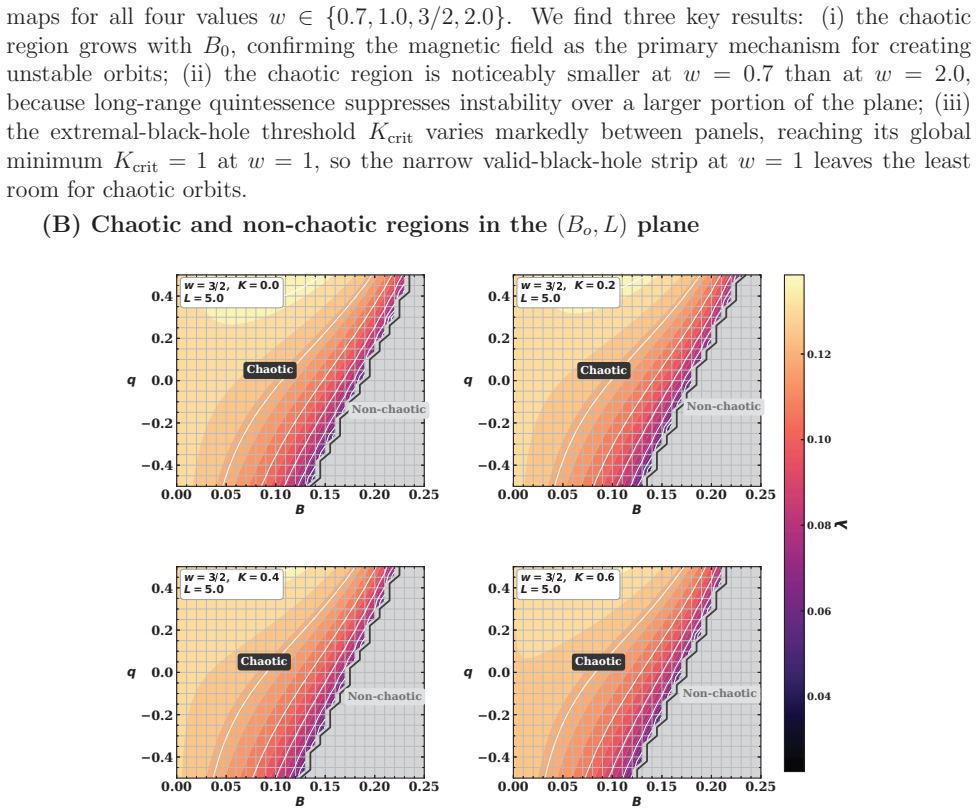
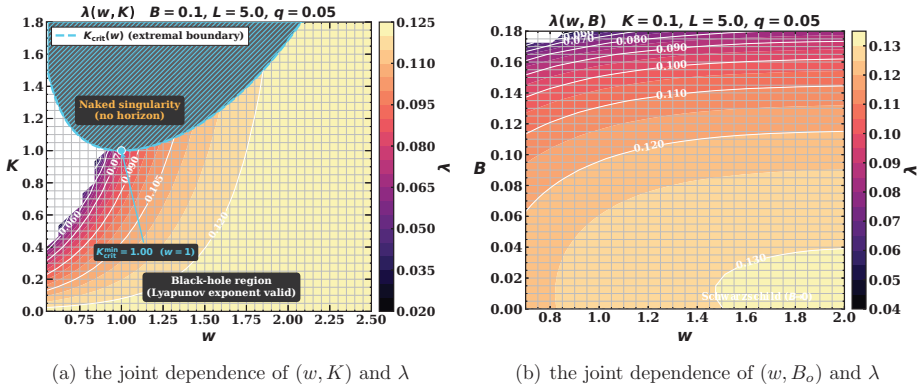
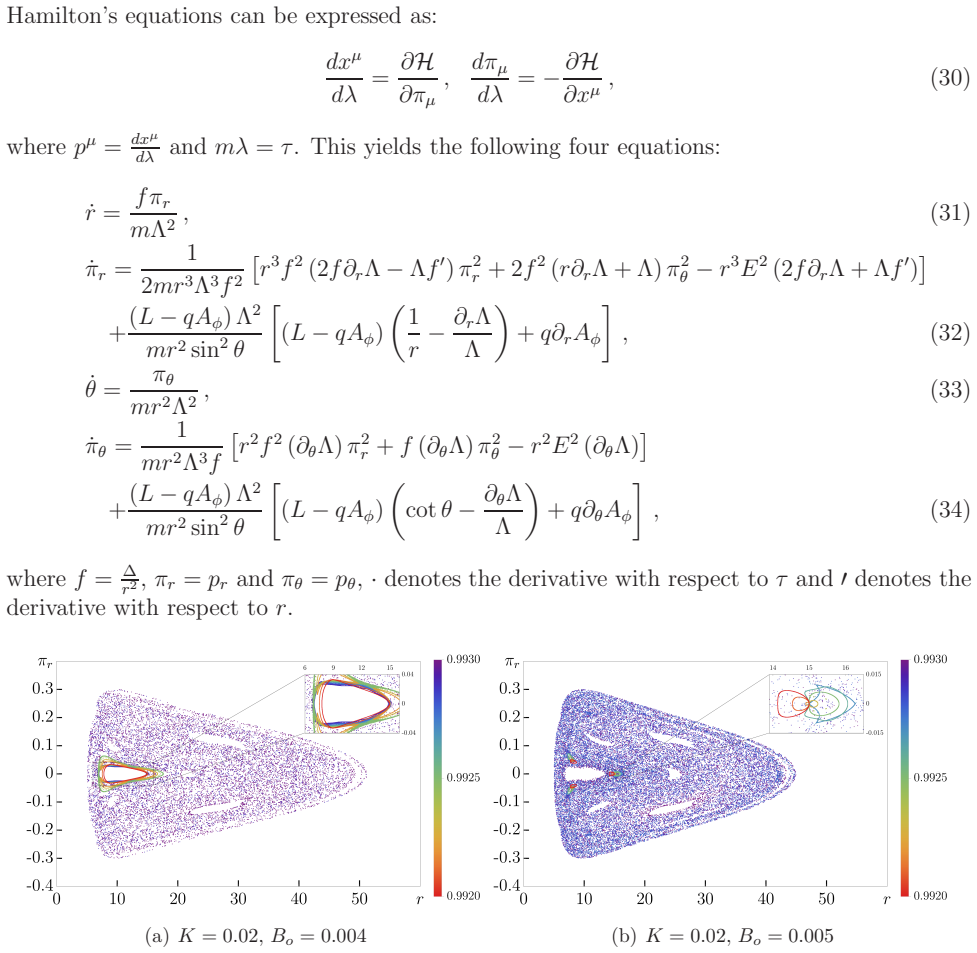
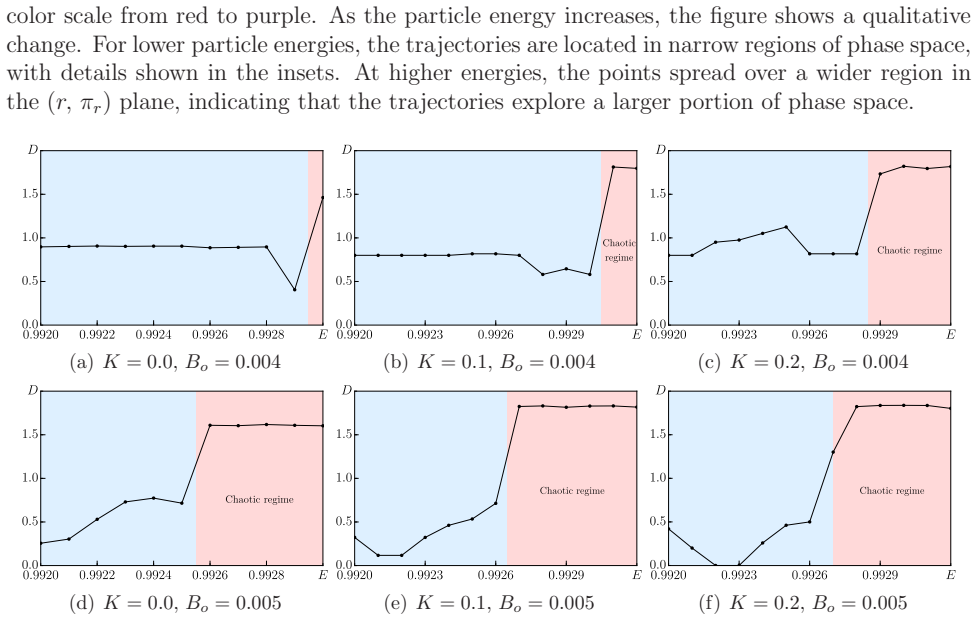
An exact solution describing a static black hole coexisting with anisotropic matter immersed in an external magnetic field is obtained via the Harrison transformation. An increase in the anisotropic matter parameter systematically suppresses the local chaotic behavior, as indicated by a reduction in the Lyapunov exponent. Conversely, variations in the external magnetic field lead to qualitative changes in global chaotic behavior, analyzed through Poincaré sections which demonstrate transitions between regular and chaotic trajectories resulting from the nonlinear gravitational-magnetic interactions.
What carries the argument
The exact Einstein-Maxwell spacetime generated by the Harrison transformation, which incorporates the anisotropic matter stress-energy tensor together with the external magnetic field.
If this is right
- The anisotropic matter parameter and the magnetic field strength play distinct yet complementary roles in shaping chaotic particle dynamics.
- The solution supplies a new theoretical framework for exploring non-integrable particle motion within magnetized black hole spacetimes.
- The construction is relevant for probing black holes at galactic centers where magnetic fields may arise from plasma effects surrounding astrophysical black holes.
Where Pith is reading between the lines
- Observed reductions in orbital chaos could serve as an indirect signature of anisotropic matter distributions near black holes.
- The same solution technique could be applied to rotating seed metrics to examine whether the suppression of local chaos persists in Kerr-like geometries.
- Varying the magnetic field might produce measurable changes in the fraction of captured versus scattered particles, affecting accretion flow patterns.
Load-bearing premise
The Harrison transformation applied to the chosen seed solution yields a physically valid exact solution of the Einstein-Maxwell equations that correctly incorporates the anisotropic matter stress-energy tensor.
What would settle it
Numerical integration of particle geodesics showing whether the Lyapunov exponent decreases monotonically with rising anisotropic parameter, or whether Poincaré sections exhibit the claimed transitions when the magnetic field strength is varied.
Figures
read the original abstract
We present an exact solution to the Einstein-Maxwell equations that describes a static black hole coexisting with anisotropic matter immersed in an external magnetic field, obtained via the Harrison transformation. Our findings reveal that an increase in the anisotropic matter parameter systematically suppresses the local chaotic behavior, as indicated by a reduction in the Lyapunov exponent. Conversely, variations in the external magnetic field lead to qualitative changes in global chaotic behavior. This is analyzed through Poincar\'e sections, which demonstrate transitions between regular and chaotic trajectories resulting from the nonlinear gravitational-magnetic interactions. These factors play distinct yet complementary roles in shaping chaotic particle dynamics around black holes. This study would offer a new theoretical framework for exploring non-integrable particle motion within magnetized black hole spacetimes and for probing a black hole at the galactic center, where magnetic fields may arise from plasma effects surrounding astrophysical black holes.
Editorial analysis
A structured set of objections, weighed in public.
Referee Report
Summary. The manuscript claims to construct an exact solution of the Einstein-Maxwell equations for a static black hole surrounded by anisotropic matter in an external magnetic field by applying the Harrison transformation to a suitable seed. It then studies timelike geodesic motion in this spacetime and reports that increasing the anisotropic-matter parameter systematically reduces the Lyapunov exponent (suppressing local chaos), while changes in the magnetic-field strength produce qualitative transitions between regular and chaotic orbits visible in Poincaré sections.
Significance. If the metric is verified to solve the Einstein-Maxwell system with the claimed stress-energy content, the work supplies a new exact magnetized black-hole spacetime that can be used to explore non-integrable particle dynamics. The separation of local (Lyapunov) and global (Poincaré) diagnostics is a useful distinction for assessing the complementary roles of anisotropic matter and magnetic fields, with potential relevance to galactic-center environments.
major comments (2)
- [Solution construction section] The section describing the solution construction: the Harrison transformation is applied to a seed already containing anisotropic matter; the manuscript must explicitly compute the resulting effective T_{\mu\nu} and demonstrate that it remains purely anisotropic plus electromagnetic, with no extraneous sources introduced by the transformation. This verification is load-bearing for every subsequent claim about particle motion.
- [Lyapunov exponent analysis] The section on Lyapunov-exponent computation: the exponent is stated to be obtained from the geodesic equations, yet no explicit form of the variational equations, integration method, or convergence/error analysis is supplied. Without these details the reported systematic suppression with the anisotropic parameter cannot be assessed.
minor comments (1)
- Notation for the anisotropic-matter parameter and magnetic-field strength should be introduced once with a clear table of symbols; repeated redefinition in later sections reduces readability.
Simulated Author's Rebuttal
We thank the referee for the careful reading and constructive comments. We address the two major points below and will revise the manuscript to incorporate the requested details.
read point-by-point responses
-
Referee: [Solution construction section] The section describing the solution construction: the Harrison transformation is applied to a seed already containing anisotropic matter; the manuscript must explicitly compute the resulting effective T_{\mu\nu} and demonstrate that it remains purely anisotropic plus electromagnetic, with no extraneous sources introduced by the transformation. This verification is load-bearing for every subsequent claim about particle motion.
Authors: We agree that an explicit post-transformation computation of the effective stress-energy tensor is necessary to confirm the solution's validity. In the revised manuscript we will add the full calculation of T_{\mu\nu}, demonstrating that the resulting tensor contains only the original anisotropic-matter contribution together with the electromagnetic field and introduces no extraneous sources. This verification will be placed immediately after the metric derivation so that all subsequent geodesic results rest on a rigorously verified spacetime. revision: yes
-
Referee: [Lyapunov exponent analysis] The section on Lyapunov-exponent computation: the exponent is stated to be obtained from the geodesic equations, yet no explicit form of the variational equations, integration method, or convergence/error analysis is supplied. Without these details the reported systematic suppression with the anisotropic parameter cannot be assessed.
Authors: We accept the referee's observation that the numerical procedure requires fuller documentation. The revised version will supply the explicit variational equations obtained by linearizing the geodesic equations, describe the integration algorithm (including the ODE solver and step-size control), and present a convergence study together with error estimates. These additions will allow independent assessment of the reported systematic decrease of the Lyapunov exponent with increasing anisotropic-matter parameter. revision: yes
Circularity Check
No circularity: metric derivation and chaos diagnostics are independent of target claims
full rationale
The paper constructs an exact solution via Harrison transformation applied to a seed metric containing anisotropic matter, then numerically extracts Lyapunov exponents and Poincaré sections from geodesic motion in the resulting spacetime. No step equates a fitted parameter to a 'prediction,' renames an input as output, or relies on a self-citation chain whose content is the target result. The suppression of chaos by the anisotropic parameter and magnetic-field effects on global behavior are computed outputs, not definitional inputs. The validity of the transformed stress-energy tensor is an external assumption (correctness risk), not a circular reduction within the derivation.
Axiom & Free-Parameter Ledger
free parameters (2)
- anisotropic matter parameter
- external magnetic field strength
axioms (1)
- standard math Harrison transformation generates an exact solution to the Einstein-Maxwell system when applied to an appropriate seed metric
Reference graph
Works this paper leans on
-
[1]
A. M. Ghez, S. Salim, N. N. Weinberg, J. R. Lu, T. Do, J. K. Dunn, K . Matthews, M. Mor- ris, S. Yelda and E. E. Becklin, et al. Astrophys. J. 689, 1044-1062 (2008) [arXiv:0808.2870 [astro-ph]]
work page internal anchor Pith review Pith/arXiv arXiv 2008
-
[2]
Monitoring stellar orbits around the Massive Black Hole in the Galactic Center
S. Gillessen, F. Eisenhauer, S. Trippe, T. Alexander, R. Genzel, F . Martins and T. Ott, Astrophys. J. 692, 1075-1109 (2009) [arXiv:0810.4674 [astro-ph]]
work page internal anchor Pith review Pith/arXiv arXiv 2009
-
[3]
R. D. Blandford and R. L. Znajek, Mon. Not. Roy. Astron. Soc. 179, 433-456 (1977)
1977
-
[4]
M. D. Johnson, V. L. Fish, S. S. Doeleman, D. P. Marrone, R. L. P lambeck, J. F. C. Wardle, K. Akiyama, K. Asada, C. Beaudoin and L. Blackburn, et al. Science 350, no.6265, 1242- 1245 (2015) [arXiv:1512.01220 [astro-ph.HE]]
work page internal anchor Pith review Pith/arXiv arXiv 2015
-
[5]
R. Blandford, D. Meier and A. Readhead, Ann. Rev. Astron. Ast rophys. 57, 467-509 (2019) [arXiv:1812.06025 [astro-ph.HE]]
-
[6]
GW190521: A Binary Black Hole Merger with a Total Mass of 150M ⊙,
R. Abbott et al. [LIGO Scientific and Virgo], Phys. Rev. Lett. 125, no.10, 101102 (2020) [arXiv:2009.01075 [gr-qc]]
-
[7]
K. Akiyama et al. [Event Horizon Telescope], Astrophys. J. Lett. 930, no.2, L12 (2022) [arXiv:2311.08680 [astro-ph.HE]]
work page internal anchor Pith review Pith/arXiv arXiv 2022
-
[8]
K. Akiyama et al. [Event Horizon Telescope], Astron. Astrophys. 704, A91 (2025) [arXiv:2509.24593 [astro-ph.HE]]
- [9]
-
[10]
Schwarzschild, Sitzungsber
K. Schwarzschild, Sitzungsber. Preuss. Akad. Wiss. Berlin (Ma th. Phys. ) 1916, 189-196 (1916)
1916
-
[11]
R. P. Kerr, Phys. Rev. Lett. 11, 237-238 (1963)
1963
-
[12]
R. P. Kerr, [arXiv:0706.1109 [gr-qc]]
work page internal anchor Pith review Pith/arXiv arXiv
-
[13]
Carter, Phys
B. Carter, Phys. Rev. 174, 1559-1571 (1968)
1968
-
[14]
Carter, Commun
B. Carter, Commun. Math. Phys. 10, no.4, 280-310 (1968)
1968
-
[15]
Walker and R
M. Walker and R. Penrose, Commun. Math. Phys. 18, 265 (1970)
1970
-
[16]
Benenti and M
S. Benenti and M. Francaviglia, Gen. Rel. Grav. 10, no.1, 79-92 (1979)
1979
-
[17]
Demianski and M
M. Demianski and M. Francaviglia, Int. J. Theor. Phys. 19, no.9, 675-680 (1980). 27
1980
-
[18]
J. M. Bardeen, 1973, in Black Holes, ed. C. DeWitt & B. S. DeWitt ( New York: Gordon & Breach), 215-240
1973
-
[19]
I. G. Dymnikova, Sov. Phys. Usp. 29, 215 (1986)
1986
-
[20]
Homoclinic Orbits around Spinning Black Holes I: Exact Solution for the Kerr Separatrix
J. Levin and G. Perez-Giz, Phys. Rev. D 79, 124013 (2009) [arXiv:0811.3814 [gr-qc]]
work page internal anchor Pith review Pith/arXiv arXiv 2009
-
[21]
Circular motion of neutral test particles in Reissner-Nordstr\"om spacetime
D. Pugliese, H. Quevedo and R. Ruffini, Phys. Rev. D 83, 024021 (2011) [arXiv:1012.5411 [astro-ph.HE]]
work page internal anchor Pith review Pith/arXiv arXiv 2011
- [22]
-
[23]
Geodesic stability, Lyapunov exponents and quasinormal modes
V. Cardoso, A. S. Miranda, E. Berti, H. Witek and V. T. Zanchin, Phys. Rev. D 79, no.6, 064016 (2009) [arXiv:0812.1806 [hep-th]]
work page internal anchor Pith review Pith/arXiv arXiv 2009
- [24]
- [25]
- [26]
- [27]
-
[28]
T. V. Targema, K. Bamba and U. Zafar, [arXiv:2605.26829 [hep-t h]]
work page internal anchor Pith review Pith/arXiv arXiv
-
[29]
M. A. Melvin, Phys. Lett. 8, 65-70 (1964)
1964
-
[30]
F. J. Ernst, J. Math. Phys. 17, no.1, 54-56 (1976)
1976
-
[31]
F. J. Ernst and W. J. Wild, J. Math. Phys. 17, no.2, 182 (1976)
1976
-
[32]
B. K. Harrison, J. Math. Phys. 9, no.11, 1744 (1968)
1968
-
[33]
R. M. Wald, Phys. Rev. D 10, 1680-1685 (1974)
1974
-
[34]
W. A. Hiscock, J. Math. Phys. 22, 1828 (1981)
1981
-
[35]
K. S. Thorne, R. H. Price and D. A. Macdonald, BLACK HOLES: THE MEMBRANE PARADIGM, (Yale University Press, New Haven and London, 1986)
1986
-
[36]
L. Rezzolla, B. J. Ahmedov and J. C. Miller, Mon. Not. Roy. Astro n. Soc. 322, 723 (2001) [arXiv:astro-ph/0011316 [astro-ph]]
work page internal anchor Pith review Pith/arXiv arXiv 2001
-
[37]
J. Podolsky and H. Ovcharenko, Phys. Rev. Lett. 135, no.18, 181401 (2025) [arXiv:2507.05199 [gr-qc]]. 28
-
[38]
Black holes in the external Bertotti-Robinson-Bonnor-Melvin electromagnetic field,
M. Astorino, Phys. Rev. D 112, no.10, 104077 (2025) [arXiv:2508.12908 [gr-qc]]
-
[39]
V. V. Kiselev, Class. Quant. Grav. 20, 1187-1198 (2003) [arXiv:gr-qc/0210040 [gr-qc]]
work page internal anchor Pith review Pith/arXiv arXiv 2003
-
[40]
Rotating black hole solutions with quintessential energy
B. Toshmatov, Z. Stuchl ´ ık and B. Ahmedov, Eur. Phys. J. Plu s 132, no.2, 98 (2017) [arXiv:1512.01498 [gr-qc]]
work page internal anchor Pith review Pith/arXiv arXiv 2017
-
[41]
Simple Black Holes with Anisotropic Fluid
I. Cho and H. C. Kim, Chin. Phys. C 43, no.2, 025101 (2019) [arXiv:1703.01103 [gr-qc]]
work page internal anchor Pith review Pith/arXiv arXiv 2019
- [42]
- [43]
- [44]
-
[45]
Anisotropic matter and nonlinear electromagnetics black holes
W. Lee and Y. S. Myung, Eur. Phys. J. C 86, no.5, 525 (2026) [arXiv:2603.01507 [gr-qc]]
work page internal anchor Pith review Pith/arXiv arXiv 2026
-
[46]
M. Xu, J. Lu, Y. Liu and S. Wu, [arXiv:2606.29881 [gr-qc]]
work page internal anchor Pith review Pith/arXiv arXiv
-
[47]
G. W. Gibbons and S. W. Hawking, Phys. Rev. D 15, 2752-2756 (1977)
1977
-
[48]
S. W. Hawking and S. F. Ross, Phys. Rev. D 52, 5865-5876 (1995) [arXiv:hep-th/9504019 [hep-th]]
work page internal anchor Pith review Pith/arXiv arXiv 1995
- [49]
- [50]
-
[51]
Carter, J
B. Carter, J. Math. Phys. 10, 70-81 (1969)
1969
-
[52]
V. P. Frolov, P. Krtous and D. Kubiznak, Living Rev. Rel. 20, no.1, 6 (2017) [arXiv:1705.05482 [gr-qc]]
work page internal anchor Pith review Pith/arXiv arXiv 2017
- [53]
-
[54]
J. M. Bardeen, W. H. Press and S. A. Teukolsky, Astrophys. J . 178, 347 (1972)
1972
-
[55]
Ferrari, L
V. Ferrari, L. Gualtieri and P. Pani, General Relativity and its Applications , CRC Press, (2020)
2020
-
[56]
Homoclinic Orbits around Spinning Black Holes II: The Phase Space Portrait
G. Perez-Giz and J. Levin, Phys. Rev. D 79, 124014 (2009) [arXiv:0811.3815 [gr-qc]]
work page internal anchor Pith review Pith/arXiv arXiv 2009
-
[57]
Computation of Lyapunov Exponents in General Relativity
X. Wu and T. y. Huang, Phys. Lett. A 313, 77-81 (2003) [arXiv:gr-qc/0302118 [gr-qc]]. 29
work page internal anchor Pith review Pith/arXiv arXiv 2003
-
[58]
J. Maldacena, S. H. Shenker and D. Stanford, JHEP 08, 106 (2016) [arXiv:1503.01409 [hep-th]]
work page internal anchor Pith review Pith/arXiv arXiv 2016
-
[59]
Universality in Chaos of Particle Motion near Black Hole Horizon
K. Hashimoto and N. Tanahashi, Phys. Rev. D 95, no.2, 024007 (2017) [arXiv:1610.06070 [hep-th]]
work page internal anchor Pith review Pith/arXiv arXiv 2017
-
[60]
Falconer, Fractal Geometry: Mathematical Foundations and Applicati ons, John Wiley & Sons, Ltd, 2003
K. Falconer, Fractal Geometry: Mathematical Foundations and Applicati ons, John Wiley & Sons, Ltd, 2003
2003
-
[61]
Kormendy and D
J. Kormendy and D. Richstone, Ann. Rev. Astron. Astrophys . 33, 581 (1995)
1995
-
[62]
V. C. Rubin and W. K. Ford, Jr., Astrophys. J. 159, 379-403 (1970)
1970
-
[63]
S. J. Sin, Phys. Rev. D 50, 3650-3654 (1994) [arXiv:hep-ph/9205208 [hep-ph]]
work page internal anchor Pith review Pith/arXiv arXiv 1994
-
[64]
J. w. Lee and I. g. Koh, Phys. Rev. D 53, 2236-2239 (1996) [arXiv:hep-ph/9507385 [hep- ph]]
work page internal anchor Pith review Pith/arXiv arXiv 1996
- [65]
-
[66]
J. W. Lee and S. Lim, JCAP 01, 007 (2010) [arXiv:0812.1342 [astro-ph]]
work page internal anchor Pith review Pith/arXiv arXiv 2010
-
[67]
L. Hui, J. P. Ostriker, S. Tremaine and E. Witten, Phys. Rev. D 95, no.4, 043541 (2017) [arXiv:1610.08297 [astro-ph.CO]]
work page internal anchor Pith review Pith/arXiv arXiv 2017
- [68]
-
[69]
D. P. Marrone, J. M. Moran, J. H. Zhao and R. Rao, Astrophys . J. Lett. 654, L57-L60 (2006) [arXiv:astro-ph/0611791 [astro-ph]]
work page internal anchor Pith review Pith/arXiv arXiv 2006
-
[70]
R. P. Eatough, H. Falcke, R. Karuppusamy, K. J. Lee, D. J. Ch ampion, E. F. Keane, G. Desvignes, D. H. F. M. Schnitzeler, L. G. Spitler and M. Kramer, et al. Nature 501, 391-394 (2013) [arXiv:1308.3147 [astro-ph.GA]]
work page internal anchor Pith review Pith/arXiv arXiv 2013
-
[71]
Bicak and V
J. Bicak and V. Janis, Mon. Not. R. astr. Soc. 212, 899 (1985)
1985
-
[72]
A. N. Aliev and D. V. Galtsov, Sov. Phys. Usp. 32, 75 (1989)
1989
-
[73]
Karas and D
V. Karas and D. Vokroulflicky, Gen. Relativ. Gravit. 24, 729-743 (1992)
1992
-
[74]
M. Wang, S. Chen and J. Jing, Eur. Phys. J. C 77, no.4, 208 (2017) [arXiv:1605.09506 [gr-qc]]
work page internal anchor Pith review Pith/arXiv arXiv 2017
-
[75]
Chaotic motion of neutral and charged particles in the magnetized Ernst-Schwarzschild spacetime
D. Li and X. Wu, Eur. Phys. J. Plus 134, no.3, 96 (2019) [arXiv:1803.02119 [gr-qc]]
work page internal anchor Pith review Pith/arXiv arXiv 2019
-
[76]
J. Podolsky and K. Vesely, Phys. Rev. D 58, 081501 (1998) [arXiv:gr-qc/9805078 [gr-qc]]. 30
work page internal anchor Pith review Pith/arXiv arXiv 1998
-
[77]
Free motion around black holes with discs or rings: between integrability and chaos - I
O. Semerak and P. Sukova, Mon. Not. Roy. Astron. Soc. 404, 545-574 (2010) [arXiv:1211.4106 [gr-qc]]
work page internal anchor Pith review Pith/arXiv arXiv 2010
-
[78]
Free motion around black holes with discs or rings: between integrability and chaos - II
O. Semerak and P. Sukova, Mon. Not. Roy. Astron. Soc. 425, 2455-2476 (2012) [arXiv:1211.4107 [gr-qc]]
work page internal anchor Pith review Pith/arXiv arXiv 2012
-
[79]
Z. Stuchl ´ ık and M. Koloˇ s, Eur. Phys. J. C76, no.1, 32 (2016) [arXiv:1511.02936 [gr-qc]]
work page internal anchor Pith review Pith/arXiv arXiv 2016
-
[80]
Radiation reaction of charged particles orbiting magnetized Schwarzschild black hole
A. Tursunov, M. Koloˇ s, Z. Stuchl ´ ık and D. V. Gal’tsov, Astrophys. J. 861, no.1, 2 (2018) [arXiv:1803.09682 [gr-qc]]
work page internal anchor Pith review Pith/arXiv arXiv 2018
discussion (0)
Sign in with ORCID, Apple, or X to comment. Anyone can read and Pith papers without signing in.