Gravitational Waves from Post-Inflationary Magnetism: Direct and Scalar-Induced Contributions
Pith reviewed 2026-06-30 12:10 UTC · model grok-4.3
The pith
Post-inflationary magnetic fields with time-dependent gauge couplings source stochastic gravitational waves that reach nano-Hz frequencies, with the direct magnetic contribution dominating the peak amplitude over the scalar-induced part.
A machine-rendered reading of the paper's core claim, the machinery that carries it, and where it could break.
Core claim
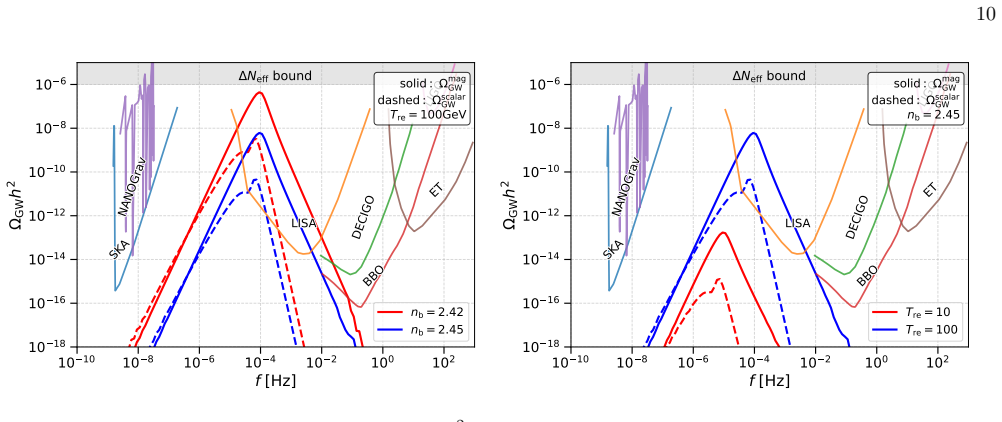
In the post-inflationary magnetogenesis scenario with time-dependent gauge couplings during inflation and reheating, magnetic anisotropic stress directly sources gravitational waves while induced curvature perturbations generate an additional scalar-induced component. The magnetic component dominates the peak amplitude whereas the scalar-induced contribution becomes important on larger scales. For blue magnetic spectra with n_b greater than or equal to 3/2 both spectra follow the infrared scaling Omega_GW proportional to f cubed below the peak, yet their ultraviolet behaviors differ. For suitable reheating and magnetogenesis parameters the resulting signal extends into the nano-Hz range rele
What carries the argument
The two sourcing mechanisms for stochastic gravitational waves: direct production from magnetic-field anisotropic stress and indirect production from curvature perturbations induced by those same magnetic fields, with their relative amplitudes and spectral shapes compared across frequency bands.
If this is right
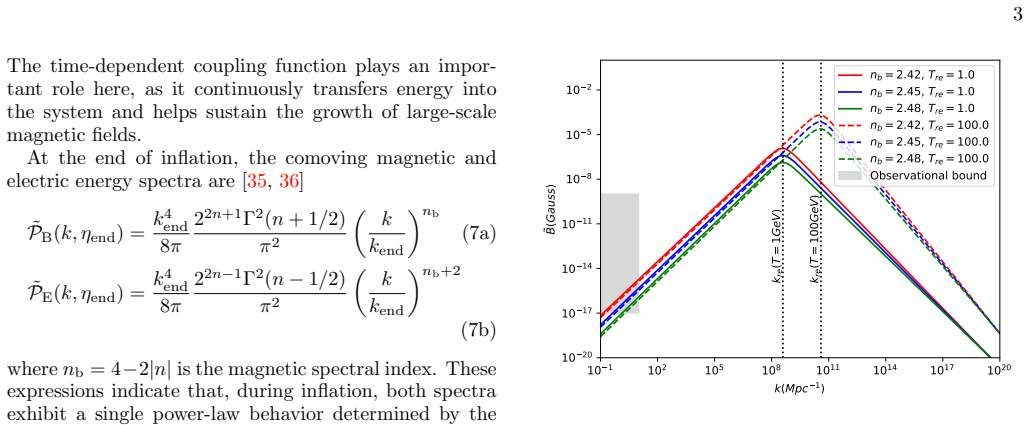
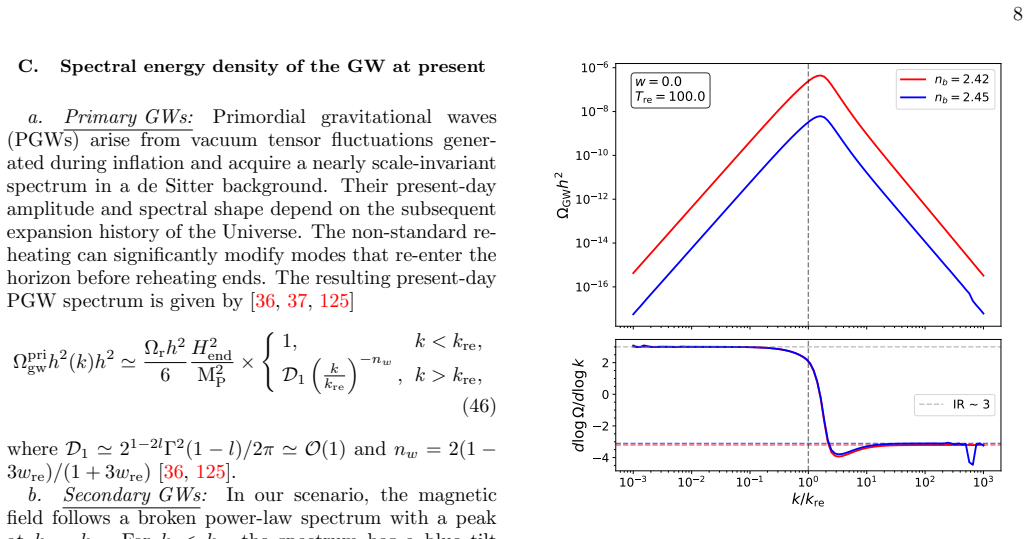
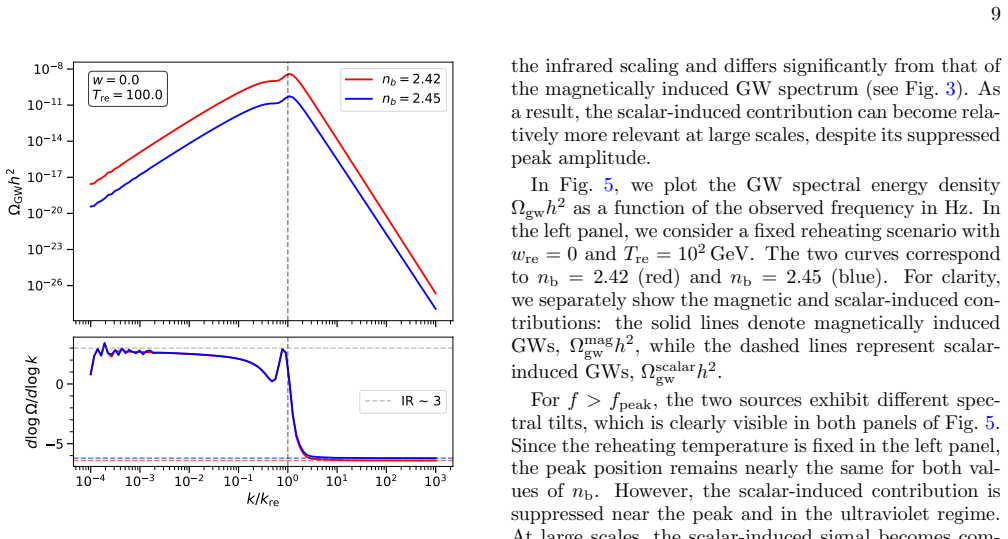
- For blue magnetic spectra with n_b greater than or equal to 3/2 both the direct and scalar-induced spectra obey Omega_GW proportional to f cubed at frequencies well below the peak.
- The direct magnetic contribution sets the maximum amplitude while the scalar-induced contribution dominates at larger scales.
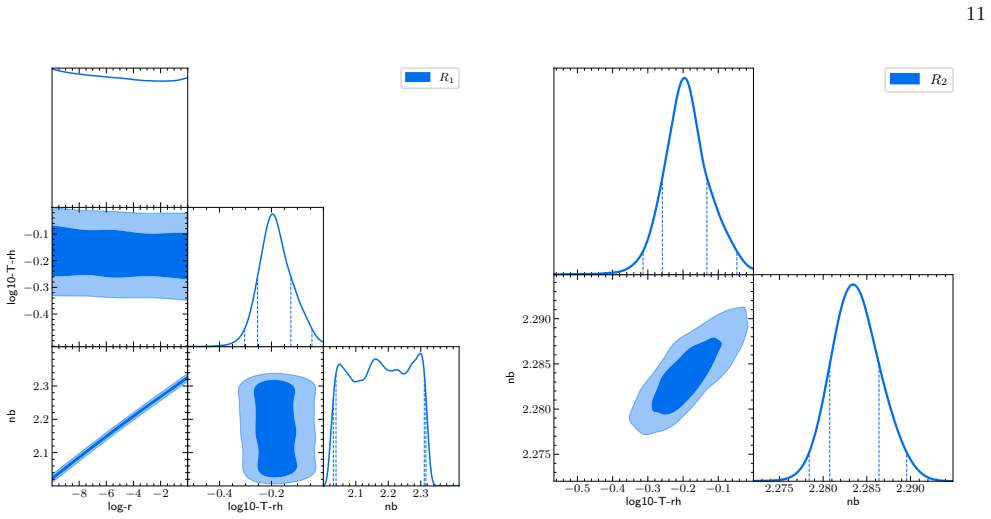
- The overall signal can be placed inside the nano-Hz window accessible to pulsar timing arrays by choosing appropriate reheating and magnetogenesis parameters.
- The differing ultraviolet slopes of the two components produce observable spectral features that distinguish this scenario from others.
- These features offer a potential probe of the duration and temperature of reheating together with the form of the primordial magnetic spectrum.
Where Pith is reading between the lines
- Future pulsar timing array data could place joint constraints on the time dependence of gauge couplings during reheating and the tilt of the magnetic spectrum.
- If the predicted spectral break between the two contributions is observed, it would link the amplitude of primordial magnetic fields to the timing of reheating in a way independent of direct magnetic-field searches.
- The same parameter space that produces a nano-Hz signal may also affect the evolution of curvature perturbations on scales that enter the horizon during reheating, offering a cross-check with CMB spectral distortions.
- Extension of the calculation to include the back-reaction of the generated gravitational waves on the magnetic field evolution would test the robustness of the peak-amplitude dominance.
Load-bearing premise
The post-inflationary magnetogenesis scenario with time-dependent gauge couplings produces the assumed magnetic spectra and anisotropic stress without violating other cosmological constraints.
What would settle it
A pulsar timing array measurement that either detects or rules out a stochastic gravitational-wave background whose peak is dominated by the magnetic contribution and whose spectrum shows the predicted infrared f cubed rise together with a distinct ultraviolet tail.
Figures
read the original abstract
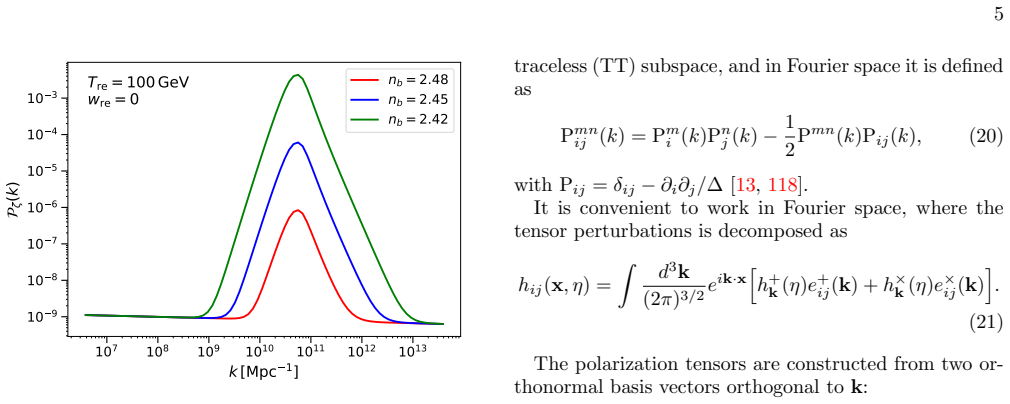
We study stochastic gravitational waves generated in a post-inflationary magnetogenesis scenario with time-dependent gauge couplings during inflation and reheating. In this setup, magnetic anisotropic stress directly sources gravitational waves, while the induced curvature perturbations generate an additional scalar-induced GW component. We compare the spectral behavior of the two contributions and find that the magnetic component dominates the peak amplitude, whereas the scalar-induced contribution becomes important on larger scales. For blue magnetic spectra with $n_{\rm b}\geq3/2$, both spectra follow the universal infrared scaling $\Omega_{\rm GW}(f\ll f_{\rm peak})\propto f^3$. However, their ultraviolet behaviors differ significantly for $f>f_{\rm peak}$, leading to distinct spectral features. For suitable reheating and magnetogenesis parameters, the resulting GW signal naturally extends into the nano-Hz range relevant for pulsar timing array observations, while remaining consistent with current bounds. The distinct spectral features of the two components may provide a useful probe of reheating dynamics and primordial magnetogenesis.
Editorial analysis
A structured set of objections, weighed in public.
Referee Report
Summary. The manuscript examines stochastic gravitational waves sourced by post-inflationary magnetogenesis with time-dependent gauge couplings during inflation and reheating. It compares the direct contribution from magnetic anisotropic stress to the scalar-induced contribution arising from curvature perturbations, finding that the magnetic component dominates the peak amplitude while the scalar-induced term is relevant on larger scales. For blue spectra with n_b ≥ 3/2 both components obey the infrared scaling Ω_GW ∝ f^3, but their ultraviolet behaviors differ; the authors state that suitable reheating and magnetogenesis parameters place the signal in the nano-Hz band accessible to pulsar timing arrays while remaining consistent with existing bounds.
Significance. If the existence of a viable parameter window is demonstrated, the work would supply a concrete mechanism linking primordial magnetogenesis and reheating dynamics to observable gravitational-wave spectra with distinguishable features, potentially offering a new probe for PTA experiments.
major comments (2)
- [Abstract] Abstract: the central claim that 'suitable reheating and magnetogenesis parameters' allow the GW signal to extend into the nano-Hz range while remaining consistent with current bounds is load-bearing for the PTA relevance, yet the abstract provides no explicit demonstration that such a window survives backreaction, CMB B-field limits, or consistency with the inflationary background; this viability must be shown with concrete parameter ranges and constraint plots.
- [Abstract] The derivation of the spectral scalings (both components ~f^3 in the IR, differing in the UV) rests on the assumed magnetic spectra with n_b ≥ 3/2 and the associated anisotropic stress; without an explicit check that these spectra can be realized without violating the assumed post-inflationary evolution, the universality of the IR scaling and the distinction between components remain conditional on unverified premises.
Simulated Author's Rebuttal
We thank the referee for their careful reading and constructive comments on our manuscript. We address each major comment below, providing point-by-point responses and indicating revisions where appropriate.
read point-by-point responses
-
Referee: [Abstract] Abstract: the central claim that 'suitable reheating and magnetogenesis parameters' allow the GW signal to extend into the nano-Hz range while remaining consistent with current bounds is load-bearing for the PTA relevance, yet the abstract provides no explicit demonstration that such a window survives backreaction, CMB B-field limits, or consistency with the inflationary background; this viability must be shown with concrete parameter ranges and constraint plots.
Authors: We agree that the abstract, being a concise summary, does not itself contain explicit parameter ranges or plots. The viability of the parameter window, including explicit checks against backreaction, CMB B-field limits, and consistency with the inflationary background, is demonstrated in Sections 3 and 4 with concrete examples and constraint plots (Figures 5–7). To strengthen the abstract, we have revised it to explicitly reference the parameter-space analysis and consistency checks performed in the main text. revision: yes
-
Referee: [Abstract] The derivation of the spectral scalings (both components ~f^3 in the IR, differing in the UV) rests on the assumed magnetic spectra with n_b ≥ 3/2 and the associated anisotropic stress; without an explicit check that these spectra can be realized without violating the assumed post-inflationary evolution, the universality of the IR scaling and the distinction between components remain conditional on unverified premises.
Authors: The blue spectra with n_b ≥ 3/2 are not merely assumed but are derived from the time-dependent gauge coupling during inflation and reheating, as shown explicitly in Section 2. Consistency with the post-inflationary evolution is verified by construction through the choice of coupling functions that keep the magnetic energy density subdominant; this is stated in Section 2.3 and cross-referenced in the discussion of spectral scalings. We have added an explicit clarifying sentence in the revised manuscript to make this verification more prominent. revision: yes
Circularity Check
No significant circularity; parameter viability presented as external consistency check
full rationale
The provided abstract and claims derive GW spectra (both direct magnetic and scalar-induced) from the assumed post-inflationary magnetogenesis setup with time-dependent gauge couplings and blue magnetic spectra n_b >= 3/2. The IR scaling Omega_GW ~ f^3 and differing UV behaviors follow directly from those inputs without reduction to a fit or self-definition. The statement that the signal 'naturally extends into the nano-Hz range for suitable reheating and magnetogenesis parameters' while 'remaining consistent with current bounds' treats parameter choice as an external viability condition rather than a fitted input renamed as prediction. No self-citations, uniqueness theorems, or ansatze are invoked in the given text. The derivation chain is therefore self-contained against the stated assumptions.
Axiom & Free-Parameter Ledger
free parameters (1)
- reheating and magnetogenesis parameters
axioms (1)
- domain assumption Post-inflationary magnetogenesis with time-dependent gauge couplings produces the stated magnetic anisotropic stress and induced curvature perturbations.
Reference graph
Works this paper leans on
-
[1]
Using this asymp- totic behavior in Eq.(43), the kernel admits the following late-time form [25–33, 110–116, 119–122]: I2 RD,s(v, u, x→ ∞)≃ 1 2x2 3(v2 +u 2 −3) 4v3u3 2 × −4vu+ (v 2 +u 2 −3) log 3−(v+u) 2 3−(v−u) 2 2 +π2(v2 +u 2 −3) 2Θ(v+u− √ 3) ! .(45) From the above analysis, it is clear that both the mag- netic and scalar-induced sources show similar ti...
-
[2]
B. P. Abbottet al.(LIGO Scientific, Virgo), Phys. Rev. Lett.116, 061102 (2016), arXiv:1602.03837 [gr-qc]
work page internal anchor Pith review Pith/arXiv arXiv 2016
-
[3]
B. P. Abbottet al.(LIGO Scientific, Virgo), Phys. Rev. Lett.116, 241102 (2016), arXiv:1602.03840 [gr-qc]
work page internal anchor Pith review Pith/arXiv arXiv 2016
-
[4]
B. P. Abbottet al.(LIGO Scientific, Virgo), Phys. Rev. Lett.116, 131103 (2016), arXiv:1602.03838 [gr-qc]
work page internal anchor Pith review Pith/arXiv arXiv 2016
-
[5]
B. P. Abbottet al.(LIGO Scientific, Virgo), Phys. Rev. D93, 122003 (2016), arXiv:1602.03839 [gr-qc]
work page internal anchor Pith review Pith/arXiv arXiv 2016
-
[6]
B. P. Abbottet al.(LIGO Scientific, VIRGO), Phys. Rev. Lett.118, 221101 (2017), [Erratum: Phys.Rev.Lett. 121, 129901 (2018)], arXiv:1706.01812 [gr-qc]
work page internal anchor Pith review Pith/arXiv arXiv 2017
-
[7]
B. P. Abbottet al.(LIGO Scientific, Virgo), Phys. Rev. Lett.118, 121101 (2017), [Erratum: Phys.Rev.Lett. 119, 029901 (2017)], arXiv:1612.02029 [gr-qc]
work page internal anchor Pith review Pith/arXiv arXiv 2017
-
[8]
Planck 2018 results. X. Constraints on inflation
Y. Akramiet al.(Planck), Astron. Astrophys.641, A10 (2020), arXiv:1807.06211 [astro-ph.CO]
work page internal anchor Pith review Pith/arXiv arXiv 2020
- [9]
-
[10]
P. A. R. Adeet al.(BICEP2, Keck Array), Phys. Rev. Lett.121, 221301 (2018), arXiv:1810.05216 [astro- ph.CO]
work page internal anchor Pith review Pith/arXiv arXiv 2018
- [11]
-
[12]
Improved Calculation of the Primordial Gravitational Wave Spectrum in the Standard Model
Y. Watanabe and E. Komatsu, Phys. Rev. D73, 123515 (2006), arXiv:astro-ph/0604176
work page internal anchor Pith review Pith/arXiv arXiv 2006
-
[13]
Cosmological Backgrounds of Gravitational Waves
C. Caprini and D. G. Figueroa, Class. Quant. Grav.35, 163001 (2018), arXiv:1801.04268 [astro-ph.CO]
work page internal anchor Pith review Pith/arXiv arXiv 2018
-
[14]
Second-Order Cosmological Perturbations from Inflation
V. Acquaviva, N. Bartolo, S. Matarrese, and A. Riotto, Nucl. Phys. B667, 119 (2003), arXiv:astro-ph/0209156
work page internal anchor Pith review Pith/arXiv arXiv 2003
-
[15]
Planck 2018 results. VI. Cosmological parameters
N. Aghanimet al.(Planck), Astron. Astrophys.641, A6 (2020), [Erratum: Astron.Astrophys. 652, C4 (2021)], arXiv:1807.06209 [astro-ph.CO]
work page internal anchor Pith review Pith/arXiv arXiv 2020
-
[16]
Sendra and T
I. Sendra and T. L. Smith, Phys. Rev. D85, 123002 (2012)
2012
-
[17]
The NANOGrav 15-year Data Set: Search for Signals from New Physics
A. Afzalet al.(NANOGrav), Astrophys. J. Lett. 951, L11 (2023), [Erratum: Astrophys.J.Lett. 971, L27 (2024), Erratum: Astrophys.J. 971, L27 (2024)], arXiv:2306.16219 [astro-ph.HE]
work page internal anchor Pith review Pith/arXiv arXiv 2023
-
[18]
Parity violation in the Cosmic Microwave Background from a pseudoscalar inflaton
L. Sorbo, JCAP06, 003 (2011), arXiv:1101.1525 [astro- ph.CO]
work page internal anchor Pith review Pith/arXiv arXiv 2011
-
[19]
Adding helicity to inflationary magnetogenesis
C. Caprini and L. Sorbo, JCAP10, 056 (2014), arXiv:1407.2809 [astro-ph.CO]
work page internal anchor Pith review Pith/arXiv arXiv 2014
-
[20]
Primordial Gravitational Waves Induced by Magnetic Fields in an Ekpyrotic Scenario
A. Ito and J. Soda, Phys. Lett. B771, 415 (2017), arXiv:1607.07062 [hep-th]
work page internal anchor Pith review Pith/arXiv arXiv 2017
- [21]
-
[22]
A. A. Starobinsky, JETP Lett.30, 682 (1979)
1979
-
[23]
L. P. Grishchuk, Zh. Eksp. Teor. Fiz.67, 825 (1974)
1974
-
[24]
M. C. Guzzetti, N. Bartolo, M. Liguori, and S. Matar- rese, Riv. Nuovo Cim.39, 399 (2016), arXiv:1605.01615 [astro-ph.CO]
work page internal anchor Pith review Pith/arXiv arXiv 2016
- [25]
-
[26]
Adams, B
J. Adams, B. Cresswell, and R. Easther, Phys. Rev. D 64, 123514 (2001)
2001
-
[27]
Primordial black holes and second order gravitational waves from ultra-slow-roll inflation
H. Di and Y. Gong, JCAP07, 007 (2018), arXiv:1707.09578 [astro-ph.CO]. 13
work page internal anchor Pith review Pith/arXiv arXiv 2018
- [28]
-
[29]
H. V. Ragavendra, P. Saha, L. Sriramkumar, and J. Silk, Phys. Rev. D103, 083510 (2021)
2021
-
[30]
N. Bhaumik and R. K. Jain, Phys. Rev. D104, 023531 (2021), arXiv:2009.10424 [astro-ph.CO]
-
[31]
M. Solbi and K. Karami, JCAP08, 056 (2021), arXiv:2102.05651 [astro-ph.CO]
- [32]
-
[33]
G. Dom` enech, S. Pi, and M. Sasaki, JCAP08, 017 (2020), arXiv:2005.12314 [gr-qc]
-
[34]
R.-g. Cai, S. Pi, and M. Sasaki, Phys. Rev. Lett.122, 201101 (2019), arXiv:1810.11000 [astro-ph.CO]
work page internal anchor Pith review Pith/arXiv arXiv 2019
- [35]
-
[36]
S. Maiti, Phys. Rev. D112, 043536 (2025), arXiv:2506.06183 [astro-ph.CO]
- [37]
-
[38]
A. Chakraborty, S. Maiti, and D. Maity, Phys. Rev. D 111, 083505 (2025), arXiv:2408.07767 [astro-ph.CO]
-
[39]
A. Chakraborty, M. R. Haque, D. Maity, and R. Mon- dal, Phys. Rev. D108, 023515 (2023), arXiv:2304.13637 [astro-ph.CO]
-
[40]
Primary gravitational waves at high frequencies I: Origin of suppression in the power spectrum
A. Hoory, J. Martin, A. Paul, and L. Sriramkumar, (2025), arXiv:2512.03959 [astro-ph.CO]
work page internal anchor Pith review Pith/arXiv arXiv 2025
- [41]
- [42]
-
[43]
S. Okano and T. Fujita, JCAP03, 026 (2021), arXiv:2005.13833 [astro-ph.CO]
-
[44]
Magnetic fields in nearby galaxies
A. Fletcher, arXiv preprint arXiv:1104.2427 (2011)
work page internal anchor Pith review Pith/arXiv arXiv 2011
-
[45]
Beck, The Astronomy and Astrophysics Review24, 4 (2016)
R. Beck, The Astronomy and Astrophysics Review24, 4 (2016)
2016
-
[46]
The outer scale of turbulence in the magneto-ionized Galactic interstellar medium
M. Haverkorn, J. C. Brown, B. M. Gaensler, and N. M. McClure-Griffiths, Astrophys. J.680, 362 (2008), arXiv:0802.2740 [astro-ph]
work page internal anchor Pith review Pith/arXiv arXiv 2008
-
[47]
Kronberg, Q
P. Kronberg, Q. Dufton, H. Li, and S. Colgate, The Astrophysical Journal560, 178 (2001)
2001
-
[48]
A. Brandenburg and E. Ntormousi, Annual Re- view of Astronomy and Astrophysics61, 561 (2023), arXiv:2211.03476 [astro-ph.GA]
-
[49]
M. S. Turner and L. M. Widrow, Phys. Rev. D37, 2743 (1988)
1988
-
[50]
F. D. Mazzitelli and F. M. Spedalieri, Phys. Rev. D52, 6694 (1995)
1995
-
[51]
Lambiase and A
G. Lambiase and A. R. Prasanna, Phys. Rev. D70, 063502 (2004)
2004
-
[52]
K. Yanagihara, F. Uchida, T. Fujita, and S. Tsu- jikawa, arXiv e-prints , arXiv:2312.07938 (2023), arXiv:2312.07938 [astro-ph.CO]
-
[53]
Caprini and R
C. Caprini and R. Durrer, Phys. Rev. D65, 023517 (2001)
2001
-
[54]
The Magnetic Origin of Primordial Black Holes: A Viable Dark Matter Scenario
S. Maiti and D. Maity, JCAP04, 020 (2026), arXiv:2508.19217 [astro-ph.CO]
work page internal anchor Pith review Pith/arXiv arXiv 2026
-
[55]
Higher order statistics of curvature perturbations in IFF model and its Planck constraints
T. Fujita and S. Yokoyama, JCAP09, 009 (2013), arXiv:1306.2992 [astro-ph.CO]
work page internal anchor Pith review Pith/arXiv arXiv 2013
-
[56]
Fujita and R
T. Fujita and R. Namba, Phys. Rev. D94, 043523 (2016)
2016
-
[57]
eLISA: Astrophysics and cosmology in the millihertz regime
P. Amaro-Seoaneet al., GW Notes6, 4 (2013), arXiv:1201.3621 [astro-ph.CO]
work page internal anchor Pith review Pith/arXiv arXiv 2013
-
[58]
E. Barausseet al., Gen. Rel. Grav.52, 81 (2020), arXiv:2001.09793 [gr-qc]
-
[59]
C. Capriniet al., JCAP04, 001 (2016), arXiv:1512.06239 [astro-ph.CO]
work page internal anchor Pith review Pith/arXiv arXiv 2016
-
[60]
Beyond LISA: Exploring Future Gravitational Wave Missions
J. Crowder and N. J. Cornish, Phys. Rev. D72, 083005 (2005), arXiv:gr-qc/0506015
work page internal anchor Pith review Pith/arXiv arXiv 2005
-
[61]
Detecting the Cosmic Gravitational Wave Background with the Big Bang Observer
V. Corbin and N. J. Cornish, Class. Quant. Grav.23, 2435 (2006), arXiv:gr-qc/0512039
work page internal anchor Pith review Pith/arXiv arXiv 2006
-
[62]
Space Based Gravitational Wave Astronomy Beyond LISA
J. Bakeret al., Bull. Am. Astron. Soc.51, 243 (2019), arXiv:1907.11305 [astro-ph.IM]
work page internal anchor Pith review Pith/arXiv arXiv 2019
-
[63]
N. Seto, S. Kawamura, and T. Nakamura, Phys. Rev. Lett.87, 221103 (2001), arXiv:astro-ph/0108011
work page internal anchor Pith review Pith/arXiv arXiv 2001
-
[64]
Kawamuraet al., Class
S. Kawamuraet al., Class. Quant. Grav.28, 094011 (2011)
2011
-
[65]
Suemasa, K
A. Suemasa, K. Nakagawa, and M. Musha, Proc. SPIE Int. Soc. Opt. Eng.10563, 105632V (2017)
2017
-
[66]
Gravitational wave astronomy with the SKA
G. Janssenet al., PoSAASKA14, 037 (2015), arXiv:1501.00127 [astro-ph.IM]
work page internal anchor Pith review Pith/arXiv arXiv 2015
-
[67]
The NANOGrav 15-year Data Set: Evidence for a Gravitational-Wave Background
G. Agazieet al.(NANOGrav), Astrophys. J. Lett.951, L8 (2023), arXiv:2306.16213 [astro-ph.HE]
work page internal anchor Pith review Pith/arXiv arXiv 2023
-
[68]
Antoniadiset al.(EPTA), The second data release from the European Pulsar Timing Array - I
A. et al, arXiv e-prints , arXiv:2306.16224 (2023), arXiv:2306.16224 [astro-ph.HE]
-
[69]
D. J. Reardonet al., Astrophys. J. Lett.951, L6 (2023), arXiv:2306.16215 [astro-ph.HE]
work page internal anchor Pith review Pith/arXiv arXiv 2023
-
[70]
Zicet al., The Parkes Pulsar Timing Array third data release, Publ
A. Zicet al., Publ. Astron. Soc. Austral.40, e049 (2023), arXiv:2306.16230 [astro-ph.HE]
-
[71]
H. Xuet al., Res. Astron. Astrophys.23, 075024 (2023), arXiv:2306.16216 [astro-ph.HE]
work page internal anchor Pith review Pith/arXiv arXiv 2023
-
[72]
TianQin: a space-borne gravitational wave detector
J. Luoet al.(TianQin), Class. Quant. Grav.33, 035010 (2016), arXiv:1512.02076 [astro-ph.IM]
work page internal anchor Pith review Pith/arXiv arXiv 2016
-
[73]
R. J. Z. Ferreira, R. K. Jain, and M. S. Sloth, JCAP 10, 004 (2013), arXiv:1305.7151 [astro-ph.CO]
work page internal anchor Pith review Pith/arXiv arXiv 2013
-
[74]
Primordial Magnetic Fields from the Post-Inflationary Universe
T. Kobayashi, JCAP05, 040 (2014), arXiv:1403.5168 [astro-ph.CO]
work page internal anchor Pith review Pith/arXiv arXiv 2014
-
[75]
Kobayashi and M
T. Kobayashi and M. S. Sloth, Phys. Rev. D100, 023524 (2019)
2019
- [76]
- [77]
-
[78]
S. Tripathy, D. Chowdhury, R. K. Jain, and L. Sriramkumar, Phys. Rev. D105, 063519 (2022), arXiv:2111.01478 [astro-ph.CO]
-
[79]
Li and L.-Y
Y. Li and L.-Y. Zhang, Mod. Phys. Lett. A37, 2250069 (2022)
2022
-
[80]
To $B$ or not to $B$: Primordial magnetic fields from Weyl anomaly
A. Benevides, A. Dabholkar, and T. Kobayashi, JHEP 11, 039 (2018), arXiv:1808.08237 [hep-th]
work page internal anchor Pith review Pith/arXiv arXiv 2018
discussion (0)
Sign in with ORCID, Apple, or X to comment. Anyone can read and Pith papers without signing in.