REVIEW 3 major objections 6 minor 83 references
Embedding gravitational-wave orbital phase into a Transformer yields sharper, faster posteriors for eccentric black-hole binaries in pulsar timing data.
Reviewed by Pith at T0; open to challenge. T0 means a machine referee read the full paper against a public rubric. the ladder, T0–T4 →
T0 review · grok-4.5
2026-07-11 23:07 UTC pith:RJG4TRPH
load-bearing objection Solid, carefully engineered SBI pipeline for eccentric BBHs in PTA data; gains are real on white-noise synthetics but the leap to realistic arrays is still aspirational. the 3 major comments →
Transformers with Physics-Informed Encodings and Simulation-Based Inference for Robust Detection of Eccentric Binary Black Holes in Pulsar Timing Array Data
The pith
A machine-rendered reading of the paper's core claim, the machinery that carries it, and where it could break.
Core claim
A hierarchical Transformer that injects the analytical gravitational-wave phase evolution of an eccentric binary as a gated positional encoding, when paired with conditional normalizing flows, produces amortized posterior distributions that are sharper, better calibrated, and computationally cheaper than those obtained from an otherwise identical physics-agnostic Transformer on the same synthetic multi-pulsar residuals.
What carries the argument
Physics-informed positional encoding (PIPE): the instantaneous orbital phase of the eccentric binary is computed analytically, wrapped, and added (via a learned scalar gate) to the ordinary sinusoidal positional embedding of each temporal token before the hierarchical Transformer encoder; the resulting context vector conditions a normalizing-flow density estimator.
Load-bearing premise
Every reported accuracy and calibration number is measured on synthetic residuals that contain only white Gaussian noise, with no red noise, dispersion-measure variations, or Hellings–Downs correlations.
What would settle it
Train and evaluate the identical architecture on the same synthetic sources after replacing the white-noise covariance with a realistic multi-component PTA noise model that includes red noise and Hellings–Downs correlations; if the phase-informed advantage in log posterior density and coverage disappears, the central claim fails under realistic conditions.
Editorial analysis
A structured set of objections, weighed in public.
Referee Report
Summary. The paper proposes a hierarchical Transformer encoder with physics-informed orbital-phase encodings (PIPE), derived from the post-Newtonian GW phase of eccentric SMBHBs, combined with discrete and continuous conditional normalizing flows for amortized simulation-based inference of EBBH parameters from multi-pulsar PTA timing residuals. A separate phase-prediction network recovers a shared Earth-term phase trajectory and realization-level SNR from noisy residuals; the predicted phase is then gated into the Transformer via learnable encodings. On synthetic white-noise PTA realizations (10 pulsars, L=400), the phase-conditioned models improve log posterior density at truth (Table 4: DNF from −1.197 to 0.805), sharpen posteriors relative to phase-agnostic baselines (Figs. 5–6), and achieve near-nominal high-credibility coverage, with a limited comparison to conventional Bayesian sampling in a large-data regime.
Significance. The work addresses a genuine gap: SBI for deterministic eccentric continuous-wave sources in PTA data, as opposed to the SGWB-focused literature. Embedding analytical PN phase evolution into Transformer positional encodings is a concrete, reusable inductive bias, and the modular pipeline (phase provider + hierarchical attention + DNF/CNF) is clearly engineered for amortization. The controlled synthetic experiments—phase MAE, LPD at truth, coverage, and a Bayesian comparison on 4×10^5 realizations—are carefully reported and support the claimed gains under the stated noise model. If the approach extends robustly to red noise and Hellings–Downs structure, it would be a useful complement to MCMC pipelines for next-generation PTA continuous-wave searches. The present evidence, however, is confined to white-noise synthetics, so the significance for realistic PTA analyses remains prospective rather than demonstrated.
major comments (3)
- [Abstract; Sec. 3 Eqs. 18–21; Sec. 7; Sec. 8] Abstract and Sec. 8 claim the framework as a scalable alternative for next-generation PTA datasets and that it “readily generalizes” to red noise and additional components, yet every quantitative result (Secs. 3, 7; Eqs. 18–21; Table 4; Figs. 5–7) uses a diagonal white-noise covariance C=σ_r²I with no red noise, DM variations, or Hellings–Downs correlations. The large-data experiment (Sec. 7.4) already shows that the benefit of explicit phase conditioning shrinks once the network can learn structure from data alone; structured noise would further weaken the shared Earth-term phase signal that PIPE injects. The central claim of improved accuracy/sharpness is supported only under the white-noise axiom. Either temper the abstract/conclusion claims to the demonstrated regime, or add at least one controlled experiment with red noise (or a simple HD component) to show that the LPD and calibrat
- [Sec. 7.4; Fig. 6] The Bayesian comparison in Sec. 7.4 and Fig. 6 is limited to a single representative validation sample in the large-data regime and does not report wall-clock cost, effective sample size, or a systematic multi-realization comparison of posterior means, widths, or KL divergence. Without a broader head-to-head (e.g., median LPD or coverage relative to the same likelihood), the claim of “faster inference compared to physics-agnostic baselines” and the positioning against conventional Bayesian pipelines remain only partially substantiated. A quantitative multi-sample comparison table would make this load-bearing claim falsifiable.
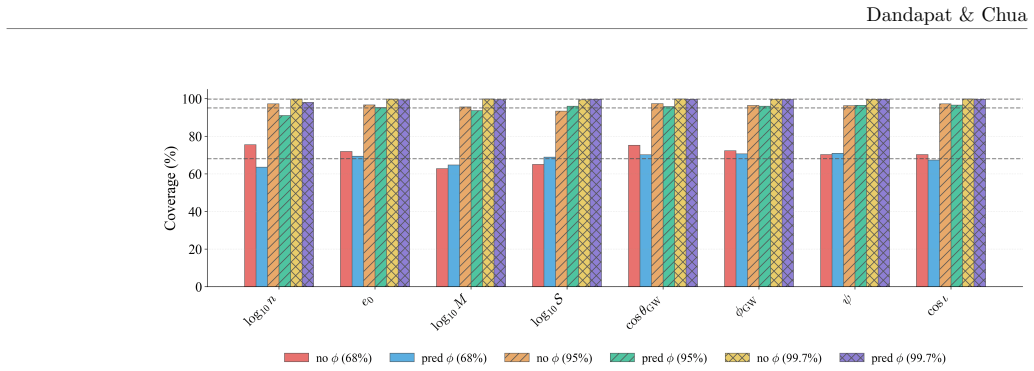
- [Sec. 7.5; Fig. 7] Fig. 7 shows substantial under/over-coverage at the 68% level for several parameters even with predicted phase, while 99.7% coverage is near nominal. The paper reports this but does not diagnose whether the miscalibration is due to flow capacity, phase-prediction error, or the restricted SNR training range. Because the abstract and Sec. 7 emphasize “sharper posteriors” and improved calibration, the 68% discrepancy needs either a fix (e.g., temperature scaling, more expressive flow, or recalibration) or an explicit caveat that sharpness gains come with imperfect frequentist coverage at 1σ.
minor comments (6)
- [Title; Abstract] Title and abstract use “Robust Detection,” but the experiments are almost entirely parameter estimation (posterior sharpness, LPD, coverage); no ROC/detection-threshold analysis is presented. Align title/abstract language with the actual evaluation.
- [Table 2; Sec. 5] Table 2 lists targets as (n0, e0, M, S) while Sec. 5 and Table 4 use (log10 n, e0, log10 M, log10 S); keep notation consistent throughout.
- [Sec. 4.1.1 Eq. (26); Sec. 8] Eq. (26) for gate gradients is standard backprop; a brief note that ω_ϕ is learned end-to-end and can down-weight bad phase predictions would help readers interpret the adaptive-safeguard claim in Sec. 8.
- [Sec. 2.3; Fig. 1] Fig. 1 caption and Sec. 2.3 fix γ0=l0=0; state whether this is also true for the training prior or only for the illustrative figure.
- [Sec. 5; Sec. 7.1] Clarify whether the phase predictor is trained on the same 4×10^5 set used for the large-data posterior experiment or a disjoint split, to avoid any train–test leakage concern for the phase channel.
- [Fig. 3; throughout] Minor typos: “F eature extraction” in Fig. 3 caption; “realisation”/“realization” spelling is mixed; “an nPN correction” footnote formatting.
Circularity Check
No significant circularity: physics-informed encodings and phase prediction are supervised features from the known PN waveform model, trained and evaluated on independent synthetic draws under standard SBI.
full rationale
The paper's derivation chain is self-contained and non-circular. The orbital phase φ(t) (Eq. 14) and residual model R(t) (Eqs. 7–9) are taken from the established post-Newtonian literature and used only to generate synthetic training data and to supervise a separate phase-prediction network (Sec. 4.2). That network is frozen before posterior training; the main Transformer+flow never sees the true phase (Sec. 4.3, Sec. 5: "the true phase is never exposed"). Posteriors are obtained by amortized conditional density estimation on held-out realisations whose parameters and noise realisations are drawn independently of the training set (Sec. 3, Sec. 7). Log-posterior-density gains (Table 4) and coverage (Fig. 7) are therefore empirical comparisons between two feature sets (predicted-phase vs. no-phase), not tautologies forced by construction or by self-citation. No free parameter is fitted to a subset of data and then re-labelled a prediction; no uniqueness theorem is imported from the authors' prior work; and the white-noise covariance (Eq. 19) is an explicit modelling choice, not a circular definition of the claimed accuracy. The framework is ordinary physics-informed SBI.
Axiom & Free-Parameter Ledger
free parameters (4)
- phase-loss weights (κ_von, α_smooth, α_spec, λ_SNR) =
8 / 0.10 / 0.05 / 0.05
- Transformer latent dimension, heads, layers, patch size, memory size
- learnable gates ω_pos, ω_ϕ
- SNR training range and noise realization procedure =
SNR ∈ [10,100] for phase net; [20,30] for main results
axioms (3)
- domain assumption 3PN quasi-Keplerian orbital dynamics and quadrupole GW polarizations correctly describe the Earth-term PTA residual for eccentric SMBHBs
- ad hoc to paper White-noise covariance C = σ²I is an adequate first approximation for testing the inference pipeline
- domain assumption Self-attention plus external-attention memory can capture the long-range temporal and inter-pulsar correlations present in PTA residuals
invented entities (1)
-
Physics-informed orbital-phase encoding (PIPE)
no independent evidence
read the original abstract
Pulsar timing arrays (PTAs) provide a unique window into nanohertz gravitational waves (GWs), but extracting astrophysical parameters from noisy, long-baseline timing residuals remains computationally challenging with traditional Bayesian techniques due to the high dimensionality of the parameter space, complex and correlated noise models, and the cost of repeated likelihood evaluations. We introduce a Transformer with a physics-informed positional-encoding framework for the efficient inference of eccentric binary black holes in relativistic orbits from PTA data. Our approach embeds analytical GW phase evolution directly into the model through structured positional encodings, enabling the network to learn physically meaningful representations from raw PTA timing residuals. We then use generative models, including discrete and continuous conditional normalizing flows, to infer posterior distributions within a simulation-based inference framework. Across a range of signal-to-noise ratios, the proposed method achieves improved accuracy, sharper posteriors, and faster inference compared to physics-agnostic baselines. While presented for deterministic white-noise signals, the modular framework readily generalizes to realistic PTA analyses incorporating red noise and additional components. This work highlights the potential of physics-aware deep learning models as scalable alternatives to conventional inference pipelines for next-generation PTA datasets.
Figures


Reference graph
Works this paper leans on
-
[1]
Abbott B Pet al.(LIGO Scientific, Virgo) 2016Phys. Rev. Lett.116061102 (Preprint 1602.03837)
-
[2]
Agazie G, Anumarlapudi A, Archibald A M, Arzoumanian Z, Baker P Tet al.2023The Astrophysical Journal Letters951L8 URL https://dx.doi.org/10.3847/2041-8213/acdac6
-
[3]
Astrophys.678A49 (Preprint2306.16225)
Antoniadis Jet al.(EPTA, InPTA) 2023Astron. Astrophys.678A49 (Preprint2306.16225)
-
[4]
Reardon D J, Zic A, Shannon R M, Hobbs G B, Bailes Met al.2023The Astrophysical Journal Letters951L6 URLhttps://dx.doi.org/10.3847/2041-8213/acdd02
-
[5]
Xu H, Chen S, Guo Y, Jiang J, Wang Bet al.2023Research in Astronomy and Astrophysics 23075024 URLhttps://dx.doi.org/10.1088/1674-4527/acdfa5
-
[6]
Perera B, DeCesar M, Demorest P, Kerr M, Lentati L, Nice D, Os lowski S, Ransom S, Keith M, Arzoumanian Zet al.2019Monthly Notices of the Royal Astronomical Society490 4666–4687
-
[7]
Agazie G, Antoniadis J, Anumarlapudi A, Archibald A M, Arumugam Pet al.2023arXiv e-printsarXiv:2309.00693 (Preprint2309.00693)
-
[8]
Phinney E 2001arXiv preprint astro-ph/0108028
-
[9]
Agazie G, Anumarlapudi A, Archibald A M, Arzoumanian Z, Baker P T, Becsy B, Blecha L, Brazier A, Brook P R, Burke-Spolaor Set al.2023The Astrophysical Journal Letters951L50
-
[10]
Antoniadis J, Arumugam P, Arumugam S, Babak S, Bagchi M, Nielsen A S B, Bassa C, Bathula A, Berthereau A, Bonetti Met al.2024Astronomy & Astrophysics690A118
-
[11]
Babak S, Falxa M, Franciolini G and Pieroni M 2024Phys. Rev. D110063022 21 Dandapat & Chua
-
[12]
Van Haasteren R, Levin Y, McDonald P and Lu T 2009Mon. Not. R. Astron. Soc.395 1005–1014
-
[13]
Ellis J A, Vallisneri M, Taylor S R and Baker P T 2020 Enterprise: Enhanced numerical toolbox enabling a robust pulsar inference suite Zenodo URL https://doi.org/10.5281/zenodo.4059815
-
[14]
Ellis J and van Haasteren R 2017 jellis18/ptmcmcsampler: Official release URL https://doi.org/10.5281/zenodo.1037579
-
[15]
Taylor S R and Gair J R 2013Phys. Rev. D88084001
-
[16]
Falxa M, Antoniadis J, Champion D J, Cognard I, Desvignes G, Guillemot L, Hu H, Janssen G, Jawor J, Karuppusamy R, Keith M J, Kramer M, Lackeos K, Liu K, McKee J W, Perrodin D, Sanidas S A, Shaifullah G M and Theureau G 2024Phys. Rev. D109123010
-
[17]
Freedman G E, Johnson A D, Van Haasteren R and Vigeland S J 2023Phys. Rev. D107 043013
-
[18]
Van Haasteren R and Vallisneri M 2014Phys. Rev. D90104012
-
[19]
Hobbs Get al.2010Class. Quant. Grav.27084013 (Preprint0911.5206)
-
[20]
George D and Huerta E A 2018Physics Letters B77864–70 (Preprint1711.03121)
-
[21]
Gabbard H, Williams M, Hayes F and Messenger C 2018Physical review letters120141103
-
[22]
Nousi P, Koloniari A E, Passalis N, Iosif P, Stergioulas N and Tefas A 2023Physical Review D 108024022
-
[23]
Chatterjee C, Petulante A, Jani K, Spencer-Smith J, Hu Y, Lau R, Fu H, Hoang T, Zhao S C and Deshmukh S 2024arXiv preprint arXiv:2412.20789
-
[24]
Chua A J and Vallisneri M 2020Physical review letters124041102
-
[25]
Dax M, Green S R, Gair J, Macke J H, Buonanno A and Sch¨ olkopf B 2021Physical review letters127241103
-
[26]
Gabbard H, Messenger C, Heng I S, Tonolini F and Murray-Smith R 2022Nature Phys.18 112–117 (Preprint1909.06296)
-
[27]
Dax M, Green S R, Gair J, Gupte N, P¨ urrer M, Raymond V, Wildberger J, Macke J H, Buonanno A and Sch¨ olkopf B 2025Nature63949–53
-
[28]
Cuoco Eet al.2023Living Reviews in Relativity262 (Preprint2210.05659) URL https://arxiv.org/abs/2210.05659
-
[29]
Chen M, Zhong Y, Feng Y, Li D and Li J 2020Science China Physics, Mechanics & Astronomy63129511
-
[30]
Liang B and Wang H 2025Astronomical Techniques and Instruments
-
[31]
Kobyzev I, Prince S J and Brubaker M A 2020IEEE transactions on pattern analysis and machine intelligence433964–3979
-
[32]
Papamakarios G, Nalisnick E, Rezende D J, Mohamed S and Lakshminarayanan B 2021 Journal of Machine Learning Research221–64
2021
-
[33]
Shih D, Freytsis M, Taylor S R, Dror J A and Smyth N 2024Physical review letters133 011402
-
[34]
Vallisneri M, Crisostomi M, Johnson A D and Meyers P M 2024arXiv preprint arXiv:2405.08857
-
[35]
Liang Bet al.2024 (Preprint2412.19169) URLhttps://arxiv.org/abs/2412.19169
Pith/arXiv arXiv 2024
-
[36]
Vaswani A, Shazeer N, Parmar N, Uszkoreit J, Jones L, Gomez A N, Kaiser L and Polosukhin I 2017Advances in Neural Information Processing Systems (NeurIPS)30URL https://arxiv.org/abs/1706.03762 22 Dandapat & Chua
-
[37]
OpenAI 2025 Introducing GPT-5https://openai.com/index/introducing-gpt-5/ accessed: 2025-12-03
2025
-
[39]
Wen Q, Zhou T, Zhang C, Chen W, Ma Z, Yan J and Sun L 2022arXiv preprint arXiv:2202.07125
-
[40]
Hwang S Y, Sabiu C G, Park I and Hong S E 2023JCAP11075 (Preprint2304.08192)
-
[41]
Allam Jr T and McEwen J D 2024RAS Techniques and Instruments3209–223
-
[42]
Instrum.3472–483 (Preprint 2406.12515)
Boersma O M, Ayache E H and van Leeuwen J 2024RAS Tech. Instrum.3472–483 (Preprint 2406.12515)
-
[43]
Hochreiter S and Schmidhuber J 1997Neural Computation91735–1780 ISSN 0899-7667 URL https://doi.org/10.1162/neco.1997.9.8.1735
-
[44]
Jadhav S, Wang Y T, Gabbard H and Cavagli` a M 2024Classical and Quantum Gravity (Preprint2403.12345)
-
[45]
Leyde K, Green S R, Dax M, Mould M, Fabbri C M and Gair J 2026arXiv preprint arXiv:2605.11274
-
[46]
Shen H, Chen H and Li T 2022Physical Review D105123005
-
[47]
Dom´ ınguez A, Udall R, Ashton G, Torres-Forn´ e A and Font J A 2024Monthly Notices of the Royal Astronomical Society(Preprint2402.06789)
-
[48]
Benedikt M and Saltas I 2025Machine Learning: Science and Technology
-
[49]
Karniadakis G E, Kevrekidis I G, Lu L, Perdikaris P, Wang S and Yang L 2021Nature Reviews Physics3422–440
-
[50]
Li H, Jung E, Chen Z, Wang Z, Wang Y, Qu H and Lau A K H 2025arXiv preprint arXiv:2506.14786
-
[51]
Blanchet L 2014Living Reviews in Relativity17(1) 2 ISSN 14338351
-
[52]
Jenet F A, Lommen A, Larson S L and Wen L 2004The Astrophysical Journal606(2) 799–803 ISSN 0004-637X URLhttps://doi.org/10.1086/383020
-
[53]
Taylor S R, Huerta E A, Gair J R and McWilliams S T 2016The Astrophysical Journal 817(1) 70 ISSN 1538-4357 URLhttp://stacks.iop.org/0004-637X/817/i=1/a=70
-
[54]
Susobhanan A 2023Classical and Quantum Gravity40155014 URL https://dx.doi.org/10.1088/1361-6382/ace234
-
[55]
Susobhanan A, Gopakumar A, Hobbs G and Taylor S R 2020Physical Review D101(4) 043022 ISSN 2470-0010 URLhttps://link.aps.org/doi/10.1103/PhysRevD.101.043022
-
[56]
Thorne K S, Misner C W and Wheeler J A 2000Gravitation(Freeman San Francisco)
-
[57]
Einstein A 1918Sitzungsberichte der Königlich Preussischen Akademie der Wissenschaften154–167
-
[58]
Gopakumar A and Iyer B R 2002Physical Review D65084011
-
[59]
Detweiler S 1979The Astrophysical Journal2341100–1104
-
[60]
Physique th´ eorique43(1) 107–132 ISSN 0246-0211 URLhttp://www.numdam.org/item/AIHPA_1985__43_1_107_0
Damour T and Deruelle N 1985Annales de l’I.H.P. Physique th´ eorique43(1) 107–132 ISSN 0246-0211 URLhttp://www.numdam.org/item/AIHPA_1985__43_1_107_0
-
[61]
Memmesheimer R M, Gopakumar A and Sch¨ afer G 2004Physical Review D70(10) 17 ISSN 15502368 URLhttps://link.aps.org/doi/10.1103/PhysRevD.70.104011
-
[62]
Boetzel Y, Susobhanan A, Gopakumar A, Klein A and Jetzer P 2017Physical Review D96(4) 044011 ISSN 2470-0010 URL https://link.aps.org/doi/10.1103/PhysRevD.96.044011http: //link.aps.org/doi/10.1103/PhysRevD.96.044011 23 Dandapat & Chua
-
[63]
Damour T, Gopakumar A and Iyer B R 2004Physical Review D70(6) 064028 ISSN 1550-7998 URLhttps://link.aps.org/doi/10.1103/PhysRevD.70.064028
-
[64]
Agazie Get al.(NANOGrav) 2023Astrophys. J. Lett.951L8 (Preprint2306.16213)
-
[65]
Petrov P, Taylor S R, Charisi M and Ma C P 2024The Astrophysical Journal976129
-
[66]
Taylor S R 2021arXiv preprint arXiv:2105.13270
-
[67]
van Haasteren R and Levin Y 2013Monthly Notices of the Royal Astronomical Society428 1147–1159
-
[68]
Guo M H, Liu Z N, Mu T J and Hu S M 2022IEEE Transactions on Pattern Analysis and Machine Intelligence455436–5447
-
[69]
Dosovitskiy A, Beyer L, Kolesnikov A, Weissenborn D, Zhai X, Unterthiner T, Dehghani M, Minderer M, Heigold G, Gelly Set al.2020arXiv preprint arXiv:2010.11929
Pith/arXiv arXiv 2010
-
[70]
Hendrycks D and Gimpel K 2016arXiv preprint arXiv:1606.08415
-
[71]
Nair V and Hinton G E 2010 Rectified linear units improve restricted boltzmann machines Proceedings of the 27th international conference on machine learning (ICML-10)pp 807–814
2010
-
[72]
265, Feb
Hellings R and Downs G 1983Astrophysical Journal, Part 2-Letters to the Editor, vol. 265, Feb. 15, 1983, p. L39-L42.265L39–L42
1983
-
[73]
Rezende D J and Mohamed S 2015Proceedings of the 32nd International Conference on Machine Learning (ICML)(Preprint1505.05770)
-
[74]
Papamakarios G, Nalisnick E, Rezende D J, Mohamed S and Lakshminarayanan B 2021 Journal of Machine Learning Research221–64 (Preprint1912.02762)
Pith/arXiv arXiv 2021
-
[75]
Chen R T Q, Rubanova Y, Bettencourt J and Duvenaud D 2018Advances in Neural Information Processing Systems (NeurIPS)31(Preprint1806.07366)
-
[76]
Dinh L, Sohl-Dickstein J and Bengio S 2017International Conference on Learning Representations (ICLR)(Preprint1605.08803)
-
[77]
Kingma D P and Dhariwal P 2018Advances in Neural Information Processing Systems (NeurIPS)31(Preprint1807.03039)
-
[78]
Papamakarios G and Murray I 2017Advances in Neural Information Processing Systems (NeurIPS)29(Preprint1605.06376)
-
[79]
Hutchinson M F 1990Communications in Statistics – Simulation and Computation19 433–450
-
[80]
Grathwohl W, Chen R T Q, Bettencourt J, Sutskever I and Duvenaud D 2019International Conference on Learning Representations (ICLR)(Preprint1810.01367)
-
[81]
Lentati L, Shannon R M, Coles W A, Verbiest J P, van Haasteren R, Ellis J, Caballero R, Manchester R N, Arzoumanian Z, Babak Set al.2016Monthly Notices of the Royal Astronomical Society4582161–2187
discussion (0)
Sign in with ORCID, Apple, or X to comment. Anyone can read and Pith papers without signing in.