Robots Ask the Way: Communication-Enabled Social Navigation
Reviewed by Pith2026-07-02 11:11 UTCgrok-4.3pith:SCZ4T3IQopen to challenge →
The pith
Robots improve navigation success by 10 points when they ask humans for directions in crowds.
A machine-rendered reading of the paper's core claim, the machinery that carries it, and where it could break.
Core claim
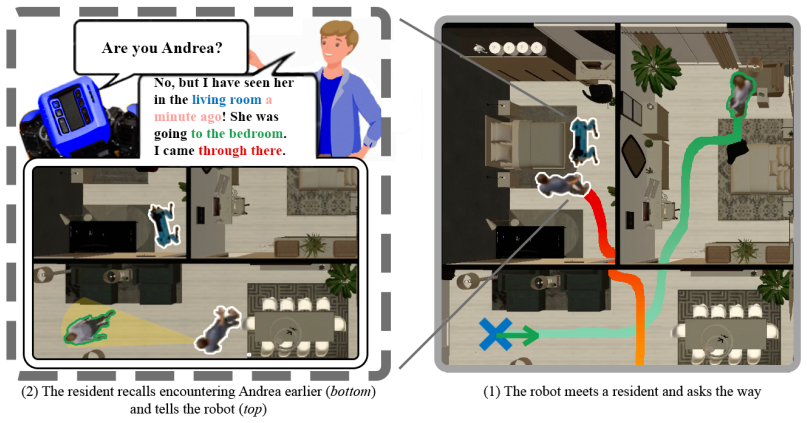
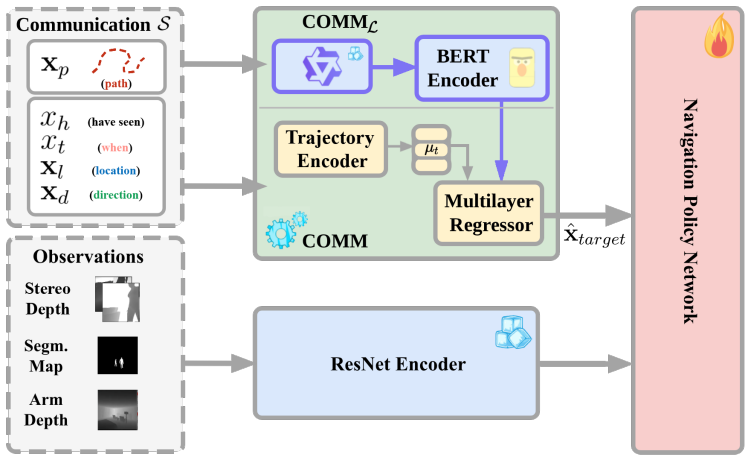
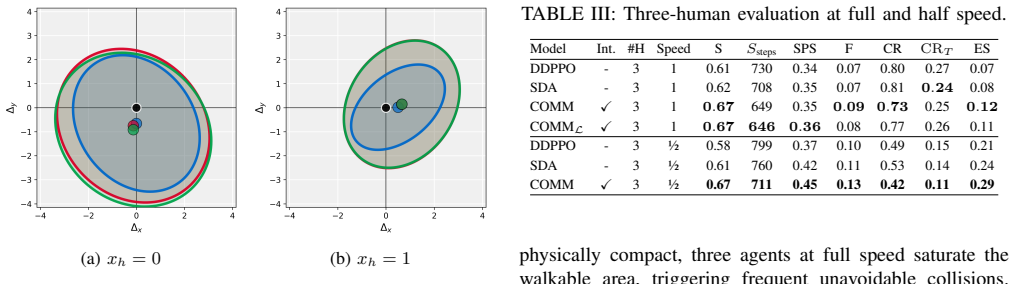
In CommNav, robotic agents seek assistance from residents by requesting details about recent sightings, locations, and movements of target individuals. The addition of the COMM module to a state-of-the-art social navigation model produces a 10 percentage-point gain in Episode Success. Pre-training COMM on a communication pretext task addresses infrequent interaction signals, and the navigation policy remains robust to natural colloquial human language, reaching episode success rates statistically similar to those obtained with perfect structured data.
What carries the argument
The COMM communication module that lets the robot issue queries about sightings and locations and integrates the resulting responses into the navigation policy.
If this is right
- Explicit human-robot communication substantially raises multi-person navigation performance.
- Pre-training on a communication pretext task improves handling of occasional interaction signals.
- Navigation policies trained on LLM-generated or human-collected colloquial instructions perform comparably to those using perfect structured data.
Where Pith is reading between the lines
- The same query-and-response pattern could reduce reliance on complete prior maps in highly dynamic indoor spaces.
- Robustness to casual language suggests the approach may work with untrained bystanders without requiring special phrasing.
- If simulator results transfer, similar communication modules could be tested in delivery or search tasks that also require locating moving targets among people.
Load-bearing premise
The extended Habitat 3.0c simulator and its information-exchange protocols produce interaction patterns that transfer to real human-robot communication in physical environments.
What would settle it
A physical experiment with real robots and human participants in a multi-person setting that measures whether episode success rises by a similar margin when the communication module is added versus when it is absent.
Figures

read the original abstract
Assistive autonomous robots operating in multi-agent environments require efficient strategies to locate specific individuals among multiple residents. Current social navigation methods focus on reactive collision avoidance and trajectory adaptation, but lack mechanisms to proactively gather information through human-robot communication. We introduce Communication-enabled Social Navigation (CommNav). In this novel task, robotic agents actively seek assistance from residents to locate target individuals by requesting information about recent sightings, locations, and movements. To evaluate CommNav, we extend Habitat 3.0 to create Habitat 3.0c, a communication-enabled variant supporting multi-human environments with information exchange protocols. Adding our communication module (COMM) to a state-of-the-art social navigation model yields a 10 percentage-point improvement in Episode Success. We further investigate the transition from structured data to natural language by evaluating models trained on LLM-generated instructions and on colloquial instructions collected from a human study. Our experiments reveal that: (i) explicit human-robot communication substantially enhances multi-person navigation performance; (ii) pre-training COMM on a communication pretext task effectively addresses the challenge of occasional interaction signals; and (iii) the navigation policy is highly robust to natural, colloquial human language, achieving an episode success statistically similar to the model using perfect structured data.
Editorial analysis
A structured set of objections, weighed in public.
Referee Report
Summary. The paper introduces CommNav, a new task for robots to proactively gather information via human-robot communication to locate targets in multi-human environments. It extends Habitat 3.0 into Habitat 3.0c with multi-human support and information-exchange protocols, adds a COMM module to a state-of-the-art social navigation baseline, and reports a 10 percentage-point gain in Episode Success. Experiments further show that the policy remains robust when switching from perfect structured data to LLM-generated or human-collected colloquial natural-language instructions.
Significance. If the empirical results hold under proper statistical reporting, the work provides a concrete demonstration that explicit communication can substantially improve multi-person social navigation performance. The new simulator variant, the communication pretext pre-training, and the inclusion of a human study for language robustness constitute clear contributions to the field of assistive robotics.
major comments (2)
- [Abstract] Abstract: the central claims of a '10 percentage-point improvement in Episode Success' and 'episode success statistically similar' to the perfect-structured-data baseline are stated without error bars, number of episodes or runs, baseline model name, or any statistical test results, preventing assessment of whether the reported delta is reliable or significant.
- [Abstract] Abstract (paragraph on Habitat 3.0c creation): the information-exchange protocols (sighting reports, location answers, etc.) are defined inside the simulator but receive no validation against real human responses collected in physical settings; if real humans produce more variable or off-topic replies, both the 10 pp gain and the claimed robustness to colloquial language rest on untested simulator assumptions.
minor comments (1)
- [Abstract] The abstract would be clearer if it named the specific state-of-the-art social navigation model used as the baseline for the COMM ablation.
Simulated Author's Rebuttal
We thank the referee for the constructive feedback. We address each major comment below and indicate the revisions we will make to strengthen the manuscript.
read point-by-point responses
-
Referee: [Abstract] Abstract: the central claims of a '10 percentage-point improvement in Episode Success' and 'episode success statistically similar' to the perfect-structured-data baseline are stated without error bars, number of episodes or runs, baseline model name, or any statistical test results, preventing assessment of whether the reported delta is reliable or significant.
Authors: We agree that these statistical details are necessary for proper assessment. In the revised abstract and main text, we will specify the number of evaluation episodes (500 per condition), report standard errors from 5 independent runs, name the baseline model explicitly, and include the results of the statistical tests (paired t-tests) used to support both the 10 percentage-point improvement and the claim of statistical similarity. revision: yes
-
Referee: [Abstract] Abstract (paragraph on Habitat 3.0c creation): the information-exchange protocols (sighting reports, location answers, etc.) are defined inside the simulator but receive no validation against real human responses collected in physical settings; if real humans produce more variable or off-topic replies, both the 10 pp gain and the claimed robustness to colloquial language rest on untested simulator assumptions.
Authors: The protocols model plausible information exchanges to enable controlled study of the COMM module. Our human study already collects real colloquial instructions to test language robustness, which partially addresses variability in human responses. We will revise the manuscript to explicitly state the simulation assumptions, note that full physical validation of protocol dynamics lies outside the current scope, and discuss this as a limitation. revision: partial
Circularity Check
No circularity: empirical results from independent simulator runs and human study
full rationale
The paper reports measured Episode Success improvements from adding the COMM module and robustness to natural language, all obtained via separate evaluation runs inside the extended Habitat 3.0c simulator plus a distinct human study for colloquial instructions. No equations, fitted parameters renamed as predictions, self-citation load-bearing premises, or definitional reductions appear in the provided text. The central claims are therefore self-contained empirical outcomes rather than constructions that collapse back to their own inputs.
Axiom & Free-Parameter Ledger
axioms (1)
- domain assumption Habitat 3.0 can be extended with communication protocols that produce realistic multi-human information exchange.
Reference graph
Works this paper leans on
-
[1]
Efficient and trustworthy so- cial navigation via explicit and implicit robot–human communication,
Y . Che, A. M. Okamura, and D. Sadigh, “Efficient and trustworthy so- cial navigation via explicit and implicit robot–human communication,” IEEE Transactions on Robotics, vol. 36, pp. 692–707, 2020
work page 2020
-
[2]
How much is too much: Exploring the effect of verbal route description length on indoor navigation,
Fathima Nourin N, P. Pramanick, and C. Sarkar, “How much is too much: Exploring the effect of verbal route description length on indoor navigation,” in2024 33rd IEEE International Conference on Robot and Human Interactive Communication (ROMAN). IEEE, 2024, pp. 1378–1385
work page 2024
-
[3]
Spatial descriptions as navigational aids: A cognitive analysis of route directions,
M.-P. Daniel and M. Denis, “Spatial descriptions as navigational aids: A cognitive analysis of route directions,”Kognitionswissenschaft, vol. 7, no. 1, pp. 45–52, 1998
work page 1998
-
[4]
A. Sen, “Integration of landmarks extracted from human route de- scriptions using nlp into indoor navigation network model,”9th International Conference on Cartography and GIS, 2024
work page 2024
-
[5]
Experimental study on verbal indoor wayfinding support,
K. Amoozandeh, S. Winter, and M. Tomko, “Experimental study on verbal indoor wayfinding support,”ISPRS Annals of the Photogram- metry, Remote Sensing and Spatial Information Sciences, vol. X-4/W5- 2024, pp. 17–24, 06 2024
work page 2024
-
[6]
An analysis of direction and motion concepts in verbal descriptions of route choices,
K. Rehrl, S. Leitinger, G. Gartner, and F. Ortag, “An analysis of direction and motion concepts in verbal descriptions of route choices,” inInternational Conference on Spatial Information Theory. Springer, 2009, pp. 471–488
work page 2009
-
[7]
Yell At Your Robot: Improving On-the-Fly from Language Corrections,
L. X. Shi, Z. Hu, T. Z. Zhao, A. Sharma, K. Pertsch, J. Luo, S. Levine, and C. Finn, “Yell At Your Robot: Improving On-the-Fly from Language Corrections,” inProceedings of Robotics: Science and Systems, Delft, Netherlands, July 2024
work page 2024
-
[8]
Habitat 3.0: A co-habitat for humans, avatars, and robots,
X. Puig, E. Undersander, A. Szot, M. Dallaire Cote, T.-Y . Yang, R. Partsey, R. Desai, A. Clegg, M. Hlavac, S. Y . Min, V . V on- druˇs, T. Gervet, V .-P. Berges, J. Turner, O. Maksymets, Z. Kira, M. Kalakrishnan, J. Malik, D. Chaplot, U. Jain, D. Batra, A. Rai, and R. Mottaghi, “Habitat 3.0: A co-habitat for humans, avatars, and robots,” inInternational ...
work page 2024
-
[9]
Following the human thread in social navigation,
L. Scofano, A. Sampieri, T. Campari, V . Sacco, I. Spinelli, L. Ballan, and F. Galasso, “Following the human thread in social navigation,” inInternational Conference on Learning Representations, vol. 2025, 2025, pp. 47 674–47 694. [Online]. Available: https://proceedings.iclr.cc/paper files/paper/2025/ file/76b010c4d21f97b7b113383ce7160cbc-Paper-Conference.pdf
work page 2025
-
[10]
Hyp2nav: Hyperbolic planning and curiosity for crowd navigation,
G. M. D’Amely di Melendugno, A. Flaborea, P. Mettes, and F. Galasso, “Hyp2nav: Hyperbolic planning and curiosity for crowd navigation,” in2024 IEEE/RSJ International Conference on Intelligent Robots and Systems (IROS), 2024, pp. 13 023–13 030
work page 2024
-
[11]
Matterport3d: Learning from rgb-d data in indoor environments,
A. Chang, A. Dai, T. Funkhouser, M. Halber, M. Niessner, M. Savva, S. Song, A. Zeng, and Y . Zhang, “Matterport3d: Learning from rgb-d data in indoor environments,”International Conference on 3D Vision (3DV), 2017
work page 2017
-
[12]
igibson 1.0: A simulation environment for interactive tasks in large realistic scenes,
B. Shen, F. Xia, C. Li, R. Mart ´ın-Mart´ın, L. Fan, G. Wang, C. P ´erez- D’Arpino, S. Buch, S. Srivastava, L. Tchapmi, M. Tchapmi, K. Vainio, J. Wong, L. Fei-Fei, and S. Savarese, “igibson 1.0: A simulation environment for interactive tasks in large realistic scenes,” in2021 IEEE/RSJ International Conference on Intelligent Robots and Systems (IROS), 2021...
work page 2021
-
[13]
Habitat-Matterport 3D Dataset (HM3D): 1000 Large-scale 3D Environments for Embodied AI
S. K. Ramakrishnan, A. Gokaslan, E. Wijmans, O. Maksymets, A. Clegg, J. Turner, E. Undersander, W. Galuba, A. Westbury, A. X. Chang,et al., “Habitat-matterport 3D dataset (HM3D): 1000 large-scale 3D environments for embodied AI,”arXiv preprint arXiv:2109.08238, 2021
work page internal anchor Pith review Pith/arXiv arXiv 2021
-
[14]
Habitat: A platform for embodied AI research,
M. Savva, A. Kadian, O. Maksymets, Y . Zhao, E. Wijmans, B. Jain, J. Straub, J. Liu, V . Koltun, J. Malik,et al., “Habitat: A platform for embodied AI research,” inICCV, 2019
work page 2019
-
[15]
AI2-THOR: An Interactive 3D Environment for Visual AI
E. Kolve, R. Mottaghi, W. Han, E. VanderBilt, L. Weihs, A. Herrasti, D. Gordon, Y . Zhu, A. Gupta, and A. Farhadi, “Ai2-thor: An interactive 3d environment for visual ai,”arXiv preprint arXiv:1712.05474, 2017
work page internal anchor Pith review Pith/arXiv arXiv 2017
-
[16]
Interactive gibson benchmark: A benchmark for interactive navigation in cluttered environments,
F. Xia, W. B. Shen, C. Li, P. Kasimbeg, M. E. Tchapmi, A. Toshev, R. Mart´ın-Mart´ın, and S. Savarese, “Interactive gibson benchmark: A benchmark for interactive navigation in cluttered environments,”IEEE Robotics and Automation Letters, vol. 5, no. 2, pp. 713–720, 2020
work page 2020
-
[17]
N. Yokoyama, Q. Luo, D. Batra, and S. Ha, “Learning Robust Agents for Visual Navigation in Dynamic Environments: The Winning Entry of iGibson Challenge 2021,” 2022
work page 2021
-
[18]
Partnr: A benchmark for planning and reasoning in embodied multi- agent tasks,
M. Chang, G. Chhablani, A. Clegg, M. Dallaire Cote, R. Desai, M. Hlavac, V . Karashchuk, J. Krantz, R. Mottaghi, P. Parashar,et al., “Partnr: A benchmark for planning and reasoning in embodied multi- agent tasks,” inInternational Conference on Learning Representations, Y . Yue, A. Garg, N. Peng, F. Sha, and R. Yu, Eds., vol. 2025, 2025, pp. 65 205–65 268
work page 2025
-
[19]
Conav: A benchmark for human-centered collaborative navigation,
C. Li, X. Sun, P. Chen, J. Fan, Z. Wang, Y . Liu, J. Zhu, C. Gan, and M. Tan, “Conav: A benchmark for human-centered collaborative navigation,”ArXiv, vol. abs/2406.02425, 2024
-
[20]
Habicrowd: A high performance sim- ulator for crowd-aware visual navigation,
A. D. Vuong, T. T. Nguyen, M. N. Vu, B. Huang, D. Nguyen, H. T. T. Binh, T. V o, and A. Nguyen, “Habicrowd: A high performance sim- ulator for crowd-aware visual navigation,” inIEEE/RSJ International Conference on Intelligent Robots and Systems, 2024
work page 2024
-
[21]
Building cooperative embodied agents modularly with large language models,
H. Zhang, W. Du, J. Shan, Q. Zhou, Y . Du, J. B. Tenenbaum, T. Shu, and C. Gan, “Building cooperative embodied agents modularly with large language models,” inThe Twelfth International Conference on Learning Representations, 2024. [Online]. Available: https://openreview.net/forum?id=EnXJfQqy0K
work page 2024
-
[22]
Capo: Cooperative plan optimization for efficient embodied multi-agent cooperation,
J. Liu, P. Zhou, Y . Du, A.-H. Tan, C. G. M. Snoek, J.-J. Sonke, and E. Gavves, “Capo: Cooperative plan optimization for efficient embodied multi-agent cooperation,” inThe Thirteenth International Conference on Learning Representations, 2025. [Online]. Available: https://openreview.net/forum?id=KRv9NubipP
work page 2025
-
[23]
igibson 2.0: Object- centric simulation for robot learning of everyday household tasks,
C. Li, F. Xia, R. Mart ´ın-Mart´ın, M. Lingelbach, S. Srivastava, B. Shen, K. E. Vainio, C. Gokmen, G. Dharan, T. Jain, A. Kurenkov, K. Liu, H. Gweon, J. Wu, L. Fei-Fei, and S. Savarese, “igibson 2.0: Object- centric simulation for robot learning of everyday household tasks,” in Proceedings of the 5th Conference on Robot Learning, ser. Proceed- ings of Ma...
work page 2022
-
[24]
Sean 2.0: Formalizing and generating social situations for robot navigation,
N. Tsoi, A. Xiang, P. Yu, S. S. Sohn, G. Schwartz, S. Ramesh, M. Hussein, A. W. Gupta, M. Kapadia, and M. V ´azquez, “Sean 2.0: Formalizing and generating social situations for robot navigation,” IEEE Robotics and Automation Letters, vol. 7, pp. 11 047–11 054, 2022
work page 2022
-
[25]
Virtualhome: Simulating household activities via programs,
X. Puig, K. K. Ra, M. Boben, J. Li, T. Wang, S. Fidler, and A. Torralba, “Virtualhome: Simulating household activities via programs,”2018 IEEE/CVF Conference on Computer Vision and Pattern Recognition, pp. 8494–8502, 2018
work page 2018
-
[26]
A review: On path planning strategies for navigation of mobile robot,
B. K. Patle, G. B. L., A. Pandey, D. R. Parhi, and A. Jagadeesh, “A review: On path planning strategies for navigation of mobile robot,” Defence Technology, 2019
work page 2019
-
[27]
RMA: Rapid motor adaptation for legged robots,
A. Kumar, Z. Fu, D. Pathak, and J. Malik, “RMA: Rapid motor adaptation for legged robots,” inRobotics: Science and Systems, 2021
work page 2021
-
[28]
Learning visual locomotion with cross-modal supervision,
A. Loquercio, A. Kumar, and J. Malik, “Learning visual locomotion with cross-modal supervision,” in2023 IEEE International Conference on Robotics and Automation (ICRA). IEEE, 2023, pp. 7295–7302
work page 2023
-
[29]
X. Zhang, Y . Wu, H. Wang, F. Iida, and L. Wang, “Adaptive loco- motion learning for quadruped robots by combining drl with a cosine oscillator based rhythm controller,”Applied Sciences, vol. 13, no. 19, 2023
work page 2023
-
[30]
Reciprocal n- body collision avoidance,
J. van den Berg, S. J. Guy, M. Lin, and D. Manocha, “Reciprocal n- body collision avoidance,” inRobotics Research, C. Pradalier, R. Sieg- wart, and G. Hirzinger, Eds. Berlin, Heidelberg: Springer Berlin Heidelberg, 2011, pp. 3–19
work page 2011
-
[31]
Reciprocal velocity obstacles for real-time multi-agent navigation,
J. Van den Berg, M. Lin, and D. Manocha, “Reciprocal velocity obstacles for real-time multi-agent navigation,” 2008
work page 2008
-
[32]
Decentralized non- communicating multiagent collision avoidance with deep reinforce- ment learning,
Y . F. Chen, M. Liu, M. Everett, and J. P. How, “Decentralized non- communicating multiagent collision avoidance with deep reinforce- ment learning,” 2017
work page 2017
-
[33]
Socially aware motion planning with deep reinforcement learning,
Y . F. Chen, M. Everett, M. Liu, and J. P. How, “Socially aware motion planning with deep reinforcement learning,” 2017
work page 2017
-
[34]
Social-aware robot navigation in urban environments,
G. Ferrer, A. Garrell, and A. Sanfeliu, “Social-aware robot navigation in urban environments,” inProc. of the European Conference on Mobile Robots, 2013
work page 2013
-
[35]
Exploiting proximity-aware tasks for embodied social navigation,
E. Cancelli, T. Campari, L. Serafini, A. X. Chang, and L. Ballan, “Exploiting proximity-aware tasks for embodied social navigation,” in Proceedings of the IEEE/CVF International Conference on Computer Vision (ICCV), October 2023, pp. 10 957–10 967
work page 2023
-
[36]
C. Chen, Y . Liu, S. Kreiss, and A. Alahi, “Crowd-robot interaction: Crowd-aware robot navigation with attention-based deep reinforce- ment learning,” 2019
work page 2019
-
[37]
Y . Lu, X. Ruan, and J. Huang, “Deep reinforcement learning based on social spatial–temporal graph convolution network for crowd nav- igation,”Machines, vol. 10, no. 8, p. 703, 2022
work page 2022
-
[38]
Q. Wu, C.-J. Wu, Y . Zhu, and J. Joo, “Communicative learning with natural gestures for embodied navigation agents with human- in-the-scene,”2021 IEEE/RSJ International Conference on Intelligent Robots and Systems (IROS), pp. 4095–4102, 2021. [Online]. Available: https://api.semanticscholar.org/CorpusID:236950428
work page 2021
-
[39]
J. K. Burgoon, L. A. Stern, and L. Dillman,Interpersonal adaptation: Dyadic interaction patterns.Cambridge University Press, 1995
work page 1995
-
[40]
Red hen lab: Dataset and tools for multimodal human communication research,
J. Joo, F. F. Steen, and M. Turner, “Red hen lab: Dataset and tools for multimodal human communication research,”KI - K ¨unstliche Intelligenz, vol. 31, pp. 357–361, 2017. [Online]. Available: https://api.semanticscholar.org/CorpusID:39121042
work page 2017
-
[41]
Understanding the dynamics of social interactions,
R. Trabelsi, J. Varadarajan, L. Zhang, I. Jabri, Y . Pei, F. Smach, A. Bouall`egue, and P. Moulin, “Understanding the dynamics of social interactions,”ACM Transactions on Multimedia Computing, Commu- nications, and Applications (TOMM), vol. 15, pp. 1 – 16, 2019
work page 2019
-
[42]
Individualism versus collective movement during travel,
C. T. M. Doherty and M. E. Laidre, “Individualism versus collective movement during travel,”Scientific Reports, vol. 12, 2022
work page 2022
-
[43]
Mpfsir: An effective multi-person pose forecasting model with social interaction recognition,
R. ˇSajina and M. Ivasic-Kos, “Mpfsir: An effective multi-person pose forecasting model with social interaction recognition,”IEEE Access, vol. 11, pp. 84 822–84 833, 2023
work page 2023
-
[44]
Peeking into the future: Predicting future person activities and locations in videos,
J. Liang, L. Jiang, J. C. Niebles, A. G. Hauptmann, and L. Fei- Fei, “Peeking into the future: Predicting future person activities and locations in videos,”2019 IEEE/CVF Conference on Computer Vision and Pattern Recognition (CVPR), pp. 5718–5727, 2019
work page 2019
-
[45]
A. Yang, A. Li, B. Yang, B. Zhang, B. Hui, B. Zheng, B. Yu, C. Gao, C. Huang, C. Lv, C. Zheng, D. Liu, F. Zhou, F. Huang, F. Hu, H. Ge, Haoran,et al., “Qwen3 technical report,” 2025
work page 2025
-
[46]
Deep residual learning for image recognition,
K. He, X. Zhang, S. Ren, and J. Sun, “Deep residual learning for image recognition,” in2016 IEEE Conference on Computer Vision and Pattern Recognition (CVPR), 2016, pp. 770–778
work page 2016
-
[47]
The surprising effectiveness of visual odometry techniques for embodied pointgoal navigation,
X. Zhao, H. Agrawal, D. Batra, and A. G. Schwing, “The surprising effectiveness of visual odometry techniques for embodied pointgoal navigation,”2021 IEEE/CVF International Conference on Computer Vision (ICCV), pp. 16 107–16 116, 2021
work page 2021
-
[48]
Is mapping necessary for realistic pointgoal navigation?
R. Partsey, E. Wijmans, N. Yokoyama, O. Dobosevych, D. Batra, and O. Maksymets, “Is mapping necessary for realistic pointgoal navigation?”2022 IEEE/CVF Conference on Computer Vision and Pattern Recognition (CVPR), pp. 17 211–17 220, 2022
work page 2022
-
[49]
BERT: Pre- training of deep bidirectional transformers for language understand- ing,
J. Devlin, M.-W. Chang, K. Lee, and K. Toutanova, “BERT: Pre- training of deep bidirectional transformers for language understand- ing,” inProceedings of the 2019 Conference of the North American Chapter of the Association for Computational Linguistics: Human Language Technologies, Volume 1 (Long and Short Papers). As- sociation for Computational Linguist...
work page 2019
-
[50]
Adap- tive coordination in social embodied rearrangement,
A. Szot, U. Jain, D. Batra, Z. Kira, R. Desai, and A. Rai, “Adap- tive coordination in social embodied rearrangement,” inInternational Conference on Machine Learning, 2023
work page 2023
-
[51]
On- line learning of reusable abstract models for object goal navigation,
T. Campari, L. Lamanna, P. Traverso, L. Serafini, and L. Ballan, “On- line learning of reusable abstract models for object goal navigation,” inCVPR, 2022
work page 2022
-
[52]
Dd-ppo: Learning near-perfect pointgoal navigators from 2.5 billion frames,
E. Wijmans, A. Kadian, A. Morcos, S. Lee, I. Essa, D. Parikh, M. Savva, and D. Batra, “Dd-ppo: Learning near-perfect pointgoal navigators from 2.5 billion frames,” inInternational Conference on Learning Representations, 2020
work page 2020
-
[53]
Bertscore: Evaluating text generation with bert,
T. Zhang, V . Kishore, F. Wu, K. Q. Weinberger, and Y . Artzi, “Bertscore: Evaluating text generation with bert,” inInternational Conference on Learning Representations, 2020
work page 2020
discussion (0)
Sign in with ORCID, Apple, or X to comment. Anyone can read and Pith papers without signing in.