REVIEW 3 major objections 5 minor 6 cited by
InverseCrafter claims that camera-controlled video generation can be solved as an inpainting inverse problem entirely in latent space, using a learned continuous mask instead of pixel-space downsampling, achieving fine-tuning-free performan
Reviewed by Pith at T0; open to challenge. T0 means a machine referee read the full paper against a public rubric. the ladder, T0–T4 →
T0 review · deepseek-v4-flash
2026-08-03 18:20 UTC pith:TEPD54OV
load-bearing objection Real efficiency win for training-free video camera control, but the central latent forward model is written ambiguously (Eq. 5 vs Eq. 7) and needs a fix before the claim is fully credible. the 3 major comments →
InverseCrafter: Efficient Video ReCapture as a Latent Domain Inverse Problem
The pith
A machine-rendered reading of the paper's core claim, the machinery that carries it, and where it could break.
Core claim
The central claim is that pixel-space video masking by the warped-view occlusion mask lifts exactly to latent space as a continuous, channel-wise mask: the latent encoding of the masked video is the pointwise product of a latent mask with the latent encoding of the clean video. The mask is defined as the normalized difference between those two encodings, and it is either predicted by a lightweight network trained to match that difference or computed on the fly without training. Given this equivalence, the warped video's latent is a linear measurement of the clean latent, and conditional generation becomes a proximal data-consistency problem solved with a few conjugate-gradient iterations at
What carries the argument
The load-bearing object is the latent mask h, a continuous multi-channel tensor produced by the learned mask encoder or by the training-free formula based on the normalized difference between encodings of clean and masked video. It represents the pixel-space forward operator inside the VAE latent space, converting a nonlinear spatial occlusion into a linear Hadamard product w = h ⊙ z. The solver then alternates between a denoising estimate of the clean latent and a conjugate-gradient solve of a proximal objective that balances measurement consistency against staying near that estimate, applied only at a chosen subset of timesteps. The mask's channel-dependence is what makes it more faithful
Load-bearing premise
The correctness of the solver rests on the claim that the video autoencoder's nonlinear latent encoding behaves as a per-channel multiplication when a region of the video is masked, so that the mask used in the conjugate-gradient update really reconstructs the masked latent; if the VAE mixes channels or breaks that product form, the update minimizes a data-consistency term different from the true forward model, and the paper also acknowledges that the initial depth-based warp
What would settle it
Take a batch of clean videos, generate warped masked videos, encode both sides, form the latent mask as defined in the paper, and measure the relative residual between the encoded masked video and the pointwise product of the mask with the encoded clean video. If that residual is not close to zero, or if the mask turns out to mark the missing rather than the known region so that the product has the wrong sign convention, then the operator equivalence fails and the conjugate-gradient update does not enforce the intended measurement; under those conditions the reported measurement PSNR would not
If this is right
- If the latent-mask equivalence holds, camera-controlled video synthesis becomes a plug-in solver on a frozen video diffusion model: no fine-tuning, no 4D training data, and no architectural changes.
- Reported runs show the approach reaching measurement PSNR 28.95 versus 28.37 for a fine-tuned baseline while cutting runtime from 134 seconds to 71 seconds, with the training-free mask variant nearly matching.
- The same formulation extends to text-guided video inpainting and object replacement by treating the masked region as the measurement and letting the frozen diffusion model fill the missing content.
- Because guidance costs only a few conjugate-gradient iterations at a subset of timesteps, the total overhead over standard diffusion inference is reported as roughly one second (71 versus 70 seconds).
- Continuous multi-channel masks avoid the conservative temporal AND-masking that forces unnecessary inpainting in fast-motion sequences, improving measurement consistency.
Where Pith is reading between the lines
- If the operator-equivalence idea transfers to other degradation types, the same latent-mask recipe could turn blur, downsampling, or compression artifacts in video into linear latent-space measurements, opening a training-free route to video restoration.
- The training-free mask variant suggests a model-agnostic heuristic for any 3D video VAE: compute the normalized latent difference on the fly, no retraining, provided the codec is available.
- The fixed timestep schedule (here controlled by a single hyperparameter α) could be made per-sample or adaptive; measuring how much earlier conjugate-gradient steps trade source fidelity for measurement consistency would be a natural extension.
- The paper itself flags that the initial warp depends on potentially inaccurate monocular depth estimates; testing whether the latent inverse formulation remains stable under iterative depth refinement would clarify how much of the final quality ceiling is set by the warp rather than the solver.
Editorial analysis
A structured set of objections, weighed in public.
Referee Report
Summary. The paper proposes InverseCrafter, a training-free framework for camera-controlled video re-capture and general video inpainting, formulated as an inverse problem solved entirely in the latent space of a video diffusion model. The key idea is to replace repeated VAE decoding/encoding by a learned (or training-free) continuous, multi-channel latent mask h such that the warped measurement w=E(y) satisfies a linear forward model w=h⊙z, enabling conjugate-gradient data-consistency updates without backpropagation. Experiments on camera control and text-guided inpainting report competitive or better metrics than fine-tuned baselines (e.g., Table 1: PSNR 28.95 vs 28.37, runtime 71s vs 134s) with near-zero inference overhead.
Significance. If the latent forward model is valid, this is a practically important contribution: it avoids VDM fine-tuning, prevents catastrophic forgetting, and cuts inference cost substantially while maintaining measurement fidelity. The paper ships code, uses external evaluation metrics not fitted to the model, and includes a training-free variant, which are strengths. The central claim, however, rests on the exact linear relation E(m⊙x)=h⊙E(x), which is neither derived nor empirically validated in the manuscript. The reported quantitative results are plausible but cannot be fully assessed until this forward-model assumption is reconciled with the equations as written.
major comments (3)
- [Eqs. (4)-(5) and Eq. (7)] The definition of h in Eq. (5) is inconsistent with its use in Eq. (7). If m in Eq. (4) is the known-region mask (as the warping description and the inpainting formulation require), then E(x)-E(m⊙x) is large in the missing regions and near zero in the known regions; after normalization to [0,1], h is a missing-region mask. But Eq. (7) requires h to be the known-region mask, because w=E(m⊙x) and the latent forward model w=h⊙z must select the preserved measurement entries. Under the stated definition, the data-consistency term in Eq. (8) would force agreement with the measurement in the unknown regions and zero out the known-region latent, which contradicts the reported successful results. This is load-bearing: if the implementation uses the complement of Eq. (5), the paper contains a sign error in the main derivation; if it uses Eq. (5) literally, the method should not work. Please correc
- [Eq. (7): latent operator equivalence] The paper claims the pixel-space masking operation is exactly reproduced in latent space by a Hadamard product with a continuous mask. For the nonlinear 3D VAE of Wan2.1, this is an approximation, not an identity: E(m⊙x)≠h⊙E(x) in general. Eq. (5) defines h as the normalized difference of encoded videos, and Eq. (6) trains P_phi to regress that difference; neither step directly minimizes the residual E(m⊙x)-h⊙E(x). Thus even a perfectly trained P_phi does not guarantee a small forward-model error. This is the central assumption behind the CG solver. I ask the authors to (i) explicitly state this as an approximation, and (ii) report a direct residual check (e.g., PSNR or relative error between h⊙E(x) and E(m⊙x) for the training-free and learned variants). Without such a check, the 'operator equivalence' claim is unsupported.
- [Algorithm 1 and Eq. (8)] The sign issue in Eq. (5) propagates to the training-free branch (Algorithm 1, line 4) and to the data-consistency update in Eq. (8). If h is the missing-region mask, the CG step solves the wrong proximal problem, so the entire pipeline inherits the sign ambiguity. The authors should ensure that the code and the paper describe the same mask convention, and ideally verify the data-consistency term on a toy example where E(m⊙x) is known.
minor comments (5)
- [Eq. (7) and Sec. 3] Dimensions are inconsistent: h is introduced as being in R^{C×M}, but Eq. (7) states z,w,h∈R^M. Please clarify that the vectors are flattened versions of the C×M tensors, or use a consistent notation.
- [Algorithm 2] Line p0←b0 uses an undefined variable b; it should be p0←r0 (or the residual). Also, the step index in line 3 should likely be i=0,...,K-1, not 'for i=0:K-1 do do'.
- [Table 3 / runtime claim] The paper claims 'near-zero additional inference overhead'; Table 3 shows 71s vs 70s (≈1.4% overhead). This is fine, but please state the percentage explicitly for clarity.
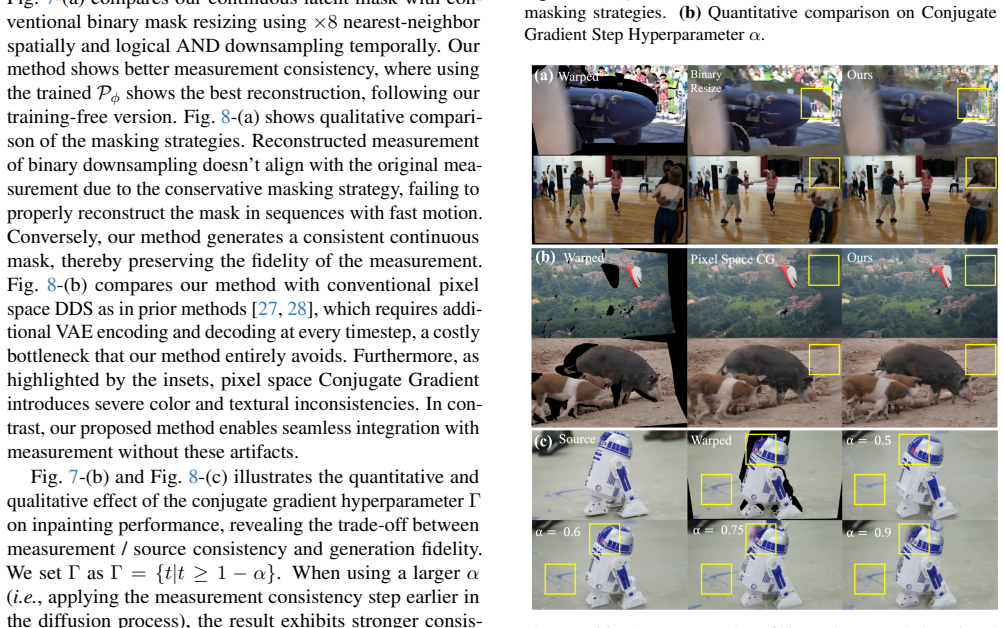
- [Section 4.3.1] The sentence 'trained P_phi is optimized to achieve superior VAE reconstruction and measurement consistency (as shown in Table 1 and Fig. 7(a))' is supported by Table 1 for PSNR/LPIPS/SSIM, but Fig. 7(a) is not clearly described; consider reporting the actual numbers of the reconstruction comparison in the main text.
- [Eq. (6)] The loss combines L1 and SSIM; the weight λ is not given numerically (only in the hyperparameter ledger). Please report the value used in experiments.
Circularity Check
No significant circularity: Eq. (7) is an approximate modeling assumption, not a rescaling of the method's own fitted target.
full rationale
The paper's central latent-domain forward model w = h ⊙ z (Eq. 7) is not entailed by the definition of h in Eq. (5); it is an assumed operator-equivalence. Eq. (5) defines h as f(E(x) − E(m⊙x)), a normalized difference of latents, and Eq. (7) asserts that E(y) equals h ⊙ E(x). Substituting Eq. (5) into Eq. (7) does not produce a tautology (it would not even give the same mask convention), so this is a modeling/validation weakness rather than a circular derivation. The mask encoder P_φ is trained on synthetic VidSTG pairs via Eq. (6) and evaluated on external UltraVideo and DAVIS benchmarks; no test-set labels are used to fit h, z, or the model. The hyperparameter α = 0.6 is tuned on the reported benchmark, which is standard practice and does not make the reported measurement-consistency numbers a fitted prediction. The paper cites prior work by the same authors, notably DDS [12] and Reangle-a-video [21], but these are independently available algorithms and references; the argument does not reduce to a self-citation chain or a uniqueness theorem. The evaluation metrics are external and the training-free variant uses only the source input available at inference. Thus the derivation is largely self-contained against external benchmarks; the main concern is the correctness of the assumed forward model, not circularity.
Axiom & Free-Parameter Ledger
free parameters (4)
- alpha (CG schedule) =
0.6
- gamma (proximal weight) =
not stated
- K (CG iterations) =
not stated
- lambda (mask encoder loss weight) =
not stated
axioms (5)
- standard math DDS proximal update (Eq. 8) correctly solves the latent-space inverse problem via conjugate-gradient iterations (from reference [12]).
- domain assumption The VAE encoder E is effectively linear under masking, allowing E(m⊙x) ≈ h⊙E(x) for a channel-wise mask h.
- domain assumption Monocular depth estimation provides sufficiently accurate geometry for the warping and mask construction.
- domain assumption Double-reprojection from [61] yields valid (m⊙x, x) training pairs for the mask encoder.
- ad hoc to paper The normalization/activation f maps the latent difference onto [0,1] in the direction required by Eq. (7).
read the original abstract
Recent approaches in controllable novel view video generation often rely on fine-tuning pre-trained Video Diffusion Models (VDMs). This dominant paradigm is computationally expensive and frequently suffers from catastrophic forgetting of the model's original generative priors. To address this challenge, here we propose InverseCrafter, a VDM training-free framework that reformulates novel view video generation as an inpainting-based inverse problem in the latent space, eliminating the need for any annotated 4D training data. The core of our method is to establish operator equivalence by employing a lightweight latent mask encoder to define a latent-domain masking operation via a continuous, multi-channel representation. This principled representation faithfully models the forward process in the latent domain, enabling efficient, backpropagation-free solvers while bypassing the costly bottleneck of repeated VAE operations. InverseCrafter achieves high-fidelity, spatio-temporally coherent novel view synthesis with near-zero additional inference overhead and excels at general-purpose video inpainting and editing by fully preserving the pre-trained VDM's generative capabilities.
Figures




Forward citations
Cited by 6 Pith papers
-
Image Restoration via Diffusion Models with Dynamic Resolution
Dynamic resolution priors enable faster diffusion-based image restoration by operating in lower-dimensional subspaces, with adapted methods outperforming prior DM approaches on most tasks.
-
CameraAnything: Refilming Videos with Arbitrary Camera Control
A video diffusion editor jointly controls extrinsic pose, multi-shot cuts, focal length, and native resolution via Plücker rays in resolution-aware 3D RoPE, trained on synthetic multi-camera pairs.
-
FlowLong: Inference-time Long Video Generation via Manifold-constrained Tweedie Matching
FlowLong generates videos several times longer than native model windows by blending adjacent predictions with Tweedie matching to enforce manifold and temporal consistency while using stochastic noise injection early...
-
Accelerating Video Inverse Problem Solvers with Autoregressive Diffusion Models
AVIS applies autoregressive diffusion models to video inverse problems by streaming restoration with measurement-consistent initialization, reducing latency from 114s to 4s and raising throughput to 1.18 FPS (or 5.91 ...
-
Embody4D: A Generalist Data Engine for Embodied 4D World Modeling
Embody4D generates novel-view videos from monocular robot videos via a 3D-aware synthesis pipeline, confidence-aware expert modulation, and interaction-aware attention for embodied 4D world modeling.
-
Embody4D: A Generalist Data Engine for Embodied 4D World Modeling
Embody4D generates high-fidelity, view-consistent novel views from monocular videos for embodied scenarios via 3D-aware data synthesis, adaptive noise injection, and interaction-aware attention.
Reference graph
Works this paper leans on
-
[1]
Sherwin Bahmani, Ivan Skorokhodov, Aliaksandr Siarohin, Willi Menapace, Guocheng Qian, Michael Vasilkovsky, Hsin- Ying Lee, Chaoyang Wang, Jiaxu Zou, Andrea Tagliasacchi, et al. Vd3d: Taming large video diffusion transformers for 3d camera control.arXiv preprint arXiv:2407.12781, 2024. 13
Pith/arXiv arXiv 2024
-
[2]
Jianhong Bai, Menghan Xia, Xintao Wang, Ziyang Yuan, Xiao Fu, Zuozhu Liu, Haoji Hu, Pengfei Wan, and Di Zhang. Syncammaster: Synchronizing multi-camera video generation from diverse viewpoints.arXiv preprint arXiv:2412.07760, 2024. 13
Pith/arXiv arXiv 2024
-
[3]
Recammaster: Camera-controlled gener- ative rendering from a single video, 2025
Jianhong Bai, Menghan Xia, Xiao Fu, Xintao Wang, Lianrui Mu, Jinwen Cao, Zuozhu Liu, Haoji Hu, Xiang Bai, Pengfei Wan, and Di Zhang. Recammaster: Camera-controlled gener- ative rendering from a single video, 2025. 1, 7, 13
2025
-
[4]
Shuai Bai, Keqin Chen, Xuejing Liu, Jialin Wang, Wenbin Ge, Sibo Song, Kai Dang, Peng Wang, Shijie Wang, Jun Tang, et al. Qwen2. 5-vl technical report.arXiv preprint arXiv:2502.13923, 2025. 14
Pith/arXiv arXiv 2025
-
[5]
Videopainter: Any- length video inpainting and editing with plug-and-play con- text control
Yuxuan Bian, Zhaoyang Zhang, Xuan Ju, Mingdeng Cao, Liangbin Xie, Ying Shan, and Qiang Xu. Videopainter: Any- length video inpainting and editing with plug-and-play con- text control. InProceedings of the Special Interest Group on Computer Graphics and Interactive Techniques Conference Conference Papers, pages 1–12, 2025. 7
2025
-
[6]
Andreas Blattmann, Tim Dockhorn, Sumith Kulal, Daniel Mendelevitch, Maciej Kilian, Dominik Lorenz, Yam Levi, Zion English, Vikram V oleti, Adam Letts, et al. Stable video diffusion: Scaling latent video diffusion models to large datasets.arXiv preprint arXiv:2311.15127, 2023. 1, 2
Pith/arXiv arXiv 2023
-
[7]
The perception-distortion tradeoff
Yochai Blau and Tomer Michaeli. The perception-distortion tradeoff. InProceedings of the IEEE conference on computer vision and pattern recognition, pages 6228–6237, 2018. 13
2018
-
[8]
Video generation models as world simulators
Tim Brooks, Bill Peebles, Connor Holmes, Will DePue, Yufei Guo, Li Jing, David Schnurr, Joe Taylor, Troy Luhman, Eric Luhman, Clarence Ng, Ricky Wang, and Aditya Ramesh. Video generation models as world simulators. 2024. 1, 12
2024
-
[9]
The 2019 davis challenge on vos: Unsupervised multi-object segmenta- tion.arXiv:1905.00737, 2019
Sergi Caelles, Jordi Pont-Tuset, Federico Perazzi, Alberto Montes, Kevis-Kokitsi Maninis, and Luc Van Gool. The 2019 davis challenge on vos: Unsupervised multi-object segmenta- tion.arXiv:1905.00737, 2019. 13
Pith/arXiv arXiv 2019
-
[10]
Emerg- ing properties in self-supervised vision transformers
Mathilde Caron, Hugo Touvron, Ishan Misra, Hervé Jégou, Julien Mairal, Piotr Bojanowski, and Armand Joulin. Emerg- ing properties in self-supervised vision transformers. InPro- ceedings of the IEEE/CVF international conference on com- puter vision, pages 9650–9660, 2021. 5, 13
2021
-
[11]
Diffusion posterior sampling for general noisy inverse problems
Hyungjin Chung, Jeongsol Kim, Michael Thompson Mccann, Marc Louis Klasky, and Jong Chul Ye. Diffusion posterior sampling for general noisy inverse problems. InInternational Conference on Learning Representations, 2023. 2, 12
2023
-
[12]
Decom- posed diffusion sampler for accelerating large-scale inverse problems
Hyungjin Chung, Suhyeon Lee, and Jong Chul Ye. Decom- posed diffusion sampler for accelerating large-scale inverse problems. InThe Twelfth International Conference on Learn- ing Representations, 2024. 2, 5, 13
2024
-
[13]
Prompt-tuning latent diffusion models for inverse problems
Hyungjin Chung, Jong Chul Ye, Peyman Milanfar, and Mauri- cio Delbracio. Prompt-tuning latent diffusion models for inverse problems. InInternational Conference on Machine Learning, pages 8941–8967. PMLR, 2024. 3
2024
-
[14]
Dif- fusion models for inverse problems.arXiv preprint arXiv:2508.01975, 2025
Hyungjin Chung, Jeongsol Kim, and Jong Chul Ye. Dif- fusion models for inverse problems.arXiv preprint arXiv:2508.01975, 2025. 3
Pith/arXiv arXiv 2025
-
[15]
Diffusion as shader: 3d- aware video diffusion for versatile video generation control,
Zekai Gu, Rui Yan, Jiahao Lu, Peng Li, Zhiyang Dou, Chenyang Si, Zhen Dong, Qifeng Liu, Cheng Lin, Ziwei Liu, Wenping Wang, and Yuan Liu. Diffusion as shader: 3d- aware video diffusion for versatile video generation control,
-
[16]
Hao He, Yinghao Xu, Yuwei Guo, Gordon Wetzstein, Bo Dai, Hongsheng Li, and Ceyuan Yang. Cameractrl: Enabling camera control for text-to-video generation.arXiv preprint arXiv:2404.02101, 2024. 13
Pith/arXiv arXiv 2024
-
[17]
Denoising diffu- sion probabilistic models.Advances in Neural Information Processing Systems, 33:6840–6851, 2020
Jonathan Ho, Ajay Jain, and Pieter Abbeel. Denoising diffu- sion probabilistic models.Advances in Neural Information Processing Systems, 33:6840–6851, 2020. 12
2020
-
[18]
Video diffusion models.Advances in Neural Information Processing Systems, 35:8633–8646, 2022
Jonathan Ho, Tim Salimans, Alexey Gritsenko, William Chan, Mohammad Norouzi, and David J Fleet. Video diffusion models.Advances in Neural Information Processing Systems, 35:8633–8646, 2022. 1
2022
-
[19]
Depthcrafter: Generating consistent long depth sequences for open-world videos, 2024
Wenbo Hu, Xiangjun Gao, Xiaoyu Li, Sijie Zhao, Xiaodong Cun, Yong Zhang, Long Quan, and Ying Shan. Depthcrafter: Generating consistent long depth sequences for open-world videos, 2024. 3, 5, 6
2024
-
[20]
Ziqi Huang, Fan Zhang, Xiaojie Xu, Yinan He, Jiashuo Yu, Ziyue Dong, Qianli Ma, Nattapol Chanpaisit, Chenyang Si, Yuming Jiang, et al. Vbench++: Comprehensive and versatile benchmark suite for video generative models.arXiv preprint arXiv:2411.13503, 2024. 5
Pith/arXiv arXiv 2024
-
[21]
Reangle- a-video: 4d video generation as video-to-video translation,
Hyeonho Jeong, Suhyeon Lee, and Jong Chul Ye. Reangle- a-video: 4d video generation as video-to-video translation,
-
[22]
Regularization by texts for latent diffusion inverse solvers.arXiv preprint arXiv:2311.15658, 2023
Jeongsol Kim, Geon Yeong Park, Hyungjin Chung, and Jong Chul Ye. Regularization by texts for latent diffusion inverse solvers.arXiv preprint arXiv:2311.15658, 2023. 4
Pith/arXiv arXiv 2023
-
[23]
Jeongsol Kim, Geon Yeong Park, and Jong Chul Ye. Dream- sampler: Unifying diffusion sampling and score distillation for image manipulation.arXiv preprint arXiv:2403.11415,
-
[24]
Flowdps: Flow-driven posterior sampling for inverse prob- lems.arXiv preprint arXiv:2503.08136, 2025
Jeongsol Kim, Bryan Sangwoo Kim, and Jong Chul Ye. Flowdps: Flow-driven posterior sampling for inverse prob- lems.arXiv preprint arXiv:2503.08136, 2025. 3
Pith/arXiv arXiv 2025
-
[25]
Pick-a-pic: An open dataset of user preferences for text-to-image generation, 2023
Yuval Kirstain, Adam Polyak, Uriel Singer, Shahbuland Ma- tiana, Joe Penna, and Omer Levy. Pick-a-pic: An open dataset of user preferences for text-to-image generation, 2023. 5, 14
2023
-
[26]
Weijie Kong, Qi Tian, Zijian Zhang, Rox Min, Zuozhuo Dai, Jin Zhou, Jiangfeng Xiong, Xin Li, Bo Wu, Jianwei Zhang, et al. Hunyuanvideo: A systematic framework for large video generative models.arXiv preprint arXiv:2412.03603, 2024. 1
Pith/arXiv arXiv 2024
-
[27]
Solving video inverse problems using image diffusion models, 2025
Taesung Kwon and Jong Chul Ye. Solving video inverse problems using image diffusion models, 2025. 8
2025
-
[28]
Vision-xl: High definition video inverse problem solver using latent image diffusion models, 2025
Taesung Kwon and Jong Chul Ye. Vision-xl: High definition video inverse problem solver using latent image diffusion models, 2025. 8
2025
-
[29]
Flux, 2024
Black Forest Labs. Flux, 2024. URL https://blackforestlabs.ai/. 12
2024
-
[30]
Flux.1 fill [dev]
Black Forest Labs. Flux.1 fill [dev]. https : / / huggingface.co/black-forest-labs/FLUX.1- 9 Fill-dev, 2025. Model release. License: flux-1-dev-non- commercial-license. 7
2025
-
[31]
Blip- 2: Bootstrapping language-image pre-training with frozen image encoders and large language models
Junnan Li, Dongxu Li, Silvio Savarese, and Steven Hoi. Blip- 2: Bootstrapping language-image pre-training with frozen image encoders and large language models. InInternational conference on machine learning, pages 19730–19742. PMLR,
-
[32]
Realcam-i2v: Real-world image- to-video generation with interactive complex camera control
Teng Li, Guangcong Zheng, Rui Jiang, Tao Wu, Yehao Lu, Yining Lin, Xi Li, et al. Realcam-i2v: Real-world image- to-video generation with interactive complex camera control. arXiv preprint arXiv:2502.10059, 2025. 13
Pith/arXiv arXiv 2025
-
[33]
Yaron Lipman, Ricky T. Q. Chen, Heli Ben-Hamu, Maxim- ilian Nickel, and Matthew Le. Flow matching for genera- tive modeling. InThe Eleventh International Conference on Learning Representations, 2023. 12
2023
-
[34]
Flow straight and fast: Learning to generate and transfer data with rectified flow
Xingchao Liu, Chengyue Gong, and qiang liu. Flow straight and fast: Learning to generate and transfer data with rectified flow. InThe Eleventh International Conference on Learning Representations, 2023. 12
2023
-
[35]
Decoupled weight decay regularization.arXiv preprint arXiv:1711.05101, 2017
I Loshchilov. Decoupled weight decay regularization.arXiv preprint arXiv:1711.05101, 2017. 5
Pith/arXiv arXiv 2017
-
[36]
Openai platform: gpt-5-mini
OpenAI. Openai platform: gpt-5-mini. https : / / platform . openai . com / docs / models / gpt - 5 - mini, 2025. Accessed on 2025-09-14. 5, 13
2025
-
[37]
Normalizing flows for probabilistic modeling and inference
George Papamakarios, Eric Nalisnick, Danilo Jimenez Rezende, Shakir Mohamed, and Balaji Lakshminarayanan. Normalizing flows for probabilistic modeling and inference. Journal of Machine Learning Research, 22(57):1–64, 2021. 12
2021
-
[38]
Zero4d: Training-free 4d video generation from single video using off-the-shelf video diffusion, 2025
Jangho Park, Taesung Kwon, and Jong Chul Ye. Zero4d: Training-free 4d video generation from single video using off-the-shelf video diffusion, 2025. 2, 7, 13
2025
-
[39]
The 2017 davis challenge on video object segmentation.arXiv preprint arXiv:1704.00675, 2017
Jordi Pont-Tuset, Federico Perazzi, Sergi Caelles, Pablo Ar- beláez, Alex Sorkine-Hornung, and Luc Van Gool. The 2017 davis challenge on video object segmentation.arXiv preprint arXiv:1704.00675, 2017. 5
Pith/arXiv arXiv 2017
-
[40]
Learning transferable visual models from natural language supervi- sion
Alec Radford, Jong Wook Kim, Chris Hallacy, Aditya Ramesh, Gabriel Goh, Sandhini Agarwal, Girish Sastry, Amanda Askell, Pamela Mishkin, Jack Clark, et al. Learning transferable visual models from natural language supervi- sion. InInternational conference on machine learning, pages 8748–8763. PmLR, 2021. 5, 13
2021
-
[41]
Silo: Solving inverse problems with latent operators
Ron Raphaeli, Sean Man, and Michael Elad. Silo: Solving inverse problems with latent operators. InProceedings of the IEEE/CVF International Conference on Computer Vision, pages 10570–10580, 2025. 3, 4, 5
2025
-
[42]
Gen3c: 3d-informed world- consistent video generation with precise camera control, 2025
Xuanchi Ren, Tianchang Shen, Jiahui Huang, Huan Ling, Yifan Lu, Merlin Nimier-David, Thomas Müller, Alexander Keller, Sanja Fidler, and Jun Gao. Gen3c: 3d-informed world- consistent video generation with precise camera control, 2025. 1, 2
2025
-
[43]
High-resolution image synthesis with latent diffusion models
Robin Rombach, Andreas Blattmann, Dominik Lorenz, Patrick Esser, and Björn Ommer. High-resolution image synthesis with latent diffusion models. InProceedings of the IEEE/CVF Conference on Computer Vision and Pattern Recognition, pages 10684–10695, 2022. 12
2022
-
[44]
Solving linear inverse problems provably via posterior sampling with latent diffusion models.Advances in Neural Information Processing Systems, 36, 2024
Litu Rout, Negin Raoof, Giannis Daras, Constantine Cara- manis, Alex Dimakis, and Sanjay Shakkottai. Solving linear inverse problems provably via posterior sampling with latent diffusion models.Advances in Neural Information Processing Systems, 36, 2024. 3
2024
-
[45]
Saurabh Saxena, Charles Herrmann, Junhwa Hur, Abhishek Kar, Mohammad Norouzi, Deqing Sun, and David J. Fleet. The surprising effectiveness of diffusion models for optical flow and monocular depth estimation, 2023. 6
2023
-
[46]
Kingma, Ab- hishek Kumar, Stefano Ermon, and Ben Poole
Yang Song, Jascha Sohl-Dickstein, Diederik P. Kingma, Ab- hishek Kumar, Stefano Ermon, and Ben Poole. Score-based generative modeling through stochastic differential equations. In9th International Conference on Learning Representations, ICLR, 2021. 12
2021
-
[47]
Alessio Spagnoletti, Jean Prost, Andrés Almansa, Nicolas Papadakis, and Marcelo Pereyra. Latino-pro: Latent consis- tency inverse solver with prompt optimization.arXiv preprint arXiv:2503.12615, 2025. 3
Pith/arXiv arXiv 2025
-
[48]
Wenqiang Sun, Shuo Chen, Fangfu Liu, Zilong Chen, Yueqi Duan, Jun Zhang, and Yikai Wang. Dimensionx: Create any 3d and 4d scenes from a single image with controllable video diffusion.arXiv preprint arXiv:2411.04928, 2024. 13
Pith/arXiv arXiv 2024
-
[49]
Thomas Unterthiner, Sjoerd Van Steenkiste, Karol Kurach, Raphael Marinier, Marcin Michalski, and Sylvain Gelly. To- wards accurate generative models of video: A new metric & challenges.arXiv preprint arXiv:1812.01717, 2018. 13
Pith/arXiv arXiv 2018
-
[50]
Generative camera dolly: Extreme monoc- ular dynamic novel view synthesis
Basile Van Hoorick, Rundi Wu, Ege Ozguroglu, Kyle Sargent, Ruoshi Liu, Pavel Tokmakov, Achal Dave, Changxi Zheng, and Carl V ondrick. Generative camera dolly: Extreme monoc- ular dynamic novel view synthesis. InEuropean Conference on Computer Vision, pages 313–331. Springer, 2024. 1, 7, 13
2024
-
[51]
Wan: Open and advanced large- scale video generative models, 2025
Team Wan, Ang Wang, Baole Ai, Bin Wen, Chaojie Mao, Chen-Wei Xie, Di Chen, Feiwu Yu, Haiming Zhao, Jianxiao Yang, Jianyuan Zeng, Jiayu Wang, Jingfeng Zhang, Jingren Zhou, Jinkai Wang, Jixuan Chen, Kai Zhu, Kang Zhao, Keyu Yan, Lianghua Huang, Mengyang Feng, Ningyi Zhang, Pan- deng Li, Pingyu Wu, Ruihang Chu, Ruili Feng, Shiwei Zhang, Siyang Sun, Tao Fang,...
2025
-
[52]
Zero-shot image restoration using denoising diffusion null-space model
Yinhuai Wang, Jiwen Yu, and Jian Zhang. Zero-shot image restoration using denoising diffusion null-space model. In The Eleventh International Conference on Learning Repre- sentations, 2023. 2
2023
-
[53]
Image quality assessment: from error visibility to structural similarity.IEEE transactions on image processing, 13(4):600–612, 2004
Zhou Wang, Alan C Bovik, Hamid R Sheikh, and Eero P Simoncelli. Image quality assessment: from error visibility to structural similarity.IEEE transactions on image processing, 13(4):600–612, 2004. 4, 13
2004
-
[54]
Controlling space and time with diffusion models.arXiv preprint arXiv:2407.07860, 2024
Daniel Watson, Saurabh Saxena, Lala Li, Andrea Tagliasac- chi, and David J Fleet. Controlling space and time with diffusion models.arXiv preprint arXiv:2407.07860, 2024. 13
Pith/arXiv arXiv 2024
-
[55]
Cat4d: 10 Create anything in 4d with multi-view video diffusion models
Rundi Wu, Ruiqi Gao, Ben Poole, Alex Trevithick, Changxi Zheng, Jonathan T Barron, and Aleksander Holynski. Cat4d: 10 Create anything in 4d with multi-view video diffusion models. arXiv preprint arXiv:2411.18613, 2024. 1, 13
Pith/arXiv arXiv 2024
-
[56]
Trajectory atten- tion for fine-grained video motion control.arXiv preprint arXiv:2411.19324, 2024
Zeqi Xiao, Wenqi Ouyang, Yifan Zhou, Shuai Yang, Lei Yang, Jianlou Si, and Xingang Pan. Trajectory atten- tion for fine-grained video motion control.arXiv preprint arXiv:2411.19324, 2024. 1, 2, 4, 7, 13
Pith/arXiv arXiv 2024
-
[57]
Dejia Xu, Weili Nie, Chao Liu, Sifei Liu, Jan Kautz, Zhangyang Wang, and Arash Vahdat. Camco: Camera- controllable 3d-consistent image-to-video generation.arXiv preprint arXiv:2406.02509, 2024. 13
Pith/arXiv arXiv 2024
-
[58]
Zhucun Xue, Jiangning Zhang, Teng Hu, Haoyang He, Yinan Chen, Yuxuan Cai, Yabiao Wang, Chengjie Wang, Yong Liu, Xiangtai Li, et al. Ultravideo: High-quality uhd video dataset with comprehensive captions.arXiv preprint arXiv:2506.13691, 2025. 5
Pith/arXiv arXiv 2025
-
[59]
Zhuoyi Yang, Jiayan Teng, Wendi Zheng, Ming Ding, Shiyu Huang, Jiazheng Xu, Yuanming Yang, Wenyi Hong, Xiao- han Zhang, Guanyu Feng, et al. Cogvideox: Text-to-video diffusion models with an expert transformer.arXiv preprint arXiv:2408.06072, 2024. 4
Pith/arXiv arXiv 2024
-
[60]
Nvs-solver: Video diffusion model as zero-shot novel view synthesizer
Meng You, Zhiyu Zhu, Hui Liu, and Junhui Hou. Nvs-solver: Video diffusion model as zero-shot novel view synthesizer. arXiv preprint arXiv:2405.15364, 2024. 2, 7, 13
Pith/arXiv arXiv 2024
-
[61]
Trajecto- rycrafter: Redirecting camera trajectory for monocular videos via diffusion models, 2025
Mark YU, Wenbo Hu, Jinbo Xing, and Ying Shan. Trajecto- rycrafter: Redirecting camera trajectory for monocular videos via diffusion models, 2025. 1, 2, 4, 7
2025
-
[62]
Where does it exist: Spatio-temporal video grounding for multi-form sentences, 2020
Zhu Zhang, Zhou Zhao, Yang Zhao, Qi Wang, Huasheng Liu, and Lianli Gao. Where does it exist: Spatio-temporal video grounding for multi-form sentences, 2020. 5 11 Appendix Supplementary Materials A. Related Works A.1. Diffusion and Flow-based Models Diffusion ModelsDiffusion models [ 17, 46] aim to model the data distribution p(x), by learning to reverse f...
2020
-
[63]
Measurement PSNR : We compute the PSNR by excluding the masked region, resulting in the measurement PSNR
-
[64]
Measurement LPIPS : We measure the LPIPS [7], which is defined as distance between feature maps of pre-trained VGG network, by excluding the masked region
-
[65]
Measurement SSIM : We compute the structural similarity [53] by excluding the masked region
-
[66]
DINO distance : We evaluate source distribution consistency by computing the average cosine distance between DINO- ViT [10] features extracted from the generated video and the source video
-
[67]
FVD : We report the Fréchet Video Distance (FVD) [ 49] to assess the overall quality and temporal coherence of the generated videos, using features from a pre-trained I3D network
-
[68]
VBench: We calculate subject consistency, temporal flickering, motion smoothness for Quality Score and overall consistency for Semantic Score, calculate the Total Score based on the metric weights&normalization method in VBench
-
[69]
CLIP-score : We report the similarity between features embedded by pre-trained CLIP [ 40]7 image encoder and text encoder. 3https://github.com/cure-lab/PnPInversion/tree/main/evaluation 4https://github.com/yuvalkirstain/PickScore 5https://github.com/JunyaoHu/common_metrics_on_video_quality 6https://github.com/Vchitect/VBench 7We use CLIP ViT-base-patch16....
-
[70]
There is only one primary object in the image
Modify the primary object that appears in the original prompt. There is only one primary object in the image
-
[71]
Avoid unrealistic substitutions (e.g., changing ‘rabbit on grass’ to ‘rocket on grass’)
The replacement must be significantly different from the original concept but contextually appropriate. Avoid unrealistic substitutions (e.g., changing ‘rabbit on grass’ to ‘rocket on grass’)
-
[72]
Ensure diversity in word choices across different modifications
-
[73]
Do not change sentence structure, introduce new elements, or modify additional details
Preserve all other words exactly as they are. Do not change sentence structure, introduce new elements, or modify additional details
-
[74]
Do not provide any additional words—output only the modified text description
-
[75]
<modified prompt1>
Editing is done by masking the primary object and filling in only that area (text-guided inpainting). In other words, it is not possible if the silhouette of the target object differs too much, so please avoid creating target prompts that result in such discrepancies. The output format must be like this: ["<modified prompt1>", "<modified prompt2>", "<modi...
-
[76]
Pick-score : To measure the alignment between the generated video and the target text prompt, we use the Pick-score [25] to predict human preferences, providing a proxy for both text-video alignment and aesthetic quality
-
[77]
VLM : We discuss about this in the following section. B.2.1. VLM metric To assess both the visual quality of the generated videos and their alignment with the target text prompt, we employ a Vision Language Model (VLM)–based evaluation metric. Specifically, we use Qwen2.5-VL-3B-Instruct [4], which is capable of processing video input natively. The VLM is ...
-
[78]
**Faithfulness to Prompt**: Does the video accurately reflect the user’s input prompt in terms of objects, attributes, style, and composition?
-
[79]
**Visual Quality**: Is the video clear, sharp, and free from any unrealistic artifacts or distortions?
-
[80]
Please put your score in <score> score </score>
**Temporal Coherence**: Is the video smooth and coherent over time, without abrupt changes or jarring transitions? Please rate this video on a scale of 0-10 (10 being perfect) and explain your reasoning. Please put your score in <score> score </score>. Prompt:{pr} Figure 10. Evaluation prompt used for VLM-based scoring with Qwen2.5-VL-3B-Instruct. The mod...
discussion (0)
Sign in with ORCID, Apple, or X to comment. Anyone can read and Pith papers without signing in.