REVIEW 1 major objections 7 minor 155 references
On large scales, galaxy clustering is fixed by symmetries plus a finite set of EFT parameters that absorb small-scale chaos.
Reviewed by Pith at T0; open to challenge. T0 means a machine referee read the full paper against a public rubric. the ladder, T0–T4 →
T0 review · grok-4.5
2026-07-31 11:30 UTC pith:TNC32UP3
load-bearing objection Solid, self-contained lecture notes that package the standard one-loop EFT-of-LSS toolkit for students; useful training material, not a new result. the 1 major comments →
GGI Lectures on Large-Scale Structure Perturbation Theory (Effective Field Theory)
The pith
A machine-rendered reading of the paper's core claim, the machinery that carries it, and where it could break.
Core claim
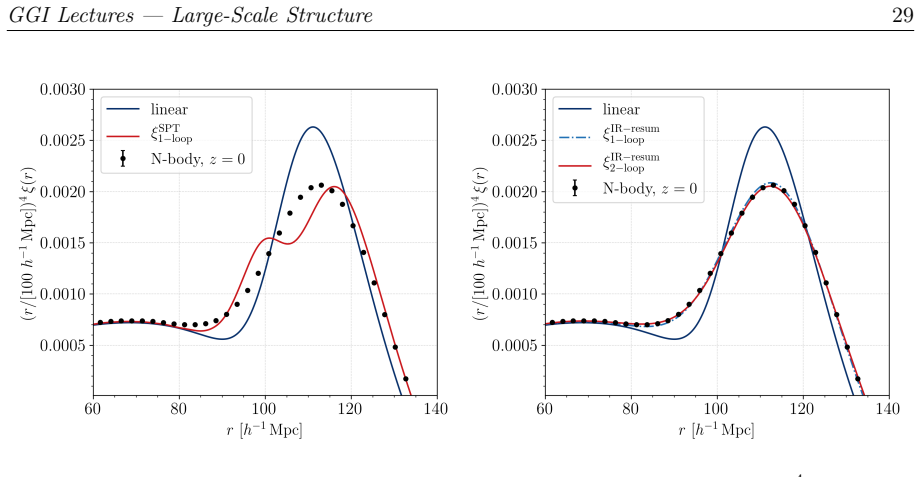
The notes establish that Standard Perturbation Theory is incomplete: its loops are UV-sensitive and its treatment of BAO wiggles breaks down, while an effective stress tensor, stochastic terms, and a symmetry-based bias and redshift-space expansion supply exactly the counterterms and operators needed. With IR resummation (equivalently organized in Lagrangian perturbation theory), the resulting one-loop EFT is claimed to be sufficient to model observed galaxy clustering in real and redshift space up to the quasi-linear scales relevant for surveys.
What carries the argument
The effective stress tensor in the Euler equation (plus its stochastic piece), constrained by Galilean invariance and the equivalence principle: it generates the k²P₁₁ counterterm and k⁴ stochastic noise that renormalize SPT loops, while the same symmetry principles fix the galaxy bias operators and the structure of redshift-space contact-operator counterterms.
Load-bearing premise
Nonlinear mode-coupling kernels are computed in the Einstein–de Sitter shortcut while only linear growth is taken from the true cosmology, on the claim that the error stays at the percent level or below for practical survey analyses.
What would settle it
Field-level and power-spectrum comparisons to N-body and hydro simulations: if one-loop EFT with the stated operators systematically fails to match phases and multipoles up to the advertised k_max once counterterms are fit, or if the EdS-kernel error exceeds the claimed sub-percent level in precision mocks, the completeness claim is wrong.
If this is right
- Survey full-shape analyses can treat small-scale and baryonic physics as a handful of fit nuisance parameters rather than as a barrier to theory.
- BAO peak shape and damping are predicted once bulk flows are resummed; coherent long-wavelength displacements drop out by the equivalence principle.
- Redshift-space multipoles need only a truncated set of µ-dependent counterterms and stochastic terms fixed by symmetries, not an arbitrary angular expansion.
- Lagrangian and Eulerian one-loop EFT are the same expansion organized differently; LPT makes IR resummation automatic.
- Stochastic power for galaxies can be white (constant) at low k, unlike matter’s k⁴ noise, because number is not conserved.
Where Pith is reading between the lines
- If the scale hierarchy k_RSD ≪ k_NL is sample-dependent as the notes stress, survey strategy may favor emission-line or high-z samples where the EFT cutoff is higher.
- The same symmetry skeleton should extend cleanly to the bispectrum and to mixed stochastic operators, which the outlook flags but does not fully develop here.
- Field-level forward modeling is the natural stress test of whether the finite operator set is truly complete, beyond smooth power-spectrum fits.
- Primordial non-Gaussianity enters as extra bias operators evaluated on Lagrangian coordinates—another direct use of the equivalence-principle logic taught for BAO.
Editorial analysis
A structured set of objections, weighed in public.
Referee Report
Summary. These are pedagogical lecture notes developing the effective field theory of cosmological large-scale structure from symmetry principles, aimed at undergraduates and beginning graduate students with no assumed cosmology or QFT background. The notes build Newtonian fluid EFT, diagnose IR/UV failures of Standard Perturbation Theory (including BAO damping and equivalence-principle cancellations), introduce the effective stress tensor, counterterms, and stochastic terms, then extend the framework to galaxy bias, redshift-space distortions (including contact-operator renormalization and RSD stochasticity), and Lagrangian perturbation theory with IR resummation. The central claim is that a finite, symmetry-fixed set of one-loop operators and free EFT coefficients is sufficient to model observed galaxy clustering in real and redshift space on large scales.
Significance. The manuscript is a coherent, self-contained training resource for a framework that is now standard in full-shape analyses of BOSS/DESI and related surveys. Strengths include: symmetry-first derivations of the Navier–Stokes/EFT stress tensor and bias/RSD operators; explicit IR cancellation from the boost/equivalence principle with soft limits of F2/F3; the Peebles k^4 stochastic argument; clear treatment of redundant bias operators and RSD contact-term renormalization (including the structural truncation at μ^4); and LPT–SPT matching with a position-space BAO picture. Free parameters (γ, bi, αi, C̃i) are treated honestly as fit quantities rather than first-principles outputs. For students and new practitioners this is a high-value synthesis; it does not claim new precision results beyond the established toolkit.
major comments (1)
- [Chapter 3 (after Eq. 71)] Chapter 3 (after Eq. 71) and the EdS/Ω_m=f² kernel approximation: the notes assert that using EdS Fn,Gn with exact D+,f mismatches the fully time-dependent solution by ≲1% and is negligible for current/future surveys, citing prior work. For lecture notes whose claim is completeness of one-loop templates, a short explicit pointer (which reference, at which order, and for which observables—Pgg multipoles vs. bispectrum) would better let students judge when the shortcut fails. This is not a correctness error in the derivation, but it is the main modeling assumption load-bearing for the “sufficient for survey modeling” claim and should be documented more tightly in the text itself rather than only by citation.
minor comments (7)
- [§3.1] Section 3.1: “histrionically” should be “historically.”
- [§5.1] Section 5.1 title: “Phenomeological” → “Phenomenological.”
- [Figures 8–19] Several figures (e.g. Figs. 8–13, 16–19) are central to the pedagogy; ensure captions state cosmology, redshift, and whether IR resummation/counterterms are included so the plots are readable standalone.
- [§6.8] Chapter 6 summary table of free parameters is very useful; a parallel one-line power-counting table (which operators enter at tree / one-loop / stochastic for P0,P2,P4) would help students design analyses.
- [§4.4, §5.4, §6.6] Cross-references: the Peebles argument is invoked in both §4.4 and later bias/RSD stochastic sections; a forward/back pointer would reduce duplication confusion for first-time readers.
- [Appendices B–C] Appendix B/C are valuable; ensure the published version has complete, non-truncated derivations (the review copy cut off mid-heading in B.3) and that homework prompts have enough hints for the stated audience.
- [Chapter 7; global] Minor notation: Θ vs. θ, and q as loop momentum vs. Lagrangian coordinate, are flagged in Ch. 7 but could be restated once in a notation table early on.
Circularity Check
No significant circularity: pedagogical EFT notes with free counterterms/bias parameters, not fitted inputs sold as predictions.
full rationale
These are teaching notes that build the one-loop EFT of LSS from symmetries (continuity/Euler/Poisson, Galilean invariance, equivalence principle) and standard SPT/LPT bookkeeping. Loop UV pieces are absorbed into free Wilson coefficients (γ, A0, b_i, α_i, C̃_i) that the text explicitly treats as fit-to-data/simulation inputs, not first-principles outputs. IR BAO damping and k^4 stochasticity are derived from the boost/EP argument and Peebles mass–momentum conservation, not from renaming a fit. The EdS/Ω_m=f² kernel shortcut is flagged as an approximation with external accuracy claims, not smuggled uniqueness. Self-citations point to technical implementations in the same program but do not force the central pedagogical claim. No step reduces a claimed prediction to its own definition or fitted input by construction.
Axiom & Free-Parameter Ledger
free parameters (5)
- Effective sound speed / counterterm γ =
≈1.8 (Mpc/h)^2 at z=0 (illustrative)
- Stochastic amplitude A0 (matter) / α0,α1,α2 (galaxies, RSD)
- Galaxy bias coefficients b1, b2, b_G2, b_Γ3, b_∇²δ
- RSD counterterms C0, C̃1, C̃2 (optional c̃ k^4 μ^4)
- IR cutoff k_IR in BAO damping Σ²
axioms (7)
- domain assumption Separation of scales L_long ≫ L_short with analytic derivative expansion of long-wavelength observables
- domain assumption Newtonian sub-horizon cosmology with matter+Λ background; other components smooth at late times
- domain assumption Initial conditions are Gaussian, adiabatic, and statistically homogeneous and isotropic
- domain assumption Equivalence principle / time-dependent uniform boost symmetry of the fluid+gravity system
- domain assumption EdS approximation Ω_m=f² for nonlinear kernels while using exact linear D_+, f
- domain assumption Single-stream perfect-fluid SPT as the leading “monopole,” with τ_ij encoding short-scale physics
- standard math Standard calculus, Fourier analysis, and Gaussian functional integrals (Wick theorem)
read the original abstract
These notes are an introduction to non-linear perturbation theory for cosmological large-scale structure. They are aimed at undergraduate and beginning graduate students and do not require any cosmology or quantum field theory background. All necessary concepts are developed from scratch. The lectures are intended to explain all key ingredients needed to model the observed clustering of galaxies in real and redshift spaces. After a brief pedagogical introduction to the ideas of effective field theory (EFT), we develop large-scale structure EFT in the context of Newtonian cosmology using symmetry principles. We discuss in detail the shortcomings of Standard Perturbation Theory, the non-linear evolution of baryon acoustic oscillations and its relation to the equivalence principle, counterterms and renormalization of the loop diagrams, and stochastic effects. Then we develop EFT for galaxy bias and redshift space distortions. We also highlight some important facts about redshift-space stochasticity, relevant for ongoing and future galaxy surveys. Finally, we introduce Lagrangian Perturbation Theory.
Figures




Reference graph
Works this paper leans on
-
[1]
S. Dodelson and F. Schmidt,Modern Cosmology, Academic Press (2020), 10.1016/C2017-0-01943-2. [2]Planckcollaboration,Planck 2018 results. VI. Cosmological parameters,1807.06209
Pith/arXiv arXiv 2020
-
[3]
Lesgourgues,The Cosmic Linear Anisotropy Solving System (CLASS) I: Overview, 1104.2932
J. Lesgourgues,The Cosmic Linear Anisotropy Solving System (CLASS) I: Overview, 1104.2932
-
[4]
D. Baumann, A. Nicolis, L. Senatore and M. Zaldarriaga,Cosmological Non-Linearities as an Effective Fluid,JCAP1207(2012) 051 [1004.2488]
Pith/arXiv arXiv 2012
-
[5]
J.J.M. Carrasco, M.P. Hertzberg and L. Senatore,The Effective Field Theory of Cosmological Large Scale Structures,JHEP09(2012) 082 [1206.2926]
Pith/arXiv arXiv 2012
-
[6]
F. Bernardeau, S. Colombi, E. Gaztanaga and R. Scoccimarro,Large scale structure of the universe and cosmological perturbation theory,Phys. Rept.367(2002) 1 [astro-ph/0112551]
Pith/arXiv arXiv 2002
-
[7]
S. Pueblas and R. Scoccimarro,Generation of Vorticity and Velocity Dispersion by Orbit Crossing,Phys. Rev.D80(2009) 043504 [0809.4606]
Pith/arXiv arXiv 2009
-
[8]
L. Mercolli and E. Pajer,On the velocity in the Effective Field Theory of Large Scale Structures,JCAP03(2014) 006 [1307.3220]
Pith/arXiv arXiv 2014
-
[9]
R. Takahashi,Third Order Density Perturbation and One-loop Power Spectrum in a Dark Energy Dominated Universe,Prog. Theor. Phys.120(2008) 549 [0806.1437]
Pith/arXiv arXiv 2008
-
[10]
M. Fasiello and Z. Vlah,Nonlinear fields in generalized cosmologies,Phys. Rev. D94 (2016) 063516 [1604.04612]
Pith/arXiv arXiv 2016
-
[11]
M. Garny and P. Taule,Loop corrections to the power spectrum for massive neutrino cosmologies with full time- and scale-dependence,JCAP01(2021) 020 [2008.00013]
Pith/arXiv arXiv 2021
-
[12]
T. Steele and T. Baldauf,Precise Calibration of the One-Loop Bispectrum in the Effective Field Theory of Large Scale Structure,Phys. Rev. D103(2021) 023520 [2009.01200]
Pith/arXiv arXiv 2021
-
[13]
M. Fasiello, T. Fujita and Z. Vlah,Perturbation theory of large scale structure in the ΛCDM Universe: Exact time evolution and the two-loop power spectrum,Phys. Rev. D 106(2022) 123504 [2205.10026]
Pith/arXiv arXiv 2022
-
[14]
C. Fidler, J. Lesgourgues, A. Mattes, A. Moradinezhad Dizgah and S. Neuland,Effective Field Theory of Large Scale Structure and Newtonian Motion Gauges,2605.05114
-
[15]
A. Chudaykin, M.M. Ivanov, O.H.E. Philcox and M. Simonović,Nonlinear perturbation theory extension of the Boltzmann code CLASS,Phys. Rev. D102(2020) 063533 [2004.10607]
Pith/arXiv arXiv 2020
-
[16]
J. Kim, C. Park, G. Rossi, S.M. Lee and J.R. Gott, III,The New Horizon Run Cosmological N-Body Simulations,J. Korean Astron. Soc.44(2011) 217 [1112.1754]
Pith/arXiv arXiv 2011
-
[17]
D. Blas, M. Garny and T. Konstandin,Cosmological perturbation theory at three-loop order,JCAP1401(2014) 010 [1309.3308]
Pith/arXiv arXiv 2014
-
[18]
Scoccimarro,Cosmological perturbations: Entering the nonlinear regime,Astrophys
R. Scoccimarro,Cosmological perturbations: Entering the nonlinear regime,Astrophys. J. 487(1997) 1 [astro-ph/9612207]. GGI Lectures — Large-Scale Structure80
Pith/arXiv arXiv 1997
-
[19]
R. Scoccimarro, M. Zaldarriaga and L. Hui,Power spectrum correlations induced by nonlinear clustering,Astrophys. J.527(1999) 1 [astro-ph/9901099]
Pith/arXiv arXiv 1999
-
[20]
D. Blas, M. Garny and T. Konstandin,On the non-linear scale of cosmological perturbation theory,JCAP09(2013) 024 [1304.1546]
Pith/arXiv arXiv 2013
-
[21]
M. McQuinn and M. White,Cosmological perturbation theory in 1+1 dimensions,JCAP 01(2016) 043 [1502.07389]
Pith/arXiv arXiv 2016
-
[22]
J.J.M. Carrasco, S. Foreman, D. Green and L. Senatore,The 2-loop matter power spectrum and the IR-safe integrand,JCAP07(2014) 056 [1304.4946]
Pith/arXiv arXiv 2014
-
[23]
J.J.M. Carrasco, S. Foreman, D. Green and L. Senatore,The Effective Field Theory of Large Scale Structures at Two Loops,JCAP07(2014) 057 [1310.0464]
Pith/arXiv arXiv 2014
-
[24]
A. Kehagias and A. Riotto,Symmetries and Consistency Relations in the Large Scale Structure of the Universe,Nucl. Phys. B873(2013) 514 [1302.0130]
Pith/arXiv arXiv 2013
-
[25]
P. Creminelli, J. Noreña, M. Simonović and F. Vernizzi,Single-Field Consistency Relations of Large Scale Structure,JCAP12(2013) 025 [1309.3557]
Pith/arXiv arXiv 2013
-
[26]
P. Creminelli, J. Gleyzes, M. Simonović and F. Vernizzi,Single-Field Consistency Relations of Large Scale Structure. Part II: Resummation and Redshift Space,JCAP02 (2014) 051 [1311.0290]
Pith/arXiv arXiv 2014
-
[27]
P. Creminelli, J. Gleyzes, L. Hui, M. Simonović and F. Vernizzi,Single-Field Consistency Relations of Large Scale Structure. Part III: Test of the Equivalence Principle,JCAP06 (2014) 009 [1312.6074]
Pith/arXiv arXiv 2014
-
[28]
T. Baldauf, M. Mirbabayi, M. Simonović and M. Zaldarriaga,Equivalence Principle and the Baryon Acoustic Peak,Phys. Rev.D92(2015) 043514 [1504.04366]
Pith/arXiv arXiv 2015
-
[29]
Weinberg,Adiabatic modes in cosmology,Phys
S. Weinberg,Adiabatic modes in cosmology,Phys. Rev. D67(2003) 123504 [astro-ph/0302326]
Pith/arXiv arXiv 2003
-
[30]
D. Blas, M. Garny, M.M. Ivanov and S. Sibiryakov,Time-Sliced Perturbation Theory for Large Scale Structure I: General Formalism,JCAP1607(2016) 052 [1512.05807]
Pith/arXiv arXiv 2016
-
[31]
D. Blas, M. Garny, M.M. Ivanov and S. Sibiryakov,Time-Sliced Perturbation Theory II: Baryon Acoustic Oscillations and Infrared Resummation,JCAP1607(2016) 028 [1605.02149]
Pith/arXiv arXiv 2016
-
[32]
M.M. Ivanov and S. Sibiryakov,Infrared Resummation for Biased Tracers in Redshift Space,JCAP1807(2018) 053 [1804.05080]
Pith/arXiv arXiv 2018
-
[33]
A. Vasudevan, M.M. Ivanov, S. Sibiryakov and J. Lesgourgues,Time-sliced perturbation theory with primordial non-Gaussianity and effects of large bulk flows on inflationary oscillating features,JCAP09(2019) 037 [1906.08697]
Pith/arXiv arXiv 2019
-
[34]
T. Matsubara,Resumming Cosmological Perturbations via the Lagrangian Picture: One-loop Results in Real Space and in Redshift Space,Phys. Rev.D77(2008) 063530 [0711.2521]
Pith/arXiv arXiv 2008
-
[35]
Z. Vlah, M. White and A. Aviles,A Lagrangian effective field theory,JCAP09(2015) 014 [1506.05264]
Pith/arXiv arXiv 2015
-
[36]
Z. Vlah, E. Castorina and M. White,The Gaussian streaming model and convolution Lagrangian effective field theory,JCAP12(2016) 007 [1609.02908]. GGI Lectures — Large-Scale Structure81
Pith/arXiv arXiv 2016
-
[37]
L. Senatore and M. Zaldarriaga,The IR-resummed Effective Field Theory of Large Scale Structures,JCAP1502(2015) 013 [1404.5954]
Pith/arXiv arXiv 2015
-
[38]
S.-F. Chen, Z. Vlah, E. Castorina and M. White,Redshift-Space Distortions in Lagrangian Perturbation Theory,JCAP03(2021) 100 [2012.04636]
Pith/arXiv arXiv 2021
-
[39]
Peacock,Large scale surveys and cosmic structure,astro-ph/0309240
J.A. Peacock,Large scale surveys and cosmic structure,astro-ph/0309240
-
[40]
Villaescusa-Navarro et al.,The Quijote simulations,Astrophys
F. Villaescusa-Navarro et al.,The Quijote simulations,Astrophys. J. Suppl.250(2020) 2 [1909.05273]
Pith/arXiv arXiv 2020
-
[41]
T. Baldauf, L. Mercolli, M. Mirbabayi and E. Pajer,The Bispectrum in the Effective Field Theory of Large Scale Structure,JCAP1505(2015) 007 [1406.4135]
Pith/arXiv arXiv 2015
-
[42]
A.A. Abolhasani, M. Mirbabayi and E. Pajer,Systematic Renormalization of the Effective Theory of Large Scale Structure,JCAP05(2016) 063 [1509.07886]
Pith/arXiv arXiv 2016
-
[43]
T. Nishimichi, F. Bernardeau and A. Taruya,Response function of the large-scale structure of the universe to the small scale inhomogeneities,Phys. Lett. B762(2016) 247 [1411.2970]
Pith/arXiv arXiv 2016
-
[44]
M. Garny, T. Konstandin, R.A. Porto and L. Sagunski,On the Soft Limit of the Large Scale Structure Power Spectrum: UV Dependence,JCAP11(2015) 032 [1508.06306]
Pith/arXiv arXiv 2015
-
[45]
T. Baldauf, L. Mercolli and M. Zaldarriaga,Effective field theory of large scale structure at two loops: The apparent scale dependence of the speed of sound,Phys. Rev.D92(2015) 123007 [1507.02256]
Pith/arXiv arXiv 2015
-
[46]
S. Foreman, H. Perrier and L. Senatore,Precision Comparison of the Power Spectrum in the EFTofLSS with Simulations,JCAP05(2016) 027 [1507.05326]
Pith/arXiv arXiv 2016
-
[47]
T. Bakx, H. Rubira, N.E. Chisari and Z. Vlah,Rapid cosmological inference with the two-loop matter power spectrum,2508.00611
-
[48]
E. Saraivanov, H. Rubira, V. Miranda and T. Eifler,Towards the Two-Loop EFTofLSS in Galaxy Lensing Surveys,2603.13031
-
[49]
S.-F. Chen, J. DeRose, M.M. Ivanov and O.H.E. Philcox,Cosmic Shear in Effective Field Theory at Two-Loop Order: RevisitingS8 in Dark Energy Survey Data,2603.28761
-
[50]
M. Lewandowski, A. Perko and L. Senatore,Analytic Prediction of Baryonic Effects from the EFT of Large Scale Structures,JCAP1505(2015) 019 [1412.5049]
Pith/arXiv arXiv 2015
-
[51]
C. Nascimento and M. Loverde,Cosmological perturbation theory for large scale structure in phase space,JCAP06(2025) 002 [2410.05389]
Pith/arXiv arXiv 2025
-
[52]
C. Nascimento, D. Jamieson, M. McQuinn and M. Loverde,A semi-analytic estimate for the effective sound speed counterterm in the EFTofLSS,JCAP02(2025) 023 [2410.11949]
Pith/arXiv arXiv 2025
-
[53]
M. Garny, D. Laxhuber and R. Scoccimarro,Vlasov perturbation theory applied to ΛCDM,Phys. Rev. D112(2025) 023556 [2505.02907]
Pith/arXiv arXiv 2025
-
[54]
Seljak,Analytic model for galaxy and dark matter clustering,Mon
U. Seljak,Analytic model for galaxy and dark matter clustering,Mon. Not. Roy. Astron. Soc.318(2000) 203 [astro-ph/0001493]
Pith/arXiv arXiv 2000
-
[55]
A. Cooray and R.K. Sheth,Halo Models of Large Scale Structure,Phys. Rept.372(2002) 1 [astro-ph/0206508]. GGI Lectures — Large-Scale Structure82
Pith/arXiv arXiv 2002
-
[56]
T. Baldauf, E. Schaan and M. Zaldarriaga,On the reach of perturbative methods for dark matter density fields,JCAP03(2016) 007 [1507.02255]
Pith/arXiv arXiv 2016
-
[57]
M.M. Ivanov, C. Cuesta-Lazaro, S. Mishra-Sharma, A. Obuljen and M.W. Toomey, Full-shape analysis with simulation-based priors: Constraints on single field inflation from BOSS,Phys. Rev. D110(2024) 063538 [2402.13310]
Pith/arXiv arXiv 2024
-
[58]
M.M. Ivanov, A. Obuljen, C. Cuesta-Lazaro and M.W. Toomey,Full-shape analysis with simulation-based priors: cosmological parameters and the structure growth anomaly, 2409.10609
-
[59]
Peebles,The large-scale structure of the universe(1980)
P.J.E. Peebles,The large-scale structure of the universe(1980)
1980
-
[60]
E. Pajer and M. Zaldarriaga,On the Renormalization of the Effective Field Theory of Large Scale Structures,JCAP08(2013) 037 [1301.7182]
Pith/arXiv arXiv 2013
-
[61]
T. Lazeyras and F. Schmidt,A robust measurement of the first higher-derivative bias of dark matter halos,1904.11294
Pith/arXiv arXiv 1904
-
[62]
A. Chudaykin, M.M. Ivanov and S. Sibiryakov,Renormalizing one-point probability distribution function for cosmological counts in cells,JCAP08(2023) 079 [2212.09799]
Pith/arXiv arXiv 2023
-
[63]
Press and P
W.H. Press and P. Schechter,Formation of galaxies and clusters of galaxies by selfsimilar gravitational condensation,Astrophys. J.187(1974) 425
1974
-
[64]
S. Ferraro, K.M. Smith, D. Green and D. Baumann,On the Equivalence of Barrier Crossing, Peak-Background Split, and Local Biasing,Mon. Not. Roy. Astron. Soc.435 (2013) 934 [1209.2175]
Pith/arXiv arXiv 2013
-
[65]
Kaiser,On the Spatial correlations of Abell clusters,Astrophys
N. Kaiser,On the Spatial correlations of Abell clusters,Astrophys. J. Lett.284(1984) L9
1984
-
[66]
Bardeen, J.R
J.M. Bardeen, J.R. Bond, N. Kaiser and A.S. Szalay,The Statistics of Peaks of Gaussian Random Fields,Astrophys. J.304(1986) 15
1986
-
[67]
P. McDonald and A. Roy,Clustering of dark matter tracers: generalizing bias for the coming era of precision LSS,JCAP0908(2009) 020 [0902.0991]
Pith/arXiv arXiv 2009
-
[68]
V. Assassi, D. Baumann, D. Green and M. Zaldarriaga,Renormalized Halo Bias,JCAP 1408(2014) 056 [1402.5916]
Pith/arXiv arXiv 2014
-
[69]
M. Mirbabayi, F. Schmidt and M. Zaldarriaga,Biased Tracers and Time Evolution, JCAP1507(2015) 030 [1412.5169]
Pith/arXiv arXiv 2015
-
[70]
L. Senatore,Bias in the Effective Field Theory of Large Scale Structures,JCAP1511 (2015) 007 [1406.7843]
Pith/arXiv arXiv 2015
-
[71]
V. Desjacques, D. Jeong and F. Schmidt,Large-Scale Galaxy Bias,Phys. Rept.733 (2018) 1 [1611.09787]
Pith/arXiv arXiv 2018
-
[72]
M. Simonovic, T. Baldauf, M. Zaldarriaga, J.J. Carrasco and J.A. Kollmeier, Cosmological perturbation theory using the FFTLog: formalism and connection to QFT loop integrals,JCAP1804(2018) 030 [1708.08130]
Pith/arXiv arXiv 2018
-
[73]
H. Rubira and F. Schmidt,Galaxy bias renormalization group,JCAP01(2024) 031 [2307.15031]
Pith/arXiv arXiv 2024
-
[74]
T. Bakx, M. Garny, H. Rubira and Z. Vlah,Galaxy bias renormalization: Two-loop Power Spectrum, One-loop Trispectrum and Bispectrum,2606.31280. GGI Lectures — Large-Scale Structure83
-
[75]
T. Baldauf, U. Seljak, R.E. Smith, N. Hamaus and V. Desjacques,Halo stochasticity from exclusion and nonlinear clustering,Phys. Rev. D88(2013) 083507 [1305.2917]
Pith/arXiv arXiv 2013
-
[76]
A. Chudaykin, M.M. Ivanov and O.H.E. Philcox,Reanalyzing DESI DR1: 1. LCDM Constraints from the Power Spectrum and Bispectrum,2507.13433
-
[77]
A. Obuljen, M. Simonović, A. Schneider and R. Feldmann,Modeling HI at the field level, Phys. Rev. D108(2023) 083528 [2207.12398]
Pith/arXiv arXiv 2023
-
[78]
Ivanov,Lyman alpha forest power spectrum in effective field theory,Phys
M.M. Ivanov,Lyman alpha forest power spectrum in effective field theory,Phys. Rev. D 109(2024) 023507 [2309.10133]
Pith/arXiv arXiv 2024
-
[79]
R. de Belsunce, M.M. Ivanov, J.M. Sullivan, K. Akitsu and S.-F. Chen,Modeling the Cosmological Lyman-αForest at the Field Level,Phys. Rev. Lett.136(2026) 101001 [2507.00284]
Pith/arXiv arXiv 2026
-
[80]
M.M. Ivanov,Galaxy Power Spectrum at Two-Loop Order: Implications for Weak Lensing Surveys and New Physics,2606.30713
-
[81]
T. Nishimichi, G. D’Amico, M.M. Ivanov, L. Senatore, M. Simonović, M. Takada et al., Blinded challenge for precision cosmology with large-scale structure: results from effective field theory for the redshift-space galaxy power spectrum,Phys. Rev. D102(2020) 123541 [2003.08277]
Pith/arXiv arXiv 2020
discussion (0)
Sign in with ORCID, Apple, or X to comment. Anyone can read and Pith papers without signing in.