REVIEW 3 major objections 6 minor 1 cited by
Larger pretraining weight decay improves a language model's downstream adaptability, even when pretraining loss gets slightly worse.
Reviewed by Pith at T0; open to challenge. T0 means a machine referee read the full paper against a public rubric. the ladder, T0–T4 →
Pretrained models trained with larger weight decay fine-tune better on downstream tasks, so the best pretraining checkpoint by loss is not always the best starting point for later training.
T0 review reviewed 2026-08-03 challenge →
load-bearing objection A plausible but under-powered empirical claim that pretraining weight decay above the default improves downstream fine-tuning; worth refereeing, but I wouldn't take Finding 1 at face value without repeated seeds and a varied fine-tuning recipe. the 3 major comments →
Weight Decay Improves Language Model Plasticity
The pith
A machine-rendered reading of the paper's core claim, the machinery that carries it, and where it could break.
The reading
Core claim
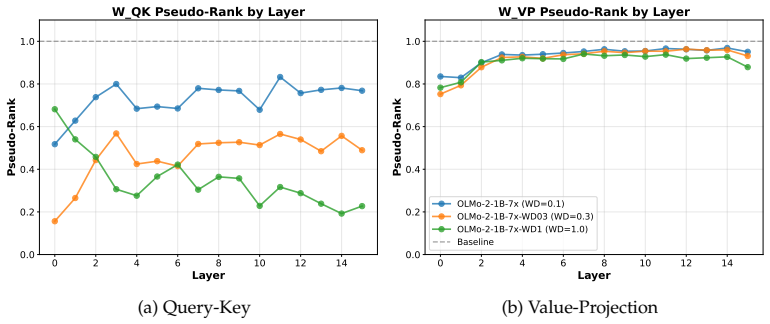
On the paper's terms: pretraining weight decay controls a property the field has not optimized for—base-model plasticity. In their setup, larger weight decay (about 0.3–1.0, above the 0.1 default) yields larger fine-tuning gains on six chain-of-thought tasks across Llama-2 and OLMo-2 models up to 4B. The best downstream value was 1.0 at 20 tokens-per-parameter and 0.3 at 140 TPP. This produces a trade-off: a base model with worse validation loss can become the better fine-tuned model. The paper further reports that the loss-minimizing and downstream-maximizing weight decays differ, and offers three mechanisms: more linearly separable representations, lower-rank attention, and less overfittin
What carries the argument
The core object is the AdamW weight-decay hyperparameter λ, the multiplicative decay applied to weights at each optimizer step after the gradient update. The experimental machinery is an end-to-end comparison: pretrain variants with different λ, fine-tune all of them with one fixed recipe, and rank them by downstream accuracy. The explanatory mechanism is λ's effect on the learned model: higher λ yields last-token embeddings that linear probes classify more accurately (linearly separated representations), lowers the pseudo-rank of the QK and value-projection matrices in attention (the fraction of singular values needed to capture 95 percent of the total), and shrinks the train-minus-validati
Load-bearing premise
The load-bearing premise is that a single fine-tuning recipe—three epochs, batch size 64, learning rate 1e-5 for 1B-and-under models and 7.5e-6 for 4B—measures plasticity fairly across all pretrained variants, so the observed ordering would not reverse if each weight-decay value received its own optimal fine-tuning settings.
What would settle it
Use the OLMo-2-1B-20x checkpoints pretrained with weight decay 0.1 and 1.0. Fine-tune both on one task, such as MetaMathQA, over a grid spanning learning rates 1e-5, 3e-5, and 1e-4 and epoch counts 1, 3, and 6, with batch size 64 held fixed. The paper's claim predicts the weight-decay-1.0 checkpoint wins under all those settings; if any reasonable setting erases or reverses the ordering, the reported plasticity advantage is an artifact of the single fixed recipe.
If this is right
- Pretrained checkpoints should be selected with downstream fine-tuning performance in mind, because the weight decay that minimizes pretraining loss differs from the weight decay that maximizes downstream accuracy.
- The common 0.1 default weight decay is likely leaving downstream performance on the table for models trained near the compute-optimal regime; values of 0.3–1.0 did better in the tested setups.
- Scaling-law and hyperparameter-sweep studies that report only validation loss can systematically misorder base models from the perspective of the final, fine-tuned model.
- A model with higher pretraining validation loss can fine-tune into a better downstream model, so validation loss alone is not a sufficient selection criterion.
- The optimal pretraining weight decay for downstream performance depends on training duration: it fell from 1.0 at 20 TPP to 0.3 at 140 TPP in these experiments.
Where Pith is reading between the lines
- Editorial inference: a practical protocol suggested by this result is to run a small multi-task fine-tuning probe on candidate checkpoints before committing large compute to post-training, since validation loss alone can pick the wrong base model.
- Editorial inference: weight decay may also buffer plasticity across multiple rounds of post-training, such as successive fine-tuning or alignment stages, because lower-rank, less-overfit representations are what continual-learning accounts identify as protecting future learning—but the paper only tests a single fine-tuning round.
- Editorial inference: the drop in optimal weight decay from 20 to 140 TPP hints at a two-dimensional scaling law in training tokens and weight decay, with the downstream-optimal λ decreasing as training grows; the paper's three-point sweep at 140 TPP is too sparse to confirm this, but it is directly testable.
- Editorial inference: since the ordering rests on one fixed fine-tuning recipe, the cleanest robustness test is a learning-rate and epoch-count grid; if any plausible grid setting reverses the ordering, plasticity needs a definition over a set of recipes rather than one recipe.
Editorial analysis
A structured set of objections, weighed in public.
Referee Report
Summary. The paper studies how the weight decay hyperparameter used during LLM pretraining affects model plasticity, measured by downstream performance after supervised fine-tuning (SFT) on six chain-of-thought tasks. Across five model setups (Llama-2 0.5B/1B/4B and OLMo-2 1B at 20 or 140 tokens-per-parameter), the authors sweep pretraining weight decay and report that larger-than-default values (e.g., 1.0 at 20 TPP, 0.3 at 140 TPP) improve fine-tuned performance, even when such values give worse pretraining validation loss. They also report mechanistic observations: higher weight decay improves linear-probe accuracy of internal representations, reduces attention-matrix pseudo-rank, and reduces the train-validation gap. The paper concludes that pretraining hyperparameter selection based solely on validation loss may not select the best downstream model.
Significance. If the main finding holds, it is practically important: it challenges the common assumption that lower pretraining validation loss should guide hyperparameter selection for models that will later be fine-tuned. The paper's empirical scope is substantial — multiple model families, sizes, training regimes, six tasks, and six evaluation metrics — and the authors are appropriately cautious about the instability of the pretraining-loss/downstream correlation (Section 4.3, Appendix Figure 9). The paper also ships a large amount of experimental detail and explicitly identifies limitations, including the use of prior checkpoints and a fixed fine-tuning recipe. The central claim is, however, currently contingent on a single fine-tuning configuration and single-run measurements, so the quantitative strength of the claim exceeds what the evidence supports.
major comments (3)
- [Section 4.2 and Appendix B.2] Finding 1 — that pretraining weight decay >0.1 improves plasticity — is measured entirely under one fixed SFT recipe: LR 1e-5 (7.5e-6 for the 4B model), 3 epochs, batch size 64, cosine schedule, warmup 0.1. No fine-tuning hyperparameter is varied, and Appendix B.2 states the recipe is inherited from Qi et al. (2025), not tuned for these pretrained checkpoints. If pretraining weight decay changes the scale of the weights or the effective step size during fine-tuning, the optimal SFT learning rate or epoch count may differ across weight-decay values. Then the reported ranking (e.g., WD=1.0 beating WD=0.1) could be an artifact of this one recipe rather than evidence about plasticity. Because the headline claim is a general statement about plasticity, this interaction must be ruled out or acknowledged as a boundary condition. A targeted fine-tuning hyperparameter sweep (at least LR and epoch
- [Section 4.2, Figures 2 and 7] All reported downstream results come from single fine-tuning runs without repeated seeds or error bars. Many comparisons between adjacent weight-decay values are small in magnitude (e.g., differences around 0.01–0.02 on average accuracy), while seed noise in SFT of models of this scale is typically at least that large. Additionally, two of the five setups have only two (Llama-2-4B-20x) or three (OLMo-2-1B-140x) weight-decay values, so the claim that 'the optimal pretraining weight decay value for plasticity is larger than 0.1' is not equally supported across setups. The authors' own Section 4.3 shows that correlation coefficients are unstable under leave-one-out re-computation, which reinforces the need for uncertainty quantification before drawing quantitative conclusions about optimal values.
- [Section 5, especially Figure 15] The mechanistic analyses in Section 5 are presented as 'effects' and 'mechanisms,' but the evidence is correlational and based on the same checkpoints that were used to establish the main result. For example, the high correlation between probing accuracy and downstream performance (Appendix Figure 15) may reflect a common cause — e.g., both are driven by the same weight-norm/regularization differences — rather than a mechanism through which linearly separable representations causally improve plasticity. The paper appropriately hedges in places ('potential explanation,' 'we conjecture'), but the section title and Finding 3 assert stronger causal language than the experiments support. The central claim of the paper does not depend on these mechanisms, so this is a framing issue, but it should be tightened.
minor comments (6)
- [Abstract and Section 6] Typo: 'the multifaceted role of that a single optimization hyperparameter plays' should read 'the multifaceted role that a single optimization hyperparameter plays.' The same phrase appears twice.
- [Appendix A.2, Table 3] The weight-decay grids are highly unbalanced across model setups: Llama-2-0.5B and 1B cover nine values, while Llama-2-4B has only {0.1, 1.0} and OLMo-2-1B-140x has only {0.1, 0.3, 1.0}. This should be stated clearly in the main text, since it affects how much weight the reader can give to the 'consistent across setups' claim.
- [Appendix B.2, Table 7] The fine-tuning batch size differs from Qi et al. (2025) (64 vs. their value) and is chosen 'due to computational constraints.' This is a reasonable practical choice, but it should be discussed as a possible source of discrepancy if results are compared directly to that prior work.
- [Figure 1] Figure 1b and 1c appear to have very compressed y-axis ranges for OLMo-2-1B-20x; consider adding a zoomed inset or annotating the loss differences, which are on the order of 0.01–0.02 and may be within optimization noise.
- [Appendix D.2.2, Figure 17] The figure caption and surrounding text discuss the 140 TPP OLMo models but the axis label says 'OLMo-2-1B-7x'; please correct the label or the description to avoid confusion.
- [General] The paper does not state whether code, configs, and model checkpoints will be released. Given the heavy reliance on pretraining runs and custom pipelines, a reproducibility statement would strengthen the manuscript.
Circularity Check
No significant circularity: the central finding is a direct empirical sweep, and self-citations are only pipeline/checkpoint reuse.
full rationale
The paper's central claim is an empirical comparison: pretrained models varying only in weight decay are fine-tuned under a fixed recipe and evaluated. The 'optimal' weight decay is read off measured accuracy curves; no parameter is fitted to the downstream result and then re-predicted, and no equation in the paper reproduces the target finding. The mechanistic sections (linear probing, attention pseudo-rank, train-val gap) are direct measurements or import external theory (Kobayashi et al. 2024); they do not define the main claim. Self-citations appear as infrastructure: the fine-tuning hyperparameters and some checkpoints come from Qi et al. (2025) and Bordt & Pawelczyk (2025), which overlap with the author list, but these are experimental inputs rather than load-bearing justifications for the plasticity result. The fixed fine-tuning recipe (Appendix B.2) is a potential confound about whether the ranking generalizes to other SFT configurations, but that is a correctness/external-validity risk, not circularity.
Axiom & Free-Parameter Ledger
axioms (4)
- domain assumption Fine-tuning performance on the chosen six CoT tasks measures model plasticity.
- domain assumption A single fixed fine-tuning recipe is appropriate for all pretrained weight-decay variants.
- domain assumption The AdamW decoupled weight-decay implementation in the pretraining repositories follows the stated equations.
- domain assumption Pseudo-rank with a 95% energy threshold is a meaningful summary of attention-matrix rank.
Cite this review
Pith. "Pith review of Weight Decay Improves Language Model Plasticity." pith.science (2026). https://pith.science/paper/TQP7M23Z
@misc{pith2026260211137,
  author       = {Pith},
  title        = {Pith review of: Weight Decay Improves Language Model Plasticity},
  year         = {2026},
  howpublished = {\url{https://pith.science/paper/TQP7M23Z}},
  note         = {Machine review of arXiv:2602.11137}
}
read the original abstract
Large language models are typically trained in two broad phases: pretraining to produce a base model, followed by further training to improve downstream performance. However, hyperparameter optimization and scaling laws are studied primarily from the perspective of the base model's validation loss, overlooking a crucial model property: downstream adaptability. In this work, we study pretraining from the perspective of model plasticity, that is, the ability of the base model to successfully adapt to downstream tasks upon additional training. We focus on the role of weight decay, a key regularization parameter during pretraining, and show through systematic experiments that larger weight decay increases the plasticity of the pretrained model, resulting in greater performance gains downstream after fine-tuning. This effect can lead to counterintuitive trade-offs where base models that perform worse after pretraining can perform better after further training. Further investigation of weight decay's mechanistic effects on model behavior reveals that it encourages linearly separable representations, regularizes attention matrices, and reduces overfitting on the training data. Together, these findings highlight the importance of pretrained model plasticity, the limits of using cross-entropy loss as the sole metric for hyperparameter optimization, and the multifaceted role that a single optimization hyperparameter plays in shaping model behavior.
Figures



Forward citations
Cited by 1 Pith paper
-
When RL Fails after SFT: Rejuvenating Model Plasticity for Robust SFT-to-RL Handoff
Excessive SFT reduces LLM plasticity for RL; Rejuvenation restores it via base-anchored fusion and targeted neuron resets, yielding better RL performance and OOD generalization.
Reference graph
Works this paper leans on
-
[1]
Diana Abagyan, Alejandro R. Salamanca, Andres Felipe Cruz-Salinas, Kris Cao, Hangyu Lin, Acyr Locatelli, Marzieh Fadaee, Ahmet Üstün, and Sara Hooker. One tokenizer to rule them all: Emergent language plasticity via multilingual tokenizers.arXiv preprint arXiv:2506.10766,
-
[5]
(2025) and pretrain the weight decay 1.0 model
Model Weight Decay Llama-2-0.5B-20x 9 values: {0.0001, 0.001, 0.01, 0.1, 0.5, 1.0, 1.5, 3.0, 10.0} Llama-2-1B-20x 9 values: {0.0001, 0.001, 0.01, 0.1, 0.5, 1.0, 1.5, 3.0, 10.0} Llama-2-4B-20x 2 values: {0.1, 1.0} OLMo-2-1B-20x 10 values: {0.1, 0.2, 0.3, 0.4, 0.5, 0.6, 0.7, 0.8, 0.9, 1.0} OLMo-2-1B-140x 3 values: {0.1, 0.3, 1.0} Table 3:Weight decay values...
2025
-
[8]
Gheorghe Comanici, Eric Bieber, Mike Schaekermann, Ice Pasupat, Noveen Sachdeva, Inderjit Dhillon, Marcel Blistein, Ori Ram, Dan Zhang, Evan Rosen, et al. Gemini 2.5: Pushing the frontier with advanced reasoning, multimodality, long context, and next generation agentic capabilities. arXiv preprint arXiv:2507.06261,
-
[9]
The Llama 3 herd of models.arXiv preprint arXiv:2407.21783,
Aaron Grattafiori, Abhimanyu Dubey, Abhinav Jauhri, Abhinav Pandey, Abhishek Kadian, Ahmad Al-Dahle, Aiesha Letman, Akhil Mathur, Alan Schelten, Alex Vaughan, et al. The Llama 3 herd of models.arXiv preprint arXiv:2407.21783,
-
[11]
Arthur Jacot, Peter Súkeník, Zihan Wang, and Marco Mondelli. Wide neural networks trained with weight decay provably exhibit neural collapse.arXiv preprint arXiv:2410.04887,
-
[13]
Pre-training under infinite compute.arXiv preprint arXiv:2509.14786,
Konwoo Kim, Suhas Kotha, Percy Liang, and Tatsunori Hashimoto. Pre-training under infinite compute.arXiv preprint arXiv:2509.14786,
-
[15]
Atli Kosson, Jeremy Welborn, Yang Liu, Martin Jaggi, and Xi Chen. Weight decay may matter more than muP for learning rate transfer in practice.arXiv preprint arXiv:2510.19093,
-
[17]
Tulu 3: Pushing frontiers in open language model post-training.arXiv preprint arXiv:2411.15124,
Nathan Lambert, Jacob Morrison, Valentina Pyatkin, Shengyi Huang, Hamish Ivison, Faeze Brahman, Lester James V Miranda, Alisa Liu, Nouha Dziri, Shane Lyu, et al. Tulu 3: Pushing frontiers in open language model post-training.arXiv preprint arXiv:2411.15124,
-
[18]
Jae-Hun Lee, Doyoung Yoon, ByeongMoon Ji, Kyungyul Kim, and Sangheum Hwang. Rethinking evaluation protocols of visual representations learned via self-supervised learning.arXiv preprint arXiv:2304.03456,
-
[19]
DeepSeek-V3 technical report.arXiv preprint arXiv:2412.19437,
14 Aixin Liu, Bei Feng, Bing Xue, Bingxuan Wang, Bochao Wu, Chengda Lu, Chenggang Zhao, Chengqi Deng, Chenyu Zhang, Chong Ruan, et al. DeepSeek-V3 technical report.arXiv preprint arXiv:2412.19437,
-
[20]
2 OLMo 2 Furious.arXiv preprint arXiv:2501.00656,
Team OLMo Team, Pete Walsh, Luca Soldaini, Dirk Groeneveld, Kyle Lo, Shane Arora, Akshita Bhagia, Yuling Gu, Shengyi Huang, Matt Jordan, et al. 2 OLMo 2 Furious.arXiv preprint arXiv:2501.00656,
-
[21]
Samet Oymak, Zalan Fabian, Mingchen Li, and Mahdi Soltanolkotabi. Generalization guaran- tees for neural networks via harnessing the low-rank structure of the Jacobian.arXiv preprint arXiv:1906.05392,
Pith/arXiv arXiv 1906
-
[22]
Matthew Riemer, Ignacio Cases, Robert Ajemian, Miao Liu, Irina Rish, Yuhai Tu, and Gerald Tesauro. Learning to learn without forgetting by maximizing transfer and minimizing interference.arXiv preprint arXiv:1810.11910,
-
[24]
Llama 2: Open foundation and fine-tuned chat models.arXiv preprint arXiv:2307.09288,
Hugo Touvron, Louis Martin, Kevin Stone, Peter Albert, Amjad Almahairi, Yasmine Babaei, Nikolay Bashlykov, Soumya Batra, Prajjwal Bhargava, Shruti Bhosale, et al. Llama 2: Open foundation and fine-tuned chat models.arXiv preprint arXiv:2307.09288,
-
[25]
Do large language model benchmarks test reliability?arXiv preprint arXiv:2502.03461,
Joshua Vendrow, Edward Vendrow, Sara Beery, and Aleksander Madry. Do large language model benchmarks test reliability?arXiv preprint arXiv:2502.03461,
-
[26]
How to set AdamW’s weight decay as you scale model and dataset size.arXiv preprint arXiv:2405.13698,
Xi Wang and Laurence Aitchison. How to set AdamW’s weight decay as you scale model and dataset size.arXiv preprint arXiv:2405.13698,
-
[27]
Longhui Yu, Weisen Jiang, Han Shi, Jincheng Yu, Zhengying Liu, Yu Zhang, James T Kwok, Zhenguo Li, Adrian Weller, and Weiyang Liu. MetaMath: Bootstrap your own mathematical questions for large language models.arXiv preprint arXiv:2309.12284,
-
[28]
Three mechanisms of weight decay regularization.arXiv preprint arXiv:1810.12281,
Guodong Zhang, Chaoqi Wang, Bowen Xu, and Roger Grosse. Three mechanisms of weight decay regularization.arXiv preprint arXiv:1810.12281,
-
[29]
For each model setup, we pretrain variants with varying weight decay values. Llama-2-0.5B Llama-2-1B Llama-2-4B OLMo-2-1B Model size 0.5B 1B 4B 1.5B Hidden size 1536 2048 4096 2048 Intermediate size 3216 4896 7792 16384 Vocab size 32000 32000 32000 100278 Context length 2048 2048 2048 4096 # Heads 32 32 32 16 # Layers 20 22 28 16 # Query groups 4 4 4 16 T...
2048
-
[64]
(2025) due to computational constraints
than Qi et al. (2025) due to computational constraints. B.3 Template We use the following template for supervised fine-tuning. Human: {question} Assistant: {response} C Evaluation 21 10 4 10 3 10 2 10 1 100 3 101 Weight Decay of PT Model 0.025 0.050 0.075 0.100 0.125 0.150 Performance on FT T ask Greedy 10 4 10 3 10 2 10 1 100 3 101 Weight Decay of PT Mod...
arXiv 2025
-
[1991]
Saurabh Kumar, Henrik Marklund, and Benjamin Van Roy. Maintaining plasticity in continual learning via regenerative regularization.arXiv preprint arXiv:2308.11958,
-
[2010]
Training dynamics impact post-training quantization robustness.arXiv preprint arXiv:2510.06213,
Albert Catalan-Tatjer, Niccolò Ajroldi, and Jonas Geiping. Training dynamics impact post-training quantization robustness.arXiv preprint arXiv:2510.06213,
-
[2017]
Plasticity loss in deep reinforcement learning: A survey.arXiv preprint arXiv:2411.04832,
Timo Klein, Lukas Miklautz, Kevin Sidak, Claudia Plant, and Sebastian Tschiatschek. Plasticity loss in deep reinforcement learning: A survey.arXiv preprint arXiv:2411.04832,
-
[2018]
OpenAI GPT-5 system card.arXiv preprint arXiv:2601.03267,
Aaditya Singh, Adam Fry, Adam Perelman, Adam Tart, Adi Ganesh, Ahmed El-Kishky, Aidan McLaughlin, Aiden Low, AJ Ostrow, Akhila Ananthram, et al. OpenAI GPT-5 system card.arXiv preprint arXiv:2601.03267,
-
[2019]
Jared Kaplan, Sam McCandlish, Tom Henighan, Tom B. Brown, et al. Scaling laws for neural language models.arXiv preprint arXiv:2001.08361,
Pith/arXiv arXiv 2001
-
[2020]
A study on the plasticity of neural networks.arXiv preprint arXiv:2106.00042,
Tudor Berariu, Wojciech Czarnecki, Soham De, Jorg Bornschein, Samuel Smith, Razvan Pascanu, and Claudia Clopath. A study on the plasticity of neural networks.arXiv preprint arXiv:2106.00042,
-
[2021]
Shane Bergsma, Nolan Dey, Gurpreet Gosal, Gavia Gray, Daria Soboleva, and Joel Hestness. Power lines: Scaling laws for weight decay and batch size in LLM pre-training.arXiv preprint arXiv:2505.13738,
-
[2022]
Adam Ibrahim, Benjamin Thérien, Kshitij Gupta, Mats L Richter, Quentin Anthony, Timothée Lesort, Eugene Belilovsky, and Irina Rish. Simple and scalable strategies to continually pre-train large language models.arXiv preprint arXiv:2403.08763,
-
[2023]
Training verifiers to solve math word problems.arXiv preprint arXiv:2110.14168,
Karl Cobbe, Vineet Kosaraju, Mohammad Bavarian, Mark Chen, Heewoo Jun, Lukasz Kaiser, Matthias Plappert, Jerry Tworek, Jacob Hilton, Reiichiro Nakano, Christopher Hesse, and John Schulman. Training verifiers to solve math word problems.arXiv preprint arXiv:2110.14168,
-
[2024]
Sebastian Bordt and Martin Pawelczyk. Train once, answer all: Many pretraining experiments for the cost of one.arXiv preprint arXiv:2509.23383,
-
[2025]
Deepseek LLM: Scaling open-source language models with longtermism.arXiv preprint arXiv:2401.02954,
Xiao Bi, Deli Chen, Guanting Chen, Shanhuang Chen, Damai Dai, Chengqi Deng, Honghui Ding, Kai Dong, Qiushi Du, Zhe Fu, et al. Deepseek LLM: Scaling open-source language models with longtermism.arXiv preprint arXiv:2401.02954,
-
[4934]
(2021); Vendrow et al
SimpleScalingn= 54,484GSM8KPlatinum (n= 1,209) + MATH (n= 5,000) Table 6:Fine-tuning and evaluation datasets.MetaMathQA and SimpleScaling are evaluated on test sets of the GSM8KPlatinum Cobbe et al. (2021); Vendrow et al. (2025) and MATH Hendrycks et al. (2021) datasets because MetaMathQA and SimpleScaling contain questions that are augmented from the tra...
2021
This paper was first reviewed by deepseek-v4-flash on August 3, 2026.
discussion (0)
Sign in with ORCID, Apple, or X to comment. Anyone can read and Pith papers without signing in.