REVIEW 5 major objections 6 minor 39 references
Skip-stage Swin Transformer hits 37.10 driving score in CARLA
Reviewed by Pith at T0; open to challenge. T0 means a machine referee read the full paper against a public rubric. the ladder, T0–T4 →
Adding skip connections between Swin Transformer stages raises the CARLA Driving Score of the authors' end-to-end driving model from 29.7 (x13 CNN baseline) to 37.1 on Town05, in a single reported evaluation run.
T0 review reviewed 2026-08-05 challenge →
load-bearing objection Plausible incremental idea, but the headline Driving Score gain is not established by the reported single-route, single-run, post-hoc-selected evaluation. the 5 major comments →
SKGE-SWIN: End-To-End Autonomous Vehicle Waypoint Prediction and Navigation Using Skip Stage Swin Transformer
The pith
A machine-rendered reading of the paper's core claim, the machinery that carries it, and where it could break.
The reading
Core claim
On the paper's own terms, the discovery is that a Swin Transformer backbone equipped with a skip-stage connection extracts better bird's-eye-view features for end-to-end driving than the CNN backbone it replaces. The winning configuration—SKGE-Swin-tiny (the small Swin variant) with features from stage 1 bilinearly upsampled and added to stage 4—reaches a Driving Score of 37.10 on the CARLA Town05 long route, against 29.71 for the x13 CNN baseline and 42.63 for the expert. The same configuration also behaves more safely at intersections in qualitative tests, for example checking left before turning right. This is presented as evidence that global attention combined with preserved high-resolu
What carries the argument
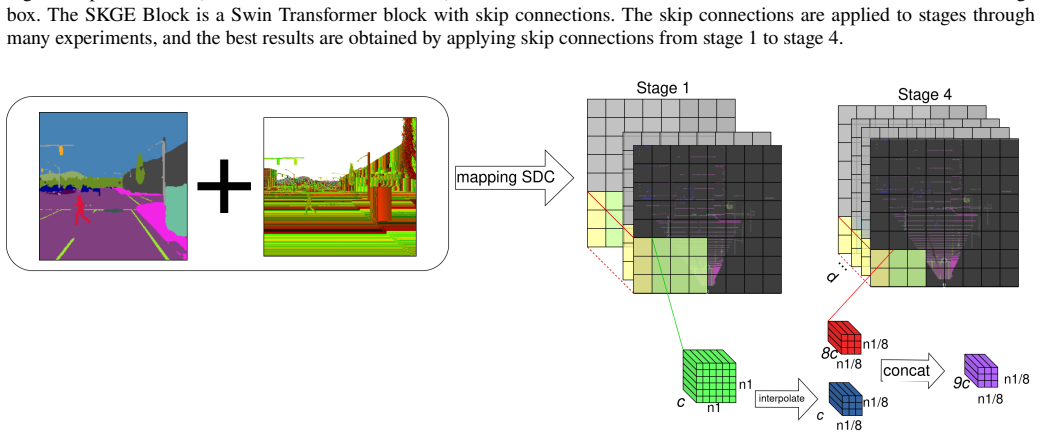
The load-bearing mechanism is the SKGE block, a Swin Transformer hierarchy in which feature maps from an early stage are resized with bilinear interpolation and added element-wise to a deeper stage. This lets the deep stage combine its own global, semantic features from shifted-window self-attention with the high-resolution spatial details that patch merging would otherwise discard. The paper systematically varies which stages are connected and finds that feeding stage 1 into stage 4, inside the BEV feature extractor, works best.
Load-bearing premise
The headline gap rests on a single evaluation run over one route (Town05 long, ClearNoon), with the winning skip-stage configuration chosen from that same evaluation; repeated runs, other routes, or held-out configuration selection could change the comparison.
What would settle it
Re-run the best configuration and the x13 baseline on several CARLA routes, including Town05 long and at least one unseen town, with at least five independent seeds per model, and compare mean Driving Score and its spread; if the 37.10-versus-29.71 gap does not persist, or another skip-stage configuration wins on the held-out routes, the paper's central claim is refuted.
If this is right
- If the central claim holds, a Swin Transformer with a stage-1-to-stage-4 skip is a viable replacement for a CNN encoder in end-to-end waypoint prediction, at the cost of roughly 2.5 times more GPU memory (1048–1382 MiB vs 556 MiB).
- The skip direction matters: forwarding early features into deeper stages helps, while the reverse stage-4-to-1 skip hurts performance, supporting the paper's claim that semantic mismatch is the reason.
- The transformer's benefit is concentrated in BEV feature extraction; as a semantic segmentation backbone it did not beat the CNN baseline, so the architecture should be placed on the BEV encoder rather than the segmentation path.
- Mixed-precision float16 speeds up the best model (22.82 to 27.49 FPS) with identical memory use, but also lowered Driving Score in the reported run (31.60 vs 37.10), so precision and driving quality can diverge.
- Qualitatively, the model shows anticipatory behavior in situations where the CNN baseline collides, such as looking left before a right turn and braking for vehicles appearing at the image edge.
Where Pith is reading between the lines
- Because the paper shows the same named architecture scoring 37.10 in one implementation and 23.27 in another, the reported advantage is tied to the full training and inference pipeline, not just to skip-stage wiring; a clean test would vary the skip connection while holding the pipeline fixed.
- The single-route evaluation offers a natural next experiment: repeated and multi-route runs would establish whether the stage-1-to-4 advantage is stable or an artifact of choosing the best configuration from the test route.
- The same skip-stage idea could transfer to other hierarchical vision encoders or to BEV tasks like motion forecasting and object detection; the paper does not test these, but the mechanism—preserving high-resolution detail into deep global stages—is task-general.
- The intersection behavior suggests a measurable design target: an intersection look-ahead or anticipation metric could make the qualitative advantage quantitative for future models.
Editorial analysis
A structured set of objections, weighed in public.
Referee Report
Summary. The paper proposes SKGE-Swin, a modification of the Swin Transformer that adds skip-stage connections to preserve high-resolution spatial features across stages, and applies it to BEV feature extraction and semantic segmentation in an end-to-end autonomous driving model built on the earlier x13 architecture. The model is trained with multi-task losses on CARLA data and evaluated on the Town05 long route in ClearNoon. The central quantitative claim is a Driving Score of 37.10 for SKGE-Swin-tiny (stage 1→4, float32, Official PyTorch) versus 29.71 for the x13 baseline, with additional ablation results over skip-stage configurations and framework implementations.
Significance. If the reported Driving Score improvement were statistically robust and attributable to the skip-stage design, the paper would offer a simple, potentially useful architectural modification for transformer-based end-to-end driving. The paper also provides a fairly complete CARLA evaluation pipeline and an ablation over skip-stage configurations. However, the evaluation protocol is not sufficiently controlled to support the central claim: the result rests on a single run, the winning configuration is selected on the same test evaluation, and the architecture is confounded with implementation framework. As presented, the evidence does not establish that SKGE-Swin outperforms the baseline.
major comments (5)
- [Section IV.C / Tables II & V] The evaluation is a single run on the Town05 long route in ClearNoon. No seeds, repetitions, or variance estimates are reported. CARLA's Driving Score is affected by stochastic NPC behavior and route-specific events, so a 7.39-point gap (37.10 vs 29.71) cannot be distinguished from run-to-run noise. The stated superiority claim requires multiple runs with mean/std (or a statistical test) across seeds and preferably additional routes/weather.
- [Section V.C / Fig. 3 / Tables IV-V] The winning skip-stage configuration (stage 1→4) was selected by comparing many variants on the same Town05 test evaluation used to report the headline result. Thus 37.10 is a maximum over configurations, not a pre-registered or held-out estimate. This selection-on-test bias inflates the apparent superiority. The authors should fix the configuration on a validation set and report the test result for that fixed configuration only.
- [Section V.C.2 / Table V] The same SKGE-Swin-tiny (stage 1→4) obtains DS 23.27 with the mmsegmentation implementation and DS 37.10 with Official PyTorch. The paper itself attributes such differences to implementation frameworks and states performance is 'highly sensitive to the implementation framework.' Since the x13 baseline's framework is not specified, the claimed gain over x13 may be a framework artifact rather than an effect of skip-stage Swin. A controlled comparison requires matching frameworks/codebases across all models.
- [Section V.A / Tables II, IV, V] The paper inconsistently identifies the best model: Table II and V identify SKGE-Swin-tiny (stage 1→4) float32/Official PyTorch as the 37.10 result, but Section V.A text highlights 'SKGE-Swin-base (stage 1→4) + LiDAR' with DS 31.50, and the conclusion refers to 'SKGE-Swin (stage 1→4)' without size/precision/framework. This ambiguity makes the central result difficult to reproduce or interpret.
- [Section V.C.2 / Table VII] The text claims 'SKGE-Swin (stage 1→4) shows the best performance' for BEV feature extraction test loss, but Table VII lists SKGE-Swin (stage 1→4) at 0.4690, worse than SKGE-Swin (stage 3) at 0.4668 and SKGE-Swin (stage 2→4) at 0.4683, and much worse than OP SKGE-Swin-tiny (stage 4) at 0.4287. The ablation rationale for selecting stage 1→4 is therefore not supported by the reported numbers.
minor comments (6)
- [Abstract] The abstract says 'an ablation study will be conducted,' but the ablation study is already presented in Section V.C. Use present/past tense.
- [Section IV.B] 'This stage aimed to evaluate the results of each model test conducted previously' appears to describe training, not evaluation. Reword for clarity.
- [Table III] There are two rows labeled 'SKGE-Swin-base (stage 3)*' with different VRAM/FPS values. One is likely a typo; please correct the label or data.
- [References] Reference [34] is about PLS regression models, not deep learning framework optimization; it does not support the claim that framework-level differences cause 10-20% performance deviations.
- [Section V.A] The text mentions 'SKGE-Swin-base (stage 1→4) + LiDAR' with DS 31.50, but this row is not in Table II; it appears only in Table V. Add an explicit cross-reference.
- [Section I] The introduction refers to 'Chapter 2' and 'Chapter 3'; in a journal/arXiv paper these should be 'Section.'
Circularity Check
No significant circularity: the reported Driving Score is an empirical CARLA measurement, not a quantity derived from fitted inputs or forced by self-citation.
full rationale
The paper's central claim is that the SKGE-Swin architecture achieves a higher CARLA Driving Score than prior methods, with the headline number 37.10 measured on the Town05 long route. Driving Score is defined operationally by the CARLA equations (11)-(13) as the product of Route Completion and Infraction Penalty; there is no fitted parameter that is later renamed as a prediction, and no derived result that is equal to its input by construction. The ablation and configuration selection (e.g., stage 1 to 4) are empirical model comparisons on the test evaluation, not a definitional reduction. The paper does cite prior work by the same authors, notably [6] for the base architecture and [26] for the MGN loss-balancing scheme, but these are used as building blocks and are not invoked as an external theorem that forces the conclusion; the reported superiority still rests on the simulator measurement. The x13 baseline is also measured under the same protocol rather than assumed. Concerns about a single unseeded run, post-hoc selection of the winning configuration, and framework-dependent differences are legitimate threats to the reliability of the comparison, but they are evaluation-validity issues rather than circularity. No step in the paper's derivation chain reduces to its own inputs, so the circularity score is 0.
Axiom & Free-Parameter Ledger
free parameters (2)
- Skip-stage connection configuration =
stage 1 to 4 (DS 37.10 on Town05 long)
- Per-task loss weights alpha_1..alpha_7 =
Adaptive via MGN [26]
axioms (5)
- domain assumption CARLA 0.9.10.1 simulation under ClearNoon is an adequate proxy for real-world driving
- domain assumption The reused dataset from TransFuser [19] is suitable, and its cleaning (outlier removal on Driving Score and Infraction Penalty) does not bias training
- ad hoc to paper Bilinear interpolation plus feature addition (Eq. 1) is a valid fusion for features from different Swin stages
- domain assumption The Swin Transformer's shifted-window attention provides the claimed global pixel-to-pixel context
- domain assumption A single evaluation run on Town05 long route is representative of model performance
invented entities (1)
-
SKGE-Block (stage-to-stage skip connection in Swin Transformer)
no independent evidence
Cite this review
Pith. "Pith review of SKGE-SWIN: End-To-End Autonomous Vehicle Waypoint Prediction and Navigation Using Skip Stage Swin Transformer." pith.science (2026). https://pith.science/paper/TUQO3UXV
@misc{pith2026250820762,
  author       = {Pith},
  title        = {Pith review of: SKGE-SWIN: End-To-End Autonomous Vehicle Waypoint Prediction and Navigation Using Skip Stage Swin Transformer},
  year         = {2026},
  howpublished = {\url{https://pith.science/paper/TUQO3UXV}},
  note         = {Machine review of arXiv:2508.20762}
}
read the original abstract
Focusing on the development of an end-to-end autonomous vehicle model with pixel-to-pixel context awareness, this research proposes the SKGE-Swin architecture. This architecture utilizes the Swin Transformer with a skip-stage mechanism to broaden feature representation globally and at various network levels. This approach enables the model to extract information from distant pixels by leveraging the Swin Transformer's Shifted Window-based Multi-head Self-Attention (SW-MSA) mechanism and to retain critical information from the initial to the final stages of feature extraction, thereby enhancing its capability to comprehend complex patterns in the vehicle's surroundings. The model is evaluated on the CARLA platform using adversarial scenarios to simulate real-world conditions. Experimental results demonstrate that the SKGE-Swin architecture achieves a superior Driving Score compared to previous methods. Furthermore, an ablation study will be conducted to evaluate the contribution of each architectural component, including the influence of skip connections and the use of the Swin Transformer, in improving model performance.
Figures



Reference graph
Works this paper leans on
-
[1]
Autonomous Driving with Deep Learning: A Survey of State-of-Art Technologies
Y. Huang and Y. Chen, “Autonomous driving with deep learning: A survey of state-of-art technologies,” 2020. [Online]. Available: https://arxiv.org/abs/2006.06091
work page internal anchor Pith review Pith/arXiv arXiv 2020
-
[2]
A survey of uncertainty in deep neural networks,
J. Gawlikowski, C. R. N. Tassi, M. Ali, J. Lee, M. Humt, J. Feng, A. Kruspe, R. Triebel, P. Jung, R. Roscher, M. Shahzad, W. Yang, R. Bamler, and X. X. Zhu, “A survey of uncertainty in deep neural networks,” Jul. 2021
work page 2021
-
[3]
Interpretable End-to-end Urban Autonomous Driving with Latent Deep Reinforcement Learning
J. Chen, S. E. Li, and M. Tomizuka, “Interpretable end-to-end urban autonomous driving with latent deep reinforcement learning,” 2020. [Online]. Available: https://arxiv.org/abs/2001.08726
work page internal anchor Pith review Pith/arXiv arXiv 2020
-
[4]
Y. Bicer, A. Alizadeh, N. K. Ure, A. Erdogan, and O. Kizilirmak, “Sample efficient interactive end-to-end deep learning for self-driving cars with selective multi-class safe dataset aggregation,” in 2019 IEEE/RSJ International Conference on Intelligent Robots and Systems (IROS) , 2019, pp. 2629–2634
work page 2019
-
[5]
A waypoint tracking controller for autonomous road vehicles using ROS framework,
R. Guti ´errez, E. L ´opez-Guill´en, L. M. Bergasa, R. Barea, ´O. P ´erez, C. G ´omez-Hu´elamo, F. Arango, J. del Egido, and J. L ´opez-Fern´andez, “A waypoint tracking controller for autonomous road vehicles using ROS framework,” Sensors, vol. 20, no. 14, p. 4062, Jul. 2020
work page 2020
-
[6]
End-to-end autonomous driving with semantic depth cloud mapping and multi-agent,
O. Natan and J. Miura, “End-to-end autonomous driving with semantic depth cloud mapping and multi-agent,” IEEE Trans. Intell. Veh. , vol. 8, no. 1, pp. 557–571, Jan. 2023
work page 2023
-
[7]
Efficientnet: Rethinking model scaling for convolu- tional neural networks,
M. Tan and Q. Le, “Efficientnet: Rethinking model scaling for convolu- tional neural networks,” inInternational conference on machine learning. PMLR, 2019, pp. 6105–6114
2019
-
[8]
Do vision transformers see like convolutional neural networks?
M. Raghu, T. Unterthiner, S. Kornblith, C. Zhang, and A. Dosovitskiy, “Do vision transformers see like convolutional neural networks?” Aug. 2021
work page 2021
-
[9]
An image is worth 16x16 words: Transformers for image recognition at scale,
A. Dosovitskiy, L. Beyer, A. Kolesnikov, D. Weissenborn, X. Zhai, T. Un- terthiner, M. Dehghani, M. Minderer, G. Heigold, S. Gelly, J. Uszkoreit, and N. Houlsby, “An image is worth 16x16 words: Transformers for image recognition at scale,” Oct. 2020
work page 2020
-
[10]
Swin transformer: Hierarchical vision transformer using shifted windows,
Z. Liu, Y. Lin, Y. Cao, H. Hu, Y. Wei, Z. Zhang, S. Lin, and B. Guo, “Swin transformer: Hierarchical vision transformer using shifted windows,” Mar. 2021
work page 2021
-
[11]
Deep residual learning for image recognition,
K. He, X. Zhang, S. Ren, and J. Sun, “Deep residual learning for image recognition,” Dec. 2015
work page 2015
-
[12]
J. Wu, Q. Xu, Y. Shen, W. Chen, K. Xu, and X.-R. Qi, “Swin transformer improves the IDH mutation status prediction of gliomas free of MRI-Based tumor segmentation,” J Clin Med , vol. 11, no. 15, Aug. 2022
work page 2022
-
[13]
Ce-net: Context encoder network for 2d medical image segmentation,
Z. Gu, J. Cheng, H. Fu, K. Zhou, H. Hao, Y. Zhao, T. Zhang, S. Gao, and J. Liu, “Ce-net: Context encoder network for 2d medical image segmentation,” IEEE transactions on medical imaging , vol. 38, no. 10, pp. 2281–2292, 2019
work page 2019
-
[14]
Segmenting transparent object in the wild with transformer,
E. Xie, W. Wang, W. Wang, P. Sun, H. Xu, D. Liang, and P. Luo, “Segmenting transparent object in the wild with transformer,” Jan. 2021
work page 2021
-
[15]
A. Vaswani, N. Shazeer, N. Parmar, J. Uszkoreit, L. Jones, A. N. Gomez, L. Kaiser, and I. Polosukhin, “Attention is all you need,” Jun. 2017
work page 2017
-
[16]
End-to-end Contextual Perception and Prediction with Interaction Transformer
L. L. Li, B. Yang, M. Liang, W. Zeng, M. Ren, S. Segal, and R. Urtasun, “End-to-end contextual perception and prediction with interaction transformer,” 2020. [Online]. Available: https://arxiv.org/abs/2008.05927
work page internal anchor Pith review Pith/arXiv arXiv 2020
-
[17]
Looking to relations for future trajectory forecast,
C. Choi and B. Dariush, “Looking to relations for future trajectory forecast,” in 2019 IEEE/CVF International Conference on Computer Vision (ICCV), 2019, pp. 921–930
work page 2019
-
[18]
Detrs beat yolos on real-time object detection,
Y. Zhao, W. Lv, S. Xu, J. Wei, G. Wang, Q. Dang, Y. Liu, and J. Chen, “Detrs beat yolos on real-time object detection,” 2024. [Online]. Available: https://arxiv.org/abs/2304.08069
Pith/arXiv arXiv 2024
-
[19]
Trans- Fuser: Imitation with Transformer-Based sensor fusion for autonomous driving,
K. Chitta, A. Prakash, B. Jaeger, Z. Yu, K. Renz, and A. Geiger, “Trans- Fuser: Imitation with Transformer-Based sensor fusion for autonomous driving,” May 2022
work page 2022
-
[20]
Brain Inspired Cognitive Model with Attention for Self-Driving Cars
S. Chen, S. Zhang, J. Shang, B. Chen, and N. Zheng, “Brain inspired cognitive model with attention for self-driving cars,” 2017. [Online]. Available: https://arxiv.org/abs/1702.05596
work page internal anchor Pith review Pith/arXiv arXiv 2017
-
[21]
Safety-enhanced autonomous driving using interpretable sensor fusion transformer,
H. Shao, L. Wang, R. Chen, H. Li, and Y. Liu, “Safety-enhanced autonomous driving using interpretable sensor fusion transformer,” 2022. [Online]. Available: https://arxiv.org/abs/2207.14024
Pith/arXiv arXiv 2022
-
[22]
Reasonnet: End-to-end driving with temporal and global reasoning,
H. Shao, L. Wang, R. Chen, S. L. Waslander, H. Li, and Y. Liu, “Reasonnet: End-to-end driving with temporal and global reasoning,”
-
[23]
U-net: Convolutional networks for biomedical image segmentation,
O. Ronneberger, P. Fischer, and T. Brox, “U-net: Convolutional networks for biomedical image segmentation,” 2015. [Online]. Available: https://arxiv.org/abs/1505.04597
Pith/arXiv arXiv 2015
-
[24]
Multi-modal fusion transformer for end-to-end autonomous driving,
A. Prakash, K. Chitta, and A. Geiger, “Multi-modal fusion transformer for end-to-end autonomous driving,” in Proceedings of the IEEE/CVF conference on computer vision and pattern recognition , 2021, pp. 7077– 7087
work page 2021
-
[25]
CARLA, “Depth camera,” https://carla.readthedocs.io/en/latest/ref sensors, 2025
work page 2025
-
[26]
Towards compact autonomous driving perception with balanced learning and multi-sensor fusion,
O. Natan and J. Miura, “Towards compact autonomous driving perception with balanced learning and multi-sensor fusion,” IEEE Transactions on Intelligent Transportation Systems , vol. 23, no. 9, pp. 16 249–16 266, 2022
work page 2022
-
[27]
Decoupled weight decay regularization,
I. Loshchilov and F. Hutter, “Decoupled weight decay regularization,” arXiv preprint arXiv:1711.05101, 2017
Pith/arXiv arXiv 2017
-
[28]
MMSegmentation: Openmmlab semantic segmentation toolbox and benchmark,
C. of MMSegmentation, “MMSegmentation: Openmmlab semantic segmentation toolbox and benchmark,” https://github.com/open-mmlab/ mmsegmentation, 2020
work page 2020
-
[29]
Pytorch: An imperative style, high-performance deep learning library,
A. Paszke, “Pytorch: An imperative style, high-performance deep learning library,” arXiv preprint arXiv:1912.01703, 2019
Pith/arXiv arXiv 1912
-
[30]
P. Micikevicius, S. Narang, J. Alben, G. Diamos, E. Elsen, D. Garcia, B. Ginsburg, M. Houston, O. Kuchaiev, G. Venkatesh, and H. Wu, “Mixed precision training,” 2018. [Online]. Available: https://arxiv.org/abs/1710.03740
Pith/arXiv arXiv 2018
-
[31]
S. Han, H. Mao, and W. J. Dally, “Deep compression: Compressing deep neural networks with pruning, trained quantization and huffman coding,”
-
[32]
Visualizing and understanding convolutional networks,
M. D. Zeiler and R. Fergus, “Visualizing and understanding convolutional networks,” 2013. [Online]. Available: https://arxiv.org/abs/1311.2901
Pith/arXiv arXiv 2013
-
[33]
Z. Li, W. Wang, H. Li, E. Xie, C. Sima, T. Lu, Q. Yu, and J. Dai, “Bevformer: Learning bird’s-eye-view representation from multi-camera images via spatiotemporal transformers,” 2022. [Online]. Available: https://arxiv.org/abs/2203.17270
Pith/arXiv arXiv 2022
-
[34]
The elephant in the room: Predictive performance of pls models,
G. Shmueli, S. Ray, J. M. Velasquez Estrada, and S. B. Chatla, “The elephant in the room: Predictive performance of pls models,” Journal of Business Research , vol. 69, no. 10, pp. 4552–4564, 2016. [Online]. Available: https://www.sciencedirect.com/science/article/pii/ S0148296316301217
work page 2016
-
[35]
Lift, splat, shoot: Encoding images from arbitrary camera rigs by implicitly unprojecting to 3d,
J. Philion and S. Fidler, “Lift, splat, shoot: Encoding images from arbitrary camera rigs by implicitly unprojecting to 3d,” 2020. [Online]. Available: https://arxiv.org/abs/2008.05711
Pith/arXiv arXiv 2020
-
[36]
nuscenes: A multimodal dataset for autonomous driving,
H. Caesar, V. Bankiti, A. H. Lang, S. Vora, V. E. Liong, Q. Xu, A. Krishnan, Y. Pan, G. Baldan, and O. Beijbom, “nuscenes: A multimodal dataset for autonomous driving,” 2020. [Online]. Available: https://arxiv.org/abs/1903.11027
Pith/arXiv arXiv 2020
-
[37]
Bevdepth: Acquisition of reliable depth for multi-view 3d object detection,
Y. Li, Z. Ge, G. Yu, J. Yang, Z. Wang, Y. Shi, J. Sun, and Z. Li, “Bevdepth: Acquisition of reliable depth for multi-view 3d object detection,” 2022. [Online]. Available: https://arxiv.org/abs/2206.10092 This work has been submitted to the IEEE for possible publication. Copyright may be transferred without notice, after which this version may no longer be...
Pith/arXiv arXiv 2022
-
[2016]
Available: https://arxiv.org/abs/1510.00149
[Online]. Available: https://arxiv.org/abs/1510.00149
-
[2023]
Available: https://arxiv.org/abs/2305.10507
[Online]. Available: https://arxiv.org/abs/2305.10507
This paper was first reviewed by deepseek-v4-flash on August 5, 2026.
discussion (0)
Sign in with ORCID, Apple, or X to comment. Anyone can read and Pith papers without signing in.