REVIEW 4 major objections 6 minor 1 cited by
Beyond Prompt Engineering: Robust Behavior Control in LLMs via Steering Target Atoms
T0 review · 4 major / 6 minor · reviewed 2026-08-07 · deepseek-v4-flash
Pith's one-line read Selecting sparse-autoencoder features by activation amplitude and frequency yields steering vectors that control LLM behavior better than prompt engineering, lifting average detoxification to 83.45%, 97.56%, and 72.23% across three test…
desk verdict A plausible, incremental advance in SAE steering that deserves review, but the missing train/eval split makes the headline numbers under-supported until fixed. read the letter →
The pith
A machine-rendered reading of the paper's core claim, the machinery that carries it, and where it could break.
The reading
What carries the argument
The key machinery is the STA atom-selection rule, which keeps an SAE atom only when both its activation-amplitude difference $\Delta a_j$ and its activation-frequency difference $\Delta f_j$ pass thresholds $\alpha$ and $\beta$. The selected atoms are then mapped back to the model's representation space through the SAE decoder, producing a single steering vector $v_{\mathrm{STA}}$ that is added to the hidden state with a multiplier $\lambda$. Amplitude locates the strongest directions, frequency filters out atoms that fire only on a few examples, and the thresholds control how fine-grained the intervention is.
What would settle it
Rebuild the STA steering vector on one half of the safety queries and measure defense rates on the held-out half; if the STA margin over CAA shrinks or disappears on the held-out split, the claimed advantage is an artifact of in-sample evaluation.
Extended reading notes
Core claim
The central claim is that the entangled steering vectors used by methods like contrastive activation addition can be decomposed by a sparse autoencoder, and that a small subset of decoded atoms carries the usable control signal. STA computes two statistics over positive and negative answer pairs: the mean amplitude difference $\Delta a_j$ and the activation-frequency difference $\Delta f_j$. An atom is kept only when both exceed thresholds, $\Delta a_j \ge \alpha$ and $\Delta f_j \ge \beta$, and the kept atoms are mapped back to the residual stream through the decoder as $v_{\mathrm{STA}} = a_{\mathrm{target}} W_{\mathrm{dec}} + b_{\mathrm{dec}}$, then applied as $\hat{h} = h + \lambda v_{\mathrm{STA}}$. With this recipe the paper reports average detoxification rising from 59.97% to 83.45% on Gemma-2-9B-pt, from 83.89% to 97.56% on Gemma-2-9B-it, and from 59.08% to 72.23% on Llama-3.1-8B, while general capability scores barely move. The paper further claims that steering is more robust than prompting because steering keeps attention on harmful queries across layers, and that a steering vector can even shorten or lengthen the chain of thought in a reasoning model.
Load-bearing premise
The load-bearing premise is that the evaluation prompts were not also used to build the steering vector; the paper never states this, and if the sets overlap, the reported gains are partly in-sample fit.
Editorial extensions
If this is right
- Safety teams could replace hand-written safety prompts with a steering vector built from a small number of safe and unsafe examples, reducing sensitivity to input phrasing.
- Because prompts can be converted into steering vectors and the converted vectors outscore the original prompts, prompt-based controls can be compiled into internal interventions for more stable deployment.
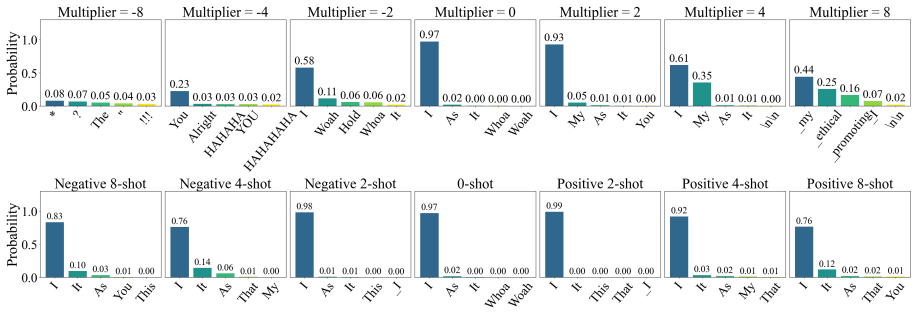
- The multiplier $\lambda$ acts as a calibrated dial: keeping $\lambda \in [0,6]$ preserves fluency while raising defense rates, and negative multipliers can stress-test safety boundaries by pushing the model toward unsafe behavior.
- On reasoning models, steering a thought-pattern vector can shorten or lengthen the chain of thought on GSM8K without losing accuracy, offering a possible remedy for overthinking.
- With very few contrastive examples the steering strategy still improves defense rates substantially, suggesting that data-efficient safety intervention is feasible.
Reading between the lines
- Outside the paper's own experiments, the scaling curve in Fig. 3 suggests the frequency criterion pays off only once roughly 32 contrastive pairs are available; on smaller samples a simple mean-difference vector is competitive, so a practical recipe might start with CAA-style steering and switch to STA as more examples accumulate.
- The prompt-to-steering translation implies a testable extension: any prompt, including a jailbreak prompt, could be compiled into a steering vector, raising the question of whether safety interventions can be inverted into attack vectors, which the paper does not discuss.
- If the reported defense numbers survive a truly held-out evaluation, the attention-scoring result suggests an additional experiment: measure whether the same selected atoms shift attention in a model with a different layer count, and whether atom selection transfers across models.
- The reasoning-length control in the paper uses CAA rather than STA because no public sparse autoencoder for the reasoning model is available; as such autoencoders appear, applying STA to thought atoms could give a finer control axis than the length coefficient alone.
Editorial analysis
A structured set of objections, weighed in public.
Referee Report
Summary. The paper proposes Steering Target Atoms (STA), a method that builds steering vectors by selecting sparse-autoencoder (SAE) features whose activation amplitude and frequency differ between positive (safe) and negative (unsafe) examples, then adding the selected atoms' decoder contributions to the residual stream. Experiments on SafeEdit and RealToxicPrompts across Gemma-2-9B-pt, Gemma-2-9B-it, and Llama-3.1-8B report higher average detoxification than Prompthand, Promptauto, CAA, and SAEAXBENCH, with relatively small changes in MMLU/GSM8K. The paper also analyzes layer choice, data-size dependence, robustness of steering versus prompting, control boundaries, and an application to controlling chain-of-thought length in DeepSeek-R1-Distill-Qwen-7B.
Significance. If the reported results hold on held-out data, STA would be a useful, lightweight, inference-time safety intervention that leverages SAE interpretability while avoiding full-model fine-tuning. The paper's strengths include reproducible code, use of publicly available SAEs, ablations of the amplitude and frequency components, direct conversion of prompts into steering vectors for a fairer comparison, and a novel reasoning-length control experiment. However, the quantitative claims are currently weakened by the absence of an explicit train/test split for steering-vector construction, the lack of error bars or multiple-seed variance, and the per-experiment selection of thresholds; the small margins over SAEAXBENCH (e.g., 72.23 vs 71.36 on Llama-3.1-8B) are therefore difficult to interpret as robust improvements.
major comments (4)
- [3.1, 4.1, Table 1, Fig. 3] The manuscript never states that the N queries used to compute Δa and Δf in Eqs. 7-11 are disjoint from the queries scored in Table 1. Since Fig. 3 varies N from 4 to 4096 while reporting defense rates on the same SafeEdit and RealToxicPrompts benchmarks, the overlap status is load-bearing. If the same prompts are used for both constructing and testing the steering vector, the reported improvements are at least partly in-sample fits rather than predictions. Please specify the construction set explicitly and re-run the comparison with a disjoint held-out evaluation set, or provide evidence that overlap is impossible by construction.
- [Table 1] The central claim of best average detoxification rests on differences that are small in some cases (STA 72.23 vs SAEAXBENCH 71.36 on Llama-3.1-8B; STA 83.45 vs 80.98 on Gemma-2-9B-pt) and no error bars, confidence intervals, or multiple-seed results are reported. Without a variance estimate, the reader cannot determine whether the improvement is statistically meaningful, especially given the construction-set overlap concern. Please report repeated runs (e.g., different random subsets for construction) with standard deviations, or at least per-category breakdowns that show the stability of the reported averages.
- [4.1, Table 5] The method relies on thresholds α and β, the multiplier λ, and the steering layer; the paper selects α/β at the top 35% position for Table 1 and top 4% for Table 5, and λ defaults to 1. The threshold choice is thus tuned per experiment, so the reported defense rates are not parameter-free evaluations. A sensitivity analysis across α, β, λ, and steering layers is needed to show that the method's advantage is not an artifact of tuning these thresholds on the evaluation benchmarks.
- [Limitations, Conclusion] The conclusion states that STA enhances 'both safety and personality alignment,' but the Limitations section explicitly says that STA 'performs well in the safety domain but shows limited effectiveness in the personality domain (see §D).' This internal inconsistency should be resolved; if the personality result is weak, the conclusion should be softened or the evidence strengthened.
minor comments (6)
- [4.1, Table 1] The baseline name 'SAEAXBEN CH' appears with an unwanted space in several places; it should be 'SAEAXBENCH' or 'SAE-AXBENCH' consistently.
- [5.2, Fig. 11 caption] The caption contains the typo 'unsing' for 'using' in both subfigures.
- [5.2] The text includes 'safety domian' instead of 'safety domain'; please proofread the section headings and captions.
- [Limitations] The Limitations section says experiments are 'conducted exclusively on the Gemma-2-9B-pt, Gemma-2-9B-it models' but the paper also evaluates Llama-3.1-8B; this phrasing is contradictory and should be corrected.
- [B.1.1, Table 2] The text in B.1.1 says 'we do not report the performance of RefusalFeature as a baseline in the main text,' yet Table 2 reports a comparison with RefusalFeature; this should be clarified or reconciled.
- [F.2] The phrase 'temperature coefficient' should be 'temperature' in standard usage, and the abbreviation 'Real' in Fig. 3 should be defined in the caption or main text even though a parenthetical note appears.
Circularity Check
The headline defense-rate gains are not stated to be measured on queries disjoint from the N queries used to fit the STA steering vector (Eqs. 7–12); Fig. 3 reports defense rates on the same datasets as N grows, so the central claim may reduce to an in-sample fit.
-
fitted input called prediction
[§3.1 (Eqs. 7–12), §4.1–4.2 (Table 1, Fig. 3)]
"We run the model M on the set of queries (N) with positive and negative answers: ... In the realm of safety domain, we employ two datasets: SafeEdit(Wang et al., 2024b) and RealToxicPrompts(Gehman et al., 2020). ... As illustrated in Fig. 3, we investigate the influence of different data scales on the performance of steering strategies."
The STA steering vector is fit by averaging positive-minus-negative SAE activations over N queries (Eqs. 7–11), thresholding atoms (Eq. 11), and mapping back to v_STA (Eq. 12). The paper's central quantitative claim is the Table 1 defense rate on SafeEdit and RealToxicPrompts. The paper never states that the evaluation queries are disjoint from the N construction queries, and Fig. 3 sweeps N from 4 to 4096 while plotting defense rates on those same two benchmarks. At large N the plotted defense rates on the same benchmarks are the same quantities reported in Table 1.
full rationale
The method itself is not definitionally circular: STA selects SAE atoms by amplitude/frequency and constructs a steering vector, which is a legitimate procedure with independent content (SAE decomposition, thresholding, mapping back via the decoder). The paper's self-citations (e.g., SafeEdit dataset, knowledge-mechanism surveys) are background/dataset citations and are not load-bearing; there is no imported uniqueness theorem and no ansatz smuggled in by self-citation. The circularity risk is concentrated in the evaluation protocol: the construction queries in Eqs. 7–11 and the benchmark queries scored in Table 1 are not stated to be disjoint, and Fig. 3's data-size sweep on the same benchmarks makes the overlap status load-bearing. Because the headline gain could therefore be partly in-sample rather than held-out, the central claim does not yet stand as a prediction; however, this is an empirical-design omission that an explicit split and re-run would resolve, so the score is 6 rather than 8–10. Error bars or repeated-seed variance would also help bound the magnitude of any in-sample effect.
Assumptions & free parameters
free parameters (3)
- alpha and beta thresholds =
top 35% or top 4% of delta-a and delta-f values
- lambda multiplier =
1 (default), range -10 to 10 explored
- steering layer =
20 for Llama-3.1-8B and Gemma-2-9B-it, 24 for Gemma-2-9B-pt
assumptions (3)
- domain assumption SAE reconstruction fidelity: h is approximately a times W_dec plus b_dec
- domain assumption SAE features are stable, meaningful units called atoms
- domain assumption Contrast between positive and negative answers isolates the target behavior
invented entities (1)
-
target atoms
Cite this review
Pith. "Pith review of Beyond Prompt Engineering: Robust Behavior Control in LLMs via Steering Target Atoms." pith.science (2026). https://pith.science/paper/TUWKUPYO
@misc{pith2026250520322,
  author       = {Pith},
  title        = {Pith review of: Beyond Prompt Engineering: Robust Behavior Control in LLMs via Steering Target Atoms},
  year         = {2026},
  howpublished = {\url{https://pith.science/paper/TUWKUPYO}},
  note         = {Machine review of arXiv:2505.20322}
}
read the original abstract
Precise control over language model generation is vital for ensuring both safety and reliability. Although prompt engineering and steering are commonly used to intervene in model behaviors, the vast number of parameters in models often results in highly intertwined internal representations. This interdependency can limit control precision and sometimes lead to unintended side effects. Recent research has explored the use of sparse autoencoders (SAE) to disentangle knowledge in high-dimensional spaces for steering. However, these applications have been limited to toy tasks owing to the nontrivial issue of locating atomic knowledge components. In this paper, we propose Steering Target Atoms (STA), a novel method that isolates and manipulates disentangled knowledge components to enhance safety. Comprehensive experiments demonstrate the effectiveness of our approach. Further analysis reveals that steering exhibits superior robustness and flexibility, particularly in adversarial scenarios. We also apply the steering strategy to the large reasoning model, confirming its effectiveness in precise reasoning control.
Figures


Figures from the paper (7 more)




Forward citations
Cited by 1 Pith paper
-
When Models Refuse: Political Steerability and Feature Richness as Measures of Ideological Depth
Comparing two open LLMs, the paper claims that greater internal political feature richness predicts steerability and that refusals on benign prompts reflect capability deficits, but the causal evidence is missing.
Reference graph
Works this paper leans on
-
[4]
LLMSteer: Improving Long-Context LLM Inference by Steering Attention on Reused Contexts
Llmsteer: Improving long-context LLM infer- ence by steering attention on reused contexts.CoRR, abs/2411.13009. Daya Guo, Dejian Yang, Haowei Zhang, Junxiao Song, Ruoyu Zhang, Runxin Xu, Qihao Zhu, Shirong Ma, Peiyi Wang, Xiao Bi, et al. 2025. Deepseek-r1: In- centivizing reasoning capability in llms via reinforce- ment learning.arXiv preprint arXiv:2501....
work page Pith review arXiv 2025
-
[5]
Word embeddings are steers for language mod- els. InProceedings of the 62nd Annual Meeting of the Association for Computational Linguistics (Vol- ume 1: Long Papers), ACL 2024, Bangkok, Thailand, August 11-16, 2024, pages 16410–16430. Associa- tion for Computational Linguistics. Peixuan Han, Cheng Qian, Xiusi Chen, Yuji Zhang, Denghui Zhang, and Heng Ji. ...
arXiv 2024
-
[6]
Openai o1 system card.arXiv preprint arXiv:2412.16720. Houcheng Jiang, Junfeng Fang, Ningyu Zhang, Guo- jun Ma, Mingyang Wan, Xiang Wang, Xiangnan He, and Tat-seng Chua. 2025. Anyedit: Edit any knowl- edge encoded in language models.arXiv preprint arXiv:2502.05628. Tanqiu Jiang, Zian Wang, Jiacheng Liang, Changjiang Li, Yuhui Wang, and Ting Wang. 2024. Ro...
arXiv 2025
-
[8]
Gemma: Open models based on gemini re- search and technology.CoRR, abs/2403.08295. Kyle O’Brien, David Majercak, Xavier Fernandes, Richard Edgar, Jingya Chen, Harsha Nori, Dean Carignan, Eric Horvitz, and Forough Poursabzi- Sangde. 2024. Steering language model re- fusal with sparse autoencoders.arXiv preprint arXiv:2411.11296. Charles O’Neill, Christine ...
arXiv 2024
-
[9]
Nina Rimsky, Nick Gabrieli, Julian Schulz, Meg Tong, Evan Hubinger, and Alexander Matt Turner
Controlling large language model agents with entropic activation steering.CoRR, abs/2406.00244. Nina Rimsky, Nick Gabrieli, Julian Schulz, Meg Tong, Evan Hubinger, and Alexander Matt Turner. 2024. Steering llama 2 via contrastive activation addition. InProceedings of the 62nd Annual Meeting of the Association for Computational Linguistics (Volume 1: Long ...
arXiv 2024
-
[10]
A systematic survey of prompt engineering in large language models: Techniques and applications. CoRR, abs/2402.07927. Daniel Scalena, Gabriele Sarti, and Malvina Nissim
-
[11]
Multi-property steering of large language mod- els with dynamic activation composition.CoRR, abs/2406.17563. Lee Sharkey, Bilal Chughtai, Joshua Batson, Jack Lind- sey, Jeff Wu, Lucius Bushnaq, Nicholas Goldowsky- Dill, Stefan Heimersheim, Alejandro Ortega, Joseph Bloom, et al. 2025. Open problems in mechanistic interpretability.arXiv preprint arXiv:2501....
arXiv 2025
-
[12]
OpenReview.net. Alexander Matt Turner, Lisa Thiergart, Gavin Leech, David Udell, Juan J Vazquez, Ulisse Mini, and Monte MacDiarmid. 2023. Activation addition: Steering language models without optimization.arXiv e- prints, pages arXiv–2308. Teun van der Weij, Massimo Poesio, and Nandi Schoots
work page 2023
Show all 18 references
-
[13]
Mengru Wang, Yunzhi Yao, Ziwen Xu, Shuofei Qiao, Shumin Deng, Peng Wang, Xiang Chen, Jia-Chen Gu, Yong Jiang, Pengjun Xie, Fei Huang, Huajun Chen, and Ningyu Zhang
Extending activation steering to broad skills and multiple behaviours.CoRR, abs/2403.05767. Mengru Wang, Yunzhi Yao, Ziwen Xu, Shuofei Qiao, Shumin Deng, Peng Wang, Xiang Chen, Jia-Chen Gu, Yong Jiang, Pengjun Xie, Fei Huang, Huajun Chen, and Ningyu Zhang. 2024a. Knowledge mec...
2024 arXiv
-
[15]
Trading inference-time compute for adversar- ial robustness.arXiv preprint arXiv:2501.18841. Wayne Xin Zhao, Kun Zhou, Junyi Li, Tianyi Tang, Xiaolei Wang, Yupeng Hou, Yingqian Min, Be- ichen Zhang, Junjie Zhang, Zican Dong, Yifan Du, Chen Yang, Yushuo Chen, Zhipeng Chen, Jinh...
-
[16]
Yu Zhao, Alessio Devoto, Giwon Hong, Xiaotang Du, Aryo Pradipta Gema, Hongru Wang, Xuanli He, Kam-Fai Wong, and Pasquale Minervini
A survey of large language models.CoRR, abs/2303.18223. Yu Zhao, Alessio Devoto, Giwon Hong, Xiaotang Du, Aryo Pradipta Gema, Hongru Wang, Xuanli He, Kam-Fai Wong, and Pasquale Minervini. 2024. Steering knowledge selection behaviours in llms via sae-based representation engine...
2023 arXiv
-
[17]
Conversely, our research focuses on improv- ing detoxification efficacy while preserving robust general performance to ensure practical model util- ity
indicates that the RefusalFeature method, while capable of effective detoxification, often ne- cessitates indiscriminate rejection of all queries, re- sulting in substantial degradation of general model utility. Conversely, our research focuses on improv- ing detoxification ef...
2024
-
[18]
To maximize their effectiveness, we concatenate these prompts at var- ious positions, including the input prefix, input suffix, and output prefix
and an automatically generated prompt Promptauto (Wu et al., 2025). To maximize their effectiveness, we concatenate these prompts at var- ious positions, including the input prefix, input suffix, and output prefix. As illustrated in Fig 3, the performance of prompts varies sig...
2025
-
[2021]
Training verifiers to solve math word prob- lems.CoRR, abs/2110.14168. Alejandro Cuadron, Dacheng Li, Wenjie Ma, Xingyao Wang, Yichuan Wang, Siyuan Zhuang, Shu Liu, Luis Gaspar Schroeder, Tian Xia, Huanzhi Mao, Nicholas Thumiger, Aditya Desai, Ion Stoica, Ana Klimovic, Graham ...
-
[2023]
Song Wang, Yaochen Zhu, Haochen Liu, Zaiyi Zheng, Chen Chen, and Jundong Li
Easyedit: An easy-to-use knowledge edit- ing framework for large language models.CoRR, abs/2308.07269. Song Wang, Yaochen Zhu, Haochen Liu, Zaiyi Zheng, Chen Chen, and Jundong Li. 2025a. Knowledge editing for large language models: A survey.ACM Comput. Surv., 57(3):59:1–59:37....
-
[2024]
David Chanin, James Wilken-Smith, Tomás Dulka, Hardik Bhatnagar, and Joseph Bloom
Improving steering vectors by targeting sparse autoencoder features.CoRR, abs/2411.02193. David Chanin, James Wilken-Smith, Tomás Dulka, Hardik Bhatnagar, and Joseph Bloom. 2024. A is for absorption: Studying feature splitting and absorp- tion in sparse autoencoders.CoRR, abs/...
2024 arXiv
-
[2025]
thought
The danger of overthinking: Examining the reasoning-action dilemma in agentic tasks.arXiv preprint arXiv:2502.08235. Hannah Cyberey and David Evans. 2025. Steer- ing the censorship: Uncovering representation vec- tors for llm" thought" control.arXiv preprint arXiv:2504.17130. ...
2025 arXiv
-
[8098]
Samuel Marks, Can Rager, Eric J
Association for Computational Linguistics. Samuel Marks, Can Rager, Eric J. Michaud, Yonatan Belinkov, David Bau, and Aaron Mueller. 2024. Sparse feature circuits: Discovering and editing in- terpretable causal graphs in language models.CoRR, abs/2403.19647. Kevin Meng, David ...
2024 arXiv
Reviewed August 7, 2026 · model on record in the stance chip above.
Discussion (0). Sign in to comment.