REVIEW 3 major objections 5 minor 57 references
Entropy bound predicts remnant for evaporating rotating black hole
Reviewed by Pith at T0; open to challenge. T0 means a machine referee read the full paper against a public rubric. the ladder, T0–T4 →
T0 review · glm-5.2
2026-07-10 03:26 UTC pith:UE2EZWTD
load-bearing objection Letter re: arXiv:2607.08661 the 3 major comments →
The Remnant of an Evaporating Rotating Regular Black Hole from the Generalized Entropy in the Final Stage of Evaporation
The pith
A machine-rendered reading of the paper's core claim, the machinery that carries it, and where it could break.
Core claim
The generalized entropy of Hawking radiation for a near-extremal rotating regular black hole decomposes into an area contribution Λ₁ ~ 4πa²/G_N (positive, bounded away from zero) and a correction contribution Λ₂ ~ (1/6)ln(a²G²_N/(α²ε⁴)) that diverges to -∞ as α → 0. The correction term crosses zero at α₂ ≈ √(2/(3π)) · m_ext, which is finite and of order m_ext. Under the assumption that neither contribution should change sign during evaporation, this crossing point sets a hard lower bound on how far the black hole can evaporate. The remnant mass is m_ext + α₂ ≈ (1 + √(2/(3π))) m_ext, and the regularization parameter ℓ_p enters only as a subleading correction, so the remnant formation does not
What carries the argument
island formula
Load-bearing premise
The argument depends on assuming that the area term and the correction term in the generalized entropy each keep a fixed sign throughout the entire evaporation process. The lower bound α₂ is identified as the point where the correction term hits zero, and the claim that the black hole cannot evaporate past this point rests entirely on the correction term not flipping to positive below α₂. If the correction term were to change sign at some smaller α, the lower-bound argument
What would settle it
A demonstration that the correction term Λ₂ in the generalized entropy changes sign at some α < α₂, or that the sign-constancy assumption is violated by a more complete calculation of the field-theory contribution to the entropy, would remove the lower bound and invalidate the remnant conclusion.
Where Pith is reading between the lines
- If remnants generically form at a mass floor of order m_ext for rotating black holes, this could provide a concrete mechanism for preserving unitarity: information is not destroyed but trapped in a stable Planck-scale object rather than radiated away.
- The fact that the regularization parameter ℓ_p enters only as a correction to α₂ suggests the remnant mass floor is robust to the specific choice of singularity regularization, which would strengthen the result's generality if confirmed.
- The exponentially large upper bound α₁ ~ e^{a²/G_N} where the total entropy vanishes implies the Page curve transition would occur extremely early in the evaporation process, which has implications for how quickly information begins to be recovered from Hawking radiation.
- If the sign-constancy assumption on Λ₁ and Λ₂ could be derived from first principles rather than postulated, the remnant conclusion would become a theorem rather than an argument from plausibility.
Editorial analysis
A structured set of objections, weighed in public.
Referee Report
Summary. This paper studies the generalized entropy of Hawking radiation in the final stage of evaporation of a rotating regular black hole (RBH). The author parametrizes the BH mass as m_0 = m_ext + alpha, where m_ext is the extremal mass, and expands the entanglement entropy (EE) of the Hawking radiation in alpha using the island formula. The EE is decomposed into an area term (Lambda_1) and a correction term (Lambda_2). The author assumes that the signs of these two contributions remain unchanged throughout evaporation, identifies the value alpha_2 at which Lambda_2 vanishes as a lower bound on alpha, and finds alpha_2 ~ sqrt(2/(3*pi)) * m_ext. This finite lower bound is interpreted as evidence for a remnant. The paper also provides a detailed perturbative solution of the quintic horizon equation for the rotating RBH metric, demonstrating smooth connection between non-extremal and extremal horizon radii.
Significance. The question of whether black hole evaporation terminates in a remnant is of broad interest for the information paradox and unitarity. The paper provides an explicit quantitative estimate of a remnant mass in a rotating regular BH setting, which is a novel contribution. The perturbative solution of the quintic horizon equation (Sec. 3) and the demonstration of smooth connection between non-extremal and extremal cases is a technically useful result that, to the author's knowledge, has not appeared elsewhere. The falsifiable prediction alpha_2 ~ sqrt(2/(3*pi)) * m_ext is a concrete, testable result.
major comments (3)
- Sec. 6, point ii: The sign-stability assumption is the sole logical bridge from 'Lambda_2 crosses zero at alpha_2' to 'alpha_2 is a lower bound on alpha.' Entropy non-negativity constrains only the sum Lambda_1 + Lambda_2 >= 0, not the individual signs of Lambda_1 and Lambda_2. Without additional justification, Lambda_2 could change sign at some alpha < alpha_2 while Lambda_1 keeps the total non-negative, and no remnant would be implied. The paper should either derive this assumption from more fundamental principles or provide a physical argument for why sign changes are disallowed in this system. As stated, the central claim depends on an undemonstrated premise.
- Eq. (56) vs. Eq. (49) and Appendix E, Eq. (78): The constant C_{kappa r_b} is dropped from Lambda_2 in Eq. (56) when computing alpha_2. However, Appendix E (Eq. 78) shows that C_{kappa r_b} contains a constant piece 2*ln[tanh(sqrt(3)/2)] ~ -0.40, which is the same order as the retained 1/6 * ln(...) term at alpha ~ alpha_2 (which is ~0.63 by construction). Including this constant would shift the zero-crossing of Lambda_2 by a factor of order e^{6*0.4} ~ 11, potentially violating the assumption alpha << m_ext. The author should either justify dropping C_{kappa r_b} quantitatively or include it in the computation of alpha_2.
- Abstract vs. body notation: The abstract states the lower bound is alpha_1, while the body (Sec. 6.2, Eq. 58) identifies alpha_2 as the lower bound and alpha_1 as the upper bound (Sec. 6.1, Eq. 57). This inconsistency between abstract and body should be corrected, as it creates confusion about which quantity is the main result.
minor comments (5)
- Sec. 5.3: The treatment of r_b involves choosing it by hand to avoid divergences (case 1) and to avoid unphysical largeness (case 3), settling on case 2 where kappa*r_b is finite. The author acknowledges in a footnote that the origin of some stationary points is unclear. While this does not block the main result, the sensitivity of the final answer to this choice should be discussed more transparently.
- Eq. (52): The result r_a ~ r_+ - G_N/(12*a*pi) places the extremal surface inside the horizon, contrary to typical results in the island formula literature where r_a > r_+. The author attributes this to the approximation in Eq. (42), but this is a notable deviation that warrants further discussion, as it may affect the validity of the island formula application.
- Sec. 5.2, Eq. (43): The derivation of kappa*t << 1 for t >> 1 is performed in Appendix D using Schwarzschild greybody factors as an approximation for the Kerr case. The author acknowledges this is an approximation, but the validity of using non-rotating greybody factors for a near-extremal rotating BH should be briefly justified, as it affects the relevant expression.
- The paper would benefit from a summary table of the key quantities (r_ext, m_ext, alpha_1, alpha_2) and their leading-order expressions, as the reader must track many expansions across many equations.
- Reference [42] is cited twice (also as [31]) for the same review on black hole remnants. This should be consolidated.
Circularity Check
No significant circularity: the derivation of α₂ from the island formula is self-contained, but the load-bearing sign-stability assumption is an unverified ansatz, not a circular definition.
full rationale
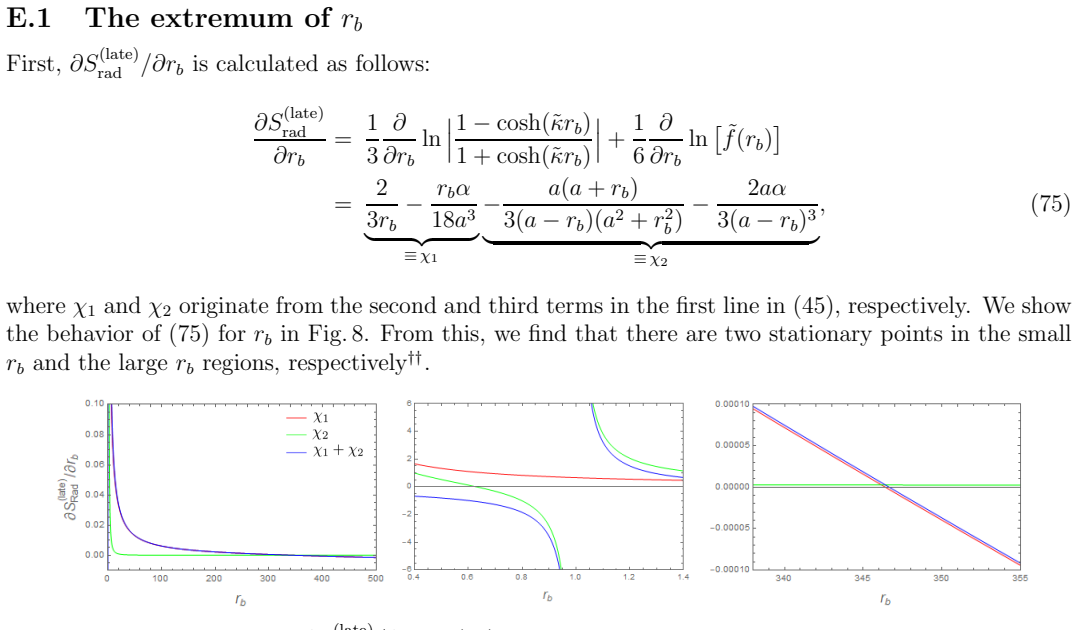
The paper's central result is the lower bound α₂ ~ √(2/(3π)) · m_ext (Eq. 58), obtained by setting the correction term Λ₂ to zero. Walking the derivation chain: the generalized entropy S_rad (Eq. 39) is constructed from the island formula (Eq. 1-2), the area term A (Eq. 37) from the rotating regular BH metric (Eq. 3), and the correction term S_field (Eq. 38) from the two-point function on the near-horizon geometry (Eq. 27). The extremal surface position r_a is solved from ∂S_rad/∂r_a = 0 (Eq. 50-52), and r_b is fixed by ∂S_rad/∂r_b = 0 (Appendix E, Eq. 76). The resulting Λ₂ (Eq. 53, fourth line) is a logarithmic function of α whose zero-crossing yields α₂. None of these steps reduce to a self-referential definition: α₂ is not defined in terms of itself, and no self-citation chain is load-bearing for the computation. The key logical step — interpreting α₂ as a physical lower bound — rests on the assumption (Sec. 6, point ii) that the signs of Λ₁ and Λ₂ remain unchanged throughout evaporation. This is explicitly stated as an assumption ('we assume that their signs should respectively remain unchanged'), motivated by the general non-negativity of entropy. While this assumption is the weakest link in the argument (entropy non-negativity constrains only the sum Λ₁+Λ₂ ≥ 0, not individual signs), it is an unverified physical ansatz rather than a circular definition. The result α₂ is computed from the geometry and the island formula, not assumed. The reader's concern about the dropped constant C_{κr_b} (Eq. 49, 56) affecting the quantitative value of α₂ is a correctness/approximation issue, not a circularity issue. No self-definitional, fitted-input-as-prediction, or self-citation-load-bearing circularity is present. The derivation, while resting on a strong assumption, is self-contained against the island formula framework and the BH geometry specified in the paper. Score 2 reflects the presence of a load-bearing unverified assumption that is not independently justified but is also not circularly defined.
Axiom & Free-Parameter Ledger
free parameters (3)
- a (angular momentum parameter) =
treated as a parameter, ~ m_ext
- rb (cutoff surface position) =
chosen so that kappa*rb is finite (Eq. 48)
- c_kappa_rb =
sqrt(6) (from extremization, Eq. 76-77)
axioms (4)
- ad hoc to paper The signs of the area term and correction term in the generalized entropy remain unchanged throughout the entire evaporation process.
- domain assumption The island formula (Eq. 2) applies to a shrinking black hole in asymptotically flat spacetime.
- domain assumption The adiabatic approximation holds up to the extremal limit.
- domain assumption The near-horizon effective 2D theory captures the relevant physics of the QES extremization.
invented entities (1)
-
Regular black hole metric (Eq. 3) with de Sitter core
no independent evidence
read the original abstract
We express the generalized entropy (GE) of the Hawking radiation in the final stage of an evaporating rotating regular black hole (BH) by writing the mass of the BH as $m_{\rm ext}+\alpha$, where $m_{\rm ext}$ represents the mass at the extremal limit and $\alpha$ is a parameter. Generally, entropy is non-negative. Based on this fact, we assume that, in the GE considered in this study, the signs of the contributions from the area term and the correction term remain unchanged throughout the entire evaporation process of the BH. Therefore, we regard $\alpha$ at which the correction term vanishes as its lower bound and determine it. As a result, we find that such a value of $\alpha$ is finite. Denoting this value by $\alpha_1$, this result indicates that the mass of the BH cannot become smaller than $m_{\rm ext}+\alpha_1$, which can be interpreted as the emergence of a remnant at the final stage of BH evaporation. The BH considered in this study is a rotating regular BH. The regularization is motivated by the fact that the fine structure of the central region becomes relevant in the final stage of evaporation. A rotating BH is considered from the viewpoint of generality.
Figures


Reference graph
Works this paper leans on
-
[1]
Particle Creation by Black Holes,
S. W. Hawking, “Particle Creation by Black Holes,” Commu n. Math. Phys. 43, 199-220 (1975)
work page 1975
-
[2]
Hawking Radiation as Tunneling
M. K. Parikh and F. Wilczek, “Hawking radiation as tunnel ing,” Phys. Rev. Lett. 85, 5042-5045 (2000) [arXiv:hep-th/9907001 [hep-th]]
work page internal anchor Pith review Pith/arXiv arXiv 2000
-
[3]
Anomalies, Hawking Radiations and Regularity in Rotating Black Holes
S. Iso, H. Umetsu and F. Wilczek, “Anomalies, Hawking rad iations and regularity in rotating black holes,” Phys. Rev. D 74, 044017 (2006) [arXiv:hep-th/0606018 [hep-th]]
work page internal anchor Pith review Pith/arXiv arXiv 2006
-
[4]
Information in black hole radiation,
D. N. Page, “Information in black hole radiation,” Phys. Rev. Lett. 71, 3743-3746 (1993) [arXiv:hep- th/9306083 [hep-th]]
-
[5]
Time Dependence of Hawking Radiation Entropy
D. N. Page, “Time Dependence of Hawking Radiation Entrop y,” JCAP 09, 028 (2013) [arXiv:1301.4995 [hep-th]]
work page internal anchor Pith review Pith/arXiv arXiv 2013
-
[6]
Entanglement Wedge Reconstruction and the Information Paradox
G. Penington, “Entanglement Wedge Reconstruction and t he Information Paradox,” JHEP 09, 002 (2020) [arXiv:1905.08255 [hep-th]]
work page internal anchor Pith review Pith/arXiv arXiv 2020
-
[7]
The entropy of bulk quantum fields and the entanglement wedge of an evaporating black hole
A. Almheiri, N. Engelhardt, D. Marolf and H. Maxfield, “Th e entropy of bulk quantum fields and the entanglement wedge of an evaporating black hole,” JHEP 12, 063 (2019) [arXiv:1905.08762 [hep-th]]
work page internal anchor Pith review Pith/arXiv arXiv 2019
-
[8]
The Page curve of Hawking radiation from semiclassical geometry
A. Almheiri, R. Mahajan, J. Maldacena and Y. Zhao, “The Pa ge curve of Hawking radiation from semi- classical geometry,” JHEP 03, 149 (2020) [arXiv:1908.10996 [hep-th]]
work page internal anchor Pith review Pith/arXiv arXiv 2020
-
[9]
A Covariant Holographic Entanglement Entropy Proposal
V. E. Hubeny, M. Rangamani and T. Takayanagi, “A Covarian t holographic entanglement entropy pro- posal,” JHEP 07, 062 (2007) [arXiv:0705.0016 [hep-th]]
work page internal anchor Pith review Pith/arXiv arXiv 2007
-
[10]
Generalized gravitational entropy
A. Lewkowycz and J. Maldacena, “Generalized gravitati onal entropy,” JHEP 08, 090 (2013) [arXiv:1304.4926 [hep-th]]
work page internal anchor Pith review Pith/arXiv arXiv 2013
-
[11]
Holographic entanglement beyond classical gravity
T. Barrella, X. Dong, S. A. Hartnoll and V. L. Martin, “Ho lographic entanglement beyond classical gravity,” JHEP 09, 109 (2013) [arXiv:1306.4682 [hep-th]]
work page internal anchor Pith review Pith/arXiv arXiv 2013
-
[12]
Quantum corrections to holographic entanglement entropy
T. Faulkner, A. Lewkowycz and J. Maldacena, “Quantum co rrections to holographic entanglement en- tropy,” JHEP 11, 074 (2013) [arXiv:1307.2892 [hep-th]]
work page internal anchor Pith review Pith/arXiv arXiv 2013
-
[13]
Quantum Extremal Surfaces: Holographic Entanglement Entropy beyond the Classical Regime
N. Engelhardt and A. C. Wall, “Quantum Extremal Surface s: Holographic Entanglement Entropy beyond the Classical Regime,” JHEP 01, 073 (2015) [arXiv:1408.3203 [hep-th]]
work page internal anchor Pith review Pith/arXiv arXiv 2015
-
[14]
Islands in Schwarzschild black holes
K. Hashimoto, N. Iizuka and Y. Matsuo, “Islands in Schwa rzschild black holes,” JHEP 06, 085 (2020) [arXiv:2004.05863 [hep-th]]
work page internal anchor Pith review Pith/arXiv arXiv 2020
-
[15]
Islands and Page curves of Reissner-Nordstr\"om black holes
X. Wang, R. Li and J. Wang, “Islands and Page curves of Rei ssner-Nordstr¨ om black holes,” JHEP04, 103 (2021) [arXiv:2101.06867 [hep-th]]
work page internal anchor Pith review Pith/arXiv arXiv 2021
-
[16]
Entanglement entropy of asymptotically flat non-extremal and extremal black holes with an island
W. Kim and M. Nam, “Entanglement entropy of asymptotica lly flat non-extremal and extremal black holes with an island,” Eur. Phys. J. C 81, no.10, 869 (2021) [arXiv:2103.16163 [hep-th]]
work page internal anchor Pith review Pith/arXiv arXiv 2021
-
[17]
Islands in charged linear dilaton black holes
B. Ahn, S. E. Bak, H. S. Jeong, K. Y. Kim and Y. W. Sun, “Isla nds in charged linear dilaton black holes,” Phys. Rev. D 105, no.4, 046012 (2022) [arXiv:2107.07444 [hep-th]]
work page internal anchor Pith review Pith/arXiv arXiv 2022
-
[18]
Island, Page Curve and Superradiance of Rotating BTZ Black Holes
M. H. Yu, C. Y. Lu, X. H. Ge and S. J. Sin, “Island, Page curv e, and superradiance of rotating BTZ black holes,” Phys. Rev. D 105, no.6, 066009 (2022) [arXiv:2112.14361 [hep-th]]
work page internal anchor Pith review Pith/arXiv arXiv 2022
-
[19]
Entanglement entropy for spherically symmetric regular black holes
O. Luongo, S. Mancini and P. Pierosara, “Entanglement e ntropy for spherically symmetric regular black holes,” Phys. Rev. D 108, no.10, 104059 (2023) [arXiv:2304.06593 [gr-qc]]
work page internal anchor Pith review Pith/arXiv arXiv 2023
-
[20]
Entanglement island and Page curve of Hawking radiation in rotating Kerr black holes
L. Wang and R. Li, “Entanglement islands and the Page cur ve of Hawking radiation for rotating Kerr black holes,” Phys. Rev. D 110, no.6, 066012 (2024) [arXiv:2406.13949 [hep-th]]
work page internal anchor Pith review Pith/arXiv arXiv 2024
-
[21]
Islands in Kerr–Newman black holes ,
M. H. Yu and X. H. Ge, “Islands in Kerr–Newman black holes ,” Eur. Phys. J. C 86, no.3, 276 (2026) [arXiv:2510.24006 [hep-th]]
-
[22]
Replica wormholes and the black hole interior
G. Penington, S. H. Shenker, D. Stanford and Z. Yang, “Re plica wormholes and the black hole interior,” JHEP 03, 205 (2022) [arXiv:1911.11977 [hep-th]]
work page internal anchor Pith review Pith/arXiv arXiv 2022
-
[23]
Replica Wormholes and the Entropy of Hawking Radiation
A. Almheiri, T. Hartman, J. Maldacena, E. Shaghoulian a nd A. Tajdini, “Replica Wormholes and the Entropy of Hawking Radiation,” JHEP 05, 013 (2020) [arXiv:1911.12333 [hep-th]]
work page internal anchor Pith review Pith/arXiv arXiv 2020
-
[24]
Replica wormholes for an evaporating 2D black hole
K. Goto, T. Hartman and A. Tajdini, “Replica wormholes f or an evaporating 2D black hole,” JHEP 04, 289 (2021) [arXiv:2011.09043 [hep-th]]. 25
work page internal anchor Pith review Pith/arXiv arXiv 2021
-
[25]
Islands in Asymptotically Flat 2D Gravity
T. Hartman, E. Shaghoulian and A. Strominger, “Islands in Asymptotically Flat 2D Gravity,” JHEP 07, 022 (2020) [arXiv:2004.13857 [hep-th]]
work page internal anchor Pith review Pith/arXiv arXiv 2020
-
[26]
Entanglement entropy for the black 0-brane,
A. Choudhury and D. Laurenzano, “Entanglement entropy for the black 0-brane,” Phys. Rev. D 110, no.12, 126018 (2024) [arXiv:2407.13336 [hep-th]]
-
[27]
Black Holes: Complementarity or Firewalls?
A. Almheiri, D. Marolf, J. Polchinski and J. Sully, “Bla ck Holes: Complementarity or Firewalls?,” JHEP 02, 062 (2013) [arXiv:1207.3123 [hep-th]]
work page internal anchor Pith review Pith/arXiv arXiv 2013
-
[28]
A. Almheiri, D. Marolf, J. Polchinski, D. Stanford and J . Sully, “An Apologia for Firewalls,” JHEP 09, 018 (2013) [arXiv:1304.6483 [hep-th]]
work page internal anchor Pith review Pith/arXiv arXiv 2013
-
[29]
The Unitarity P uzzle and Planck Mass Stable Particles,
Y. Aharonov, A. Casher and S. Nussinov, “The Unitarity P uzzle and Planck Mass Stable Particles,” Phys. Lett. B 191, 51 (1987)
work page 1987
-
[30]
The Generalized Uncertainty Principle and Black Hole Remnants
R. J. Adler, P. Chen and D. I. Santiago, “The Generalized uncertainty principle and black hole remnants,” Gen. Rel. Grav. 33, 2101-2108 (2001) [arXiv:gr-qc/0106080 [gr-qc]]
work page internal anchor Pith review Pith/arXiv arXiv 2001
-
[32]
Non-singular general relativistic gravi tational collapse,
J. Bardeen, “Non-singular general relativistic gravi tational collapse,” Proceedings of the 5th International Conference on Gravitation and the Theory of Relativity, Tbi lisi (1968)
work page 1968
-
[33]
Vacuum nonsingular black hole,
I. Dymnikova, “Vacuum nonsingular black hole,” Gen. Re l. Grav. 24, 235-242 (1992)
work page 1992
-
[34]
C. Bambi and L. Modesto, “Rotating regular black holes, ” Phys. Lett. B 721, 329-334 (2013) [arXiv:1302.6075 [gr-qc]]
work page internal anchor Pith review Pith/arXiv arXiv 2013
-
[35]
Action Integrals and Pa rtition Functions in Quantum Gravity,
G. W. Gibbons and S. W. Hawking, “Action Integrals and Pa rtition Functions in Quantum Gravity,” Phys. Rev. D 15, 2752-2756 (1977)
work page 1977
-
[36]
Entanglement entropy of black holes
S. N. Solodukhin, “Entanglement entropy of black holes ,” Living Rev. Rel. 14, 8 (2011) [arXiv:1104.3712 [hep-th]]
work page internal anchor Pith review Pith/arXiv arXiv 2011
-
[37]
The entropy of Hawking radiation
A. Almheiri, T. Hartman, J. Maldacena, E. Shaghoulian a nd A. Tajdini, “The entropy of Hawking radia- tion,” Rev. Mod. Phys. 93, no.3, 035002 (2021) [arXiv:2006.06872 [hep-th]]
work page internal anchor Pith review Pith/arXiv arXiv 2021
-
[38]
Les Houches lectures on two-dimensiona l gravity and holography,
G. J. Turiaci, “Les Houches lectures on two-dimensiona l gravity and holography,” SciPost Phys. Lect. Notes 113, 1 (2026) [arXiv:2412.09537 [hep-th]]
-
[39]
Lectures on Quantum Extremal Surfaces and the Page Curve
R. Mahajan, “Lectures on Quantum Extremal Surfaces and the Page Curve,” [arXiv:2502.01933 [hep-th]]
work page internal anchor Pith review Pith/arXiv arXiv
-
[40]
Is the information loss problem a paradox?
L. Buoninfante and F. Di Filippo, “Is the information lo ss problem a paradox?,” [arXiv:2504.00516 [gr-qc]]
work page internal anchor Pith review Pith/arXiv arXiv
-
[41]
The Information Paradox and The Island Form ula
T. Keizer, “The Information Paradox and The Island Form ula” Utrecht University, Bachelor thesis, 2021; M. T. N. Imseis, “A Pedagogical Review of Black Holes, Hawkin g Radiation and the Information Paradox” University of Cambridge, 2021; A. King, “Resolving a parado x: AdS/CFT and black hole information loss” Imperial college London, Master thesis, 2022; ...
work page 2021
-
[42]
Black Hole Remnants and the Information Loss Paradox
P. Chen, Y. C. Ong and D. h. Yeom, “Black Hole Remnants and the Information Loss Paradox,” Phys. Rept. 603, 1-45 (2015) [arXiv:1412.8366 [gr-qc]]
work page internal anchor Pith review Pith/arXiv arXiv 2015
-
[43]
A. Almheiri, R. Mahajan and J. Maldacena, “Islands outs ide the horizon,” [arXiv:1910.11077 [hep-th]]
work page internal anchor Pith review Pith/arXiv arXiv 1910
-
[44]
The universality of islands outside the horizon
S. He, Y. Sun, L. Zhao and Y. X. Zhang, “The universality o f islands outside the horizon,” JHEP 05, 047 (2022) [arXiv:2110.07598 [hep-th]]
work page internal anchor Pith review Pith/arXiv arXiv 2022
-
[45]
Black Hole Information Loss: Some Food for Thoughts
Y. C. Ong and D. h. Yeom, “Summary of Parallel Session: “B lack Hole Evaporation and Information Loss Paradox”,” [arXiv:1602.06600 [hep-th]]
work page internal anchor Pith review Pith/arXiv arXiv
-
[46]
New solutions of charged regular black holes and their stability
N. Uchikata, S. Yoshida and T. Futamase, “New solutions of charged regular black holes and their stability,” Phys. Rev. D 86, 084025 (2012) [arXiv:1209.3567 [gr-qc]]
work page internal anchor Pith review Pith/arXiv arXiv 2012
-
[47]
Slowly rotating regular black holes with a charged thin shell
N. Uchikata and S. Yoshida, “Slowly rotating regular bl ack holes with a charged thin shell,” Phys. Rev. D 90, no.6, 064042 (2014) [arXiv:1506.06478 [gr-qc]]
work page internal anchor Pith review Pith/arXiv arXiv 2014
-
[48]
Regular Magnetic Black Holes and Monopoles from Nonlinear Electrodynamics
K. A. Bronnikov, “Regular magnetic black holes and mono poles from nonlinear electrodynamics,” Phys. Rev. D 63, 044005 (2001) [arXiv:gr-qc/0006014 [gr-qc]]. 26
work page internal anchor Pith review Pith/arXiv arXiv 2001
-
[49]
Regular Black Hole in General Relativity Coupled to Nonlinear Electrodynamics
E. Ayon-Beato and A. Garcia, “Regular black hole in gene ral relativity coupled to nonlinear electrody- namics,” Phys. Rev. Lett. 80, 5056-5059 (1998) [arXiv:gr-qc/9911046 [gr-qc]]
work page internal anchor Pith review Pith/arXiv arXiv 1998
-
[50]
New Regular Black Hole Solution from Nonlinear Electrodynamics
E. Ayon-Beato and A. Garcia, “New regular black hole sol ution from nonlinear electrodynamics,” Phys. Lett. B 464, 25 (1999) [arXiv:hep-th/9911174 [hep-th]]
work page internal anchor Pith review Pith/arXiv arXiv 1999
-
[51]
Four Parametric Regular Black Hole Solution
E. Ayon-Beato and A. Garcia, “Four parametric regular b lack hole solution,” Gen. Rel. Grav. 37, 635 (2005) [arXiv:hep-th/0403229 [hep-th]]
work page internal anchor Pith review Pith/arXiv arXiv 2005
-
[52]
Formation and evaporation of non-singular black holes
S. A. Hayward, “Formation and evaporation of regular bl ack holes,” Phys. Rev. Lett. 96, 031103 (2006) [arXiv:gr-qc/0506126 [gr-qc]]
work page internal anchor Pith review Pith/arXiv arXiv 2006
-
[53]
Construction of Regular Black Holes in General Relativity
Z. Y. Fan and X. Wang, “Construction of Regular Black Hol es in General Relativity,” Phys. Rev. D 94, no.12, 124027 (2016) [arXiv:1610.02636 [gr-qc]]
work page internal anchor Pith review Pith/arXiv arXiv 2016
-
[54]
Noncommutative geometry inspired Schwarzschild black hole
P. Nicolini, A. Smailagic and E. Spallucci, “Noncommut ative geometry inspired Schwarzschild black hole,” Phys. Lett. B 632, 547-551 (2006) [arXiv:gr-qc/0510112 [gr-qc]]
work page internal anchor Pith review Pith/arXiv arXiv 2006
-
[55]
Charged rotating noncommutative black holes
L. Modesto and P. Nicolini, “Charged rotating noncommu tative black holes,” Phys. Rev. D 82, 104035 (2010) [arXiv:1005.5605 [gr-qc]]
work page internal anchor Pith review Pith/arXiv arXiv 2010
-
[56]
Particle motions around regular black holes
K. Isomura, R. Suzuki and S. Tomizawa, “Particle motion s around regular black holes,” Phys. Rev. D 107, no.8, 084003 (2023) [arXiv:2301.10465 [gr-qc]]
work page internal anchor Pith review Pith/arXiv arXiv 2023
-
[57]
Existence conditi ons of nonsingular dyonic black holes in nonlinear electrodynamics,
R. Tsuda, R. Suzuki and S. Tomizawa, “Existence conditi ons of nonsingular dyonic black holes in nonlinear electrodynamics,” [arXiv:2308.02146 [gr-qc]]
- [58]
discussion (0)
Sign in with ORCID, Apple, or X to comment. Anyone can read and Pith papers without signing in.