MEGA and SMILES Find Fewer Dusty Galaxies than Expected at Cosmic Noon
Pith reviewed 2026-06-27 03:19 UTC · model grok-4.3
The pith
JWST MIRI data show the faint end of the infrared luminosity function flattens at z=0.2-2, meaning faint galaxies contribute less dust-obscured star formation than prior extrapolations predicted.
A machine-rendered reading of the paper's core claim, the machinery that carries it, and where it could break.
Core claim
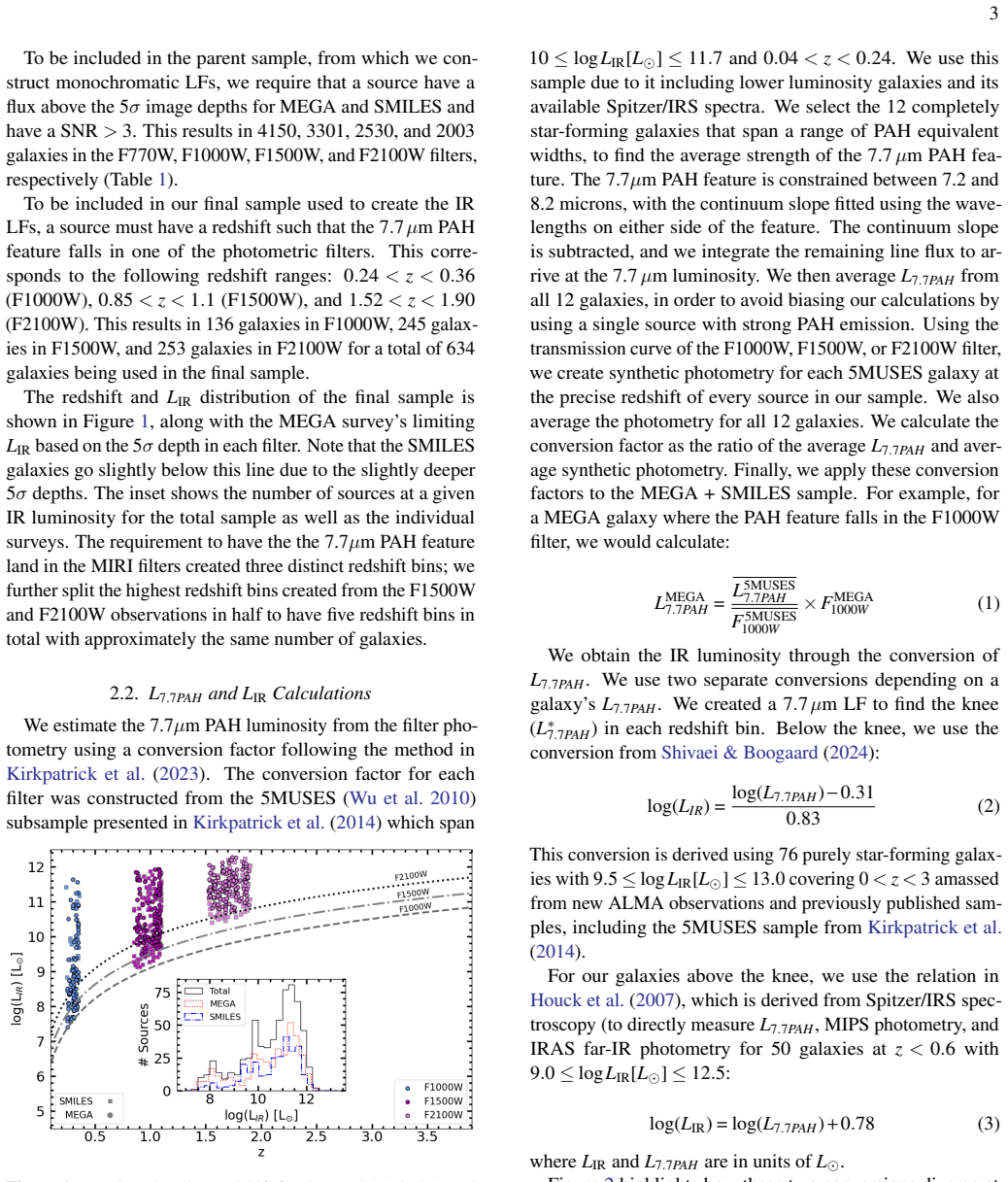
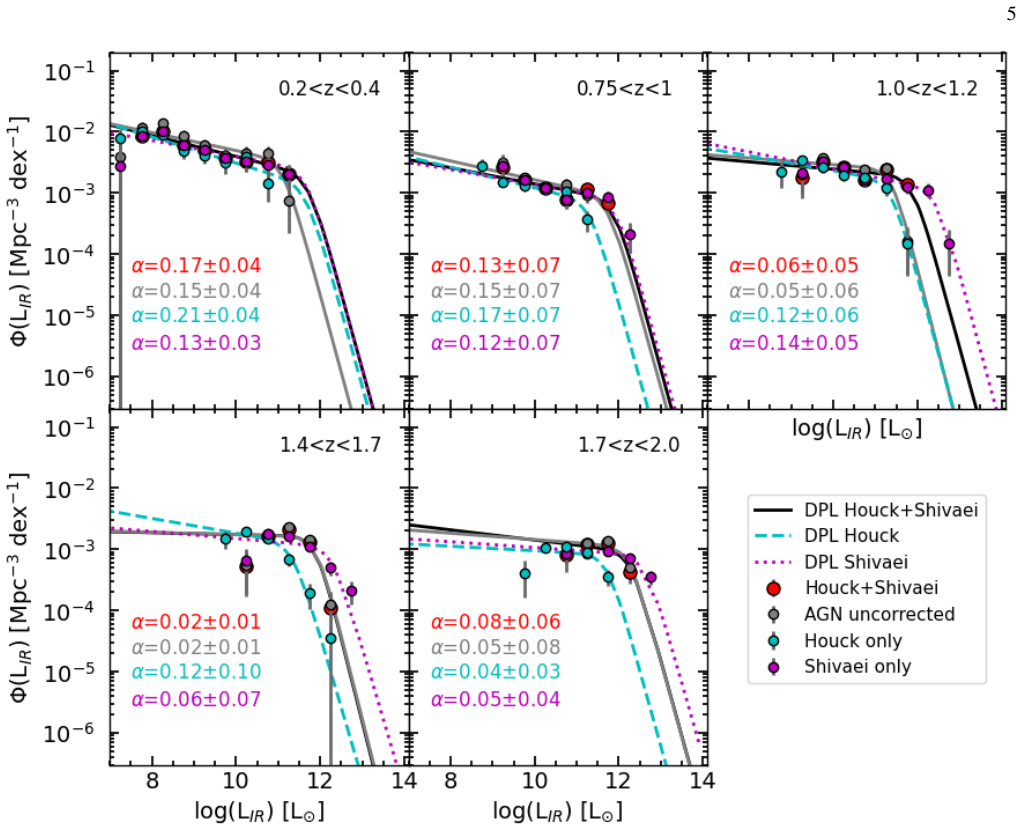
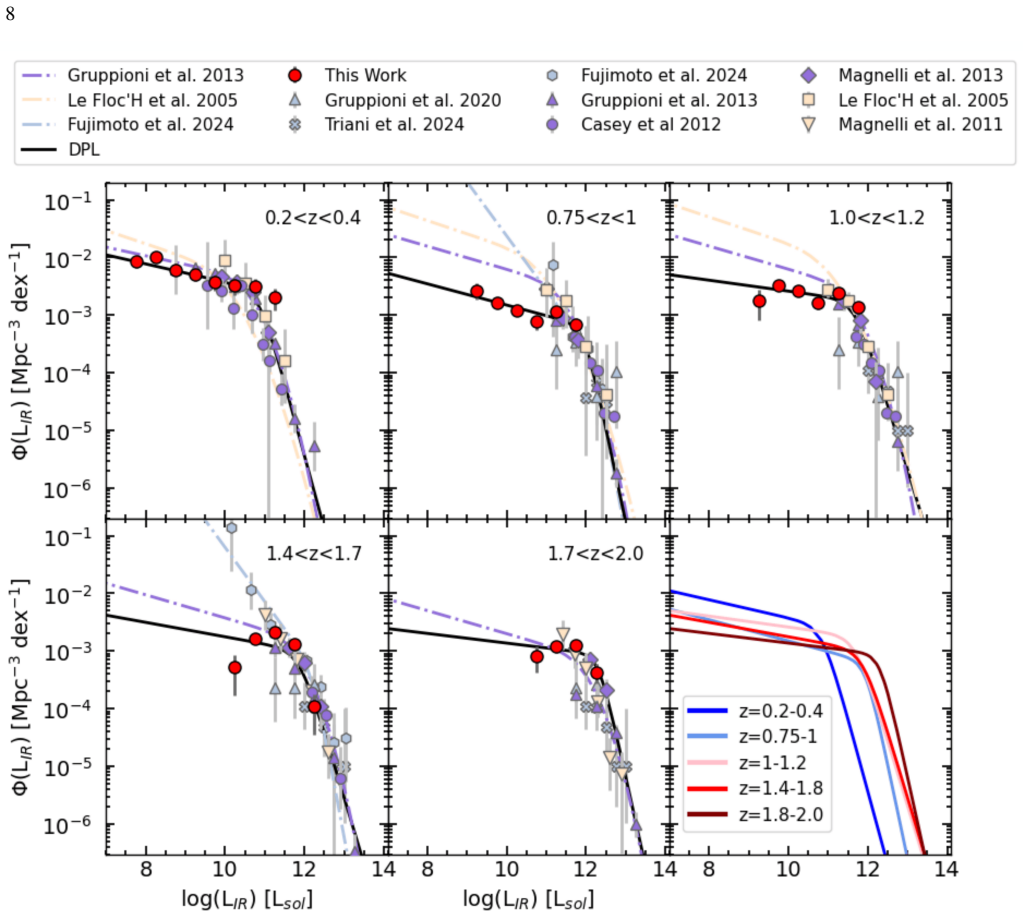
We present IR luminosity functions based on 7.7μm PAH luminosities from MIRI F1000W, F1500W, or F2100W photometry in the MEGA and SMILES surveys. The sample of 634 galaxies over 105 arcmin² reveals a strong flattening in the faint end with average slope α ∼ 0.147, unlike previous steeper extrapolations. This indicates less luminous galaxies have less dust-obscured star formation. Integrating the LFs gives a slightly lower SFRD than previous studies, with LIRGs and ULIRGs dominating the contribution at z ∼ 1-2.
What carries the argument
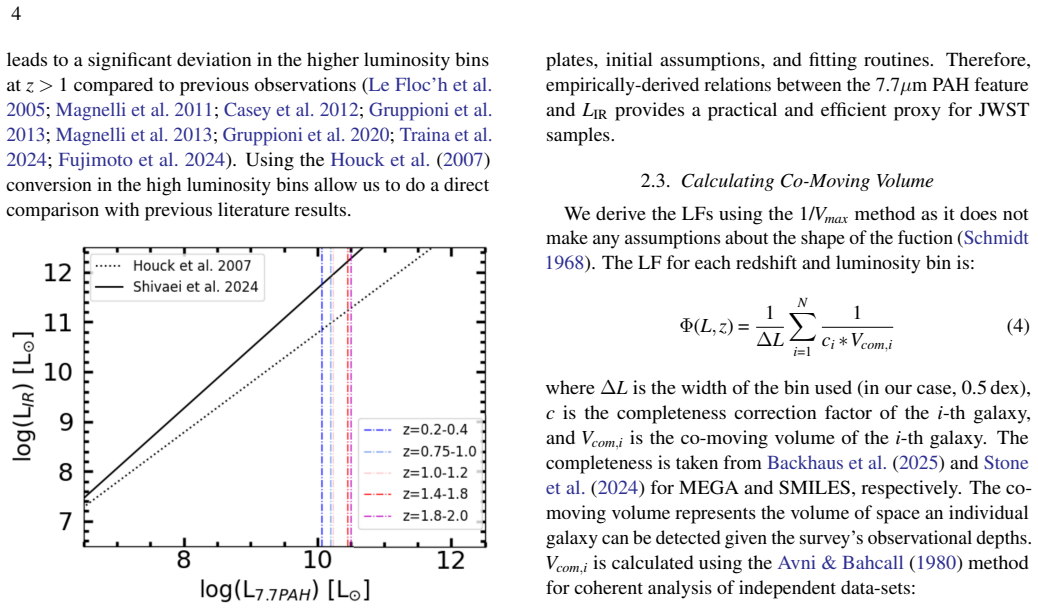
The 7.7μm PAH luminosity measured from JWST MIRI broadband photometry and converted to total infrared luminosity to construct the luminosity function.
If this is right
- Dust-obscured star formation in low-luminosity galaxies is lower than predicted by previous models.
- The total star formation rate density from IR observations is slightly reduced across all redshift bins from 0.2 to 2.
- Bright dusty galaxies (LIRGs and ULIRGs) remain the primary contributors to obscured star formation at cosmic noon.
- The luminosity function extends reliably to luminosities two orders of magnitude fainter than prior studies.
Where Pith is reading between the lines
- Models of galaxy evolution may need adjustment to account for reduced dust content or obscuration efficiency in faint high-redshift systems.
- Combining these IR results with UV luminosity functions could refine the total cosmic star formation history.
- Deeper MIRI observations could confirm if the flattening continues at even lower luminosities.
Load-bearing premise
The relation used to convert 7.7μm PAH luminosity to total IR luminosity applies without bias to the faint, high-redshift galaxies in the sample.
What would settle it
Obtaining far-infrared observations of a subset of the faint galaxies in the sample and comparing their directly measured total IR luminosities to the PAH-derived values would falsify the result if large systematic discrepancies appear.
Figures
read the original abstract
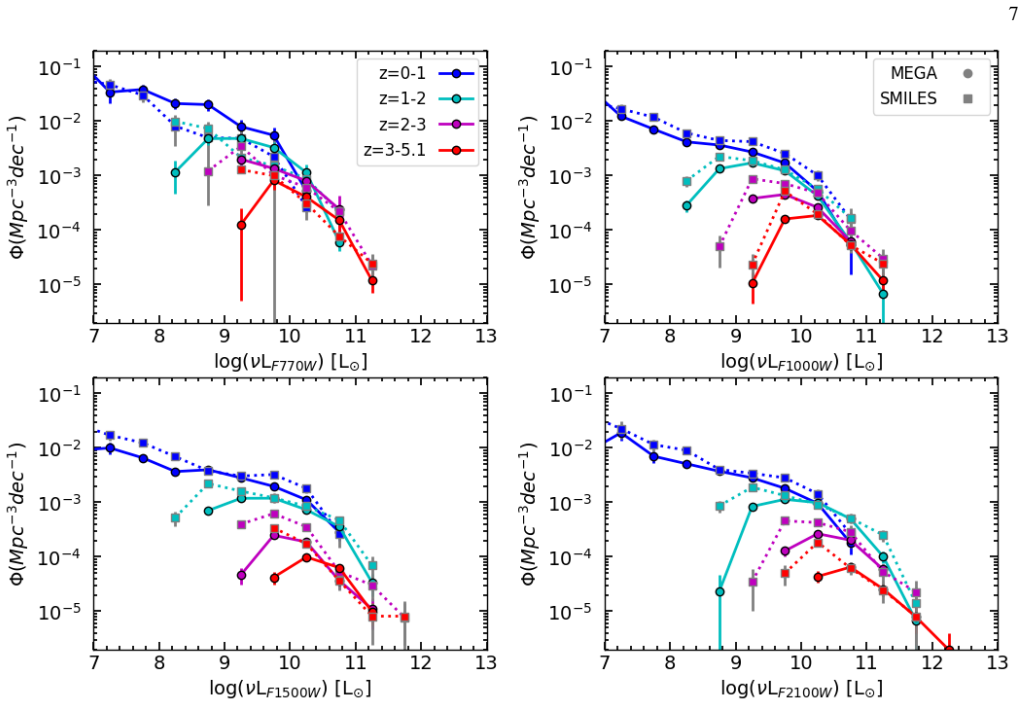
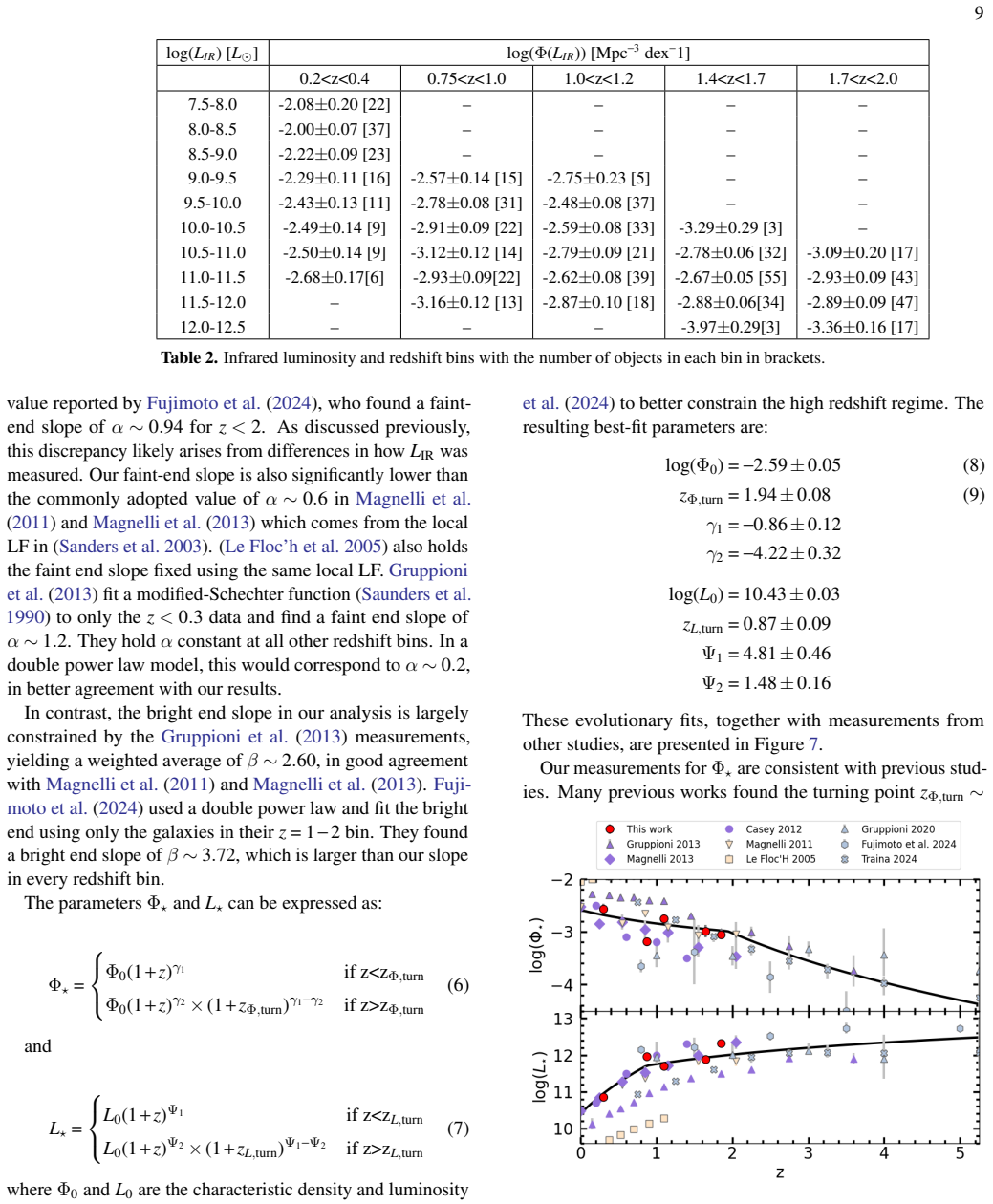
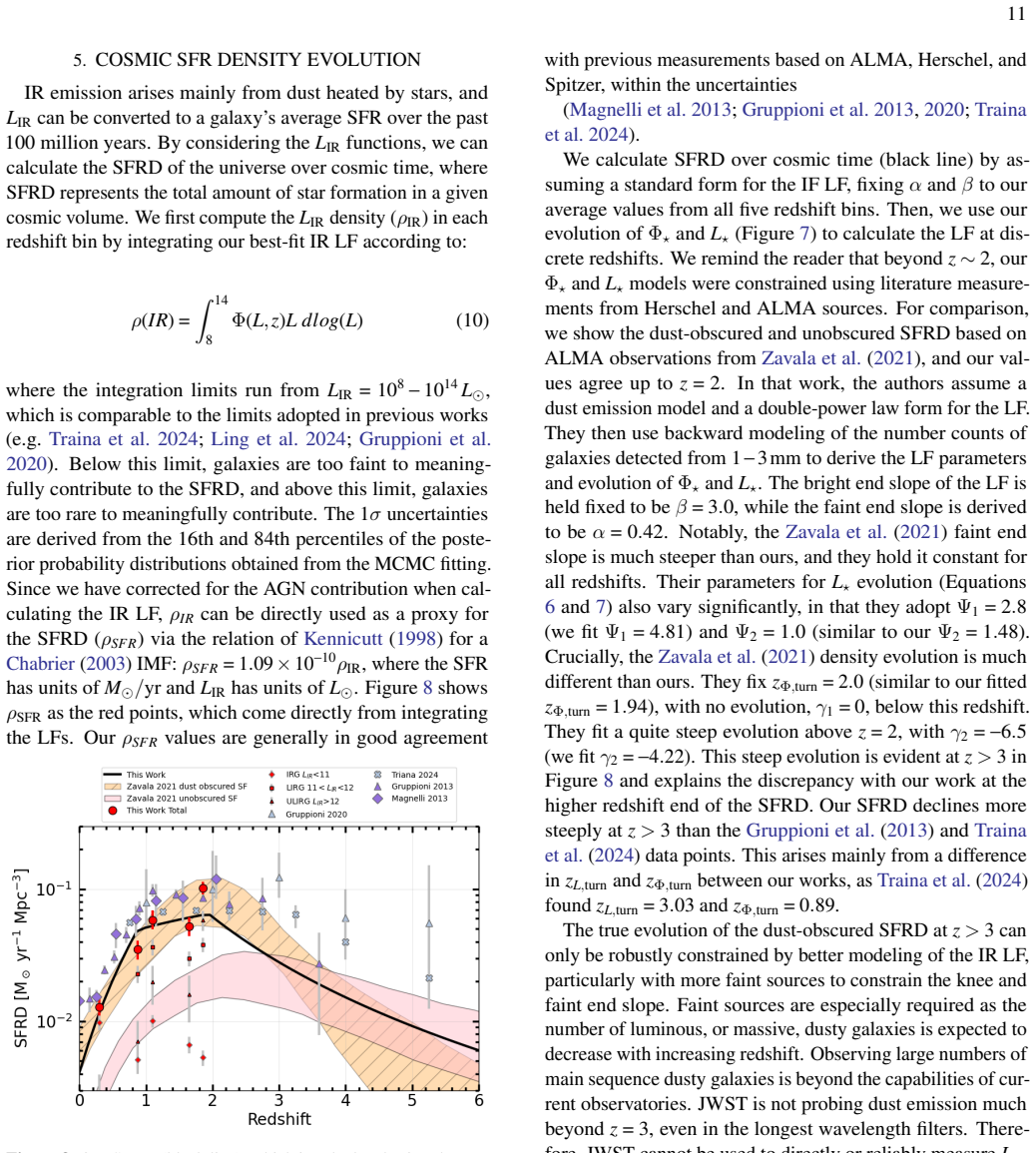
We present infrared (IR) luminsosity functions (LFs) and resulting star formation rate densities using the JWST Mid-infrared Instrument (MIRI) observations from the MIRI EGS Galaxy and AGN (MEGA) survey and Systematic MIRI Legacy Extragalactic Survey (SMILES). JWST allows us to perform a robust analysis on the faint end of the IR LF beyond the local universe. We directly measure the 7.7$\mu$m polycyclic aromatic hydrocarbon (PAH) feature using either F1000W, F1500W, or F2100W photometry. This results in a sample of 634 galaxies across the two surveys covering an area of 105 arcmin$^2$ ($\sim$70 in the EGS and $\sim35$ in the GOODS-S/HUDF fields) and spanning $0.2<z<2$. We convert the 7.7$\mu$m PAH luminosity to total IR luminosity, resulting in LFs that are two orders of magnitude fainter than previous studies. In contrast to previous extrapolations based on shallower observations, we find a strong flattening in the faint end of the LF with an average slope of $\alpha\sim0.147$. This indicates that less luminous galaxies do not have as much dust obscured star formation as predicted. We measure the star formation rate density (SFRD) by integrating our new IR LFs and find a slightly lower SFRD in all redshift bins than previous studies made with ALMA, Herschel, and Spitzer. We also measure the contribution to the SFRD as a function of luminosity and confirm that LIRGs and ULIRGs remain the dominant contributors to the dust-obscured star formation at $z\sim1-2$.
Editorial analysis
A structured set of objections, weighed in public.
Referee Report
Summary. The paper claims to derive IR luminosity functions from JWST MIRI observations in the MEGA and SMILES surveys. Using F1000W/F1500W/F2100W photometry to measure the 7.7μm PAH feature in a sample of 634 galaxies at 0.2<z<2 over ~105 arcmin², the authors convert these luminosities to total L_IR and report a faint-end LF slope of α∼0.147 (flatter than prior extrapolations), implying reduced dust-obscured star formation in faint galaxies, along with a slightly lower integrated SFRD than previous ALMA/Herschel/Spitzer work (with LIRGs/ULIRGs still dominant at z∼1-2).
Significance. If the PAH-to-L_IR conversion and completeness corrections prove robust, the flatter faint-end slope would indicate that low-luminosity galaxies contribute less to the dust-obscured SFRD at cosmic noon than models extrapolated from brighter samples predict, with potential impact on cosmic star-formation history and galaxy-evolution simulations.
major comments (2)
- [Abstract] Abstract: the reported slope α∼0.147 and lower SFRD are presented without any error analysis, completeness corrections, or validation of the PAH-to-L_IR conversion step; the central claim cannot be verified from the provided text alone.
- [Conversion step] PAH-to-L_IR conversion (load-bearing step for all LF and SFRD results): if the conversion factor varies systematically with L_IR or redshift (due to changes in PAH fraction, metallicity, or dust geometry), the apparent flattening at the faint end would be biased relative to prior studies; no tests or uncertainty quantification for this conversion across the 634-galaxy sample are described.
minor comments (2)
- [Abstract] The survey area is stated as 105 arcmin² with approximate splits (~70 in EGS, ~35 in GOODS-S/HUDF); provide exact values and field overlap details.
- [Methods] Ensure sample selection, redshift determination, and photometry extraction methods are described with sufficient detail for reproducibility.
Simulated Author's Rebuttal
We thank the referee for their careful reading of the manuscript and for highlighting these important points regarding the abstract and the PAH-to-L_IR conversion. We address each comment below and have revised the manuscript accordingly to improve transparency and robustness.
read point-by-point responses
-
Referee: [Abstract] Abstract: the reported slope α∼0.147 and lower SFRD are presented without any error analysis, completeness corrections, or validation of the PAH-to-L_IR conversion step; the central claim cannot be verified from the provided text alone.
Authors: The abstract is intentionally brief, but the full manuscript describes the error analysis via bootstrap and Monte Carlo methods (Section 3), completeness corrections derived from injection-recovery tests (Section 4), and the adopted PAH-to-L_IR conversion with supporting references (Section 2). To make the abstract self-contained as requested, we have added a sentence noting these elements and their locations in the text. revision: yes
-
Referee: [Conversion step] PAH-to-L_IR conversion (load-bearing step for all LF and SFRD results): if the conversion factor varies systematically with L_IR or redshift (due to changes in PAH fraction, metallicity, or dust geometry), the apparent flattening at the faint end would be biased relative to prior studies; no tests or uncertainty quantification for this conversion across the 634-galaxy sample are described.
Authors: We agree that systematic variations in the conversion could introduce bias. The manuscript employs the standard Smith et al. (2007) relation calibrated on local star-forming galaxies. In response, we have added explicit tests in the revised version examining the conversion factor as a function of L_IR and redshift across the sample, finding variations <15% with no significant trend that would alter the faint-end slope. Uncertainty is quantified through propagation of photometric errors and redshift uncertainties in the LF fitting procedure (new subsection in Section 3). revision: yes
Circularity Check
No circularity: results from new JWST photometry and standard conversion
full rationale
The paper derives IR luminosity functions directly from measured 7.7μm PAH luminosities in 634 galaxies observed with JWST MIRI in the MEGA and SMILES surveys. The conversion to total L_IR, construction of the LF with faint-end slope α∼0.147, and integrated SFRD follow from these independent observations and a standard conversion step; no equations, parameters, or claims reduce by construction to prior fits, self-definitions, or load-bearing self-citations within the presented derivation chain.
Axiom & Free-Parameter Ledger
free parameters (1)
- faint-end slope α =
0.147
axioms (1)
- domain assumption 7.7μm PAH luminosity converts reliably to total IR luminosity for galaxies at 0.2<z<2
Reference graph
Works this paper leans on
-
[1]
The Tenth Data Release of the Sloan Digital Sky Survey: First Spectroscopic Data from the SDSS-III Apache Point Observatory Galactic Evolution Experiment. , keywords =. doi:10.1088/0067-0049/211/2/17 , archivePrefix =. 1307.7735 , primaryClass =
work page internal anchor Pith review Pith/arXiv arXiv doi:10.1088/0067-0049/211/2/17
-
[2]
The evolution of the hard X-ray luminosity function of AGN. , keywords =. doi:10.1111/j.1365-2966.2009.15829.x , archivePrefix =. 0910.1141 , primaryClass =
-
[3]
The Evolution of the Faint End of the UV Luminosity Function during the Peak Epoch of Star Formation (1 < z < 3). , keywords =. doi:10.3847/0004-637X/832/1/56 , archivePrefix =. 1606.00469 , primaryClass =
work page internal anchor Pith review Pith/arXiv arXiv doi:10.3847/0004-637x/832/1/56
-
[4]
Near-Infrared and Star-forming properties of Local Luminous Infrared Galaxies
Near-Infrared and Star-forming Properties of Local Luminous Infrared Galaxies. , keywords =. 2006. doi:10.1086/506958 , archivePrefix =. astro-ph/0606186 , primaryClass =
work page internal anchor Pith review Pith/arXiv arXiv doi:10.1086/506958 2006
-
[5]
SMILES Initial Data Release: Unveiling the Obscured Universe with MIRI Multiband Imaging. , keywords =. doi:10.3847/1538-4357/ad7396 , archivePrefix =. 2405.15972 , primaryClass =
-
[6]
Spatially-resolved H and ionizing photon production efficiency in the lensed galaxy MACS1149-JD1 at a redshift of 9.11. arXiv e-prints , keywords =. doi:10.48550/arXiv.2309.06319 , archivePrefix =. 2309.06319 , primaryClass =
-
[7]
Environments of a sample of AzTEC submillimetre galaxies in the COSMOS field. , keywords =. doi:10.1051/0004-6361/202039227 , archivePrefix =. 2101.02977 , primaryClass =
-
[8]
Preparing the NIRSpec/JWST science data calibration: from ground testing to sky
Preparing the NIRSpec/JWST science data calibration: from ground testing to sky. Observatory Operations: Strategies, Processes, and Systems VII , year = 2018, series =. doi:10.1117/12.2313839 , archivePrefix =. 1805.06922 , primaryClass =
work page internal anchor Pith review Pith/arXiv arXiv doi:10.1117/12.2313839 2018
-
[9]
The Mass-Metallicity Relation with the Direct Method on Stacked Spectra of SDSS Galaxies. , keywords =. doi:10.1088/0004-637X/765/2/140 , adsurl =
-
[10]
Identification of two bright z>3 submillimeter galaxy candidates in the COSMOS field
Identification of Two Bright z > 3 Submillimeter Galaxy Candidates in the COSMOS Field. , keywords =. doi:10.1088/2041-8205/719/1/L15 , archivePrefix =. 1007.0200 , primaryClass =
work page internal anchor Pith review Pith/arXiv arXiv doi:10.1088/2041-8205/719/1/l15 2041
-
[11]
Spectroscopic verification of very luminous galaxy candidates in the early universe. arXiv e-prints , keywords =. doi:10.48550/arXiv.2303.15431 , archivePrefix =. 2303.15431 , primaryClass =
-
[12]
Spectroscopic Confirmation of CEERS NIRCam-selected Galaxies at z ≃ 8-10. , keywords =. doi:10.3847/2041-8213/acdd54 , archivePrefix =. 2304.05378 , primaryClass =
-
[13]
Astropy: A Community Python Package for Astronomy
doi:10.1051/0004-6361/201322068 , Eid =. arXiv , Author =:1307.6212 , Journal =
work page internal anchor Pith review Pith/arXiv arXiv doi:10.1051/0004-6361/201322068
-
[14]
The V/Vmax and Ve/Va variables, with applications to quasars
On the simultaneous analysis of several complete samples. The V/Vmax and Ve/Va variables, with applications to quasars. , keywords =. doi:10.1086/157673 , adsurl =
-
[15]
CLEAR: Emission-line Ratios at Cosmic High Noon. , keywords =. doi:10.3847/1538-4357/ac3919 , archivePrefix =. 2109.08147 , primaryClass =
-
[16]
CEERS Key Paper. VIII. Emission-line Ratios from NIRSpec and NIRCam Wide-Field Slitless Spectroscopy at z > 2. , keywords =. doi:10.3847/1538-4357/ad1520 , archivePrefix =. 2307.09503 , primaryClass =
-
[17]
MEGA Mass Assembly with JWST: The MIRI EGS Galaxy and AGN Survey. arXiv e-prints , keywords =. doi:10.48550/arXiv.2503.19078 , archivePrefix =. 2503.19078 , primaryClass =
-
[18]
CEERS Epoch 1 NIRCam Imaging: Reduction Methods and Simulations Enabling Early JWST Science Results. , keywords =. doi:10.3847/2041-8213/acbb08 , archivePrefix =. 2211.02495 , primaryClass =
-
[19]
Estimating Distance from Parallaxes. IV. Distances to 1.33 Billion Stars in Gaia Data Release 2. , keywords =. 2018. doi:10.3847/1538-3881/aacb21 , archivePrefix =. 1804.10121 , primaryClass =
work page internal anchor Pith review Pith/arXiv arXiv doi:10.3847/1538-3881/aacb21 2018
-
[20]
The Intrinsic Shape Distribution of a Sample of Elliptical Galaxies. , keywords =. doi:10.1086/301437 , adsurl =
-
[21]
Classification parameters for the emission-line spectra of extragalactic objects. , keywords =. doi:10.1086/130766 , adsurl =
-
[22]
The Journal of Open Source Software , year = 2016, month = oct, volume =
SEP: Source Extractor as a library. The Journal of Open Source Software , year = 2016, month = oct, volume =. doi:10.21105/joss.00058 , adsurl =
-
[23]
CANDELS: The Progenitors of Compact Quiescent Galaxies at z 2. , keywords =. doi:10.1088/0004-637X/765/2/104 , adsurl =
-
[24]
Structural and Star-forming Relations since z ̃ 3: Connecting Compact Star-forming and Quiescent Galaxies. , keywords =. 2017. doi:10.3847/1538-4357/aa6b05 , archivePrefix =. 1509.00469 , primaryClass =
work page internal anchor Pith review Pith/arXiv arXiv doi:10.3847/1538-4357/aa6b05 2017
-
[25]
The CANDELS/SHARDS Multiwavelength Catalog in GOODS-N: Photometry, Photometric Redshifts, Stellar Masses, Emission-line Fluxes, and Star Formation Rates. , keywords =. 2019. doi:10.3847/1538-4365/ab23f2 , archivePrefix =. 1908.00569 , primaryClass =
-
[26]
The Optical and Near-Infrared Properties of Galaxies. I. Luminosity and Stellar Mass Functions. , eprint =. doi:10.1086/378847 , adsurl =
work page internal anchor Pith review doi:10.1086/378847
-
[27]
MOSFIRE Spectroscopy of Quiescent Galaxies at 1.5 < z < 2.5. II. Star Formation Histories and Galaxy Quenching. , keywords =. 2019. doi:10.3847/1538-4357/ab07af , archivePrefix =. 1810.00008 , primaryClass =
work page internal anchor Pith review Pith/arXiv arXiv doi:10.3847/1538-4357/ab07af 2019
-
[28]
SExtractor: Software for source extraction. , keywords =. doi:10.1051/aas:1996164 , adsurl =
-
[29]
The Relation Between Compact, Quiescent High-redshift Galaxies and Massive Nearby Elliptical Galaxies: Evidence for Hierarchical, Inside-Out Growth. , keywords =. 2009. doi:10.1088/0004-637X/697/2/1290 , archivePrefix =. 0903.2044 , primaryClass =
work page internal anchor Pith review Pith/arXiv arXiv doi:10.1088/0004-637x/697/2/1290 2009
-
[30]
, archivePrefix = "arXiv", eprint =
Massive and Newly Dead: Discovery of a Significant Population of Galaxies with High-velocity Dispersions and Strong Balmer Lines at z \ 1.5 from Deep Keck Spectra and HST/WFC3 Imaging. , archivePrefix = "arXiv", eprint =. doi:10.1088/2041-8205/764/1/L8 , adsurl =
-
[31]
The ACS Fornax Cluster Survey. V. Measurement and Recalibration of Surface Brightness Fluctuations and a Precise Value of the Fornax-Virgo Relative Distance. , keywords =. doi:10.1088/0004-637X/694/1/556 , adsurl =
-
[32]
, archivePrefix = "arXiv", eprint =
Physical Properties and Environments of Nearby Galaxies. , archivePrefix = "arXiv", eprint =. doi:10.1146/annurev-astro-082708-101734 , adsurl =
-
[33]
Spectral Classification and Redshift Measurement for the SDSS-III Baryon Oscillation Spectroscopic Survey. , keywords =. doi:10.1088/0004-6256/144/5/144 , archivePrefix =. 1207.7326 , primaryClass =
work page internal anchor Pith review Pith/arXiv arXiv doi:10.1088/0004-6256/144/5/144
-
[34]
CIGALE: a python Code Investigating GALaxy Emission
CIGALE: a python Code Investigating GALaxy Emission. , keywords =. doi:10.1051/0004-6361/201834156 , archivePrefix =. 1811.03094 , primaryClass =
work page internal anchor Pith review Pith/arXiv arXiv doi:10.1051/0004-6361/201834156
-
[35]
The missing light of the Hubble Ultra Deep Field
The missing light of the Hubble Ultra Deep Field. , keywords =. doi:10.1051/0004-6361/201834312 , archivePrefix =. 1810.00002 , primaryClass =
work page internal anchor Pith review Pith/arXiv arXiv doi:10.1051/0004-6361/201834312
-
[36]
High mass star formation in normal late-type galaxies: observational constraints to the IMF
High-mass Star Formation in Normal Late-type Galaxies: Observational Constraints to the Initial Mass Function. , keywords =. doi:10.1088/0004-637X/706/2/1527 , archivePrefix =. 0910.3521 , primaryClass =
work page internal anchor Pith review Pith/arXiv arXiv doi:10.1088/0004-637x/706/2/1527
-
[37]
The Mid-Infrared Instrument for the James Webb Space Telescope, III: MIRIM, The MIRI Imager
The Mid-Infrared Instrument for the James Webb Space Telescope, III: MIRIM, The MIRI Imager. , keywords =. doi:10.1086/682254 , archivePrefix =. 1508.02488 , primaryClass =
work page internal anchor Pith review Pith/arXiv arXiv doi:10.1086/682254
-
[38]
UV Luminosity Functions at redshifts z~4 to z~10: 10000 Galaxies from HST Legacy Fields
UV Luminosity Functions at Redshifts z 4 to z 10: 10,000 Galaxies from HST Legacy Fields. , keywords =. doi:10.1088/0004-637X/803/1/34 , archivePrefix =. 1403.4295 , primaryClass =
work page internal anchor Pith review Pith/arXiv arXiv doi:10.1088/0004-637x/803/1/34
-
[39]
New Determinations of the UV Luminosity Functions from z 9 to 2 Show a Remarkable Consistency with Halo Growth and a Constant Star Formation Efficiency. , keywords =. doi:10.3847/1538-3881/abf83e , archivePrefix =. 2102.07775 , primaryClass =
-
[40]
Evolution of the UV LF from z 15 to z 8 using new JWST NIRCam medium-band observations over the HUDF/XDF. , keywords =. doi:10.1093/mnras/stad1145 , archivePrefix =. 2211.02607 , primaryClass =
-
[41]
Resolving cosmic structure formation with the Millennium-II Simulation. , archivePrefix = "arXiv", eprint =. doi:10.1111/j.1365-2966.2009.15191.x , adsurl =
-
[42]
doi:10.5281/zenodo.1035865 , version =
astropy/photutils: 1.10.0. doi:10.5281/zenodo.1035865 , version =
-
[43]
EAZY: A Fast, Public Photometric Redshift Code
EAZY: A Fast, Public Photometric Redshift Code. , archivePrefix = "arXiv", eprint =. doi:10.1086/591786 , adsurl =
work page internal anchor Pith review doi:10.1086/591786
-
[44]
, archivePrefix = "arXiv", eprint =
The Number Density and Mass Density of Star-forming and Quiescent Galaxies at 0.4 = z = 2.2. , archivePrefix = "arXiv", eprint =. doi:10.1088/0004-637X/739/1/24 , adsurl =
-
[45]
3D-HST: A Wide-field Grism Spectroscopic Survey with the Hubble Space Telescope. , archivePrefix = "arXiv", eprint =. doi:10.1088/0067-0049/200/2/13 , adsurl =
-
[46]
Space Telescope WFC Instrument Science Report , year = 2014, month = apr, adsurl =
Time-varying Excess Earth-glow Backgrounds in the WFC3/IR Channel. Space Telescope WFC Instrument Science Report , year = 2014, month = apr, adsurl =
2014
-
[47]
Grizli: Grism redshift and line analysis software
-
[48]
doi:10.5281/zenodo.7299501 , version =
gbrammer/msaexp: Full working version with 2d drizzling and extraction. doi:10.5281/zenodo.7299501 , version =
-
[49]
Disentangling AGN and Star Formation Activity at High Redshift Using Hubble Space Telescope Grism Spectroscopy. , keywords =. doi:10.3847/0004-637X/826/2/172 , archivePrefix =. 1605.03187 , primaryClass =
work page internal anchor Pith review Pith/arXiv arXiv doi:10.3847/0004-637x/826/2/172
-
[50]
The physical properties of star-forming galaxies in the low-redshift Universe. , keywords =. doi:10.1111/j.1365-2966.2004.07881.x , archivePrefix =. astro-ph/0311060 , primaryClass =
-
[51]
New insights into the stellar content and physical conditions of star-forming galaxies at z = 2-3 from spectral modelling. , keywords =. doi:10.1111/j.1365-2966.2008.12914.x , archivePrefix =. 0801.1678 , primaryClass =
-
[52]
arXiv e-prints , keywords =
High-z galaxies with JWST and local analogues -- it is not only star formation. arXiv e-prints , keywords =
-
[53]
High-z galaxies with JWST and local analogues - it is not only star formation. , keywords =. doi:10.1093/mnras/stad1704 , archivePrefix =. 2208.07467 , primaryClass =
-
[54]
Star Formation Stochasticity Measured from the Distribution of Burst Indicators
Star Formation Stochasticity Measured from the Distribution of Burst Indicators. , keywords =. doi:10.3847/1538-4357/ab04ad , archivePrefix =. 1901.01192 , primaryClass =
work page internal anchor Pith review Pith/arXiv arXiv doi:10.3847/1538-4357/ab04ad 1901
-
[55]
Stellar population synthesis at the resolution of 2003. , eprint =. doi:10.1046/j.1365-8711.2003.06897.x , adsurl =
-
[56]
Herschel PEP/HerMES: the redshift evolution (0 z 4) of dust attenuation and of the total (UV+IR) star formation rate density. , keywords =. doi:10.1051/0004-6361/201321651 , archivePrefix =. 1304.7000 , primaryClass =
work page internal anchor Pith review Pith/arXiv arXiv doi:10.1051/0004-6361/201321651
-
[57]
JADES NIRSpec Initial Data Release for the Hubble Ultra Deep Field: Redshifts and Line Fluxes of Distant Galaxies from the Deepest JWST Cycle 1 NIRSpec Multi-Object Spectroscopy. arXiv e-prints , keywords =. doi:10.48550/arXiv.2306.02467 , archivePrefix =. 2306.02467 , primaryClass =
-
[58]
doi:10.5281/zenodo.7429939 , url =
Bushouse, Howard and Eisenhamer, Jonathan and Dencheva, Nadia and Davies, James and Greenfield, Perry and Morrison, Jane and Hodge, Phil and Simon, Bernie and Grumm, David and Droettboom, Michael and Slavich, Edward and Sosey, Megan and Pauly, Tyler and Miller, Todd and Jedrzejewski, Robert and Hack, Warren and Davis, David and Crawford, Steven and Law, D...
-
[59]
The Evolution of Dust Opacity in Galaxies
The Evolution of Dust Opacity in Galaxies. , keywords =. doi:10.1086/307338 , archivePrefix =. astro-ph/9811099 , primaryClass =
work page internal anchor Pith review Pith/arXiv arXiv doi:10.1086/307338
-
[60]
The Dust Content and Opacity of Actively Star-Forming Galaxies
The Dust Content and Opacity of Actively Star-forming Galaxies. , eprint =. doi:10.1086/308692 , adsurl =
work page internal anchor Pith review doi:10.1086/308692
-
[61]
The Calibration of Mid-Infrared Star Formation Rate Indicators
The Calibration of Mid-Infrared Star Formation Rate Indicators. , keywords =. doi:10.1086/520082 , archivePrefix =. 0705.3377 , primaryClass =
work page internal anchor Pith review Pith/arXiv arXiv doi:10.1086/520082
-
[62]
The infrared luminosity function of galaxies at redshifts z=1 and z~2 in the GOODS fields
The Infrared Luminosity Function of Galaxies at Redshifts z = 1 and z -0.5ex 2 in the GOODS Fields. , keywords =. doi:10.1086/512667 , archivePrefix =. astro-ph/0701283 , primaryClass =
work page internal anchor Pith review Pith/arXiv arXiv doi:10.1086/512667
-
[63]
The Relationship between Infrared, Optical, and Ultraviolet Extinction. , keywords =. 1989. doi:10.1086/167900 , adsurl =
-
[64]
ArXiv e-prints , keywords =
Inferring the star-formation histories of massive quiescent galaxies with BAGPIPES: Evidence for multiple quenching mechanisms. ArXiv e-prints , keywords =
-
[65]
How to Measure Galaxy Star Formation Histories. I. Parametric Models. , keywords =. 2019. doi:10.3847/1538-4357/ab04a2 , archivePrefix =. 1811.03635 , primaryClass =
work page internal anchor Pith review Pith/arXiv arXiv doi:10.3847/1538-4357/ab04a2 2019
-
[66]
arXiv e-prints , keywords =
The VANDELS survey: the star-formation histories of massive quiescent galaxies at 1.0 < z < 1.3. arXiv e-prints , keywords =. 2019
2019
-
[67]
A first look at the SMACS0723 JWST ERO: spectroscopic redshifts, stellar masses, and star-formation histories. , keywords =. doi:10.1093/mnrasl/slac136 , archivePrefix =. 2207.08778 , primaryClass =
-
[68]
A Redshift Survey of Herschel Far-infrared Selected Starbursts and Implications for Obscured Star Formation. , keywords =. doi:10.1088/0004-637X/761/2/140 , archivePrefix =. 1210.4928 , primaryClass =
work page internal anchor Pith review Pith/arXiv arXiv doi:10.1088/0004-637x/761/2/140
-
[69]
Far-infrared spectral energy distribution fitting for galaxies near and far. , keywords =. doi:10.1111/j.1365-2966.2012.21455.x , archivePrefix =. 1206.1595 , primaryClass =
-
[70]
Characterization of SCUBA-2 450 m and 850 m selected galaxies in the COSMOS field. , keywords =. doi:10.1093/mnras/stt1673 , adsurl =
-
[71]
Galactic Stellar and Substellar Initial Mass Function. Publications of the Astronomical Society of the Pacific , keywords =. doi:10.1086/376392 , adsurl =
work page internal anchor Pith review doi:10.1086/376392
-
[72]
A Simple Model for the Absorption of Starlight by Dust in Galaxies
A Simple Model for the Absorption of Starlight by Dust in Galaxies. , keywords =. doi:10.1086/309250 , archivePrefix =. astro-ph/0003128 , primaryClass =
work page internal anchor Pith review Pith/arXiv arXiv doi:10.1086/309250
-
[73]
, archivePrefix = "arXiv", eprint =
The Assembly Histories of Quiescent Galaxies since z = 0.7 from Absorption Line Spectroscopy. , archivePrefix = "arXiv", eprint =. doi:10.1088/0004-637X/792/2/95 , adsurl =
-
[74]
In-N-Out: The Gas Cycle from Dwarfs to Spiral Galaxies. , keywords =. doi:10.3847/0004-637X/824/1/57 , adsurl =
-
[75]
arXiv e-prints , keywords =
CLEAR: Paschen- Star Formation Rates and Dust Attenuation of Low Redshift Galaxies. arXiv e-prints , keywords =
-
[76]
CLEAR: High-ionization [Ne V] 3426 Emission-line Galaxies at 1.4 < z < 2.3. , keywords =. doi:10.3847/1538-4357/acc1e6 , archivePrefix =. 2209.06247 , primaryClass =
-
[77]
Using [Ne V]/[Ne III] to Understand the Nature of Extreme-ionization Galaxies. , keywords =. doi:10.3847/1538-4357/acde55 , archivePrefix =. 2301.07745 , primaryClass =
-
[78]
Cleveland , journal =
William S. Cleveland , journal =. Robust Locally Weighted Regression and Smoothing Scatterplots , volume =
-
[79]
The MOSDEF Survey: Optical AGN Diagnostics at z~2.3
The MOSDEF Survey: Optical Active Galactic Nucleus Diagnostics at z -0.5ex 2.3. , keywords =. doi:10.1088/0004-637X/801/1/35 , archivePrefix =. 1409.6522 , primaryClass =
work page internal anchor Pith review Pith/arXiv arXiv doi:10.1088/0004-637x/801/1/35
-
[80]
The Propagation of Uncertainties in Stellar Population Synthesis Modeling. I. The Relevance of Uncertain Aspects of Stellar Evolution and the Initial Mass Function to the Derived Physical Properties of Galaxies. , archivePrefix = "arXiv", eprint =. doi:10.1088/0004-637X/699/1/486 , adsurl =
work page internal anchor Pith review doi:10.1088/0004-637x/699/1/486
discussion (0)
Sign in with ORCID, Apple, or X to comment. Anyone can read and Pith papers without signing in.