REVIEW 5 major objections 5 minor 63 references
Causality-aware Safety Testing for Autonomous Driving Systems
T0 review · 5 major / 5 minor · reviewed 2026-08-07 · deepseek-v4-flash
Pith's one-line read A causal-graph fuzzer finds 56 extra Apollo violations with 134% more violation diversity.
desk verdict Genuinely novel idea for diversity-aware ADS fuzzing, but the evaluation is too thin and the LiNGAM-on-binary-data step is a load-bearing risk. read the letter →
The pith
A machine-rendered reading of the paper's core claim, the machinery that carries it, and where it could break.
The reading
What carries the argument
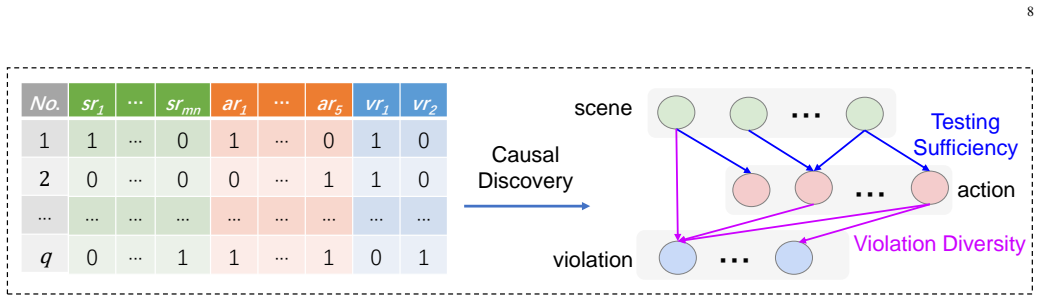
The scene-action-violation causal graph is the central object: a weighted DAG whose nodes are binary scene occupancy indicators (32 radial-annular sectors around the ego vehicle), five binary ego-action indicators (accelerate, decelerate, left turn, right turn, maintain), and two binary violation indicators (ego-caused or NPC-caused collision). The graph is estimated with LiNGAM, a linear non-Gaussian acyclic causal discovery method, from the vectorized scenario observation; binary adjacency matrices of the estimated graphs supply the cosine-distance feedback for testing sufficiency and violation diversity, and the outgoing causal strengths supply the per-NPC average causal effects that drive adaptive mutation. It is the mechanism that turns raw scenario traces into a searchable coverage space.
What would settle it
Rerun Causal-Fuzzer on the same four scenarios and time budgets with causal-effect mutation weights replaced by uniform random weights while keeping the same causal-graph feedback and thresholds; if the reported 22.06% gain in testing sufficiency and 134.09% gain in violation diversity shrink to statistical noise, the causal machinery is not load-bearing.
Extended reading notes
Core claim
The central discovery claimed is that the interdependence between scenes, ADS motion commands, and violations can be encoded as a directed acyclic causal graph, and the edge combinations of that graph define two useful coverage objectives: scene-to-action edges measure testing sufficiency, while (scene, action)-to-violation edges measure violation diversity. Causal-Fuzzer discovers such a graph per executed scenario from vectorized binary observations, converts the causal strength matrix to a binary adjacency matrix, and uses the minimum cosine distance to previously seen graphs as novelty feedback. It then estimates the average causal effect of each NPC vehicle on ego actions and violations, and mutates NPCs with probability proportional to that effect, with an epsilon-greedy escape to random mutation. The paper reports that this combination finds more violations, more causally distinct violations, and better scene-action edge coverage than random testing, AV-Fuzzer, and DoppelTest.
Load-bearing premise
The load-bearing premise is that LiNGAM causal discovery, which assumes linear structural equations with independent non-Gaussian continuous noise and no hidden confounders, yields correct causal graphs when applied to binary occupancy, action, and violation indicators; if the graphs are wrong, both the diversity feedback and the mutation weights lose their meaning.
Editorial extensions
If this is right
- Testing coverage for ADSs should be reported as activated causal edges, not merely as counts of inputs, actions, or violations, because identical motions can be safe or unsafe depending on scene context.
- Prioritizing mutations by NPC causal effect reduces the number of scenarios needed to reach the first safety violation, so the same time budget yields more distinct failures.
- The 134.09% increase in violation diversity means the fuzzer finds failures across more semantic categories, such as ego-accelerated collisions versus NPC-induced collisions, not just more instances of one collision type.
- With correct causal graphs, the same feedback and mutation machinery generalizes beyond the four tested scenarios to any scenario expressible in the vectorized scene-action-violation representation.
Reading between the lines
- Because scene occupancy is binary and actions are five discrete indicators, the causal graph cannot distinguish quantitative risk levels within the same edge combination; graded encodings or continuous causal models would be a natural extension.
- The mutation weighting depends entirely on the discovered graph's outgoing causal strengths, so the method's practical value is bounded by the quality of causal discovery on the vectorized data; replacing LiNGAM with a discrete or nonlinear causal discovery method is the first robustness check.
- The 32.1-versus-71.5 speed-up to first failure suggests the largest efficiency gain comes from early causal-effect weighting, while the diversity gains may accumulate later from the feedback thresholds; testing this temporal decomposition would be a direct follow-up experiment.
Editorial analysis
A structured set of objections, weighed in public.
Referee Report
Summary. The paper proposes Causal-Fuzzer, a fuzzing technique for simulation-based testing of autonomous driving systems. It vectorizes scenario observations into binary scene-sector occupancy indicators, binary ego-action indicators, and binary violation indicators; runs LiNGAM causal discovery on each executed scenario to build a scene-action-violation causal graph; and uses that graph to define two feedback metrics (testing sufficiency via scene-to-action edges and violation diversity via scene/action-to-violation edges) and an adaptive mutation strategy that mutates NPCs with higher estimated causal effects. The authors evaluate Causal-Fuzzer on Apollo 7.0 with the LGSVL simulator across four functional scenarios, comparing against random testing, AV-Fuzzer, and DoppelTest. They report higher violation counts, higher SAC/SAVC values, and earlier first-failure detection, and they include an ablation study to isolate the contributions of the causal feedback and causal mutation components.
Significance. If the discovered causal graphs are valid, this is a genuinely useful direction: it ties together input-scene diversity, action diversity, and violation diversity in a single causal structure, and it uses causal strengths to prioritize mutations in an interpretable way. The evaluation on an industry-grade ADS with a high-fidelity simulator, the inclusion of three baselines, and the ablation study are strengths. The central weakness is that the causal discovery step is not validated against any ground truth, and the same causal graphs are both the object being discovered and the basis for the reported diversity and sufficiency metrics. The empirical claims therefore currently rest on an unverified modeling assumption, and the headline quantitative claims contain internal inconsistencies.
major comments (5)
- [Section III-B2, Eq. (5)] LiNGAM is used despite the data violating its identifiability assumptions. Equation (5) assumes each variable is a linear function of its parents plus independent non-Gaussian continuous noise, and the standard estimation assumes i.i.d. samples. The input matrix X_sav, however, is composed of 32 binary occupancy indicators, 5 binary action indicators, and 2 binary violation indicators, collected from a single execution trace over time. Binary variables cannot be generated by a linear SEM with continuous additive noise, and temporal samples are not independent. As a result, the weighted adjacency matrix W and the edge orientations used in Sections III-B3 and III-C1 are not identifiable from the stated assumptions. The authors need to either justify the application of LiNGAM to this data, use a causal discovery method whose assumptions match discrete/mixed, serially dependent observations, or demonstrate via synthetic ground-truth experiments that the recovered graphs are still reliable.
- [Section IV-B, Table I] The DoWhy-based validation does not establish that the discovered edges correspond to true causal mechanisms. The permutation and independence tests check statistical compatibility of a DAG with the observed data; they do not compare the recovered edge set against a known ground-truth causal graph. Moreover, the paper reports mean p-values of 0.001 as evidence that the graphs accurately represent the data, but without stating the null hypothesis, a p-value below 0.05 cannot be interpreted as confirming compatibility. The KL divergence and MSE values also lack any baseline or reference model. A meaningful validation would use scenarios with known causal structure, such as hand-constructed situations where the true cause of a collision is known, and measure edge-level precision/recall of the discovered graph.
- [Section IV-C, Table II] The headline numbers are internally inconsistent. In Table II, the average SAVC of Causal-Fuzzer is 12.9, and the best baseline average SAVC is 6.8 (AV-Fuzzer), not 5.5 (DoppelTest). The claimed 134.09% violation-diversity increase therefore compares against the wrong baseline; the correct increase relative to the best baseline is 89.7%. In addition, the abstract states that testing sufficiency is 12.9 versus 6.8, but the testing sufficiency metric defined in the paper is SAC, whose averages are 183.3 versus 150.1. The abstract's 98.4 versus 42.4 values refer to violation count, not SAVC. These metric labels and percentages need to be corrected and recomputed consistently.
- [Section IV-C, Tables II and III] All effectiveness and efficiency claims rest on only two 10-hour runs per scenario type. No variance, confidence intervals, or statistical significance tests are reported, and no information is given about random-seed variation or initialization diversity. With just two runs, differences such as Scenario 1 SAVC of 11.0 versus 7.0 are within plausible simulator noise, so the statement that Causal-Fuzzer 'significantly outperforms' the baselines is not supported by the experimental design. The authors should report distributions over a larger number of independent runs and apply appropriate statistical tests or effect-size measures.
- [Section III-B3 and Section IV-C] The SAC and SAVC metrics are defined from the same causal graphs that Causal-Fuzzer is rewarded to expand, so the reported improvements in these metrics partly measure the algorithm's success at optimizing its own objective. This is a form of circularity: a fuzzer that is explicitly rewarded for creating new scene-action or scene-action-violation edge combinations will naturally report more such combinations, even if the edges are spurious. The absolute violation count is a more independent signal, but the diversity and sufficiency claims need an external notion of coverage or a ground-truth set of causal relations in the simulator to avoid circularity. A concrete test would be to fix a set of semantically meaningful scenario categories with known causes and measure whether the discovered edges align with those causes.
minor comments (5)
- [Algorithm 1] In Line 1, the set 'SV C' appears to be a typo for 'SAV C', and in Line 17 the expression 'Distance(Gs′ saf, F P)' appears to be a typo for 'Distance(Gs′ sav, SAVC)'.
- [Section III-B3] The text says thresholds 'θts and θcd', but the violation-diversity threshold was introduced as 'θvd'; use consistent notation.
- [Abstract] The sentence 'We evaluated Causal-Fuzzer on an industry-grade ADS Apollo, with a high-fidelity.' is incomplete; the simulator name should appear in the sentence or the sentence should be finished.
- [Equation (12)] The definition of the weights w_i should clarify the direction convention, since W in Eq. (5) is defined with wij representing the strength from xj to xi; the sum 'Pp j=1 wij' needs to be written unambiguously.
- [Tables II and III] The units of SAC and SAVC should be stated explicitly in the table captions, and the half-integer average values resulting from two runs should be explained or replaced with per-run values.
Circularity Check
Testing sufficiency and violation diversity are defined from the same causal-edge distances the fuzzer uses as selection thresholds, so the reported SAC/SAVC improvements are partly self-referential; the raw violation count is independent.
-
self definitional
[Section III-B3 (Eqs. 7-8), Algorithm 1 (Lines 14-18), and Section IV-C (Table II)]
"we calculate the minimum distance between binary matrices: tss′ = min s∈∆ Distance(Bs′ sa, Bs sa), (7) vds′ = min s∈∆ Distance(Bs′ sav, Bs sav). (8) ... The values of tss′ and vds′ represent the testing sufficiency and violation diversity, respectively. ... if Distance(Gs′ sav, SAC ) ≥ θts and F its′ < F its then SAC ← SAC ∪ {s′} ... if Distance(Gs′ saf , F P) ≥ θvd then SAV C← F P∪ {s′}."
Eqs. (7)-(8) define testing sufficiency and violation diversity as the minimum distance between causal-edge submatrices of the new graph and those of existing seeds. Algorithm 1 then adds a seed to SAC exactly when this distance exceeds θts, and to SAVC when it exceeds θvd. The reported SAC and SAVC counts in Table II are therefore the algorithm's own acceptance sets: they count seeds that satisfied the feedback thresholds used to steer the search. Claiming that Causal-Fuzzer 'enhances testing sufficiency' and 'increases violation diversity' relative to baselines is partly reporting that the method optimizes its own objective; the metric is defined from the same causal graphs the fuzzer is rewarded to expand.
full rationale
The paper's headline claims rest partly on metrics that are constructed from the same causal graphs used as the fuzzing objective. The SAC and SAVC sets populated in Algorithm 1 are exactly the quantities reported in Section IV-C as 'testing sufficiency' and 'violation diversity', so the reported improvements in these metrics are self-referential rather than independent measurements. However, the absolute violation count is generated by the simulator oracle and is not derived from the causal graph, and the comparisons are against external baselines, giving the central claim independent empirical content. No load-bearing self-citation or imported uniqueness theorem is present; LiNGAM and DoWhy are cited from the external literature. The LiNGAM-on-binary-data concern is a validity/identifiability risk: the inputs to Eq. (5) are binary occupancy, action, and violation indicators, which violate the continuous non-Gaussian noise assumption, and Table I's DoWhy tests only check in-sample Markov compatibility rather than ground-truth causal structure. This is a correctness risk, not a circularity step, because it does not reduce the derivation to its inputs by construction. Score 4 reflects the partial self-referentiality of the diversity/sufficiency metrics while acknowledging the independent violation-count signal.
Assumptions & free parameters
free parameters (6)
- testing sufficiency threshold theta_ts =
0.3
- violation diversity threshold theta_vd =
0
- acceleration thresholds theta_a+ and theta_a- =
0.1 and -0.1
- heading threshold theta_h =
0.1
- exploration probability epsilon =
0.5
- perception range L and partition m x n =
L=50, m=8, n=4
assumptions (5)
- ad hoc to paper LiNGAM linear SEM assumptions hold on vectorized scenario data, including linearity, non-Gaussian independent noise, acyclicity, and causal sufficiency.
- domain assumption The 32-sector occupancy abstraction preserves the causally relevant scene information for the ADS.
- domain assumption The five binary action indicators with fixed thresholds capture the causally relevant ego actions.
- domain assumption Collision fault attribution to ego or NPC based on speeds and lane crossing is correct.
- ad hoc to paper The sum of outgoing causal strengths from occupied scene nodes estimates the causal effect of each NPC on ego actions and violations.
Cite this review
Pith. "Pith review of Causality-aware Safety Testing for Autonomous Driving Systems." pith.science (2026). https://pith.science/paper/VMJJMSZN
@misc{pith2026250608688,
  author       = {Pith},
  title        = {Pith review of: Causality-aware Safety Testing for Autonomous Driving Systems},
  year         = {2026},
  howpublished = {\url{https://pith.science/paper/VMJJMSZN}},
  note         = {Machine review of arXiv:2506.08688}
}
read the original abstract
Simulation-based testing is essential for evaluating the safety of Autonomous Driving Systems (ADSs). Comprehensive evaluation requires testing across diverse scenarios that can trigger various types of violations under different conditions. While existing methods typically focus on individual diversity metrics, such as input scenarios, ADS-generated motion commands, and system violations, they often fail to capture the complex interrelationships among these elements. This oversight leads to gaps in testing coverage, potentially missing critical issues in the ADS under evaluation. However, quantifying these interrelationships presents a significant challenge. In this paper, we propose a novel causality-aware fuzzing technique, Causal-Fuzzer, to enable efficient and comprehensive testing of ADSs by exploring causally diverse scenarios. The core of Causal-Fuzzer is constructing a causal graph to model the interrelationships among the diversities of input scenarios, ADS motion commands, and system violations. Then the causal graph will guide the process of critical scenario generation. Specifically, Causal-Fuzzer proposes (1) a causality-based feedback mechanism that quantifies the combined diversity of test scenarios by assessing whether they activate new causal relationships, and (2) a causality-driven mutation strategy that prioritizes mutations on input scenario elements with higher causal impact on ego action changes and violation occurrence, rather than treating all elements equally. We evaluated Causal-Fuzzer on an industry-grade ADS Apollo, with a high-fidelity. Our empirical results demonstrate that Causal-Fuzzer significantly outperforms existing methods in (1) identifying a greater diversity of violations, (2) providing enhanced testing sufficiency with improved coverage of causal relationships, and (3) achieving greater efficiency in detecting the first critical scenarios.
Figures


Figures from the paper (5 more)


Reference graph
Works this paper leans on
-
[1]
Boundary state generation for testing and improvement of autonomous driving systems,
M. Biagiola and P. Tonella, “Boundary state generation for testing and improvement of autonomous driving systems,” IEEE Transactions on Software Engineering, 2024
work page 2024
-
[2]
Y . Ji, Z. Xu, C. Zhao, K. Chen, and Y . Du, “Accelerated testing and eval- uation for black-box autonomous driving systems via adaptive markov chain monte carlo,” IEEE Transactions on Intelligent Transportation Systems, 2025
work page 2025
-
[3]
Misconfiguration software testing for failure emergence in autonomous driving systems,
Y . Chen, Y . Huai, S. Li, C. Hong, and J. Garcia, “Misconfiguration software testing for failure emergence in autonomous driving systems,” Proceedings of the ACM on Software Engineering , vol. 1, no. FSE, pp. 1913–1936, 2024
work page 1913
-
[4]
Specification-based autonomous driving system testing,
Y . Zhou, Y . Sun, Y . Tang, Y . Chen, J. Sun, C. M. Poskitt, Y . Liu, and Z. Yang, “Specification-based autonomous driving system testing,”IEEE Transactions on Software Engineering , vol. 49, no. 6, pp. 3391–3410, 2023
work page 2023
-
[5]
Behavexplor: Behavior diversity guided testing for autonomous driving systems,
M. Cheng, Y . Zhou, and X. Xie, “Behavexplor: Behavior diversity guided testing for autonomous driving systems,” in Proceedings of the 32nd ACM SIGSOFT International Symposium on Software Testing and Analysis, 2023, pp. 488–500
2023
-
[6]
Doppelg ¨anger test generation for revealing bugs in autonomous driving software,
Y . Huai, Y . Chen, S. Almanee, T. Ngo, X. Liao, Z. Wan, Q. A. Chen, and J. Garcia, “Doppelg ¨anger test generation for revealing bugs in autonomous driving software,” in 2023 IEEE/ACM 45th International Conference on Software Engineering (ICSE) . IEEE, 2023, pp. 2591– 2603
work page 2023
-
[7]
Sovar: Build generalizable scenarios from accident reports for autonomous driving testing,
A. Guo, Y . Zhou, H. Tian, C. Fang, Y . Sun, W. Sun, X. Gao, A. T. Luu, Y . Liu, and Z. Chen, “Sovar: Build generalizable scenarios from accident reports for autonomous driving testing,” in Proceedings of the 39th IEEE/ACM International Conference on Automated Software Engineering, 2024, pp. 268–280
2024
-
[8]
Lgsvl simulator: A high fidelity simulator for autonomous driving,
G. Rong, B. H. Shin, H. Tabatabaee, Q. Lu, S. Lemke, M. Mo ˇzeiko, E. Boise, G. Uhm, M. Gerow, S. Mehta et al. , “Lgsvl simulator: A high fidelity simulator for autonomous driving,” in 2020 IEEE 23rd International conference on intelligent transportation systems (ITSC) . IEEE, 2020, pp. 1–6
work page 2020
Show all 63 references
-
[9]
Carla: An open urban driving simulator,
A. Dosovitskiy, G. Ros, F. Codevilla, A. Lopez, and V . Koltun, “Carla: An open urban driving simulator,” in Conference on robot learning . PMLR, 2017, pp. 1–16
2017
-
[10]
A survey on automated driving system testing: Landscapes and trends,
S. Tang, Z. Zhang, Y . Zhang, J. Zhou, Y . Guo, S. Liu, S. Guo, Y .-F. Li, L. Ma, Y . Xue et al. , “A survey on automated driving system testing: Landscapes and trends,” ACM Transactions on Software Engineering and Methodology, vol. 32, no. 5, pp. 1–62, 2023
2023
-
[11]
Building critical testing scenarios for autonomous driving from real accidents,
X. Zhang and Y . Cai, “Building critical testing scenarios for autonomous driving from real accidents,” in Proceedings of the 32nd ACM SIGSOFT International Symposium on Software Testing and Analysis , 2023, pp. 462–474
2023
-
[12]
Target: Automated scenario generation from traffic rules for testing autonomous vehicles,
Y . Deng, J. Yao, Z. Tu, X. Zheng, M. Zhang, and T. Zhang, “Target: Automated scenario generation from traffic rules for testing autonomous vehicles,” arXiv preprint arXiv:2305.06018 , 2023
2023 arXiv
-
[13]
Viohawk: Detecting traffic violations of autonomous driving systems through criticality-guided simulation testing,
Z. Li, J. Dai, Z. Huang, N. You, Y . Zhang, and M. Yang, “Viohawk: Detecting traffic violations of autonomous driving systems through criticality-guided simulation testing,” in Proceedings of the 33rd ACM SIGSOFT International Symposium on Software Testing and Analysis , 2024,...
2024
-
[14]
Drivefuzz: Discovering autonomous driving bugs through driving quality-guided fuzzing,
S. Kim, M. Liu, J. J. Rhee, Y . Jeon, Y . Kwon, and C. H. Kim, “Drivefuzz: Discovering autonomous driving bugs through driving quality-guided fuzzing,” in Proceedings of the 2022 ACM SIGSAC Conference on Computer and Communications Security , 2022, pp. 1753–1767
2022
-
[15]
Curiosity-driven testing for sequential decision-making process,
J. He, Z. Yang, J. Shi, C. Yang, K. Kim, B. Xu, X. Zhou, and D. Lo, “Curiosity-driven testing for sequential decision-making process,” in Proceedings of the IEEE/ACM 46th International Conference on Software Engineering, 2024, pp. 1–14
2024
-
[16]
Mosat: finding safety violations of autonomous driving systems using multi-objective genetic algorithm,
H. Tian, Y . Jiang, G. Wu, J. Yan, J. Wei, W. Chen, S. Li, and D. Ye, “Mosat: finding safety violations of autonomous driving systems using multi-objective genetic algorithm,” in Proceedings of the 30th ACM Joint European Software Engineering Conference and Symposium on the Fo...
2022
-
[17]
Av-fuzzer: Finding safety violations in autonomous driving systems,
G. Li, Y . Li, S. Jha, T. Tsai, M. Sullivan, S. K. S. Hari, Z. Kalbarczyk, and R. Iyer, “Av-fuzzer: Finding safety violations in autonomous driving systems,” in 2020 IEEE 31st international symposium on software reliability engineering (ISSRE) . IEEE, 2020, pp. 25–36
2020
-
[18]
Causality- driven testing of autonomous driving systems,
L. Giamattei, A. Guerriero, R. Pietrantuono, and S. Russo, “Causality- driven testing of autonomous driving systems,” ACM Transactions on Software Engineering and Methodology , vol. 33, no. 3, pp. 1–35, 2024
2024
-
[19]
Accelerated safety testing for highly automated vehicles: Application and capability comparison of surrogate models,
H. Zhang, J. Sun, and Y . Tian, “Accelerated safety testing for highly automated vehicles: Application and capability comparison of surrogate models,” IEEE Transactions on Intelligent Vehicles , 2023
2023
-
[20]
Learn- ing configurations of operating environment of autonomous vehicles to maximize their collisions,
C. Lu, Y . Shi, H. Zhang, M. Zhang, T. Wang, T. Yue, and S. Ali, “Learn- ing configurations of operating environment of autonomous vehicles to maximize their collisions,” IEEE Transactions on Software Engineering, vol. 49, no. 1, pp. 384–402, 2022
2022
-
[21]
Many-objective reinforcement learning for online testing of dnn-enabled systems,
F. U. Haq, D. Shin, and L. C. Briand, “Many-objective reinforcement learning for online testing of dnn-enabled systems,” in 2023 IEEE/ACM 45th International Conference on Software Engineering (ICSE) . IEEE, 2023, pp. 1814–1826
2023
-
[22]
sceno rita: Generating diverse, fully-mutable, test scenarios for autonomous vehicle planning,
Y . Huai, S. Almanee, Y . Chen, X. Wu, Q. A. Chen, and J. Garcia, “sceno rita: Generating diverse, fully-mutable, test scenarios for autonomous vehicle planning,” IEEE Transactions on Software Engineering , 2023
2023
-
[23]
Physcov: physical test coverage for autonomous vehicles,
C. Hildebrandt, M. von Stein, and S. Elbaum, “Physcov: physical test coverage for autonomous vehicles,” in Proceedings of the 32nd ACM SIGSOFT International Symposium on Software Testing and Analysis , 2023, pp. 449–461
2023
-
[24]
S3c: Spatial semantic scene coverage for autonomous vehicles,
T. Woodlief, F. Toledo, S. Elbaum, and M. B. Dwyer, “S3c: Spatial semantic scene coverage for autonomous vehicles,” in Proceedings of the IEEE/ACM 46th International Conference on Software Engineering , 2024, pp. 1–13
2024
-
[25]
Apollo: Open source autonomous driving,
Baidu, “Apollo: Open source autonomous driving,” 2019. [Online]. Available: https://github.com/ApolloAuto/apollo
2019
-
[26]
End-to-end autonomous driving: Challenges and frontiers,
L. Chen, P. Wu, K. Chitta, B. Jaeger, A. Geiger, and H. Li, “End-to-end autonomous driving: Challenges and frontiers,” IEEE Transactions on Pattern Analysis and Machine Intelligence , 2024
2024
-
[27]
Lmdrive: Closed-loop end-to-end driving with large language models,
H. Shao, Y . Hu, L. Wang, G. Song, S. L. Waslander, Y . Liu, and H. Li, “Lmdrive: Closed-loop end-to-end driving with large language models,” in Proceedings of the IEEE/CVF Conference on Computer Vision and Pattern Recognition, 2024, pp. 15 120–15 130
2024
-
[28]
Dualad: Disentangling the dynamic and static 14 world for end-to-end driving,
S. Doll, N. Hanselmann, L. Schneider, R. Schulz, M. Cordts, M. En- zweiler, and H. Lensch, “Dualad: Disentangling the dynamic and static 14 world for end-to-end driving,” in Proceedings of the IEEE/CVF Confer- ence on Computer Vision and Pattern Recognition , 2024, pp. 14 728– 14 737
2024
-
[29]
Planning-oriented autonomous driving,
Y . Hu, J. Yang, L. Chen, K. Li, C. Sima, X. Zhu, S. Chai, S. Du, T. Lin, W. Wang et al. , “Planning-oriented autonomous driving,” in Proceedings of the IEEE/CVF Conference on Computer Vision and Pattern Recognition, 2023, pp. 17 853–17 862
2023
-
[30]
(2019) Apollo: An open autonomous driving platform
Baidu. (2019) Apollo: An open autonomous driving platform. [Online]. Available: https://github.com/ApolloAuto/apollo
2019
-
[31]
Foundation
A. Foundation. (2022) Autoware: The world’s leading open-source software project for autonomous driving. [Online]. Available: https: //github.com/autowarefoundation/autoware
2022
-
[32]
Rocas: Root cause analysis of autonomous driving accidents via cyber-physical co-mutation,
S. Feng, Y . Ye, Q. Shi, Z. Cheng, X. Xu, S. Cheng, H. Choi, and X. Zhang, “Rocas: Root cause analysis of autonomous driving accidents via cyber-physical co-mutation,”arXiv preprint arXiv:2409.07774, 2024
2024 arXiv
-
[33]
Scenarios for development, test and validation of automated vehicles,
T. Menzel, G. Bagschik, and M. Maurer, “Scenarios for development, test and validation of automated vehicles,” in 2018 IEEE Intelligent Vehicles Symposium (IV). IEEE, 2018, pp. 1821–1827
2018
-
[34]
A framework for automated driving system testable cases and scenarios,
E. Thorn, S. C. Kimmel, M. Chaka, B. A. Hamilton et al. , “A framework for automated driving system testable cases and scenarios,” United States. Department of Transportation. National Highway Traffic Safety . . . , Tech. Rep., 2018
2018
-
[35]
Defining and substantiating the terms scene, situation, and scenario for automated driving,
S. Ulbrich, T. Menzel, A. Reschka, F. Schuldt, and M. Maurer, “Defining and substantiating the terms scene, situation, and scenario for automated driving,” in 2015 IEEE 18th international conference on intelligent transportation systems. IEEE, 2015, pp. 982–988
2015
-
[36]
Pearl, Causality
J. Pearl, Causality. Cambridge university press, 2009
2009
-
[37]
Deciphering spatio-temporal graph forecasting: A causal lens and treatment,
Y . Xia, Y . Liang, H. Wen, X. Liu, K. Wang, Z. Zhou, and R. Zimmer- mann, “Deciphering spatio-temporal graph forecasting: A causal lens and treatment,” Advances in Neural Information Processing Systems , vol. 36, 2024
2024
-
[38]
Neural network semantic backdoor detection and mitigation: A causality-based approach,
B. Sun, J. Sun, W. Koh, and J. Shi, “Neural network semantic backdoor detection and mitigation: A causality-based approach,” in Proceedings of the 33rd USENIX Security Symposium. USENIX Association, San Francisco, CA, USA , 2024
2024
-
[39]
You can’t see me: Physical removal attacks on {lidar- based} autonomous vehicles driving frameworks,
Y . Cao, S. H. Bhupathiraju, P. Naghavi, T. Sugawara, Z. M. Mao, and S. Rampazzi, “You can’t see me: Physical removal attacks on {lidar- based} autonomous vehicles driving frameworks,” in 32nd USENIX Security Symposium (USENIX Security 23) , 2023, pp. 2993–3010
2023
-
[40]
A survey on causal discovery: theory and practice,
A. Zanga, E. Ozkirimli, and F. Stella, “A survey on causal discovery: theory and practice,” International Journal of Approximate Reasoning , vol. 151, pp. 101–129, 2022
2022
-
[41]
A linear non-gaussian acyclic model for causal discovery
S. Shimizu, P. O. Hoyer, A. Hyv ¨arinen, A. Kerminen, and M. Jordan, “A linear non-gaussian acyclic model for causal discovery.” Journal of Machine Learning Research , vol. 7, no. 10, 2006
2006
-
[42]
Shimizu, Statistical Causal Discovery: LiNGAM Approach
S. Shimizu, Statistical Causal Discovery: LiNGAM Approach. Springer, 2022
2022
-
[43]
Python package for causal discovery based on lingam,
T. Ikeuchi, M. Ide, Y . Zeng, T. N. Maeda, and S. Shimizu, “Python package for causal discovery based on lingam,” Journal of Machine Learning Research, vol. 24, no. 14, pp. 1–8, 2023
2023
-
[44]
Nonlinear independent component analysis for principled disentanglement in unsupervised deep learning,
A. Hyv ¨arinen, I. Khemakhem, and H. Morioka, “Nonlinear independent component analysis for principled disentanglement in unsupervised deep learning,” Patterns, vol. 4, no. 10, 2023
2023
-
[45]
Independent component analysis, a new concept?
P. Comon, “Independent component analysis, a new concept?” Signal processing, vol. 36, no. 3, pp. 287–314, 1994
1994
-
[46]
Directlingam: A direct method for learning a linear non-gaussian structural equation model,
S. Shimizu, T. Inazumi, Y . Sogawa, A. Hyvarinen, Y . Kawahara, T. Washio, P. O. Hoyer, K. Bollen, and P. Hoyer, “Directlingam: A direct method for learning a linear non-gaussian structural equation model,” Journal of Machine Learning Research-JMLR , vol. 12, no. Apr, pp. 1225...
2011
-
[47]
Deepstellar: Model-based quantitative analysis of stateful deep learning systems,
X. Du, X. Xie, Y . Li, L. Ma, Y . Liu, and J. Zhao, “Deepstellar: Model-based quantitative analysis of stateful deep learning systems,” in Proceedings of the 2019 27th ACM Joint Meeting on European Software Engineering Conference and Symposium on the Foundations of Software En...
2019
-
[48]
Icsfuzz: Collision detector bug discovery in autonomous driving simulators,
W. Fu, H. Huang, Y . Zhang, K. Zhang, J. Huang, W.-B. Lee, and J. Wang, “Icsfuzz: Collision detector bug discovery in autonomous driving simulators,” arXiv preprint arXiv:2408.05694 , 2024
2024 arXiv
-
[49]
Neural network guided evolutionary fuzzing for finding traffic violations of autonomous vehicles,
Z. Zhong, G. Kaiser, and B. Ray, “Neural network guided evolutionary fuzzing for finding traffic violations of autonomous vehicles,” IEEE Transactions on Software Engineering , vol. 49, no. 4, pp. 1860–1875, 2022
2022
-
[50]
Incremental reinforce- ment learning with dual-adaptive ε-greedy exploration,
W. Ding, S. Jiang, H.-W. Chen, and M.-S. Chen, “Incremental reinforce- ment learning with dual-adaptive ε-greedy exploration,” in Proceedings of the AAAI Conference on Artificial Intelligence , vol. 37, no. 6, 2023, pp. 7387–7395
2023
-
[51]
Redriver: Runtime enforcement for autonomous vehicles,
Y . Sun, C. M. Poskitt, X. Zhang, and J. Sun, “Redriver: Runtime enforcement for autonomous vehicles,” in Proceedings of the IEEE/ACM 46th International Conference on Software Engineering, 2024, pp. 1–12
2024
-
[52]
Y . Huai. (2023) Sora-svl. [Online]. Available: https://ics.uci.edu/∼yhuai/ SORA-SVL/
2023
-
[53]
Toward falsifying causal graphs using a permutation-based test,
E. Eulig, A. A. Mastakouri, P. Bl ¨obaum, M. Hardt, and D. Janzing, “Toward falsifying causal graphs using a permutation-based test,” arXiv preprint arXiv:2305.09565, 2023
2023 arXiv
-
[54]
Dowhy: An end-to-end library for causal inference,
A. Sharma and E. Kiciman, “Dowhy: An end-to-end library for causal inference,” arXiv preprint arXiv:2011.04216 , 2020
2011 arXiv
-
[55]
Moditector: Module-directed testing for autonomous driving systems,
R. Wang, M. Cheng, X. Xie, Y . Zhou, and L. Ma, “Moditector: Module-directed testing for autonomous driving systems,”arXiv preprint arXiv:2502.08504, 2025
2025 arXiv
-
[56]
Decictor: Towards evaluating the robustness of decision-making in autonomous driving systems,
M. Cheng, X. Xie, Y . Zhou, J. Wang, G. Meng, and K. Yang, “Decictor: Towards evaluating the robustness of decision-making in autonomous driving systems,” in Proceedings of the 47th IEEE/ACM International Conference on Software Engineering (ICSE) , 2025, pp. 651–651
2025
-
[57]
Moral testing of autonomous driving systems,
W. Tang, M. Cheng, Y . Zhou, and Y . Liu, “Moral testing of autonomous driving systems,” arXiv preprint arXiv:2505.03683 , 2025
2025 arXiv
-
[58]
Synthetic vs. real: An analysis of critical scenarios for autonomous vehicle testing,
Q. Song, A. Bensoussan, and M. Mousavi, “Synthetic vs. real: An analysis of critical scenarios for autonomous vehicle testing,” Automated Software Engineering, 2025
2025
-
[59]
Causality-invariant interactive mining for cross-modal similarity learning,
J. Yan, C. Deng, H. Huang, and W. Liu, “Causality-invariant interactive mining for cross-modal similarity learning,” IEEE Transactions on Pattern Analysis and Machine Intelligence , 2024
2024
-
[60]
Droid: Driver-centric risk object identification,
C. Li, S. H. Chan, and Y .-T. Chen, “Droid: Driver-centric risk object identification,” IEEE transactions on pattern analysis and machine intelligence, 2023
2023
-
[61]
Generation of risky scenarios for testing automated driving visual perception based on causal analysis,
Z. Jiang, J. Liu, P. Sun, M. Sang, H. Li, and Y . Pan, “Generation of risky scenarios for testing automated driving visual perception based on causal analysis,” IEEE Transactions on Intelligent Transportation Systems, 2024
2024
-
[62]
Causalaf: Causal autoregressive flow for safety-critical driving scenario generation,
W. Ding, H. Lin, B. Li, and D. Zhao, “Causalaf: Causal autoregressive flow for safety-critical driving scenario generation,” in Conference on Robot Learning, CoRL 2022, 14-18 December 2022, Auckland, New Zealand, ser. Proceedings of Machine Learning Research, vol. 205. PMLR, 2...
2022
-
[63]
Acav: A framework for automatic causality analysis in autonomous vehicle accident record- ings,
H. Sun, C. M. Poskitt, Y . Sun, J. Sun, and Y . Chen, “Acav: A framework for automatic causality analysis in autonomous vehicle accident record- ings,” in Proceedings of the IEEE/ACM 46th International Conference on Software Engineering , 2024, pp. 1–13
2024
Reviewed August 7, 2026 · model on record in the stance chip above.
Discussion (0). Sign in to comment.