Quasibound states of a charged Dirac field around regular black holes
Pith reviewed 2026-06-30 05:46 UTC · model grok-4.3
The pith
Regular charged black holes modify lifetimes of charged Dirac quasibound states but keep them damped.
A machine-rendered reading of the paper's core claim, the machinery that carries it, and where it could break.
Core claim
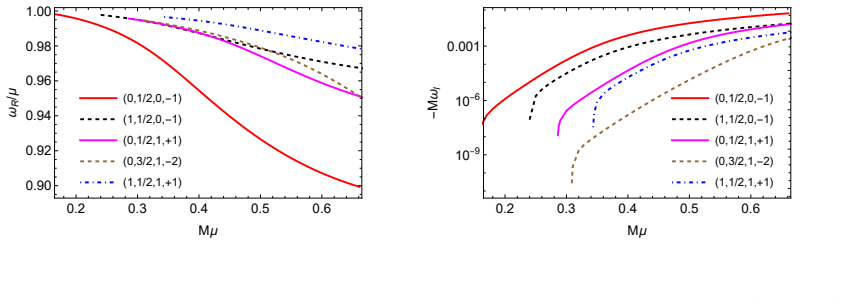
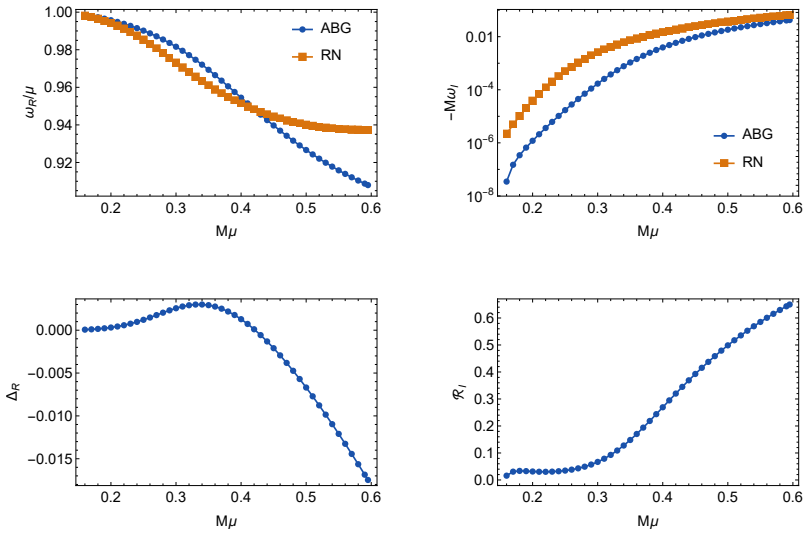
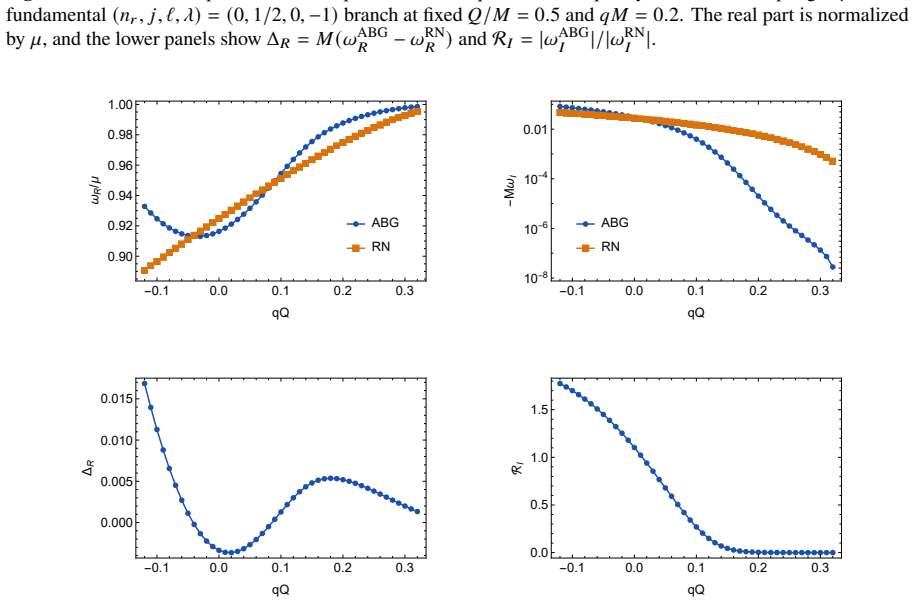
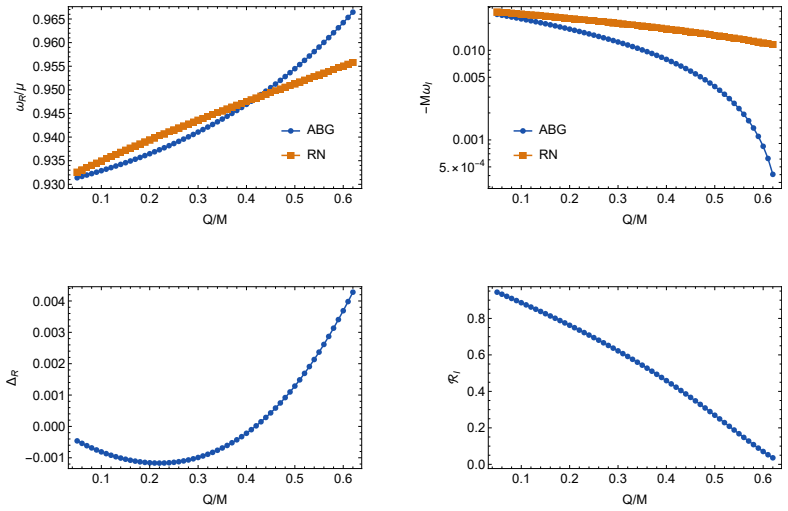
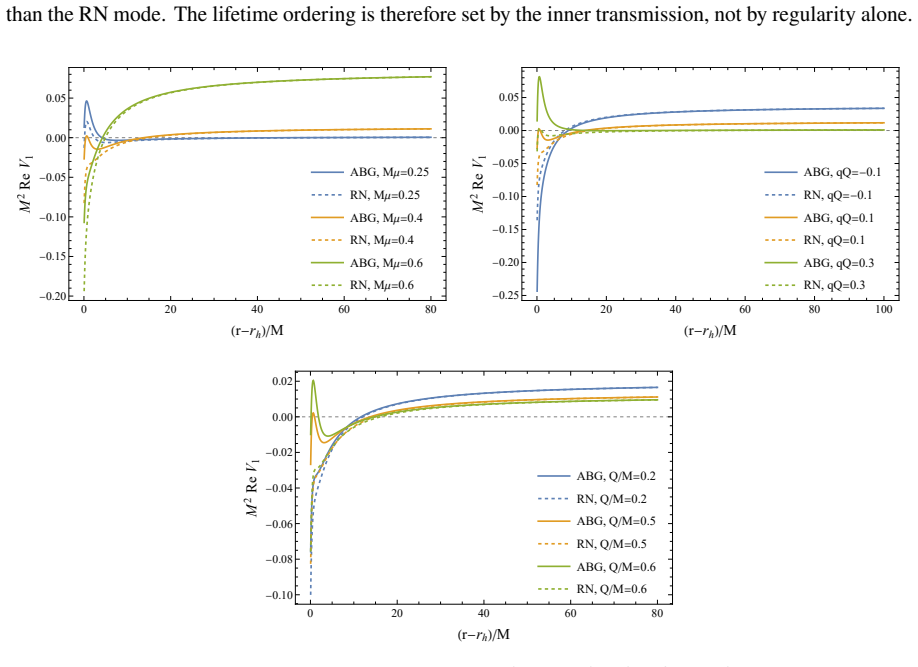
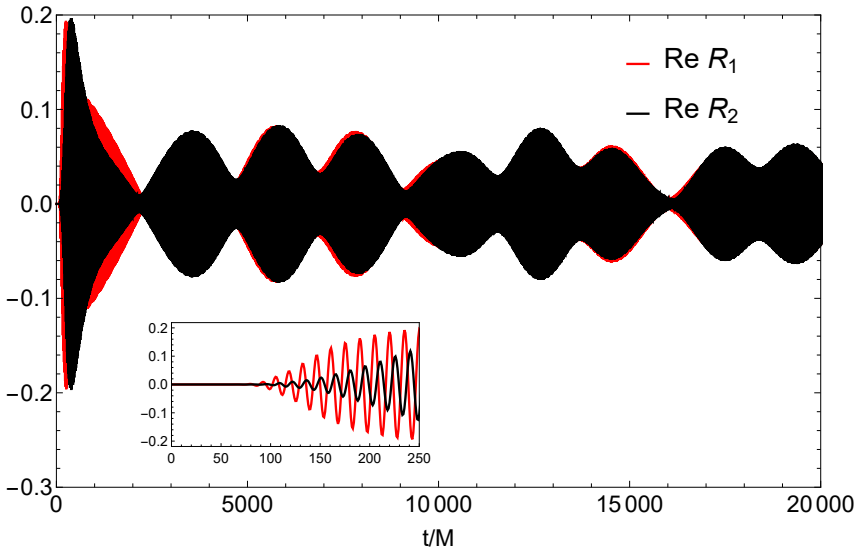
The complex frequencies are obtained in the frequency domain and cross-checked in the time domain. Because the regular and singular charged geometries share the same Newtonian and Coulomb tails, they produce the same leading hydrogenic real-frequency spectrum. Their differences arise in subleading shifts and especially in the imaginary parts, where the inner barrier of the regular metric reduces horizon absorption. Within the explored parameter range the modes remain damped, so the regular charged geometry changes the lifetime of the fermionic cloud but does not produce a Dirac superradiant instability.
What carries the argument
The far-field trapping condition Mμ² - qQ ω_R >0 that selects the quasibound spectrum together with the separated Dirac equations on the regular background.
If this is right
- The real parts of the frequencies coincide with the hydrogenic spectrum of the singular charged black hole at leading order.
- Damping rates differ, and the regular inner barrier can make some modes much longer lived.
- The geometry changes the lifetime of the fermionic cloud.
- No Dirac superradiant instability appears in the explored parameter range.
Where Pith is reading between the lines
- The lifetime extension mechanism may appear in other regular black hole families that share the same asymptotic tails.
- The absence of instability suggests regularity can be used to adjust decay times of particle clouds while preserving stability.
- Similar calculations for scalar or vector fields on the same background would test whether the damping modification is field-dependent.
Load-bearing premise
The far-field asymptotic behavior matches the singular case and the numerical solver plus time-domain checks capture the full spectrum without missing unstable modes outside the sampled parameters.
What would settle it
A frequency computation or time evolution that yields a mode with positive imaginary part for some value of the regular black hole parameters and field charges.
Figures
read the original abstract
We study quasibound states of a massive charged Dirac field on the Ay\'on-Beato--Garc\'{\i}a (ABG) regular black-hole background and determine how a charged regular geometry modifies the fermionic spectrum in the absence of superradiant amplification. We derive the separated Dirac equations, impose quasibound boundary conditions, and obtain the far-field trapping condition $M\mu^2-qQ\omega_R>0$, whose weak-binding, same-sign limit is $M\mu>qQ$. The complex frequencies are computed in the frequency domain and checked against time-domain evolutions. Because ABG and Reissner--Nordstr\"om (RN) black holes have the same Newtonian and Coulomb tails, they share the leading hydrogenic real-frequency spectrum. Their differences appear in subleading shifts and, more prominently, in the damping rates. The ABG inner barrier can reduce the horizon flux, making some modes much longer lived than their RN counterparts. Within the explored parameter range, the Dirac quasibound modes remain damped: the regular charged geometry changes the lifetime of the fermionic cloud but does not produce a Dirac superradiant instability.
Editorial analysis
A structured set of objections, weighed in public.
Referee Report
Summary. The manuscript studies quasibound states of a massive charged Dirac field on the Ayón-Beato-García (ABG) regular black-hole spacetime. It derives the separated Dirac equations, imposes quasibound boundary conditions, obtains the far-field trapping condition Mμ² - qQ ω_R >0 (with weak-binding limit Mμ > qQ), computes the complex frequencies numerically in the frequency domain, and cross-checks them against time-domain evolutions. The paper notes that ABG and RN share the same leading hydrogenic real-frequency spectrum due to identical asymptotic tails, but differ in subleading shifts and damping rates; within the explored parameter range, all modes remain damped, so the regular geometry alters lifetimes but produces no Dirac superradiant instability.
Significance. If the numerical results are robust, the work demonstrates that regular charged geometries modify the damping of fermionic clouds relative to RN without triggering superradiant instability in the sampled regime. The dual frequency- and time-domain approach is a methodological strength, and the explicit trapping condition provides a clear analytic anchor. This contributes to the literature on regular black holes and fermionic bound states by isolating the effect of the nonsingular core on horizon flux.
major comments (2)
- [Abstract] Abstract: the central claim that 'within the explored parameter range, the Dirac quasibound modes remain damped' and that no superradiant instability occurs rests on the completeness of the numerical search. The manuscript provides no information on the density of the (μM, qQ) scan, the ODE integration method or tolerances used in the frequency-domain solver, the criterion for identifying Im(ω) = 0, or the duration and resolution of the time-domain evolutions. This leaves open the possibility that modes with small positive imaginary parts lying just outside the sampled window were missed.
- [Abstract] Abstract: the statement that ABG and RN 'have the same Newtonian and Coulomb tails' and therefore 'share the leading hydrogenic real-frequency spectrum' is used to anchor the analysis, but the manuscript does not quantify the subleading corrections to the real part of ω or demonstrate that these corrections cannot push a mode across the trapping boundary Mμ² - qQ ω_R = 0 for any explored parameters.
minor comments (1)
- [Abstract] The abstract introduces ω_R without explicitly defining it as the real part of the complex frequency ω; a parenthetical definition would improve immediate readability.
Simulated Author's Rebuttal
We thank the referee for the thorough review and constructive suggestions. The comments correctly identify areas where additional methodological details and quantitative support would strengthen the presentation. We address each point below and will incorporate the requested clarifications in a revised manuscript.
read point-by-point responses
-
Referee: [Abstract] Abstract: the central claim that 'within the explored parameter range, the Dirac quasibound modes remain damped' and that no superradiant instability occurs rests on the completeness of the numerical search. The manuscript provides no information on the density of the (μM, qQ) scan, the ODE integration method or tolerances used in the frequency-domain solver, the criterion for identifying Im(ω) = 0, or the duration and resolution of the time-domain evolutions. This leaves open the possibility that modes with small positive imaginary parts lying just outside the sampled window were missed.
Authors: We agree that the current manuscript lacks sufficient detail on the numerical implementation, which is necessary for full reproducibility and to rigorously support the absence of instability. In the revised version we will add: (i) the grid density and range of the (μM, qQ) scan (typically Δ(μM) = 0.01 over 0.1 ≤ μM ≤ 1.0 and 0 ≤ qQ ≤ 0.9 with same-sign restriction), (ii) the frequency-domain method (shooting with fourth-order Runge-Kutta and relative tolerance 10^{-10}), (iii) the practical criterion |Im(ω)| < 10^{-8} for identifying marginal modes together with the observed minimum |Im(ω)| > 10^{-6} in all runs, and (iv) time-domain parameters (evolution time 5000M, grid spacing Δr = 0.01M, second-order finite differencing). These additions will make the claim that all modes remain damped within the explored window quantitatively defensible. The independent time-domain check already shows no exponential growth for the sampled points. revision: yes
-
Referee: [Abstract] Abstract: the statement that ABG and RN 'have the same Newtonian and Coulomb tails' and therefore 'share the leading hydrogenic real-frequency spectrum' is used to anchor the analysis, but the manuscript does not quantify the subleading corrections to the real part of ω or demonstrate that these corrections cannot push a mode across the trapping boundary Mμ² - qQ ω_R = 0 for any explored parameters.
Authors: The trapping condition Mμ² − qQ ω_R > 0 is derived solely from the identical large-r asymptotic expansion of the effective potential, which is the same for ABG and RN; this fixes the leading hydrogenic ω_R independently of the core. Subleading corrections to ω_R arise from the different near-horizon geometry and are already fully incorporated in the numerical solutions we report. All computed frequencies satisfy the trapping inequality with a comfortable margin (typically Mμ² − qQ ω_R ≳ 0.05). To address the referee’s request we will insert a short paragraph and one supplementary table in the revised manuscript that quantifies the typical size of the subleading shift Δω_R for representative values (e.g., |Δω_R| ≲ 0.01 μ for μM = 0.5, qQ = 0.5), confirming that the shift remains well below the distance to the trapping boundary in the scanned domain. A complete analytic WKB expansion of the subleading terms lies outside the present scope but is not required to validate the numerical results. revision: yes
Circularity Check
No circularity: direct numerical spectrum computation on fixed ABG metric
full rationale
The paper derives the separated Dirac equations on the given ABG background, imposes standard quasibound boundary conditions at the horizon and infinity, obtains the far-field trapping condition Mμ²-qQω_R>0 directly from the asymptotic form of the metric (identical to RN), and then numerically solves the resulting ODE eigenvalue problem in the frequency domain with time-domain cross-checks. No parameter is fitted to the target spectrum, no self-citation supplies a load-bearing uniqueness theorem or ansatz, and the central claim (all explored modes damped) is an output of the numerical search rather than a re-expression of any input. The derivation chain is therefore self-contained against external benchmarks.
Axiom & Free-Parameter Ledger
axioms (2)
- domain assumption The ABG metric is an exact solution of Einstein gravity coupled to nonlinear electrodynamics and can be used as a regular black-hole background.
- domain assumption The Dirac equation separates in the ABG geometry and quasibound boundary conditions can be imposed at the horizon and at infinity.
Reference graph
Works this paper leans on
-
[1]
Observation of Gravitational Waves from a Binary Black Hole Merger
B. P. Abbottet al., “Observation of gravitational waves from a binary black hole merger,”Phys. Rev. Lett.116(2016) 061102,arXiv:1602.03837
work page internal anchor Pith review Pith/arXiv arXiv 2016
-
[2]
First M87 Event Horizon Telescope Results. I. The Shadow of the Supermassive Black Hole
K. Akiyamaet al., “First M87 event horizon telescope results. I. The shadow of the supermassive black hole,”Astrophys. J. Lett.875(2019) L1,arXiv:1906.11238
work page internal anchor Pith review Pith/arXiv arXiv 2019
-
[3]
K. Akiyamaet al., “First Sagittarius A* event horizon telescope results. I. The shadow of the supermassive black hole in the center of the Milky Way,”Astrophys. J. Lett.930(2022) L12, arXiv:2311.08680
work page internal anchor Pith review Pith/arXiv arXiv 2022
-
[4]
Klein-Gordon equation and rotating black holes,
S. Detweiler, “Klein-Gordon equation and rotating black holes,”Phys. Rev. D22(1980) 2323
1980
-
[5]
Instability of the massive Klein-Gordon field on the Kerr spacetime
S. R. Dolan, “Instability of the massive Klein-Gordon field on the Kerr spacetime,”Phys. Rev. D76 (2007) 084001,arXiv:0705.2880. 19
work page internal anchor Pith review Pith/arXiv arXiv 2007
-
[6]
Quasinormal modes of black holes: from astrophysics to string theory
R. A. Konoplya and A. Zhidenko, “Quasinormal modes of black holes: From astrophysics to string theory,”Rev. Mod. Phys.83(2011) 793,arXiv:1102.4014
work page internal anchor Pith review Pith/arXiv arXiv 2011
-
[7]
Superradiance -- the 2020 Edition
R. Brito, V. Cardoso, and P. Pani,Superradiance: New Frontiers in Black Hole Physics, vol. 906 of Lecture Notes in Physics. Springer, 2015.arXiv:1501.06570
work page internal anchor Pith review Pith/arXiv arXiv 2015
-
[8]
A. Arvanitaki, S. Dimopoulos, S. Dubovsky, N. Kaloper, and J. March-Russell, “String axiverse,” Phys. Rev. D81(2010) 123530,arXiv:0905.4720
work page internal anchor Pith review Pith/arXiv arXiv 2010
-
[9]
Are black holes a serious threat to scalar field dark matter models?
J. Barranco, A. Bernal, J. C. Degollado, A. Diez-Tejedor, M. Megevand, M. Alcubierre, D. Nunez, and O. Sarbach, “Are black holes a serious threat to scalar field dark matter models?”Phys. Rev. D 84(2011) 083008,arXiv:1108.0931
work page internal anchor Pith review Pith/arXiv arXiv 2011
-
[10]
Schwarzschild black holes can wear scalar wigs
J. Barranco, A. Bernal, J. C. Degollado, A. Diez-Tejedor, M. Megevand, M. Alcubierre, D. Nunez, and O. Sarbach, “Schwarzschild black holes can wear scalar wigs,”Phys. Rev. Lett.109(2012) 081102,arXiv:1207.2153
work page internal anchor Pith review Pith/arXiv arXiv 2012
-
[11]
Non-singular general-relativistic gravitational collapse,
J. M. Bardeen, “Non-singular general-relativistic gravitational collapse,” inProceedings of the International Conference GR5, p. 174. Tbilisi University Press, Tbilisi, U.S.S.R., 1968
1968
-
[12]
Vacuum nonsingular black hole,
I. Dymnikova, “Vacuum nonsingular black hole,”Gen. Relativ. Gravit.24(1992) 235–242
1992
-
[13]
Regular Black Hole in General Relativity Coupled to Nonlinear Electrodynamics
E. Ayón-Beato and A. García, “Regular black hole in general relativity coupled to nonlinear electrodynamics,”Phys. Rev. Lett.80(1998) 5056,arXiv:gr-qc/9911046
work page internal anchor Pith review Pith/arXiv arXiv 1998
-
[14]
New Regular Black Hole Solution from Nonlinear Electrodynamics
E. Ayón-Beato and A. García, “New regular black hole solution from nonlinear electrodynamics,” Phys. Lett. B464(1999) 25,arXiv:hep-th/9911174
work page internal anchor Pith review Pith/arXiv arXiv 1999
-
[15]
The Bardeen Model as a Nonlinear Magnetic Monopole
E. Ayón-Beato and A. García, “The Bardeen model as a nonlinear magnetic monopole,”Phys. Lett. B493(2000) 149–152,arXiv:gr-qc/0009077
work page internal anchor Pith review Pith/arXiv arXiv 2000
-
[16]
Regular Magnetic Black Holes and Monopoles from Nonlinear Electrodynamics
K. A. Bronnikov, “Regular magnetic black holes and monopoles from nonlinear electrodynamics,” Phys. Rev. D63(2001) 044005,arXiv:gr-qc/0006014
work page internal anchor Pith review Pith/arXiv arXiv 2001
-
[17]
Regular electrically charged structures in Nonlinear Electrodynamics coupled to General Relativity
I. Dymnikova, “Regular electrically charged structures in nonlinear electrodynamics coupled to general relativity,”Class. Quantum Grav.21(2004) 4417–4429,arXiv:gr-qc/0407072
work page internal anchor Pith review Pith/arXiv arXiv 2004
-
[18]
Formation and evaporation of non-singular black holes
S. A. Hayward, “Formation and evaporation of regular black holes,”Phys. Rev. Lett.96(2006) 031103,arXiv:gr-qc/0506126
work page internal anchor Pith review Pith/arXiv arXiv 2006
-
[19]
Construction of Regular Black Holes in General Relativity
Z.-Y. Fan and X. Wang, “Construction of regular black holes in general relativity,”Phys. Rev. D94 (2016) 124027,arXiv:1610.02636
work page internal anchor Pith review Pith/arXiv arXiv 2016
-
[20]
Regular black holes: a short topic review,
C. Lan, H. Yang, Y. Guo, and Y.-G. Miao, “Regular black holes: a short topic review,”Int. J. Theor. Phys.62(2023) 202,arXiv:2303.11696
-
[21]
Regular black holes sourced by nonlinear electrodynamics,
K. A. Bronnikov, “Regular black holes sourced by nonlinear electrodynamics,” 2022. arXiv:2211.00743
-
[22]
Quasinormal modes of regular black holes
A. Flachi and J. P. S. Lemos, “Quasinormal modes of regular black holes,”Phys. Rev. D87(2013) 024034,arXiv:1211.6212
work page internal anchor Pith review Pith/arXiv arXiv 2013
-
[23]
Instability of Massive Scalar Fields in Kerr-Newman Spacetime
H. Furuhashi and Y. Nambu, “Instability of massive scalar fields in Kerr-Newman spacetime,”Prog. Theor. Phys.112(2004) 983,arXiv:gr-qc/0402037. 20
work page internal anchor Pith review Pith/arXiv arXiv 2004
-
[24]
Stability of the extremal Reissner-Nordström black hole to charged scalar perturbations,
S. Hod, “Stability of the extremal Reissner-Nordström black hole to charged scalar perturbations,” Phys. Lett. B713(2012) 505
2012
-
[25]
No-bomb theorem for charged Reissner-Nordström black holes,
S. Hod, “No-bomb theorem for charged Reissner-Nordström black holes,”Phys. Lett. B718(2013) 1489–1492
2013
-
[26]
Rapid growth of superradiant instabilities for charged black holes in a cavity
C. A. R. Herdeiro, J. C. Degollado, and H. F. Rúnarsson, “Rapid growth of superradiant instabilities for charged black holes in a cavity,”Phys. Rev. D88(2013) 063003,arXiv:1305.5513
work page internal anchor Pith review Pith/arXiv arXiv 2013
-
[27]
Stability of black holes in Einstein-charged scalar field theory in a cavity
S. R. Dolan, S. Ponglertsakul, and E. Winstanley, “Stability of black holes in einstein-charged scalar field theory in a cavity,”Phys. Rev. D92(2015) 124047,arXiv:1507.02156
work page internal anchor Pith review Pith/arXiv arXiv 2015
-
[28]
Charged black hole bombs in a Minkowski cavity
O. J. C. Dias and R. Masachs, “Charged black hole bombs in a Minkowski cavity,”Class. Quantum Grav.35(2018) 184001,arXiv:1801.10176
work page internal anchor Pith review Pith/arXiv arXiv 2018
-
[29]
Z. Zhu, S.-J. Zhang, C. E. Pellicer, B. Wang, and E. Abdalla, “Stability of Reissner–Nordström black hole in de Sitter background under charged scalar perturbation,”Phys. Rev. D90(2014) 044042,arXiv:1405.4931. Addendum: Phys. Rev. D 90, 049904 (2014)
work page internal anchor Pith review Pith/arXiv arXiv 2014
-
[30]
Charged scalar field instability between the event and cosmological horizons
R. A. Konoplya and A. Zhidenko, “Charged scalar field instability between the event and cosmological horizons,”Phys. Rev. D90(2014) 064048,arXiv:1406.0019
work page internal anchor Pith review Pith/arXiv arXiv 2014
-
[31]
Spatially regular charged black holes supporting charged massive scalar clouds,
S. Hod, “Spatially regular charged black holes supporting charged massive scalar clouds,”Phys. Rev. D109(2024) 064074,arXiv:2401.07907
-
[32]
Absorption and (unbounded) superradiance in a static regular black hole spacetime,
M. A. A. de Paula, L. C. S. Leite, S. R. Dolan, and L. C. B. Crispino, “Absorption and (unbounded) superradiance in a static regular black hole spacetime,” 2024. arXiv:2401.01767
-
[33]
Superradiant instability of a charged regular black hole,
S. R. Dolan, M. A. A. de Paula, and L. C. B. Crispino, “Superradiant instability of a charged regular black hole,”Phys. Rev. D109(2024) 124037,arXiv:2401.14967
-
[34]
Charged superradiant instability in a spherical regular black hole,
Y. Zhan, H. Xu, and S.-J. Zhang, “Charged superradiant instability in a spherical regular black hole,” Eur. Phys. J. C84(2024) 1315,arXiv:2410.19261
-
[35]
Y. Zhan, H. Xu, H. Chen, and S.-J. Zhang, “Charged superradiant instability of spherically symmetric regular black holes in de Sitter spacetime: time- and frequency-domain analysis,”Eur. Phys. J. C86(2026) 523,arXiv:2602.00518
work page internal anchor Pith review Pith/arXiv arXiv 2026
-
[36]
Interaction of neutrinos and gravitational fields,
D. R. Brill and J. A. Wheeler, “Interaction of neutrinos and gravitational fields,”Rev. Mod. Phys.29 (1957) 465
1957
-
[37]
Chandrasekhar,The Mathematical Theory of Black Holes
S. Chandrasekhar,The Mathematical Theory of Black Holes. Oxford University Press, 1983
1983
-
[38]
Absorption cross section of small black holes,
W. G. Unruh, “Absorption cross section of small black holes,”Phys. Rev. D14(1976) 3251
1976
-
[39]
Note on the absence of massive fermion superradiance from a Kerr black hole,
B. R. Iyer and A. Kumar, “Note on the absence of massive fermion superradiance from a Kerr black hole,”Phys. Rev. D18(1978) 4799
1978
-
[40]
F. Finster, N. Kamran, J. Smoller, and S.-T. Yau, “Non-existence of time-periodic solutions of the Dirac equation in an axisymmetric black hole geometry,”Commun. Math. Phys.205(1999) 249, arXiv:gr-qc/9905047
work page internal anchor Pith review Pith/arXiv arXiv 1999
-
[41]
The problem of embedded eigenvalues for the Dirac equation in the Schwarzschild black hole metric
D. Batic, M. Nowakowski, and K. Morgan, “The problem of embedded eigenvalues for the Dirac equation in the Schwarzschild black hole metric,”Universe2(2016) 31,arXiv:1701.03889. 21
work page internal anchor Pith review Pith/arXiv arXiv 2016
-
[42]
Scattering of massive Dirac fields on the Schwarzschild black hole spacetime
W. M. Jin, “Scattering of massive Dirac fields on the Schwarzschild black hole spacetime,”Class. Quantum Grav.15(1998) 3163–3175,arXiv:gr-qc/0009009
work page internal anchor Pith review Pith/arXiv arXiv 1998
-
[43]
Dirac Quasi-Normal Modes in Schwarzschild Black Hole Spacetimes
H. T. Cho, “Dirac quasinormal modes in Schwarzschild black hole space-times,”Phys. Rev. D68 (2003) 024003,arXiv:gr-qc/0303078
work page internal anchor Pith review Pith/arXiv arXiv 2003
-
[44]
Bound states of the Dirac equation on Kerr spacetime
S. R. Dolan and D. Dempsey, “Bound states of the Dirac equation on Kerr spacetime,”Class. Quantum Grav.32(2015) 184001,arXiv:1504.03190
work page internal anchor Pith review Pith/arXiv arXiv 2015
-
[45]
Y. Huang, D.-J. Liu, X.-H. Zhai, and X.-Z. Li, “Massive charged Dirac fields around Reissner-Nordström black holes: quasibound states and long-lived modes,”Phys. Rev. D96(2017) 065002,arXiv:1708.04761
work page internal anchor Pith review Pith/arXiv arXiv 2017
-
[46]
Quasibound states of the Dirac field in Schwarzschild and Reissner–Nordström black hole backgrounds,
C. A. Sporea, “Quasibound states of the Dirac field in Schwarzschild and Reissner–Nordström black hole backgrounds,”Mod. Phys. Lett. A34(2019) 1950323,arXiv:1905.05086
-
[47]
Quasinormal modes of massive fermions in Kerr spacetime: Long-lived modes and the fine structure
R. A. Konoplya and A. Zhidenko, “Quasinormal modes of massive fermions in Kerr spacetime: long-lived modes and the fine structure,”Phys. Rev. D97(2018) 084034,arXiv:1712.06667
work page internal anchor Pith review Pith/arXiv arXiv 2018
-
[48]
G.-S. Chen, C.-B. Yang, S.-S. Bao, Y. Tang, and Y.-L. Wu, “Revisiting the fermionic quasibound states around Schwarzschild black holes with improved analytic spectrum,”Phys. Rev. D111no. 12, (2025) 125006,arXiv:2501.08881 [gr-qc]
-
[49]
Dirac quasinormal modes in spherically symmetric regular black holes
J. Li, H. Ma, and K. Lin, “Dirac quasinormal modes in spherically symmetric regular black holes,” Phys. Rev. D88(2013) 064001,arXiv:1308.6499
work page internal anchor Pith review Pith/arXiv arXiv 2013
-
[50]
Dirac quasinormal modes of Born-Infeld black hole spacetimes,
H. Ma and J. Li, “Dirac quasinormal modes of Born-Infeld black hole spacetimes,”Chinese Phys. C 44(2020) 095102
2020
-
[51]
The Dirac propagator in the Kerr-Newman metric
D. Batic and H. Schmid, “The Dirac propagator in the Kerr-Newman metric,”Prog. Theor. Phys. 116(2006) 517,arXiv:gr-qc/0606050
work page internal anchor Pith review Pith/arXiv arXiv 2006
-
[52]
Finite motion of electrons in the field of microscopic black holes,
I. M. Ternov, A. B. Gaina, and G. A. Chizhov, “Finite motion of electrons in the field of microscopic black holes,”Sov. Phys. J.23(1980) 695–700
1980
-
[53]
An analytic representation for the quasi-normal modes of Kerr black holes,
E. W. Leaver, “An analytic representation for the quasi-normal modes of Kerr black holes,”Proc. R. Soc. A402(1985) 285
1985
-
[54]
Late-Time Behavior of Stellar Collapse and Explosions: I. Linearized Perturbations
C. Gundlach, R. H. Price, and J. Pullin, “Late-time behavior of stellar collapse and explosions. I. Linearized perturbations,”Phys. Rev. D49(1994) 883–889,arXiv:gr-qc/9307009
work page internal anchor Pith review Pith/arXiv arXiv 1994
-
[55]
Matrix pencil method for estimating parameters of exponentially damped/undamped sinusoids in noise,
Y. Hua and T. K. Sarkar, “Matrix pencil method for estimating parameters of exponentially damped/undamped sinusoids in noise,”IEEE Trans. Acoust. Speech Signal Process.38(1990) 814–824
1990
-
[56]
Using the matrix pencil method to estimate the parameters of a sum of complex exponentials,
T. K. Sarkar and O. Pereira, “Using the matrix pencil method to estimate the parameters of a sum of complex exponentials,”IEEE Antennas Propag. Mag.37(1995) 48–55
1995
-
[57]
E. Berti, V. Cardoso, J. A. Gonzalez, and U. Sperhake, “Mining information from binary black hole mergers: a comparison of estimation methods for complex exponentials in noise,”Phys. Rev. D75 (2007) 124017,arXiv:gr-qc/0701086
work page internal anchor Pith review Pith/arXiv arXiv 2007
-
[58]
J. Jing, “Late-time evolution of charged massive Dirac fields in the Reissner-Nordström black-hole background,”Phys. Rev. D72(2005) 027501,arXiv:gr-qc/0408090. 22
work page internal anchor Pith review Pith/arXiv arXiv 2005
discussion (0)
Sign in with ORCID, Apple, or X to comment. Anyone can read and Pith papers without signing in.