Halo-driven Origin and Suppression of Over-massive Black Holes and Little Red Dots
Pith reviewed 2026-05-20 16:00 UTC · model grok-4.3
The pith
Halo gravity drives rapid early black hole growth above local relations, then a hot medium suppresses accretion to restore them.
A machine-rendered reading of the paper's core claim, the machinery that carries it, and where it could break.
Core claim
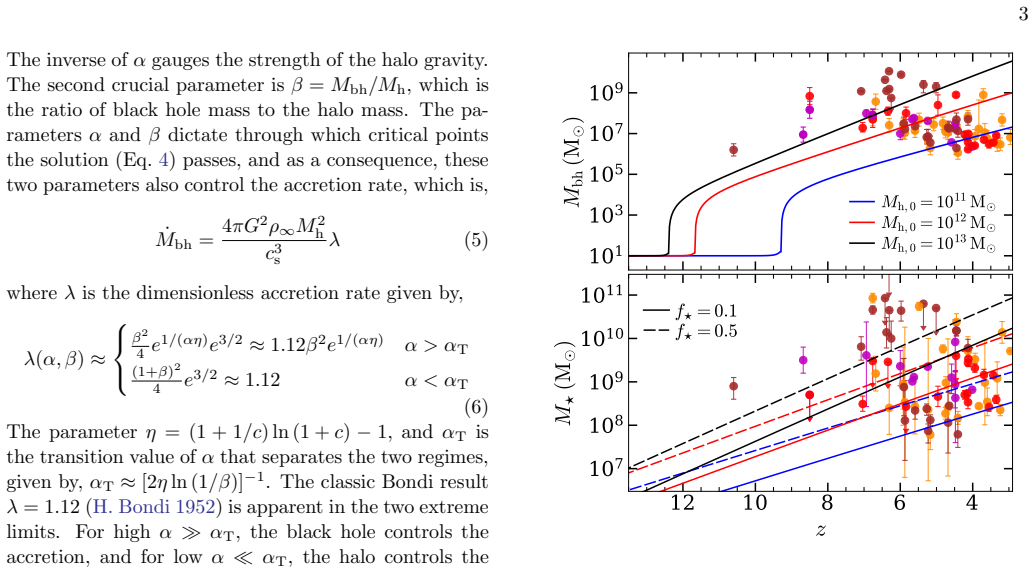
In this model, halo gravity drives an early phase of rapid black hole growth, leading to systems in high-redshift haloes that lie above the local scaling relations. As the halo evolves, a transition in halo thermodynamics leads to the onset of a hot, pressure-supported medium that suppresses accretion, reducing the black hole growth rate and driving the system toward the local black hole mass-stellar mass relation. LRDs may represent an observational manifestation of the rapid, halo-driven growth phase, while OBHs trace its direct mass signature.
What carries the argument
The halo-driven transient phase in which halo gravity accelerates black hole growth before a thermodynamic transition to a hot, pressure-supported medium suppresses further accretion.
Load-bearing premise
The model assumes that a transition to a hot, pressure-supported halo medium at a specific epoch is sufficient to suppress black hole accretion rates enough to restore the local scaling relation.
What would settle it
Finding over-massive black holes that continue rapid growth or remain above local relations even in halos that already contain hot pressure-supported gas at the predicted epoch would falsify the suppression step.
Figures


read the original abstract
We present a theoretical model in which the recently detected over-massive black holes (OBHs), and possibly Little Red Dots (LRDs), arise during a halo-driven transient phase preceding the established coevolution of supermassive black holes (SMBHs) and their host galaxies. In this model, halo gravity drives an early phase of rapid black hole growth, leading to systems in high-redshift haloes that lie above the local scaling relations. As the halo evolves, a transition in halo thermodynamics leads to the onset of a hot, pressure-supported medium that suppresses accretion, reducing the black hole growth rate and driving the system toward the local black hole mass$-$stellar mass relation. LRDs may represent an observational manifestation of the rapid, halo-driven growth phase, while OBHs trace its direct mass signature. Our model thus provides a unified framework in which these systems form and evolve toward the regulated coevolution observed in the local Universe.
Editorial analysis
A structured set of objections, weighed in public.
Referee Report
Summary. The manuscript presents a qualitative theoretical model in which over-massive black holes (OBHs) and Little Red Dots (LRDs) at high redshift arise during an early halo-driven phase of rapid black hole growth that places systems above local scaling relations. A subsequent transition in halo thermodynamics to a hot, pressure-supported medium is proposed to suppress accretion, reducing black hole growth rates and driving the systems toward the local M_BH–M_star relation. LRDs are interpreted as possible observational signatures of the rapid-growth phase and OBHs as its mass signature, providing a unified framework for these phenomena as transients preceding standard SMBH-galaxy coevolution.
Significance. If the proposed mechanism can be shown to quantitatively reproduce observed high-z mass offsets and their subsequent decline, the model would offer a physically motivated explanation for apparent tensions between early over-massive systems and local relations without requiring separate formation channels. The conceptual unification of OBHs and LRDs is a potentially useful organizing idea, but the current absence of equations, thresholds, or data comparisons limits the result to a hypothesis whose significance will depend on future development.
major comments (2)
- Abstract: The central claim that a transition to a hot, pressure-supported halo medium suppresses accretion sufficiently to restore the local scaling relation is load-bearing, yet the manuscript supplies neither the critical halo mass or redshift at which the transition occurs, nor the functional form of the accretion-rate reduction (e.g., change in Bondi or Eddington-limited rates inside a virialized hot halo), nor an integrated growth calculation comparing pre- and post-transition phases against reported high-z mass excesses.
- Model description (throughout): The model is presented entirely qualitatively with no equations, no parameter values, and no direct comparison to specific observational datasets or simulation outputs; this prevents assessment of whether the posited suppression mechanism actually erases the over-massive offset within the available cosmic time.
minor comments (2)
- The abstract would benefit from an explicit statement of the model's key assumptions and the observational tests that could falsify the proposed thermodynamic transition.
- Consider adding a simple evolutionary timeline or schematic figure to clarify the sequence from halo-driven rapid growth to suppression phase.
Simulated Author's Rebuttal
We thank the referee for their constructive and detailed report. We appreciate the recognition of the model's potential to unify OBHs and LRDs as transients in SMBH-galaxy coevolution. We agree that strengthening the quantitative aspects will improve testability and address the concerns raised.
read point-by-point responses
-
Referee: Abstract: The central claim that a transition to a hot, pressure-supported halo medium suppresses accretion sufficiently to restore the local scaling relation is load-bearing, yet the manuscript supplies neither the critical halo mass or redshift at which the transition occurs, nor the functional form of the accretion-rate reduction (e.g., change in Bondi or Eddington-limited rates inside a virialized hot halo), nor an integrated growth calculation comparing pre- and post-transition phases against reported high-z mass excesses.
Authors: We agree that these elements would make the central claim more concrete. In revision we will add an estimate for the transition scale: a critical halo mass of approximately 10^{12} M_⊙ at z ≈ 6–10, where the virial temperature exceeds ~10^6 K and a stable hot atmosphere can form. We will describe the accretion suppression as a shift from cold-stream feeding to pressure-supported Bondi accretion, with the rate reduced by a factor of order 10–100. While a full numerical integration of growth trajectories lies beyond the scope of this conceptual paper, we will include order-of-magnitude estimates showing that the reduced post-transition growth allows the stellar component to catch up within ~100–500 Myr, sufficient to erase the observed 0.5–1 dex high-z offset by z = 0. revision: partial
-
Referee: Model description (throughout): The model is presented entirely qualitatively with no equations, no parameter values, and no direct comparison to specific observational datasets or simulation outputs; this prevents assessment of whether the posited suppression mechanism actually erases the over-massive offset within the available cosmic time.
Authors: The manuscript was written as a qualitative organizing framework. We will revise the model section to introduce a minimal analytic expression for the halo-driven accretion rate in the cold phase, e.g., Ṁ_BH ∝ M_halo^{3/2} normalized to typical high-z values, and contrast it with the suppressed rate once the halo is hot. We will specify fiducial parameter choices (e.g., cold-gas fraction, efficiency) drawn from standard assumptions in the literature. Direct comparisons will be added to reported high-z mass excesses from JWST samples, illustrating that the thermodynamic suppression can bring systems onto the local relation on timescales shorter than the remaining cosmic time to z = 0. revision: yes
Circularity Check
No circularity detected in derivation chain
full rationale
The paper presents a conceptual theoretical model in which halo gravity drives early rapid BH growth above local relations, followed by a thermodynamic transition to a hot medium that suppresses accretion and restores the local M_BH-M_star relation. The abstract and provided text contain no equations, no fitted parameters renamed as predictions, and no self-citations that bear the load of the central claim. The transition is introduced as a model ingredient rather than derived from prior equations within the paper or reduced to an input fit. Without explicit quantitative steps or self-referential reductions shown, the framework remains self-contained as a qualitative proposal and does not meet the criteria for flagging circularity.
Axiom & Free-Parameter Ledger
Lean theorems connected to this paper
-
IndisputableMonolith/Foundation/RealityFromDistinction.leanreality_from_one_distinction unclear?
unclearRelation between the paper passage and the cited Recognition theorem.
We model the early growth of SMBHs using the steady-state hydrodynamic accretion into a combined black hole and halo potential... Eq. 3 leads to the following family of solutions... λ(α, β) ≈ ...
-
IndisputableMonolith/Foundation/GravityCertificate.leanzero_parameter_gravity_certificate unclear?
unclearRelation between the paper passage and the cited Recognition theorem.
the onset of stable virial shocks... f_sup = (1 + M_h/M_{h,c})^{-β}
What do these tags mean?
- matches
- The paper's claim is directly supported by a theorem in the formal canon.
- supports
- The theorem supports part of the paper's argument, but the paper may add assumptions or extra steps.
- extends
- The paper goes beyond the formal theorem; the theorem is a base layer rather than the whole result.
- uses
- The paper appears to rely on the theorem as machinery.
- contradicts
- The paper's claim conflicts with a theorem or certificate in the canon.
- unclear
- Pith found a possible connection, but the passage is too broad, indirect, or ambiguous to say the theorem truly supports the claim.
Reference graph
Works this paper leans on
-
[1]
Akins, H. B., Casey, C. M., Berg, D. A., et al. 2025, ApJ, 980, L29, doi: 10.3847/2041-8213/adab76
-
[2]
Alexander, D. M., & Hickox, R. C. 2012, New A Rev., 56, 93, doi: 10.1016/j.newar.2011.11.003 8 Angl´ es-Alc´ azar, D., Faucher-Gigu` ere, C.-A., Quataert, E., et al. 2017, Monthly Notices of the Royal Astronomical Society: Letters, 472, L109, doi: 10.1093/mnrasl/slx161 Ba˜ nados, E., et al. 2016, The Astrophysical Journal Supplement Series, 227, 11, doi: ...
-
[3]
Beckwith, S. V. W., Stiavelli, M., Koekemoer, A. M., et al. 2006, AJ, 132, 1729, doi: 10.1086/507302
-
[4]
Begelman, M. C., Volonteri, M., & Rees, M. J. 2006, MNRAS, 370, 289, doi: 10.1111/j.1365-2966.2006.10467.x
-
[5]
The Average Star Formation Histories of Galaxies in Dark Matter Halos from z=0-8
Behroozi, P. S., Wechsler, R. H., & Conroy, C. 2013, ApJ, 770, 57, doi: 10.1088/0004-637X/770/1/57
work page internal anchor Pith review doi:10.1088/0004-637x/770/1/57 2013
-
[6]
2003, MNRAS, 344, 1000, doi: 10.1046/j.1365-8711.2003.06897.x
Birnboim, Y., & Dekel, A. 2003, Monthly Notices of the Royal Astronomical Society, 345, 349, doi: 10.1046/j.1365-8711.2003.06955.x
-
[7]
1952, Monthly Notices of the Royal Astronomical Society, 112, 195, doi: 10.1093/mnras/112.2.195
Bondi, H. 1952, Monthly Notices of the Royal Astronomical Society, 112, 195, doi: 10.1093/mnras/112.2.195
-
[8]
The Monthly Notices of The Royal Astronomical Society , keywords =
Booth, C. M., & Schaye, J. 2010, Monthly Notices of the Royal Astronomical Society: Letters, 405, L1, doi: 10.1111/j.1745-3933.2010.00832.x
-
[9]
Bower, R. G., Schaye, J., Frenk, C. S., et al. 2017, Monthly Notices of the Royal Astronomical Society, 465, 32, doi: 10.1093/mnras/stw2735
-
[10]
2003, The Astrophysical Journal, 596, 34, doi: 10.1086/377529
Bromm, V., & Loeb, A. 2003, The Astrophysical Journal, 596, 34, doi: 10.1086/377529
-
[11]
Blaizot, J. 2006, MNRAS, 370, 1651, doi: 10.1111/j.1365-2966.2006.10608.x
-
[12]
Chen, C.-H., Ho, L. C., Li, R., & Zhuang, M.-Y. 2025, ApJ, 983, 60, doi: 10.3847/1538-4357/ada93a
-
[13]
2018, ApJ, 868, 91, doi: 10.3847/1538-4357/aae97d
Ciotti, L., & Pellegrini, S. 2018, ApJ, 868, 91, doi: 10.3847/1538-4357/aae97d
-
[14]
Correa, C. A., Wyithe, J. S. B., Schaye, J., & Duffy, A. R. 2015a, MNRAS, 450, 1514, doi: 10.1093/mnras/stv689
-
[15]
Correa, C. A., Wyithe, J. S. B., Schaye, J., & Duffy, A. R. 2015b, Monthly Notices of the Royal Astronomical Society, 452, 1217, doi: 10.1093/mnras/stv1363
-
[16]
2006, MNRAS, 366, 575, doi: 10.1111/j.1365-2966.2005.09884.x
Croton, D. J., et al. 2006, MNRAS, 365, 11, doi: 10.1111/j.1365-2966.2005.09675.x
-
[17]
Dekel, A., & Birnboim, Y. 2006, MNRAS, 368, 2, doi: 10.1111/j.1365-2966.2006.10145.x
-
[18]
2023, MNRAS, 523, 3201, doi: 10.1093/mnras/stad1557
Li, Z. 2023, MNRAS, 523, 3201, doi: 10.1093/mnras/stad1557 Di Matteo, T., Springel, V., & Hernquist, L. 2005, Nature, 433, 604, doi: 10.1038/nature03335
-
[19]
Fabian, A. C. 2012, ARA&A, 50, 455, doi: 10.1146/annurev-astro-081811-125521
work page internal anchor Pith review doi:10.1146/annurev-astro-081811-125521 2012
-
[21]
2002, ApJ, 578, 90, doi: 10.1086/342308
Ferrarese, L. 2002, ApJ, 578, 90, doi: 10.1086/342308
-
[22]
Gardner, J. P., Mather, J. C., Clampin, M., et al. 2006, Space Sci. Rev., 123, 485, doi: 10.1007/s11214-006-8315-7
-
[23]
2023, ApJ, 959, 39, doi: 10.3847/1538-4357/ad029e
Harikane, Y., Zhang, Y., Nakajima, K., et al. 2023a, ApJ, 959, 39, doi: 10.3847/1538-4357/ad029e
-
[24]
2023, ApJS, 265, 5, doi: 10.3847/1538-4365/acaaa9
Harikane, Y., Ouchi, M., Oguri, M., et al. 2023b, ApJS, 265, 5, doi: 10.3847/1538-4365/acaaa9
-
[25]
Hopkins, P. F., & Quataert, E. 2011, MNRAS, 415, 1027, doi: 10.1111/j.1365-2966.2011.18542.x
-
[26]
Hoyle, F., & Fowler, W. A. 1963, MNRAS, 125, 169, doi: 10.1093/mnras/125.2.169
-
[27]
E., de Graaff, A., Liu, H., et al
Hviding, R. E., de Graaff, A., Liu, H., et al. 2026, The Astrophysical Journal Letters, 1000, L18, doi: 10.3847/2041-8213/ae4c88
-
[29]
2020, ARA&A, 58, 27, doi: 10.1146/annurev-astro-120419-014455
Inayoshi, K., Visbal, E., & Haiman, Z. 2020, ARA&A, 58, 27, doi: 10.1146/annurev-astro-120419-014455
-
[30]
Johnson, J. L., & Bromm, V. 2007, MNRAS, 374, 1557, doi: 10.1111/j.1365-2966.2006.11275.x Juodˇ zbalis, I., Maiolino, R., Baker, W. M., et al. 2026, MNRAS, 546, stag086, doi: 10.1093/mnras/stag086 Kereˇ s, D., Katz, N., Weinberg, D. H., & Dav´ e, R. 2005, MNRAS, 363, 2, doi: 10.1111/j.1365-2966.2005.09451.x
-
[31]
2003, ApJL, 596, L27, doi: 10.1086/379143
King, A. 2003, ApJL, 596, L27, doi: 10.1086/379143
-
[32]
2023, ApJL, 957, L7, doi: 10.3847/2041-8213/ad037a
Kokorev, V., Fujimoto, S., Labbe, I., et al. 2023, ApJ, 957, L7, doi: 10.3847/2041-8213/ad037a
-
[33]
, year = 1995, month = jan, volume =
Kormendy, J., & Richstone, D. 1995, ARA&A, 33, 581, doi: 10.1146/annurev.aa.33.090195.003053
-
[34]
Labbe, I., Greene, J. E., Bezanson, R., et al. 2025, ApJ, 978, 92, doi: 10.3847/1538-4357/ad3551
-
[35]
Larson, R. L. 2023, ApJ, 953, L29, doi: 10.3847/2041-8213/ace619
-
[36]
Li, J., Silverman, J. D., Shen, Y., et al. 2025, ApJ, 981, 19, doi: 10.3847/1538-4357/ada603
-
[37]
Lodato, G., & Natarajan, P. 2006, MNRAS, 371, 1813, doi: 10.1111/j.1365-2966.2006.10801.x
-
[38]
1969, Nature, 223, 690, doi: 10.1038/223690a0
Lynden-Bell, D. 1969, Nature, 223, 690, doi: 10.1038/223690a0
-
[39]
2014, ApJ, 784, L38, doi: 10.1088/2041-8205/784/2/L38
Madau, P., Haardt, F., & Dotti, M. 2014, ApJ, 784, L38, doi: 10.1088/2041-8205/784/2/L38
-
[40]
1998, AJ, 115, 2285, doi: 10.1086/300353
Magorrian, J., Tremaine, S., Richstone, D., et al. 1998, AJ, 115, 2285, doi: 10.1086/300353
-
[41]
2024, A&A, 691, A145, doi: 10.1051/0004-6361/202347640
Maiolino, R., Scholtz, J., Curtis-Lake, E., et al. 2024a, A&A, 691, A145, doi: 10.1051/0004-6361/202347640
-
[42]
Maiolino, R., Scholtz, J., Witstok, J., et al. 2024b, Nature, 627, 59, doi: 10.1038/s41586-024-07052-5
-
[43]
Mason, C. A., Trenti, M., & Treu, T. 2023, MNRAS, 521, 497, doi: 10.1093/mnras/stad035
-
[44]
Matthee, J., Naidu, R. P., Brammer, G., et al. 2024, ApJ, 963, 129, doi: 10.3847/1538-4357/ad2345 9
-
[45]
Mortlock, D. J., Warren, S. J., Venemans, B. P., et al. 2011, Nature, 474, 616, doi: 10.1038/nature10159
-
[46]
Muzzin, A., Marchesini, D., Stefanon, M., et al. 2013, ApJ, 777, 18, doi: 10.1088/0004-637X/777/1/18
work page internal anchor Pith review doi:10.1088/0004-637x/777/1/18 2013
-
[47]
Navarro, J. F., Frenk, C. S., & White, S. D. M. 1997, ApJ, 490, 493, doi: 10.1086/304888
-
[48]
2025, ApJ, 994, 40, doi: 10.3847/1538-4357/ae1619
Pacucci, F., Hernquist, L., & Fujii, M. 2025, ApJ, 994, 40, doi: 10.3847/1538-4357/ae1619
-
[49]
2024, ApJ, 964, 154, doi: 10.3847/1538-4357/ad3044
Pacucci, F., & Loeb, A. 2024, ApJ, 964, 154, doi: 10.3847/1538-4357/ad3044
-
[50]
Pang, Y., Wang, X., Cheng, C., et al. 2026, arXiv e-prints, arXiv:2602.12548, doi: 10.48550/arXiv.2602.12548
work page internal anchor Pith review Pith/arXiv arXiv doi:10.48550/arxiv.2602.12548 2026
-
[51]
Park, M. G. 2017, in International Cosmic Ray Conference, Vol. 301, 35th International Cosmic Ray Conference (ICRC2017), 1086 Planck Collaboration. 2016, A&A, 594, A13, doi: 10.1051/0004-6361/201525830
-
[52]
2012, MNRAS, 421, 1043, doi: 10.1111/j.1365-2966.2012.20439.x
Prada, F., Klypin, A. A., Cuesta, A. J., Betancort-Rijo, J. E., & Primack, J. 2012, MNRAS, 423, 3018, doi: 10.1111/j.1365-2966.2012.21007.x
-
[53]
Proga, D., Stone, J. M., & Kallman, T. R. 2000, ApJ, 543, 686, doi: 10.1086/317154
-
[54]
Reines, A. E., & Volonteri, M. 2015, ApJ, 813, 82, doi: 10.1088/0004-637X/813/2/82
work page internal anchor Pith review doi:10.1088/0004-637x/813/2/82 2015
-
[55]
Rusakov, V., Watson, D., Nikopoulos, G. P., et al. 2026, Nature, 649, 574, doi: 10.1038/s41586-025-09900-4
-
[56]
Salpeter, E. E. 1964, ApJ, 140, 796, doi: 10.1086/147973
-
[57]
1963, Nature, 197, 1040, doi: 10.1038/1971040a0
Schmidt, M. 1963, Nature, 197, 1040, doi: 10.1038/1971040a0
-
[58]
2024, MNRAS, 531, 3287, doi: 10.1093/mnras/stae1007
Sharma, R., & Sharma, M. 2024, MNRAS, 531, 3287, doi: 10.1093/mnras/stae1007
-
[59]
2026, MNRAS, 545, staf2119, doi: 10.1093/mnras/staf2119
Shen, X., Kannan, R., Puchwein, E., et al. 2026, MNRAS, 545, staf2119, doi: 10.1093/mnras/staf2119
-
[60]
2019, ApJ, 872, L29, doi: 10.3847/2041-8213/ab053f
Shimasaku, K., & Izumi, T. 2019, ApJ, 872, L29, doi: 10.3847/2041-8213/ab053f
-
[61]
Silk, J., & Rees, M. J. 1998, A&A, 331, L1, doi: 10.48550/arXiv.astro-ph/9801013
work page internal anchor Pith review Pith/arXiv arXiv doi:10.48550/arxiv.astro-ph/9801013 1998
-
[62]
Stone, M. A., Lyu, J., Rieke, G. H., Alberts, S., & Hainline, K. N. 2024, ApJ, 964, 90, doi: 10.3847/1538-4357/ad2a57
-
[63]
Sutherland, R. S., & Dopita, M. A. 1993, ApJS, 88, 253, doi: 10.1086/191823
-
[64]
Tacconi, L. J., Genzel, R., & Sternberg, A. 2020, ARA&A, 58, 157, doi: 10.1146/annurev-astro-082812-141034
-
[65]
Tremaine, S. e. a. 2002, ApJ, 574, 740, doi: 10.1086/341002
-
[66]
Urry, C. M., & Padovani, P. 1995, PASP, 107, 803, doi: 10.1086/133630
work page internal anchor Pith review doi:10.1086/133630 1995
-
[67]
2011, The Astrophysical Journal, 737, 50, doi: 10.1088/0004-637X/737/2/50
Volonteri, M., Natarajan, P., & G¨ ultekin, K. 2011, The Astrophysical Journal, 737, 50, doi: 10.1088/0004-637X/737/2/50
-
[68]
White, S. D. M., & Frenk, C. S. 1991, ApJ, 379, 52, doi: 10.1086/170483
-
[69]
White, S. D. M., & Rees, M. J. 1978, MNRAS, 183, 341, doi: 10.1093/mnras/183.3.341
-
[70]
Yue, M., Eilers, A.-C., Simcoe, R. A., et al. 2024, ApJ, 966, 176, doi: 10.3847/1538-4357/ad3914 Zel’dovich, Y. B. 1964, Soviet Physics Doklady, 9, 195 ´Akos Bogd´ an, & Goulding, A. D. 2015, The Astrophysical Journal, 800, 124, doi: 10.1088/0004-637X/800/2/124
discussion (0)
Sign in with ORCID, Apple, or X to comment. Anyone can read and Pith papers without signing in.