Optically Selected Superthin Galaxies Remain Thin in the Near-infrared
Pith reviewed 2026-07-02 09:33 UTC · model grok-4.3
The pith
Optically selected superthin galaxies remain superthin in the near-infrared.
A machine-rendered reading of the paper's core claim, the machinery that carries it, and where it could break.
Core claim
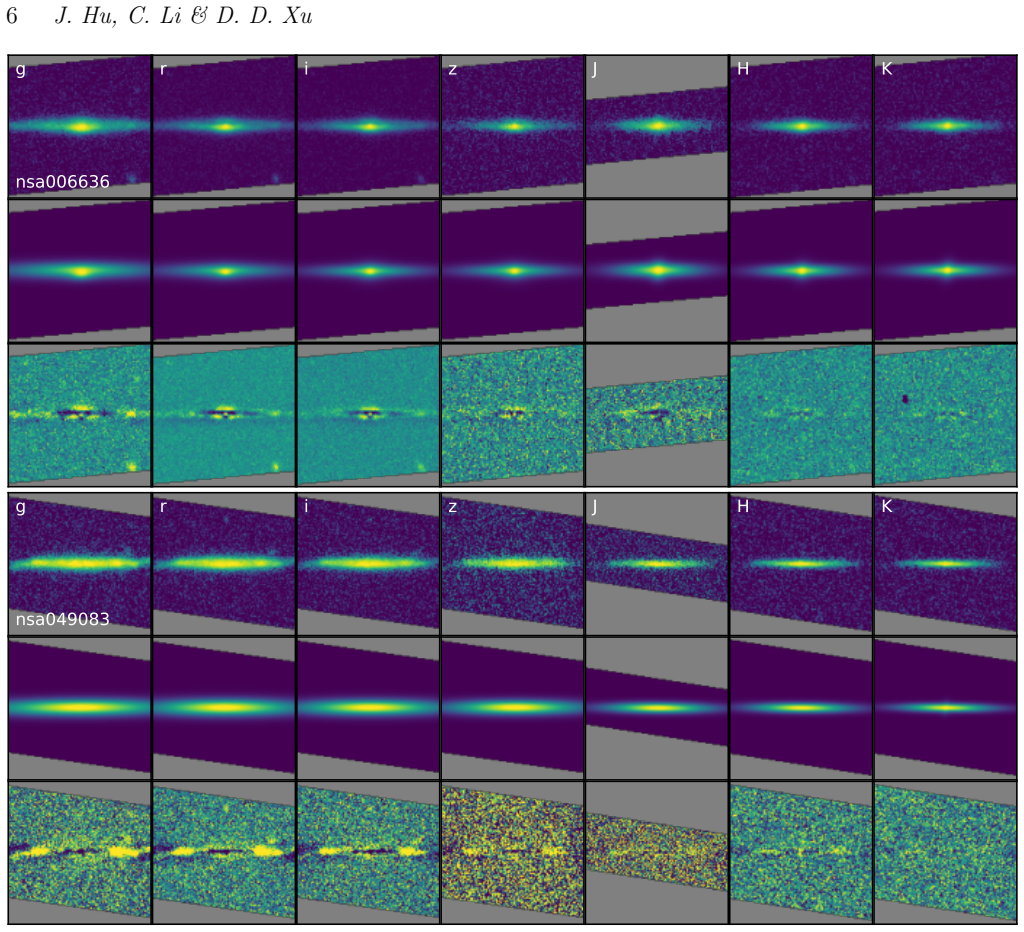
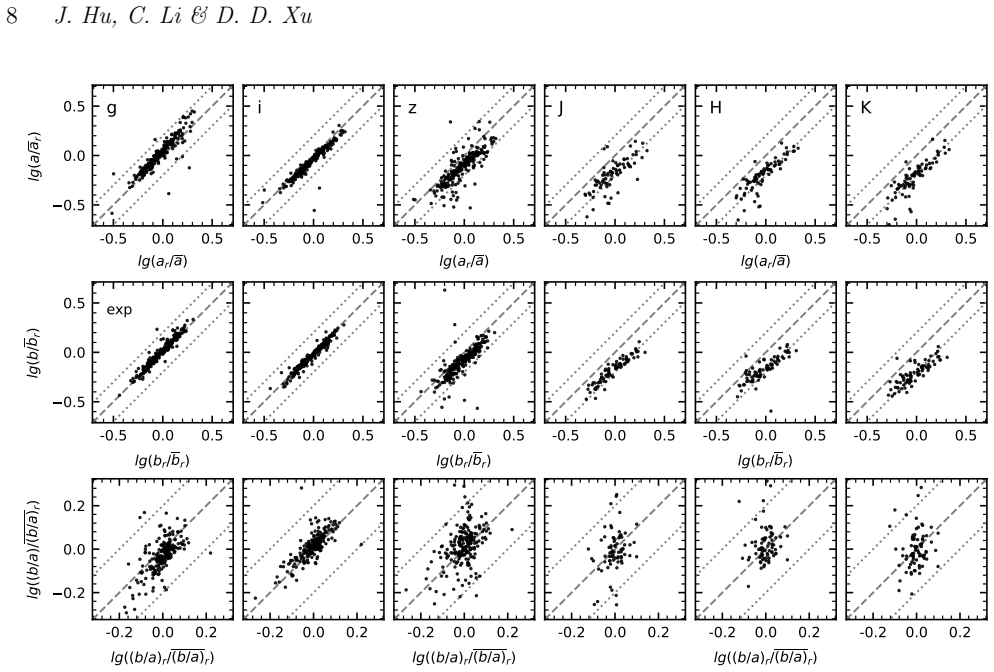
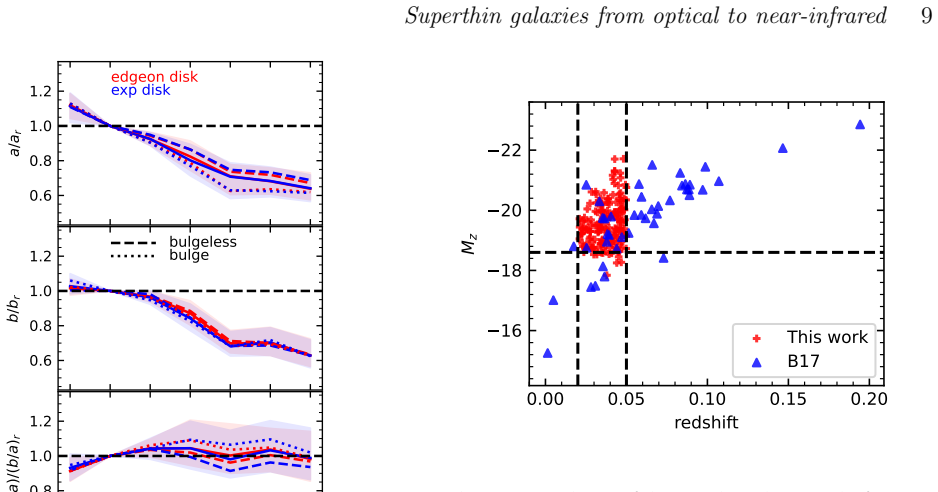
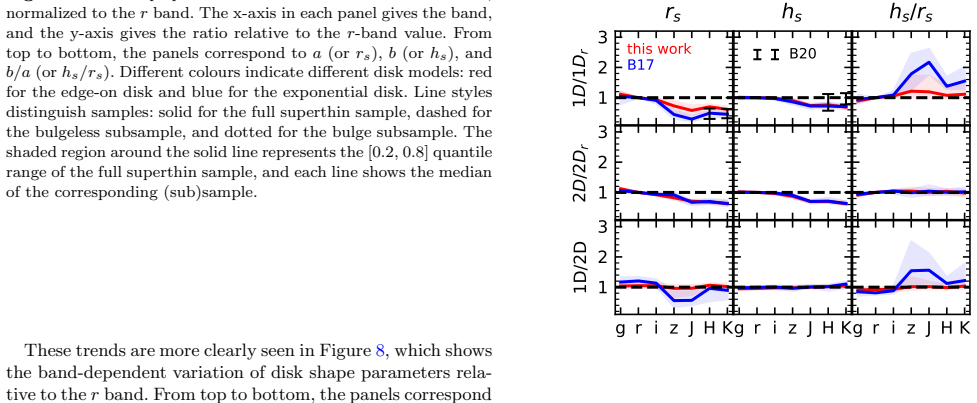
Optically selected superthin galaxies defined by disk axis ratios a/b greater than 9 in SDSS r-band images keep essentially the same axis ratios when measured in near-infrared bands, with sizes decreasing but no increase in thickness, showing that old stellar populations do not form a prominent thick disk; earlier apparent thickening is traced to one-dimensional fitting biases, and the sample exhibits lower clustering on 0.1 to 1 h inverse Mpc scales plus lower overdensities at 1 h inverse Mpc.
What carries the argument
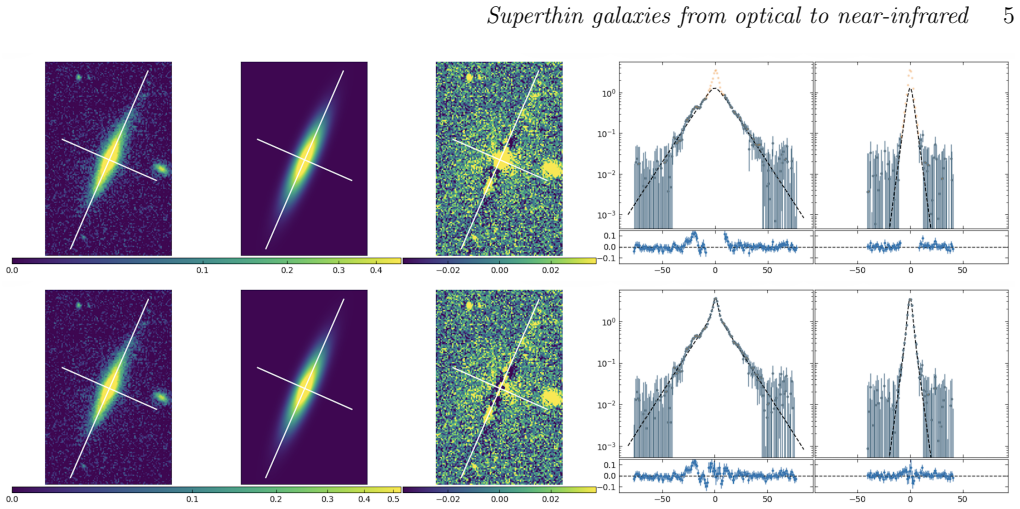
Two-dimensional bulge-disk decomposition applied across SDSS griz to UKIDSS JHK bands to extract disk axis ratios and scale lengths.
If this is right
- Old stellar populations traced by near-infrared light do not produce a prominent thick disk in these galaxies.
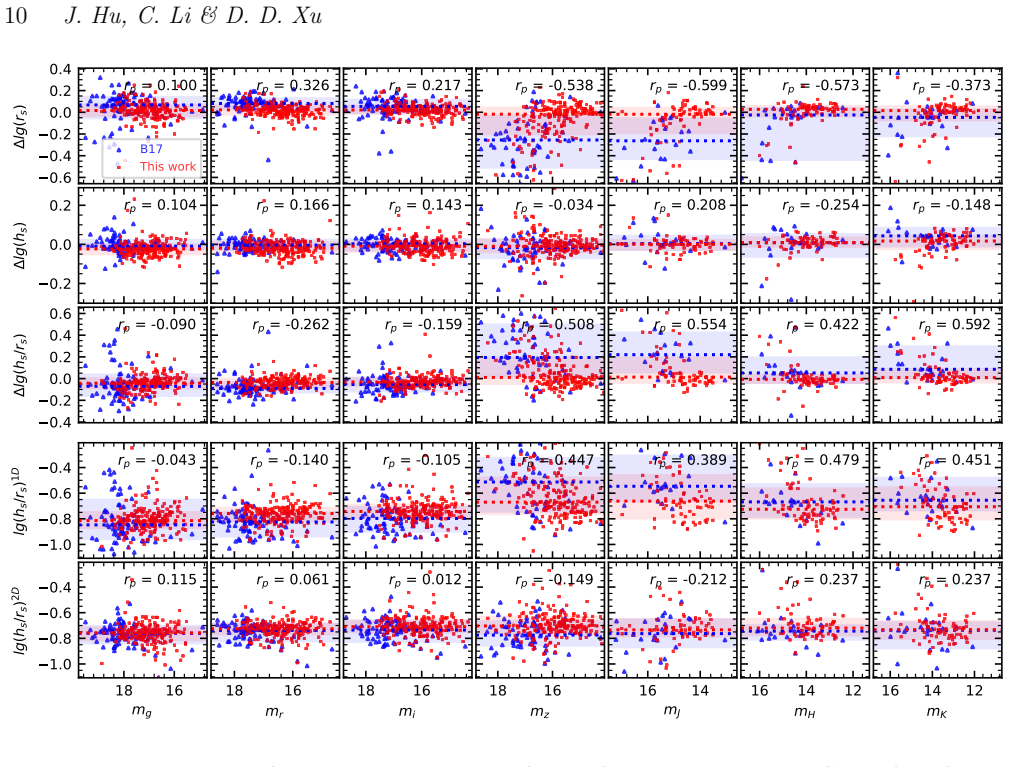
- Reported near-infrared thickening in earlier work stems mainly from magnitude- and band-dependent biases in one-dimensional fitting.
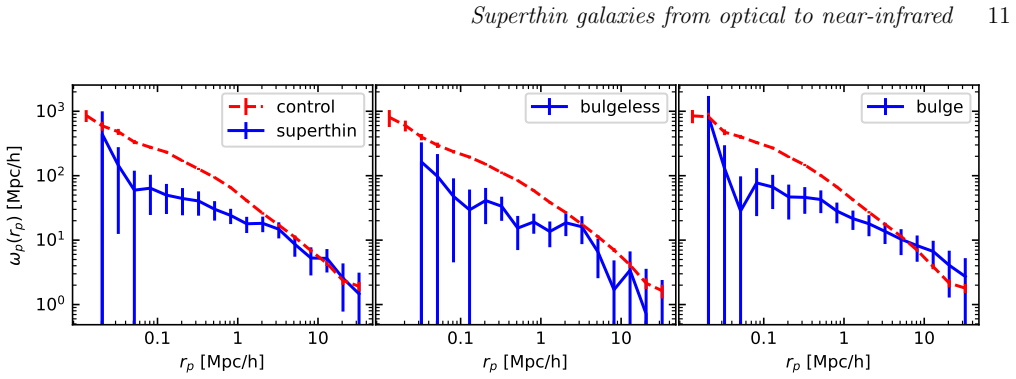
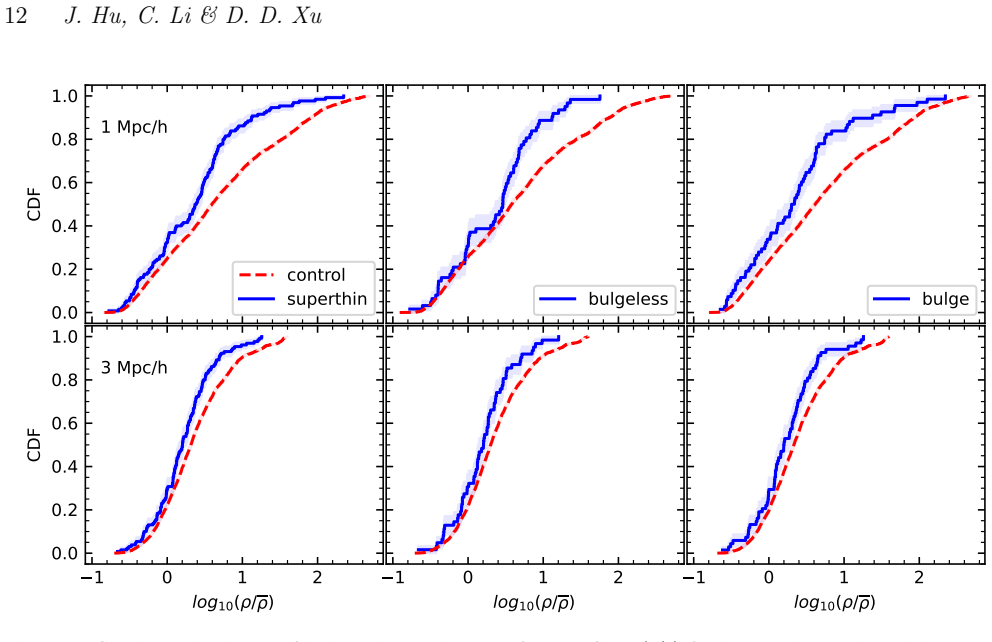
- Superthin galaxies exhibit lower clustering on scales of 0.1 to 1 h inverse Mpc and lower overdensities at 1 h inverse Mpc.
- These galaxies are preferentially central objects in relatively low-mass dark matter halos.
- High host-halo spin contributes to building and preserving extended, vertically thin stellar disks.
Where Pith is reading between the lines
- Galaxy formation models must include channels that preserve thin stellar disks against vertical heating when host halos carry high spin.
- Multi-band axis-ratio measurements could be extended to other extreme disk samples to check whether thinness is age-independent across populations.
- The absence of residual large-scale-structure dependence implies that local halo properties outweigh cosmic-web effects in sustaining superthin morphologies.
- Superthin galaxies may represent a distinct formation pathway for disk galaxies that avoids significant vertical thickening over cosmic time.
Load-bearing premise
The two-dimensional decomposition of SDSS r-band images correctly isolates galaxies whose intrinsic disks have axis ratios above 9 without major contamination from projection effects or component misclassification.
What would settle it
A measurement in which the K-band disk axis ratio for the same galaxies drops substantially below the optical value would falsify the central claim.
Figures
read the original abstract
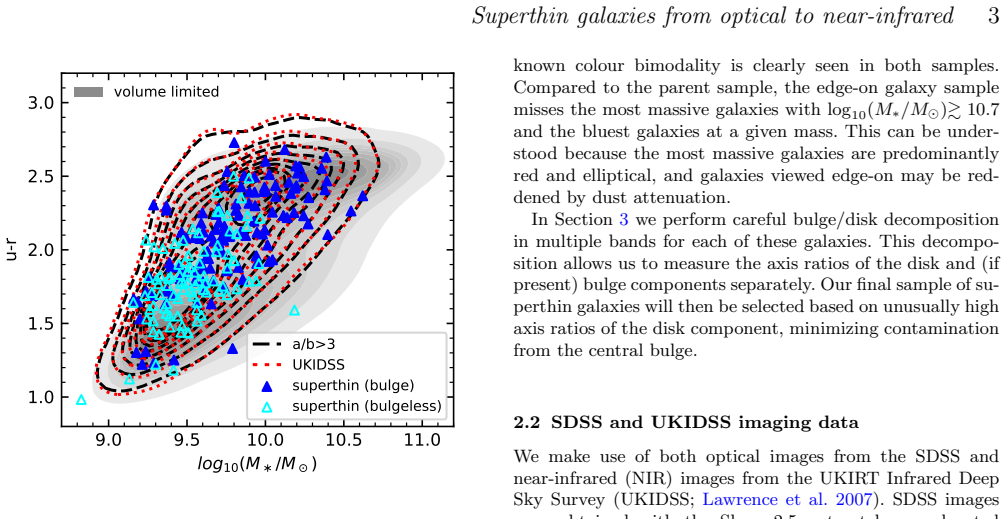
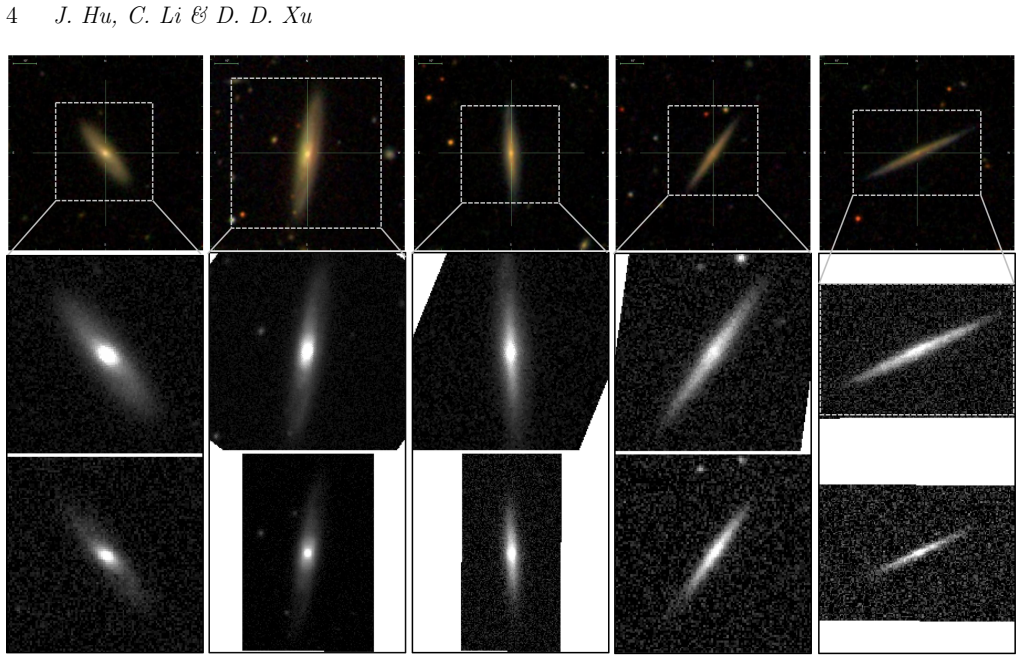
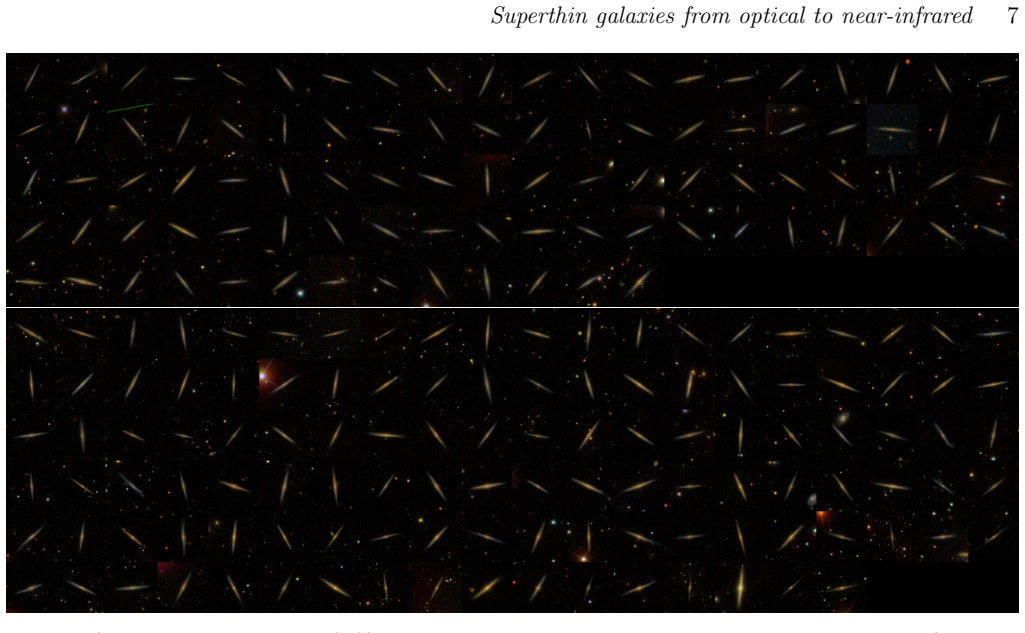
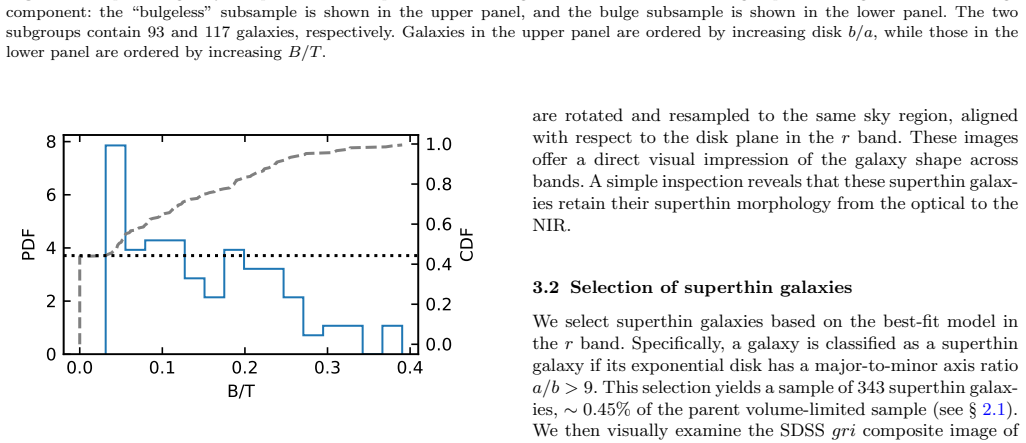
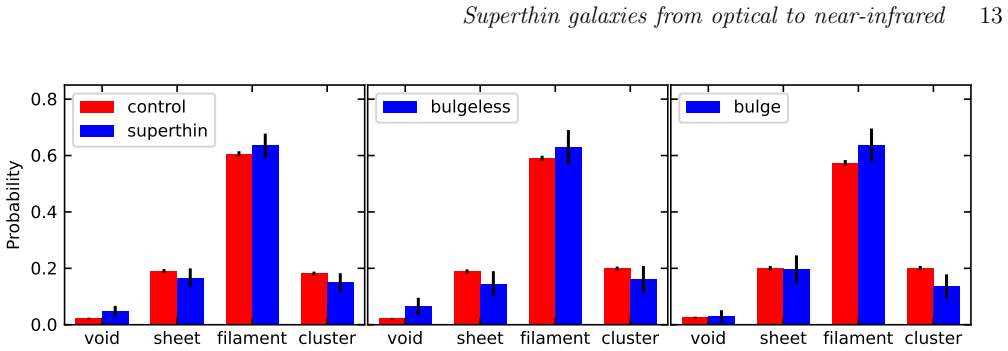
We investigate whether galaxies identified as superthin in optical images remain superthin in the near-infrared (NIR), and how their extreme disk morphology is related to environment. From a nearby volume-limited sample, we select 210 superthin galaxies using two-dimensional bulge/disk decomposition of SDSS $r$-band images, requiring the disk component to have a major-to-minor axis ratio $a/b>9$. We measure disk shapes from SDSS $griz$ to UKIDSS $JHK$ bands. Both the major- and minor-axis scales decrease from the optical to the NIR, reaching $\sim0.6$ of their $r$-band values in the $K$ band, but the disk axis ratio remains nearly unchanged. Thus, optically selected superthin galaxies remain superthin in the NIR, implying that the old stellar populations traced by NIR light do not form a prominent thick disk. Reanalysis of our sample and a previous superthin sample shows that earlier reported NIR thickening is mainly due to a magnitude- and band-dependent bias in one-dimensional fitting. We further compare their environments with matched control samples using projected cross-correlations, reconstructed local overdensities, and large-scale-structure classifications. Superthin galaxies show lower clustering on $\sim0.1$--$1\,h^{-1}\,\mathrm{Mpc}$ scales and lower overdensities at $1\,h^{-1}\,\mathrm{Mpc}$, but no clear residual dependence on large-scale-structure type. These results suggest that superthin galaxies are preferentially central galaxies in relatively low-mass dark matter halos, consistent with a picture in which high host-halo spin helps build and preserve extended, vertically thin stellar disks.
Editorial analysis
A structured set of objections, weighed in public.
Referee Report
Summary. The paper selects 210 superthin galaxies (disk component a/b >9 from 2D bulge/disk decomposition of SDSS r-band images) in a nearby volume-limited sample. It measures major- and minor-axis scales and axis ratios from SDSS griz through UKIDSS JHK, finding sizes shrink to ~0.6 of r-band values in K but axis ratios stay nearly constant. This implies optically selected superthin galaxies remain superthin in NIR, so old stellar populations lack a prominent thick disk. The authors reanalyze their sample plus a prior one to attribute earlier NIR-thickening reports to 1D fitting bias. Environmental analysis via projected cross-correlations, local overdensities, and LSS classification shows lower clustering on 0.1-1 h^{-1} Mpc scales and lower overdensities, suggesting superthin galaxies are centrals in low-mass, high-spin halos.
Significance. If the result holds, the work constrains disk vertical structure by showing old stars do not build thick disks in these systems and supports halo-spin models for preserving thin disks. The explicit correction for 1D fitting bias via reanalysis is a clear strength, as is the use of public multi-band photometry and statistical environmental metrics. The environmental findings add context on morphology-density relations.
major comments (2)
- [Sample selection] The central claim that the r-band 2D decomposition cleanly selects galaxies with intrinsic disk a/b >9 (without significant projection effects, PSF convolution errors, or component misidentification) is load-bearing for interpreting unchanged NIR axis ratios, yet the manuscript provides no quantitative robustness tests at this extreme threshold (e.g., varying initial guesses, profile assumptions, or PSF impact); see the sample selection description.
- [Environmental analysis] Details on control-sample matching criteria (stellar mass, redshift, luminosity) and error propagation for the projected cross-correlations and reconstructed overdensities are not reported, weakening assessment of the reported differences on ~0.1-1 h^{-1} Mpc scales and the halo-spin interpretation; see the environmental analysis section.
minor comments (2)
- [Abstract] The abstract states that 'earlier reported NIR thickening is mainly due to a magnitude- and band-dependent bias in one-dimensional fitting' but does not reference the specific section presenting the reanalysis and bias quantification.
- [Throughout] Notation for axis ratio (observed vs. intrinsic, major-to-minor definition) should be stated explicitly and used consistently when reporting values across bands.
Simulated Author's Rebuttal
We thank the referee for their careful reading and constructive comments. We address the two major comments point by point below and will revise the manuscript to incorporate the requested details and tests.
read point-by-point responses
-
Referee: [Sample selection] The central claim that the r-band 2D decomposition cleanly selects galaxies with intrinsic disk a/b >9 (without significant projection effects, PSF convolution errors, or component misidentification) is load-bearing for interpreting unchanged NIR axis ratios, yet the manuscript provides no quantitative robustness tests at this extreme threshold (e.g., varying initial guesses, profile assumptions, or PSF impact); see the sample selection description.
Authors: We agree that explicit quantitative robustness tests at the a/b >9 threshold would strengthen the sample selection. In the revised manuscript we will add a dedicated subsection reporting results from (i) repeated decompositions with varied initial guesses, (ii) fits performed with and without a bulge component, and (iii) an assessment of PSF convolution effects on recovered axis ratios for galaxies near the selection boundary. These tests will be performed on both the full sample and a representative subset. revision: yes
-
Referee: [Environmental analysis] Details on control-sample matching criteria (stellar mass, redshift, luminosity) and error propagation for the projected cross-correlations and reconstructed overdensities are not reported, weakening assessment of the reported differences on ~0.1-1 h^{-1} Mpc scales and the halo-spin interpretation; see the environmental analysis section.
Authors: We acknowledge that the current text omits the precise matching tolerances and error-propagation procedures. The revised version will specify the exact criteria (including bin widths or tolerances in stellar mass, redshift, and luminosity) used to construct the control samples and will describe the error estimation methods, including any bootstrap or jackknife resampling applied to the projected cross-correlation functions and local overdensities. revision: yes
Circularity Check
No circularity: purely observational selection and band-to-band measurement with no self-referential derivations or load-bearing self-citations
full rationale
The paper performs a volume-limited selection of galaxies via public SDSS r-band 2D bulge/disk decompositions (a/b > 9 threshold), then measures the same axis ratios in grizJHK bands from the same and additional public surveys. No equations, fitted parameters, or predictions are defined in terms of the target result; the axis-ratio invariance is a direct empirical outcome. The reanalysis of prior 1D-fitting biases references earlier literature (including possibly overlapping samples) but is not required to establish the central NIR-thinness claim, which rests on independent photometry. This matches the default expectation for an observational catalog study whose central result is externally falsifiable against the input imaging data.
Axiom & Free-Parameter Ledger
free parameters (1)
- axis ratio threshold a/b >9
axioms (1)
- domain assumption Two-dimensional bulge/disk decomposition of SDSS r-band images yields reliable major-to-minor axis ratios for disk components
Reference graph
Works this paper leans on
-
[1]
Modern astrophysics
New morphological types of galaxies. Modern astrophysics. A memorial to Otto Struve , year = 1967, editor =
1967
-
[2]
The Formation and Dynamics of Galaxies , year = 1974, \ =
Structure, Dynamics and Statistical Properties of Galaxies (invited Paper). The Formation and Dynamics of Galaxies , year = 1974, \ =
1974
-
[3]
ELUCID - Exploring the Local Universe with ReConstructed Initial Density Field III: Constrained Simulation in the SDSS Volume. , keywords =. doi:10.3847/0004-637X/831/2/164 , archivePrefix =. 1608.01763 , primaryClass =
work page internal anchor Pith review Pith/arXiv arXiv doi:10.3847/0004-637x/831/2/164
-
[4]
The Seventh Data Release of the Sloan Digital Sky Survey
The Seventh Data Release of the Sloan Digital Sky Survey. , keywords =. doi:10.1088/0067-0049/182/2/543 , archivePrefix =. 0812.0649 , primaryClass =
work page internal anchor Pith review Pith/arXiv arXiv doi:10.1088/0067-0049/182/2/543
-
[5]
Evolution of Low Surface Brightness Ultrathin Galaxies: The Role of Dark Matter Halo and Bar Formation on Disk Thickness. , keywords =. doi:10.3847/1538-4357/ae0991 , archivePrefix =. 2509.12966 , primaryClass =
-
[6]
First results from the IllustrisTNG simulations: radio haloes and magnetic fields
First results from the IllustrisTNG simulations: radio haloes and magnetic fields. , keywords =. doi:10.1093/mnras/sty2206 , archivePrefix =. 1707.03396 , primaryClass =
work page internal anchor Pith review Pith/arXiv arXiv doi:10.1093/mnras/sty2206
-
[7]
First results from the IllustrisTNG simulations: a tale of two elements - chemical evolution of magnesium and europium. , keywords =. doi:10.1093/mnras/sty618 , archivePrefix =. 1707.03401 , primaryClass =
work page internal anchor Pith review Pith/arXiv arXiv doi:10.1093/mnras/sty618
-
[8]
First results from the IllustrisTNG simulations: the galaxy color bimodality
First results from the IllustrisTNG simulations: the galaxy colour bimodality. , keywords =. doi:10.1093/mnras/stx3040 , archivePrefix =. 1707.03395 , primaryClass =
work page internal anchor Pith review Pith/arXiv arXiv doi:10.1093/mnras/stx3040
-
[9]
First results from the IllustrisTNG simulations: the stellar mass content of groups and clusters of galaxies. , keywords =. doi:10.1093/mnras/stx3112 , archivePrefix =. 1707.03406 , primaryClass =
work page internal anchor Pith review Pith/arXiv arXiv doi:10.1093/mnras/stx3112
-
[10]
First results from the IllustrisTNG simulations: matter and galaxy clustering
First results from the IllustrisTNG simulations: matter and galaxy clustering. , keywords =. doi:10.1093/mnras/stx3304 , archivePrefix =. 1707.03397 , primaryClass =
work page internal anchor Pith review Pith/arXiv arXiv doi:10.1093/mnras/stx3304
-
[11]
Research in Astronomy and Astrophysics , keywords =
Formation of Superthin Galaxies in IllustrisTNG. Research in Astronomy and Astrophysics , keywords =. doi:10.1088/1674-4527/ad5399 , archivePrefix =. 2406.13745 , primaryClass =
-
[12]
, year = 2017, month = apr, volume = 466, number = 3, pages =
Mass modelling of superthin galaxies: IC5249, UGC7321 and IC2233. , year = 2017, month = apr, volume = 466, number = 3, pages =. doi:10.1093/mnras/stw3219 , adsurl =
-
[13]
, year = 2022, month = aug, volume = 514, number = 4, pages =
Are superthin galaxies low-surface-brightness galaxies seen edge-on? The star formation probe. , year = 2022, month = aug, volume = 514, number = 4, pages =. doi:10.1093/mnras/stac1502 , adsurl =
-
[14]
Detailed Decomposition of Galaxy Images. II. Beyond Axisymmetric Models. , keywords =. doi:10.1088/0004-6256/139/6/2097 , archivePrefix =. 0912.0731 , primaryClass =
work page internal anchor Pith review Pith/arXiv arXiv doi:10.1088/0004-6256/139/6/2097 2097
-
[15]
Detailed Structural Decomposition of Galaxy Images
Detailed Structural Decomposition of Galaxy Images. , keywords =. doi:10.1086/340952 , archivePrefix =. astro-ph/0204182 , primaryClass =
work page internal anchor Pith review Pith/arXiv arXiv doi:10.1086/340952
-
[16]
Improved background subtraction for the Sloan Digital Sky Survey images
Improved Background Subtraction for the Sloan Digital Sky Survey Images. , keywords =. doi:10.1088/0004-6256/142/1/31 , archivePrefix =. 1105.1960 , primaryClass =
work page internal anchor Pith review Pith/arXiv arXiv doi:10.1088/0004-6256/142/1/31 1960
-
[17]
SExtractor: Software for source extraction. , keywords =. doi:10.1051/aas:1996164 , adsurl =
-
[18]
The Extraordinary ``Superthin'' Spiral Galaxy UGC 7321. I. Disk Color Gradients and Global Properties from Multiwavelength Observations. , keywords =. doi:10.1086/301128 , archivePrefix =. astro-ph/9909142 , primaryClass =
work page internal anchor Pith review Pith/arXiv arXiv doi:10.1086/301128
-
[19]
Reconstructing the cosmic density field with the distribution of dark matter haloes. , keywords =. doi:10.1111/j.1365-2966.2008.14301.x , archivePrefix =. 0803.1213 , primaryClass =
-
[20]
Reconstructing the cosmic velocity and tidal fields with galaxy groups selected from the Sloan Digital Sky Survey. , keywords =. doi:10.1111/j.1365-2966.2011.20174.x , archivePrefix =. 1108.1008 , primaryClass =
-
[21]
, year = 1970, month = mar, volume =
Gravitational instability: an approximate theory for large density perturbations. , year = 1970, month = mar, volume =
1970
-
[22]
The dependence of clustering on galaxy properties. , keywords =. doi:10.1111/j.1365-2966.2006.10066.x , archivePrefix =. astro-ph/0509873 , primaryClass =
-
[23]
The clustering of narrow-line AGN in the local Universe. , keywords =. doi:10.1111/j.1365-2966.2006.11079.x , archivePrefix =. astro-ph/0607492 , primaryClass =
-
[24]
Bulletin of the American Astronomical Society , year = 1979, volume =
Spectroscopic Observations of Superthin Galaxies. Bulletin of the American Astronomical Society , year = 1979, volume =
1979
-
[25]
Spectroscopic observations of superthin galaxies. , keywords =. doi:10.1086/159349 , adsurl =
-
[26]
Thin Edge-On Galaxies as a Tool for the Investigation of Large-Scale Streaming Motions in the Universe. , keywords =. doi:10.1086/115098 , adsurl =
-
[27]
Astronomische Nachrichten , keywords =
Flat galaxies catalogue. Astronomische Nachrichten , keywords =. doi:10.1002/asna.2113140302 , adsurl =
-
[28]
Bulletin of the Special Astrophysics Observatory , keywords =
The revised Flat Galaxy Catalogue. Bulletin of the Special Astrophysics Observatory , keywords =
-
[29]
A Catalog of Edge-on Disk Galaxies: From Galaxies with a Bulge to Superthin Galaxies
A catalog of edge-on disk galaxies. From galaxies with a bulge to superthin galaxies. , keywords =. doi:10.1051/0004-6361:20053981 , archivePrefix =. astro-ph/0509294 , primaryClass =
work page internal anchor Pith review Pith/arXiv arXiv doi:10.1051/0004-6361:20053981
-
[30]
Edge-on disk galaxies in the SDSS DR6: Fractions of bulgeless and other disk galaxies
Edge-on disk galaxies in the SDSS DR6: Fractions of bulgeless and other disk galaxies. Astronomische Nachrichten , keywords =. doi:10.1002/asna.200811132 , archivePrefix =. 0901.1894 , primaryClass =
work page internal anchor Pith review Pith/arXiv arXiv doi:10.1002/asna.200811132
-
[31]
Astronomische Nachrichten , keywords =
Flat galaxies in the SDSS DR6. Astronomische Nachrichten , keywords =. doi:10.1002/asna.200911293 , adsurl =
-
[32]
Astronomische Nachrichten , keywords =
Disk galaxies and their environment. Astronomische Nachrichten , keywords =. doi:10.1002/asna.200911292 , adsurl =
-
[33]
The Edge-On Perspective of Bulgeless, Simple Disk Galaxies. , keywords =. doi:10.1086/649607 , archivePrefix =. 1001.4542 , primaryClass =
-
[34]
Photometric parameters of edge-on galaxies from 2MASS observations
Photometric parameters of edge-on galaxies from 2MASS observations. , keywords =. doi:10.1051/0004-6361:20020633 , archivePrefix =. astro-ph/0207539 , primaryClass =
work page internal anchor Pith review Pith/arXiv arXiv doi:10.1051/0004-6361:20020633
-
[35]
Structural Parameters of Stellar Disks from 2MASS Images of Edge-on Galaxies
Structural Parameters of Stellar Disks from two Micron All Sky Survey Images of Edge-on Galaxies. , keywords =. doi:10.1088/0004-637X/702/2/1567 , archivePrefix =. 0907.3472 , primaryClass =
work page internal anchor Pith review Pith/arXiv arXiv doi:10.1088/0004-637x/702/2/1567
-
[36]
The Catalog of Edge-on Disk Galaxies from SDSS. I. The Catalog and the Structural Parameters of Stellar Disks. , keywords =. doi:10.1088/0004-637X/787/1/24 , archivePrefix =. 1404.3072 , primaryClass =
work page internal anchor Pith review Pith/arXiv arXiv doi:10.1088/0004-637x/787/1/24
-
[37]
Very Thin Disc Galaxies in The SDSS Catalog of Edge-on Galaxies
Very thin disc galaxies in the SDSS catalogue of edge-on galaxies. , keywords =. doi:10.1093/mnras/stw2972 , archivePrefix =. 1612.01042 , primaryClass =
work page internal anchor Pith review Pith/arXiv arXiv doi:10.1093/mnras/stw2972
-
[38]
Astronomische Nachrichten , keywords =
Near-infrared photometry of superthin edge-on galaxies. Astronomische Nachrichten , keywords =. doi:10.1002/asna.202013700 , archivePrefix =. 2003.09842 , primaryClass =
-
[39]
Spectral Observations of Superthin Galaxies. , keywords =. doi:10.3847/1538-4357/abfb03 , archivePrefix =. 2105.11855 , primaryClass =
-
[40]
The shapes of galaxies in the Sloan Digital Sky Survey. , keywords =. doi:10.1111/j.1365-2966.2008.13480.x , archivePrefix =. 0802.0877 , primaryClass =
-
[41]
Advanced Science Letters , keywords =
The formation of disk galaxies in computer simulations. Advanced Science Letters , keywords =
-
[42]
At the heart of the matter: the origin of bulgeless dwarf galaxies and Dark Matter cores
Bulgeless dwarf galaxies and dark matter cores from supernova-driven outflows. , keywords =. doi:10.1038/nature08640 , archivePrefix =. 0911.2237 , primaryClass =
work page internal anchor Pith review Pith/arXiv arXiv doi:10.1038/nature08640
-
[43]
Meddelanden fran Lunds Astronomiska Observatorium Serie II , year = 1946, month = jan, volume =
On the Apparent Diameters and the Orientation in Space of Extragalactic Nebulae. Meddelanden fran Lunds Astronomiska Observatorium Serie II , year = 1946, month = jan, volume =
1946
-
[44]
, year = 1970, month = jun, volume =
The Intrinsic Flattening of e, so, and Spiral Galaxies as Related to Galaxy Formation and Evolution. , year = 1970, month = jun, volume =. doi:10.1086/150475 , adsurl =
-
[45]
The intrinsic flattening of galaxies. , keywords =. doi:10.1086/157559 , adsurl =
-
[46]
The apparent and true ellipticities of galaxies of different Hubble types in the Second Reference Catalogue. , keywords =. doi:10.1093/mnras/194.3.679 , adsurl =
-
[47]
Optical and 21-cm line data
Inclination and absorption effects on the apparent diameters, optical luminosities and neutral hydrogen radiation of galaxies I. Optical and 21-cm line data. , year = 1972, month = jan, volume =
1972
-
[48]
, keywords =
Axial ratios of edge-on spirals. , keywords =
-
[49]
The global structure of galactic discs. , keywords =. doi:10.1046/j.1365-8711.1998.01896.x , archivePrefix =. astro-ph/9804337 , primaryClass =
-
[50]
Flattening and truncation of stellar discs in edge-on spiral galaxies. , keywords =. doi:10.1046/j.1365-8711.2002.05556.x , archivePrefix =. astro-ph/0204154 , primaryClass =
-
[51]
Secular Evolution and the Formation of Pseudobulges in Disk Galaxies. , keywords =. doi:10.1146/annurev.astro.42.053102.134024 , archivePrefix =. astro-ph/0407343 , primaryClass =
-
[52]
Core condensation in heavy halos: a two-stage theory for galaxy formation and clustering. , keywords =. doi:10.1093/mnras/183.3.341 , adsurl =
-
[53]
Formation and rotation of disc galaxies with haloes. , keywords =. doi:10.1093/mnras/193.2.189 , adsurl =
-
[54]
Formation of galaxies and large-scale structure with cold dark matter. , keywords =. doi:10.1038/311517a0 , adsurl =
-
[55]
The formation of galactic discs. , keywords =. doi:10.1046/j.1365-8711.1998.01227.x , archivePrefix =. astro-ph/9707093 , primaryClass =
-
[56]
, year = 1969, month = feb, volume =
Origin of the Angular Momentum of Galaxies. , year = 1969, month = feb, volume =. doi:10.1086/149876 , adsurl =
-
[57]
Astrophysics , year = 1970, month = oct, volume =
Spatial structure of perturbations and origin of galactic rotation in fluctuation theory. Astrophysics , year = 1970, month = oct, volume =. doi:10.1007/BF01001625 , adsurl =
-
[58]
Angular momentum growth in protogalaxies. , keywords =. doi:10.1086/162573 , adsurl =
-
[59]
The formation of disc galaxies. , keywords =. doi:10.1046/j.1365-8711.1998.01931.x , archivePrefix =. astro-ph/9802311 , primaryClass =
-
[60]
Formation of disk galaxies: feedback and the angular momentum problem
Formation of Disk Galaxies: Feedback and the Angular Momentum Problem. , keywords =. doi:10.1086/307374 , archivePrefix =. astro-ph/9801094 , primaryClass =
work page internal anchor Pith review Pith/arXiv arXiv doi:10.1086/307374
-
[61]
Implementing Feedback in Simulations of Galaxy Formation: A Survey of Methods
Implementing Feedback in Simulations of Galaxy Formation: A Survey of Methods. , keywords =. doi:10.1086/317828 , archivePrefix =. astro-ph/0001276 , primaryClass =
work page internal anchor Pith review Pith/arXiv arXiv doi:10.1086/317828
-
[62]
, year = 1972, month = dec, volume =
Galactic Bridges and Tails. , year = 1972, month = dec, volume =. doi:10.1086/151823 , adsurl =
-
[63]
Evolution of Galaxies and Stellar Populations , year = 1977, editor =
Mergers and Some Consequences. Evolution of Galaxies and Stellar Populations , year = 1977, editor =
1977
-
[64]
Sinking Satellites of Spiral Systems. , keywords =. doi:10.1086/164619 , adsurl =
-
[65]
Heating of Galactic Disks by Mergers. , keywords =. doi:10.1086/172184 , adsurl =
-
[66]
Galactic Disks, Infall, and the Global Value of Omega. , keywords =. doi:10.1086/171185 , adsurl =
-
[67]
Quantifying the Fragility of Galactic Disks in Minor Mergers
Quantifying the Fragility of Galactic Disks in Minor Mergers. , keywords =. doi:10.1086/176956 , archivePrefix =. astro-ph/9510052 , primaryClass =
work page internal anchor Pith review Pith/arXiv arXiv doi:10.1086/176956
-
[68]
Sinking satellites and the heating of galaxy discs. , keywords =. doi:10.1046/j.1365-8711.1999.02354.x , archivePrefix =. astro-ph/9809412 , primaryClass =
-
[69]
Multiple minor mergers: formation of elliptical galaxies and constraints for the growth of spiral disks. , keywords =. doi:10.1051/0004-6361:20078010 , archivePrefix =. 0709.3439 , primaryClass =
work page internal anchor Pith review Pith/arXiv arXiv doi:10.1051/0004-6361:20078010
-
[70]
Formation of a spiral galaxy in a major merger
Formation of a Spiral Galaxy in a Major Merger. , keywords =. doi:10.1086/429486 , archivePrefix =. astro-ph/0411379 , primaryClass =
work page internal anchor Pith review Pith/arXiv arXiv doi:10.1086/429486
-
[71]
Forming Disk Galaxies in Wet Major Mergers. I. Three Fiducial Examples. , keywords =. doi:10.3847/0004-637X/821/2/90 , archivePrefix =. 1602.03189 , primaryClass =
work page internal anchor Pith review Pith/arXiv arXiv doi:10.3847/0004-637x/821/2/90
-
[72]
The Destruction of Thin Stellar Disks Via Cosmologically Common Satellite Accretion Events
The Destruction of Thin Stellar Disks Via Cosmologically Common Satellite Accretion Events. , keywords =. doi:10.1088/0004-637X/694/2/L98 , archivePrefix =. 0810.2785 , primaryClass =
work page internal anchor Pith review Pith/arXiv arXiv doi:10.1088/0004-637x/694/2/l98
-
[73]
Can gas prevent the destruction of thin stellar discs by minor mergers?. , keywords =. doi:10.1111/j.1365-2966.2009.16190.x , archivePrefix =. 0906.0764 , primaryClass =
-
[74]
Statistical Properties of Collisionless Equal- and Unequal-Mass Merger Remnants of Disk Galaxies
Statistical Properties of Collisionless Equal- and Unequal-Mass Merger Remnants of Disk Galaxies. , keywords =. doi:10.1086/378581 , archivePrefix =. astro-ph/0110179 , primaryClass =
work page internal anchor Pith review Pith/arXiv arXiv doi:10.1086/378581
-
[75]
A Merger-Driven Scenario for Cosmological Disk Galaxy Formation
A Merger-driven Scenario for Cosmological Disk Galaxy Formation. , keywords =. doi:10.1086/504412 , archivePrefix =. astro-ph/0503369 , primaryClass =
work page internal anchor Pith review Pith/arXiv arXiv doi:10.1086/504412
-
[76]
How do Disks Survive Mergers?. , keywords =. doi:10.1088/0004-637X/691/2/1168 , archivePrefix =. 0806.1739 , primaryClass =
work page internal anchor Pith review Pith/arXiv arXiv doi:10.1088/0004-637x/691/2/1168
-
[77]
I - A model for the three-dimensional distribution of light in galactic disks
Surface photometry of edge-on spiral galaxies. I - A model for the three-dimensional distribution of light in galactic disks. , keywords =
-
[78]
Annales d'Astrophysique , year = 1948, month = jan, volume =
Recherches sur les Nebuleuses Extragalactiques. Annales d'Astrophysique , year = 1948, month = jan, volume =
1948
-
[79]
, year = 1970, month = jun, volume =
On the Disks of Spiral and S0 Galaxies. , year = 1970, month = jun, volume =. doi:10.1086/150474 , adsurl =
-
[80]
The Sloan Digital Sky Survey Photometric System. , keywords =. doi:10.1086/117915 , adsurl =
discussion (0)
Sign in with ORCID, Apple, or X to comment. Anyone can read and Pith papers without signing in.