Agentic multi-fidelity learning of quasiparticle and excitonic properties
Pith reviewed 2026-06-27 21:15 UTC · model grok-4.3
The pith
An agent-guided multi-fidelity workflow detects and corrects numerical instabilities in GW-BSE calculations of quasiparticle gaps and exciton energies for strained MoS2-WS2 bilayers.
A machine-rendered reading of the paper's core claim, the machinery that carries it, and where it could break.
Core claim
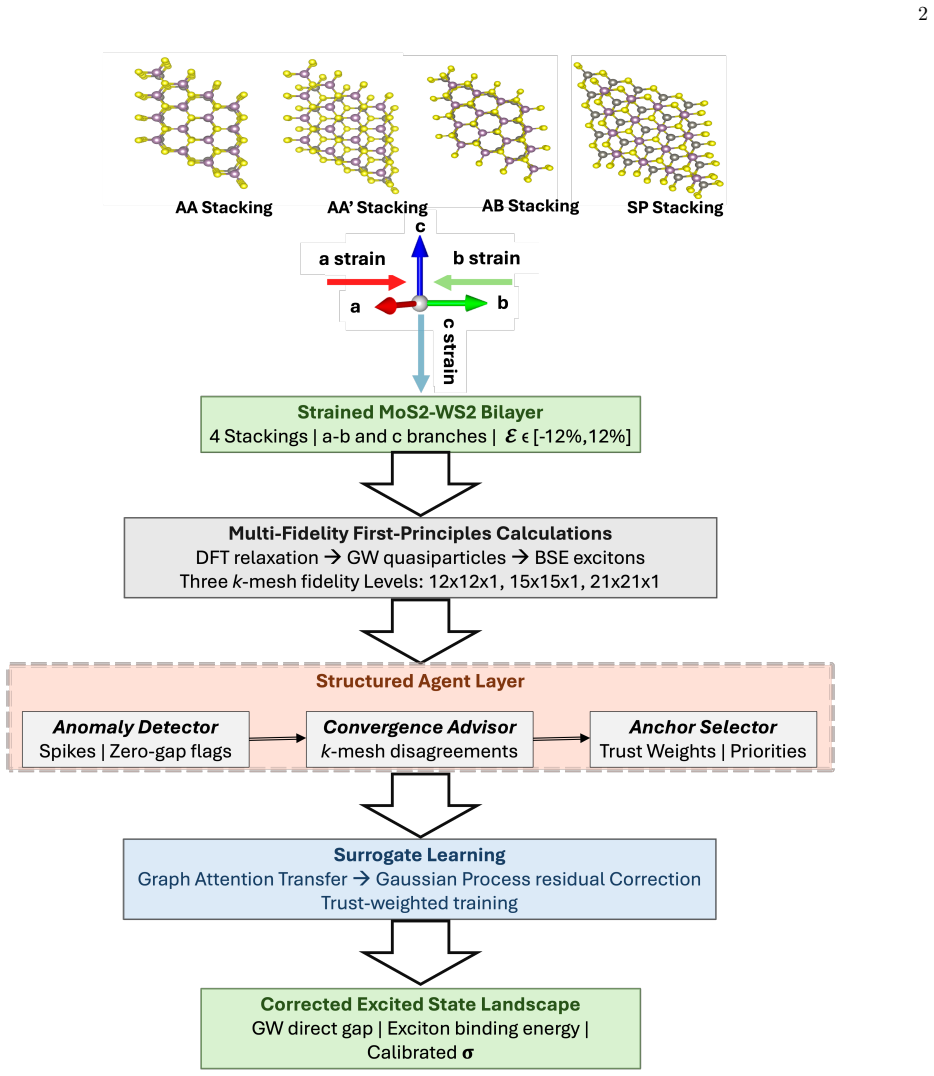
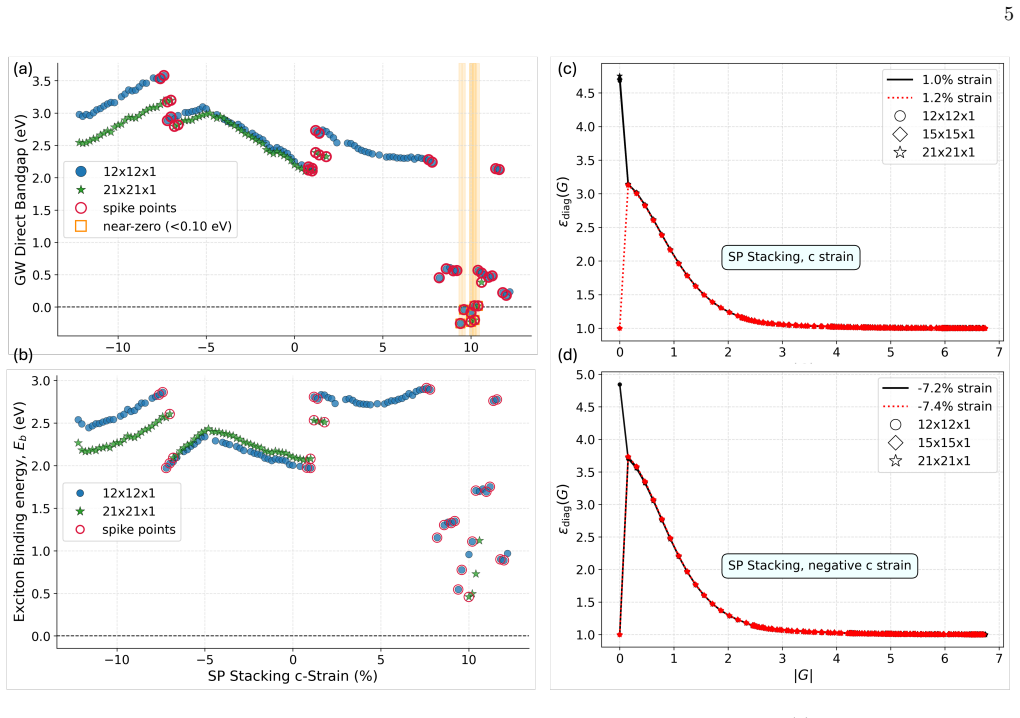
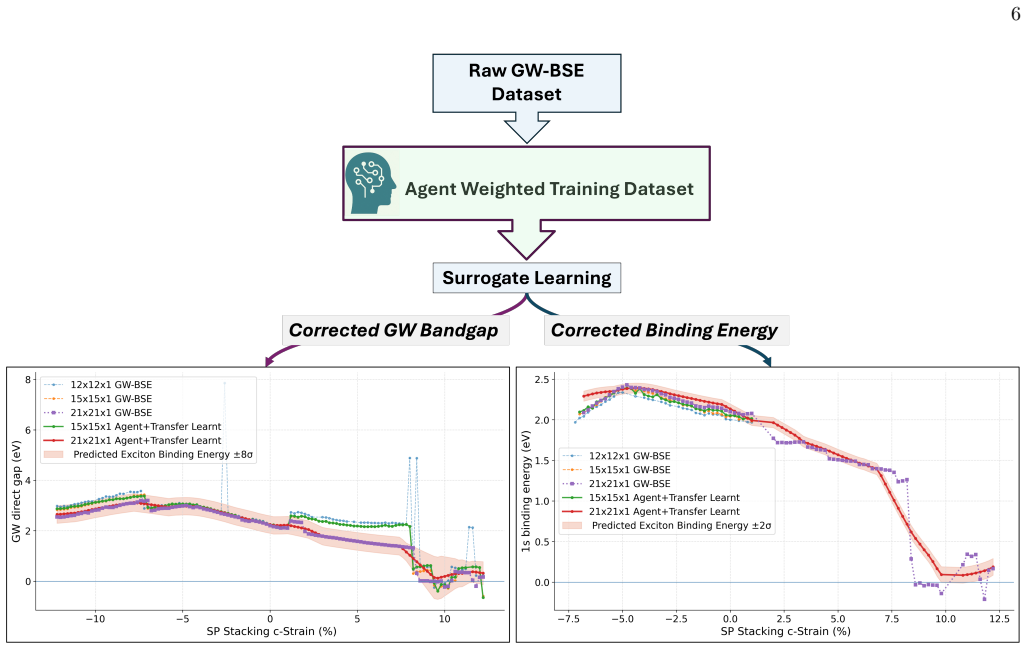
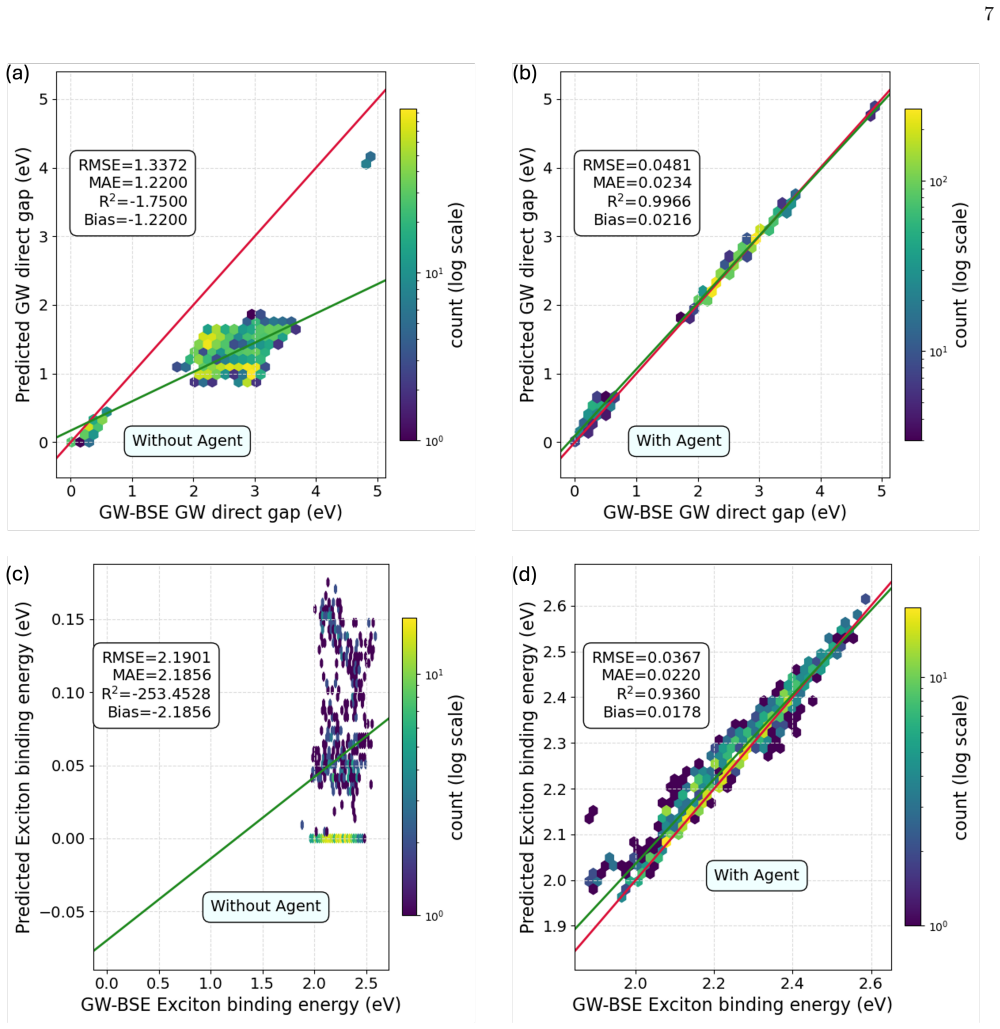
The framework identifies spike-like excursions, near-zero-gap collapse and cross-fidelity inconsistencies associated with fragile long-wavelength dielectric screening. A structural agent evaluates calculations by assigning confidence weights and selectively using a small number of high-accuracy reference points. Machine learning models then transfer information across related systems and apply Gaussian process corrections to recover improved quasiparticle gaps and exciton binding energies, with calibrated uncertainty estimates. The approach corrects numerically induced artifacts without erasing physical strain dependence and substantially improves agreement with higher-fidelity references re
What carries the argument
The structural agent that assigns confidence weights by detecting numerical instabilities such as spike-like excursions and near-zero-gap collapse in GW-BSE data across stacking and strain configurations.
If this is right
- The workflow identifies spike-like excursions, near-zero-gap collapse and cross-fidelity inconsistencies associated with fragile long-wavelength dielectric screening.
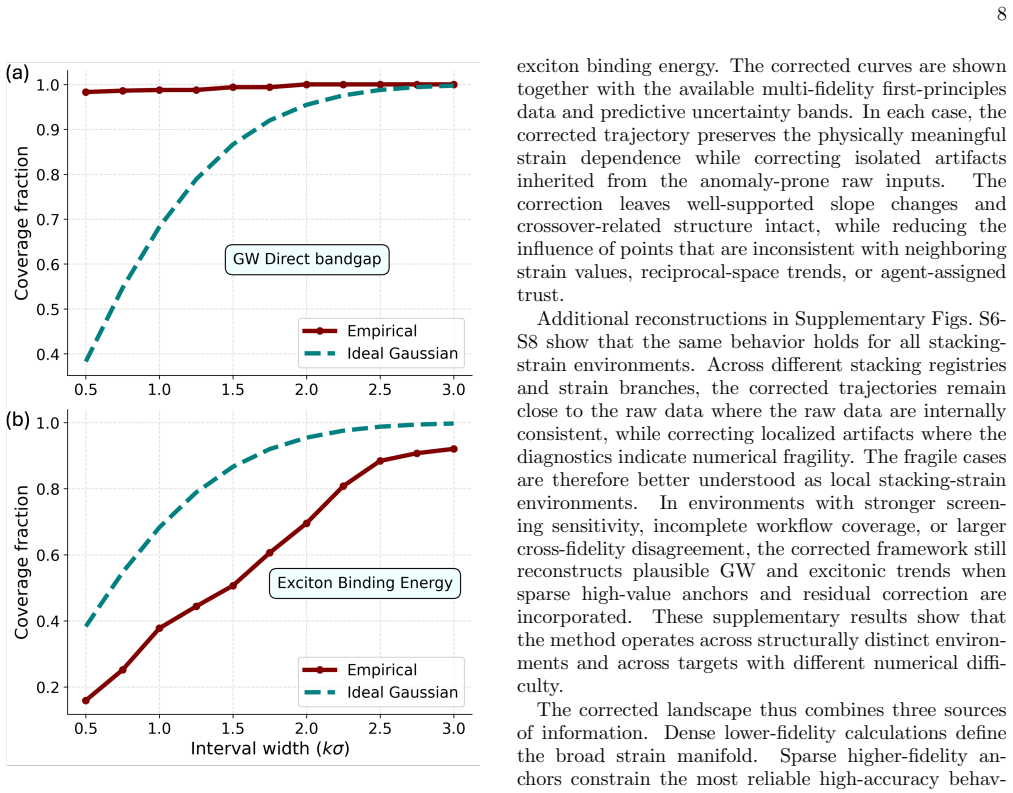
- Machine learning models transfer information across related systems and apply Gaussian process corrections to recover improved quasiparticle gaps and exciton binding energies with calibrated uncertainty estimates.
- The method corrects numerically induced artifacts without erasing physical strain dependence.
- The framework is readily transferable to other optoelectronic nanomaterials characterized by strong quantum confinement.
Where Pith is reading between the lines
- Similar agent-based detection of numerical fragility could be applied to other high-throughput first-principles workflows that suffer from convergence issues.
- The calibrated uncertainty estimates from the Gaussian process corrections could guide where additional high-fidelity calculations are most needed in a materials screening campaign.
- Extending the agent to flag inconsistencies across different reciprocal-space samplings might further reduce the density of k-point grids required for stable results.
Load-bearing premise
A structural agent can reliably detect and weight numerical instabilities like spike-like excursions and near-zero-gap collapse in GW-BSE calculations across different stacking registries and strain branches.
What would settle it
A comparison on the same strained bilayer dataset where the agent-weighted corrections produce worse agreement with high-fidelity references than the no-agent baseline, or where known near-zero-gap collapse cases are not flagged.
Figures
read the original abstract
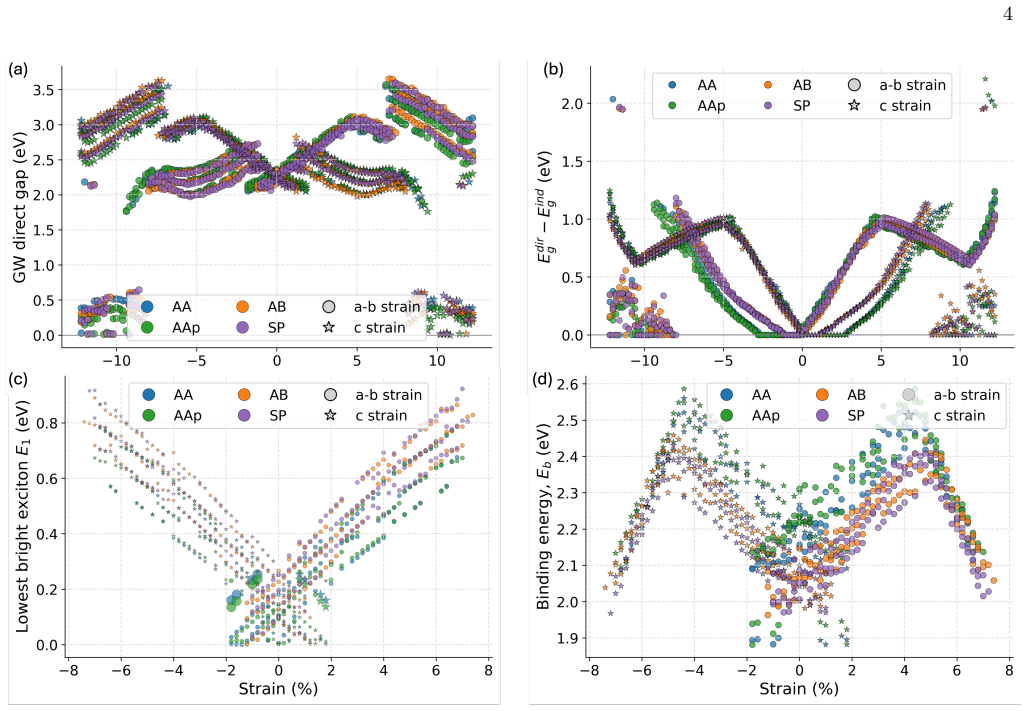
Many-body GW-Bethe-Salpeter equation calculations are essential for accurate simulations of electronic structure and optical properties in modern low-dimensional nanomaterials. However, these methods are computationally demanding and can exhibit localized numerical instabilities or convergence failures that are difficult to detect within high-throughput workflows. We introduce an agent-guided multi-fidelity framework for correcting GW-Bethe-Salpeter excited-state landscapes in strained MoS2-WS2 bilayers. Across stacking registries, strain branches and reciprocal-space samplings, the workflow identifies spike-like excursions, near-zero-gap collapse and cross-fidelity inconsistencies associated with fragile long-wavelength dielectric screening. A structural agent evaluates calculations by assigning confidence weights and selectively using a small number of high-accuracy reference points. Machine learning models then transfer information across related systems and apply Gaussian process corrections to recover improved quasiparticle gaps and exciton binding energies, with calibrated uncertainty estimates. The approach corrects numerically induced artifacts without erasing physical strain dependence and substantially improves agreement with higher-fidelity references relative to a no-agent baseline. These results show that reliable surrogate learning for excited-state materials requires explicit diagnosis of numerical fragility, not direct interpolation of raw first-principles data points. The proposed framework is readily transferable to other optoelectronic nanomaterials characterized by strong quantum confinement, such as quantum dots, nanoribbons, layered two-dimensional semiconductors, and hybrid perovskite nanostructures.
Editorial analysis
A structured set of objections, weighed in public.
Referee Report
Summary. The manuscript introduces an agent-guided multi-fidelity framework for GW-BSE calculations on strained MoS2-WS2 bilayers. A structural agent assigns confidence weights to detect numerical artifacts (spike-like excursions, near-zero-gap collapse, cross-fidelity inconsistencies) across stacking registries, strain branches, and reciprocal-space samplings; high-fidelity references are then selectively used with ML transfer learning and Gaussian process corrections to recover improved quasiparticle gaps and exciton binding energies with uncertainty estimates. The central claim is that this corrects numerically induced artifacts without erasing physical strain dependence and substantially outperforms a no-agent baseline.
Significance. If the agent's artifact detection proves reliable, the work would address a practical barrier in high-throughput excited-state simulations of 2D materials by distinguishing numerical fragility from physical trends, enabling more trustworthy surrogate models. The explicit focus on diagnosing numerical issues rather than raw interpolation is a constructive contribution.
major comments (2)
- [Abstract] Abstract: the assertion that the workflow 'substantially improves agreement with higher-fidelity references relative to a no-agent baseline' is presented without any quantitative metrics, error analysis, or tabulated comparisons, preventing verification of the magnitude or statistical significance of the claimed improvement.
- [Abstract] Abstract (structural agent description): the mechanism by which the agent 'evaluates calculations by assigning confidence weights' via detection of spikes, gap collapses, and inconsistencies is stated at a high level but supplies no implementation details, training procedure, decision thresholds, or validation metrics (e.g., precision on labeled artifact cases). This is load-bearing for the claim that physical strain dependence is preserved, because inadvertent flagging of genuine long-wavelength screening changes would bias the selective reference set and subsequent GP corrections.
minor comments (1)
- [Abstract] The abstract refers to 'calibrated uncertainty estimates' from the Gaussian process step but does not indicate the calibration procedure or provide any reliability assessment.
Simulated Author's Rebuttal
We thank the referee for the constructive feedback and positive assessment of the work's significance. We address the two major comments on the abstract below and agree to revise the abstract accordingly.
read point-by-point responses
-
Referee: [Abstract] Abstract: the assertion that the workflow 'substantially improves agreement with higher-fidelity references relative to a no-agent baseline' is presented without any quantitative metrics, error analysis, or tabulated comparisons, preventing verification of the magnitude or statistical significance of the claimed improvement.
Authors: We agree that the abstract would be strengthened by including quantitative support for the improvement claim. While the full manuscript contains detailed error analyses, MAE comparisons, and statistical tests versus the no-agent baseline in the Results section, we will revise the abstract to incorporate key quantitative metrics (e.g., specific error reductions and uncertainty estimates) to enable immediate verification. revision: yes
-
Referee: [Abstract] Abstract (structural agent description): the mechanism by which the agent 'evaluates calculations by assigning confidence weights' via detection of spikes, gap collapses, and inconsistencies is stated at a high level but supplies no implementation details, training procedure, decision thresholds, or validation metrics (e.g., precision on labeled artifact cases). This is load-bearing for the claim that physical strain dependence is preserved, because inadvertent flagging of genuine long-wavelength screening changes would bias the selective reference set and subsequent GP corrections.
Authors: The abstract is intentionally concise. Full details on the agent's implementation (including confidence-weight assignment, artifact detection criteria, training on labeled cases, decision thresholds, and validation metrics such as precision) appear in the Methods and supplementary sections. To directly address the concern about preserving physical trends, we will add a brief clause to the abstract summarizing the validation that the agent does not erase strain dependence. revision: yes
Circularity Check
No circularity: multi-fidelity corrections benchmarked against independent higher-fidelity references
full rationale
The abstract describes an agent that detects numerical artifacts (spikes, gap collapse, inconsistencies) to assign confidence weights and selectively incorporate a small number of high-accuracy reference points, after which ML transfer and Gaussian process corrections are applied. The claimed improvements are explicitly measured by agreement with higher-fidelity references relative to a no-agent baseline. No equations, self-citations, or self-definitional steps are supplied that would reduce the GP corrections or final predictions to the inputs by construction. The workflow is therefore self-contained against external benchmarks.
Axiom & Free-Parameter Ledger
axioms (1)
- domain assumption GW-BSE calculations exhibit detectable numerical instabilities such as spike-like excursions and near-zero-gap collapse that can be identified by a structural agent
Reference graph
Works this paper leans on
-
[1]
Kirklin, J
S. Kirklin, J. E. Saal, B. Meredig, A. Thompson, J. W. Doak, M. Aykol, S. R¨ uhl, and C. Wolverton, The open quantum materials database (oqmd): assessing the accu- racy of dft formation energies, npj Computational Mate- rials1, 1 (2015)
2015
-
[2]
M. K. Horton, J. H. Montoya, M. Liu, and K. A. Persson, High-throughput prediction of the ground-state collinear magnetic order of inorganic materials using density func- tional theory, npj Computational Materials5, 64 (2019)
2019
-
[3]
A. Jain, S. P. Ong, G. Hautier, W. Chen, W. D. Richards, S. Dacek, S. Cholia, D. Gunter, D. Skinner, G. Ceder, et al., Commentary: The materials project: A materials genome approach to accelerating materials innovation, APL materials1(2013)
2013
-
[4]
M. K. Horton, P. Huck, R. X. Yang, J. M. Munro, S. Dwaraknath, A. M. Ganose, R. S. Kingsbury, M. Wen, J. X. Shen, T. S. Mathis,et al., Accelerated data-driven materials science with the materials project, Nature Ma- terials24, 1522 (2025)
2025
-
[5]
Ghosh, F
A. Ghosh, F. Ronning, S. M. Nakhmanson, and J.-X. Zhu, Machine learning study of magnetism in uranium- based compounds, Physical Review Materials4, 064414 (2020)
2020
-
[6]
V´ eril, A
M. V´ eril, A. Scemama, M. Caffarel, F. Lipparini, M. Boggio-Pasqua, D. Jacquemin, and P.-F. Loos, Questdb: A database of highly accurate excitation ener- gies for the electronic structure community, Wiley Inter- disciplinary Reviews: Computational Molecular Science 11, e1517 (2021)
2021
-
[7]
Westermayr and P
J. Westermayr and P. Marquetand, Machine learning for electronically excited states of molecules, Chemical Re- views121, 9873 (2020)
2020
-
[8]
Manzeli, D
S. Manzeli, D. Ovchinnikov, D. Pasquier, O. V. Yazyev, and A. Kis, 2d transition metal dichalcogenides, Nature Reviews Materials2, 1 (2017)
2017
-
[9]
K. F. Mak and J. Shan, Photonics and optoelectronics of 2d semiconductor transition metal dichalcogenides, Na- ture Photonics10, 216 (2016)
2016
-
[10]
Z. Peng, X. Chen, Y. Fan, D. J. Srolovitz, and D. Lei, Strain engineering of 2d semiconductors and graphene: from strain fields to band-structure tuning and pho- tonic applications, Light: Science & Applications9, 190 (2020)
2020
-
[11]
Fan and M
J. Fan and M. Sun, Transition metal dichalcogenides (tmdcs) heterostructures: synthesis, excitons and photo- electric properties, The Chemical Record22, e202100313 (2022)
2022
-
[12]
G. H. Ahn, M. Amani, H. Rasool, D.-H. Lien, J. P. Mas- tandrea, J. W. Ager III, M. Dubey, D. C. Chrzan, A. M. Minor, and A. Javey, Strain-engineered growth of two- dimensional materials, Nature communications8, 608 (2017)
2017
-
[13]
X. Leng, F. Jin, M. Wei, and Y. Ma, Gw method and bethe–salpeter equation for calculating electronic excita- tions, Wiley Interdisciplinary Reviews: Computational Molecular Science6, 532 (2016)
2016
-
[14]
Withers, O
F. Withers, O. Del Pozo-Zamudio, A. Mishchenko, A. P. Rooney, A. Gholinia, K. Watanabe, T. Taniguchi, S. J. Haigh, A. Geim, A. Tartakovskii,et al., Light-emitting diodes by band-structure engineering in van der waals heterostructures, Nature materials14, 301 (2015)
2015
-
[15]
Y. Qi, M. A. Sadi, D. Hu, M. Zheng, Z. Wu, Y. Jiang, and Y. P. Chen, Recent progress in strain engineering on van der waals 2d materials: Tunable electrical, elec- trochemical, magnetic, and optical properties, Advanced Materials35, 2205714 (2023)
2023
-
[16]
P. Chen, T. W. Lo, Y. Fan, S. Wang, H. Huang, and D. Lei, Chiral coupling of valley excitons and light through photonic spin–orbit interactions, Advanced Op- tical Materials8, 1901233 (2020)
2020
-
[17]
J. Du, H. Yu, B. Liu, M. Hong, Q. Liao, Z. Zhang, and Y. Zhang, Strain engineering in 2d material-based flexible optoelectronics, Small Methods5, 2000919 (2021)
2021
-
[18]
Aryasetiawan and O
F. Aryasetiawan and O. Gunnarsson, The gw method, Reports on progress in Physics61, 237 (1998)
1998
-
[19]
Hedin, New method for calculating the one-particle green’s function with application to the electron-gas problem, Physical Review139, A796 (1965)
L. Hedin, New method for calculating the one-particle green’s function with application to the electron-gas problem, Physical Review139, A796 (1965)
1965
-
[20]
W. G. Aulbur, L. J¨ onsson, and J. W. Wilkins, Quasi- particle calculations in solids, Solid State Physics54, 1 (1999)
1999
-
[21]
Cutkosky, Solutions of a bethe-salpeter equation, Physical Review96, 1135 (1954)
R. Cutkosky, Solutions of a bethe-salpeter equation, Physical Review96, 1135 (1954)
1954
-
[22]
Z. Ye, T. Cao, K. O’brien, H. Zhu, X. Yin, Y. Wang, S. G. Louie, and X. Zhang, Probing excitonic dark states in single-layer tungsten disulphide, Nature513, 214 (2014)
2014
-
[23]
Chaves, J
A. Chaves, J. G. Azadani, H. Alsalman, D. Da Costa, R. Frisenda, A. Chaves, S. H. Song, Y. D. Kim, D. He, J. Zhou,et al., Bandgap engineering of two-dimensional semiconductor materials, npj 2D Materials and Applica- tions4, 29 (2020)
2020
-
[24]
X. Gan, D. Englund, D. Van Thourhout, and J. Zhao, 2d materials-enabled optical modulators: From visible to terahertz spectral range, Applied Physics Reviews9 (2022)
2022
-
[25]
Gopalan, M
S. Gopalan, M. L. Van de Put, G. Gaddemane, and 15 M. V. Fischetti, Theoretical study of electronic transport in two-dimensional transition metal dichalcogenides: Ef- fects of the dielectric environment, Physical Review Ap- plied18, 054062 (2022)
2022
-
[26]
Zhang, J
X. Zhang, J. A. Leveillee, and A. Schleife, Effect of dy- namical screening in the bethe-salpeter framework: Exci- tons in crystalline naphthalene, Physical Review B107, 235205 (2023)
2023
-
[27]
Gulans, S
A. Gulans, S. Kontur, C. Meisenbichler, D. Nabok, P. Pavone, S. Rigamonti, S. Sagmeister, U. Werner, and C. Draxl, Exciting: a full-potential all-electron package implementing density-functional theory and many-body perturbation theory, Journal of Physics: Condensed Mat- ter26, 363202 (2014)
2014
-
[28]
Dr¨ uppel, T
M. Dr¨ uppel, T. Deilmann, J. Noky, P. Marauhn, P. Kr¨ uger, and M. Rohlfing, Electronic excitations in transition metal dichalcogenide monolayers from an lda+ gdw approach, Physical Review B98, 155433 (2018)
2018
-
[29]
Varrassi, F
L. Varrassi, F. Ellinger, E. Flage-Larsen, M. Wolloch, G. Kresse, N. Marzari, and C. Franchini, Automated workflow for accurate high-throughput gw calculations using plane waves, npj Computational Materials11, 351 (2025)
2025
-
[30]
Biswas and A
T. Biswas and A. K. Singh, py gwbse: a high throughput workflow package for gw-bse calculations, npj Computa- tional Materials9, 22 (2023)
2023
-
[31]
Vinod, S
V. Vinod, S. Maity, P. Zaspel, and U. Kleinekath¨ ofer, Multifidelity machine learning for molecular excitation energies, Journal of Chemical Theory and Computation 19, 7658 (2023)
2023
-
[32]
C.-H. Yang, B. S. S. Pokuri, X. Y. Lee, S. Balakrishnan, C. Hegde, S. Sarkar, and B. Ganapathysubramanian, Multi-fidelity machine learning models for structure– property mapping of organic electronics, Computational Materials Science213, 111599 (2022)
2022
-
[33]
D. Baum, A. F¨ orster, and L. Visscher, Transfer learning of gw bethe–salpeter equation excitation energies, Chem- ical Science (2026)
2026
-
[34]
S. Pak, J. Lee, Y.-W. Lee, A.-R. Jang, S. Ahn, K. Y. Ma, Y. Cho, J. Hong, S. Lee, H. Y. Jeong,et al., Strain- mediated interlayer coupling effects on the excitonic be- haviors in an epitaxially grown mos2/ws2 van der waals heterobilayer, Nano letters17, 5634 (2017)
2017
-
[35]
Y. He, Y. Yang, Z. Zhang, Y. Gong, W. Zhou, Z. Hu, G. Ye, X. Zhang, E. Bianco, S. Lei,et al., Strain-induced electronic structure changes in stacked van der waals het- erostructures, Nano letters16, 3314 (2016)
2016
-
[36]
Louis, Y
S.-Y. Louis, Y. Zhao, A. Nasiri, X. Wang, Y. Song, F. Liu, and J. Hu, Graph convolutional neural networks with global attention for improved materials property prediction, Physical Chemistry Chemical Physics22, 18141 (2020)
2020
-
[37]
P. Veliˇ ckovi´ c, G. Cucurull, A. Casanova, A. Romero, P. Lio, and Y. Bengio, Graph attention networks, arXiv preprint arXiv:1710.10903 (2017)
Pith/arXiv arXiv 2017
-
[38]
X. Wang, H. Ji, C. Shi, B. Wang, Y. Ye, P. Cui, and P. S. Yu, Heterogeneous graph attention network, inThe world wide web conference(2019) pp. 2022–2032
2019
-
[39]
Heinze-Deml, M
C. Heinze-Deml, M. H. Maathuis, and N. Meinshausen, Causal structure learning, Annual Review of Statistics and Its Application5, 371 (2018)
2018
-
[40]
X. Hu, R. Zhang, K. Tang, J. Guo, Q. Yi, R. Chen, Z. Du, L. Li, Q. Guo, Y. Chen,et al., Causality-driven hierarchical structure discovery for reinforcement learn- ing, Advances in Neural Information Processing Systems 35, 20064 (2022)
2022
-
[41]
V. L. Deringer, A. P. Bart´ ok, N. Bernstein, D. M. Wilkins, M. Ceriotti, and G. Cs´ anyi, Gaussian process regression for materials and molecules, Chemical reviews 121, 10073 (2021)
2021
-
[42]
Williams and C
C. Williams and C. Rasmussen, Gaussian processes for regression, Advances in neural information processing systems8(1995)
1995
-
[43]
Farkous, M
M. Farkous, M. Bikerouin, D. V. Thuan, Y. Benhouria, M. El-Yadri, E. Feddi, H. Erguig, F. Dujardin, C. V. Nguyen, N. V. Hieu,et al., Strain effects on the elec- tronic and optical properties of van der waals heterostruc- ture mos2/ws2: a first-principles study, Physica E: Low- dimensional Systems and Nanostructures116, 113799 (2020)
2020
-
[44]
S.-H. Yang, S. Murugan, C. Sivakumar, Y.-C. Hsu, B. Balraj, J.-H. Tsia, M.-H. Chen, and M.-S. Ho, Ex- ploring the frontier of 2d materials: Strain and electric field effects in mos2/ws2 vdw heterostructures, Journal of Alloys and Compounds1012, 178457 (2025)
2025
-
[45]
OpenAI, Gpt-5.5 (large language model) (2026), ac- cessed: 2026-05-25
2026
-
[46]
Hafner, Ab-initio simulations of materials using vasp: Density-functional theory and beyond, Journal of com- putational chemistry29, 2044 (2008)
J. Hafner, Ab-initio simulations of materials using vasp: Density-functional theory and beyond, Journal of com- putational chemistry29, 2044 (2008)
2044
discussion (0)
Sign in with ORCID, Apple, or X to comment. Anyone can read and Pith papers without signing in.