REVIEW 3 major objections 4 minor 1 cited by
The paper claims that the instabilities of next-to-leading-order high-energy gluon evolution are a factorization-scheme artifact, and that rotating the operator basis with an e^{-L} transformation restores stable evolution to rapidity 10.
Reviewed by Pith at T0; open to challenge. T0 means a machine referee read the full paper against a public rubric. the ladder, T0–T4 →
T0 review · deepseek-v4-flash
2026-08-03 22:59 UTC pith:Y7EDSQVU
load-bearing objection A serious scheme-change proposal that likely fixes the NLO BK instability, but the Letter lets the companion paper do the heavy lifting on Eq. (18), so independent verification is needed. the 3 major comments →
Rotating the Color Glass Condensate
The pith
A machine-rendered reading of the paper's core claim, the machinery that carries it, and where it could break.
Core claim
The central claim is that the catastrophic NLO correction to the BK equation does not signal a genuine breakdown of the high-energy expansion but follows from the scheme in which the high-energy OPE is set up. Inserting the identity e^{-L}e^{L} defines a rotated operator basis in which composite small-x operators depend only on the ratio ζ/μ², and the same similarity transformation acts on the evolution kernel through the Campbell identity. In the resulting NLO BK equation, the double collinear logarithms of the standard NLO kernel are exactly canceled by terms generated from the commutator [K_LO, L_LO], while new terms are effectively ordered in k⁻ rather than k⁺. The paper demonstrates num
What carries the argument
The load-bearing object is the operator L that generates the rotation. Defined on dipole-chain states, L_LO contains the kernel x₁₂²/(x₁₃²x₃₂²) times ln(μ²|x₁₃||x₃₂|) acting on the difference between a two-dipole and a one-dipole state; this logarithm is the collinear piece of the rapidity phase space controlled by the lifetime constraint k⁻ = k⊥²/k⁺ < P⁻. The rotation e^{−ᾱₛL} enforces ∂S̄/∂ln μ² + ∂S̄/∂ln ζ = 0, so the rotated operators depend only on ζ/μ². The rotated kernel K̄ = e^{−ᾱₛL} K e^{ᾱₛL} is built with the Campbell identity; at NLO the commutator [K_LO, L_LO] cancels the double collinear logarithms of the standard kernel.
Load-bearing premise
The stability demonstration is numerical and assumes fixed coupling with ᾱₛ=0.3, a single saturation-inspired initial condition, a specific scheme choice for the form of L, and the as-yet-uncomputed NNLO corrections removing the anti-collinear double logarithms that begin to appear after Y=10.
What would settle it
Evolve the rotated NLO equation from a different dipole initial condition, for example a Gaussian with initial saturation scale Q₀=2 GeV instead of 1 GeV, at the same fixed coupling, and check whether the amplitude stays positive up to Y=10; if it turns negative before Y=10, the central stability claim fails.
If this is right
- Dipole evolution from a saturation-inspired initial condition stays positive and monotonic to rapidity Y=10 with fixed coupling, reaching beyond the range of existing deep-inelastic data.
- The rotation is not an ad hoc kernel modification: physical cross sections are invariant provided the hard coefficient functions are rotated alongside the operators, keeping the scheme consistent with the underlying OPE.
- The framework unifies previously separate stabilization strategies—the conformal dipole transformation and target-rapidity evolution—as limiting cases of one algebraic construction.
- Because the rotated kernel is independent of the collinear scale μ, the method is designed to extend to N²LO and beyond using the known higher-order kernel; the residual high-rapidity growth is expected to be controlled by NNLO terms.
Where Pith is reading between the lines
- If the stability holds beyond the single tested initial condition, earlier phenomenological extractions of the saturation scale that relied on ad hoc resummations could be reinterpreted as scheme choices, potentially shifting the extracted values once the corresponding coefficient functions are transformed consistently.
- The same operator-rotation logic should apply to other high-energy observables such as dijet production, forward hadron production, and semi-inclusive DIS; a testable prediction is that each observable's NLO coefficient function receives a specific transformation that restores stability.
- The claim that the anti-collinear instabilities appearing beyond Y=10 are tamed by NNLO corrections is an extrapolation; once the NNLO kernel is implemented, evolving past Y=10 and checking positivity would directly test this assumption.
Editorial analysis
A structured set of objections, weighed in public.
Referee Report
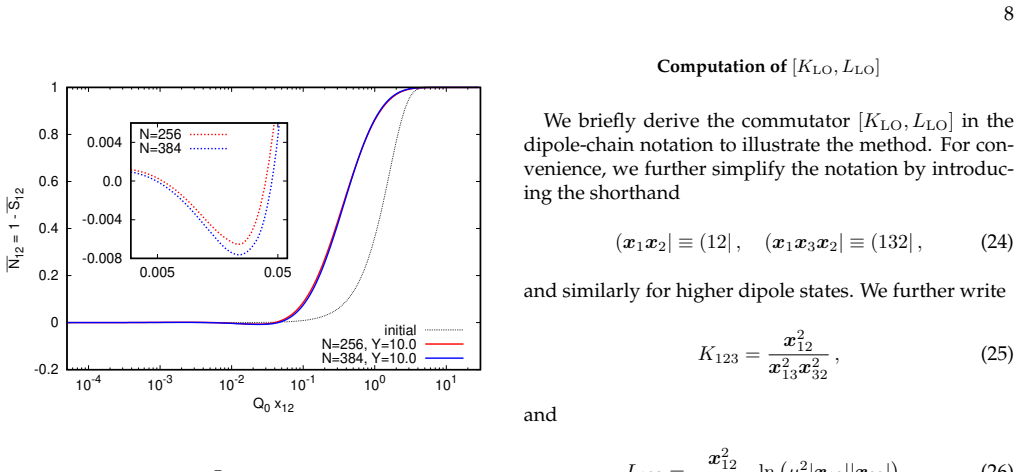
Summary. The paper proposes a new factorization-scheme transformation, implemented by an operator e^{-L} inside the high-energy OPE, that rotates the dipole operators and the coefficient functions while leaving physical cross sections invariant. Within this scheme the authors derive a rotated NLO BK equation (Eq. (18)) in which the double collinear logarithms that destabilize the standard NLO BK equation are claimed to be canceled by a commutator term. They present a numerical solution of Eq. (18) with an MV-model initial condition and fixed coupling, showing stable, positive evolution up to Y=10, in contrast to the standard NLO BK equation whose solution quickly becomes negative. The method is presented as systematically improvable and as unifying earlier conformal and target-rapidity schemes.
Significance. If Eq. (18) is correct, this is a significant step: it provides a systematic way to remove double collinear logarithms in high-energy QCD evolution while preserving the high-energy OPE and physical observables, with clear implications for small-x phenomenology at the EIC. The paper is well organized and the operator/Doi-Peliti formalism is elegant. The numerical work is supported by convergence tests in the Supplemental Material (Figs. 2-4), and the authors are explicit about limitations such as fixed coupling, residual single logarithms, and the need for NNLO corrections. The main weakness is that the derivation of the central rotated equation, especially the cancellation of double logarithms, is delegated to a companion paper and is not verifiable from the present manuscript alone.
major comments (3)
- [Supplemental Material, Eq. (30) -> Eq. (18)] Eq. (18) is the central result, but its derivation is not contained in the Letter. The Supplemental Material computes only the bra form of [K_LO,L_LO] in Eq. (30) and then states that contraction with |Sbar> gives Eq. (111) of [43] and 'eventually' Eq. (18). The reduction of the double x3,x4 integrals in Eq. (30) to the local ln^2 term in the second term of Eq. (18), and the matching of the last two terms, are not shown. An error in the 1/2 prefactor or in the log arguments in this step would restore the standard instability. Please include the essential contraction/integration steps in the Supplemental Material, or display explicitly how the projected commutator cancels the double-log part of Eq. (21).
- [Numerical stability of NLO BK, Fig. 1 and Eq. (13)] The stability claim is demonstrated for a single point in scheme space, namely L_LO = log(mu^2 |x13||x32|) in Eq. (13). The text acknowledges that the constant coefficient in L_LO is unconstrained. No test of scheme dependence is provided. Since the central claim is that the rotated scheme restores stability, please show that the qualitative behavior in Fig. 1 is robust under allowed scheme variations (e.g., replacing |x13||x32| by c |x13||x32| with c ~ 1, or using |x13||x32|/|x12|) and, if possible, estimate the effect of the neglected O(alpha_s^3) terms in Eq. (17).
- [Numerical stability of NLO BK, Fig. 1] The comparison with 'the same initial condition' is not well defined because the rotation also transforms the initial condition: a given physical dipole S(0) corresponds to Sbar(0)=exp(-alpha_s L) S(0), not to the same functional form (19). If the standard NLO run uses Eq. (19) for S(0) while the rotated run uses it for Sbar(0), the two evolutions start from different physical states, and the comparison may conflate a kernel effect with an initial-condition effect. Please clarify the mapping between the initial conditions used in the two panels and, ideally, repeat the rotated evolution starting from the Sbar(0) obtained by rotating the same S(0) used in the standard run.
minor comments (4)
- [Conclusions] The sentence 'ensuring the perturbative stability and consistency of the framework across the full kinematic domain' is stronger than what is demonstrated. The text itself states that beyond Y=10 anti-collinear double-logarithmic instabilities appear and that their taming relies on NNLO corrections. Please temper the claim.
- [Abstract and Introduction] The paper states that additional single logarithms [54,55] are not canceled by the scheme and their treatment is left for future work. This qualification should appear in the abstract, which currently says the method 'restores perturbative stability order by order' without noting these residual logs.
- [Fig. 1 and Supplemental Material] The inset in Fig. 1 is small and the reader cannot easily see the negative region. Please enlarge it or provide a separate panel. Also specify the numerical setup used for the standard NLO BK curve (same grid, step-size tests, and implementation of the NLO kernel).
- [Notation] The notation for the rotated dipole is not always consistent: Eq. (14) defines \bar S_12 to first order, while Eq. (18) evolves \bar S_12 and the state |\bar S> is used in the derivation. Clarify the relation between the state |\bar S>, its components (x1x2|\bar S>, and the composite operator \bar S_12.
Circularity Check
No significant circularity: the numerical stability is a genuine consequence of the rotated NLO BK equation, not a fitted reproduction; the only caveat is that the final contraction to Eq. (18) is deferred to the companion paper.
full rationale
The derivation chain is not circular at the level of construction. The rotated operator |\bar S> = exp(-\bar\alpha_s L)|S> is a similarity transformation, and Eq. (12) fixes \partial L_LO / \partial \ln\mu^2 = K_LO, with the remaining constant in the log left as an acknowledged scheme choice. The explicit form of L_LO in Eq. (13) is stated as a scheme choice ('the argument in the log in Eq. (13) is a scheme choice'), not a parameter fitted to the numerical result. The double-logarithmic cancellation in Eq. (18) follows algebraically from the commutator [K_LO,L_LO] computed in the Supplemental Material; the numerical evolution in Fig. 1 is a genuine solution of the resulting equation, using a stated MV-model initial condition and fixed coupling, with convergence checks. The most load-bearing external input is the companion paper [43], to which the final contraction/integration leading to Eq. (18) is explicitly deferred: 'Once contracted with the state |\bar S>, this equation yields Eq. (111) of [43], and eventually, Eq. (18) of this paper (see [43] for more details).' This is a proof-deferral and verifiability caveat, but it is not an equivalence-by-construction or a fitted-input-called-prediction. The stated limitations (fixed coupling, single initial condition, residual anti-collinear logs at Y>10, expected NNLO taming) are transparent assumptions rather than hidden circular inputs. Accordingly, no circular step is established, and the score reflects only the minor companion-paper dependency.
Axiom & Free-Parameter Ledger
free parameters (4)
- fixed coupling \bar{\alpha}_s =
0.3
- initial saturation scale Q0 =
1.0 GeV
- IR scale \Lambda =
0.2 GeV
- scheme choice in L_LO: ln(\mu^2 |x13||x32|)
axioms (5)
- domain assumption High-energy OPE factorization of DIS into hard coefficient function and Wilson-line operators (Eq. (1)).
- domain assumption Doi-Peliti formalism can represent the operator algebra with a Fock-space inner product and completeness relation.
- domain assumption The NLO BK kernel K_NLO of Ref. [17] is correct and can be represented as in Eq. (20).
- ad hoc to paper Truncation of the BCH expansion of the rotated kernel at O(\bar{\alpha}_s^2), and neglect of O(\bar{\alpha}_s^3) terms.
- domain assumption The scheme condition d\bar{S}/d\ln\mu^2 + d\bar{S}/d\ln\zeta = 0 (Eq. (12)) can be imposed order by order.
invented entities (2)
-
The operator L (rotation operator)
no independent evidence
-
Rotated composite dipole \bar{S}_{12}
no independent evidence
read the original abstract
High-energy QCD evolution beyond leading order suffers from instabilities driven by large collinear logarithms. We present a framework, consistent with the standard high-energy operator product expansion (OPE), that restores perturbative stability order by order. The method involves a change of basis in the space of high-energy operators, which modifies both the evolution kernel and the coefficient functions while leaving physical observables invariant. Within this factorization scheme, we derive a next-to-leading-order renormalization-group equation whose numerical solution exhibits stable evolution up to large rapidities, paving the way for a systematic framework for precision studies of gluon saturation at current and future colliders.
Figures


Forward citations
Cited by 1 Pith paper
-
Simultaneous Color Glass Condensate fit to deep inelastic scattering and forward hadron production at HERA, RHIC, and the LHC
A simultaneous LO CGC/BK fit to HERA DIS and RHIC/LHC forward hadron production reaches χ²/dof≈1, with complementary constraints and RHIC K-factors roughly twice those at the LHC.
Reference graph
Works this paper leans on
-
[1]
R. P . Feynman, Phys. Rev. Lett.23, 1415 (1969)
1969
-
[2]
J. D. Bjorken and E. A. Paschos, Phys. Rev.185, 1975 (1969)
1975
-
[3]
L. V . Gribov, E. M. Levin, and M. G. Ryskin, Phys. Rept. 100, 1 (1983)
1983
-
[4]
A. H. Mueller and J.-w. Qiu, Nucl. Phys. B268, 427 (1986)
1986
-
[5]
L. D. McLerran and R. Venugopalan, Phys. Rev. D49, 2233 (1994), arXiv:hep-ph/9309289
Pith/arXiv arXiv 1994
-
[6]
A. Morreale and F. Salazar, Universe7, 312 (2021), arXiv:2108.08254 [hep-ph]
Pith/arXiv arXiv 2021
-
[7]
R. Abdul Khaleket al., Nucl. Phys. A1026, 122447 (2022), arXiv:2103.05419 [physics.ins-det]
Pith/arXiv arXiv 2022
-
[8]
F. Gelis, E. Iancu, J. Jalilian-Marian, and R. Venugopalan, Ann. Rev. Nucl. Part. Sci.60, 463 (2010), arXiv:1002.0333 [hep-ph]
Pith/arXiv arXiv 2010
- [9]
-
[10]
Y. V . Kovchegov, Phys. Rev. D60, 034008 (1999), arXiv:hep-ph/9901281
Pith/arXiv arXiv 1999
-
[11]
J. Jalilian-Marian, A. Kovner, A. Leonidov, and H. Weigert, Nucl. Phys. B504, 415 (1997), arXiv:hep- ph/9701284
arXiv 1997
-
[12]
J. Jalilian-Marian, A. Kovner, A. Leonidov, and H. Weigert, Phys. Rev. D59, 014014 (1998), arXiv:hep- ph/9706377
arXiv 1998
-
[13]
A. Kovner, J. G. Milhano, and H. Weigert, Phys. Rev. D 62, 114005 (2000), arXiv:hep-ph/0004014
Pith/arXiv arXiv 2000
-
[14]
E. Iancu, A. Leonidov, and L. D. McLerran, Nucl. Phys. A 692, 583 (2001), arXiv:hep-ph/0011241
Pith/arXiv arXiv 2001
-
[15]
E. Iancu, A. Leonidov, and L. D. McLerran, Phys. Lett. B 510, 133 (2001), arXiv:hep-ph/0102009
Pith/arXiv arXiv 2001
-
[16]
E. Ferreiro, E. Iancu, A. Leonidov, and L. McLerran, Nucl. Phys. A703, 489 (2002), arXiv:hep-ph/0109115
Pith/arXiv arXiv 2002
-
[17]
I. Balitsky and G. A. Chirilli, Phys. Rev. D77, 014019 (2008), arXiv:0710.4330 [hep-ph]
Pith/arXiv arXiv 2008
-
[18]
I. Balitsky and G. A. Chirilli, Nucl. Phys. B822, 45 (2009), arXiv:0903.5326 [hep-ph]
Pith/arXiv arXiv 2009
-
[19]
T. Lappi and H. M ¨antysaari, Phys. Rev. D91, 074016 (2015), arXiv:1502.02400 [hep-ph]
Pith/arXiv arXiv 2015
-
[20]
Andersson, G
B. Andersson, G. Gustafson, and J. Samuelsson, Nucl. Phys. B467, 443 (1996)
1996
-
[21]
J. Kwiecinski, A. D. Martin, and P . J. Sutton, Z. Phys. C 71, 585 (1996), arXiv:hep-ph/9602320
Pith/arXiv arXiv 1996
-
[22]
J. Kwiecinski, A. D. Martin, and A. M. Stasto, Phys. Rev. D56, 3991 (1997), arXiv:hep-ph/9703445
Pith/arXiv arXiv 1997
-
[23]
G. P . Salam, JHEP07, 019 (1998), arXiv:hep-ph/9806482
Pith/arXiv arXiv 1998
-
[24]
M. Ciafaloni and D. Colferai, Phys. Lett. B452, 372 (1999), arXiv:hep-ph/9812366
Pith/arXiv arXiv 1999
-
[25]
M. Ciafaloni, D. Colferai, and G. P . Salam, Phys. Rev. D 60, 114036 (1999), arXiv:hep-ph/9905566
Pith/arXiv arXiv 1999
-
[26]
M. Ciafaloni, D. Colferai, G. P . Salam, and A. M. Stasto, Phys. Rev. D68, 114003 (2003), arXiv:hep-ph/0307188
Pith/arXiv arXiv 2003
- [27]
-
[28]
L. Motyka and A. M. Stasto, Phys. Rev. D79, 085016 (2009), arXiv:0901.4949 [hep-ph]
Pith/arXiv arXiv 2009
-
[29]
L. N. Lipatov, Sov. J. Nucl. Phys.23, 338 (1976)
1976
-
[30]
E. A. Kuraev, L. N. Lipatov, and V . S. Fadin, Sov. Phys. JETP45, 199 (1977)
1977
-
[31]
I. I. Balitsky and L. N. Lipatov, Sov. J. Nucl. Phys.28, 822 (1978)
1978
-
[32]
V . S. Fadin and L. N. Lipatov, Phys. Lett. B429, 127 (1998), arXiv:hep-ph/9802290
Pith/arXiv arXiv 1998
-
[33]
M. Ciafaloni and G. Camici, Phys. Lett. B430, 349 (1998), arXiv:hep-ph/9803389
Pith/arXiv arXiv 1998
-
[34]
V . S. Fadin, R. Fiore, and A. Papa, Nucl. Phys. B769, 108 (2007), arXiv:hep-ph/0612284
Pith/arXiv arXiv 2007
-
[35]
V . S. Fadin, R. Fiore, and A. Papa, Phys. Lett. B647, 179 (2007), arXiv:hep-ph/0701075
Pith/arXiv arXiv 2007
-
[36]
V . S. Fadin, R. Fiore, A. V . Grabovsky, and A. Papa, Nucl. Phys. B784, 49 (2007), arXiv:0705.1885 [hep-ph]
Pith/arXiv arXiv 2007
- [37]
-
[38]
E. Iancu, J. D. Madrigal, A. H. Mueller, G. Soyez, and D. N. Triantafyllopoulos, Phys. Lett. B744, 293 (2015), arXiv:1502.05642 [hep-ph]
Pith/arXiv arXiv 2015
-
[39]
Also referred to as the next-to-leading logarithmic (NLL) accuracy
-
[40]
B. Duclou ´e, E. Iancu, A. H. Mueller, G. Soyez, and D. N. Triantafyllopoulos, JHEP04, 081 (2019), arXiv:1902.06637 [hep-ph]
Pith/arXiv arXiv 2019
- [41]
-
[42]
T. Lappi and H. M ¨antysaari, Phys. Rev. D93, 094004 (2016), arXiv:1601.06598 [hep-ph]
Pith/arXiv arXiv 2016
-
[43]
R. Boussarie, P . Caucal, and Y. Mehtar-Tani, (2025), arXiv:2509.20236 [hep-ph]
arXiv 2025
-
[44]
Regge, Nuovo Cim.14, 951 (1959)
T. Regge, Nuovo Cim.14, 951 (1959)
1959
-
[45]
An analog formulation was proposed in the context of jet physics [63, 64]
-
[46]
M. Doi, J. Phys. A: Math. Gen.9, 1465 (1976)
1976
-
[47]
Peliti, J
L. Peliti, J. Physique46, 1469 (1985)
1985
-
[48]
Y. V . Kovchegov and E. Levin,Quantum Chromodynamics at High Energy, Vol. 33 (Oxford University Press, 2013)
2013
-
[49]
I. Balitsky and G. A. Chirilli, Phys. Rev. D83, 031502 (2011), arXiv:1009.4729 [hep-ph]
Pith/arXiv arXiv 2011
- [50]
- [51]
- [52]
-
[53]
H. H ¨anninen, T. Lappi, and R. Paatelainen, Annals Phys. 393, 358 (2018), arXiv:1711.08207 [hep-ph]
Pith/arXiv arXiv 2018
-
[54]
E. Iancu, J. D. Madrigal, A. H. Mueller, G. Soyez, and D. N. Triantafyllopoulos, Phys. Lett. B750, 643 (2015), arXiv:1507.03651 [hep-ph]
Pith/arXiv arXiv 2015
-
[55]
A. Kovner, M. Lublinsky, V . V . Skokov, and Z. Zhao, JHEP 07, 148 (2024), arXiv:2308.15545 [hep-ph]
Pith/arXiv arXiv 2024
-
[56]
McLerran and R
L. McLerran and R. Venugopalan, Phys. Rev. D49, 2233 (1994)
1994
-
[57]
McLerran and R
L. McLerran and R. Venugopalan, Phys. Rev. D49, 3352 (1994)
1994
-
[58]
Balitsky, Phys
I. Balitsky, Phys. Rev. D75, 014001 (2007)
2007
-
[59]
Iancu, J
E. Iancu, J. Madrigal, A. Mueller, G. Soyez, and D. Tri- antafyllopoulos, Physics Letters B750, 643 (2015)
2015
-
[60]
Abramowiczet al.(H1, ZEUS), Eur
H. Abramowiczet al.(H1, ZEUS), Eur. Phys. J. C75, 580 (2015), arXiv:1506.06042 [hep-ex]
Pith/arXiv arXiv 2015
-
[61]
S. Caron-Huot and M. Herranen, JHEP02, 058 (2018), arXiv:1604.07417 [hep-ph]
Pith/arXiv arXiv 2018
-
[62]
G. Brunello, S. Caron-Huot, G. Crisanti, M. Giroux, and S. Smith, (2025), arXiv:2508.03794 [hep-ph]
arXiv 2025
-
[63]
T. Becher, M. Neubert, L. Rothen, and D. Y. Shao, JHEP11, 019 (2016), [Erratum: JHEP 05, 154 (2017)], arXiv:1605.02737 [hep-ph]
Pith/arXiv arXiv 2016
-
[64]
Caron-Huot, JHEP03, 036 (2018), arXiv:1501.03754 [hep-ph]
S. Caron-Huot, JHEP03, 036 (2018), arXiv:1501.03754 [hep-ph]. 7 -0.2 0 0.2 0.4 0.6 0.8 1 10-4 10-3 10-2 10-1 100 101 N __ 12 = 1 - S __ 12 Q0 x12 initial Euler, Y=10.0 midpoint, Y=10.0 Heun, Y=10.0 -0.008 -0.004 0.0 0.004 0.005 0.05 Euler midpoint Heun Figure 2. The evolution of ¯N12 from the initial condition up to Y= 10.0withN= 256. Black dashed curve d...
Pith/arXiv arXiv 2018
-
[65]
+ x2 12 x2 13x2 24x2 34 ln x2 13x2 24 x2 14x2 32 , (22) Kf = 2 x4 34 − x2 14x2 32 +x 2 24x2 13 −x 2 12x2 34 x4 34(x2 13x2 24 −x 2 14x2
-
[66]
ln x2 13x2 24 x2 14x2 32 . (23) Eq. (20) can be generalized to any(x 1x2 . . .xn|state by following the same underlying Leibniz rule as in Eq. (7). Computation of[K LO, LLO] We briefly derive the commutator[K LO, LLO]in the dipole-chain notation to illustrate the method. For con- venience, we further simplify the notation by introduc- ing the shorthand (x...
discussion (0)
Sign in with ORCID, Apple, or X to comment. Anyone can read and Pith papers without signing in.