Signal-Driven Observation for Long-Horizon Web Agents
Pith reviewed 2026-06-28 01:22 UTC · model grok-4.3
The pith
Web agents can avoid context degradation over long tasks by observing the DOM only when signals indicate relevant changes rather than after every action.
A machine-rendered reading of the paper's core claim, the machinery that carries it, and where it could break.
Core claim
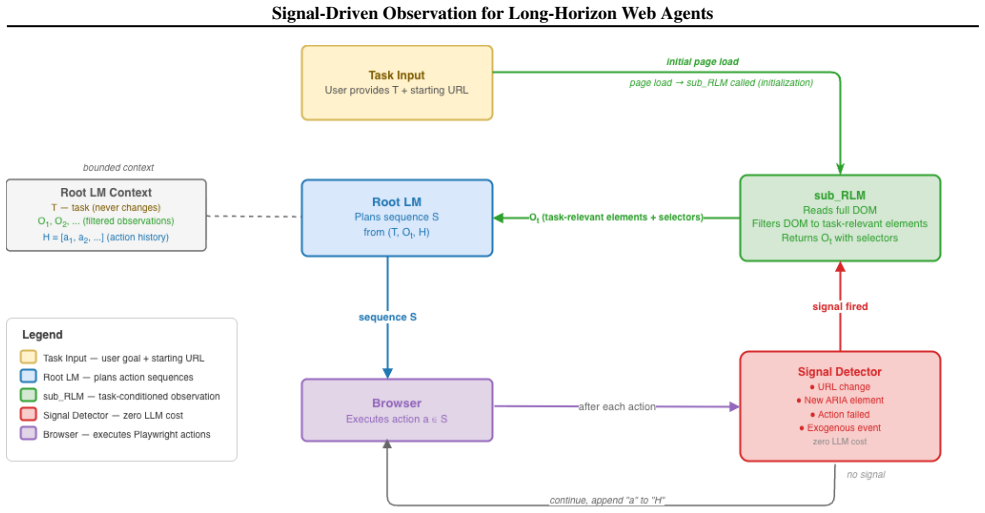
The central claim is that the architectural mistake of tying full DOM observation to every action step causes progressive context degradation in long-horizon web agents, and that Signal-Driven Observation corrects this by using a separate sub-call to return only task-relevant elements and their selectors, with the call re-invoked only when a signal detector fires on URL transitions, newly visible interactive elements, action failures, or exogenous browser events.
What carries the argument
Signal-Driven Observation (SDO): a dedicated sub-call that reads the full DOM but returns only task-relevant elements and selectors, re-invoked only when a lightweight signal detector fires.
If this is right
- Long-horizon web tasks become feasible without early loss of reasoning quality from token overload.
- Observation frequency can be set independently of action frequency.
- Only task-relevant page content enters the agent's context on each invocation.
- New research questions arise around the design of the signal detector and handling of missed or spurious signals.
Where Pith is reading between the lines
- The same decoupling principle could extend to agents operating in other high-volume state environments such as codebases or simulation traces.
- Production deployments might see lower token and latency costs if signals reduce average observation size.
- Existing web-agent benchmarks may need longer task sequences to expose the claimed degradation effect.
- Training regimes for agents could shift to include explicit signal-prediction objectives.
Load-bearing premise
A lightweight signal detector can be defined that fires exactly when task-relevant DOM changes occur without missing critical updates or triggering too often.
What would settle it
An experiment in which the signal detector either fails to trigger on a DOM change required for task success or triggers so frequently that total context usage equals or exceeds the baseline of full observation after every action.
Figures
read the original abstract
Web agents operating over long horizons ingest raw DOM and accessibility trees -- routinely tens of thousands of tokens -- at every action step, causing progressive context degradation that erodes reasoning well before tasks complete. We argue that this coupling of observation frequency to action frequency is an architectural mistake. Drawing on the insight from Recursive Language Models that querying a document outperforms reading it wholesale, we propose Signal-Driven Observation (SDO): a dedicated sub-call reads the full DOM but returns only task-relevant elements and their selectors, and is re-invoked only when a lightweight signal detector fires -- triggered by URL transitions, newly visible interactive elements, action failures, or exogenous browser events. We outline the open problems SDO introduces and call on the community to treat observation compression as a core architectural decision in web agent design.
Editorial analysis
A structured set of objections, weighed in public.
Referee Report
Summary. The manuscript argues that web agents' routine ingestion of full raw DOM and accessibility trees (tens of thousands of tokens) at every action step causes progressive context degradation over long horizons. It identifies the coupling of observation frequency to action frequency as an architectural mistake and proposes Signal-Driven Observation (SDO): a dedicated sub-call that returns only task-relevant elements and selectors, re-invoked only when a lightweight signal detector fires on events such as URL transitions, newly visible interactive elements, action failures, or exogenous browser events. The paper draws an analogy to Recursive Language Models, outlines open problems introduced by SDO, and calls for the community to treat observation compression as a core architectural decision.
Significance. If a reliable, low-cost signal detector can be realized, SDO could meaningfully extend the effective horizon of web agents by mitigating context bloat while preserving task-relevant state, potentially improving reasoning stability on complex, multi-step tasks.
major comments (1)
- Abstract: The central claim that SDO corrects an architectural mistake rests on the existence of a lightweight signal detector that fires precisely on task-relevant DOM changes without missing critical updates or over-triggering; the manuscript explicitly flags this as an open problem but provides no mechanism, threshold definition, or argument establishing that such a detector can be both reliable and cheap.
Simulated Author's Rebuttal
We thank the referee for their review. We address the single major comment below.
read point-by-point responses
-
Referee: Abstract: The central claim that SDO corrects an architectural mistake rests on the existence of a lightweight signal detector that fires precisely on task-relevant DOM changes without missing critical updates or over-triggering; the manuscript explicitly flags this as an open problem but provides no mechanism, threshold definition, or argument establishing that such a detector can be both reliable and cheap.
Authors: The manuscript's core argument is that routinely ingesting full raw DOM trees at every action step constitutes an architectural mistake because it couples observation frequency to action frequency and produces progressive context degradation. SDO is introduced as a proposed alternative architecture that decouples the two, drawing an explicit analogy to Recursive Language Models. The abstract and body both state that realizing a reliable, low-cost signal detector remains an open problem; no mechanism, threshold, or empirical argument for its feasibility is supplied because the work is positioned as a reframing of the observation problem rather than a complete system. The claim that the current coupling is mistaken does not logically require demonstrating that a perfect detector already exists. revision: no
Circularity Check
No circularity: architectural proposal with no equations or self-referential derivations
full rationale
The paper contains no equations, fitted parameters, or derivation chain. Its central argument is an explicit architectural diagnosis (coupling of observation to action frequency) followed by a proposal (SDO) that draws on an external insight from Recursive Language Models. No step reduces by construction to its own inputs, no self-citation is load-bearing for a mathematical result, and no prediction is statistically forced. The open problems section explicitly flags the signal detector as unresolved, confirming the work is a call for further research rather than a closed self-referential construction.
Axiom & Free-Parameter Ledger
axioms (1)
- domain assumption Querying a document outperforms reading it wholesale
invented entities (1)
-
Signal detector
no independent evidence
Reference graph
Works this paper leans on
-
[1]
WebArena: A Realistic Web Environment for Building Autonomous Agents
Shuyan Zhou and Frank F. Xu and Hao Zhu and Xuhui Zhou and Robert Lo and Abishek Sridhar and Xianyi Cheng and Yonatan Bisk and Daniel Fried and Uri Alon and Graham Neubig , title =. CoRR , volume =. 2023 , url =. doi:10.48550/ARXIV.2307.13854 , eprinttype =. 2307.13854 , timestamp =
work page internal anchor Pith review Pith/arXiv arXiv doi:10.48550/arxiv.2307.13854 2023
-
[2]
Taiyi Wang and Sian Gooding and Florian Hartmann and Oriana Riva and Edward Grefenstette , title =. CoRR , volume =. 2026 , url =. doi:10.48550/ARXIV.2603.19685 , eprinttype =. 2603.19685 , timestamp =
-
[3]
Andy Chung and Yichi Zhang and Kaixiang Lin and Aditya Rawal and Qiaozi Gao and Joyce Chai , title =. CoRR , volume =. 2025 , url =. doi:10.48550/ARXIV.2512.04307 , eprinttype =. 2512.04307 , timestamp =
-
[4]
Rauno Arike and Elizabeth Donoway and Henning Bartsch and Marius Hobbhahn , title =. CoRR , volume =. 2025 , url =. doi:10.48550/ARXIV.2505.02709 , eprinttype =. 2505.02709 , timestamp =
-
[5]
Achyutha Menon and Magnus Saebo and Tyler Crosse and Spencer Gibson and Eyon Jang and Diogo Cruz , title =. CoRR , volume =. 2026 , url =. doi:10.48550/ARXIV.2603.03258 , eprinttype =. 2603.03258 , timestamp =
-
[6]
Alex L. Zhang and Tim Kraska and Omar Khattab , title =. CoRR , volume =. 2025 , url =. doi:10.48550/ARXIV.2512.24601 , eprinttype =. 2512.24601 , timestamp =
work page internal anchor Pith review Pith/arXiv arXiv doi:10.48550/arxiv.2512.24601 2025
-
[7]
Agentfold: Long-horizon web agents with proactive context management.CoRR, abs/2510.24699, 2025
Rui Ye and Zhongwang Zhang and Kuan Li and Huifeng Yin and Zhengwei Tao and Yida Zhao and Liangcai Su and Liwen Zhang and Zile Qiao and Xinyu Wang and Pengjun Xie and Fei Huang and Siheng Chen and Jingren Zhou and Yong Jiang , title =. CoRR , volume =. 2025 , url =. doi:10.48550/ARXIV.2510.24699 , eprinttype =. 2510.24699 , timestamp =
-
[8]
WorkArena: How Capable Are Web Agents at Solving Common Knowledge Work Tasks?
Alexandre Drouin and Maxime Gasse and Massimo Caccia and Issam H. Laradji and Manuel Del Verme and Tom Marty and L. WorkArena: How Capable Are Web Agents at Solving Common Knowledge Work Tasks? , journal =. 2024 , url =. doi:10.48550/ARXIV.2403.07718 , eprinttype =. 2403.07718 , timestamp =
work page internal anchor Pith review Pith/arXiv arXiv doi:10.48550/arxiv.2403.07718 2024
-
[9]
L. WorkArena++: Towards Compositional Planning and Reasoning-based Common Knowledge Work Tasks , journal =. 2024 , url =. doi:10.48550/ARXIV.2407.05291 , eprinttype =. 2407.05291 , timestamp =
-
[10]
The BrowserGym Ecosystem for Web Agent Research , journal =
Thibault Le Sellier de Chezelles and Maxime Gasse and Alexandre Drouin and Massimo Caccia and L. The BrowserGym Ecosystem for Web Agent Research , journal =. 2024 , url =. doi:10.48550/ARXIV.2412.05467 , eprinttype =. 2412.05467 , timestamp =
-
[11]
VisualWebArena: Evaluating Multimodal Agents on Realistic Visual Web Tasks
Jing Yu Koh and Robert Lo and Lawrence Jang and Vikram Duvvur and Ming Chong Lim and Po. VisualWebArena: Evaluating Multimodal Agents on Realistic Visual Web Tasks , journal =. 2024 , url =. doi:10.48550/ARXIV.2401.13649 , eprinttype =. 2401.13649 , timestamp =
work page internal anchor Pith review Pith/arXiv arXiv doi:10.48550/arxiv.2401.13649 2024
-
[12]
OSWorld: Benchmarking Multimodal Agents for Open-Ended Tasks in Real Computer Environments
Tianbao Xie and Danyang Zhang and Jixuan Chen and Xiaochuan Li and Siheng Zhao and Ruisheng Cao and Toh Jing Hua and Zhoujun Cheng and Dongchan Shin and Fangyu Lei and Yitao Liu and Yiheng Xu and Shuyan Zhou and Silvio Savarese and Caiming Xiong and Victor Zhong and Tao Yu , title =. CoRR , volume =. 2024 , url =. doi:10.48550/ARXIV.2404.07972 , eprinttyp...
work page internal anchor Pith review Pith/arXiv arXiv doi:10.48550/arxiv.2404.07972 2024
-
[13]
Tianci Xue and Weijian Qi and Tianneng Shi and Chan Hee Song and Boyu Gou and Dawn Song and Huan Sun and Yu Su , title =. CoRR , volume =. 2025 , url =. doi:10.48550/ARXIV.2504.01382 , eprinttype =. 2504.01382 , timestamp =
-
[14]
Divyansh Garg and Shaun VanWeelden and Diego Caples and Andis Draguns and Nikil Ravi and Pranav Putta and Naman Garg and Tomas Abraham and Michael Lara and Federico Lopez and James Liu and Atharva Gundawar and Prannay Hebbar and Youngchul Joo and Jindong Gu and Charles London and Christian A. Schr. CoRR , volume =. 2025 , url =. doi:10.48550/ARXIV.2504.11...
-
[15]
2026 , eprint=
Odysseys: Benchmarking Web Agents on Realistic Long Horizon Tasks , author=. 2026 , eprint=
2026
-
[16]
The Long-Horizon Task Mirage? Diagnosing Where and Why Agentic Systems Break
Xinyu Jessica Wang and Haoyue Bai and Yiyou Sun and Haorui Wang and Shuibai Zhang and Wenjie Hu and Mya Schroder and Bilge Mutlu and Dawn Song and Robert D. Nowak , title =. CoRR , volume =. 2026 , url =. doi:10.48550/ARXIV.2604.11978 , eprinttype =. 2604.11978 , timestamp =
work page internal anchor Pith review Pith/arXiv arXiv doi:10.48550/arxiv.2604.11978 2026
-
[17]
Imene Kerboua and Sahar Omidi Shayegan and Megh Thakkar and Xing Han L. FocusAgent: Simple Yet Effective Ways of Trimming the Large Context of Web Agents , journal =. 2025 , url =. doi:10.48550/ARXIV.2510.03204 , eprinttype =. 2510.03204 , timestamp =
-
[18]
LineRetriever: Planning-Aware Observation Reduction for Web Agents , journal =
Imene Kerboua and Sahar Omidi Shayegan and Megh Thakkar and Xing Han L. LineRetriever: Planning-Aware Observation Reduction for Web Agents , journal =. 2025 , url =. doi:10.48550/ARXIV.2507.00210 , eprinttype =. 2507.00210 , timestamp =
-
[19]
ACON: Optimizing Context Compression for Long-horizon LLM Agents
Minki Kang and Wei. CoRR , volume =. 2025 , url =. doi:10.48550/ARXIV.2510.00615 , eprinttype =. 2510.00615 , timestamp =
work page internal anchor Pith review Pith/arXiv arXiv doi:10.48550/arxiv.2510.00615 2025
-
[20]
AppWorld: A controllable world of apps and people for benchmarking interactive coding agents, 2024
Harsh Trivedi and Tushar Khot and Mareike Hartmann and Ruskin Manku and Vinty Dong and Edward Li and Shashank Gupta and Ashish Sabharwal and Niranjan Balasubramanian , title =. CoRR , volume =. 2024 , url =. doi:10.48550/ARXIV.2407.18901 , eprinttype =. 2407.18901 , timestamp =
-
[21]
Zilong Wang and Yuedong Cui and Li Zhong and Zimin Zhang and Da Yin and Bill Yuchen Lin and Jingbo Shang , title =. CoRR , volume =. 2024 , url =. doi:10.48550/ARXIV.2407.19056 , eprinttype =. 2407.19056 , timestamp =
-
[22]
Yunteng Tan and Zhi Gao and Xinxiao Wu , title =. CoRR , volume =. 2026 , url =. doi:10.48550/ARXIV.2603.07024 , eprinttype =. 2603.07024 , timestamp =
-
[23]
2025 , eprint=
Lost in the Maze: Overcoming Context Limitations in Long-Horizon Agentic Search , author=. 2025 , eprint=
2025
-
[24]
Dawei Yan and Haokui Zhang and Guangda Huzhang and Yang Li and Yibo Wang and Qing. M\(. CoRR , volume =. 2026 , url =. doi:10.48550/ARXIV.2603.00503 , eprinttype =. 2603.00503 , timestamp =
-
[25]
Yong Wu and Yanzhao Zheng and Tianze Xu and ZhenTao Zhang and YuanQiang Yu and JiHuai Zhu and Chao Ma and BinBin Lin and Baohua Dong and Hangcheng Zhu and Ruohui Huang and Gang Yu , title =. CoRR , volume =. 2026 , url =. doi:10.48550/ARXIV.2604.01664 , eprinttype =. 2604.01664 , timestamp =
-
[26]
Masafumi Enomoto and Ryoma Obara and Haochen Zhang and Masafumi Oyamada , title =. CoRR , volume =. 2026 , url =. doi:10.48550/ARXIV.2604.01535 , eprinttype =. 2604.01535 , timestamp =
-
[27]
Su Kara and Fazle Elahi Faisal and Suman Nath , title =. CoRR , volume =. 2025 , url =. doi:10.48550/ARXIV.2510.03285 , eprinttype =. 2510.03285 , timestamp =
-
[28]
2026 , eprint=
StressWeb: A Diagnostic Benchmark for Web Agent Robustness under Realistic Interaction Variability , author=. 2026 , eprint=
2026
-
[29]
L. DoomArena:. CoRR , volume =. 2025 , url =. doi:10.48550/ARXIV.2504.14064 , eprinttype =. 2504.14064 , timestamp =
-
[30]
Yanzhe Zhang and Tao Yu and Diyi Yang , title =. CoRR , volume =. 2024 , url =. doi:10.48550/ARXIV.2411.02391 , eprinttype =. 2411.02391 , timestamp =
-
[31]
Unsafer in Many Turns: Benchmarking and Defending Multi-Turn Safety Risks in Tool-Using Agents
Xu Li and Simon Yu and Minzhou Pan and Yiyou Sun and Bo Li and Dawn Song and Xue Lin and Weiyan Shi , title =. CoRR , volume =. 2026 , url =. doi:10.48550/ARXIV.2602.13379 , eprinttype =. 2602.13379 , timestamp =
work page internal anchor Pith review Pith/arXiv arXiv doi:10.48550/arxiv.2602.13379 2026
-
[32]
Samuel Schmidgall and Michael Moor , title =. CoRR , volume =. 2025 , url =. doi:10.48550/ARXIV.2503.18102 , eprinttype =. 2503.18102 , timestamp =
-
[33]
Guibin Zhang and Junhao Wang and Junjie Chen and Wangchunshu Zhou and Kun Wang and Shuicheng Yan , title =. CoRR , volume =. 2025 , url =. doi:10.48550/ARXIV.2509.03312 , eprinttype =. 2509.03312 , timestamp =
-
[34]
ST-WebAgentBench: A Benchmark for Evaluating Safety and Trustworthiness in Web Agents
Ido Levy and Ben Wiesel and Sami Marreed and Alon Oved and Avi Yaeli and Segev Shlomov , title =. CoRR , volume =. 2024 , url =. doi:10.48550/ARXIV.2410.06703 , eprinttype =. 2410.06703 , timestamp =
work page internal anchor Pith review Pith/arXiv arXiv doi:10.48550/arxiv.2410.06703 2024
-
[35]
Preemptive Detection and Correction of Misaligned Actions in
Haishuo Fang and Xiaodan Zhu and Iryna Gurevych , editor =. Preemptive Detection and Correction of Misaligned Actions in. Proceedings of the 2025 Conference on Empirical Methods in Natural Language Processing,. 2025 , url =. doi:10.18653/V1/2025.EMNLP-MAIN.12 , timestamp =
-
[36]
Kaixin Ma and Hongming Zhang and Hongwei Wang and Xiaoman Pan and Dong Yu , title =. CoRR , volume =. 2023 , url =. doi:10.48550/ARXIV.2309.08172 , eprinttype =. 2309.08172 , timestamp =
-
[37]
Ziyu Lu and Tengjin Weng and Yiying Yang and Yuhang Zhao and Xinxin Huang and Wenhao Jiang , title =. CoRR , volume =. 2026 , url =. doi:10.48550/ARXIV.2601.21352 , eprinttype =. 2601.21352 , timestamp =
-
[38]
Language Models can Solve Computer Tasks
Geunwoo Kim and Pierre Baldi and Stephen McAleer , title =. CoRR , volume =. 2023 , url =. doi:10.48550/ARXIV.2303.17491 , eprinttype =. 2303.17491 , timestamp =
work page internal anchor Pith review Pith/arXiv arXiv doi:10.48550/arxiv.2303.17491 2023
-
[39]
RAGEN: Understanding Self-Evolution in LLM Agents via Multi-Turn Reinforcement Learning
Zihan Wang and Kangrui Wang and Qineng Wang and Pingyue Zhang and Linjie Li and Zhengyuan Yang and Xing Jin and Kefan Yu and Minh Nhat Nguyen and Licheng Liu and Eli Gottlieb and Yiping Lu and Kyunghyun Cho and Jiajun Wu and Li Fei. CoRR , volume =. 2025 , url =. doi:10.48550/ARXIV.2504.20073 , eprinttype =. 2504.20073 , timestamp =
work page internal anchor Pith review Pith/arXiv arXiv doi:10.48550/arxiv.2504.20073 2025
discussion (0)
Sign in with ORCID, Apple, or X to comment. Anyone can read and Pith papers without signing in.