Signature of Bursty Star Formation in the High-Redshift Galaxies Detected with JWST
Pith reviewed 2026-06-28 13:20 UTC · model grok-4.3
The pith
Shorter star formation timescales explain the slow UV luminosity function evolution at z > 10 without changes to efficiency, dust, or IMF.
A machine-rendered reading of the paper's core claim, the machinery that carries it, and where it could break.
Core claim
The paper claims that the slow evolution of ultraviolet luminosity functions at redshifts greater than 10 is reproduced by shifting to even shorter star formation timescales in the semi-analytical model while holding star formation efficiency constant. Dust-free conditions or a top-heavy initial mass function alone fail to match the data at z approximately 14. When ultraviolet luminosity functions are paired with stellar mass estimates obtained from Prospector-based spectral energy distribution fitting, the results indicate that evolving star formation timescales rather than initial mass function or dust variations are the primary cause, with moderate AGN activity offering an additional boos
What carries the argument
semi-analytical model of the UV luminosity function that varies only the characteristic star formation timescale while holding star formation efficiency fixed
If this is right
- At redshifts less than or equal to 5, longer star formation timescales with nearly constant efficiency dominate the luminosity function.
- Between redshifts 6 and 10, shorter timescales explain the data without any increase in star formation efficiency.
- At redshifts greater than 10, further shortening of the timescale accounts for the slow luminosity function evolution.
- Moderate AGN activity can increase UV luminosities at z around 14 without requiring adjustments to stellar parameters.
- The observed evolution reflects changing physical conditions during the earliest phases of galaxy assembly.
Where Pith is reading between the lines
- If star formation timescales continue to shorten at still higher redshifts, the model would predict even flatter luminosity function evolution than currently observed.
- Independent constraints on stellar masses at z greater than 10 could tighten limits on how much the timescale must decrease.
- The same mechanism may influence the timing and sources of cosmic reionization through altered ultraviolet output from early galaxies.
- Bursty formation histories could leave distinct signatures in the scatter of galaxy properties at fixed luminosity.
Load-bearing premise
The semi-analytical model calibrated against z approximately 2 to 10 data can be extrapolated to z greater than 10 by varying only the star formation timescale while keeping all other parameters fixed.
What would settle it
Direct estimates of star formation durations in z greater than 10 galaxies, obtained independently from spectral energy distribution fitting or other tracers, that are inconsistent with the short timescales needed to match the observed UV luminosity function.
Figures
read the original abstract
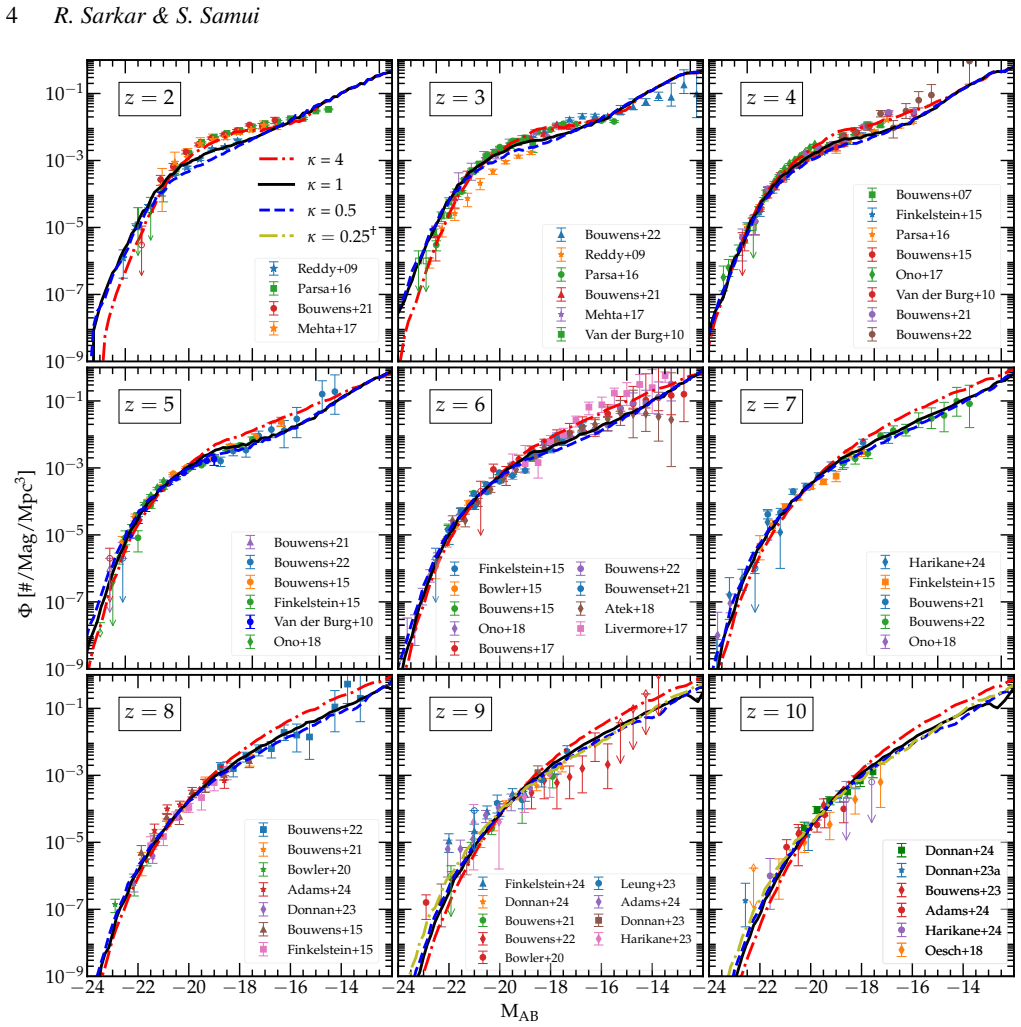
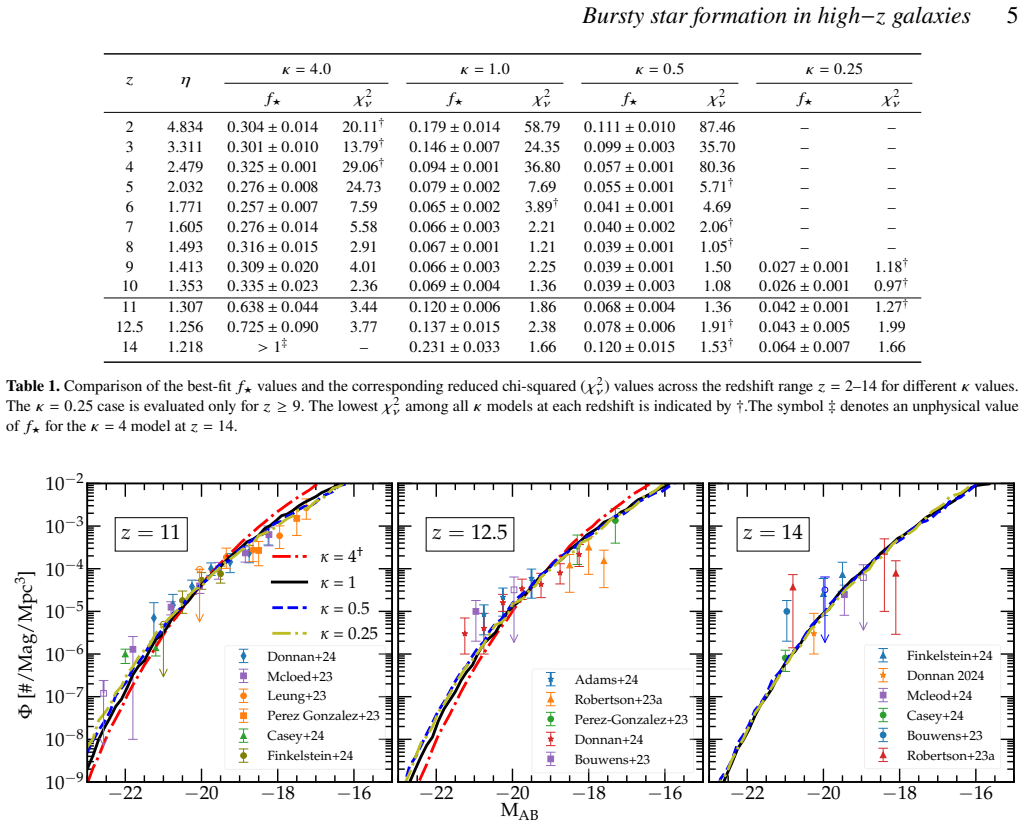
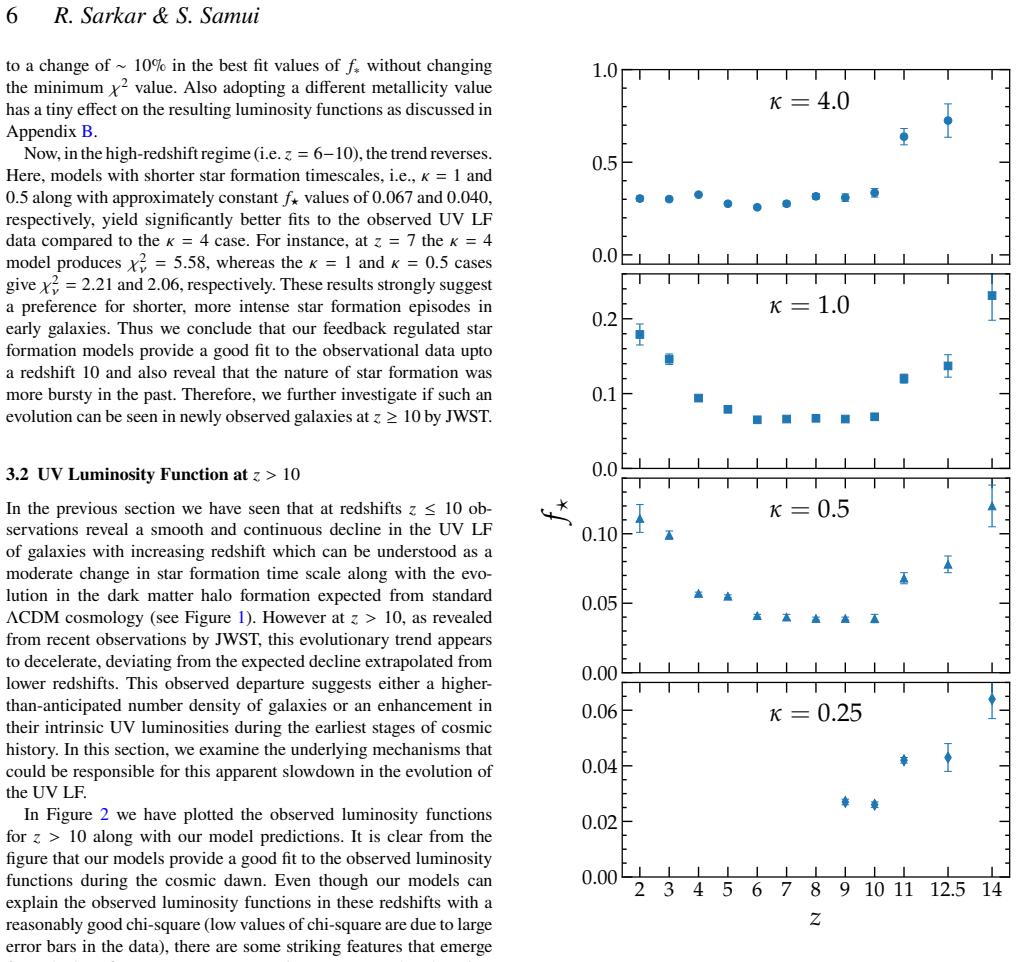
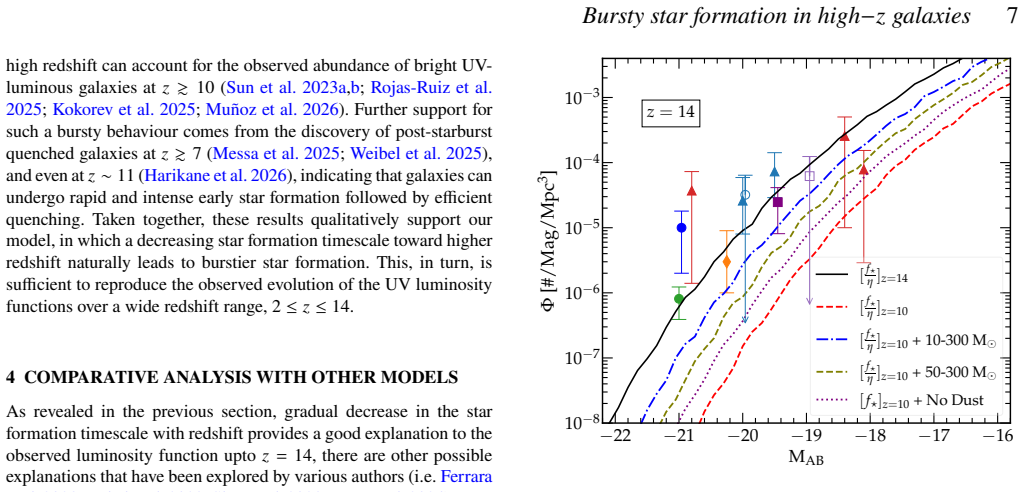
Recent JWST observations reveal an unexpectedly slow evolution in ultraviolet luminosity functions (UV LFs) at redshifts $z > 10$. To investigate this phenomenon, we develop a semi-analytical model of the UV LF, calibrated against well-constrained measurements at $z \sim 2-10$. Our analysis identifies a transition in star formation modes across cosmic epochs: at $z \lesssim 5$, a longer characteristic star formation timescale with nearly constant star formation efficiency ($f_\star$) dominates, whereas at $6 \lesssim z \lesssim 10$, shorter timescales prevail without requiring an increase in $f_\star$. For $z > 10$, the slow UV LF evolution is best explained by a shift toward even shorter star formation timescales without changing the star formation efficiency. Dust-free conditions or a top-heavy initial mass function (IMF) alone cannot reproduce the observations at $z\sim 14$. By combining UV LF with stellar mass estimates from Prospector-based SED fitting, we try to break degeneracies between IMF variations and star formation histories. Our results indicate that evolving star formation timescales rather than IMF or dust changes are the primary drivers of the observed high-redshift UV LF evolution, reflecting changing physical conditions during the earliest phases of galaxy assembly. Additionally, we show that moderate AGN activity could further boost UV luminosities at $z \sim 14$, potentially explaining the observed UV LF without changes in stellar parameters.
Editorial analysis
A structured set of objections, weighed in public.
Referee Report
Summary. The manuscript develops a semi-analytical model of the UV luminosity function calibrated against measurements at z∼2–10. It concludes that the unexpectedly slow evolution of the UV LF at z>10 is explained by a further reduction in the characteristic star-formation timescale while holding star-formation efficiency f⋆ fixed; dust-free conditions and a top-heavy IMF are stated to be unable to reproduce the z∼14 data on their own. The model is combined with Prospector SED fits to address IMF–SFH degeneracies, and moderate AGN activity is suggested as an additional UV boost at z∼14.
Significance. If the fixed-parameter extrapolation is valid, the work supplies a physically motivated account of JWST high-z observations that ties the UV LF behavior to evolving star-formation timescales rather than changes in efficiency, dust, or IMF. The attempt to break degeneracies with SED fitting and the explicit consideration of AGN contributions are constructive steps toward testable predictions.
major comments (2)
- [Abstract] Abstract (paragraph beginning 'For z > 10'): the central claim that dust-free conditions or a top-heavy IMF 'alone cannot reproduce the observations at z∼14' is obtained inside a model whose only free parameter at high redshift is the star-formation timescale, with f⋆ and all other ingredients held at their z∼2–10 values. No explicit test is shown that the same conclusion survives if, for example, the dust optical-depth scaling or the IMF-dependent UV-to-mass conversion are allowed to vary with redshift.
- [Abstract] Abstract (paragraph on Prospector SED fits): the statement that these fits 'break the IMF–SFH degeneracy' rests on the same extrapolation of the semi-analytical model to z>10. Without a quantitative table or figure comparing the likelihoods under the fixed-parameter versus alternative scenarios, it is not possible to assess whether the degeneracy is actually broken or merely re-parameterized.
minor comments (1)
- Notation for the characteristic star-formation timescale and f⋆ should be defined explicitly at first use rather than introduced only in the abstract.
Simulated Author's Rebuttal
We thank the referee for their constructive comments. We respond to each major comment below.
read point-by-point responses
-
Referee: [Abstract] Abstract (paragraph beginning 'For z > 10'): the central claim that dust-free conditions or a top-heavy IMF 'alone cannot reproduce the observations at z∼14' is obtained inside a model whose only free parameter at high redshift is the star-formation timescale, with f⋆ and all other ingredients held at their z∼2–10 values. No explicit test is shown that the same conclusion survives if, for example, the dust optical-depth scaling or the IMF-dependent UV-to-mass conversion are allowed to vary with redshift.
Authors: We agree that the quoted claim is derived within the fiducial model in which only the star-formation timescale is allowed to vary at z>10 while f⋆ and other parameters remain fixed at their z∼2–10 values. The manuscript does not present explicit tests in which the dust optical-depth scaling or the IMF-dependent UV-to-mass conversion are also permitted to evolve. We will therefore add a dedicated subsection (and associated figure) in the revised manuscript that repeats the z∼14 comparison after allowing those two ingredients to vary with redshift, thereby testing whether the preference for shorter timescales survives. revision: yes
-
Referee: [Abstract] Abstract (paragraph on Prospector SED fits): the statement that these fits 'break the IMF–SFH degeneracy' rests on the same extrapolation of the semi-analytical model to z>10. Without a quantitative table or figure comparing the likelihoods under the fixed-parameter versus alternative scenarios, it is not possible to assess whether the degeneracy is actually broken or merely re-parameterized.
Authors: The referee is correct that the current text does not supply a quantitative comparison (e.g., likelihood ratios or Bayesian evidence) between the fixed-parameter extrapolation and alternative IMF/SFH scenarios. In the revised manuscript we will add a table that reports the relative likelihoods (or evidence ratios) obtained when the Prospector SED posteriors are combined with the UV LF constraints under the fiducial model versus under models that allow redshift-dependent IMF or SFH variations. revision: yes
Circularity Check
No significant circularity in model calibration and extrapolation
full rationale
The paper develops a semi-analytical UV LF model calibrated on independent z~2-10 observations, then interprets z>10 data by varying the characteristic star-formation timescale while holding f_star and other parameters fixed. This is a conventional extrapolation and parameter-inference procedure, not a reduction where any claimed result is equivalent to its inputs by construction. No self-definitional steps, fitted inputs renamed as predictions, load-bearing self-citations, uniqueness theorems, or ansatz smuggling appear in the abstract or described derivation. The exclusion of dust-free or top-heavy IMF scenarios follows from comparisons internal to the fixed model but does not collapse to a tautology. The derivation remains self-contained against external benchmarks.
Axiom & Free-Parameter Ledger
free parameters (2)
- characteristic star formation timescale
- star formation efficiency f_star
axioms (1)
- domain assumption The semi-analytical UV LF model calibrated at z~2-10 remains valid at z>10 when only the star-formation timescale is changed.
Reference graph
Works this paper leans on
-
[2]
z~7 Galaxies in the HUDF: First Epoch WFC3/IR Results
z -0.5ex 7 Galaxies in the HUDF: First Epoch WFC3/IR Results. , keywords =. doi:10.1088/2041-8205/709/1/L16 , archivePrefix =. 0909.1806 , primaryClass =
work page internal anchor Pith review Pith/arXiv arXiv doi:10.1088/2041-8205/709/1/l16 2041
-
[5]
The present-day star formation rate of the Milky-Way determined from Spitzer detected young stellar objects , volume =
Robitaille, Thomas and Whitney, Barbara , year =. The present-day star formation rate of the Milky-Way determined from Spitzer detected young stellar objects , volume =. ApJ , doi =
-
[17]
The Burstiness of Star Formation at z 6: A Huge Diversity in the Recent Star Formation Histories of Very UV-faint Galaxies. , keywords =. doi:10.3847/1538-4357/addc74 , archivePrefix =. 2410.01905 , primaryClass =
-
[19]
Nelson, Dylan and Pillepich, Annalisa and Springel, Volker and Pakmor, Rüdiger and Weinberger, Rainer and Genel, Shy and Torrey, Paul and Vogelsberger, Mark and Marinacci, Federico and Hernquist, Lars , year=. First results from the TNG50 simulation: galactic outflows driven by supernovae and black hole feedback , volume=. MNRAS , publisher=. doi:10.1093/...
work page internal anchor Pith review doi:10.1093/mnras/stz2306
-
[20]
Pillepich, Annalisa and Nelson, Dylan and Springel, Volker and Pakmor, Rüdiger and Torrey, Paul and Weinberger, Rainer and Vogelsberger, Mark and Marinacci, Federico and Genel, Shy and van der Wel, Arjen and Hernquist, Lars , year=. First results from the TNG50 simulation: the evolution of stellar and gaseous discs across cosmic time , volume=. MNRAS , pu...
-
[22]
A Long Time Ago in a Galaxy Far, Far Away: A Candidate z 12 Galaxy in Early JWST CEERS Imaging. , keywords =. doi:10.3847/2041-8213/ac966e , archivePrefix =. 2207.12474 , primaryClass =
-
[25]
Discovery of z~8 Galaxies in the HUDF from ultra-deep WFC3/IR Observations
Discovery of z -0.5ex 8 Galaxies in the Hubble Ultra Deep Field from Ultra-Deep WFC3/IR Observations. , keywords =. doi:10.1088/2041-8205/709/2/L133 , archivePrefix =. 0909.1803 , primaryClass =
work page internal anchor Pith review Pith/arXiv arXiv doi:10.1088/2041-8205/709/2/l133 2041
-
[33]
A Remarkably Luminous Galaxy at z=11.1 Measured with Hubble Space Telescope Grism Spectroscopy
A Remarkably Luminous Galaxy at z=11.1 Measured with Hubble Space Telescope Grism Spectroscopy. , keywords =. doi:10.3847/0004-637X/819/2/129 , archivePrefix =. 1603.00461 , primaryClass =
work page internal anchor Pith review Pith/arXiv arXiv doi:10.3847/0004-637x/819/2/129
-
[35]
On the ages of bright galaxies 500 Myr after the big bang: insights into star formation activity at z 15 with JWST. , keywords =. doi:10.1093/mnras/stac3535 , archivePrefix =. 2208.01599 , primaryClass =
-
[37]
2023 , eprint=
The Next Generation Deep Extragalactic Exploratory Public (NGDEEP) Survey , author=. 2023 , eprint=
2023
-
[39]
z 2-9 Galaxies Magnified by the Hubble Frontier Field Clusters. II. Luminosity Functions and Constraints on a Faint-end Turnover. , keywords =. doi:10.3847/1538-4357/ac86d1 , archivePrefix =. 2205.11526 , primaryClass =
-
[41]
Observational Searches for Galaxies at z > 6
Observational Searches for Star-Forming Galaxies at z > 6. , keywords =. doi:10.1017/pasa.2016.26 , archivePrefix =. 1511.05558 , primaryClass =
work page internal anchor Pith review Pith/arXiv arXiv doi:10.1017/pasa.2016.26 2016
-
[42]
Reionization Era Bright Emission Line Survey: Selection and Characterization of Luminous Interstellar Medium Reservoirs in the z > 6.5 Universe. , keywords =. doi:10.3847/1538-4357/ac5a4a , archivePrefix =. 2106.13719 , primaryClass =
-
[57]
Super-early JWST galaxies, outflows, and Ly visibility in the Epoch of Reionization. , keywords =. doi:10.1051/0004-6361/202348321 , archivePrefix =. 2310.12197 , primaryClass =
-
[63]
Early galaxy formation and its large-scale effects. , keywords =. doi:10.1016/j.physrep.2018.10.002 , archivePrefix =. 1809.09136 , primaryClass =
-
[76]
Samui, Saumyadip and Subramanian, Kandaswamy and Srianand, Raghunathan , year=. Models of high redshift luminosity functions and galactic outflows: The dependence on halo mass function , volume=. New Astronomy , publisher=. doi:10.1016/j.newast.2009.02.006 , number=
-
[84]
New synthesis models of consistent extragalactic background light over cosmic time
New synthesis models of consistent extragalactic background light over cosmic time. , keywords =. doi:10.1093/mnras/stz174 , archivePrefix =. 1801.09693 , primaryClass =
work page internal anchor Pith review Pith/arXiv arXiv doi:10.1093/mnras/stz174
-
[107]
The z = 9-10 galaxy population in the Hubble Frontier Fields and CLASH surveys: the z = 9 luminosity function and further evidence for a smooth decline in ultraviolet luminosity density at z 8. , keywords =. doi:10.1093/mnras/stw904 , archivePrefix =. 1602.05199 , primaryClass =
work page internal anchor Pith review Pith/arXiv arXiv doi:10.1093/mnras/stw904
-
[111]
CAMB: Code for Anisotropies in the Microwave Background
-
[113]
A dusty compact object bridging galaxies and quasars at cosmic dawn. , keywords =. doi:10.1038/s41586-022-04454-1 , archivePrefix =. 2204.06393 , primaryClass =
-
[114]
ALMA confirmation of an obscured hyperluminous radio-loud AGN at z = 6.853 associated with a dusty starburst in the 1.5 deg ^ 2 COSMOS field. , keywords =. doi:10.1093/mnras/stad266 , archivePrefix =. 2206.00018 , primaryClass =
-
[115]
On the Coevolution of the AGN and Star-forming Galaxy Ultraviolet Luminosity Functions at 3 < z < 9. , keywords =. doi:10.3847/1538-4357/ac89eb , archivePrefix =. 2207.02233 , primaryClass =
-
[116]
Peterson, B. M. , title =
-
[117]
Rybicki, G. B. and Lightman, A. P. , title =
-
[119]
Black Hole Halo Mass Relation from UNIONS Weak Lensing. , keywords =. doi:10.3847/2041-8213/ad58b0 , archivePrefix =. 2402.10740 , primaryClass =
-
[126]
The Evolution and Properties of Rotating Massive Star Populations
The Evolution and Properties of Rotating Massive Star Populations. , keywords =. doi:10.3847/1538-4357/aa679f , archivePrefix =. 1702.04722 , primaryClass =
work page internal anchor Pith review Pith/arXiv arXiv doi:10.3847/1538-4357/aa679f
-
[128]
The ultraviolet continuum slopes ( ) of galaxies at z ≃ 8-16 from JWST and ground-based near-infrared imaging. , keywords =. doi:10.1093/mnras/stad073 , archivePrefix =. 2208.04914 , primaryClass =
-
[129]
The ALMA REBELS Survey: specific star formation rates in the reionization era. , keywords =. doi:10.1093/mnras/stac2291 , archivePrefix =. 2203.07392 , primaryClass =
-
[132]
Dusty Starbursts Masquerading as Ultra-high Redshift Galaxies in JWST CEERS Observations. , keywords =. doi:10.3847/2041-8213/acacfe , archivePrefix =. 2208.01816 , primaryClass =
-
[135]
Adams N. J., et al., 2024, @doi [ ] 10.3847/1538-4357/ad2a7b , https://ui.adsabs.harvard.edu/abs/2024ApJ...965..169A 965, 169
-
[136]
Andrews B. H., Martini P., 2013, @doi [ ] 10.1088/0004-637X/765/2/140 , https://ui.adsabs.harvard.edu/abs/2013ApJ...765..140A 765, 140
-
[137]
Arrabal Haro P., et al., 2023, @doi [ ] 10.1038/s41586-023-06521-7 , https://ui.adsabs.harvard.edu/abs/2023Natur.622..707A 622, 707
-
[138]
Asplund M., Grevesse N., Sauval A. J., Scott P., 2009, @doi [ ] 10.1146/annurev.astro.46.060407.145222 , https://ui.adsabs.harvard.edu/abs/2009ARA&A..47..481A 47, 481
-
[139]
Atek H., Richard J., Kneib J.-P., Schaerer D., 2018, @doi [ ] 10.1093/mnras/sty1820 , 479, 5184
-
[140]
Bagley M. B., et al., 2024, @doi [ ] 10.3847/1538-4357/ad09dc , https://ui.adsabs.harvard.edu/abs/2024ApJ...961..209B 961, 209
-
[141]
Barkana R., Loeb A., 2001, @doi [ ] 10.1016/S0370-1573(01)00019-9 , https://ui.adsabs.harvard.edu/abs/2001PhR...349..125B 349, 125
-
[142]
Benson A. J., Lacey C. G., Baugh C. M., Cole S., Frenk C. S., 2002, @doi [ ] 10.1046/j.1365-8711.2002.05387.x , https://ui.adsabs.harvard.edu/abs/2002MNRAS.333..156B 333, 156
-
[143]
Best P. N., Kaiser C. R., Heckman T. M., Kauffmann G., 2006, @doi [ ] 10.1111/j.1745-3933.2006.00159.x , https://ui.adsabs.harvard.edu/abs/2006MNRAS.368L..67B 368, L67
-
[144]
Bouwens R. J., Illingworth G. D., Franx M., Ford H., 2007, @doi [ ] 10.1086/521811 , https://ui.adsabs.harvard.edu/abs/2007ApJ...670..928B 670, 928
-
[145]
Bouwens R. J., et al., 2012, @doi [ ] 10.1088/0004-637X/754/2/83 , https://ui.adsabs.harvard.edu/abs/2012ApJ...754...83B 754, 83
-
[146]
Bouwens R. J., et al., 2015, @doi [ ] 10.1088/0004-637X/803/1/34 , https://ui.adsabs.harvard.edu/abs/2015ApJ...803...34B 803, 34
-
[147]
Bouwens R. J., Oesch P. A., Illingworth G. D., Ellis R. S., Stefanon M., 2017, @doi [ ] 10.3847/1538-4357/aa70a4 , 843, 129
-
[148]
Bouwens R. J., Stefanon M., Oesch P. A., Illingworth G. D., Nanayakkara T., Roberts-Borsani G., Labb \'e I., Smit R., 2019, @doi [ ] 10.3847/1538-4357/ab24c5 , https://ui.adsabs.harvard.edu/abs/2019ApJ...880...25B 880, 25
-
[149]
Bouwens R. J., et al., 2021, @doi [ ] 10.3847/1538-3881/abf83e , https://ui.adsabs.harvard.edu/abs/2021AJ....162...47B 162, 47
-
[150]
Bouwens R. J., Illingworth G. D., van Dokkum P. G., Oesch P. A., Stefanon M., Ribeiro B., 2022, @doi [ ] 10.3847/1538-4357/ac4791 , 927, 81
-
[151]
Bouwens R., Illingworth G., Oesch P., Stefanon M., Naidu R., van Leeuwen I., Magee D., 2023, @doi [ ] 10.1093/mnras/stad1014 , https://ui.adsabs.harvard.edu/abs/2023MNRAS.523.1009B 523, 1009
-
[152]
Bower R. G., Benson A. J., Malbon R., Helly J. C., Frenk C. S., Baugh C. M., Cole S., Lacey C. G., 2006, @doi [ ] 10.1111/j.1365-2966.2006.10519.x , https://ui.adsabs.harvard.edu/abs/2006MNRAS.370..645B 370, 645
-
[153]
Bowler R. A. A., et al., 2015, @doi [ ] 10.1093/mnras/stv1403 , https://ui.adsabs.harvard.edu/abs/2015MNRAS.452.1817B 452, 1817
-
[154]
Bowler R. A. A., Jarvis M. J., Dunlop J. S., McLure R. J., McLeod D. J., Adams N. J., Milvang-Jensen B., McCracken H. J., 2020, @doi [ ] 10.1093/mnras/staa313 , https://ui.adsabs.harvard.edu/abs/2020MNRAS.493.2059B 493, 2059
-
[155]
Boylan-Kolchin M., 2023, @doi [Nature Astronomy] 10.1038/s41550-023-01937-7 , https://ui.adsabs.harvard.edu/abs/2023NatAs...7..731B 7, 731
-
[156]
Bromm V., Loeb A., 2002, @doi [ ] 10.1086/341189 , https://ui.adsabs.harvard.edu/abs/2002ApJ...575..111B 575, 111
-
[157]
Bromm V., Coppi P. S., Larson R. B., 2002, @doi [ ] 10.1086/323947 , https://ui.adsabs.harvard.edu/abs/2002ApJ...564...23B 564, 23
-
[158]
Bunker A. J., et al., 2024, @doi [ ] 10.1051/0004-6361/202347094 , https://ui.adsabs.harvard.edu/abs/2024A&A...690A.288B 690, A288
-
[159]
Burgarella D., et al., 2013, @doi [ ] 10.1051/0004-6361/201321651 , https://ui.adsabs.harvard.edu/abs/2013A&A...554A..70B 554, A70
-
[160]
Carniani S., et al., 2024, @doi [ ] 10.1038/s41586-024-07860-9 , https://ui.adsabs.harvard.edu/abs/2024Natur.633..318C 633, 318
-
[161]
Casey C. M., et al., 2024, @doi [ ] 10.3847/1538-4357/ad2075 , https://ui.adsabs.harvard.edu/abs/2024ApJ...965...98C 965, 98
-
[162]
Castellano M., et al., 2022, @doi [ ] 10.3847/2041-8213/ac94d0 , 938, L15
-
[163]
Chabrier G., 2003, @doi [ ] 10.1086/376392 , https://ui.adsabs.harvard.edu/abs/2003PASP..115..763C 115, 763
work page internal anchor Pith review doi:10.1086/376392 2003
-
[164]
Conroy C., Gunn J. E., 2010, @doi [ ] 10.1088/0004-637X/712/2/833 , https://ui.adsabs.harvard.edu/abs/2010ApJ...712..833C 712, 833
work page internal anchor Pith review doi:10.1088/0004-637x/712/2/833 2010
-
[165]
Conroy C., Gunn J. E., White M., 2009, @doi [ ] 10.1088/0004-637X/699/1/486 , https://ui.adsabs.harvard.edu/abs/2009ApJ...699..486C 699, 486
work page internal anchor Pith review doi:10.1088/0004-637x/699/1/486 2009
-
[166]
Curti M., Mannucci F., Cresci G., Maiolino R., 2020, @doi [ ] 10.1093/mnras/stz2910 , https://ui.adsabs.harvard.edu/abs/2020MNRAS.491..944C 491, 944
-
[167]
Curtis-Lake E., et al., 2023, @doi [Nature Astronomy] 10.1038/s41550-023-01918-w , https://ui.adsabs.harvard.edu/abs/2023NatAs...7..622C 7, 622
-
[168]
Dekel A., Sarkar K. C., Birnboim Y., Mandelker N., Li Z., 2023, @doi [ ] 10.1093/mnras/stad1557 , https://ui.adsabs.harvard.edu/abs/2023MNRAS.523.3201D 523, 3201
-
[169]
Dijkstra M., Haiman Z., Rees M. J., Weinberg D. H., 2004, @doi [ ] 10.1086/380603 , https://ui.adsabs.harvard.edu/abs/2004ApJ...601..666D 601, 666
-
[170]
Donnan C. T., et al., 2023a, @doi [ ] 10.1093/mnras/stac3472 , https://ui.adsabs.harvard.edu/abs/2023MNRAS.518.6011D 518, 6011
-
[171]
Donnan C. T., McLeod D. J., McLure R. J., Dunlop J. S., Carnall A. C., Cullen F., Magee D., 2023b, @doi [ ] 10.1093/mnras/stad471 , https://ui.adsabs.harvard.edu/abs/2023MNRAS.520.4554D 520, 4554
-
[172]
Donnan C. T., et al., 2024, @doi [ ] 10.1093/mnras/stae2037 , https://ui.adsabs.harvard.edu/abs/2024MNRAS.533.3222D 533, 3222
-
[173]
Dotter A., 2016, @doi [ ] 10.3847/0067-0049/222/1/8 , https://ui.adsabs.harvard.edu/abs/2016ApJS..222....8D 222, 8
work page internal anchor Pith review doi:10.3847/0067-0049/222/1/8 2016
-
[174]
Ferrara A., Pallottini A., Dayal P., 2023, @doi [ ] 10.1093/mnras/stad1095 , 522, 3986
-
[175]
Finkelstein S. L., et al., 2015, @doi [ ] 10.1088/0004-637X/810/1/71 , https://ui.adsabs.harvard.edu/abs/2015ApJ...810...71F 810, 71
-
[177]
Finkelstein S. L., et al., 2022b, @doi [ ] 10.3847/1538-4357/ac3aed , https://ui.adsabs.harvard.edu/abs/2022ApJ...928...52F 928, 52
-
[178]
Finkelstein S. L., et al., 2023, @doi [ ] 10.3847/2041-8213/acade4 , https://ui.adsabs.harvard.edu/abs/2023ApJ...946L..13F 946, L13
-
[179]
Finkelstein S. L., et al., 2024, @doi [ ] 10.3847/2041-8213/ad4495 , https://ui.adsabs.harvard.edu/abs/2024ApJ...969L...2F 969, L2
-
[180]
Fu S., et al., 2025, @doi [ ] 10.3847/1538-4357/adddb1 , https://ui.adsabs.harvard.edu/abs/2025ApJ...987..186F 987, 186
-
[181]
Fujimoto S., et al., 2024, @doi [ ] 10.3847/1538-4357/ad9027 , https://ui.adsabs.harvard.edu/abs/2024ApJ...977..250F 977, 250
-
[182]
Harikane Y., et al., 2023a, @doi [ ] 10.3847/1538-4365/acaaa9 , https://ui.adsabs.harvard.edu/abs/2023ApJS..265....5H 265, 5
-
[183]
Harikane Y., et al., 2023b, @doi [ ] 10.3847/1538-4357/ad029e , https://ui.adsabs.harvard.edu/abs/2023ApJ...959...39H 959, 39
-
[184]
Harikane Y., et al., 2025, @doi [ ] 10.3847/1538-4357/ad9b2c , https://ui.adsabs.harvard.edu/abs/2025ApJ...980..138H 980, 138
-
[185]
Harikane Y., et al., 2026, @doi [arXiv e-prints] 10.48550/arXiv.2601.21833 , https://ui.adsabs.harvard.edu/abs/2026arXiv260121833H p. arXiv:2601.21833
-
[186]
Ishigaki M., Kawamata R., Ouchi M., Oguri M., Shimasaku K., Ono Y., 2015, @doi [ ] 10.1088/0004-637X/799/1/12 , https://ui.adsabs.harvard.edu/abs/2015ApJ...799...12I 799, 12
discussion (0)
Sign in with ORCID, Apple, or X to comment. Anyone can read and Pith papers without signing in.