REVIEW 2 major objections 1 minor 1 cited by
Quasi-periodic oscillation frequencies in black holes change their trend with temperature exactly when the hole crosses a thermodynamic phase boundary.
Reviewed by Pith at T0; open to challenge. T0 means a machine referee read the full paper against a public rubric. the ladder, T0–T4 →
T0 review · grok-4.3
2026-05-25 08:41 UTC pith:Z3CFUK44
load-bearing objection The paper shows QPO frequency-temperature curves changing at the known phase transition points in RN-AdS and Kerr by direct substitution into standard expressions, but offers no check on whether those expressions remain valid in the transition regime. the 2 major comments →
Probing Black Hole Phase Transitions through Quasi-Periodic Oscillations
The pith
A machine-rendered reading of the paper's core claim, the machinery that carries it, and where it could break.
Core claim
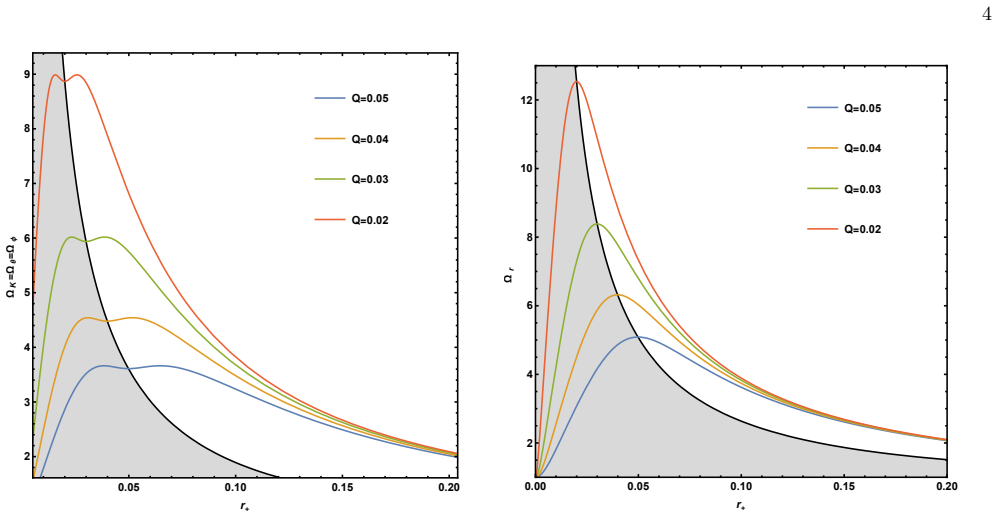
Using both RN AdS and Kerr black hole backgrounds across different QPO models, the analysis shows that QPO frequencies trace out distinct thermodynamic phases and also reflect their stability properties. As the black hole transitions between different thermodynamic phases, the trend of QPO frequencies with respect to temperature also shifts.
What carries the argument
Quasi-periodic oscillation frequencies obtained by substituting the RN AdS or Kerr metric directly into standard orbital QPO expressions and then comparing the results to Hawking temperature.
Load-bearing premise
The usual QPO frequency formulas stay valid and meaningful when the background geometry itself is undergoing a thermodynamic phase transition.
What would settle it
An observation of QPO frequencies versus temperature in an accreting black hole that shows no change in slope or pattern at the temperature where a phase transition is independently expected would falsify the central claim.
If this is right
- QPO timing data could indicate when an accreting black hole is crossing from one thermodynamic phase to another.
- The stability of each thermodynamic branch can be read from the same frequency-temperature curve.
- The signature appears across multiple standard QPO models and both charged AdS and rotating black holes.
Where Pith is reading between the lines
- If the frequency shift survives in more realistic accretion-disk models, X-ray timing archives could be re-examined for phase-transition candidates.
- The method could be applied to other black-hole solutions whose phase diagrams are already known from thermodynamic calculations.
- It leaves open whether the physical mechanism producing the QPOs itself changes when the background crosses a phase boundary.
Editorial analysis
A structured set of objections, weighed in public.
Referee Report
Summary. The manuscript claims that quasi-periodic oscillation (QPO) frequencies computed from standard models in RN-AdS and Kerr backgrounds trace distinct thermodynamic phases of black holes and reflect their stability properties. As the Hawking temperature varies, the trends in upper and lower QPO frequencies shift when the black hole crosses phase transition points in the extended phase space, suggesting that changes in geometry during transitions may influence QPO behavior. The work is explicitly framed as a mathematical exploration rather than an observational claim, citing the lack of data and the speculative status of black hole phase transitions.
Significance. If the reported correlation between QPO frequency trends and thermodynamic phase structure holds under scrutiny, it would provide a novel mathematical link between black hole thermodynamics in the extended phase space and astrophysical observables, potentially allowing QPO data to indicate phase stability. The manuscript receives credit for using standard metrics and QPO expressions without introducing new free parameters or ad-hoc adjustments to force the reported behavior.
major comments (2)
- [Methodology and results sections on RN-AdS QPO computation] The central claim that QPO frequencies reflect thermodynamic phases and stability relies on direct substitution of the RN-AdS metric into standard QPO expressions (geodesic/epicyclic frequencies) without re-derivation or bounds on the effects of the negative cosmological constant in the regime of multiple horizons at fixed T and P; this assumption is load-bearing for interpreting trend shifts as genuine signatures rather than potential artifacts of the unadjusted formulas.
- [Results and discussion] No error analysis, robustness checks, or comparisons against alternative QPO prescriptions are supplied, which directly affects the reliability of the reported phase-tracing behavior (as the paper itself qualifies the results as only a mathematical possibility).
minor comments (1)
- [Abstract] Abstract contains typos: 'Our results shows' should be 'Our results show'; 'lack of of observational data' should be 'lack of observational data'.
Simulated Author's Rebuttal
We thank the referee for the thorough review and valuable comments. Our manuscript is explicitly framed as a mathematical exploration of possible connections between QPO frequencies and black hole thermodynamics in the extended phase space, without claiming observational implications. Below we address the major comments point by point.
read point-by-point responses
-
Referee: [Methodology and results sections on RN-AdS QPO computation] The central claim that QPO frequencies reflect thermodynamic phases and stability relies on direct substitution of the RN-AdS metric into standard QPO expressions (geodesic/epicyclic frequencies) without re-derivation or bounds on the effects of the negative cosmological constant in the regime of multiple horizons at fixed T and P; this assumption is load-bearing for interpreting trend shifts as genuine signatures rather than potential artifacts of the unadjusted formulas.
Authors: The QPO frequency expressions employed are the standard geodesic and epicyclic frequency formulas derived from the general stationary metric, which have been applied in the literature to a range of spacetimes including those with a cosmological constant. The RN-AdS metric components already incorporate the negative cosmological constant, and the calculations are performed at fixed pressure and temperature in the extended phase space. We did not perform a full re-derivation because the expressions depend only on the metric functions and their derivatives, which remain well-defined. Nevertheless, we acknowledge that explicit bounds on the influence of multiple horizons would strengthen the interpretation. We will add a dedicated paragraph in the methodology section discussing the regime of validity and any potential artifacts. revision: yes
-
Referee: [Results and discussion] No error analysis, robustness checks, or comparisons against alternative QPO prescriptions are supplied, which directly affects the reliability of the reported phase-tracing behavior (as the paper itself qualifies the results as only a mathematical possibility).
Authors: We agree that the absence of quantitative error estimates and comparisons with other QPO models limits the robustness assessment. The manuscript already qualifies the findings as a mathematical possibility rather than a definitive link. To address this, we will include a short subsection in the discussion that (i) notes the qualitative nature of the observed trend shifts, (ii) references the range of QPO models used, and (iii) explicitly states that alternative prescriptions could alter the precise locations of slope changes while preserving the overall phase-tracing pattern in our calculations. revision: yes
Circularity Check
No significant circularity; derivation is self-contained
full rationale
The paper applies standard QPO frequency expressions (geodesic/epicyclic frequencies) directly to the RN-AdS and Kerr metrics and plots the resulting upper/lower frequencies against Hawking temperature. Thermodynamic phases and stability are determined independently from the usual extended phase-space quantities (e.g., heat capacity, Gibbs free energy). No parameter is fitted to a subset of data and then relabeled as a prediction, no self-citation is invoked as a uniqueness theorem, and no ansatz is smuggled in. The observed trend shifts are therefore outputs of the explicit substitution rather than tautological redefinitions of the inputs.
Axiom & Free-Parameter Ledger
free parameters (1)
- orbital radius or frequency parameters inside each QPO model
axioms (2)
- standard math The RN AdS and Kerr metrics correctly describe the spacetime geometry for the thermodynamic analysis.
- domain assumption Hawking temperature is the appropriate control parameter for locating thermodynamic phase transitions.
read the original abstract
In this work, we probe the well known thermodynamic phase structure of black hole through the lens of its quasi-periodic oscillations (QPOs). Can QPOs be influenced by black hole phase transitions? Do they carry any signature of such transitions in their observational patterns? These were the central questions guiding our study. Using both RN AdS and Kerr black hole backgrounds across different QPO models, we analyzed the behavior of upper and lower QPO frequencies as functions of the Hawking temperature. Our results shows that QPO frequencies trace out distinct thermodynamic phases and also reflect their stability properties. As the black hole transitions between different thermodynamic phases, the trend of QPO frequencies with respect to temperature also shifts. Due to lack of of observational data, the present work is primarily more on the mathematical side, as the underlying mechanism responsible for the Hawking temperature has not yet been fully understood or experimentally verified. Moreover, given the speculative nature of black hole phase transitions, it would be unfair to claim that our results establish a definitive connection between an observable quantity such as the QPO frequency and the thermodynamic phase behavior of black holes. Nevertheless, our analysis suggests a possibility that changes in black hole geometry could be one of the contributing factors influencing QPO behavior.
Figures


Lean theorems connected to this paper
-
IndisputableMonolith/Cost/FunctionalEquation.leanwashburn_uniqueness_aczel (J uniqueness) unclear?
unclearRelation between the paper passage and the cited Recognition theorem.
QPO frequencies trace out distinct thermodynamic phases... trend of QPO frequencies with respect to temperature also shifts (RP model: nu_U=nu_phi, nu_L=nu_phi-nu_r; ER/WD variants)
-
IndisputableMonolith/Foundation/BlackBodyRadiationDeep.leanblackBodyRadiationDeepCert (J-cost on thermal ratios) unclear?
unclearRelation between the paper passage and the cited Recognition theorem.
RN-AdS lapse f(r)=1-2M/r+Q^2/r^2+r^2/kappa^2; T from f'(r_+); VdW-like branches for Q<Q_c
What do these tags mean?
- matches
- The paper's claim is directly supported by a theorem in the formal canon.
- supports
- The theorem supports part of the paper's argument, but the paper may add assumptions or extra steps.
- extends
- The paper goes beyond the formal theorem; the theorem is a base layer rather than the whole result.
- uses
- The paper appears to rely on the theorem as machinery.
- contradicts
- The paper's claim conflicts with a theorem or certificate in the canon.
- unclear
- Pith found a possible connection, but the passage is too broad, indirect, or ambiguous to say the theorem truly supports the claim.
Forward citations
Cited by 1 Pith paper
-
Mapping Quasi-Periodic Oscillations to Lyapunov Exponent across Black Hole Thermodynamic Phase Transitions
For a nonminimally coupled magnetic AdS black hole, the Lyapunov exponent and QPO frequencies both reproduce the swallowtail branch structure of the Van der Waals-like thermodynamic phase transition.
Reference graph
Works this paper leans on
-
[1]
B. P. Abbott et al. (LIGO Scientific Collaboration and Virgo Collaboration),Observation of Gravitational Waves from a Binary Black Hole Merger, Phys. Rev. Lett.116, 061102 (2016) [arXiv:1602.03837]
work page internal anchor Pith review Pith/arXiv arXiv 2016
-
[2]
The Event Horizon Telescope Collaboration et al.,First M87 Event Horizon Telescope Results. I. The Shadow of the Supermassive Black Hole, Astrophys. J. Lett.871, L1 (2019)
work page 2019
-
[3]
The Event Horizon Telescope Collaboration et al.,First M87 Event Horizon Telescope Results. II. Array and In- strumentation, Astrophys. J. Lett.875, L2 (2019)
work page 2019
-
[4]
The Event Horizon Telescope Collaboration et al.,First M87 Event Horizon Telescope Results. III. Data Process- ing and Calibration, Astrophys. J. Lett.875, L3 (2019)
work page 2019
-
[5]
The Event Horizon Telescope Collaboration et al.,First M87 Event Horizon Telescope Results. IV. Imaging the Central Supermassive Black Hole, Astrophys. J. Lett. 875, L4 (2019)
work page 2019
-
[6]
The Event Horizon Telescope Collaboration et al.,First M87 Event Horizon Telescope Results. V. Physical Ori- gin of the Asymmetric Ring, Astrophys. J. Lett.875, L5 (2019)
work page 2019
-
[7]
The Event Horizon Telescope Collaboration et al.,First M87 Event Horizon Telescope Results. VI. The Shadow and Mass of the Central Black Hole, Astrophys. J. Lett. 875, L6 (2019)
work page 2019
-
[8]
J. Shipley and S. R. Dolan, Class. Quant. Grav. 33 (2016) no.17, 175001
work page 2016
- [9]
-
[10]
F. Atamurotov, A. Abdujabbarov and B. Ahmedov, As- trophys. Space Sci. 348 (2013), 179-188
work page 2013
-
[11]
S. Vagnozzi et al., Horizon-scale tests of gravity theories and fundamental physics from the Event Horizon Tele- scope image of Sagittarius A*, Class. Quantum Grav. 40, 165007 (2023)
work page 2023
-
[12]
J. D. Bekenstein, Black holes and entropy, Phys. Rev. D 7, 2333-2346 (1973) doi:10.1103/PhysRevD.7.2333
-
[13]
S. W. Hawking, Black hole explosions, Nature248, 30-31 (1974) doi:10.1038/248030a0
-
[14]
S. W. Hawking, Particle Creation by Black Holes, Commun. Math. Phys.43, 199-220 (1975) [er- ratum: Commun. Math. Phys.46, 206 (1976)] doi:10.1007/BF02345020
-
[15]
J. M. Bardeen, B. Carter and S. W. Hawking, The Four laws of black hole mechanics, Commun. Math. Phys.31, 161-170 (1973) doi:10.1007/BF01645742
-
[16]
R. M. Wald, Entropy and black-hole thermo- dynamics, Phys. Rev. D20, 1271-1282 (1979) doi:10.1103/PhysRevD.20.1271
-
[17]
Black-hole thermodynamics, Physics Today, 33(1):24–31, 1980
Jacob D Bekenstein. Black-hole thermodynamics, Physics Today, 33(1):24–31, 1980
work page 1980
-
[18]
R. M. Wald, The thermodynamics of black holes, Living Rev. Rel.4, 6 (2001) doi:10.12942/lrr-2001-6 [arXiv:gr- qc/9912119 [gr-qc]]
-
[19]
S.Carlip, Black Hole Thermodynamics, Int. J. Mod. Phys. D23, 1430023 (2014) 11 doi:10.1142/S0218271814300237 [arXiv:1410.1486 [gr-qc]]
work page internal anchor Pith review Pith/arXiv arXiv doi:10.1142/s0218271814300237 2014
-
[20]
A.C.Wall, A Survey of Black Hole Thermodynamics, [arXiv:1804.10610 [gr-qc]]
work page internal anchor Pith review Pith/arXiv arXiv
-
[21]
P.Candelas and D.W.Sciama, Irreversible Thermody- namics of Black Holes, Phys. Rev. Lett.38, 1372-1375 (1977) doi:10.1103/PhysRevLett.38.1372
-
[22]
On Black Hole Entropy Corrections in the Grand Canonical Ensemble
S. Mahapatra, P. Phukon and T. Sarkar, Phys. Rev. D84, 044041 (2011) doi:10.1103/PhysRevD.84.044041 [arXiv:1103.5885 [hep-th]]
work page internal anchor Pith review Pith/arXiv arXiv doi:10.1103/physrevd.84.044041 2011
-
[23]
P. C. W. Davies, Thermodynamic Phase Transitions of Kerr-Newman Black Holes in De Sitter Space, Class. Quant. Grav.6, 1909 (1989) doi:10.1088/0264- 9381/6/12/018
-
[24]
S. W. Hawking and D. N. Page, Thermodynamics of Black Holes in anti-De Sitter Space, Commun. Math. Phys.87, 577 (1983) doi:10.1007/BF01208266
-
[25]
A. Curir, Rotating black holes as dissipative spin- thermodynamical systems, General Relativity and Grav- itation,13, 417, (1981) doi:10.1007/BF00756588
-
[26]
Anna Curir, Black hole emissions and phase transitions, General Relativity and Gravitation,13, 1177, (1981) doi:10.1007/BF00759866
-
[27]
D. Pavon and J. M. Rubi, Nonequilibrium Thermody- namic Fluctuations of Black Holes, Phys. Rev. D37, 2052-2058 (1988) doi:10.1103/PhysRevD.37.2052
-
[28]
Pavon, Phase transition in Reissner-Nordstrom black holes, Phys
D. Pavon, Phase transition in Reissner-Nordstrom black holes, Phys. Rev. D43, 2495-2497 (1991) doi:10.1103/PhysRevD.43.2495
-
[29]
Kaburaki, Critical behavior of extremal Kerr-Newman black holes, Gen
O. Kaburaki, Critical behavior of extremal Kerr-Newman black holes, Gen. Rel. Grav.28, 843 (1996)
work page 1996
-
[30]
R. G. Cai, Z. J. Lu and Y. Z. Zhang, Critical behav- ior in (2+1)-dimensional black holes, Phys. Rev. D55, 853-860 (1997) doi:10.1103/PhysRevD.55.853 [arXiv:gr- qc/9702032 [gr-qc]]
-
[31]
R. G. Cai and J. H. Cho, Thermodynamic curvature of the BTZ black hole, Phys. Rev. D60, 067502 (1999) doi:10.1103/PhysRevD.60.067502 [arXiv:hep-th/9803261 [hep-th]]
work page internal anchor Pith review Pith/arXiv arXiv doi:10.1103/physrevd.60.067502 1999
-
[32]
Y. H. Wei, Thermodynamic critical and geometrical properties of charged BTZ black hole, Phys. Rev. D80, 024029 (2009) doi:10.1103/PhysRevD.80.024029
-
[33]
A general framework to study the extremal phase transition of black holes
K. Bhattacharya, S. Dey, B. R. Majhi and S. Samanta, General framework to study the extremal phase transi- tion of black holes, Phys. Rev. D99, no.12, 124047 (2019) doi:10.1103/PhysRevD.99.124047 [arXiv:1903.03434 [gr- qc]]
work page internal anchor Pith review Pith/arXiv arXiv doi:10.1103/physrevd.99.124047 2019
-
[34]
Enthalpy and the Mechanics of AdS Black Holes
D. Kastor, S. Ray and J. Traschen, Enthalpy and the Mechanics of AdS Black Holes, Class. Quant. Grav. 26, 195011 (2009) doi:10.1088/0264-9381/26/19/195011 [arXiv:0904.2765 [hep-th]]
work page internal anchor Pith review Pith/arXiv arXiv doi:10.1088/0264-9381/26/19/195011 2009
-
[35]
B. P. Dolan, The cosmological constant and the black hole equation of state, Class. Quant. Grav. 28, 125020 (2011) doi:10.1088/0264-9381/28/12/125020 [arXiv:1008.5023 [gr-qc]]
work page internal anchor Pith review Pith/arXiv arXiv doi:10.1088/0264-9381/28/12/125020 2011
-
[36]
B. P. Dolan, Pressure and volume in the first law of black hole thermodynamics, Class. Quant. Grav. 28, 235017 (2011) doi:10.1088/0264-9381/28/23/235017 [arXiv:1106.6260 [gr-qc]]
work page internal anchor Pith review Pith/arXiv arXiv doi:10.1088/0264-9381/28/23/235017 2011
-
[37]
B. P. Dolan, Compressibility of rotating black holes, Phys. Rev. D84, 127503 (2011) doi:10.1103/PhysRevD.84.127503 [arXiv:1109.0198 [gr-qc]]
work page internal anchor Pith review Pith/arXiv arXiv doi:10.1103/physrevd.84.127503 2011
-
[38]
B. P. Dolan, Where Is the PdV in the First Law of Black Hole Thermodynamics?, doi:10.5772/52455 [arXiv:1209.1272 [gr-qc]]
-
[39]
P-V criticality of charged AdS black holes
D. Kubiznak and R. B. Mann, P-V criticality of charged AdS black holes, JHEP07, 033 (2012) doi:10.1007/JHEP07(2012)033 [arXiv:1205.0559 [hep- th]]
work page internal anchor Pith review Pith/arXiv arXiv doi:10.1007/jhep07(2012)033 2012
-
[40]
Black hole chemistry: thermodynamics with Lambda
D. Kubiznak, R. B. Mann and M. Teo, Black hole chemistry: thermodynamics with Lambda, Class. Quant. Grav.34, no.6, 063001 (2017) doi:10.1088/1361- 6382/aa5c69 [arXiv:1608.06147 [hep-th]]
work page internal anchor Pith review Pith/arXiv arXiv doi:10.1088/1361- 2017
- [41]
-
[42]
S. Kato, J. Fukue, Publ. Astron. Soc. Jpn. 32, 377 (1980)
work page 1980
- [43]
-
[44]
R.V. Wagoner, A.S. Silbergleit, M. Ortega-Rodriguez, Astrophys. J. 559, L25 (2001)
work page 2001
-
[45]
A.S. Silbergleit, R.V. Wagoner, M. Ortega-Rodr´ ıguez, Astrophys. J. 548, 335 (2001)
work page 2001
-
[46]
D.H. Wang, L. Chen, C.M. Zhang, Y.J. Lei, J.L. Qu, L.M. Song, Mon. Not. R. Astron. Soc. 454, 1231 (2015)
work page 2015
-
[47]
L. Rezzolla, S.I. Yoshida, T.J. Maccarone, O. Zanotti, Mon. Not. R. Astron. Soc. 344, L37 (2003)
work page 2003
- [48]
- [49]
-
[50]
P.C. Fragile, O. Straub, O. Blaes, Mon. Not. R. Astron. Soc. 461, 1356 (2016)
work page 2016
-
[51]
Z. Stuchl´ ık, A. Kotrlov´ a, G. T¨ or¨ ok, Astron. Astrophys. 552, A10 (2013)
work page 2013
-
[52]
Z. Stuchl´ ık, A. Kotrlov´ a, G. T¨ or¨ ok, Acta Astron. 62, 389 (2012)
work page 2012
-
[53]
M. Ortega-Rodr´ ıguez, H. Sol´ ıs-S´ anchez, L. ´Alvarez- Garc´ ıa, E. Dodero-Rojas, Mon. Not. R. Astron. Soc. 492, 1755 (2020)
work page 2020
-
[54]
Z. Stuchl´ ık, M. Koloˇ s, J. Kov´ aˇr, P. Slan´ y, A. Tursunov, Universe 6, 26 (2020)
work page 2020
-
[55]
A. Maselli, G. Pappas, P. Pani, L. Gualtieri, S. Motta, V. Ferrari, L. Stella, Astrophys. J. 899, 139 (2020)
work page 2020
-
[56]
J. Rayimbaev, K.F. Dialektopoulos, F. Sarikulov, A. Ab- dujabbarov, Eur. Phys. J. C 83, 572 (2023)
work page 2023
-
[57]
O. D¨ onmez, Appl. Math. Comput. 181, 256 (2006). https://doi. org/10.1016/j.amc.2006.01.031
-
[58]
O. Donmez, Res. Astron. Astrophys. 24, 085001 (2024). https:// doi.org/10.1088/1674-4527/ad5b9e. arXiv:2310.13847 [astroph.HE]
-
[59]
O. Donmez, Eur. Phys. J. C 84, 524 (2024). https://doi.org/ 10.1140/epjc/s10052-024-12876-6. arXiv:2311.08388 [astroph.HE]
-
[60]
O. Donmez, Mod. Phys. Lett. A 39, 2450076–665 (2024). https://doi.org/10.1142/S0217732324500767. arXiv:2405.15467 [gr-qc]
-
[61]
F. Koyuncu, O. D¨ onmez, Mod. Phys. Lett. A 29, 1450115 (2014). https://doi.org/10.1142/S0217732314501156
-
[62]
M. Koussour, S. Bekov, A. Syzdykova, S. Mumi- nov, I. Ibragimov, J. Rayimbaev, arXiv e-prints (2024). https://doi.org/10.48550/ arXiv.2412.20073. arXiv:2412.20073 [astro-ph.CO]
-
[63]
O. Donmez, Phys. Lett. B 827, 136997 (2022). https://doi.org/10. 1016/j.physletb.2022.136997. arXiv:2103.03160 [astro-ph.HE] 12
-
[64]
O. Donmez, F. Dogan, T. Sahin, Universe 8, 458 (2022). https://doi.org/10.3390/universe8090458. arXiv:2205.14382 O. Donmez, F. Dogan, Universe 10, 152 (2024). https://doi.org/ 10.3390/universe10040152
-
[65]
Donmez, JCAP 09, 006 (2024) , arXiv:2402.16707 [astro-ph.HE]
O. D¨ onmez, 2024, 006 (2024). https://doi.org/10.1088/ 1475-7516/2024/09/006. arXiv:2402.16707 [astro-ph.HE]
-
[66]
O. Donmez, J. High Energy Astrophys. 45, 1 (2025). https:// doi.org/10.1016/j.jheap.2024.11.002. arXiv:2408.10102 [astroph.HE]
-
[67]
O. Donmez, F. Dogan, Phys. Dark Universe 46, 101718 (2024). https://doi.org/10.1016/j.dark.2024.101718. arXiv:2407.01478 [gr-qc]
-
[68]
A. Dasgupta, N. Tiwari and I. Banerjee, Signa- tures of Einstein-Maxwell dilaton-axion gravity from the observed quasi-periodic oscillations in black holes, [arXiv:2503.02708 [gr-qc]]
-
[69]
I. Banerjee, Testing black holes in non-linear elec- trodynamics from the observed quasi-periodic oscilla- tions, JCAP08, no.08, 034 (2022) doi:10.1088/1475- 7516/2022/08/034 [arXiv:2203.10890 [gr-qc]]
-
[70]
I. Banerjee, S. Chakraborty and S. SenGupta, Looking for extra dimensions in the observed quasi-periodic oscillations of black holes,JCAP09, 037 (2021) doi:10.1088/1475-7516/2021/09/037 [arXiv:2105.06636 [gr-qc]]
-
[71]
S. Jumaniyozov, M. Zahid, M. Alloqulov, I. Ibragimov, J. Rayimbaev and S. Murodov, Radiative properties and QPOs around charged black hole in Kalb–Ramond gravity, Eur. Phys. J. C85, no.2, 126 (2025) doi:10.1140/epjc/s10052-025-13863-1
-
[72]
J. Rayimbaev, S. Murodov, A. Shermatov and A. Yusupov, QPOs from charged particles around mag- netized black holes in braneworlds, Eur. Phys. J. C84, no.10, 1114 (2024) doi:10.1140/epjc/s10052-024-13463-5
-
[73]
E. Ghorani, S. Mitra, J. Rayimbaev, B. Puli¸ ce, F. Ata- murotov, A. Abdujabbarov and D. Demir, Constraints on metric-Palatini gravity from QPO data, Eur. Phys. J. C84, no.10, 1022 (2024) doi:10.1140/epjc/s10052-024- 13373-6 [arXiv:2410.04993 [gr-qc]]
-
[74]
S. Jumaniyozov, S. U. Khan, J. Rayimbaev, A. Abdujab- barov, S. Urinbaev and S. Murodov, Circular motion and QPOs near black holes in Kalb–Ramond gravity, Eur. Phys. J. C84, no.9, 964 (2024) doi:10.1140/epjc/s10052- 024-13351-y
-
[75]
Tursunali Xamidov , Uktamjon Uktamov, Sanjar Shay- matov, Bobomurat Ahmedov ,Quasiperiodic oscillations around a Schwarzschild black hole surrounded by a Dehnen type dark matter halo,Physics of the Dark Uni- verse 47, February 2025, 101805
work page 2025
-
[76]
Bambi, Black Holes: A Laboratory for Testing Strong Gravity (2017)
C. Bambi, Black Holes: A Laboratory for Testing Strong Gravity (2017)
work page 2017
-
[77]
M. Shahzadi, M. Koloˇ s, Z. Stuchl´ ık, Y. Habib, Eur. Phys. J. C 81, 1067 (2021). https://doi.org/10.1140/epjc/s10052-021-09868-1. arXiv:2104.09640 [astro-ph.HE]
discussion (0)
Sign in with ORCID, Apple, or X to comment. Anyone can read and Pith papers without signing in.