Bridging Physical Reasoning and Task Generalization via Visual Action Outcome Reasoning Alignment
Reviewed by Pith T0 review T1 audit T2 compute T3 formal T4 kernel 2026-07-08 02:53 UTCglm-5.2pith:ZK6IRPDTrecord.jsonopen to challenge →
The pith
Aligning reasoning to physical outcomes lets 8B model beat expert agent
A machine-rendered reading of the paper's core claim, the machinery that carries it, and where it could break.
Core claim
The central discovery is that supervising the alignment between a VLM's reasoning trace and the actual visual consequences of its actions — not just task success — is what enables cross-task and cross-environment generalization. The paper provides direct evidence through reward breakdown analysis: supervised fine-tuning transfers static scene perception but fails on placement and collision reasoning; success-driven RL collapses into shortcut visual-to-action mappings that abandon grounded reasoning entirely. Only when both the initial-scene alignment and the post-action outcome alignment are jointly rewarded does the model develop reasoning that generalizes to unseen tasks, a different simor
What carries the argument
VAORA's mechanism is a symbolic projection-and-compare pipeline: the model's reasoning trace is parsed into structured symbolic tuples (object positions on a 3×3 spatial grid, predicted collision events with contact points and directions, placement descriptions relative to reference objects), and the simulator's ground-truth states are extracted into the same symbolic format. Consistency between the two is measured by soft grid scores and coordinate distances, producing dense reward signals that directly supervise whether the model's reasoning matches physical reality. The visual-action alignment rewards are gated by a DQN-derived success probability to ensure reasoning is only rewarded when
If this is right
- If grounding reasoning to post-action outcomes is the key to generalization, then any interactive reasoning task — robotic manipulation, navigation, tool use — could benefit from the same symbolic-alignment reward pattern, not just physics puzzles.
- The finding that success-driven RL collapses into shortcut mappings suggests that reward shaping for VLMs in continuous-action spaces requires outcome-level supervision, not just task-success signals, to avoid degenerate solutions.
- The zero-shot transfer from PHYRE to Virtual Tool implies that aligned physical reasoning is at least partially environment-agnostic — the model learns transferable causal concepts rather than simulator-specific visual correlations.
- The improvement on CRAFT VQA from training only on PHYRE suggests that grounding reasoning to action outcomes induces broader causal understanding that extends beyond action selection to passive reasoning and question answering.
Where Pith is reading between the lines
- The restriction of the collision reward to first-collision-only events means the generalization claim is validated on a structurally constrained subset of tasks (10 of 25 PHYRE types). Tasks requiring multi-step collision chains are excluded from held-out testing, so the generalization advantage may not extend to tasks with longer causal chains.
- The symbolic extraction functions are hand-designed for 2D physics puzzles with discrete object types and simple collision dynamics. Whether the same approach scales to 3D environments, deformable objects, or fluid dynamics — where symbolic state extraction is far less tractable — remains an open question.
- The reliance on a pretrained DQN expert for dense reward estimation creates a ceiling: the VLM cannot be rewarded for actions the DQN considers unlikely to succeed, potentially limiting exploration beyond the expert's competence distribution.
- The single-turn, single-action setting means the model cannot learn from failed attempts. Extending to multi-turn interaction — where the model observes outcomes and updates its reasoning — could substantially expand the range of generalizable physical concepts, as the authors themselves note.
Load-bearing premise
The collision reward only models the first object the placed ball collides with, which means the held-out testing set is restricted to 10 of 25 PHYRE task types where the key physical interaction is a single direct collision. The generalization claim is validated only on tasks matching this structural constraint; tasks requiring multi-step collision chains are excluded from evaluation.
What would settle it
If one tested VAORA on the 15 excluded PHYRE task types — those requiring multi-step collision chains — and found that the alignment rewards provided no signal and performance degraded to baseline levels, the central claim that outcome alignment enables generalization would be significantly weakened.
Figures
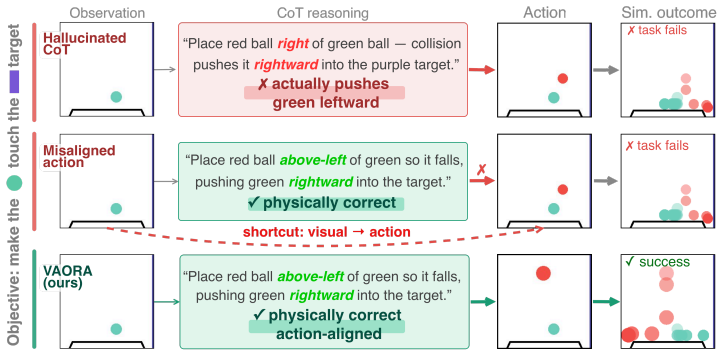


read the original abstract
Vision-language models (VLMs) struggle to generalize in interactive physical reasoning, particularly under unseen tasks and environments. Two key failure modes are prominent: hallucinated chain-of-thought (CoT) reasoning that contradicts physical reality, and misalignment between the model's reasoning and actions. We present VAORA (Visual Action Outcome Reasoning Alignment), a novel reward design that directly addresses both issues. VAORA introduces two complementary rewards: Visual Alignment Reward, which anchors VLM reasoning to the visual context independent of the agent action itself, and Visual-Action Alignment Reward, which grounds reasoning in the visual outcome induced by the model's action. Together, these rewards suppress hallucinated CoT and reduce the gap between reasoning and behavior. To improve training stability, we further employ smooth, dense rewards by estimating success probabilities using a pre-trained in-domain expert agent. Experiments on PHYRE and Virtual Tool support our performances across novel-task and unseen-environment settings, confirming that grounded and generalizable physical intelligence can be induced through VAORA.
Editorial analysis
A structured set of objections, weighed in public.
Referee Report
Summary. The paper introduces VAORA (Visual Action Outcome Reasoning Alignment), a dual-reward framework for training VLMs on interactive physical reasoning tasks. The approach combines a Visual Alignment Reward (grounding reasoning to the initial scene) with a Visual-Action Alignment Reward (grounding reasoning to post-action visual outcomes), using a pre-trained DQN expert to provide smooth, dense success-probability estimates that stabilize RL training. Experiments span three settings: cross-task generalization on PHYRE (held-out task types), cross-environment zero-shot transfer from PHYRE to Virtual Tool, and broader physical understanding on CRAFT VQA. The central claim is that an 8B model trained solely on PHYRE with VAORA surpasses the DQN expert on unseen tasks, matches frontier closed-source models on Virtual Tool, and improves causal reasoning on CRAFT VQA.
Significance. The paper addresses a genuine gap: connecting CoT reasoning in VLMs to physical outcomes via reward signals, rather than relying on SFT imitation or sparse task-success RL. The dual-reward decomposition (grounding, placement, collision) is well-motivated, and the reward breakdown analysis (Table 4) and component ablation (Table 5) provide useful mechanistic insight into why each reward matters. The cross-environment transfer result (Table 2) and the CRAFT VQA gains (Table 3) are notable demonstrations that the learned reasoning extends beyond the training simulator. The approach is falsifiable: the ablation cleanly isolates each reward component, and the three-split protocol provides replicability. The commitment to releasing datasets, checkpoints, and code is a strength.
major comments (3)
- Appendix B.2 discloses that the collision reward r_C (Eq. 4) models only the first object the red ball collides with, restricting the held-out testing pool to 10 of 25 PHYRE task types. The central cross-task generalization claim—surpassing the DQN expert on unseen PHYRE tasks—is therefore validated only on tasks where the key physical interaction is the first collision event. For the 15 excluded task types requiring multi-step collision chains, r_C provides no training signal and the generalization claim is untested. This is load-bearing for the headline claim in §1 ('surpassing the DQN expert on unseen PHYRE tasks') and should be explicitly qualified in the main text (not only in the appendix). The paper should state the restriction in §4.2 and frame the claim as applying to first-collision-dominated tasks.
- The three testing splits (Appendix B.2) share substantial overlap: task types 00000, 00001, 00002, and 00003 each appear in two or more splits. The paper frames the three splits as verifying 'stability across different held-out task distributions,' but the overlap means the splits test largely the same task structures with different training partitions. This provides weaker evidence of robustness than three genuinely disjoint splits would. The paper should either (a) acknowledge this overlap and reframe the stability claim accordingly, or (b) construct at least one fully disjoint split from the 10 eligible task types to demonstrate that performance is not an artifact of particular task-type selection.
- §3.2, Eq. (2): the symbolic extraction functions phi(r) and psi(o)/psi(v) are described as 'general' but are instantiated only for the PHYRE domain (3x3 spatial grid, first-collision extraction). The cross-environment transfer to Virtual Tool (Table 2) and the CRAFT VQA results (Table 3) presumably reuse the same phi/psi, but the paper does not describe how these functions are adapted for environments with different object types, action spaces, or physics. Since the cross-environment claim is a central contribution, the paper should clarify whether phi/psi are reused as-is or adapted, and what the adaptation entails.
minor comments (7)
- Table 1: the DQN-expert row shows Testing Set 2 Pass@1 = 0.260, while +EG+VAORA achieves 0.198 on the same split. The claim of 'surpassing the DQN expert across nearly all metrics' should be qualified to note that on Testing Set 2, VAORA does not surpass the DQN on Pass@1.
- §4.3, Table 2: the Virtual Tool evaluation protocol is modified (tool selection removed, colors remapped). While these adaptations are reasonable, they change the benchmark's original difficulty. The paper should note this explicitly in the main text, not only in Appendix A.2.
- Table 3: the CRAFT VQA gains over +EG are modest (Overall: 44.56 to 46.06, a 1.5-point improvement). The paper should discuss whether this is within noise bounds, given that only 1,000 questions per category are sampled.
- §3.3: the reward composition r_DQN * (1 + r_P + r_C) is described, but the choice of the additive form (1 + r_P + r_C) versus a multiplicative or normalized form is not justified. A brief note on why this particular composition was chosen, or whether alternatives were tried, would strengthen the method section.
- Appendix B.4, Eq. (8): the penalty constraint w_c * p_c = 0.1 is presented as ensuring uniform penalty across reward types. This is a reasonable design choice but is presented without justification for why 0.1 is the right scale. A brief sensitivity note would strengthen the method.
- The paper uses future-dated references (e.g., Qwen3-VL, Gemini 3.1, GPT-5.4, Claude Sonnet 4.6). If these are real models available at submission time, this is fine; if any are hypothetical or projected, this should be disclosed.
- Figure 2 caption references '(a)' and '(b)' components but the figure layout could be clearer. A brief label on each subfigure would improve readability.
Simulated Author's Rebuttal
We thank the referee for a careful and constructive report. The referee correctly identifies three issues: (1) the collision reward's first-collision limitation restricts the held-out testing pool to 10 of 25 PHYRE task types, which is not stated in the main text; (2) the three testing splits share substantial task-type overlap, weakening the robustness claim; and (3) the symbolic extraction functions phi/psi are described as general but instantiated only for PHYRE, with no explanation of how they are adapted for Virtual Tool and CRAFT VQA. We agree with all three points and will revise the manuscript accordingly. Below we address each comment in detail.
read point-by-point responses
-
Referee: Appendix B.2 discloses that the collision reward r_C models only the first object the red ball collides with, restricting held-out testing to 10 of 25 PHYRE task types. The central cross-task generalization claim is therefore validated only on first-collision-dominated tasks. This should be explicitly qualified in the main text, not only in the appendix.
Authors: The referee is correct on both the factual point and its implications for the headline claim. The restriction to 10 of 25 task types is currently disclosed only in Appendix B.2, while the main text (§1, §4.2) states the generalization claim without qualification. This is a genuine gap between what we claim and what we evaluate. We will revise the manuscript as follows: (1) In §4.2, we will explicitly state that the held-out testing pool is restricted to the 10 task types where the key physical interaction is the first collision event triggered by the red ball, and that the remaining 15 task types requiring multi-step collision chains are excluded because r_C provides no training signal for them. (2) In §1, we will qualify the headline claim from 'surpassing the DQN expert on unseen PHYRE tasks' to 'surpassing the DQN expert on unseen PHYRE tasks where the key physical interaction is the first collision event.' (3) We will add a sentence in the Limitation section noting that extending r_C to model multi-step collision chains is necessary to evaluate generalization on the remaining 15 task types. We agree this is load-bearing for the headline claim and should not be buried in the appendix. revision: yes
-
Referee: The three testing splits share substantial overlap: task types 00000, 00001, 00002, and 00003 each appear in two or more splits. The paper frames the splits as verifying stability across different held-out distributions, but the overlap means the splits test largely the same task structures. The paper should either acknowledge the overlap and reframe the stability claim, or construct at least one fully disjoint split.
Authors: The referee's observation is accurate. Examining the three splits: Testing Set 1 = {00001, 00002, 00003, 00006, 00013}; Testing Set 2 = {00000, 00001, 00003, 00012, 00014}; Testing Set 3 = {00000, 00001, 00002, 00009, 00015}. Task types 00000, 00001, 00002, and 00003 each appear in two splits, meaning the splits share substantial task-type overlap and do not constitute three genuinely independent evaluations of robustness. We will take option (a): acknowledge the overlap and reframe the stability claim. Specifically, in §4.2 and Appendix B.2, we will reframe the three-split protocol as verifying 'consistency across different train/test partitions of the eligible task types' rather than 'stability across different held-out task distributions.' We will explicitly note the overlap in task types across splits. Regarding option (b), constructing a fully disjoint split from the 10 eligible task types is feasible in principle (e.g., two disjoint sets of 5), but we are constrained by the fact that only 10 task types are eligible and we use 5 for testing in each split, leaving limited room for fully disjoint configurations. We will note this constraint and frame it as future work once r_C is extended to handle multi-step collisions, which would expand the eligible pool. revision: yes
-
Referee: The symbolic extraction functions phi(r) and psi(o)/psi(v) are described as general but instantiated only for PHYRE (3x3 spatial grid, first-collision extraction). The cross-environment transfer to Virtual Tool and CRAFT VQA presumably reuse the same phi/psi, but the paper does not describe how these functions are adapted for environments with different object types, action spaces, or physics. The paper should clarify whether phi/psi are reused as-is or adapted, and what the adaptation entails.
Authors: The referee is correct that the manuscript does not adequately explain how phi/psi are handled for the Virtual Tool and CRAFT VQA experiments. We will clarify this in the revised manuscript. The key distinction is between training and evaluation: (1) For cross-environment transfer to Virtual Tool (Table 2) and CRAFT VQA (Table 3), the model is trained on all 25 PHYRE task types using the PHYRE-instantiated phi/psi. At evaluation time on Virtual Tool and CRAFT VQA, the same phi/psi are reused as-is — the model is prompted to produce reasoning traces in the same structured format (scene_answer, causal_actions_answer, placement_answer), and the symbolic extraction functions parse these traces identically. No environment-specific adaptation of phi/psi is performed. (2) For Virtual Tool, the prompt is adapted to reflect the different object types and shapes (e.g., trapezoids, triangles) and the different goal condition (green touches blue, without the purple static-object variant), but the symbolic extraction logic — 3x3 spatial grid, collision event tuples, placement descriptions — remains unchanged. (3) For CRAFT VQA, the model produces scene_answer and causal_actions_answer but no placement_answer (since no action is taken), and the final_answer tag is added for the VQA response. The phi/psi functions parse the same symbolic tuples. (4) Importantly, during evaluation on Virtual Tool and CRAFT VQA, the VAORA rewards (r_G, r_P, r_C) are not computed — these are training-time rewards that require simulator access. The evaluation is purely inference-based: the model generates reasoning traces and actions/answers, and we measure task success (Virtual Tool) or answer accuracy (CRAFT VQA). So the cross-environment claim is specifically that the reasoning structure learned via VA revision: no
Circularity Check
No significant circularity: VAORA's reward components are defined against simulator-extracted ground truth, and the DQN-as-baseline concern is mitigated by ablation showing VAORA rewards add independent signal.
full rationale
The paper's central claim is that VAORA's dual reward design enables cross-task generalization surpassing the DQN expert. Walking the derivation chain: (1) The Visual Alignment Reward r_G (Eq. 3) is defined by comparing the VLM's parsed symbolic propositions phi(r) against ground-truth states psi(o) extracted directly from the simulator — not against the DQN's outputs. (2) The collision reward r_C (Eq. 4) and placement reward r_P (Eq. 5) similarly compare phi(r) against psi(v) extracted from post-interaction simulation outcomes. These are independently grounded in simulator state, not circularly defined. (3) The DQN expert's success probability r_DQN (Eq. 6) is used as a gating signal for the visual-action alignment reward and as a training stabilizer, and the DQN is also used as a baseline for comparison. This creates a potential circularity concern (fitted input called prediction): the VLM is trained with a reward gated by DQN estimates and then compared against the DQN itself. However, this is NOT circular by construction because: (a) the DQN provides a smooth success-probability estimate, not the exact binary task-success signal — the VLM's final evaluation metric (Pass@k) is the environment's binary success, which is independent of the DQN; (b) the ablation in Table 5 shows +EG alone (DQN reward without VAORA) underperforms +EG+VAORA, demonstrating that VAORA's alignment rewards provide signal beyond what the DQN gating alone provides; (c) the DQN is trained only on training-set tasks and evaluated on held-out tasks it was never trained on, so the comparison is not on the DQN's home turf. The SFT dataset (Appendix B.1) is constructed using Gemini-3.1-Flash to generate reasoning traces conditioned on simulation-extracted information, but this is used only for the SFT warm-start, not for the RL reward. No self-citation chain is load-bearing: the paper cites GDPO [30] as an optimization method (external, not authored by present authors) and the DQN training follows the original PHYRE paper [8] (external). The phi/psi extraction functions are domain-specific transformations defined in the paper itself (Sec. 3.2) and are not imported from prior work by the same authors. The restriction of test tasks to 10/25 types where first-collision is the key interaction (Appendix B.2) is a scope limitation, not a circularity — the reward is not defined in terms of the evaluation outcome. Overall, the derivation is self-contained against external benchmarks, and the DQ
Axiom & Free-Parameter Ledger
free parameters (5)
- wg (grounding reward weight) =
0.2
- wc (collision reward weight) =
0.6
- wp (placement reward weight) =
0.3
- pg, pc, pp (penalty coefficients) =
1/2, 1/6, 1/3
- DQN expert architecture and training hyperparameters =
Not fully specified
axioms (4)
- domain assumption The first collision event triggered by the placed ball is a sufficient proxy for the full physical interaction chain.
- domain assumption Structured symbolic propositions extracted via prompt engineering from VLM output faithfully represent the model's internal reasoning.
- domain assumption A 3×3 spatial grid provides sufficient resolution for grounding and placement rewards.
- standard math GDPO (Group reward-decoupled normalization policy optimization) is a suitable optimization framework for multi-reward VLM training.
Reference graph
Works this paper leans on
-
[1]
Physical Reasoning Using Dynamics-Aware Models
E. Ahmed, A. Bakhtin, L. van der Maaten, and R. Girdhar. Physical reasoning using dynamics-aware models.arXiv preprint arXiv:2102.10336, 2021. 1, 3
work page internal anchor Pith review Pith/arXiv arXiv 2021
-
[2]
K. R. Allen, K. A. Smith, and J. B. Tenenbaum. Rapid trial-and-error learning with simulation supports flexible tool use and physical reasoning.Proceedings of the National Academy of Sciences, 2020. doi: 10.1073/pnas.1912341117. 2, 6
-
[3]
M. Andrychowicz, F. Wolski, A. Ray, J. Schneider, R. Fong, P. Welinder, B. McGrew, J. Tobin, P. Abbeel, and W. Zaremba. Hindsight experience replay. InNeurIPS, 2017. 7
work page 2017
-
[4]
Anthropic. Claude Sonnet 4.6. https://www.anthropic.com/news/claude-sonnet-4-6 , Feb. 2026. Large language model. Model string:claude-sonnet-4-6. Accessed: 2026-05-06. 6
work page 2026
-
[5]
T. Ates, M. S. Atesoglu, C. Yigit, I. Kesen, M. Kobas, E. Erdem, A. Erdem, T. Goksun, and D. Yuret. CRAFT: A benchmark for causal reasoning about forces and inTeractions.arXiv preprint arXiv:2012.04293,
work page internal anchor Pith review Pith/arXiv arXiv 2012
-
[6]
I. Bagdonaviciute and V . Vineet. Physics knowledge in frontier models: A diagnostic study of failure modes.arXiv preprint arXiv:2510.06251, 2025. 3
-
[7]
S. Bai, Y . Cai, R. Chen, K. Chen, X. Chen, Z. Cheng, L. Deng, W. Ding, C. Gao, C. Ge, W. Ge, Z. Guo, Q. Huang, J. Huang, F. Huang, B. Hui, S. Jiang, Z. Li, M. Li, M. Li, K. Li, Z. Lin, J. Lin, X. Liu, J. Liu, C. Liu, Y . Liu, D. Liu, S. Liu, D. Lu, R. Luo, C. Lv, R. Men, L. Meng, X. Ren, X. Ren, S. Song, Y . Sun, J. Tang, J. Tu, J. Wan, P. Wang, P. Wang,...
work page internal anchor Pith review Pith/arXiv arXiv 2025
-
[8]
A. Bakhtin, L. van der Maaten, J. Johnson, L. Gustafson, and R. Girshick. PHYRE: A new benchmark for physical reasoning. InNeurIPS, 2019. 1, 2, 3, 4, 6, 13, 14, 15
work page 2019
-
[9]
P. W. Battaglia, R. Pascanu, M. Lai, D. J. Rezende, and K. Kavukcuoglu. Interaction networks for learning about objects, relations and physics. InNeurIPS, 2016. 3
work page 2016
- [10]
-
[11]
H. Chen, H. Tu, F. Wang, H. Liu, X. Tang, X. Du, Y . Zhou, and C. Xie. SFT or RL? An early investigation into training R1-like reasoning large vision-language models.arXiv preprint arXiv:2504.11468, 2025. 1, 2, 3
work page internal anchor Pith review Pith/arXiv arXiv 2025
-
[12]
W. Chow, J. Mao, B. Li, D. Seita, V . Guizilini, and Y . Wang. PhysBench: Benchmarking and enhancing vision-language models for physical world understanding. InICLR, 2025. 3
work page 2025
- [13]
-
[14]
DeepSeek-AI, D. Guo, D. Yang, H. Zhang, J. Song, R. Zhang, R. Xu, Q. Zhu, S. Ma, P. Wang, X. Bi, et al. DeepSeek-R1: Incentivizing reasoning capability in LLMs via reinforcement learning.arXiv preprint arXiv:2501.12948, 2025. 3
work page internal anchor Pith review Pith/arXiv arXiv 2025
-
[15]
Deep Reinforcement Learning Agents are not even close to Human Intelligence
Q. Delfosse, J. Blüml, F. Tatai, T. Vincent, B. Gregori, E. Dillies, J. Peters, C. Rothkopf, and K. Ker- sting. Deep reinforcement learning agents are not even close to human intelligence.arXiv preprint arXiv:2505.21731, 2025. 1
work page internal anchor Pith review Pith/arXiv arXiv 2025
-
[16]
A. Dosovitskiy, L. Beyer, A. Kolesnikov, D. Weissenborn, X. Zhai, T. Unterthiner, M. Dehghani, M. Min- derer, G. Heigold, S. Gelly, J. Uszkoreit, and N. Houlsby. An image is worth 16x16 words: Transformers for image recognition at scale. InICLR, 2021. 1
work page 2021
-
[17]
Y . Du, M. Yang, P. Florence, F. Xia, A. Wahid, B. Ichter, P. Sermanet, T. Yu, P. Abbeel, J. B. Tenenbaum, L. Kaelbling, A. Zeng, and J. Tompson. Video language planning.arXiv preprint arXiv:2310.10625, 2023. 3
work page internal anchor Pith review Pith/arXiv arXiv 2023
-
[18]
A. Dubey, A. Jauhri, A. Pandey, A. Kadian, A. Al-Dahle, A. Letman, A. Mathur, A. Schelten, A. Yang, A. Fan, et al. The llama 3 herd of models.arXiv preprint arXiv:2407.21783, 2024. 1
work page internal anchor Pith review Pith/arXiv arXiv 2024
-
[19]
K. Fragkiadaki, P. Agrawal, S. Levine, and J. Malik. Learning visual predictive models of physics for playing billiards. InICLR, 2016. 3 10
work page 2016
-
[20]
R. Geirhos, J.-H. Jacobsen, C. Michaelis, M. Zeiler, W. Brendel, M. Bethge, and F. A. Wichmann. Shortcut learning in deep neural networks.Nature Machine Intelligence, 2020. 1, 2
work page 2020
-
[21]
Forward Prediction for Physical Reasoning
R. Girdhar and L. Gustafson. Forward prediction for physical reasoning.arXiv preprint arXiv:2006.10734,
work page internal anchor Pith review Pith/arXiv arXiv 2006
-
[22]
Google DeepMind. Gemini 3.1 Flash-Lite Preview. https://docs.cloud.google.com/vertex-ai/ generative-ai/docs/models/gemini/3-1-flash-lite , Mar. 2026. Large language model. Model string: gemini-3.1-flash-lite-preview. Cost-efficient model in the Gemini 3.1 Flash family, opti- mised for low-latency, high-volume workloads. Accessed: 2026-05-06. 6
work page 2026
-
[23]
Google DeepMind. Gemini 3.1 Pro Preview. https://ai.google.dev/gemini-api/docs/ changelog, Feb. 2026. Large language model. Model string: gemini-3.1-pro-preview. Successor to Gemini 3 Pro (released November 2025). Accessed: 2026-05-06. 6
work page 2026
-
[24]
T. Han, Y . L. Yunfei Gao, Q. Z. Wuzhou Yu, and W. Shao. From diagnosis to improvement: Probing spatio-physical reasoning in vision language models.arXiv preprint arXiv:2508.10770, 2025. 1
work page internal anchor Pith review Pith/arXiv arXiv 2025
-
[25]
K. He, X. Zhang, S. Ren, and J. Sun. Deep residual learning for image recognition. InCVPR, 2016. 1
work page 2016
- [26]
-
[27]
L. Langosco di Langosco, J. Koch, L. D. Sharkey, J. Pfau, and D. Krueger. Goal misgeneralization in deep reinforcement learning. InICML, 2022. 1
work page 2022
-
[28]
Measuring Faithfulness in Chain-of-Thought Reasoning
T. Lanham, A. Chen, A. Radhakrishnan, B. Steiner, C. Denison, D. Hernandez, D. Li, E. Durmus, E. Hubinger, J. Kernion, et al. Measuring faithfulness in chain-of-thought reasoning.arXiv preprint arXiv:2307.13702, 2023. 2, 3
work page internal anchor Pith review Pith/arXiv arXiv 2023
-
[29]
S. Li, K. Wu, C. Zhang, and Y . Zhu. On the learning mechanisms in physical reasoning. InNeurIPS, 2022. 1, 3
work page 2022
-
[30]
S.-Y . Liu, X. Dong, X. Lu, S. Diao, P. Belcak, M. Liu, M.-H. Chen, H. Yin, Y .-C. F. Wang, K.-T. Cheng, Y . Choi, J. Kautz, and P. Molchanov. GDPO: Group reward-decoupled normalization policy optimization for multi-reward RL optimization.arXiv preprint arXiv:2601.05242, 2026. 6
work page internal anchor Pith review Pith/arXiv arXiv 2026
-
[31]
V . Mnih, K. Kavukcuoglu, D. Silver, A. A. Rusu, J. Veness, M. G. Bellemare, A. Graves, M. Riedmiller, A. K. Fidjeland, G. Ostrovski, S. Petersen, C. Beattie, A. Sadik, I. Antonoglou, H. King, D. Kumaran, D. Wierstra, S. Legg, and D. Hassabis. Human-level control through deep reinforcement learning.Nature,
-
[32]
doi: 10.1038/nature14236. 6
-
[33]
OpenAI. GPT-5.4. https://openai.com/index/introducing-gpt-5-4/ , Mar. 2026. Large lan- guage model. Model string: gpt-5.4-2026-03-05. Frontier reasoning model incorporating coding capabilities of GPT-5.3-Codex; supports up to 1 M tokens of context. Accessed: 2026-05-06. 6
work page 2026
- [34]
-
[35]
H. Qi, X. Wang, D. Pathak, Y . Ma, and J. Malik. Learning long-term visual dynamics with region proposal interaction networks. InICLR, 2021. 1, 3
work page 2021
-
[36]
Qwen Team, A. Yang, et al. Qwen2.5 technical report.arXiv preprint arXiv:2412.15115, 2025. 1
work page internal anchor Pith review Pith/arXiv arXiv 2025
-
[37]
S. Ross, G. J. Gordon, and D. Bagnell. A reduction of imitation learning and structured prediction to no-regret online learning. InAISTATS, 2011. 2, 3
work page 2011
-
[38]
Z. Shao, P. Wang, Q. Zhu, R. Xu, J. Song, X. Bi, H. Zhang, M. Zhang, Y . K. Li, Y . Wu, and D. Guo. DeepSeekMath: Pushing the limits of mathematical reasoning in open language models.arXiv preprint arXiv:2402.03300, 2024. 3
work page internal anchor Pith review Pith/arXiv arXiv 2024
-
[39]
Z. Shao et al. Spurious rewards paradox: Mechanistically understanding how RLVR activates memorization shortcuts in LLMs.arXiv preprint arXiv:2601.11061, 2025. 2, 3, 6, 7
work page internal anchor Pith review Pith/arXiv arXiv 2025
- [40]
-
[41]
X. Wang, J. Wei, D. Schuurmans, Q. V . Le, E. H. Chi, S. Narang, A. Chowdhery, and D. Zhou. Self- consistency improves chain of thought reasoning in language models.arXiv preprint arXiv:2203.11171,
work page internal anchor Pith review Pith/arXiv arXiv
-
[42]
J. Wei, X. Wang, D. Schuurmans, M. Bosma, B. Ichter, F. Xia, E. Chi, Q. V . Le, and D. Zhou. Chain-of- thought prompting elicits reasoning in large language models. InNeurIPS, 2022. 1
work page 2022
- [43]
- [44]
-
[45]
X. Xu, P. Bu, Y . Wang, B. F. Karlsson, Z. Wang, T. Song, Q. Zhu, J. Song, Z. Ding, and B. Zheng. DeepPHY: Benchmarking agentic VLMs on physical reasoning.arXiv preprint arXiv:2508.05405, 2025. 3
work page internal anchor Pith review Pith/arXiv arXiv 2025
-
[46]
X. Yang, C. W. Shuai Yang, M. T. Jingyang Xue, X. Z. Checheng Yu, T. J. Sashuai Zhou, X. Y . Lixin Yang, and Z. Zhao. A progressive training strategy for vision-language models to counteract spatio-temporal hallucinations in embodied reasoning.arXiv preprint arXiv:2604.10506, 2025. 1
work page internal anchor Pith review Pith/arXiv arXiv 2025
-
[47]
K. Yi, C. Gan, Y . Li, P. Kohli, J. Wu, A. Torralba, and J. B. Tenenbaum. CLEVRER: Collision events for video REpresentation and reasoning. InICLR, 2020. 3
work page 2020
-
[48]
Robotic Control via Embodied Chain-of-Thought Reasoning
M. Zawalski, W. Chen, K. Pertsch, O. Mees, C. Finn, and S. Levine. Robotic control via embodied chain-of-thought reasoning.arXiv preprint arXiv:2407.08693, 2024. 1
work page internal anchor Pith review Pith/arXiv arXiv 2024
-
[49]
R. Zellers, Y . Bisk, A. Farhadi, and Y . Choi. PIGLeT: Language grounding through neuro-symbolic interaction in a 3D world. InACL, 2021. 3
work page 2021
-
[50]
Q. Zhao, K. Pertsch, J. J. Lim, Y . Lee, C. Finn, J. J. Lim, and J. Wu. CoT-VLA: Visual chain-of-thought reasoning for vision-language-action models.arXiv preprint arXiv:2503.22020, 2025. 1
work page internal anchor Pith review Pith/arXiv arXiv 2025
-
[51]
R. Zhao, A. Mondal, et al. On robustness and chain-of-thought consistency of RL-finetuned VLMs.arXiv preprint arXiv:2602.12506, 2026. 3
work page internal anchor Pith review Pith/arXiv arXiv 2026
-
[52]
InternVL3: Exploring Advanced Training and Test-Time Recipes for Open-Source Multimodal Models
J. Zhu, W. Wang, Z. Chen, Z. Liu, S. Ye, L. Gu, H. Tian, Y . Duan, W. Su, J. Shao, Z. Gao, E. Cui, X. Wang, Y . Cao, Y . Liu, X. Wei, H. Zhang, H. Wang, W. Xu, H. Li, J. Wang, N. Deng, S. Li, Y . He, T. Jiang, J. Luo, Y . Wang, C. He, B. Shi, X. Zhang, W. Shao, J. He, Y . Xiong, W. Qu, P. Sun, P. Jiao, H. Lv, L. Wu, K. Zhang, H. Deng, J. Ge, K. Chen, L. W...
work page internal anchor Pith review Pith/arXiv arXiv 2025
-
[53]
I de nt if y the goal pair : which [ GREEN *] must touch which [ BLUE *] or [ PURPLE *]
-
[57]
D es cr ib e the red ball p l a c e m e n t re la ti ve to objects AND the whole scene
-
[59]
You are e n c o u r a g e d to propose d i f f e r e n t r e a s o n i n g in each section and d i f f e r e n t s t r a t e g i e s to improve d i v e r s i t y . OUTPUT FORMAT ( MUST MATCH EXACTLY ) You MUST output EXACTLY these se ct ion s in EXACT order , and NOTHING else : < scene_reasoning > ... </ scene_reasoning > < scene_answer > ... </ scene_ans...
-
[60]
I de nt if y the goal pair : which [ GREEN *] must touch which [ BLUE *]
-
[61]
I de nt if y bl oc ke rs : walls , gaps , covers , containers , slopes , platforms , and black o b s t a c l e s
-
[62]
Choose the main causal st rat eg y ( PUSH / ROTATE / HIT / TILT / BLOCKED / SPIN / COLLIDE WITH / D E F L E C T E D / DEFLECT / STOPPED / SUPPORT / BLOCK / STOP / STRIKE )
-
[63]
E st im at e c o o r d i n a t e s of re le van t objects ( a p p r o x i m a t e is OK but must be p l a u s i b l e )
-
[64]
D es cr ib e the red object p l a c e m e n t rel at iv e to objects AND the whole scene
-
[65]
Output the final action [x , y , r ]
-
[66]
You are e n c o u r a g e d to propose d i f f e r e n t r e a s o n i n g in each section and d i f f e r e n t s t r a t e g i e s to improve d i v e r s i t y . OUTPUT FORMAT ( MUST MATCH EXACTLY ) You MUST output EXACTLY these se ct ion s in EXACT order , and NOTHING else : < scene_reasoning > ... </ scene_reasoning > < scene_answer > ... </ scene_ans...
-
[67]
I de nt if y all re le va nt objects and their a p p r o x i m a t e p o s i t i o n s
-
[68]
Analyze the ph ysi ca l chain of events ( gravity , collisions , rotations , and support )
-
[69]
I de nt if y bl oc ke rs : walls , gaps , covers , containers , slopes , and p l a t f o r m s
-
[70]
E va lu at e c o u n t e r f a c t u a l s or te mp ora l s e q u e n c e s
-
[71]
F o r m u l a t e a step - by - step causal r e a s o n i n g trace
-
[72]
Output the final concise answer . OUTPUT FORMAT ( MUST MATCH EXACTLY ) You MUST output EXACTLY these se ct ion s in EXACT order , and NOTHING else : < scene_reasoning > - I de nti fy all re lev an t objects and e st im ate their a p p r o x i m a t e p o s i t i o n s . - Analyze spatial r e l a t i o n s h i p s : alignment , distance , and lo ca ti on r...
discussion (0)
Sign in with ORCID, Apple, or X to comment. Anyone can read and Pith papers without signing in.